REVIEW 3 major objections 6 minor 29 references
Enhancing quantum control by improving shape pulse generation
T0 review · 3 major / 6 minor · reviewed 2026-08-14 · deepseek-v4-flash
Pith's one-line read The paper argues that fitting a small set of sinusoidal amplitude and phase modulations can produce high-fidelity control pulses for quantum systems, demonstrating this on 4-, 7-, and 12-qubit NMR experiments and in simulations up to 100…
desk verdict A useful NMR pulse-shaping trick wrapped in overclaimed scalability: the small experiments are real, the 100-qubit fidelity claim is just the optimization cost. read the letter →
The pith
A machine-rendered reading of the paper's core claim, the machinery that carries it, and where it could break.
The reading
What carries the argument
The carrying object is the truncated sine-series envelope: $\Omega(t)=\sum_{k=1}^{s_A}a_k\sin(b_k t+c_k)$ and $\varphi(t)=\sum_{k=1}^{s_P}d_k\sin(f_k t+g_k)$. These few coefficients define a smooth pulse whose time-sliced propagators can be evaluated with an exponentiation-free approximation that precomputes the non-diagonal pieces once and updates only diagonal exponentials at each time step. That combination makes each function evaluation linear in the number of time slices rather than in the number of optimization variables, which is what allows a 24- to 78-parameter search to be rerun many times quickly. For systems too large to store the full quantum state, the paper additionally averages the fidelity over selected subsystems.
What would settle it
For a 16-qubit lattice pulse, compute the complete $2^{16}$-dimensional evolution with an independent time-step integrator using the optimized amplitude and phase shapes, and compare the resulting fidelity with the reported $F_{sub}$; if the full fidelity falls far below $1-F_{sub}$ (for instance below 0.99 when $F_{sub}$ is 0.01), the subsystem proxy is the weak point.
Extended reading notes
Core claim
The central claim is that for a fixed quantum-control task, the optimal radio-frequency pulse can be represented by a short Fourier-like series for the amplitude $\Omega(t)$ and the phase $\varphi(t)$, so the optimization searches over the series coefficients rather than over every time slice. Doing so cuts the number of fitted parameters from the hundreds used by standard time-discretized gradient ascent to 24–78, which accelerates convergence and naturally yields smooth pulses. The paper supports the claim by preparing pseudo-pure states and implementing rotations in real NMR experiments on 4, 7, and 12 qubits, and by computing optimized pulses for model square lattices of 16, 36, and 100 spins, with a memory and time estimate for 65,536. For the 12-qubit system the optimized pulse reaches full-system simulated fidelity above 0.97; for the larger lattices the reported metric is the average fidelity over small subsystems.
Load-bearing premise
The scalability conclusion rests on the assumption that the average fidelity measured on small subgroups reflects the performance of the whole system; for the 16-, 36-, and 100-qubit simulations the paper never simulates the full system, so significant couplings across subgroup boundaries could break the proxy.
Editorial extensions
If this is right
- For systems described by the NMR Hamiltonian, a smooth pulse optimized on 24–78 parameters can replace hundreds of time-step variables: the paper reports $F_{sub}<0.007$ for 12 qubits and full-system simulated fidelity above 0.97.
- Pulse duration and discretization can be changed without changing the number of fitted parameters, and the paper exploits this by refining the time step during optimization while keeping the cost linear in the number of time slices.
- Because the optimized pulse is a sum of smooth sines, it meets spectrometer constraints on amplitude changes, and the same 63-parameter shape works for model 16-, 36-, and 100-qubit lattices when multiple rotating frames are used.
- The paper states that the approach generalizes to other quantum-technology platforms that use shaped electromagnetic pulses, not only NMR.
Reading between the lines
- A natural next test is to warm-start the optimization with coefficients from a nearby task or Hamiltonian; the paper does not explore this, but the gradient-free search would make such reuse especially cheap.
- If the subsystem proxy is validated against full-system fidelity, the method's memory advantage suggests pulse design can scale to very large spin lattices only if the model Hamiltonian is accurate, making model error the new bottleneck.
- The same sine-series parametrization could be extended to hardware-specific constraints such as bandwidth limits or slew rates by restricting the frequency and magnitude ranges of the fitted coefficients, a feature the paper leaves implicit.
Signed reviews
Editorial analysis
A structured set of objections, weighed in public.
Referee Report
Summary. The paper presents a pulse-shaping algorithm for NMR quantum control in which the amplitude and phase envelopes are parameterized as truncated sums of sine functions (Eqs. (8)-(9)), with the resulting small number of coefficients optimized by a derivative-free Nelder-Mead method. The propagator is evaluated with a fast approximation due to Bhole and Jones (Eq. (10)), and for larger systems the optimization is performed on subsystems with the average cost Fsub defined in Eq. (14). The authors report experimental implementations of the resulting pulses for 4-, 7-, and 12-qubit NMR systems and simulations for 16-, 36-, 100-, and 65536-qubit square lattices, claiming that the algorithm drastically reduces the number of fitted parameters while remaining fast and scalable and producing high-fidelity control.
Significance. The proposed parameterization is an interesting alternative to time-sliced GRAPE optimization and, if fully validated, would be practically useful: it naturally supplies smooth pulses, allows robustness constraints through Eq. (13), and makes the parameter count independent of pulse duration and discretization. The experimental work with real NMR systems is a genuine strength, and the 12-qubit full-system simulation check in Sec. V.C is the right kind of validation. However, the large-system claims currently rest on Fsub, which is the optimization objective and is computed without inter-subsystem couplings; the one available calibration point indicates that Fsub is optimistic. The large-system claims in the abstract and conclusion are therefore not quantitatively established as written.
major comments (3)
- [Section V.D, Eq. (14)] The success metric for the 16-, 36-, and 100-qubit simulations is Fsub, the average over subsystem infidelities. This quantity is exactly the cost function minimized by the optimizer, so reporting Fsub < 0.012 states that the fit converged; it does not independently quantify global control fidelity. Because each subsystem simulation omits couplings across subsystem boundaries in the nearest-neighbor lattices of Fig. 8, the full-system evolution can differ from the product of the subsystem evolutions. The only available calibration is the 12-qubit case in Sec. V.C, where Fsub < 0.007 corresponds to a full-system infidelity of about 0.03, already a factor of roughly four larger. To support the headline claim of 'good fidelity' for 16, 36, and 100 qubits, the authors should compute full-system fidelities for the 16- and 36-qubit cases using Eqs. (4)-(5), and provide a quantitative bound or an independent validation for the 100-qubit case.
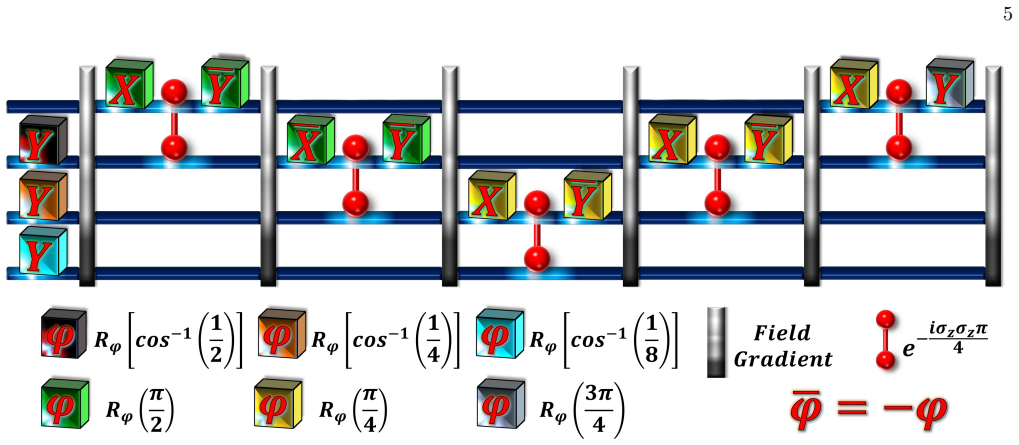
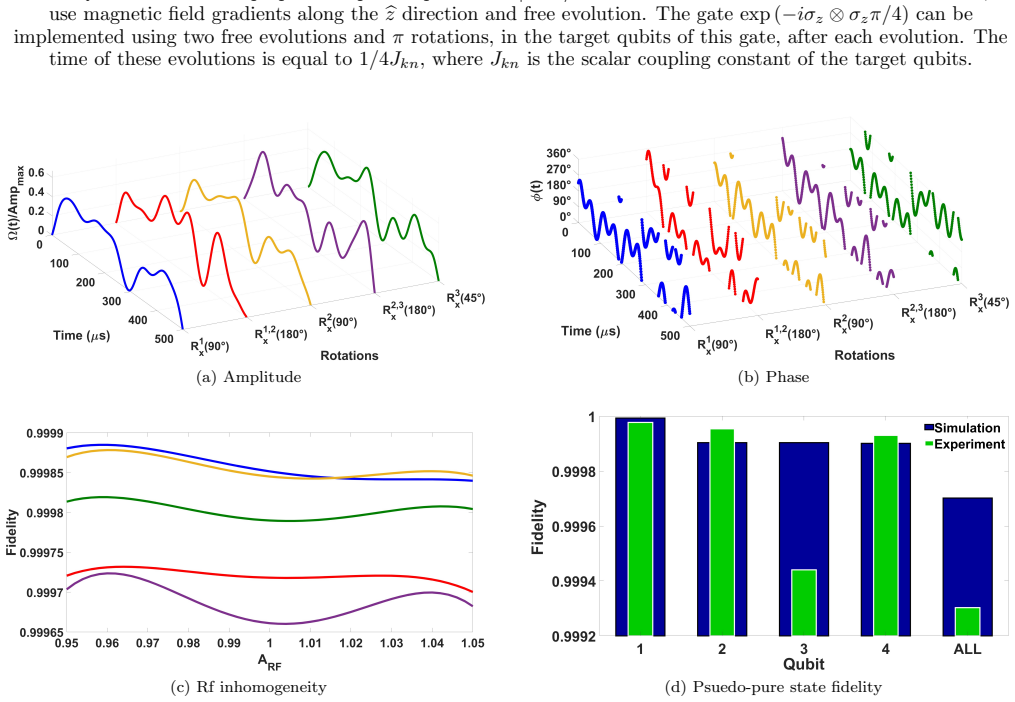
- [Section V.A, Fig. 3(d)] The reported experimental pseudo-pure state fidelity of 0.9993 is obtained by comparing the theoretical state with the tensor product of four individually tomographed single-qubit states. This procedure discards all correlations between qubits and is not a valid estimate of the fidelity of the actual four-qubit state to the target |1111>: correlated errors can be invisible to the tensor-product quantity, and the tensor-product state can have a higher overlap with the product target than the real state. The full four-qubit density matrix should be reconstructed, or a lower bound on the true fidelity should be obtained, before 0.9993 is cited as an experimental state-preparation fidelity.
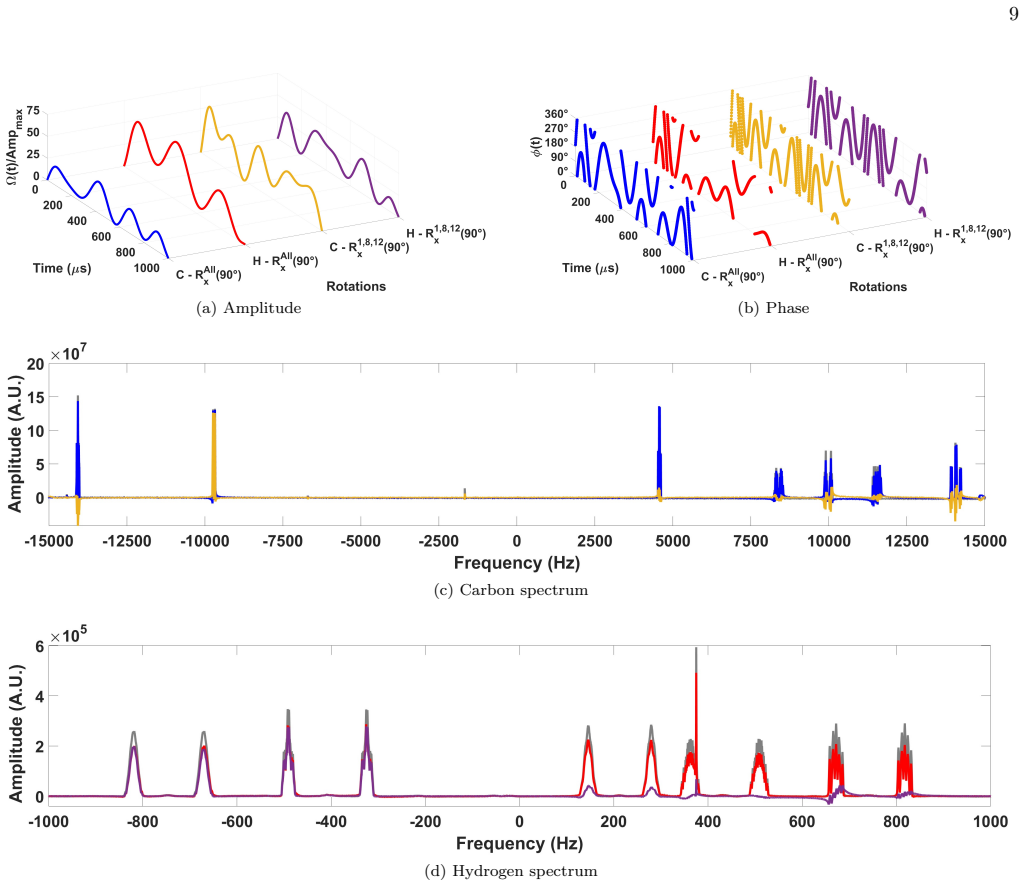
- [Section V.B, Fig. 6(c)] The 7-qubit experimental validation is a single-qubit spectrum check on qubit 7 after the labelled-PPS preparation; it does not characterize the full 7-qubit state. The numerical full-circuit fidelity greater than 0.99 is computed with the same evolution model used in the optimization, so it is not an independent experimental validation. The text should state this limitation explicitly, or present a fuller tomographic check, so that the experimental support for the 7-qubit claim is not overstated.
minor comments (6)
- [Abstract and throughout] The manuscript contains several grammatical and typographical errors, including 'Most quantum processors requires' in the abstract, 'qbits' in Sec. V.D, and 'Psuedo-pure' in the caption of Fig. 3; a careful language edit is needed.
- [Section IV, Eq. (10)] The approximation from Bhole and Jones is used without stating its validity conditions or giving an error bound for the parameter ranges considered; the paper itself notes in Sec. V.D that the error grows with the resonance-offset spread, so this limitation should be quantified or tested.
- [Section V.D, Fig. 8] The text says the 16-qubit system was divided into 7 groups of 4 qubits, which implies overlapping groups rather than a partition; the authors should clarify whether the groups overlap and how Eq. (14) weights qubits that appear in multiple groups.
- [Section V.C] The 12-qubit full-system fidelity is reported only as 'greater than 0.97'; giving the computed value and the number of tested pulses would make the Fsub-to-fidelity gap easier to assess.
- [Section IV] The claim that the algorithm converges faster than GRAPE is not supported by any quantitative comparison; a table with wall-clock times and final fidelities for the same system and computer would be needed.
- [General] No data availability statement or code repository is provided, which limits reproducibility of the optimized pulse shapes and of the numerical results.
Circularity Check
Large-system 'good fidelity' claims rest on Fsub, the very cost function being minimized, not on an independent full-system check.
-
fitted input called prediction
[Section V.D, 'Simulations for 16, 36, 100 and 65536 Qubits'; Fsub defined in Eq. (14)]
"After approximately 3 hours of optimization, it was possible to obtain Fsub < 0.012, with a δt = 0.625 µs, which is an excellent result."
Fsub in Eq. (14) is the average infidelity over subsystem unitaries, and the text states 'here we perform the optimization in subsystems'; it is the objective function minimized by the Nelder-Mead search. Reporting Fsub < 0.012 as 'an excellent result' therefore restates the optimizer's termination value, not an independently computed fidelity of the full 100-qubit evolution. The paper provides no full-system UHT fidelity for 16, 36, or 100 qubits. Its only full-system check, for 12 qubits in Section V.C, found full-system fidelity > 0.97 while Fsub < 0.007, showing Fsub can overstate fidelity. Hence the large-system 'good fidelity' claim reduces by construction to the fit.
full rationale
The core algorithm is not circular: the sinusoidal parameterization in Eqs. (8)-(9), the Bhole-Jones propagator approximation in Eq. (10), and the robustness objective in Eq. (13) are explicit modeling assumptions, and the 4-, 7-, and 12-qubit experimental claims are supported by real NMR spectra and, for 12 qubits, by a full-system simulation using Eqs. (4)-(5). Self-citations (e.g., Refs. [16], [17], [23]) are contextual and not load-bearing. The one genuinely circular step is the use of Fsub, Eq. (14), as evidence of good fidelity for the 16-, 36-, and 100-qubit lattice simulations: Fsub is precisely the objective being minimized, so reporting Fsub < 0.012 as 'an excellent result' restates the optimization's termination value rather than independently validating the pulse against the full system. No full-system unitary fidelity is reported for those sizes, and the 12-qubit comparison shows Fsub can be optimistic (Fsub < 0.007 while full-system infidelity is 0.03). Thus the large-system scalability claim is partially circular, while the experimental portions remain independent and give the paper substantial non-circular content.
Assumptions & free parameters
free parameters (4)
- Sine-series coefficients a_k, b_k, c_k, d_k, f_k, g_k =
not reported
- Number of sine terms sA and sP =
7/14, 5/8, 10/16, 7/14 in different tests
- Envelope smoothing constants zeta1 and zeta2 =
2
- Robustness weights alpha1, alpha2, alpha3 and epsilon =
0.3, 0.4, 0.3 and 0.05
assumptions (4)
- domain assumption The Bhole-Jones approximation in Eq. (10) is accurate for the delta-t values and Hamiltonian parameters used throughout.
- domain assumption A limited sum of sinusoids, Eqs. (8)-(9), can represent the optimal pulse envelope well enough to reach high fidelity.
- ad hoc to paper Optimizing pulses on subsystems and averaging their cost functions via Eq. (14) is a valid proxy for full-system fidelity, including when couplings cross subsystem boundaries.
- domain assumption The liquid-state NMR Hamiltonian in Eq. (6) accurately captures the spin dynamics of the molecules used.
Cite this review
Pith. "Pith review of Enhancing quantum control by improving shape pulse generation." pith.science (2026). https://pith.science/paper/3R6PDX42
@misc{pith2026190808003,
  author       = {Pith},
  title        = {Pith review of: Enhancing quantum control by improving shape pulse generation},
  year         = {2026},
  howpublished = {\url{https://pith.science/paper/3R6PDX42}},
  note         = {Machine review of arXiv:1908.08003}
}
read the original abstract
Most quantum processors requires pulse sequences for controlling quantum states. Here, we present an alternative algorithm for computing an optimal pulse sequence in order to perform a specific task, being an implementation of a quantum gate or a quantum state preparation. In our method, we reduced drastically the number of parameters to be fitted, by using a limited number of functions as the modulations for the amplitude and phase of the radio-frequency pulses, and employed approximations to make the algorithm fast and scalable. We demonstrate the success of the proposed algorithm, by performing several real experiments for 4, 7 and 12 quantum bits systems using NMR. In addition, we have also shown the efficiency of the algorithm, finding pulses for controlling with good fidelity the quantum states of spins in a fictional square bi-dimensional lattices containing 16, 36 and 100 qubits.
Figures

Figures from the paper (6 more)




Reference graph
Works this paper leans on
- [13]
-
[10]
T. E. Skinner and N. I. Gershenzon, Optimal control de- sign of pulse shapes as analytic functions , J. Magn. Re- son. 204, 248 (2010)
work page 2010
-
[1]
S. J. Glaser, U. Boscain, T. Calarco, C. P. Koch, W. Kckenberger, R. Kosloff, I. Kuprov, B. Luy, S. Schirmer, T. Schulte-Herbrggen, D. Sugny and F. K. Wilhelm, Training Schrdinger’s cat: quantum optimal control, Eur. Phys. J. D 69, 279 (2015)
work page 2015
-
[2]
I. Oliveira, R. S. Sarthour, T. Bonagamba, E. Azevedo and J. C. C. Freitas, NMR Quantum Information Pro- cessing, Elsevier (2007)
work page 2007
-
[3]
M. A. Nielsen and I. L. Chuang, Quantum Computation and Quantum Information , Cambridge University Press 12 (2000)
work page 2000
-
[4]
N. Khaneja, T. Reiss, C. Kehlet, T. Schulte-Herbrggen and S. J. Glaser, Optimal control of coupled spin dynam- ics: design of NMR pulse sequences by gradient ascent algorithms, J. Magn. Reson. 172, 296 (2005)
work page 2005
- [5]
- [6]
Show all 29 references
-
[7]
Nebendahl, H
V. Nebendahl, H. Hffner and C. F. Roos, Optimal control of entangling operations for trapped-ion quantum comput- ing, Phys. Rev. A 79, 012312 (2009)
2009
-
[8]
Fisher, F
R. Fisher, F. Helmer, S. J. Glaser, F. Marquardt and T. Schulte-Herbrggen, Optimal control of circuit quantum electrodynamics in one and two dimensions , Phys. Rev. B 81, 085328 (2010)
2010
-
[9]
Lucarelli, Quantum optimal control via gradient ascent in function space and the time-bandwidth quantum speed limit, Phys
D. Lucarelli, Quantum optimal control via gradient ascent in function space and the time-bandwidth quantum speed limit, Phys. Rev. A 97, 062346 (2018)
2018
-
[11]
I. I. Maximov, Z. Toner and N. C. Nielsen, Optimal con- trol design of NMR and dynamic nuclear polarization ex- periments using monotonically convergent algorithms , J. Chem. Phys. 128, 184505 (2008)
2008
-
[12]
S. C. Hou, L. C. Wang and X. X. Yi, Realization of quan- tum gates by Lyapunov control , Phys. Lett. A 378, 699 (2014)
2014
-
[14]
Doria, T
P. Doria, T. Calarco and S. Montangero, Optimal Con- trol Technique for Many-Body Quantum Dynamics, Phys. Rev. Lett. 106, 190501 (2011)
2011
-
[15]
Machnes, E
S. Machnes, E. Assmat, D. Tannor and F. K. Wilhelm, Tunable, Flexible, and Efficient Optimization of Control Pulses for Practical Qubits, Phys. Rev. Lett. 120, 150401 (2018)
2018
-
[16]
D. Lu, K. Li, J. Li, H. Katiyar, A. J. Park, G. Feng, T.Xin, H. Li, G. Long, A. Brodutch, J. Baugh, B. Zeng and R. Laflamme, Enhancing quantum control by boot- strapping a quantum processor of 12 qubits, npj Quantum Information 3, 45 (2017)
2017
-
[17]
C. A. Ryan, C. Negrevergne, M. Laforest, E. Knill and R. Laflamme, Liquid-state nuclear magnetic resonance as a testbed for developing quantum control methods , Phys. Rev. A 78, 012328 (2008)
2008
-
[18]
Wright, Numerical Optimization, Second edition, Springer-Verlag New York (2006)
Jorge Nocedal and S. Wright, Numerical Optimization, Second edition, Springer-Verlag New York (2006)
2006
-
[19]
M. H. Levitt, Spin Dynamics, Wiley (2001)
2001
-
[20]
Bhole and J
G. Bhole and J. A. Jones, Practical pulse engineering: Gradient ascent without matrix exponentiation, Frontiers of Physics 13, 130312 (2018)
2018
-
[21]
Bruker BioSpin, Pulse Programming, Manual for Top- Spin 2.1 Version 2.1.1, Bruker BioSpin GmbH (2008)
2008
-
[22]
J. A. Jones and E. Knill, Efficient Refocusing of One-Spin and Two-Spin Interactions for NMR Quantum Compu- tation, J. Magn. Reson. 141, 322 (1999)
1999
-
[23]
J. P. S. Peterson, R. S. Sarthour, A. M. Souza, I. S. Oliveira, F. Brito and F. de Melo, Reliability of Digitized Quantum Annealing and the Decay of Entanglement, An- nalen der Physik 530, 1800007 (2018)
2018
-
[24]
G. M. Leskowitz and L. J. Mueller, State interrogation in nuclear magnetic resonance quantum-information pro- cessing, Phys. Rev. A 69, 052302 (2004)
2004
-
[25]
A. J. Park, E. McKay, D. Lu and R. Laflamme, Simu- lation of anyonic statistics and its topological path inde- pendence using a seven-qubit quantum simulator , New J. Phys. 18, 043043 (2016)
2016
-
[26]
J. C. Lagarias, J. A. Reeds, M. H. Wright and P. E. Wright, Convergence Properties of the Nelder-Mead sim- plex Method in Low Dimensions , SIAM Journal of Opti- mization 9, 112 (1998)
1998
-
[27]
Han and M
L. Han and M. Neumann, Effect of dimensionality on the NelderMead simplex method, Optimization Methods and Software 21, 1 (2006)
2006
-
[28]
D. O. de Mello, D. Schffner, J. Werkmann, T. Preuschoff, L. Kohfahl, M. Schlosser and G. Birkl, Defect-Free As- sembly of 2D Clusters of More Than 100 Single-Atom Quantum Systems, Phys. Rev. Lett. 122, 203601 (2019)
2019
-
[29]
I. A. Silva, A. M. Souza, T. R. Bromley, M. Cianciaruso, R. Marx, R. S. Sarthour, I. S. Oliveira, R. Lo Franco, S. J. Glaser, E. R. deAzevedo, D. O. Soares-Pinto and G. Adesso, Observation of Time-Invariant Coherence in a Nuclear Magnetic Resonance Quantum Simulator , Phys. Re...
2016
Reviewed August 14, 2026 · model on record in the stance chip above.
Discussion (0). Continue with ORCID to comment.