REVIEW 3 major objections 5 minor 2 cited by
Towards Consumer-Grade Cybersickness Prediction: Multi-Model Alignment for Real-Time Vision-Only Inference
T0 review · 3 major / 5 minor · reviewed 2026-08-10 · deepseek-v4-flash
Pith's one-line read A video encoder trained to imitate non-invasive sensor embeddings can predict VR cybersickness from video alone at 88.4%, matching EEG-based predictors.
desk verdict A genuinely useful video-only cybersickness idea, but the headline accuracy is contradicted by the paper's own ablation; requires fixes and released artifacts. read the letter →
The pith
A machine-rendered reading of the paper's core claim, the machinery that carries it, and where it could break.
The reading
What carries the argument
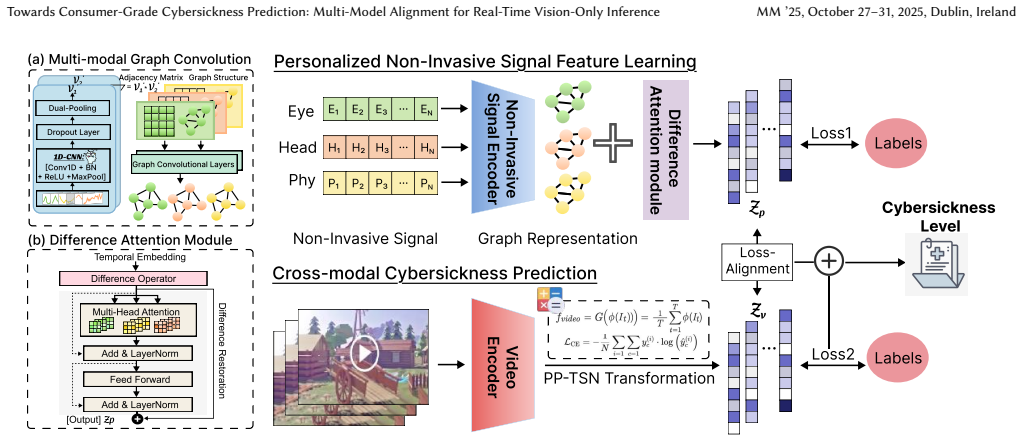
The load-bearing mechanism is cross-modal alignment: an MSE loss $L_{\text{align}} = \frac{1}{N}\sum_i \|z_v^{(i)} - z_p^{(i)}\|^2$ pulls a video embedding $z_v$ toward the personalized embedding $z_p$ computed from non-invasive sensor signals. The sensor embedding comes from a modality-specific graph convolutional network whose nodes are features within head, eye, and physiological modalities, followed by a Difference Attention Module that computes attention from local central-difference signal changes $\Delta X_t = X_t - \frac{1}{2k+1}\sum_{\tau=t-k}^{t+k} X_\tau$, so dynamic changes drive the fusion and baseline drift is downweighted. This machinery turns the deployment problem into a representation-transfer problem: the video encoder inherits per-user traits during joint training, and at inference the sensors are no longer needed.
What would settle it
Run the same experiment with subject-wise cross-validation, where all clips from each participant stay in either training or test, and compare top-1 accuracy; if accuracy drops sharply under this split, the video-only personalization claim is an artifact of identity leakage rather than true generalization.
Extended reading notes
Core claim
The central claim is that a video-only model can match EEG-based cybersickness prediction by transferring personalization from non-invasive sensors during training. The model, MM-PTGNN, builds per-modality graphs over head, eye, and physiological time series, fuses them with a Difference Attention Module that emphasizes transient changes rather than baselines, and then forces the video embedding to approximate the sensor-derived embedding with a mean squared error alignment loss. After training, the sensor branch is discarded and prediction runs on VR video alone, reaching 88.4% accuracy versus 89.16% for the EEG baseline while keeping inference around 90ms per sample. The paper interprets the gap of less than one point as evidence that non-invasive signals carry the personalized information needed for consumer-grade deployment.
Load-bearing premise
The evaluation assumes that the test participants are people the model has never been trained on; if the same person's video clips appear in both training and testing, the reported personalization accuracy could be inflated by the model memorizing that person.
Editorial extensions
If this is right
- Consumer VR headsets could run personalized cybersickness prediction using only the rendered video stream, with no EEG caps or skin-contact sensors.
- The reported 88.4% video-only accuracy is within about one point of the EEG-based 89.16% baseline, so the main barrier to comfort prediction becomes software rather than hardware.
- At roughly 90ms per sample on a single GPU, the model is fast enough to support real-time adaptive responses, such as adjusting field of view or content difficulty mid-session.
- A 42.3MB model size makes the approach plausible for edge devices, not just server-side inference.
Reading between the lines
- It is an open question whether the video-only model generalizes to VR content and demographics far from the 27-participant dataset; the alignment may encode stable user traits or may memorize dataset-specific video-sensor correlations.
- Because alignment transfers sensor-derived traits into video features, the same recipe could distill other expensive measurements, such as physiological biomarkers, into camera-only models for health and engagement monitoring.
- The difference-attention idea—attend to local signal changes rather than raw values—could transfer to other wearable time-series tasks, such as stress detection or seizure monitoring, where baseline drift is a known problem.
- A direct extension would be few-shot personalization: train the alignment on a large multi-user corpus, then adapt the video encoder with a few minutes of each new user's headset signals without retraining the full model.
Editorial analysis
A structured set of objections, weighed in public.
Referee Report
Summary. The paper proposes MM-PTGNN, a framework for personalized cybersickness prediction that trains a video encoder to imitate sensor-derived embeddings (head motion, eye tracking, physiological signals) via a cross-modal alignment loss, then performs video-only inference at deployability. The headline claims are 88.4% Top-1 accuracy matching EEG-based methods (89.16%), with roughly 90 ms inference latency. The manuscript reports experiments on a 27-participant dataset with 5-fold cross-validation, and includes ablation studies, feature-similarity diagnostics, and latency measurements. The core technical idea—training a video-only model by aligning with non-invasive multimodal signals—is plausible and potentially useful, but the reported results contain a direct internal contradiction in the central accuracy number, and the evaluation protocol is underspecified in a way that could invalidate the personalization claim.
Significance. If the claims were reliably established, the framework would be practically significant: it would offer a wearable-free, real-time cybersickness predictor for consumer VR, with accuracy comparable to EEG-based approaches. The paper targets a relevant problem, and the cross-modal alignment strategy is a reasonable route. However, the central numerical claim is not currently supported: the paper's own ablation table reports a Full Model accuracy of 73.1% for the same video-only inference setup that the abstract and Table 3 report as 88.4%, with no reconciliation. In addition, the cross-validation protocol does not state whether folds are subject-wise or window-wise, which is load-bearing for the personalization claim. No code or data are provided to adjudicate the contradiction. These issues are central rather than peripheral.
major comments (3)
- [§4.5, Table 5 vs. Abstract and Table 3] The central accuracy claim is contradicted by the paper's own ablation results. The abstract and Table 3 report 88.4% Top-1 accuracy for 'Ours Video', while Table 5 reports 'Full Model (ours)' at 73.1% Top-1 and 68.2% Macro-F1, and §4.5 states that all models are trained and evaluated under identical settings using the same video-only inference setup. These two sets of numbers cannot both be correct. The manuscript offers no explanation for the discrepancy, no confidence intervals, and no error bars. As written, the headline claim of 88.4% accuracy is unsupported; either the headline or the ablation must be wrong.
- [§4.2, Evaluation Metrics and 5-fold cross-validation] The paper reports 'held-out test set averaged over 5-fold cross-validation' but never states whether the splits are subject-wise or window-wise. With only 27 participants and sliding-window time series, overlapping windows from the same participant are highly correlated; a window-wise random split would allow the model to memorize user identity and thereby inflate both the accuracy and the personalization claims. The authors must specify the split strategy and, in particular, confirm that all windows of a given participant are confined to either the training or test fold. Without this detail, the reported 88.4% accuracy cannot be interpreted as evidence of cross-user personalization.
- [§4.3.2, Table 2 and Eq. (15)] The alignment-quality evidence in Table 2 is circular as evidence of personalization. The cosine similarity and MSE between z_v and z_p are direct measurements of the objective minimized by L_align in Eq. (15); high similarity between the video embedding and the sensor embedding is expected by construction when that loss is optimized. The randomized baseline is a useful sanity check, but the metric itself cannot independently demonstrate that the video encoder has learned personalized traits. The subsequent accuracy comparison against external baselines partially grounds the claim, but the feature-level table should not be presented as independent validation.
minor comments (5)
- [Abstract and Table 4] The abstract states an average inference latency of 90 ms, but Table 4 reports 93.6 ms for the proposed video-only model; these should be reconciled.
- [Abstract] There is a typo in the abstract: 'relesed' should be 'released'.
- [§4.1 and Table 1] The text lists 'HR, BMP, EDA, and SKT' while the earlier introduction and Table 1 refer to BVP (blood volume pulse); the abbreviation should be consistent.
- [§4.4] The sentence 'Our model can achieve as fast as Kundo' is inconsistent with Table 4, which lists Kundo at 90 ms and the proposed model at 93.6 ms; the wording should be corrected to avoid implying the proposed model is faster.
- [§3.1.2, Eq. (4)] The notation H'_t in Eq. (4) is not defined; the equation uses E_t in one line and H'_t in the next, and the relationship between these variables should be clarified.
Circularity Check
Table 2's alignment evidence is the same MSE minimized in Eq. (15), so it is circular as proof of personalized transfer; the central accuracy claim is independent but internally inconsistent.
-
self definitional
[Section 4.3.2, Eq. (15), Table 2]
"The alignment is forced via mean squared error: Lalign = 1/N \sum_i || z_v^(i) - z_p^(i) ||_2^2 (15). ... To evaluate whether the video encoder effectively learns personalized representations aligned with those derived from non-invasive sensor signals, we measure the similarity between the video embedding z_v and the sensor embedding z_p at the feature level. Specifically, we compute the cosine similarity and mean squared error (MSE) between each embedding pair(z_v,z_p) across the validation set."
The evaluation metric MSE is identical to the alignment objective Lalign that the model is trained to minimize in Eq. (15); cosine similarity is a monotone transform of the same distance. Hence Table 2's result that the full model has higher cosine similarity and lower MSE than the w/o-alignment variant is a report of the optimized training loss, relabeled as evidence of personalization transfer. The randomized baseline only shows the loss is sensitive to pairing. This does not independently confirm that personalized traits were transferred; downstream accuracy (if internally consistent) would be the independent evidence.
full rationale
The only concrete circularity is the alignment-quality check in Section 4.3.2: the metric used as evidence is the exact objective being minimized, so it reduces to the training loss by construction. This is peripheral to the headline accuracy claim, which is benchmarked against external baselines and therefore has independent content. However, the paper itself contains a load-bearing internal contradiction: Section 4.5 states all ablations use the same video-only inference setup, yet Table 5 reports Full Model (ours) at 73.1% Top-1 while Table 3 reports Ours Video at 88.4% Top-1; no reconciliation is given. That is a correctness/consistency problem, not a circularity, so it is noted but does not by itself raise the circularity score. The 5-fold split ambiguity (subject-wise vs window-wise) is likewise a validity concern, not a circularity. No load-bearing self-citation or imported uniqueness theorem was found; the cited prior work by an overlapping author is a general susceptibility statement, not the derivation's load-bearing premise. Score is set to 4 for the one self-definitional evaluation step, not for the unresolved accuracy inconsistency.
Assumptions & free parameters
free parameters (4)
- sliding window size T =
300 (chosen from Fig. 5 sweep)
- difference kernel size k =
5 (chosen from Fig. 5 sweep)
- alignment-regularization weight beta =
not reported
- fusion coefficient lambda =
learned in [0,1]
assumptions (4)
- domain assumption The ground-truth cybersickness labels (levels 0-10) from the dataset of [20] are accurate and reflect the user's true sickness state.
- domain assumption Downsampling head and eye motion signals from 30Hz to 1Hz and computing interval statistics preserves the personalized information needed for prediction.
- domain assumption The 5-fold split is statistically valid (e.g., subject-wise), preventing identity leakage between train and test.
- standard math Standard backpropagation and batch normalization behave as assumed for the 1D-CNN and GCN layers.
Cite this review
Pith. "Pith review of Towards Consumer-Grade Cybersickness Prediction: Multi-Model Alignment for Real-Time Vision-Only Inference." pith.science (2026). https://pith.science/paper/3RFMFZYV
@misc{pith2026250101212,
  author       = {Pith},
  title        = {Pith review of: Towards Consumer-Grade Cybersickness Prediction: Multi-Model Alignment for Real-Time Vision-Only Inference},
  year         = {2026},
  howpublished = {\url{https://pith.science/paper/3RFMFZYV}},
  note         = {Machine review of arXiv:2501.01212}
}
read the original abstract
Cybersickness remains a major obstacle to the widespread adoption of immersive virtual reality (VR), particularly in consumer-grade environments. While prior methods rely on invasive signals such as electroencephalography (EEG) for high predictive accuracy, these approaches require specialized hardware and are impractical for real-world applications. In this work, we propose a scalable, deployable framework for personalized cybersickness prediction leveraging only non-invasive signals readily available from commercial VR headsets, including head motion, eye tracking, and physiological responses. Our model employs a modality-specific graph neural network enhanced with a Difference Attention Module to extract temporal-spatial embeddings capturing dynamic changes across modalities. A cross-modal alignment module jointly trains the video encoder to learn personalized traits by aligning video features with sensor-derived representations. Consequently, the model accurately predicts individual cybersickness using only video input during inference. Experimental results show our model achieves 88.4\% accuracy, closely matching EEG-based approaches (89.16\%), while reducing deployment complexity. With an average inference latency of 90ms, our framework supports real-time applications, ideal for integration into consumer-grade VR platforms without compromising personalization or performance. The code will be relesed at https://github.com/U235-Aurora/PTGNN.
Figures


Figures from the paper (3 more)


Forward citations
Cited by 2 Pith papers
-
BioKD: Selective Physiology-to-Video Knowledge Distillation via Reliability Gate for Emotion Recognition
BioKD uses a reliability gate and progressive distillation so that noisy physiological signals improve a video-only emotion recognition model, beating baselines on DEAP and AMIGOS.
-
From Adaptation to Intelligence: A Systematic Review of Data, Strategies, and Impact in Personalized VR
A systematic review synthesizes 132 VR personalization studies into a five-stage closed-loop pipeline and identifies trends toward multimodal sensing, AI-based adaptation, and unresolved evaluation and privacy challenges.
Reference graph
Works this paper leans on
-
[1]
Suprith Balasubramanian and Rajiv Soundararajan. 2019. Prediction of Discom- fort due to Egomotion in Immersive Videos for Virtual Reality. In 2019 IEEE International Symposium on Mixed and Augmented Reality (ISMAR) . 169–177. https://doi.org/10.1109/ISMAR.2019.000-7
-
[2]
Eunhee Chang, Hyun-Taek Kim, and Byounghyun Yoo. 2021. Predicting cyber- sickness based on user’s gaze behaviors in HMD-based virtual reality. Jour- nal of Computational Design and Engineering 8 (04 2021), 728–739. https: //doi.org/10.1093/jcde/qwab010
-
[3]
Y. Chen and C. T. Lin. 2020. Challenges in Deploying EEG-Based Cybersickness Detection for Consumer VR Applications. Frontiers in Human Neuroscience 14 (2020), 567
work page 2020
-
[4]
Yoonseon Choi, Dayoung Jeong, Bogoan Kim, and Kyungsik Han. 2024. Early Prediction of Cybersickness in Virtual Reality Using a Large Language Model for Multimodal Time Series Data. In Companion of the 2024 on ACM International Joint Conference on Pervasive and Ubiquitous Computing . 25–29
work page 2024
-
[5]
Wei Fan, Jingru Fei, Dingyu Guo, Kun Yi, Xiaozhuang Song, Haolong Xi- ang, Hangting Ye, and Min Li. 2025. MedGNN: Towards Multi-resolution Spatiotemporal Graph Learning for Medical Time Series Classification. arXiv:2502.04515 [cs.LG] https://arxiv.org/abs/2502.04515
work page Pith review arXiv 2025
-
[6]
A.S. Fernandes and S.K. Feiner. 2016. Combating VR sickness through subtle dynamic field-of-view modification. In Proc. IEEE Symp. 3D User Interfaces (3DUI) . 201–210. https://doi.org/10.1109/3DUI.2016.7460053
arXiv 2016
-
[7]
A.M. Gavgani, K.V. Nesbitt, K.L. Blackmore, and E. Nalivaiko. 2018. Cybersickness- related changes in brain hemodynamics: A pilot study comparing VR and non- VR tasks. In Proc. IEEE Int. Symp. Mixed Augmented Reality (ISMAR) . 121–126. https://doi.org/10.1109/ISMAR.2018.00036
arXiv 2018
-
[9]
Rifatul Islam, Kevin Desai, and John Quarles. 2021. Cybersickness Prediction from Integrated HMD’s Sensors: A Multimodal Deep Fusion Approach using Eye- tracking and Head-tracking Data. In 2021 IEEE International Symposium on Mixed and Augmented Reality (ISMAR) . 31–40. https://doi.org/10.1109/ISMAR52148. 2021.00017
arXiv 2021
Show all 36 references
-
[10]
Jin Yong Jeon, Hyun In Jo, and Kounseok Lee. 2023. Psycho-physiological restora- tion with audio-visual interactions through virtual reality simulations of sound- scape and landscape experiences in urban, waterfront, and green environments. Sustainable Cities and Society 99 (2...
2023
-
[11]
Dayoung Jeong and Kyungsik Han. 2022. Leveraging multimodal sensory infor- mation in cybersickness prediction. In Proceedings of the 28th ACM Symposium on Virtual Reality Software and Technology . 1–2
2022
-
[12]
Dayoung Jeong and Kyungsik Han. 2024. PRECYSE: Predicting Cybersickness using Transformer for Multimodal Time-Series Sensor Data. Proc. ACM Interact. Mob. Wearable Ubiquitous Technol. 8, 2, Article 42 (May 2024), 24 pages. https: //doi.org/10.1145/3659594
2024 doi
-
[13]
Daekyo Jeong, Sangbong Yoo, and Jang Yun. 2019. Cybersickness Analysis with EEG Using Deep Learning Algorithms. In 2019 IEEE Conference on Virtual Reality and 3D User Interfaces (VR) . 827–835. https://doi.org/10.1109/VR.2019.8798334
2019
-
[14]
Guanxuan Jiang, Xuansheng Xia, Yue Li, Hai-Ning Liang, and Pan Hui. 2024. ChemistryVR: Enhancing Educational Experiences through Virtual Chemistry Lab Simulations. In SIGGRAPH Asia 2024 Educator’s Forum (SA ’24) . Association for Computing Machinery, New York, NY, USA, Article...
2024
-
[15]
Shan Jin, Yuyang Wang, Lik-Hang Lee, Xinyi Luo, and Pan Hui. 2023. Devel- opment of an immersive simulator for improving student chemistry learning efficiency. In Proceedings of the 16th International Symposium on Visual Informa- tion Communication and Interaction . 1–8. https...
2023
-
[16]
H. G. Kim and Y. M. Ro. 2020. Limitations of Optical Flow Features for VR Sickness Prediction in Dynamic Environments. In IEEE International Conference on Multimedia and Expo (ICME) . 1–6
2020
-
[17]
J. Kim, W. Kim, H. Oh, S. Lee, and S. Lee. 2019. A Deep Cybersickness Predic- tor Based on Brain Signal Analysis for Virtual Reality Contents. In IEEE/CVF International Conference on Computer Vision (ICCV) . 10579–10588
2019
-
[18]
Jinwoo Kim, Woojae Kim, Heeseok Oh, Seongmin Lee, and Sanghoon Lee. 2019. A Deep Cybersickness Predictor Based on Brain Signal Analysis for Virtual Reality Contents. In 2019 IEEE/CVF International Conference on Computer Vision (ICCV) . 10579–10588. https://doi.org/10.1109/ICCV...
2019
-
[19]
Seongyeop Kim, Sangmin Lee, and Yong Man Ro. 2020. Estimating VR Sickness Caused By Camera Shake in VR Videography. In 2020 IEEE International Confer- ence on Image Processing (ICIP) . 3433–3437. https://doi.org/10.1109/ICIP40778. 2020.9190721
2020
-
[20]
Ripan Kumar Kundu, Rifatul Islam, John Quarles, and Khaza Anuarul Hoque
-
[21]
Asif Laghari, Imran Niazi, and Joseph Coughlan. 2021. VR Veterans vs. Novices: How Prior Experience Shapes Cybersickness and Adaptation. In Proc. IEEE Conf. Virtual Real. 3D User Interfaces (IEEE VR) . 123–132. https://doi.org/10.1109/ VRW52623.2021.00030
2021
-
[22]
Tae Min Lee, Jong-Chul Yoon, and In-Kwon Lee. 2019. Motion Sickness Pre- diction in Stereoscopic Videos using 3D Convolutional Neural Networks. IEEE Transactions on Visualization and Computer Graphics 25, 5 (2019), 1919–1927. https://doi.org/10.1109/TVCG.2019.2899186
2019
-
[23]
Ruichen Li, Yuyang Wang, Handi Yin, Jean-Rémy Chardonnet, and Pan Hui
-
[24]
Nicolas Martin, Nicolas Mathieu, pallamin nico, Martin Ragot, and Diverrez J- Marc. 2020. Virtual reality sickness detection: an approach based on physiological signals and machine learning. https://doi.org/10.1109/ISMAR50242.2020.00065
2020
-
[25]
In 2023 IEEE International Symposium on Mixed and Augmented Reality (ISMAR)
A deep cybersickness predictor through kinematic data with encoded physiological representation. In 2023 IEEE International Symposium on Mixed and Augmented Reality (ISMAR). IEEE, 1132–1141
2023
-
[26]
Padmanaban, T
N. Padmanaban, T. Ruban, and G. Wetzstein. 2019. Dynamic Field-of-View Restric- tion for Cybersickness Reduction in VR. In Proceedings of the ACM SIGGRAPH Symposium on Applied Perception. 1–8
2019
-
[27]
Norcia, and Gordon Wetzstein
Nitish Padmanaban, Timon Ruban, Vincent Sitzmann, Anthony M. Norcia, and Gordon Wetzstein. 2018. Towards a Machine-Learning Approach for Sickness Prediction in 360° Stereoscopic Videos. IEEE Transactions on Visualization and Computer Graphics 24, 4 (2018), 1594–1603. https://d...
2018 doi
-
[28]
Ramaseri-Chandra and Hassan Reza
Ananth N. Ramaseri-Chandra and Hassan Reza. 2025. Dynamic Cybersickness Mitigation via Adaptive FFR and FoV adjustments. arXiv:2502.03419 [cs.HC] https://arxiv.org/abs/2502.03419
2025 arXiv
-
[29]
Xuanjie Qiu, Fang Yan, and Haihong Liu. 2023. A difference attention ResNet- LSTM network for epileptic seizure detection using EEG signal. Biomedical Signal Processing and Control 83 (2023), 104652. https://doi.org/10.1016/j.bspc. 2023.104652
2023
-
[30]
Gary E Riccio and Thomas A Stoffregen. 1991. An ecological theory of motion sickness and postural instability. Ecological Psychology 3, 3 (1991), 195–240. https://doi.org/10.1207/s15326969eco0303_2
1991 doi
-
[31]
Lisa Rebenitsch and Charles Owen. 2016. Individual Variation in Susceptibility to Cybersickness. ACM Transactions on Applied Perception 13, 3 (2016), 1–23. https://doi.org/10.1145/2912125
2016 doi
-
[32]
Stanney, Kelly S
Kay M. Stanney, Kelly S. Hale, Isabelina Nahmens, and Robert S. Kennedy. 2020. Gender Differences in Cybersickness: Clarifying the Role of Navigation and Interaction Modalities. Frontiers in Virtual Reality 1 (2020), 572924. https: MM ’25, October 27–31, 2025, Dublin, Ireland ...
2020
-
[33]
Smith and S
J. Smith and S. Lee. 2021. Mitigating Visually Induced Motion Sickness Through Adaptive Motion Compensation in Virtual Environments. IEEE Transactions on Visualization and Computer Graphics 28, 4 (2021), 2123–2132
2021
-
[34]
Minghui Wu, Chenxu Zhao, Anyang Su, Donglin Di, Tianyu Fu, Da An, Min He, Ya Gao, Meng Ma, Kun Yan, and Ping Wang. 2024. Hypergraph Multi-modal Large Language Model: Exploiting EEG and Eye-tracking Modalities to Evaluate Heterogeneous Responses for Video Understanding. In Proc...
2024
-
[35]
Ryo Toyoda, Fernando Russo Abegão, and Jarka Glassey. 2022. VR-based health and safety training in various high-risk engineering industries: a literature review. International Journal of Educational Technology in Higher Education 19 (08 2022). https://doi.org/10.1186/s41239-02...
2022 doi
-
[37]
Chen, and Jian Wu
Yixuan Wu, Kaiyuan Hu, Danny Z. Chen, and Jian Wu. 2024. AI-Enhanced Virtual Reality in Medicine: A Comprehensive Survey. arXiv:2402.03093 [cs.CV] https://arxiv.org/abs/2402.03093
2024 arXiv
-
[2023]
arXiv:2302.03037 [cs.HC] https://arxiv.org/abs/2302.03037
LiteVR: Interpretable and Lightweight Cybersickness Detection using Explainable AI. arXiv:2302.03037 [cs.HC] https://arxiv.org/abs/2302.03037
Reviewed August 10, 2026 · model on record in the stance chip above.
Discussion (0). Continue with ORCID to comment.