REVIEW 3 major objections 7 minor 32 references
Ta-G-T: Subjectivity Capture in Table to Text Generation via RDF Graphs
T0 review · 3 major / 7 minor · reviewed 2026-08-06 · deepseek-v4-flash
Pith's one-line read A three-stage pipeline of small fine-tuned T5 models, using RDF triples as an intermediate representation, generates subjective yet factually grounded table text, performing comparably to GPT-3.5 and beating Mistral-7B and Llama-2 without…
desk verdict A modular three-stage T2T pipeline with RDF intermediate representation, solidly engineered but overclaimed in its headline numbers and with an aggregation training setup that deserves scrutiny. read the letter →
The pith
A machine-rendered reading of the paper's core claim, the machinery that carries it, and where it could break.
The reading
What carries the argument
The load-bearing mechanism is the modular three-stage pipeline: deterministic conversion of each table row into RDF triples (subject–predicate–object), a T5-large model that verbalizes each triple, a T5-large aggregation model that merges sentences into a coherent narrative, and a T5-large style-transfer model that adds evaluative phrases. The named intermediate representation is the RDF graph, a structured set of subject–predicate–object facts extracted directly from the table, which grounds generation and provides an audit trail for factual errors. A T5-large classifier fine-tuned on the Movies Subjectivity Dataset serves as the automatic subjectivity metric, measuring the percentage of sentences judged subjective.
What would settle it
Check whether the subjective phrases in the pipeline's outputs are consistent with the actual data: for a random sample of Ta2TS tables, have annotators verify each evaluative phrase (e.g., "dramatic increase") against the corresponding numerical delta; if a large fraction of phrases contradict the data, the claim that subjectivity is fact-grounded fails.
Extended reading notes
Core claim
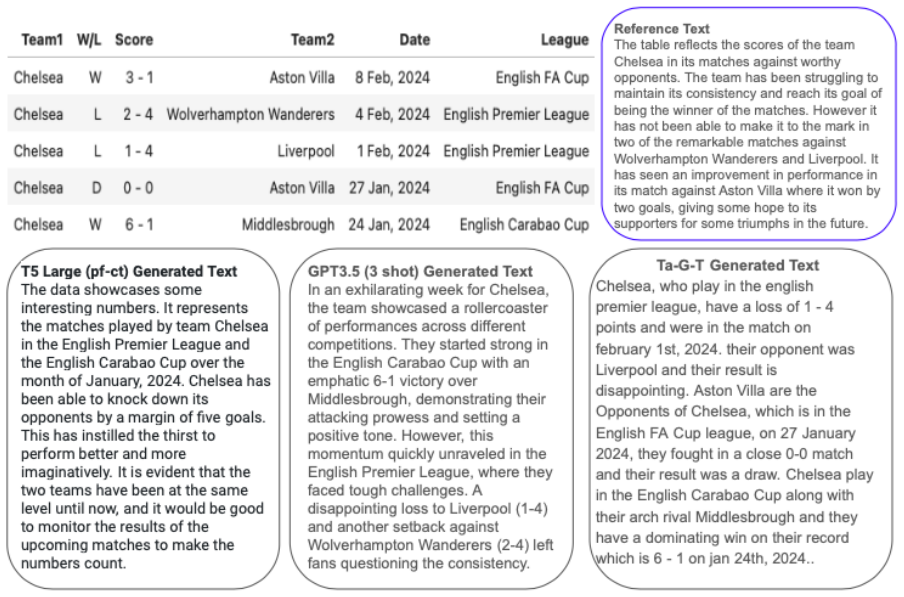
The central discovery is that inserting RDF triples as an intermediate representation, followed by a dedicated sentence-aggregation stage and a final subjectivity-infusion stage, lets a pipeline of T5-large models generate table descriptions that balance factual fidelity with interpretive language. The RDF extraction is deterministic: the first column becomes the subject, headers become predicates, and cell values become objects. Three fine-tuned T5-large models handle triple-to-text (trained on WebNLG), sentence aggregation (trained on a synthetic dataset built from first-stage outputs and WebNLG references), and objective-to-subjective style transfer (trained on the reversed Wiki Neutrality Corpus). Evaluated on Ta2TS, the pipeline scores 25.46 METEOR and 82.50 BERTScore, beating Mistral-7B and Llama-2 across all reported metrics and coming close to GPT-3.5, despite never being fine-tuned on the evaluation dataset. The paper also introduces an automatic subjectivity metric by fine-tuning a T5-large binary classifier on the Movies Subjectivity Dataset, and its ablation shows the subjectivity stage raises detected subjectivity from roughly 4% to 12–25% depending on domain.
Load-bearing premise
The aggregation model is trained on a synthetic dataset whose input sentences come from the first-stage T5 model but whose target texts are human-written WebNLG references that are not verified to correspond to those inputs; if the targets do not match the generated sentences, the model learns an arbitrary input-to-output mapping that can corrupt factual content.
Editorial extensions
If this is right
- Small, task-specific fine-tuned models can match or beat much larger open LLMs on structured data-to-text, suggesting scale is not the only route to strong performance on tables.
- The RDF intermediate representation provides a natural audit trail: factual errors can be traced to a specific stage (extraction, aggregation, or subjectivity infusion).
- The pipeline transfers across domains (finance, weather, sports) without fine-tuning on the target dataset, because training uses WebNLG and WNC only.
- The automatic subjectivity metric enables quantitative ablation of subjective content, as demonstrated by the drop from 12–25% to roughly 4% when the third stage is removed.
- Each stage can be independently optimized or replaced, e.g., swapping the subjectivity model for an audience-specific one, without retraining the whole pipeline.
Reading between the lines
- A direct stress test would be to measure factual consistency (e.g., percentage of generated claims entailed by the table) across pipeline stages; the paper reports human coverage and accuracy scores but no automatic fidelity check on the final subjective text.
- The subjectivity classifier trained on movie reviews may not capture domain-specific evaluative language in finance and weather; a domain-adapted classifier could change the reported subjectivity percentages.
- The deterministic row-wise RDF extraction ignores cross-row trends, so the pipeline likely under-exploits temporal comparisons; an extension that summarizes differences across rows before aggregation could improve both coverage and subjective insight.
- Because the aggregation stage is trained on synthetic pairs, its quality depends on the first-stage model's output distribution; if the first stage is replaced or fine-tuned, the aggregation model may need retraining—an implicit coupling the modular design does not fully eliminate.
Editorial analysis
A structured set of objections, weighed in public.
Referee Report
Summary. The paper presents Ta-G-T, a three-stage pipeline for table-to-text generation that aims to produce both objective and subjective text. Stage 1 converts tables to RDF triples via a deterministic heuristic and generates a sentence per triple with a T5-large fine-tuned on WebNLG. Stage 2 aggregates the individual sentences using a T5-large trained on a synthetic dataset built from Stage-1 outputs and WebNLG references. Stage 3 infuses subjectivity using a T5-large fine-tuned on the reversed WNC corpus. The system is evaluated on the Ta2TS dataset with BLEU, METEOR, ROUGE-L, BERTScore, a novel automatic subjectivity classifier, and human ratings. The paper claims that Ta-G-T achieves performance comparable to GPT-3.5 and outperforms Mistral-7B and Llama-2 on several metrics, while not being fine-tuned on the evaluation dataset.
Significance. If the results are validated, the pipeline offers a modular, computationally efficient alternative to LLMs for structured data-to-text, with explicit control over factual grounding via RDF and an explicit aggregation stage. The idea of using an intermediate RDF representation is a useful contribution, and the paper provides a concrete instantiation with publicly available datasets. However, the evaluation has several issues: the comparative claims are partly inconsistent with the reported numbers, the training-data construction for the aggregation stage is not validated, and the automatic subjectivity metric is applied out of domain without evidence of transfer. These issues are addressable but currently hinder acceptance.
major comments (3)
- [§6.1, Table 1] The claim that 'Ta-G-T outperforms both Mistral-7b and Llama-2 across all four metrics' is contradicted by Table 1: Ta-G-T's BLEU-4 (1.63) is lower than Llama-2 5-shot (2.84), and its ROUGE-L (18.57) is lower than Llama-2 5-shot (19.88). Additionally, the statement 'GPT-3.5 consistently achieves the highest scores across all metrics' is false because T5-base (pf-ct) has the highest BERTScore (85.15) in the table. The abstract's more modest phrase 'outperforming ... in several metrics' is accurate, but the body's stronger claim is not. No confidence intervals or significance tests are provided for any automatic metric, so the reported differences may not be statistically reliable. Please correct the overclaims and add appropriate statistical analysis.
- [§5.2] The aggregation stage is trained on a synthetic dataset whose inputs are Stage-1 T5 outputs for WebNLG triples and whose targets are human-written WebNLG references. Those references are written from the gold RDF triples, not from the generated sentences, so the input and target can diverge whenever Stage-1 hallucinates, omits, or reorders content. This mismatch can cause the aggregation model to learn an arbitrary input-to-output mapping that rewrites or discards input facts. Since Stage 2 sits between factual verbalization and subjectivity infusion, any fact lost here cannot be recovered downstream. The paper provides no direct evaluation of Stage 2's factual fidelity; Table 4's ablation only measures BLEU/METEOR/ROUGE/BERTScore, which reward fluency and lexical overlap, not triple-level recall. I recommend either verifying that the synthetic input-target pairs are semantically consistent or adding a triple-level factual recall evaluation on Ta2TS to support the claim that RDF grounding preserves facts.
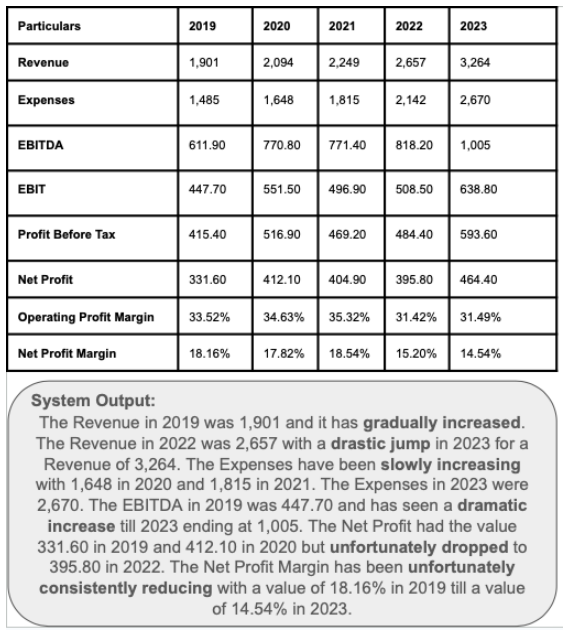
- [§6.1] The automatic subjectivity metric is a T5-large classifier fine-tuned on the Movies Subjectivity Dataset (Pang and Lee, 2004), which contains movie reviews and plot summaries. This classifier is then applied to financial, weather, and sports table descriptions from Ta2TS, yet the paper provides no evidence that it transfers to these domains, such as precision/recall on a held-out Ta2TS sample or correlation with the human subjectivity judgments in Table 2. The ablation study in Table 3 relies entirely on this classifier to demonstrate the contribution of the subjectivity infusion stage; without validation, the reported subjectivity percentages are difficult to interpret. Please validate the classifier on the target domains or, at minimum, report human-evaluated subjectivity for the ablation conditions.
minor comments (7)
- [§2.1] There is a typo in contribution 2: 'forautomatic evaluation' should read 'for automatic evaluation.'
- [Table 5] The per-genre counts in Table 5 sum to 3,879 (1498+1031+1350), not the stated total of 3,849 in Section 4. Please correct the total or the row counts.
- [Table 1] The caption states that the highest scores are in bold and the second highest underlined, but the table as rendered contains no such formatting. Also, the header 'Bleu-4' is inconsistent with the metric name 'BLEU-4' used elsewhere.
- [§6.2] The harmonic mean is used to aggregate human evaluator scores, but no justification is given for why the harmonic mean is preferable to the arithmetic mean for rating scales. Please report per-evaluator statistics and explain the choice.
- [§6.2] The paper does not describe how the 100 samples for human evaluation were selected, whether they are stratified by domain, or whether the same samples were used for all models. This information is needed to assess the representativeness of the human evaluation.
- [References] Some reference entries are incomplete or inconsistent, e.g., 'Tom B Brown. 2020. Language models are few-shot learners.' does not list all authors and is missing the full citation details. Please check all references against the required style.
- [General] The paper does not state whether code or trained models will be released. Releasing the pipeline would significantly aid reproducibility and is strongly encouraged.
Circularity Check
No significant circularity; the pipeline is evaluated on an external benchmark, with only minor self-citation of baseline scores.
full rationale
Ta-G-T's central derivation is self-contained. The RDF-extraction stage is a deterministic heuristic (Section 5.1); the T5 generators are fine-tuned on external datasets (WebNLG, WNC, Movies Subjectivity Dataset) and evaluated on Ta2TS without fine-tuning on that set (Section 6.1), so the main METEOR/BERTScore/subjectivity numbers are not fitted to the evaluation reference. The subjectivity metric is an independently trained classifier (Pang and Lee, 2004), and the ablation in Section 6.3 measures a real drop when Stage 3 is removed. The only self-citation that is load-bearing is Section 5.5, where all baseline numbers are "directly use[d]" from Dey and Bhattacharyya (2024), a prior paper by two of the same authors; this supports the LLM-comparison claim but is not a circular reduction because those numbers are externally reproducible benchmark results on the same dataset. The Section 5.2 aggregation training set (Stage-1 outputs paired with WebNLG references) is a possible correctness risk, not a circularity: even if input-target alignment is loose, the final evaluation is on Ta2TS and the model is not fit to those references. Section 8's admitted lack of established subjectivity metrics is a validity limitation, not circularity.
Assumptions & free parameters
free parameters (4)
- Training epochs per stage =
3, 50, 50
- Fine-tuning learning rate =
2e-5
- Batch size =
4
- Adafactor optimizer settings =
1e-3 learning rate, decay 0.8
assumptions (4)
- domain assumption The first column of a table is the subject, column headers are predicates, and cell values are objects, forming a single-star RDF graph per row.
- ad hoc to paper Sentences generated independently from RDF triples, paired with human-written WebNLG references, form a valid supervised dataset for learning sentence aggregation.
- domain assumption A T5 model trained on the Movies Subjectivity Dataset (movie reviews) can reliably classify subjectivity in financial, weather, and sports table-generated text.
- domain assumption Reversing the Wiki Neutrality Corpus (treating subjective sentences as targets) teaches a model to inject subjectivity while preserving factual content.
Cite this review
Pith. "Pith review of Ta-G-T: Subjectivity Capture in Table to Text Generation via RDF Graphs." pith.science (2026). https://pith.science/paper/3RILA2MK
@misc{pith2026250719710,
  author       = {Pith},
  title        = {Pith review of: Ta-G-T: Subjectivity Capture in Table to Text Generation via RDF Graphs},
  year         = {2026},
  howpublished = {\url{https://pith.science/paper/3RILA2MK}},
  note         = {Machine review of arXiv:2507.19710}
}
read the original abstract
In Table-to-Text (T2T) generation, existing approaches predominantly focus on providing objective descriptions of tabular data. However, generating text that incorporates subjectivity, where subjectivity refers to interpretations beyond raw numerical data, remains underexplored. To address this, we introduce a novel pipeline that leverages intermediate representations to generate both objective and subjective text from tables. Our three-stage pipeline consists of: 1) extraction of Resource Description Framework (RDF) triples, 2) aggregation of text into coherent narratives, and 3) infusion of subjectivity to enrich the generated text. By incorporating RDFs, our approach enhances factual accuracy while maintaining interpretability. Unlike large language models (LLMs) such as GPT-3.5, Mistral-7B, and Llama-2, our pipeline employs smaller, fine-tuned T5 models while achieving comparable performance to GPT-3.5 and outperforming Mistral-7B and Llama-2 in several metrics. We evaluate our approach through quantitative and qualitative analyses, demonstrating its effectiveness in balancing factual accuracy with subjective interpretation. To the best of our knowledge, this is the first work to propose a structured pipeline for T2T generation that integrates intermediate representations to enhance both factual correctness and subjectivity.
Figures


Figures from the paper (2 more)

Reference graph
Works this paper leans on
-
[1]
I \ n igo Alonso and Eneko Agirre. 2024. Automatic logical forms improve fidelity in table-to-text generation. Expert Systems with Applications, 238:121869
work page 2024
-
[2]
S \"o ren Auer, Christian Bizer, Georgi Kobilarov, Jens Lehmann, Richard Cyganiak, and Zachary Ives. 2007. Dbpedia: A nucleus for a web of open data. In international semantic web conference, pages 722--735. Springer
work page 2007
-
[3]
Tom B Brown. 2020. Language models are few-shot learners. arXiv preprint arXiv:2005.14165
arXiv 2020
-
[4]
Wenhu Chen, Jianshu Chen, Yu Su, Zhiyu Chen, and William Yang Wang. 2020. Logical natural language generation from open-domain tables. arXiv preprint arXiv:2004.10404
work page Pith review arXiv 2020
-
[5]
Jacob Devlin, Ming-Wei Chang, Kenton Lee, and Kristina Toutanova. 2019. https://doi.org/10.18653/v1/N19-1423 BERT : Pre-training of deep bidirectional transformers for language understanding . In Proceedings of the 2019 Conference of the North A merican Chapter of the Association for Computational Linguistics: Human Language Technologies, Volume 1 (Long a...
-
[6]
Tathagata Dey and Pushpak Bhattacharyya. 2024. Facts-and-feelings: Capturing both objectivity and subjectivity in table-to-text generation. arXiv preprint arXiv:2406.10560
work page Pith review arXiv 2024
-
[7]
Thiago Castro Ferreira, Chris van der Lee, Emiel Van Miltenburg, and Emiel Krahmer. 2019. Neural data-to-text generation: A comparison between pipeline and end-to-end architectures. arXiv preprint arXiv:1908.09022
work page Pith review arXiv 2019
-
[8]
Claire Gardent, Anastasia Shimorina, Shashi Narayan, and Laura Perez-Beltrachini. 2017. https://doi.org/10.18653/v1/W17-3518 The W eb NLG challenge: Generating text from RDF data . In Proceedings of the 10th International Conference on Natural Language Generation, pages 124--133, Santiago de Compostela, Spain. Association for Computational Linguistics
Show all 32 references
-
[9]
Albert Gatt and Emiel Krahmer. 2018. Survey of the state of the art in natural language generation: Core tasks, applications and evaluation. Journal of Artificial Intelligence Research, 61:65--170
2018
-
[10]
Jie He, Yijun Yang, Wanqiu Long, Deyi Xiong, Victor Gutierrez-Basulto, and Jeff Z Pan. 2025. Evaluating and improving graph to text generation with large language models. arXiv preprint arXiv:2501.14497
2025 arXiv
-
[11]
Jonathan Herzig, Pawe Krzysztof Nowak, Thomas M \"u ller, Francesco Piccinno, and Julian Martin Eisenschlos. 2020. Tapas: Weakly supervised table parsing via pre-training. arXiv preprint arXiv:2004.02349
2020 arXiv
-
[12]
Albert Q. Jiang, Alexandre Sablayrolles, Arthur Mensch, Chris Bamford, Devendra Singh Chaplot, Diego de las Casas, Florian Bressand, Gianna Lengyel, Guillaume Lample, Lucile Saulnier, Lélio Renard Lavaud, Marie-Anne Lachaux, Pierre Stock, Teven Le Scao, Thibaut Lavril, Thomas ...
2023 arXiv
-
[13]
Ratnesh Kumar Joshi, Sagnik Sengupta, and Asif Ekbal. 2024. From hallucinations to facts: Enhancing language models with curated knowledge graphs. arXiv preprint arXiv:2412.18672
2024 arXiv
-
[14]
Mihir Kale and Abhinav Rastogi. 2020. Text-to-text pre-training for data-to-text tasks. arXiv preprint arXiv:2005.10433
2020 arXiv
-
[15]
Anirban Laha, Parag Jain, Abhijit Mishra, and Karthik Sankaranarayanan. 2020. Scalable micro-planned generation of discourse from structured data. Computational Linguistics, 45(4):737--763
2020
-
[16]
Ao Liu, Haoyu Dong, Naoaki Okazaki, Shi Han, and Dongmei Zhang. 2022. https://doi.org/10.18653/v1/2022.emnlp-main.373 PLOG : Table-to-logic pretraining for logical table-to-text generation . In Proceedings of the 2022 Conference on Empirical Methods in Natural Language Process...
2022 doi
-
[17]
Bo Pang and Lillian Lee. 2004. A sentimental education: Sentiment analysis using subjectivity summarization based on minimum cuts. arXiv preprint cs/0409058
2004 arXiv
-
[18]
Ankur Parikh, Xuezhi Wang, Sebastian Gehrmann, Manaal Faruqui, Bhuwan Dhingra, Diyi Yang, and Dipanjan Das. 2020. https://doi.org/10.18653/v1/2020.emnlp-main.89 ToTTo : A controlled table-to-text generation dataset . In Proceedings of the 2020 Conference on Empirical Methods i...
2020 doi
-
[19]
Reid Pryzant, Richard Diehl Martinez, Nathan Dass, Sadao Kurohashi, Dan Jurafsky, and Diyi Yang. 2020. Automatically neutralizing subjective bias in text. In Proceedings of the aaai conference on artificial intelligence, volume 34, pages 480--489
2020
-
[20]
Colin Raffel, Noam Shazeer, Adam Roberts, Katherine Lee, Sharan Narang, Michael Matena, Yanqi Zhou, Wei Li, and Peter J. Liu. 2020. Exploring the limits of transfer learning with a unified text-to-text transformer. J. Mach. Learn. Res., 21(1)
2020
-
[21]
Ehud Reiter. 2007. https://aclanthology.org/W07-2315 An architecture for data-to-text systems . In Proceedings of the Eleventh E uropean Workshop on Natural Language Generation ( ENLG 07) , pages 97--104, Saarbr \"u cken, Germany. DFKI GmbH
2007
-
[22]
Ehud Reiter and Robert Dale. 1997. Building applied natural language generation systems. Natural Language Engineering, 3(1):57--87
1997
-
[23]
Leonardo FR Ribeiro, Martin Schmitt, Hinrich Sch \"u tze, and Iryna Gurevych. 2020. Investigating pretrained language models for graph-to-text generation. arXiv preprint arXiv:2007.08426
2020 arXiv
-
[24]
Xiaoyu Shen, Ernie Chang, Hui Su, Jie Zhou, and Dietrich Klakow. 2020. Neural data-to-text generation via jointly learning the segmentation and correspondence. arXiv preprint arXiv:2005.01096
2020 arXiv
-
[25]
Hugo Touvron, Louis Martin, Kevin Stone, Peter Albert, Amjad Almahairi, Yasmine Babaei, Nikolay Bashlykov, Soumya Batra, Prajjwal Bhargava, Shruti Bhosale, Dan Bikel, Lukas Blecher, Cristian Canton Ferrer, Moya Chen, Guillem Cucurull, David Esiobu, Jude Fernandes, Jeremy Fu, W...
2023 arXiv
-
[26]
Qingyun Wang, Semih Yavuz, Victoria Lin, Heng Ji, and Nazneen Rajani. 2021. Stage-wise fine-tuning for graph-to-text generation. arXiv preprint arXiv:2105.08021
2021 arXiv
-
[27]
Sam Wiseman, Stuart M Shieber, and Alexander M Rush. 2017. Challenges in data-to-document generation. arXiv preprint arXiv:1707.08052
2017 arXiv
-
[28]
Pengcheng Yin, Graham Neubig, Wen-tau Yih, and Sebastian Riedel. 2020. Tabert: Pretraining for joint understanding of textual and tabular data. arXiv preprint arXiv:2005.08314
2020 arXiv
-
[29]
Shuo Yu, Yingbo Wang, Ruolin Li, Guchun Liu, Yanming Shen, Shaoxiong Ji, Bowen Li, Fengling Han, Xiuzhen Zhang, and Feng Xia. 2025. Graph2text or graph2token: A perspective of large language models for graph learning. arXiv preprint arXiv:2501.01124
2025 arXiv
-
[30]
Shuzhou Yuan and Michael F \"a rber. 2023. Evaluating generative models for graph-to-text generation. arXiv preprint arXiv:2307.14712
2023 arXiv
-
[31]
URL: " 'urlintro :=
ENTRY address author booktitle chapter edition editor howpublished institution journal key month note number organization pages publisher school series title type volume year eprint doi pubmed url lastchecked label extra.label sort.label short.list INTEGERS output.state before...
-
[32]
write newline
" write newline "" before.all 'output.state := FUNCTION n.dashify 't := "" t empty not t #1 #1 substring "-" = t #1 #2 substring "--" = not "--" * t #2 global.max substring 't := t #1 #1 substring "-" = "-" * t #2 global.max substring 't := while if t #1 #1 substring * t #2 gl...
Reviewed August 6, 2026 · model on record in the stance chip above.
Discussion (0). Sign in to comment.