REVIEW 4 major objections 5 minor 83 references
Phase diagram of lasing under correlated pump from GPU-accelerated Truncated Wigner dynamics
T0 review · 4 major / 5 minor · reviewed 2026-08-14 · deepseek-v4-flash
Pith's one-line read Power-law correlated pumping relaxes the superradiant-laser drive requirement: the optimal pump rate drops by $N^{1-\alpha}$ for $\alpha<1$ and by $\log N$ at $\alpha=1$, while ultra-narrow emission persists for all $\alpha$ and…
desk verdict A clean, well-executed numerical study of a new power-law correlated pump family that makes a plausible case for a coherent-lasing crossover near α≈1, though the key g^(2) extrapolation rests on TWA data outside the benchmarked range. read the letter →
The pith
A machine-rendered reading of the paper's core claim, the machinery that carries it, and where it could break.
The reading
What carries the argument
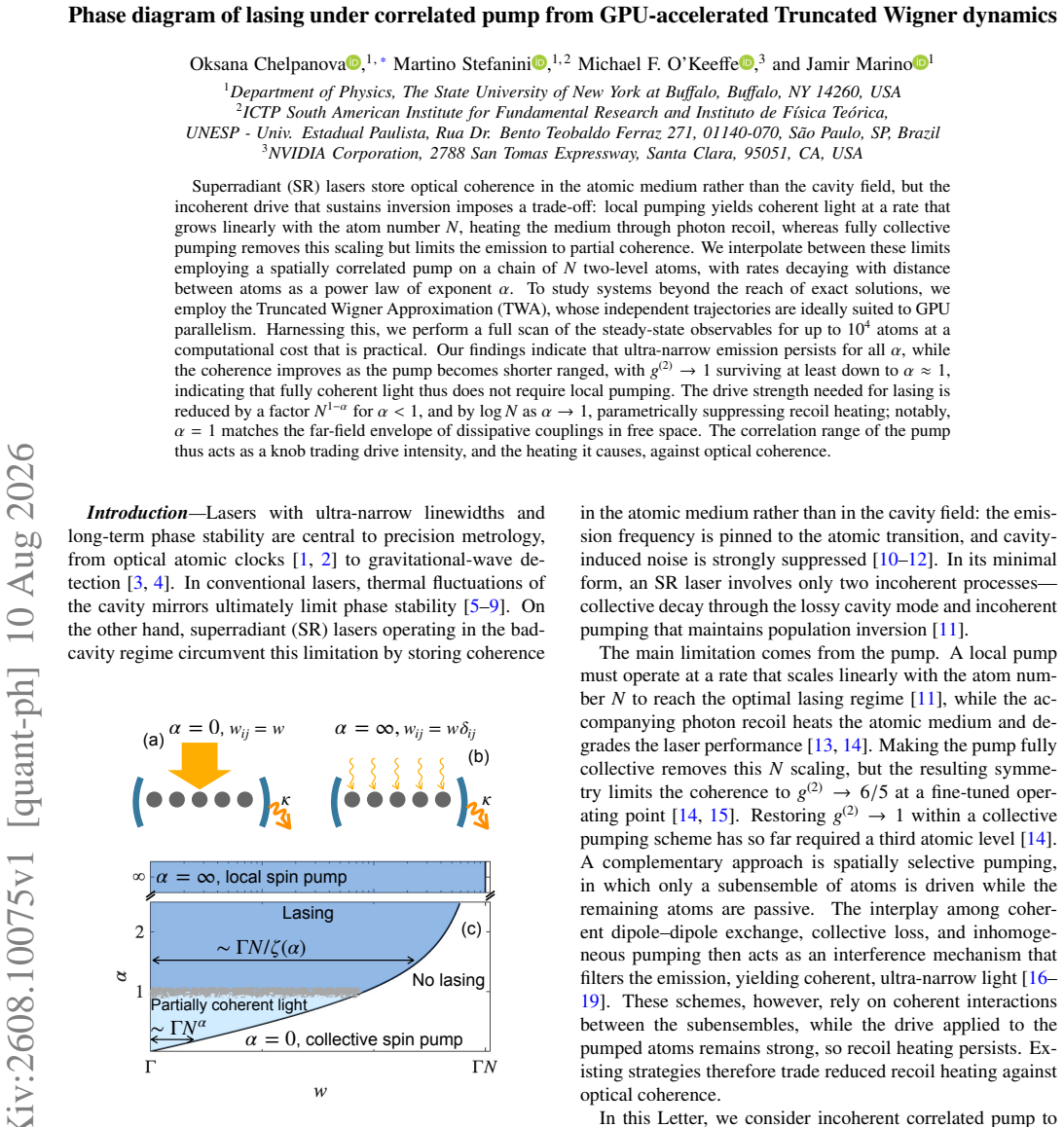
The central object is the pump-rate matrix $w_{ij}=w/(|i-j|+1)^\alpha$ on a chain of $N$ two-level atoms, whose exponent $\alpha$ tunes from a rank-one collective pump ($\alpha=0$) to a full-rank local pump ($\alpha\to\infty$). The argument is carried by the eigenvalue spectrum of this matrix: its largest eigenvalue, proportional to the inverse Kac factor $K^{-1}(N,\alpha)=\sum_j w_{ij}$, sets the lasing-region boundary and produces the $N^{1-\alpha}$, $\log N$, and $\zeta(\alpha)$ reductions in required pump rate, while the breaking of permutation symmetry at finite $\alpha$ opens the Hilbert-space sectors that allow $g^{(2)}\to1$. The computational machinery is the truncated Wigner approximation with independent stochastic trajectories evolved in parallel on GPUs, which lets the authors evaluate steady-state magnetization, intensity, second-order coherence, and linewidth for up to $10^4$ atoms.
What would settle it
Compute $g^{(2)}_{\min}$ at $\alpha=0.9$ and $\alpha=1$ for $N$ from 40 to a few hundred using an exact or non-semiclassical method, such as a tensor-network or symmetry-adapted solver, and compare the $1/N$ extrapolation: if the extrapolated value saturates above 1, or the minimum shifts in rescaled pump rate relative to the truncated Wigner scan, the claim that fully coherent emission survives at $\alpha\approx1$ is falsified. In experiment, a chain of atoms with a tunable power-law correlated repumping kernel measuring $g^{(2)}$ versus $N$ at $\alpha=1$ would settle the same question.
Extended reading notes
Core claim
The paper's central claim is that correlated pumping of power-law type directly relaxes the drive requirement of the superradiant laser. Relative to the standard local-pump value, the rate needed to reach optimal lasing is reduced by a factor $\sim N^{1-\alpha}$ for $\alpha<1$, by $\log N$ at $\alpha=1$, and by $\zeta(\alpha)$ for $\alpha>1$, parametrically suppressing the recoil heating that limits current implementations. This reduction does not compromise the defining feature of the SR laser: superradiant emission with an ultra-narrow linewidth persists for all values of $\alpha$. What it costs is coherence, which improves as the pump becomes shorter ranged: fully coherent emission, $g^{(2)}\to1$, survives at least down to $\alpha\approx1$, and finite-size extrapolation suggests it may extend below. The three properties decouple: the drive requirement tracks the largest eigenvalue of the pump matrix $w_{ij}$, coherence tracks how strongly the pump breaks permutation symmetry, and the ultra-narrow linewidth is inherited from collective loss with minor sensitivity to pump range.
Load-bearing premise
The paper's central quantitative conclusions rest on the semiclassical simulation method being reliable for large systems over the pump-rate range that locates the best coherence; the method is benchmarked against an exact solution only at $N=40$ and the paper states it overestimates $g^{(2)}$ and linewidth at stronger pumping.
Editorial extensions
If this is right
- Free-space dissipative couplings correspond to $\alpha\approx1$, so a repumping scheme built from free-space emission would already lower the required pump rate by a factor $\sim\log N$ relative to the local-pump SR laser, without further dissipation engineering.
- For $\alpha>1$ the required pump rate is reduced by the constant factor $\zeta(\alpha)$, so even short-ranged correlated pumping softens the drive requirement while the lasing region broadens as $\alpha$ grows.
- Fully coherent emission with $g^{(2)}\to1$ does not require local pumping; a power-law pump with $\alpha\gtrsim1$ combines coherence with a sublinear or constant pump-rate scaling.
- The three defining properties of the SR laser decouple: drive requirement is set by the largest eigenvalue of the pump matrix, coherence by the degree of permutation-symmetry breaking, and linewidth by the collective loss channel.
- GPU-accelerated truncated Wigner dynamics makes full steady-state phase diagrams for thousands of spins practical and applies to arbitrary pump or decay matrices, so the same scan can be repeated for other correlated-dissipation kernels.
Reading between the lines
- If the $1/N$ extrapolation is trusted, the coherent regime may extend below $\alpha\approx1$; finite-size data in the paper suggest but do not prove this, so an exact or experimental measurement of $g^{(2)}$ at smaller $\alpha$ would test whether a true threshold exists.
- The eigenvalue-scaling argument implies a design rule the paper does not state explicitly: any pump kernel whose largest eigenvalue grows slower than $N$ would relax the drive requirement, so shaping the kernel's spectrum rather than its real-space power law could further suppress recoil heating.
- The paper's kernel is a purely positive envelope; realistic Green-tensor kernels add oscillatory phases and coherent dipole-dipole exchange, and whether those preserve the coherence-drive trade-off is a testable question for waveguide or free-space implementations.
- Because the truncated Wigner approximation overestimates $g^{(2)}$ and linewidth at strong pumping, the quantitative boundary of the coherent region may shift when evaluated with methods that retain operator noncommutativity; the qualitative decoupling of drive, coherence, and linewidth is the part most likely to survive.
Editorial analysis
A structured set of objections, weighed in public.
Referee Report
Summary. The manuscript studies a chain of N two-level atoms in the bad-cavity regime, subject to collective loss and an incoherent pump whose rates decay with interatomic distance as a power law, w_ij = w/(|i-j|+1)^alpha. Using a GPU-accelerated truncated Wigner approximation (TWA), the authors map the steady-state magnetization, intensity, second-order coherence g^(2), and linewidth over the rescaled pump rate w̃ = w_max^nu/(ΓN) and the exponent α, for systems up to N=10^4. Their central claims are: (i) the drive requirement for lasing is set by the largest eigenvalue of the pump matrix, reducing the required pump rate by N^{1−α} for α<1, by log N at α=1, and by ζ(α) for α>1; (ii) ultra-narrow linewidth persists for all α; and (iii) fully coherent emission, g^(2)→1 in the thermodynamic limit, survives at least down to α≈1, giving a continuous interpolation between collective and local pumping. The paper also advertises GPU-accelerated TWA as a practical tool for driven-dissipative spin systems beyond permutation symmetry.
Significance. If the results hold, the eigenvalue-scaling argument for the drive reduction is a clean and practically relevant result, and the identification of α≈1 as the boundary of full coherence would establish a new trade-off axis for superradiant lasers, with free-space emission (α≈1) singled out as a promising operating point. The manuscript has clear strengths: Eq. (3) is a parameter-free mathematical scaling statement; the collapse of the lasing region onto the rescaled pump rate is an empirical observation rather than a fit; the data and code are made available; and the GPU benchmark is detailed and reproducible. The paper is also commendably explicit about the known limitations of TWA, including its overestimate of g^(2) and linewidth at strong pumping. However, the central coherence crossover at α≈1 rests on TWA data in a regime that has not been benchmarked, and the finite-size extrapolations are quoted without uncertainties, so the quantitative boundary is not yet firmly established.
major comments (4)
- [§Methods; SM S2; Figs. 2–3] The central coherence result, g^(2)→1 for α≳0.7–0.9 in the thermodynamic limit, is obtained from TWA data for finite α, but the only quantitative benchmark (SM S2) is for the local-pump limit α=∞ at N=40 and for w̃≲1/4, where TWA "reproduces the exact solution". The g^(2)_min data in Fig. 3 are sampled over w̃∈[0.1,1], and the finite-α regime is not benchmarked at all, so the known overestimate of g^(2) in the local strong-pump limit does not by itself control the error in the finite-α region. Please benchmark TWA against an exact small-N Lindblad solution for several finite α (e.g., N=6–12), report the value of w̃ at which g^(2)_min occurs and the TWA error at that point, and discuss whether the overestimate direction is expected to persist for finite α.
- [Fig. 3(b) and §Results] The 1/N extrapolations of g^(2)_min are quoted as numbers (1.15 at α=0.5, 1.04 at α=0.7, "even closer" at α≥0.9) without statistical uncertainties, fit residuals, or sensitivity analysis. Since the extrapolated values are close to the coherent limit 1 and the TWA bias is of comparable magnitude, the statement that full coherence survives "at least down to α≈1" is not quantitatively constrained. Add error bars from trajectory resampling, report the fit form and residuals, and test sensitivity to the largest-N points and to the range of N included.
- [§Results, paragraph on recoil heating] The statement that correlated pumping "parametrically suppress[es] the recoil heating" is an inference from the reduced required pump rate; no recoil-heating term or temperature observable is modeled. Since the abstract motivates the work with recoil heating, either include a minimal model of the heating (e.g., a momentum-diffusion or temperature observable coupled to the pump rate) or restate the result as a reduction of the required drive intensity, with the heating reduction presented as a prediction rather than a demonstrated outcome.
- [Fig. 2(d) and §Methods] The ultra-narrow linewidth claim for all α rests on a spectral estimate whose low-frequency resolution is set by the finite evolution time τ=5/Γ, yet no frequency resolution or convergence check with τ is reported. Without this information, "ultra-narrow" is not quantitatively defined and the comparison across α is not controlled. Please report the resolution δω=2π/τ, show Δν as a function of τ for representative α, and state the smallest resolvable linewidth.
minor comments (5)
- [Eq. (3) and footnote 32] The main text states w_max^ν ∼ wζ(α) for α>1, but the footnote correctly notes that this limit requires α−1 ≫ (log N)^{−1}. Make this crossover condition explicit in the main text, since the α=1 log N regime and the α>1 constant regime meet at this scale.
- [Fig. 3 caption and Abstract] The caption of Fig. 3 says the data "place an upper bound near α≈1 on the crossover to coherent emission," while the abstract states that full coherence survives down to α≈1. Clarify whether α≈1 is an upper or a lower bound on the coherent-emission region and use consistent language.
- [SM S2] The benchmark against the exact solution is shown only at N=40; provide at least one additional exact comparison at a different N for the local-pump limit, or state explicitly that permutation-invariant solvers are limited in N, so that the N-dependence of the TWA error is documented.
- [End Matter, GPU benchmark] The timing benchmark fixes τ_r=5 and adjusts ΓN so that ΓN·Δt is constant; state whether this protocol affects the relative performance for small N, where the physical value of ΓN would be much smaller than in the large-N runs.
- [§Results and Fig. 3] The sampling of w̃ is described as ten equally spaced values between 1/10 and 1; specify whether the same ten values are used for all α and N, and whether g^(2)_min is selected from these points or obtained by interpolation.
Circularity Check
No significant circularity: the central scaling claims rest on independent eigenvalue mathematics and externally benchmarked TWA simulations, not on fitted inputs or self-citation chains.
full rationale
The paper's central quantitative claims are (i) the drive-rate reduction and (ii) the coherence crossover g^(2) -> 1 near alpha approximately 1. Claim (i) follows from Eq. (3), the largest-eigenvalue scaling w_max ~ w N^{1-alpha}, w log N, or w zeta(alpha), which is a mathematical property of the Toeplitz-like pump matrix expressed through the inverse Kac factor, combined with the empirical observation in Fig. 2 that the lasing region collapses onto w~ = w_max/(Gamma N). Rescaling by w_max is a presentation choice; the collapse itself is a falsifiable observation, and the paper states it was verified numerically by diagonalizing w_ij. The reduction factor N^{1-alpha}, log N, and zeta(alpha) is therefore a restatement of Eq. (3) together with that observed collapse, not a fit of the threshold to the eigenvalue. Claim (ii) is obtained from TWA finite-size scans and 1/N extrapolations of g^(2)_min; the TWA method is benchmarked in SM S2 against the exact permutation-invariant solver PIQS, with the paper explicitly reporting that TWA overestimates g^(2) and linewidth at strong pumping. That is an independent, externally implemented benchmark, so citing the authors' earlier TWA paper (Ref. [20]) is not load-bearing circularity. No uniqueness theorem from the authors is invoked to force a choice, and the known limitations of TWA are disclosed as qualitative-reliability caveats rather than hidden inputs. The remaining concerns about TWA accuracy in the unbenchmarked finite-alpha regime, and the absence of error bars on the extrapolated limits, are correctness risks rather than circularity.
Assumptions & free parameters
assumptions (5)
- domain assumption Adiabatic elimination of the bad cavity reduces the atom-cavity coupling to collective spin loss at rate Gamma=4g^2/kappa.
- domain assumption Local atomic decay gamma and coherent dipole-dipole interactions are negligible.
- domain assumption The truncated Wigner approximation reliably captures steady-state magnetization, intensity, g^(2), and linewidth in the simulated parameter window.
- ad hoc to paper The power-law kernel w_ij = w/(|i-j|+1)^alpha is a representative minimal interpolation between collective and local pumping.
- domain assumption The lasing threshold is controlled by the largest eigenvalue of the pump-rate matrix.
Cite this review
Pith. "Pith review of Phase diagram of lasing under correlated pump from GPU-accelerated Truncated Wigner dynamics." pith.science (2026). https://pith.science/paper/3S52SUEP
@misc{pith2026260810075,
  author       = {Pith},
  title        = {Pith review of: Phase diagram of lasing under correlated pump from GPU-accelerated Truncated Wigner dynamics},
  year         = {2026},
  howpublished = {\url{https://pith.science/paper/3S52SUEP}},
  note         = {Machine review of arXiv:2608.10075}
}
abstract
Superradiant (SR) lasers store optical coherence in the atomic medium rather than the cavity field, but the incoherent drive that sustains inversion imposes a trade-off: local pumping yields coherent light at a rate that grows linearly with the atom number $N$, heating the medium through photon recoil, whereas fully collective pumping removes this scaling but limits the emission to partial coherence. We interpolate between these limits employing a spatially correlated pump on a chain of $N$ two-level atoms, with rates decaying with distance between atoms as a power law of exponent $\alpha$. To study systems beyond the reach of exact solutions, we employ the Truncated Wigner Approximation (TWA), whose independent trajectories are ideally suited to GPU parallelism. Harnessing this, we perform a full scan of the steady-state observables for up to $10^4$ atoms at a computational cost that is practical. Our findings indicate that ultra-narrow emission persists for all $\alpha$, while the coherence improves as the pump becomes shorter ranged, with $g^{(2)} \to 1$ surviving at least down to $\alpha \approx 1$, indicating that fully coherent light thus does not require local pumping. The drive strength needed for lasing is reduced by a factor $N^{1-\alpha}$ for $\alpha < 1$, and by $\log N$ as $\alpha \to 1$, parametrically suppressing recoil heating; notably, $\alpha = 1$ matches the far-field envelope of dissipative couplings in free space. The correlation range of the pump thus acts as a knob trading drive intensity, and the heating it causes, against optical coherence.
Figures


Figures from the paper (1 more)

Reference graph
Works this paper leans on
-
[1]
T. L. Nicholson, S. Campbell, R. Hutson, G. E. Marti, B. Bloom, R. L. McNally, W. Zhang, M. Barrett, M. S. Safronova, G. Strouse,et al., Systematic evaluation of an atomic clock at 2×10- 18 total uncertainty, Nature communi- cations6, 6896 (2015)
2015
-
[2]
Chen, Active optical clock, Chinese Science Bulletin54, 348 (2009)
J. Chen, Active optical clock, Chinese Science Bulletin54, 348 (2009)
2009
-
[3]
Bothwell, C
T. Bothwell, C. J. Kennedy, A. Aeppli, D. Kedar, J. M. Robin- son, E. Oelker, A. Staron, and J. Ye, Resolving the gravitational redshift across a millimetre-scale atomic sample, Nature602, 420 (2022)
2022
-
[4]
Haroche, Laser, offspring and powerful enabler of quantum science, PRX Quantum6, 010102 (2025)
S. Haroche, Laser, offspring and powerful enabler of quantum science, PRX Quantum6, 010102 (2025)
2025
-
[5]
H. J. Kimble, B. L. Lev, and J. Ye, Optical interferometers with reduced sensitivity to thermal noise, Phys. Rev. Lett.101, 260602 (2008)
work page 2008
-
[6]
A. D. Ludlow, X. Huang, M. Notcutt, T. Zanon-Willette, S. M. Foreman, M. M. Boyd, S. Blatt, and J. Ye, Compact, thermal-noise-limited optical cavity for diode laser stabilization at 1×10⁻¹⁵, Opt. Lett.32, 641 (2007)
work page 2007
-
[7]
G. D. Cole, W. Zhang, M. J. Martin, J. Ye, and M. Aspelmeyer, Tenfold reduction of brownian noise in high-reflectivity optical coatings, Nature Photonics7, 644 (2013)
work page 2013
- [8]
Show all 83 references
-
[9]
J. Yu, S. H ¨afner, T. Legero, S. Herbers, D. Nicolodi, C. Y . Ma, F. Riehle, U. Sterr, D. Kedar, J. M. Robinson, E. Oelker, and J. Ye, Excess noise and photoinduced effects in highly reflective crystalline mirror coatings, Phys. Rev. X13, 041002 (2023)
2023
-
[10]
M. A. Norcia, J. R. K. Cline, J. A. Muniz, J. M. Robinson, R. B. Hutson, A. Goban, G. E. Marti, J. Ye, and J. K. Thompson, Frequency measurements of superradiance from the strontium clock transition, Phys. Rev. X8, 021036 (2018)
2018
-
[11]
Meiser, J
D. Meiser, J. Ye, D. R. Carlson, and M. J. Holland, Prospects for a millihertz-linewidth laser, Phys. Rev. Lett.102, 163601 (2009)
2009
-
[12]
Dubey, G
S. Dubey, G. A. Kazakov, B. Heizenreder, S. Zhou, S. Ben- netts, S. A. Sch ¨affer, A. Sitaram, and F. Schreck (MoSaiQC Collaboration), Modeling of a continuous superradiant laser on the sub-mhz 1s0→ 3p0 transition in neutral strontium-88, Phys. Rev. Res.7, 013292 (2025)
2025
-
[13]
M. A. Norcia and J. K. Thompson, Cold-strontium laser in the superradiant crossover regime, Phys. Rev. X6, 011025 (2016)
2016
-
[14]
J. T. Reilly, S. B. J¨ager, J. Cooper, and M. J. Holland, Fully col- lective superradiant lasing with vanishing sensitivity to cavity length vibrations, Phys. Rev. Lett.136, 143803 (2026)
2026
-
[15]
Supplemental materials containing discussion on evaluation of two-time correlation functions, benchmark between TW A and cumulants, discussion on solutions in case of local and collec- tive spin pump, and additional data for correlated spin pump
-
[16]
Chelpanova, M
O. Chelpanova, M. Stefanini, D. Sarenac, T. Thomay, and J. Marino, One knob to tune them all: Phase-controlled photon statistics and linewidth in partially pumped atomic ensembles (2026), arXiv:2604.26117 [quant-ph]
2026 arXiv
-
[17]
Bychek, R
A. Bychek, R. Holzinger, and H. Ritsch, Nanoscale mirrorless superradiant lasing, Phys. Rev. Lett.135, 143601 (2025)
2025
-
[18]
Nadolny, M
T. Nadolny, M. Brunelli, and C. Bruder, Nonreciprocal interac- tions induce frequency shifts in superradiant lasers, Phys. Rev. Lett.134, 193603 (2025)
2025
-
[19]
Bychek, M
A. Bychek, M. Fasser, I. Vybornyi, K. Hammerer, S. F. Yelin, H. Ritsch, and R. Holzinger, Continuous narrow-linewidth superradiance in waveguide qed (2026), arXiv:2607.06556 [quant-ph]
2026 arXiv
-
[20]
Hosseinabadi, O
H. Hosseinabadi, O. Chelpanova, and J. Marino, User-friendly truncated wigner approximation for dissipative spin dynamics, 7 PRX Quantum6, 030344 (2025)
2025
-
[21]
Breuer and F
H.-P. Breuer and F. Petruccione,The Theory of Open Quantum Systems(Oxford University Press, 2007)
2007
-
[22]
Stefanini, A
M. Stefanini, A. A. Ziolkowska, D. Budker, U. Poschinger, F. Schmidt-Kaler, A. Browaeys, A. Imamoglu, D. Chang, and J. Marino, Is lindblad for me?, SciPost Phys. Lect. Notes , 129 (2026)
2026
-
[23]
Fazio, J
R. Fazio, J. Keeling, L. Mazza, and M. Schir`o, Many-body open quantum systems, SciPost Phys. Lect. Notes , 99 (2025)
2025
-
[24]
S. J. Masson, J. P. Covey, S. Will, and A. Asenjo-Garcia, Dicke superradiance in ordered arrays of multilevel atoms, PRX Quantum5, 010344 (2024)
2024
-
[25]
S. J. Masson, I. Ferrier-Barbut, L. A. Orozco, A. Browaeys, and A. Asenjo-Garcia, Many-body signatures of collective decay in atomic chains, Phys. Rev. Lett.125, 263601 (2020)
2020
-
[26]
Gavalda, G
A. Gavalda, G. Tremblier, M. Poitrinal, S. Pancaldi, A. Browaeys, and I. Ferrier-Barbut, Fourier imaging of collec- tive spontaneous emission modes in superradiant cold atomic clouds (2026), arXiv:2607.08421 [physics.atom-ph]
2026 arXiv
-
[27]
Novotny and B
L. Novotny and B. Hecht,Principles of Nano-Optics, 2nd ed. (Cambridge University Press, 2012)
2012
-
[28]
Campa, T
A. Campa, T. Dauxois, and S. Ruffo, Statistical mechanics and dynamics of solvable models with long-range interactions, Physics Reports480, 57 (2009)
2009
-
[29]
Defenu, T
N. Defenu, T. Donner, T. Macr `ı, G. Pagano, S. Ruffo, and A. Trombettoni, Long-range interacting quantum systems, Rev. Mod. Phys.95, 035002 (2023)
2023
-
[30]
N. Defenu, Metastability and discrete spectrum of long-range systems, Proceedings of the National Academy of Sciences118, e2101785118 (2021), https://www.pnas.org/doi/pdf/10.1073/pnas.2101785118
2021 doi
-
[31]
Passarelli, P
G. Passarelli, P. Lucignano, R. Fazio, and A. Russomanno, Dis- sipative time crystals with long-range lindbladians, Phys. Rev. B106, 224308 (2022)
2022
-
[32]
Notice that the divergence ofζ(α) atα→1 + is cutoffby system size, sincew max ν converges towζ(α) only ifα−1≫(logN) −1, otherwise it has the same scaling asα=1,w max ν ∼wlogN
-
[33]
R. M. Gray,Toeplitz and Circulant Matrices: A Review, V ol. 2 (2006) pp. 155–239, https://www.emerald.com/ftcit/article- pdf/2/3/155/11531750/0100000006en.pdf
2006
-
[34]
D. F. Walls and G. J. Milburn,Quantum optics(Springer Sci- ence & Business Media, 2025)
2025
-
[35]
Meiser and M
D. Meiser and M. J. Holland, Intensity fluctuations in steady- state superradiance, Phys. Rev. A81, 063827 (2010)
2010
-
[36]
E. W. Lloyd, A. A. Ziolkowska, and J. Keeling, Permutation- symmetric quantum trajectories (2026), arXiv:2605.11103 [quant-ph]
2026 arXiv
-
[37]
Shammah, S
N. Shammah, S. Ahmed, N. Lambert, S. De Liberato, and F. Nori, Open quantum systems with local and collective in- coherent processes: Efficient numerical simulations using per- mutational invariance, Phys. Rev. A98, 063815 (2018)
2018
-
[38]
Barberena, Generalized holstein-primakoffmapping and 1/n expansion of collective spin systems undergoing single particle dissipation (2025), arXiv:2508.05751 [quant-ph]
D. Barberena, Generalized holstein-primakoffmapping and 1/n expansion of collective spin systems undergoing single particle dissipation (2025), arXiv:2508.05751 [quant-ph]
2025 arXiv
-
[39]
M. Xu, D. A. Tieri, and M. J. Holland, Simulating open quan- tum systems by applying su(4) to quantum master equations, Phys. Rev. A87, 062101 (2013)
2013
-
[40]
Holzinger, N
R. Holzinger, N. S. Bassler, J. Lyne, F. G. Jimenez, J. T. Gohsrich, and C. Genes, Solving dicke superradiance analyti- cally: A compendium of methods, Phys. Rev. A113, 043718 (2026)
2026
-
[41]
Guardiola-Navarrete, S
E. Guardiola-Navarrete, S. Cardenas-Lopez, and A. Asenjo- Garcia,Chapter Three - Phase-space methods for many-body quantum optics, edited by L. F. Dimauro, H. Perrin, and S. Yelin, Advances In Atomic, Molecular, and Optical Physics, V ol. 74 (Academic Press, 2025) pp. 87–156
2025
-
[42]
C. D. Mink, D. Petrosyan, and M. Fleischhauer, Hybrid discrete-continuous truncated wigner approximation for driven, dissipative spin systems, Phys. Rev. Res.4, 043136 (2022)
2022
-
[43]
Hartmann, T
J. Hartmann, T. Schlegel, V . Noel, C. D. Mink, and M. Fleis- chhauer, Truncated wigner approximation for spins in continu- ous phase space (2026), arXiv:2607.17295 [quant-ph]
2026 arXiv
-
[44]
V . Noel, M. Fleischhauer, and I. Lesanovsky, Path integral approach to the truncated wigner approximation of driven- dissipative spins (2026), arXiv:2607.26029 [quant-ph]
2026 arXiv
-
[45]
Plankensteiner, C
D. Plankensteiner, C. Hotter, and H. Ritsch, QuantumCumu- lants.jl: A Julia framework for generalized mean-field equa- tions in open quantum systems, Quantum6, 617 (2022)
2022
-
[46]
J. H. Mentink, M. V . Tretyakov, A. Fasolino, M. I. Katsnelson, and T. Rasing, Stable and fast semi-implicit integration of the stochastic landau–lifshitz equation, Journal of Physics: Con- densed Matter22, 176001 (2010)
2010
-
[47]
Noel and I
V . Noel and I. Lesanovsky, Quantum to classical relaxation dy- namics of the dissipative rydberg gas (2026), arXiv:2604.10538 [cond-mat.quant-gas]
2026 arXiv
-
[48]
C. D. Mink and M. Fleischhauer, Collective radiative interac- tions in the discrete truncated wigner approximation, SciPost Physics15, 10.21468/scipostphys.15.6.233 (2023)
2023 doi
-
[49]
Sierra, S
E. Sierra, S. J. Masson, and A. Asenjo-Garcia, Dicke superra- diance in ordered lattices: Dimensionality matters, Phys. Rev. Res.4, 023207 (2022)
2022
-
[50]
Seetharam, A
K. Seetharam, A. Lerose, R. Fazio, and J. Marino, Correlation engineering via nonlocal dissipation, Phys. Rev. Res.4, 013089 (2022)
2022
-
[51]
Seetharam, A
K. Seetharam, A. Lerose, R. Fazio, and J. Marino, Dynamical scaling of correlations generated by short- and long-range dis- sipation, Phys. Rev. B105, 184305 (2022)
2022
-
[52]
Marino, Universality class of ising critical states with long- range losses, Phys
J. Marino, Universality class of ising critical states with long- range losses, Phys. Rev. Lett.129, 050603 (2022)
2022
-
[53]
L. F. dos Prazeres, H. Hosseinabadi, and J. Marino, Kinetically constrained superradiance (2026), arXiv:2605.05343 [quant- ph]
2026 arXiv
-
[54]
Cardenas-Lopez, E
S. Cardenas-Lopez, E. Guardiola-Navarrete, and A. Asenjo- Garcia, Steady-state spin order and superradiance beyond the dicke limit (2026), arXiv:2511.10638 [quant-ph]
2026 arXiv
-
[55]
Windt, M
B. Windt, M. Bello, D. Malz, and J. I. Cirac, Effects of retar- dation on many-body superradiance in chiral waveguide qed, Phys. Rev. Lett.134, 173601 (2025)
2025
-
[56]
X. Li, J. Marino, D. E. Chang, and B. Flebus, Solid-state plat- form for cooperative quantum dynamics driven by correlated emission, Phys. Rev. B111, 064424 (2025)
2025
-
[57]
Gunning, S
A. Gunning, S. Schmid, Z. Liu, S. Kuriyattil, A. Deger, and A. J. Daley, Interaction geometry and ground-state properties of sparse quantum lattice models (2026), arXiv:2606.20387 [quant-ph]
2026 arXiv
-
[58]
Periwal, E
A. Periwal, E. S. Cooper, P. Kunkel, J. F. Wienand, E. J. Davis, and M. Schleier-Smith, Programmable interactions and emer- gent geometry in an array of atom clouds, Nature600, 630 (2021)
2021
-
[59]
Hosseinabadi, Y
H. Hosseinabadi, Y . Tserkovnyak, E. Demler, and J. Marino, Magnon nesting in driven two-dimensional quantum magnets, Phys. Rev. B113, 014404 (2026)
2026
-
[60]
Hosseinabadi, D
H. Hosseinabadi, D. E. Chang, and J. Marino, Far from equi- librium field theory for strongly coupled light and matter: Dy- namics of frustrated multimode cavity qed, Phys. Rev. Res.6, 043314 (2024)
2024
-
[61]
Chelpanova, M
O. Chelpanova, M. Stefanini, M. F. O’Keeffe, and J. Marino, Phase diagram of lasing under correlated pump from 8 gpu-accelerated truncated wigner dynamics, 10.5281/zen- odo.21853127 (2026)
2026 doi
-
[62]
Center for Computational Research, University at Buffalo, UB CCR Support Portfolio, (2020),http://hdl.handle.net/ 10477/79221
2020
-
[63]
Tosca, F
J. Tosca, F. Carnazza, L. Giacomelli, and C. Ciuti, Efficient variational dynamics of open quantum bosonic systems via au- tomatic differentiation (2025), arXiv:2507.14076 [quant-ph]
2025 arXiv
-
[64]
Spiechowicz, M
J. Spiechowicz, M. Kostur, and L. Machura, Gpu accelerated monte carlo simulation of brownian motors dynamics with cuda, Computer Physics Communications191, 140 (2015)
2015
-
[65]
Okuta, Y
R. Okuta, Y . Unno, D. Nishino, S. Hido, and C. Loomis, Cupy: A numpy-compatible library for nvidia gpu calculations, inPro- ceedings of Workshop on Machine Learning Systems (Learn- ingSys) in The Thirty-first Annual Conference on Neural Infor- mation Processing Systems (NIPS)(2017)
2017
-
[66]
Bradbury, R
J. Bradbury, R. Frostig, P. Hawkins, M. J. Johnson, Y . Katariya, C. Leary, D. Maclaurin, G. Necula, A. Paszke, J. VanderPlas, S. Wanderman-Milne, and Q. Zhang, JAX: composable trans- formations of Python+NumPy programs (2018)
2018
-
[67]
The MathWorks, Inc.,Parallel Computing Toolbox, version R2024a, The MathWorks, Inc., Natick, Massachusetts (2025)
2025
-
[68]
NVTX annotations in Python can be used to identify regions of the profiler output corresponding to specific operations in the code
GPU usage can be profiled with NVIDIA Nsight Systems to an- alyze kernel scheduling and memory traffic. NVTX annotations in Python can be used to identify regions of the profiler output corresponding to specific operations in the code
-
[69]
Altland and B
A. Altland and B. Simons,Condensed Matter Field Theory, 3rd ed. (Cambridge University Press, 2023)
2023
-
[70]
Note that by itself model (1) can host a dark state due to the collective spin loss, but we assume that at timet=0 the system was prepared in the spin-polarized state
-
[71]
Bu ˇca and T
B. Bu ˇca and T. Prosen, A note on symmetry reductions of the lindblad equation: transport in constrained open spin chains, New Journal of Physics14, 073007 (2012)
2012
-
[72]
Xu and M
M. Xu and M. J. Holland, Conditional ramsey spectroscopy with synchronized atoms, Phys. Rev. Lett.114, 103601 (2015)
2015
-
[73]
J. A. Acebr ´on, L. L. Bonilla, C. J. P ´erez Vicente, F. Ritort, and R. Spigler, The kuramoto model: A simple paradigm for syn- chronization phenomena, Rev. Mod. Phys.77, 137 (2005)
2005
-
[74]
Kirton and J
P. Kirton and J. Keeling, Superradiant and lasing states in driven-dissipative dicke models, New Journal of Physics20, 015009 (2018)
2018
-
[75]
Shimshi and E
Y . Shimshi and E. Shahmoon, Dissipative phase transition and metrology in collectively pumped superradiance (2024), arXiv:2408.12243 [quant-ph]
2024 arXiv
-
[76]
Shankar, S
A. Shankar, S. B. J ¨ager, J. T. Reilly, R. Kaubruegger, M. J. Holland, and W. Hahn, Dynamical aspects of steady-state subradiance: Detailed balance and its breakdown (2026), arXiv:2605.15785 [quant-ph]. 9 S1. TRUNCA TED WIGNER APPROXIMA TION: DYNAMICS AND OBSERV ABLES Below, ...
2026 arXiv
-
[78]
For each quantum spin-1/2,σ k =(σ x k,σ y k,σ z k), we introduce a corresponding classical spins k =(s x k,s y k,s z k)
-
[79]
(S1) The white noises satisfy⟨ξα i (t)ξβ j (t′)⟩= Γδ(t−t ′)δαβ and⟨χα i (t)χβ j(t′)⟩=w i jδ(t−t′)δαβ, whereα,β={x,y}
The dynamics of each classical spins k is described by the following stochastic differential equations: ∂tsx i = +1 2Γsz i X j sx j− 1 2 sz i X j wi jsx j +ξ x i sz i−χ x i sz i ∂tsy i = +1 2Γsz i X j sy j− 1 2 sz i X j wi jsy j +ξ y i sz i−χ y i sz i ∂tsz i =− 1 2Γ X j sx i s...
-
[80]
We sampleN trj initial conditions for the classical spins from the discrete distributions x,y k =±1 ands z k =1, corresponding to a spin-polarized state with all emitters in the excited state
-
[81]
(S1) for a time τs≈10/[w(2η(α)−1)]
For the correlated-pump problem, we prepare the steady state by evolving the dynamics governed by Eq. (S1) for a time τs≈10/[w(2η(α)−1)]. This preparation time is used in the finite-size scaling analysis to account for the relaxation of all pump modes, including the slowest on...
-
[82]
Symmetrically ordered two-point functions are similarly given by ⟨σα kσβ l⟩TW A= 1 Ntrj P i sα k,isβ l,i
The steady-state observables are evaluated by averaging the corresponding classical quantities over the unperturbed tra- jectories,⟨σ α k⟩TW A= 1 Ntrj P i sα k,i, wherei=1,...,N trj. Symmetrically ordered two-point functions are similarly given by ⟨σα kσβ l⟩TW A= 1 Ntrj P i sα...
-
[83]
In particular,⟨S +S−⟩= ⟨S +S−⟩TW A+⟨S z⟩TW A/2 and ⟨S +S +S−S−⟩=⟨S +S +S−S−⟩TW A+2⟨S +S zS−⟩TW A − 1 3⟨S z⟩TW A+ 1 2⟨S zS z⟩TW A− 4 3⟨S +S−⟩TW A
Single-time, normally ordered correlation functions can be expressed in terms of symmetrically ordered correlation functions by accounting for all possible permutations and using the commutation relations. In particular,⟨S +S−⟩= ⟨S +S−⟩TW A+⟨S z⟩TW A/2 and ⟨S +S +S−S−⟩=⟨S +S +...
-
[100]
In its simplest form, GPU acceleration is straightforward to implement
GPU acceleration can therefore substantially reduce the computational time required to obtain the semiclassical solu- tion [63, 64]. In its simplest form, GPU acceleration is straightforward to implement. In Python, NumPy arrays can be replaced with CuPy [65] or JAX [66] array...
Reviewed August 14, 2026 · model on record in the stance chip above.
Discussion (0). Continue with ORCID to comment.