REVIEW 3 major objections 4 minor 1 cited by
Towards NNLO QCD predictions for off-shell top-quark pair production and decays
T0 review · 3 major / 4 minor · reviewed 2026-08-06 · deepseek-v4-flash
Pith's one-line read This paper delivers the first NNLO QCD prediction for off-shell top-quark pair production with leptonic decays, estimating the missing two-loop virtual corrections through the double-pole approximation anchored to the on-shell cross…
desk verdict First NNLO number for off-shell W+W-bbbar with massive bottom quarks, but the fitted non-factorisable two-loop piece is load-bearing and only indirectly validated. read the letter →
The pith
A machine-rendered reading of the paper's core claim, the machinery that carries it, and where it could break.
The reading
What carries the argument
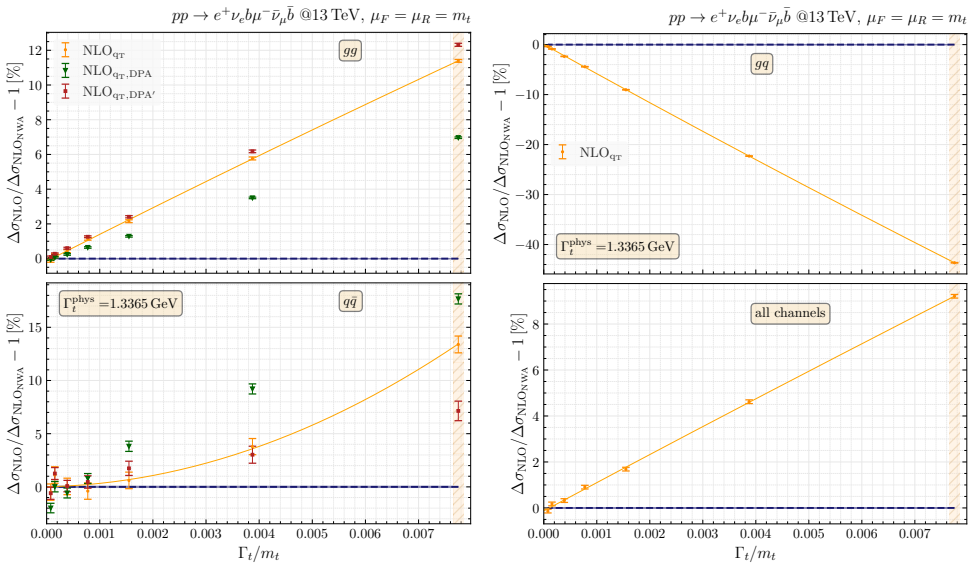
The load-bearing device is the double-pole approximation (DPA) for the two-loop virtual amplitude: the off-shell amplitude is expanded keeping only its double-resonant $t\bar t$ topology, with the residue evaluated on projected on-shell momenta, so production and decay factorise. The factorisable part multiplies polarised tree-level production and decay amplitudes by their two-loop corrections; the non-factorisable part is assumed to have the one-log-per-loop form $\Delta\sigma_{\rm NNLO,H}^{\rm non-fact} = A^{(2)}_{\rm nf}\log^2(\Gamma_t/Q_h) + B^{(2)}_{\rm nf}\log(\Gamma_t/Q_h) + C^{(2)}_{\rm nf} + O(\Gamma_t/Q_h)$, whose unknown coefficients are extracted by computing the cross section at several artificially small top-quark widths, fitting the residual width dependence, and matching the $\Gamma_t\to 0$ limit to the known on-shell $t\bar t$ NNLO cross section. Two supporting mechanisms carry the accuracy: massification, which restores bottom-quark mass logarithms in the two-loop production and decay amplitudes obtained in the massless limit, and $q_T$-subtraction with an $r_{\rm cut}\to 0$ extrapolation, which handles the infrared singularities of the $2\to 6$, $2\to 7$ and $2\to 8$ real and real-virtual contributions.
What would settle it
A direct calculation of the genuine two-loop non-factorisable contributions — soft-gluon exchanges linking the $t\bar t$ production stage to the top or anti-top decays, i.e., two-loop six-point integrals with internal masses — in the gluon-fusion channel would settle the claim: if the resulting constant differs from the fitted $C^{(2)}_{\rm nf}$ by more than the quoted ~1.5% systematic, the on-shell matching has fixed the wrong value. A cheaper immediate check is to rerun the $\Gamma_t \to 0$ fit restricted to the smallest widths ($\Gamma_t/\Gamma_t^{\rm phys} \le 0.1$), where the logarithmic ansatz should dominate; a significant shift of the extracted constant would signal contamination by power corrections beyond the fitted linear term.
Extended reading notes
Core claim
The paper's central claim is that the inclusive cross section for $W^+W^-b\bar b$ production with leptonic decays and massive bottom quarks can be computed at NNLO accuracy by treating only the genuine two-loop virtual contribution in the double-pole approximation. The factorisable two-loop corrections are constructed from available polarised two-loop on-shell $t\bar t$ production amplitudes combined with two-loop top-quark decay amplitudes obtained from heavy-to-light form factors, with bottom-quark mass effects restored by massification. The non-factorisable corrections, which are not directly computable, are fixed by requiring that the off-shell cross section reproduces the on-shell $t\bar t$ NNLO cross section times branching ratios in the $\Gamma_t \to 0$ limit, using the known functional form $A^{(2)}_{\rm nf}\log^2(\Gamma_t/Q_h) + B^{(2)}_{\rm nf}\log(\Gamma_t/Q_h) + C^{(2)}_{\rm nf}$ for their width dependence. With this construction the paper obtains $\sigma_{\rm NNLO} = 10623(55)\pm 152$ fb at 13 TeV, an 11% upward shift of the NLO result, a numerical uncertainty below 2%, and residual perturbative uncertainties of about $+3.2\%/-4.6\%$. Along the way it establishes that the double-pole approximation reproduces the exact NLO result at the per-mille to few-percent level across fiducial and differential observables, and that the non-factorisable two-loop corrections, though roughly 20% of the factorisable ones, shift the NNLO correction at order one because other contributions largely cancel.
Load-bearing premise
The whole result rests on the assumption that the missing two-loop non-factorisable corrections have exactly the assumed dependence on the top-quark width — a squared logarithm, a single logarithm, and a constant term — and that the constant fixed by matching to the known on-shell $t\bar t$ cross section in the zero-width limit is the correct one, a check performed so far only at lower orders and in the subdominant channels.
Editorial extensions
If this is right
- The inclusive $e^+\nu_e \mu^-\bar\nu_\mu b\bar b$ cross section at 13 TeV is predicted at $\sigma_{\rm NNLO} = 10623(55)\pm 152$ fb, an 11% upward correction over NLO with numerical uncertainty below 2%.
- The double-pole approximation, validated at NLO to per-mille accuracy in fiducial cross sections and a few percent in distribution tails, supplies a stand-in for two-loop amplitudes in processes where exact multi-loop results are out of reach.
- Non-factorisable two-loop corrections matter at order one for the NNLO shift because other contributions largely cancel, so a DPA-based NNLO prediction that omits them would be qualitatively incomplete.
- After removing spurious finite-width terms, the matched prediction gives $\sigma^{\Delta\rm trunc}_{\rm NNLO} = 10278(55)\pm152$ fb, allowing consistent future comparisons with narrow-width treatments of $t\bar t$ plus $tW$ production.
- The exact NLO computation of the process with a resolved jet in the 4-flavour scheme with massive bottom quarks is the first of its kind and provides a new handle for jet-based background modelling.
Reading between the lines
- My inference: the same construction — exact real and real-virtual pieces, DPA for the genuine two-loop virtual, on-shell matching in the zero-width limit — is portable to other unstable-particle processes (such as $t\bar t H$ or single-top channels) for which exact two-loop amplitudes are unavailable but an on-shell NNLO anchor exists.
- My inference: the headline number is only as strong as the fitted constant $C^{(2)}_{\rm nf}$; a future direct computation of the non-factorisable two-loop diagrams that shifts that constant would move the predicted cross section by about the quoted 1.5% systematic — the method's conclusion, not its architecture, is the vulnerable piece.
- My inference: because the fit leaves the single-log coefficient $B^{(2)}_{\rm nf}$ weakly constrained, an analytic computation of the double- and single-log coefficients from soft-gluon exponentiation on the resonant propagators would tighten the prediction more efficiently than additional Monte Carlo statistics.
- My inference: extending the $\Gamma_t \to 0$ fit bin-by-bin would test whether the non-factorisable two-loop corrections change sign or grow in kinematic tails, as the one-loop study in the bottom-jet-tagged setup suggests; differential NNLO predictions for this process would then be the natural next target.
Signed reviews
Editorial analysis
A structured set of objections, weighed in public.
Referee Report
Summary. The paper presents an NLO QCD calculation of pp -> W+W- b bbar production with leptonic decays and massive bottom quarks in the 4FS, implemented in the qT-subtraction framework and validated against an independent dipole-subtraction calculation. It then constructs the double-pole approximation (DPA) for the virtual corrections at NLO and shows that the DPA reproduces exact NLO results at the per-mille-to-percent level. The main new result is an approximate NNLO prediction for the inclusive cross section: the exact double-real and real-virtual contributions and the one-loop squared terms are combined with factorisable two-loop corrections built from polarised on-shell t-tbar amplitudes and massified top-decay form factors, while the non-factorisable two-loop contribution is inferred from the Gamma_t -> 0 limit through an on-shell matching procedure. The quoted NNLO cross section is 10623(55) +- 152 fb, corresponding to an NNLO/NLO K-factor of 1.108.
Significance. If the matching procedure is reliable, this is the first NNLO-quality prediction for off-shell top-quark pair production with decays in the 4FS with massive bottom quarks, and it would be a significant step towards a complete NNLO calculation for this process. The paper contains several genuine strengths: the exact NLO calculation is cross-checked against an independent implementation at the 0.04% (CKMP) and 0.2% (CMP) level; the NLO DPA is validated against exact NLO in fiducial cross sections and differential distributions; the rcut extrapolation is studied with a replica method and with alternative fit models; and the small-width extrapolation is validated at LO, at NLO, and in the off-diagonal NNLO channels that are computed exactly. The paper is also unusually transparent about the limitations of the non-factorisable two-loop inference. The main caveat is that the constant term of the non-factorisable two-loop correction is not computed but is fixed by the on-shell matching, so the final NNLO number inherits the model assumptions of that matching.
major comments (3)
- [Sec. 5.3.3, Eq. (76)] The central number is controlled by the constant C^(2)_nf of the non-factorisable two-loop corrections, but this constant is not extracted from data at the physical width. It is defined through Eq. (77) as the value that makes the Gamma_t -> 0 extrapolation of the off-shell NNLO_fact result coincide with the on-shell NNLO cross section. The fitted quantity is therefore the full off-shell-minus-on-shell difference, which also includes single-top/non-resonant contributions, 4FS/5FS effects, bottom-mass effects, and truncation subtleties. The ansatz in Eq. (73) assumes that all of these are described by A^(2)_nf log^2 + B^(2)_nf log + C^(2)_nf + D^(2)(Gamma_t/mt) plus power-suppressed terms. Any Gamma_t-dependent contamination not of this form is absorbed into C^(2)_nf and shifts sigma_NNLO at the physical width by an amount that is not covered by the quoted +-152 fb fit error. The NLO validation in this section checks the procedure at one loop, where the non-factorisable correction is relatively small, but at NNLO the non-factorisable contribution is O(1) of the NNLO correction, so the one-loop cross-check cannot bound the two-loop model error. I request a concrete sensitivity test: repeat the fit with additional power-correction terms, e.g. E(2)(Gamma_t/mt)^2 or (Gamma_t/mt) log(Gamma_t/mt), and report the resulting shift in C^(2)_nf and in sigma_NNLO. Without such a test, the statement that the numerical uncertainty is below 2% is not fully supported.
- [Sec. 5.4, Table 3] The main result does not follow from its stated components. In Table 3 the all-channel values are sigma_NNLO_qT,DPA' = 10623(55) +- 152 fb and sigma_NNLO_fact = 9546(55) fb, while the last row gives Delta_sigma_NNLO,H|non-fact = 1107 +- 152 fb. The text in Sec. 5.4 says that the total NNLO cross section is obtained as the sum of sigma_NNLO_fact and Delta_sigma_NNLO,H|non-fact, but 9546 + 1107 = 10653, not 10623. This is a 30 fb (about 0.3%) discrepancy in the headline cross section. Please correct the table or the definition of the sum, and explain where the difference comes from.
- [Appendix A, Sec. 3.1] The modified on-shell projection relaxes conservation of the invariant mass Q of the event, rescales the top-quark energies, and adjusts the initial-state momenta, and it is used over the entire phase space rather than only near threshold. This projection is part of the construction of the factorisable two-loop corrections and of the reweighting in Eq. (63), so any bias introduced by the projection can propagate into the fitted non-factorisable constant through the matching in Sec. 5.1. The NLO DPA validation is reassuring, but it does not directly bound the effect on the two-loop factorisable contribution, which is much larger in absolute terms. I ask for an explicit estimate of the projection dependence, for example by comparing the modified projection with the standard Q-conserving projection in the phase-space region where both are defined, and by reporting the change in Delta_sigma_NNLO,H|non-fact when the projection choice is varied.
minor comments (4)
- [Sec. 2.2.1] The word 'perfomed' appears in the consistency-check paragraph; it should be 'performed'.
- [Appendix A] The phrase 'off-shell skaddones momenta' appears to contain a stray word; it should presumably read 'off-shell momenta'.
- [Sec. 5.3.3, Eq. (85)] The formula for the replica standard deviation appears garbled in the printed version (the sum over sqrt terms is not a standard deviation). Please clarify the exact expression used.
- [Sec. 5.3.3, Fig. 16] The fitted coefficients A^(2)_nf, B^(2)_nf and D^(2) are shown only through correlation plots; reporting their central values and uncertainties in a table would make the model-dependence discussion more quantitative.
Circularity Check
No significant circularity: the on-shell matching is an externally validated boundary condition, not a tautology.
full rationale
The only step that could look circular is the determination of the non-factorisable two-loop constant C^(2)_nf through the Gamma_t-to-0 matching (Secs. 5.1 and 5.3.3). The paper explicitly states that this constant "cannot be extracted solely through this approach" and is fixed by requiring the off-shell cross section to reproduce the independent on-shell t-tbar NNLO cross section of Ref. [2] in the zero-width limit (Eqs. 76-77). The final physical-width prediction (Eq. 88) is not forced to equal the on-shell value: it is obtained by adding the off-shell and fitted logarithmic contributions evaluated at Gamma_t = Gamma_phys, and it differs from the on-shell-matched sigma_Delta_trunc by about 3% (10623 vs 10278 fb), showing that the physical-width result carries independent off-shell content. The NLO version of the same reconstruction is validated against the exact off-shell NLO calculation (Fig. 13), and the off-diagonal NNLO channels are computed exactly. The functional ansatz Eq. (73) is a modelling assumption and a genuine accuracy limitation, acknowledged by the authors, but it is not a case of defining the prediction in terms of its own output. All other ingredients, such as the two-loop factorisable amplitudes, real contributions, and massification, are external or independently checked. No circular reduction is exhibited.
Assumptions & free parameters
free parameters (2)
- Gamma_t-extrapolation fit coefficients (A(2)_nf, B(2)_nf, C(2)_nf, D(2)) =
not individually tabulated; the combined non-factorisable corrections are Delta_sigma_NNLO,H|non-fact = 1107 +/- 152…
- rcut-extrapolation fit parameters per partonic channel =
not quoted; results are given for extrapolated cross sections
assumptions (5)
- domain assumption The off-shell cross section factorises as sigma_ttbar times branching ratios in the Gamma_t -> 0 limit (Eq. 77)
- domain assumption The non-factorisable two-loop virtual corrections have the functional form A(2)_nf log^2(Gamma_t/Qh) + B(2)_nf log(Gamma_t/Qh) + C(2)_nf + O(Gamma_t/Qh) (Eq. 73)
- domain assumption The double-pole approximation captures the two-loop virtual amplitude with sufficient accuracy for the inclusive cross section
- domain assumption Massification restores bottom-quark mass effects in the two-loop production/decay amplitudes up to power corrections O(mb^2/mt^2)
- ad hoc to paper The modified on-shell projection (relaxing Q conservation) does not introduce a significant bias
Cite this review
Pith. "Pith review of Towards NNLO QCD predictions for off-shell top-quark pair production and decays." pith.science (2026). https://pith.science/paper/3SJG6TDD
@misc{pith2026250711410,
  author       = {Pith},
  title        = {Pith review of: Towards NNLO QCD predictions for off-shell top-quark pair production and decays},
  year         = {2026},
  howpublished = {\url{https://pith.science/paper/3SJG6TDD}},
  note         = {Machine review of arXiv:2507.11410}
}
abstract
We consider QCD radiative corrections to $W^+W^-b {\bar b}$ production with leptonic decays and massive bottom quarks at the LHC. We perform an exact next-to-leading order (NLO) calculation within the $q_T$-subtraction formalism and validate it against an independent computation in the dipole subtraction scheme. Non-resonant and off-shell effects related to the top quarks and the leptonic decays of the $W^\pm$ bosons are consistently included. We also consider the approximation in which the real-emission contribution is computed exactly while the virtual is evaluated in the double-pole approximation (DPA), which formally requires the inclusion of both factorisable and non-factorisable corrections. We evaluate such contributions and show that the DPA performs remarkably well at both the inclusive and differential levels. We then extend our calculation to the next-to-next-to-leading order (NNLO). All tree-level and one-loop amplitudes are evaluated exactly, while the missing two-loop virtual contribution is estimated using the DPA. The factorisable two-loop corrections are explicitly computed by relying on available results for the polarised two-loop on-shell top-quark pair production amplitudes and the corresponding top-quark decays. The non-factorisable contributions are inferred by exploiting the cancellation of logarithmic singularities in the $\Gamma_t\to 0$ limit through an on-shell matching procedure. The NNLO corrections for the inclusive cross section are found to increase the NLO prediction by approximately $11\%$, with a numerical uncertainty that is conservatively estimated to be below the $2\%$ level $\unicode{x2013}$ significantly smaller than the $5\%$ residual perturbative uncertainties.
Figures


Figures from the paper (13 more)




Forward citations
Cited by 1 Pith paper
-
Complete NLO corrections to off-shell $\boldsymbol{t\bar{t}}$ production in the $\boldsymbol{\ell+j}$ decay channel
First complete NLO QCD+EW predictions for off-shell ttbar production in the lepton+jets channel, including all subleading Born and NLO terms and an IR-safe photon-jet treatment, at 13.6 TeV.
Reference graph
Works this paper leans on
- [1]
- [2]
- [3]
- [4]
- [5]
-
[6]
J. Mazzitelli, P. F. Monni, P. Nason, E. Re, M. Wiesemann, and G. Zanderighi, Next-to-Next-to-Leading Order Event Generation for Top-Quark Pair Production , Phys. Rev. Lett. 127 (2021), no. 6 062001, [arXiv:2012.14267]
arXiv 2021
-
[7]
J. Mazzitelli, P. F. Monni, P. Nason, E. Re, M. Wiesemann, and G. Zanderighi, Top-pair production at the LHC with MINNLO P S, JHEP 04 (2022) 079, [ arXiv:2112.12135]
arXiv 2022
-
[8]
A TLASCollaboration, G. Aad et al., Measurement of the t¯t production cross-section using eµ events with b-tagged jets in pp collisions at √s = 7 and 8 TeV with the ATLAS detector , Eur. Phys. J. C 74 (2014), no. 10 3109, [ arXiv:1406.5375]. [Addendum: Eur.Phys.J.C 76, 642 (2016)]
arXiv 2014
Show all 111 references
-
[9]
CMS Collaboration, A. M. Sirunyan et al., Measurement of the tt production cross section, the top quark mass, and the strong coupling constant using dilepton events in pp collisions at √s = 13 TeV, Eur. Phys. J. C 79 (2019), no. 5 368, [ arXiv:1812.10505]
2019 arXiv
-
[10]
CMS Collaboration, A. M. Sirunyan et al., Measurement of t¯t normalised multi-differential cross sections in pp collisions at √s = 13 TeV, and simultaneous determination of the strong coupling strength, top quark pole mass, and parton distribution functions , Eur. Phys. J. C 8...
2020 arXiv
-
[11]
A TLASCollaboration, G. Aad et al., Measurement of the t¯t production cross-section and lepton differential distributions in eµ dilepton events from pp collisions at √s = 13 TeV with the ATLAS detector, Eur. Phys. J. C 80 (2020), no. 6 528, [ arXiv:1910.08819]
2020 arXiv
-
[12]
A TLASCollaboration, G. Aad et al., Inclusive and differential cross-sections for dilepton tt production measured in √s = 13 TeV pp collisions with the ATLAS detector , JHEP 07 (2023) 141, [arXiv:2303.15340]
2023 arXiv
-
[13]
Aaboud et al., Probing the quantum interference between singly and doubly resonant top-quark production in pp collisions at √s = 13 TeV with the ATLAS detector , Phys
A TLASCollaboration, M. Aaboud et al., Probing the quantum interference between singly and doubly resonant top-quark production in pp collisions at √s = 13 TeV with the ATLAS detector , Phys. Rev. Lett. 121 (2018), no. 15 152002, [ arXiv:1806.04667]
2018 arXiv
-
[14]
Aad et al., Measurements of differential cross-sections of W bW bproduction in the dilepton channel in pp collisions at √s = 13 TeV using the ATLAS detector , arXiv:2506.14700
A TLASCollaboration, G. Aad et al., Measurements of differential cross-sections of W bW bproduction in the dilepton channel in pp collisions at √s = 13 TeV using the ATLAS detector , arXiv:2506.14700
-
[15]
Bernreuther, A
W. Bernreuther, A. Brandenburg, Z. G. Si, and P. Uwer, Top quark pair production and decay at hadron colliders, Nucl. Phys. B 690 (2004) 81–137, [ hep-ph/0403035]
2004 arXiv
-
[16]
Melnikov and M
K. Melnikov and M. Schulze, NLO QCD corrections to top quark pair production and decay at hadron colliders, JHEP 08 (2009) 049, [ arXiv:0907.3090]. 64
2009 arXiv
-
[17]
Bernreuther and Z.-G
W. Bernreuther and Z.-G. Si, Distributions and correlations for top quark pair production and decay at the Tevatron and LHC. , Nucl. Phys. B 837 (2010) 90–121, [ arXiv:1003.3926]
2010 arXiv
-
[18]
Biswas, K
S. Biswas, K. Melnikov, and M. Schulze, Next-to-leading order QCD effects and the top quark mass measurements at the LHC , JHEP 08 (2010) 048, [ arXiv:1006.0910]
2010 arXiv
-
[19]
Melnikov, A
K. Melnikov, A. Scharf, and M. Schulze, Top quark pair production in association with a jet: QCD corrections and jet radiation in top quark decays , Phys. Rev. D 85 (2012) 054002, [ arXiv:1111.4991]
2012 arXiv
-
[20]
J. M. Campbell and R. K. Ellis, Top-Quark Processes at NLO in Production and Decay , J. Phys. G 42 (2015), no. 1 015005, [ arXiv:1204.1513]
2015 arXiv
-
[21]
Melnikov and O
K. Melnikov and O. I. Yakovlev, Top near threshold: All αs corrections are trivial, Phys. Lett. B 324 (1994) 217–223, [ hep-ph/9302311]
1994 arXiv
-
[22]
V. S. Fadin, V. A. Khoze, and A. D. Martin, How suppressed are the radiative interference effects in heavy unstable particle production? , Phys. Lett. B 320 (1994) 141–144, [ hep-ph/9309234]
1994 arXiv
-
[23]
Gao and A
J. Gao and A. S. Papanastasiou, Top-quark pair-production and decay at high precision , Phys. Rev. D 96 (2017), no. 5 051501, [ arXiv:1705.08903]
2017 arXiv
-
[24]
Behring, M
A. Behring, M. Czakon, A. Mitov, A. S. Papanastasiou, and R. Poncelet, Higher order corrections to spin correlations in top quark pair production at the LHC , Phys. Rev. Lett. 123 (2019), no. 8 082001, [arXiv:1901.05407]
2019 arXiv
-
[25]
Czakon, A
M. Czakon, A. Mitov, and R. Poncelet, NNLO QCD corrections to leptonic observables in top-quark pair production and decay, JHEP 05 (2021) 212, [ arXiv:2008.11133]
2021 arXiv
-
[26]
Alcaraz Maestre et al., The SM and NLO Multileg and SM MC Working Groups: Summary Report , arXiv:1203.6803
SM, NLO MUL TILEG W orking Group, SM MC W orking GroupCollaboration, J. Alcaraz Maestre et al., The SM and NLO Multileg and SM MC Working Groups: Summary Report , arXiv:1203.6803
-
[27]
Frixione, E
S. Frixione, E. Laenen, P. Motylinski, B. R. Webber, and C. D. White, Single-top hadroproduction in association with a W boson , JHEP 07 (2008) 029, [ arXiv:0805.3067]
2008 arXiv
-
[28]
C. D. White, S. Frixione, E. Laenen, and F. Maltoni, Isolating Wt production at the LHC , JHEP 11 (2009) 074, [ arXiv:0908.0631]
2009 arXiv
-
[29]
Demartin, B
F. Demartin, B. Maier, F. Maltoni, K. Mawatari, and M. Zaro, tWH associated production at the LHC , Eur. Phys. J. C 77 (2017), no. 1 34, [ arXiv:1607.05862]
2017 arXiv
-
[30]
ATLAS, Studies of t¯t/tW interference effects in b¯bl+l′−ν ¯ν′ final states with Powheg and MG5 aMC@NLO setups , ATL-PHYS-PUB-2021-042 (2021)
2021
-
[31]
Aaboud et al., Search for top squarks in final states with one isolated lepton, jets, and missing transverse momentum in √s = 13 TeV pp collisions with the ATLAS detector , Phys
A TLASCollaboration, M. Aaboud et al., Search for top squarks in final states with one isolated lepton, jets, and missing transverse momentum in √s = 13 TeV pp collisions with the ATLAS detector , Phys. Rev. D 94 (2016), no. 5 052009, [ arXiv:1606.03903]
2016 arXiv
-
[32]
Aaboud et al., Search for direct top squark pair production in final states with two leptons in √s = 13 TeV pp collisions with the ATLAS detector , Eur
A TLASCollaboration, M. Aaboud et al., Search for direct top squark pair production in final states with two leptons in √s = 13 TeV pp collisions with the ATLAS detector , Eur. Phys. J. C 77 (2017), no. 12 898, [ arXiv:1708.03247]
2017 arXiv
-
[33]
Aad et al., ATLAS Run 1 searches for direct pair production of third-generation squarks at the Large Hadron Collider , Eur
A TLASCollaboration, G. Aad et al., ATLAS Run 1 searches for direct pair production of third-generation squarks at the Large Hadron Collider , Eur. Phys. J. C 75 (2015), no. 10 510, [arXiv:1506.08616]. [Erratum: Eur.Phys.J.C 76, 153 (2016)]
2015 arXiv
-
[34]
Aaboud et al., Search for bottom squark pair production in proton–proton collisions at √s = 13 TeV with the ATLAS detector , Eur
A TLASCollaboration, M. Aaboud et al., Search for bottom squark pair production in proton–proton collisions at √s = 13 TeV with the ATLAS detector , Eur. Phys. J. C 76 (2016), no. 10 547, [arXiv:1606.08772]. 65
2016 arXiv
-
[35]
A TLASCollaboration, M. Aaboud et al., Search for a scalar partner of the top quark in the jets plus missing transverse momentum final state at √s=13 TeV with the ATLAS detector , JHEP 12 (2017) 085, [arXiv:1709.04183]
2017 arXiv
-
[36]
Aad et al., Search for gluinos in events with an isolated lepton, jets and missing transverse momentum at √s = 13 TeV with the ATLAS detector , Eur
A TLASCollaboration, G. Aad et al., Search for gluinos in events with an isolated lepton, jets and missing transverse momentum at √s = 13 TeV with the ATLAS detector , Eur. Phys. J. C 76 (2016), no. 10 565, [ arXiv:1605.04285]
2016 arXiv
-
[37]
Denner, S
A. Denner, S. Dittmaier, S. Kallweit, and S. Pozzorini, NLO QCD corrections to WWbb production at hadron colliders, Phys. Rev. Lett. 106 (2011) 052001, [ arXiv:1012.3975]
2011 arXiv
-
[38]
Bevilacqua, M
G. Bevilacqua, M. Czakon, A. van Hameren, C. G. Papadopoulos, and M. Worek, Complete off-shell effects in top quark pair hadroproduction with leptonic decay at next-to-leading order , JHEP 02 (2011) 083, [arXiv:1012.4230]
2011 arXiv
-
[39]
Denner, S
A. Denner, S. Dittmaier, S. Kallweit, and S. Pozzorini, NLO QCD corrections to off-shell top-antitop production with leptonic decays at hadron colliders , JHEP 10 (2012) 110, [ arXiv:1207.5018]
2012 arXiv
-
[40]
Frederix, Top Quark Induced Backgrounds to Higgs Production in the W W(∗) → llνν Decay Channel at Next-to-Leading-Order in QCD , Phys
R. Frederix, Top Quark Induced Backgrounds to Higgs Production in the W W(∗) → llνν Decay Channel at Next-to-Leading-Order in QCD , Phys. Rev. Lett. 112 (2014), no. 8 082002, [ arXiv:1311.4893]
2014 arXiv
-
[41]
Cascioli, S
F. Cascioli, S. Kallweit, P. Maierh¨ ofer, and S. Pozzorini, A unified NLO description of top-pair and associated Wt production, Eur. Phys. J. C 74 (2014), no. 3 2783, [ arXiv:1312.0546]
2014 arXiv
-
[42]
Heinrich, A
G. Heinrich, A. Maier, R. Nisius, J. Schlenk, M. Schulze, L. Scyboz, and J. Winter, NLO and off-shell effects in top quark mass determinations , JHEP 07 (2018) 129, [ arXiv:1709.08615]
2018 arXiv
-
[43]
Denner and M
A. Denner and M. Pellen, NLO electroweak corrections to off-shell top-antitop production with leptonic decays at the LHC , JHEP 08 (2016) 155, [ arXiv:1607.05571]
2016 arXiv
-
[44]
Bevilacqua, H
G. Bevilacqua, H. B. Hartanto, M. Kraus, and M. Worek, Top Quark Pair Production in Association with a Jet with Next-to-Leading-Order QCD Off-Shell Effects at the Large Hadron Collider , Phys. Rev. Lett. 116 (2016), no. 5 052003, [ arXiv:1509.09242]
2016 arXiv
-
[45]
Bevilacqua, H
G. Bevilacqua, H. B. Hartanto, M. Kraus, and M. Worek, Off-shell Top Quarks with One Jet at the LHC: A comprehensive analysis at NLO QCD , JHEP 11 (2016) 098, [ arXiv:1609.01659]
2016 arXiv
-
[46]
Jeˇ zo and P
T. Jeˇ zo and P. Nason,On the Treatment of Resonances in Next-to-Leading Order Calculations Matched to a Parton Shower , JHEP 12 (2015) 065, [ arXiv:1509.09071]
2015 arXiv
-
[47]
Jeˇ zo, J
T. Jeˇ zo, J. M. Lindert, P. Nason, C. Oleari, and S. Pozzorini, An NLO+PS generator for t¯t and W t production and decay including non-resonant and interference effects , Eur. Phys. J. C 76 (2016), no. 12 691, [arXiv:1607.04538]
2016 arXiv
-
[48]
Jeˇ zo, J
T. Jeˇ zo, J. M. Lindert, and S. Pozzorini, Resonance-aware NLOPS matching for off-shell tt + tW production with semileptonic decays , JHEP 10 (2023) 008, [ arXiv:2307.15653]
2023 arXiv
-
[49]
Catani and M
S. Catani and M. Grazzini, An NNLO subtraction formalism in hadron collisions and its application to Higgs boson production at the LHC , Phys. Rev. Lett. 98 (2007) 222002, [ hep-ph/0703012]
2007 arXiv
-
[50]
Bonciani, S
R. Bonciani, S. Catani, M. Grazzini, H. Sargsyan, and A. Torre, The qT subtraction method for top quark production at hadron colliders , Eur. Phys. J. C 75 (2015), no. 12 581, [ arXiv:1508.03585]
2015 arXiv
-
[51]
Catani, S
S. Catani, S. Devoto, M. Grazzini, S. Kallweit, and J. Mazzitelli, Bottom-quark production at hadron colliders: fully differential predictions in NNLO QCD , JHEP 03 (2021) 029, [ arXiv:2010.11906]
2021 arXiv
-
[52]
Catani, S
S. Catani, S. Devoto, M. Grazzini, S. Kallweit, J. Mazzitelli, and C. Savoini, Higgs Boson Production in Association with a Top-Antitop Quark Pair in Next-to-Next-to-Leading Order QCD , Phys. Rev. Lett. 130 (2023), no. 11 111902, [ arXiv:2210.07846]. 66
2023 arXiv
-
[53]
Buonocore, S
L. Buonocore, S. Devoto, S. Kallweit, J. Mazzitelli, L. Rottoli, and C. Savoini, Associated production of a W boson and massive bottom quarks at next-to-next-to-leading order in QCD , Phys. Rev. D 107 (2023), no. 7 074032, [ arXiv:2212.04954]
2023 arXiv
-
[54]
Buonocore, S
L. Buonocore, S. Devoto, M. Grazzini, S. Kallweit, J. Mazzitelli, L. Rottoli, and C. Savoini, Precise Predictions for the Associated Production of a W Boson with a Top-Antitop Quark Pair at the LHC , Phys. Rev. Lett. 131 (2023), no. 23 231901, [ arXiv:2306.16311]
2023 arXiv
-
[55]
Devoto, M
S. Devoto, M. Grazzini, S. Kallweit, J. Mazzitelli, and C. Savoini, Precise predictions for ttH production at the LHC: inclusive cross section and differential distributions , JHEP 03 (2025) 189, [arXiv:2411.15340]
2025 arXiv
-
[56]
Catani, I
S. Catani, I. Fabre, M. Grazzini, and S. Kallweit, t¯tH production at NNLO: the flavour off-diagonal channels, Eur. Phys. J. C 81 (2021), no. 6 491, [ arXiv:2102.03256]
2021 arXiv
-
[57]
Catani, S
S. Catani, S. Devoto, M. Grazzini, and J. Mazzitelli, Soft-parton contributions to heavy-quark production at low transverse momentum , JHEP 04 (2023) 144, [ arXiv:2301.11786]
2023 arXiv
-
[58]
Devoto and J
S. Devoto and J. Mazzitelli, in preparation
-
[59]
Denner and S
A. Denner and S. Dittmaier, Electroweak Radiative Corrections for Collider Physics , Phys. Rept. 864 (2020) 1–163, [ arXiv:1912.06823]
2020 arXiv
-
[60]
L. Chen, M. Czakon, and R. Poncelet, Polarized double-virtual amplitudes for heavy-quark pair production, JHEP 03 (2018) 085, [ arXiv:1712.08075]
2018 arXiv
-
[61]
Bonciani and A
R. Bonciani and A. Ferroglia, Two-Loop QCD Corrections to the Heavy-to-Light Quark Decay , JHEP 11 (2008) 065, [ arXiv:0809.4687]
2008 arXiv
-
[62]
Beneke, T
M. Beneke, T. Huber, and X. Q. Li, Two-loop QCD correction to differential semi-leptonic b → u decays in the shape-function region , Nucl. Phys. B 811 (2009) 77–97, [ arXiv:0810.1230]
2009 arXiv
-
[63]
H. M. Asatrian, C. Greub, and B. D. Pecjak, NNLO corrections to ¯B → Xul¯ν in the shape-function region, Phys. Rev. D 78 (2008) 114028, [ arXiv:0810.0987]
2008 arXiv
-
[64]
Bell, NNLO corrections to inclusive semileptonic B decays in the shape-function region , Nucl
G. Bell, NNLO corrections to inclusive semileptonic B decays in the shape-function region , Nucl. Phys. B 812 (2009) 264–289, [ arXiv:0810.5695]
2009 arXiv
-
[65]
A. A. Penin, Two-loop photonic corrections to massive Bhabha scattering , Nucl. Phys. B 734 (2006) 185–202, [hep-ph/0508127]
2006 arXiv
-
[66]
Mitov and S
A. Mitov and S. Moch, The Singular behavior of massive QCD amplitudes , JHEP 05 (2007) 001, [hep-ph/0612149]
2007 arXiv
-
[67]
Becher and K
T. Becher and K. Melnikov, Two-loop QED corrections to Bhabha scattering , JHEP 06 (2007) 084, [arXiv:0704.3582]
2007 arXiv
-
[68]
Engel, C
T. Engel, C. Gnendiger, A. Signer, and Y. Ulrich, Small-mass effects in heavy-to-light form factors , JHEP 02 (2019) 118, [ arXiv:1811.06461]
2019 arXiv
-
[69]
G. Wang, T. Xia, L. L. Yang, and X. Ye, On the high-energy behavior of massive QCD amplitudes , arXiv:2312.12242
-
[70]
Denner, S
A. Denner, S. Dittmaier, M. Roth, and L. H. Wieders, Electroweak corrections to charged-current e+e− → 4 fermion processes: Technical details and further results , Nucl. Phys. B 724 (2005) 247–294, [hep-ph/0505042]. [Erratum: Nucl.Phys.B 854, 504–507 (2012)]
2005 arXiv
-
[71]
Cascioli, P
F. Cascioli, P. Maierh¨ ofer, and S. Pozzorini,Scattering Amplitudes with Open Loops , Phys. Rev. Lett. 108 (2012) 111601, [ arXiv:1111.5206]. 67
2012 arXiv
-
[72]
Buccioni, S
F. Buccioni, S. Pozzorini, and M. Zoller, On-the-fly reduction of open loops , Eur. Phys. J. C 78 (2018), no. 1 70, [ arXiv:1710.11452]
2018 arXiv
-
[73]
Buccioni, J.-N
F. Buccioni, J.-N. Lang, J. M. Lindert, P. Maierh¨ ofer, S. Pozzorini, H. Zhang, and M. F. Zoller, OpenLoops 2, Eur. Phys. J. C 79 (2019), no. 10 866, [ arXiv:1907.13071]
2019 arXiv
-
[74]
Beenakker, F
W. Beenakker, F. A. Berends, and A. P. Chapovsky, One loop QCD interconnection effects in pair production of top quarks , Phys. Lett. B 454 (1999) 129–136, [ hep-ph/9902304]
1999 arXiv
-
[75]
Falgari, A
P. Falgari, A. S. Papanastasiou, and A. Signer, Finite-width effects in unstable-particle production at hadron colliders, JHEP 05 (2013) 156, [ arXiv:1303.5299]
2013 arXiv
-
[76]
Denner, S
A. Denner, S. Dittmaier, and M. Roth, Nonfactorizable photonic corrections to e+e− → W W→ four fermions, Nucl. Phys. B 519 (1998) 39–84, [ hep-ph/9710521]
1998 arXiv
-
[77]
Dittmaier and C
S. Dittmaier and C. Schwan, Non-factorizable photonic corrections to resonant production and decay of many unstable particles , Eur. Phys. J. C 76 (2016), no. 3 144, [ arXiv:1511.01698]
2016 arXiv
-
[78]
A. P. Chapovsky, V. A. Khoze, A. Signer, and W. J. Stirling, Nonfactorizable corrections and effective field theories, Nucl. Phys. B 621 (2002) 257–302, [ hep-ph/0108190]
2002 arXiv
-
[79]
Beneke, A
M. Beneke, A. P. Chapovsky, A. Signer, and G. Zanderighi, Effective theory approach to unstable particle production, Phys. Rev. Lett. 93 (2004) 011602, [ hep-ph/0312331]
2004 arXiv
-
[80]
Beneke, A
M. Beneke, A. P. Chapovsky, A. Signer, and G. Zanderighi, Effective theory calculation of resonant high-energy scattering, Nucl. Phys. B 686 (2004) 205–247, [ hep-ph/0401002]
2004 arXiv
-
[81]
Grazzini, S
M. Grazzini, S. Kallweit, and M. Wiesemann, Fully differential NNLO computations with MATRIX , Eur. Phys. J. C 78 (2018), no. 7 537, [ arXiv:1711.06631]
2018 arXiv
-
[82]
Denner, J.-N
A. Denner, J.-N. Lang, and S. Uccirati, Recola2: REcursive Computation of One-Loop Amplitudes 2 , Comput. Phys. Commun. 224 (2018) 346–361, [ arXiv:1711.07388]
2018 arXiv
-
[83]
Catani and M
S. Catani and M. H. Seymour, A General algorithm for calculating jet cross-sections in NLO QCD , Nucl. Phys. B 485 (1997) 291–419, [ hep-ph/9605323]. [Erratum: Nucl.Phys.B 510, 503–504 (1998)]
1997 arXiv
-
[84]
Denner, S
A. Denner, S. Dittmaier, and L. Hofer, Collier: a fortran-based Complex One-Loop LIbrary in Extended Regularizations, Comput. Phys. Commun. 212 (2017) 220–238, [ arXiv:1604.06792]
2017 arXiv
-
[85]
R. K. Ellis and G. Zanderighi, Scalar one-loop integrals for QCD , JHEP 02 (2008) 002, [arXiv:0712.1851]
2008 arXiv
-
[86]
H. H. Patel, Package-X: A Mathematica package for the analytic calculation of one-loop integrals , Comput. Phys. Commun. 197 (2015) 276–290, [ arXiv:1503.01469]
2015 arXiv
-
[87]
Chen, Two-Loop master integrals for heavy-to-light form factors of two different massive fermions , JHEP 02 (2018) 066, [ arXiv:1801.01033]
L.-B. Chen, Two-Loop master integrals for heavy-to-light form factors of two different massive fermions , JHEP 02 (2018) 066, [ arXiv:1801.01033]
2018 arXiv
-
[88]
Grozin, Lectures on QED and QCD , hep-ph/0508242
A. Grozin, Lectures on QED and QCD , hep-ph/0508242
-
[89]
Becher and M
T. Becher and M. Neubert, On the Structure of Infrared Singularities of Gauge-Theory Amplitudes , JHEP 06 (2009) 081, [ arXiv:0903.1126]. [Erratum: JHEP 11, 024 (2013)]
2009 arXiv
-
[90]
Becher and M
T. Becher and M. Neubert, Infrared singularities of scattering amplitudes in perturbative QCD , Phys. Rev. Lett. 102 (2009) 162001, [ arXiv:0901.0722]. [Erratum: Phys.Rev.Lett. 111, 199905 (2013)]
2009 arXiv
-
[91]
Ferroglia, M
A. Ferroglia, M. Neubert, B. D. Pecjak, and L. L. Yang, Two-loop divergences of massive scattering amplitudes in non-abelian gauge theories , JHEP 11 (2009) 062, [ arXiv:0908.3676]. 68
2009 arXiv
-
[92]
Bernreuther and A
W. Bernreuther and A. Brandenburg, Tracing CP violation in the production of top quark pairs by multiple TeV proton proton collisions , Phys. Rev. D 49 (1994) 4481–4492, [ hep-ph/9312210]
1994 arXiv
-
[93]
Actis, A
S. Actis, A. Denner, L. Hofer, A. Scharf, and S. Uccirati, Recursive generation of one-loop amplitudes in the Standard Model , JHEP 04 (2013) 037, [ arXiv:1211.6316]
2013 arXiv
-
[94]
Actis, A
S. Actis, A. Denner, L. Hofer, J.-N. Lang, A. Scharf, and S. Uccirati, RECOLA: REcursive Computation of One-Loop Amplitudes, Comput. Phys. Commun. 214 (2017) 140–173, [ arXiv:1605.01090]
2017 arXiv
-
[95]
Catani and M
S. Catani and M. H. Seymour, The Dipole formalism for the calculation of QCD jet cross-sections at next-to-leading order, Phys. Lett. B 378 (1996) 287–301, [ hep-ph/9602277]
1996 arXiv
-
[96]
Catani, S
S. Catani, S. Dittmaier, M. H. Seymour, and Z. Trocsanyi, The Dipole formalism for next-to-leading order QCD calculations with massive partons , Nucl. Phys. B 627 (2002) 189–265, [ hep-ph/0201036]
2002 arXiv
-
[97]
Denner, S
A. Denner, S. Dittmaier, M. Roth, and D. Wackeroth, Electroweak radiative corrections to e+e− → W W→ 4 fermions in double pole approximation: The RACOONWW approach , Nucl. Phys. B 587 (2000) 67–117, [ hep-ph/0006307]
2000 arXiv
-
[98]
Buonocore, M
L. Buonocore, M. Grazzini, S. Kallweit, C. Savoini, and F. Tramontano, Mixed QCD-EW corrections to pp → ℓνℓ + X at the LHC , Phys. Rev. D 103 (2021) 114012, [ arXiv:2102.12539]
2021 arXiv
-
[99]
R. D. Ball et al., Parton distributions with LHC data , Nucl. Phys. B 867 (2013) 244–289, [arXiv:1207.1303]
2013 arXiv
-
[100]
Buckley, J
A. Buckley, J. Ferrando, S. Lloyd, K. Nordstr¨ om, B. Page, M. R¨ ufenacht, M. Sch¨ onherr, and G. Watt, LHAPDF6: parton density access in the LHC precision era , Eur. Phys. J. C 75 (2015) 132, [arXiv:1412.7420]
2015 arXiv
-
[101]
Cacciari, G
M. Cacciari, G. P. Salam, and G. Soyez, The anti- kt jet clustering algorithm , JHEP 04 (2008) 063, [arXiv:0802.1189]
2008 arXiv
-
[102]
Catani, M
S. Catani, M. Grazzini, and H. Sargsyan, Azimuthal asymmetries in QCD hard scattering: infrared safe but divergent, JHEP 06 (2017) 017, [ arXiv:1703.08468]
2017 arXiv
-
[103]
Buonocore, M
L. Buonocore, M. Grazzini, and F. Tramontano, The qT subtraction method: electroweak corrections and power suppressed contributions, Eur. Phys. J. C 80 (2020), no. 3 254, [ arXiv:1911.10166]
2020 arXiv
-
[104]
Czakon and A
M. Czakon and A. Mitov, Top++: A Program for the Calculation of the Top-Pair Cross-Section at Hadron Colliders , Comput. Phys. Commun. 185 (2014) 2930, [ arXiv:1112.5675]
2014 arXiv
-
[105]
L.-B. Chen, H. T. Li, J. Wang, and Y. Wang, Analytic result for the top-quark width at next-to-next-to-leading order in QCD , Phys. Rev. D 108 (2023), no. 5 054003, [ arXiv:2212.06341]
2023 arXiv
-
[106]
NNPDF Collaboration, R. D. Ball et al., Parton distributions for the LHC Run II , JHEP 04 (2015) 040, [arXiv:1410.8849]
2015 arXiv
-
[107]
NNPDF Collaboration, R. D. Ball et al., Parton distributions from high-precision collider data , Eur. Phys. J. C 77 (2017), no. 10 663, [ arXiv:1706.00428]
2017 arXiv
-
[108]
M. A. Ebert, I. Moult, I. W. Stewart, F. J. Tackmann, G. Vita, and H. X. Zhu, Subleading power rapidity divergences and power corrections for q T , JHEP 04 (2019) 123, [ arXiv:1812.08189]
2019 arXiv
-
[109]
Cieri, C
L. Cieri, C. Oleari, and M. Rocco, Higher-order power corrections in a transverse-momentum cut for colour-singlet production at NLO , Eur. Phys. J. C 79 (2019), no. 10 852, [ arXiv:1906.09044]
2019 arXiv
-
[110]
M. N. Costantini, M. Madigan, L. Mantani, and J. M. Moore, A critical study of the Monte Carlo replica method, JHEP 12 (2024) 064, [ arXiv:2404.10056]
2024 arXiv
-
[111]
Denner, R
A. Denner, R. Feger, and A. Scharf, Irreducible background and interference effects for Higgs-boson production in association with a top-quark pair , JHEP 04 (2015) 008, [ arXiv:1412.5290]. 69
2015 arXiv
Reviewed August 6, 2026 · model on record in the stance chip above.
Discussion (0). Continue with ORCID to comment.