REVIEW 6 minor 67 references
Idempotents and one-sided units: Lattice invariants and a semigroup of functors on the category of monoids
T0 review · 0 major / 6 minor · reviewed 2026-08-14 · deepseek-v4-flash
Pith's one-line read This paper proves that the lattice of submonoids generated by idempotents and one-sided units in any monoid is determined by a four-bit type, and that the functors extracting these submonoids compose to form a monoid of exactly fifteen…
desk verdict A genuinely useful classification of idempotent/unit-generated submonoids with a 15-element functor monoid, mostly tight proofs, and only minor blemishes; worth refereeing. read the letter →
The pith
A machine-rendered reading of the paper's core claim, the machinery that carries it, and where it could break.
The reading
What carries the argument
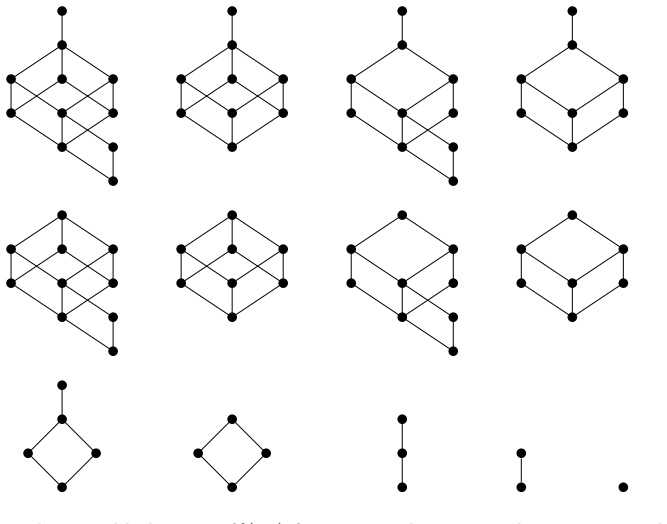
The load-bearing mechanism is the four-bit type $T(M)$ together with the stable/unstable dichotomy from Green's relations. The identity element $1$ of a monoid is stable exactly when the $\mathcal{J}$-class of $1$ equals the unit group $G(M)$, equivalently when $M$ contains no bicyclic submonoid; in that case $G=G_L=G_R=G_{LR}$ and the lattice collapses to the five-element chain of Figure 3. When $1$ is unstable, Lemmas 3.5 and 3.6 force the seven submonoids $G,G_L,G_R,F,F_L,F_R,F_{LR}$ to remain distinct while leaving only the three binary choices measured by $T_2,T_3,T_4$. The argument's key identity is the imported product description $F_R(M)=G_R(M)\cdot E(M)$, which feeds into Lemma 3.5(ii) to show $G_L\cap F_R\subseteq G$; that containment is what prevents uncontrolled collapse and lets the type alone determine the whole lattice. The direct-product multiplicativity of the type, $T(M\times N)=T(M)\times T(N)$, then lets the paper realize all sixteen types from four small monoids.
What would settle it
Enumerate all monoids of order up to 8, compute for each monoid the type $T(M)$ and the lattice $L(M)$, and check that $L(M)$ is the diagram prescribed by Theorem 4.4; any monoid whose lattice is not the predicted shape is a direct counterexample. A more targeted test is to check whether every element of $F_R(M)$ has the form $g\,e_1\cdots e_k$ with $g$ a right unit and each $e_i$ idempotent, since the imported product description is the step where the argument would first fail.
Extended reading notes
Core claim
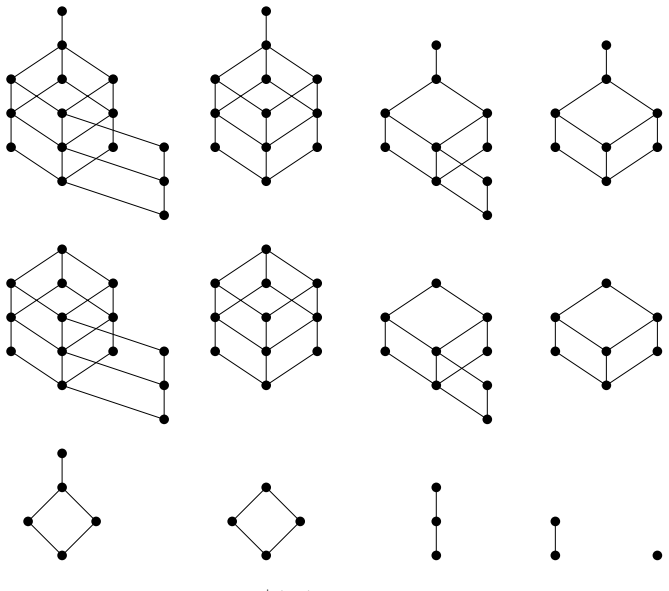
The paper's central claim is that the lattice $L(M)=\{X(M):X\in \mathcal{F}\}$, where $\mathcal{F}=\{O,E,G,G_L,G_R,G_{LR},F,F_L,F_R,F_{LR},I\}$, is classified by the binary quadruple $T(M)=(T_1(M),T_2(M),T_3(M),T_4(M))$. The four bits ask whether $G(M)=G_L(M)$, whether $F_{LR}(M)=M$, whether $F_{LR}(M)=G_{LR}(M)$, and whether $G(M)=\{1\}$; Theorem 4.4 states that for a stable identity the lattice is one of the eight diagrams in Figure 4, and for an unstable identity one of the eight diagrams in Figure 6, with Figure 7 listing the possibilities up to isomorphism. The same section shows every one of the sixteen quadruples arises by taking direct products of four basic monoids. Independently, Section 5 proves that the enlarged collection $\mathcal{F}^+=\mathcal{F}\cup\{Q,P,P_L,P_R\}$, with $Q=E\circ G_{LR}$, $P=F\circ G_{LR}$, $P_L=F_L\circ G_{LR}$, $P_R=F_R\circ G_{LR}$, is closed under composition and has exactly fifteen elements, the four new functors being genuinely new; the enhanced lattice $L^+(M)$ is then shown to be classified by the same four-bit type and hence to add no discriminating power beyond $L(M)$.
Load-bearing premise
Everything rests on the imported lemma that in every monoid the submonoid generated by right units and idempotents consists exactly of products of one right unit with finitely many idempotents; if some monoid failed that description, the proof that left units meet it only in the two-sided units would break, and with it the stable/unstable collapse analysis and the classification.
Editorial extensions
If this is right
- For any monoid $M$, the lattice $L(M)$ has one of the finitely many shapes in Figure 7; deciding which one requires only the four bits of $T(M)$.
- Every one of the sixteen types occurs, so the classification cannot be sharpened by adding further binary conditions of the same kind to the type.
- The eleven functors of $\mathcal{F}$ together with $Q,P,P_L,P_R$ form a 15-element monoid under composition; no further new functors appear when all compositions are taken.
- The enhanced lattice $L^+(M)$ is classified by the same four-bit type as $L(M)$, so it adds no new discriminating information beyond $L(M)$.
- The monoid $\mathcal{F}^+$ is $\mathcal{J}$-trivial, so its Green's relations coincide with equality and the divisibility order in Figure 9 describes the whole structure.
Reading between the lines
- The same direct-product recipe that realizes all sixteen types also serves as a practical way to construct monoids with prescribed lattice shapes from a group, an idempotent-generated monoid, the positive integers, and the bicyclic monoid.
- This suggests testing whether other natural element classes, for example regular elements or elements whose powers eventually repeat, give operators that again form a finite monoid under composition; the closure to fifteen here makes such finiteness plausible.
- Remark 6.5 leaves open whether $L^+(M)$ is always a sublattice of $Sub(M)$; that can be settled by a computer search over small monoids, and a counterexample would show the enhanced lattice has a subtle incompleteness invisible to the four-bit classification.
- The four added functors are best read as bookkeeping that closes the operator monoid under composition rather than as new invariants, since they change neither the type nor the discriminating power of the lattice.
Signed reviews
Editorial analysis
A structured set of objections, weighed in public.
Referee Report
Summary. This paper studies the submonoids of an arbitrary monoid M generated by idempotents and by one- or two-sided units, viewed as functors on the category of monoids with composition as the operation; the basic functors are O, E, G, GL, GR, GLR, F, FL, FR, FLR, I. The main results are threefold. First, the lattice L(M) = {X(M) : X in F} is classified: a four-bit type T(M) records whether G = GL, whether FLR = M, whether FLR = GLR, and whether G = {1}; Proposition 4.2 shows that all sixteen types occur via direct products of a nontrivial group, an idempotent-generated monoid, the positive integers, and the bicyclic monoid, and Theorem 4.4 shows that the type completely determines L(M), whose possible shapes are the finite list in Figures 4, 6 and 7. Second, the monoid F+ generated by F together with the four new functors Q = E∘GLR, P = F∘GLR, PL = FL∘GLR, PR = FR∘GLR is proved to have exactly fifteen elements (Proposition 5.6), with a complete composition table (Table 3) and a description of its Green structure, including J-triviality and subsemigroup and congruence counts obtained with GAP (Section 5.5). Third, Section 6 classifies the enhanced lattice L+(M) = {X(M) : X in F+} and shows that it equals L(M) unless T1 = T3 = 0, in which case at most four additional nodes appear; the enhanced invariant carries no more isomorphism-type information than L.
Significance. If correct, the results give a complete and very small classification: every monoid's lattice of submonoids generated by idempotents and units is one of finitely many shapes determined by four yes/no questions, and the composition of any two of the fifteen functors is again one of them, so the associated operators form a 15-element J-trivial monoid. The paper's main strength is its explicitness: the composition tables are fully displayed; the distinctness claims are witnessed by four concrete monoids; all sixteen types are realized by explicit products; and the classification is falsifiable in that any monoid can be checked against its type. The paper is also honest about the limits of the invariant, including the open question of whether L+(M) is always a sublattice of Sub(M) (Remark 6.5). I explicitly checked the point most plausibly load-bearing, the identity FR(M) = GR(M)·E(M) imported from [22, Lemma 2.5] and used in Lemma 3.5(ii); it is elementary (conjugate idempotents past right units) and is not a gap. The GAP-based structural claims in Section 5.5 are stated clearly but would benefit from an accompanying script for full reproducibility.
minor comments (6)
- [Section 4, before (4.3)] In the unstable case, the text says that Lemma 3.7(ii) gives {G, GL, GR} ∩ {F, FL, FR, FLR} ≠ ∅; since it has just been established that E ≠ {1}, Lemma 3.7(ii) gives the opposite, namely that this intersection is empty, and the empty intersection is exactly what is needed to justify the distinctness of the seven submonoids listed in (4.3). This looks like a typographical error in the inequality symbol rather than a mathematical gap, but it should be corrected.
- [Lemma 3.5(ii)] The equality FR(M) = GR(M)·E(M) is imported from [22, Lemma 2.5] and is load-bearing, since it is used to prove that GL ∩ FR ⊆ G, which underlies the stable/unstable dichotomy (Lemma 3.10) and hence the classification in Theorem 4.4. The proof is very short (for a right unit g with right inverse g' and an idempotent e, one has eg = g(g'eg) with g'eg idempotent, so right units can be moved to the left of any product of idempotents); please include it so that the central argument is self-contained.
- [Section 5.5] The structural claims about F+ (J-triviality, 2904 subsemigroups, 1613 congruences, 76 principal congruences) are attributed to GAP, but no code or session output is provided, so these claims cannot be checked by a reader. Please include the GAP script or an explicit machine-readable verification artifact in an appendix or as supplementary material.
- [Proposition 5.6] The proof that |F+| = 15 rests on the assertion that L+(M) has size 15 for M = G×E×P×B, followed by the phrase that one may easily check this. Since this is the only place where the fifteen functors are shown pairwise distinct, please display the table of the fifteen quadruples (X(G), X(E), X(P), X(B)) or spell out which pairs of functors are separated by which factor; the preceding sentence on the lower bound |F+| ≥ 11 is also too compressed, as the point is that the eleven functors of F already give eleven distinct submonoids on a monoid of type (0,0,0,0).
- [Sections 2.1 and 3] The symbol E is used for both the set of idempotents and the submonoid they generate, and in Lemma 3.3 and in the proof of Lemma 3.5(ii) the two uses appear close together. Please adopt a clearer convention (for instance a distinct symbol for the set of idempotents) or state the convention once in Section 2.1, since this is a genuine source of possible misreading.
- [Theorem 4.4 and Figures 4, 6, 7] The classification proof is a prose case analysis in which the figures carry much of the information. Please state explicitly that the displayed Hasse diagrams are verified by combining Lemmas 3.5-3.10 with the type conditions, in particular that every displayed cover is a proper containment and that no containments other than the transitive closure of the displayed edges occur; this would make the role of the figures fully checkable.
Circularity Check
No significant circularity: central lattice classification and 15-element functor monoid are established by explicit lemmas and constructions; citations to [22] are prior proved results, not restatements of the target claims.
full rationale
The derivation chain is not circular. The paper's central results -- that the lattice L(M) is determined by the four-bit type T(M), and that the functor monoid F+ has size 15 -- are proved by direct lattice-theoretic arguments, composition tables, and explicit separating examples. Where the paper imports results from the author's earlier article [22], notably [22, Lemma 2.1] in Lemma 3.3(i), [22, Lemma 2.3] in Lemma 3.10, and [22, Lemma 2.5] in Lemma 3.5(ii), these are prior published facts about arbitrary monoids, not restatements of the present classification. In particular, [22, Lemma 2.5] (FR = GRE) is used to prove GL ∩ FR ⊆ G; it is not derived from the target theorem and is independently verifiable by bubbling right units left past idempotents, so it is not an unverified premise smuggled in by self-citation. The type questions T1-T4 record genuine lattice and unit conditions, and Theorem 4.4 uses Lemmas 3.6, 3.7, and 3.10 to rule out further collapses; no fitted parameter is renamed as a prediction. Proposition 5.6 separates all 15 functors using the explicit monoid G × E × P × B and the composition table, again by construction. Two non-circular blemishes should be noted: before (4.3) the intersection {G, GL, GR} ∩ {F, FL, FR, FLR} is printed as nonempty when the argument and the subsequent distinctness claim require it to be empty, a typo; and the paper relies on [22] for a few elementary lemmas instead of reproving them in-line. Neither amounts to circularity. The open question in Remark 6.5 about whether L+(M) is always a sublattice of Sub(M) is a clearly stated limitation, not a hidden circular step.
Assumptions & free parameters
assumptions (5)
- domain assumption The paper assumes, without proof here, several elementary results from its own prior article [22]: Lemmas 2.1, 2.3, 2.5, 2.8 and 2.9 about idempotents and one-sided units.
- domain assumption The submonoid generated by idempotents and right units equals the set product GR * E ([22, Lemma 2.5]); used in Lemma 3.5(ii).
- standard math Green's relations and stability facts from [50], [64] and [25], including that the identity is stable iff J1 = H1; used in Lemma 3.10.
- standard math A monoid generated by x and y with yx = 1 and xy ≠ 1 is isomorphic to the bicyclic monoid ([45, pp. 31-32]); used in Lemma 3.6(ii) => (v).
- standard math A finite join-semilattice with a bottom element is a lattice; used in Propositions 2.3 and 6.1.
invented entities (4)
-
Q = E ∘ GLR
independent evidence
-
P = F ∘ GLR
independent evidence
-
PL = FL ∘ GLR
independent evidence
-
PR = FR ∘ GLR
independent evidence
Cite this review
Pith. "Pith review of Idempotents and one-sided units: Lattice invariants and a semigroup of functors on the category of monoids." pith.science (2026). https://pith.science/paper/3SP5BKHY
@misc{pith2026190808225,
  author       = {Pith},
  title        = {Pith review of: Idempotents and one-sided units: Lattice invariants and a semigroup of functors on the category of monoids},
  year         = {2026},
  howpublished = {\url{https://pith.science/paper/3SP5BKHY}},
  note         = {Machine review of arXiv:1908.08225}
}
abstract
For a monoid $M$, we denote by $\mathbb G(M)$ the group of units, $\mathbb E(M)$ the submonoid generated by the idempotents, and $\mathbb G_L(M)$ and $\mathbb G_R(M)$ the submonoids consisting of all left or right units. Writing $\mathcal M$ for the (monoidal) category of monoids, $\mathbb G$, $\mathbb E$, $\mathbb G_L$ and $\mathbb G_R$ are all (monoidal) functors $\mathcal M\to\mathcal M$. There are other natural functors associated to submonoids generated by combinations of idempotents and one- or two-sided units. The above functors generate a monoid with composition as its operation. We show that this monoid has size $15$, and describe its algebraic structure. We also show how to associate certain lattice invariants to a monoid, and classify the lattices that arise in this fashion. A number of examples are discussed throughout, some of which are essential for the proofs of the main theoretical results.
Figures


Figures from the paper (9 more)




Reference graph
Works this paper leans on
-
[22]
J. East. Idempotents and one-sided units in infinite par tial Brauer monoids. J. Algebra, 534:427–482, 2019
work page 2019
-
[1]
J. Araújo and J. D. Mitchell. Relative ranks in the monoid of endomorphisms of an independence algebra. Monatsh. Math. , 151(1):1–10, 2007
work page 2007
-
[2]
S. Banach. Sur un thèoréme de M. Sierpiński. Fund. Math., 25:5–6, 1935
work page 1935
-
[3]
G. M. Bergman. Generating infinite symmetric groups. Bull. London Math. Soc. , 38(3):429–440, 2006
work page 2006
-
[4]
S. Bulman-Fleming. Regularity and products of idempote nts in endomorphism monoids of projective acts. Mathematika, 42(2):354–367, 1995
work page 1995
-
[5]
S. Bulman-Fleming and J. Fountain. Products of idempote nt endomorphisms of free acts of infinite rank. Monatsh. Math. , 124(1):1–16, 1997
work page 1997
-
[6]
S. Y. Chen and S. C. Hsieh. Factorizable inverse semigrou ps. Semigroup Forum, 8(4):283–297, 1974
work page 1974
-
[7]
A. H. Clifford and G. B. Preston. The algebraic theory of semigroups. Vol. I . Mathematical Surveys, No. 7. American Mathematical Society, Providence, R.I., 1961
work page 1961
Show all 67 references
-
[8]
Dolinka and J
I. Dolinka and J. East. Idempotent generation in the endo morphism monoid of a uniform partition. Comm. Algebra , 44(12):5179–5198, 2016
2016
-
[9]
Dolinka and J
I. Dolinka and J. East. The idempotent-generated subsem igroup of the Kauffman monoid. Glasg. Math. J. , 59(3):673–683, 2017
2017
-
[10]
Dolinka and J
I. Dolinka and J. East. Twisted Brauer monoids. Proc. Roy. Soc. Edinburgh Sect. A , 148(4):731–750, 2018
2018
-
[11]
Dolinka, J
I. Dolinka, J. East, and R. D. Gray. Motzkin monoids and p artial Brauer monoids. J. Algebra, 471:251–298, 2017
2017
-
[12]
Dolinka, J
I. Dolinka, J. East, and J. D. Mitchell. Idempotent rank in the endomorphism monoid of a nonuniform partition. Bull. Aust. Math. Soc. , 93(1):73–91, 2016
2016
-
[13]
Dolinka, R
I. Dolinka, R. D. Gray, and N. Ruškuc. On regularity and t he word problem for free idempotent generated semigroups. Proc. Lond. Math. Soc. (3) , 114(3):401–432, 2017
2017
-
[14]
Dolinka and N
I. Dolinka and N. Ruškuc. Every group is a maximal subgro up of the free idempotent generated semigroup over a band. Internat. J. Algebra Comput. , 23(3):573–581, 2013
2013
-
[15]
Droste and R
M. Droste and R. Göbel. The normal subsemigroups of the m onoid of injective maps. Semigroup Forum, 87(2):298–312, 2013
2013
-
[16]
D. Easdown. Biordered sets come from semigroups. J. Algebra, 96(2):581–591, 1985
1985
-
[17]
J. East. Generators and relations for partition monoid s and algebras. J. Algebra, 339:1–26, 2011
2011
-
[18]
J. East. On the singular part of the partition monoid. Internat. J. Algebra Comput. , 21(1-2):147–178, 2011
2011
-
[19]
J. East. Generation of infinite factorizable inverse mo noids. Semigroup Forum, 84(2):267–283, 2012
2012
-
[20]
J. East. Infinite partition monoids. Internat. J. Algebra Comput. , 24(4):429–460, 2014
2014
-
[21]
J. East. Infinite dual symmetric inverse monoids. Period. Math. Hungar. , 75(2):273–285, 2017
2017
-
[23]
East and D
J. East and D. G. FitzGerald. The semigroup generated by the idempotents of a partition monoid. J. Algebra, 372:108–133, 2012. 21 Figure 12: The possible lattices L +(M ) for a monoid M , up to lattice isomorphism
2012
-
[24]
East and R
J. East and R. D. Gray. Diagram monoids and Graham–Hough ton graphs: Idempotents and generating sets of ideals. J. Combin. Theory Ser. A , 146:63–128, 2017
2017
-
[25]
East and P
J. East and P. M. Higgins. Green’s relations and stabili ty for subsemigroups. Semigroup Forum , to appear, arXiv:1906.02313
1906 arXiv
-
[26]
J. A. Erdos. On products of idempotent matrices. Glasgow Math. J. , 8:118–122, 1967
1967
-
[27]
Everitt and J
B. Everitt and J. Fountain. Partial symmetry, reflectio n monoids and Coxeter groups. Adv. Math., 223(5):1782–1814, 2010
2010
-
[28]
Everitt and J
B. Everitt and J. Fountain. Partial mirror symmetry, la ttice presentations and algebraic monoids. Proc. Lond. Math. Soc. (3), 107(2):414–450, 2013
2013
-
[29]
D. G. FitzGerald. A presentation for the monoid of unifo rm block permutations. Bull. Austral. Math. Soc. , 68(2):317–324, 2003
2003
-
[30]
D. G. FitzGerald. Factorizable inverse monoids. Semigroup Forum, 80(3):484–509, 2010
2010
-
[31]
D. G. FitzGerald and J. Leech. Dual symmetric inverse mo noids and representation theory. J. Austral. Math. Soc. Ser. A , 64(3):345–367, 1998
1998
-
[32]
Fountain
J. Fountain. Products of idempotent integer matrices. Math. Proc. Cambridge Philos. Soc. , 110(3):431–441, 1991
1991
-
[33]
Fountain and V
J. Fountain and V. Gould. Products of idempotent endomo rphisms of relatively free algebras with weak exchange prop erties. Proc. Edinb. Math. Soc. (2) , 50(2):343–362, 2007
2007
-
[34]
Fountain and A
J. Fountain and A. Lewin. Products of idempotent endomo rphisms of an independence algebra of finite rank. Proc. Edinburgh Math. Soc. (2) , 35(3):493–500, 1992
1992
-
[35]
Fountain and A
J. Fountain and A. Lewin. Products of idempotent endomo rphisms of an independence algebra of infinite rank. Math. Proc. Cambridge Philos. Soc. , 114(2):303–319, 1993
1993
-
[36]
R. Gray. Idempotent rank in endomorphism monoids of fini te independence algebras. Proc. Roy. Soc. Edinburgh Sect. A , 137(2):303–331, 2007
2007
-
[37]
Gray and N
R. Gray and N. Ruškuc. Maximal subgroups of free idempot ent-generated semigroups over the full transformation mon oid. Proc. Lond. Math. Soc. (3) , 104(5):997–1018, 2012
2012
-
[38]
Gray and N
R. Gray and N. Ruskuc. On maximal subgroups of free idemp otent generated semigroups. Israel J. Math. , 189:147–176, 2012
2012
-
[39]
J. A. Green. On the structure of semigroups. Ann. of Math. (2) , 54:163–172, 1951
1951
-
[40]
P. M. Higgins. Techniques of semigroup theory . Oxford Science Publications. The Clarendon Press, Oxford University Press, New York, 1992
1992
-
[41]
P. M. Higgins, J. M. Howie, J. D. Mitchell, and N. Ruškuc. Countable versus uncountable ranks in infinite semigroups o f transformations and relations. Proc. Edinb. Math. Soc. (2) , 46(3):531–544, 2003
2003
-
[42]
P. M. Higgins, J. M. Howie, and N. Ruškuc. Generators and factorisations of transformation semigroups. Proc. Roy. Soc. Edinburgh Sect. A , 128(6):1355–1369, 1998
1998
-
[43]
J. M. Howie. The subsemigroup generated by the idempote nts of a full transformation semigroup. J. London Math. Soc. , 41:707–716, 1966
1966
-
[44]
J. M. Howie. Idempotent generators in finite full transf ormation semigroups. Proc. Roy. Soc. Edinburgh Sect. A , 81(3- 4):317–323, 1978. 22
1978
-
[45]
J. M. Howie. Fundamentals of semigroup theory , volume 12 of London Mathematical Society Monographs. New Series . The Clarendon Press, Oxford University Press, New York, 1995. O xford Science Publications
1995
-
[46]
J. M. Howie and R. B. McFadden. Idempotent rank in finite f ull transformation semigroups. Proc. Roy. Soc. Edinburgh Sect. A , 114(3-4):161–167, 1990
1990
-
[47]
J. M. Howie, N. Ruškuc, and P. M. Higgins. On relative ran ks of full transformation semigroups. Comm. Algebra , 26(3):733–748, 1998
1998
-
[48]
Joyal and R
A. Joyal and R. Street. Braided tensor categories. Adv. Math. , 102(1):20–78, 1993
1993
-
[49]
Kudryavtseva and V
G. Kudryavtseva and V. Mazorchuk. On presentations of B rauer-type monoids. Cent. Eur. J. Math. , 4(3):413–434 (electronic), 2006
2006
-
[50]
Lallement
G. Lallement. Semigroups and combinatorial applications . John Wiley & Sons, New York-Chichester-Brisbane, 1979. Pu re and Applied Mathematics, A Wiley-Interscience Publicatio n
1979
-
[51]
Mac Lane
S. Mac Lane. Categories for the working mathematician , volume 5 of Graduate Texts in Mathematics . Springer-Verlag, New York, second edition, 1998
1998
-
[52]
Maltcev and V
V. Maltcev and V. Mazorchuk. Presentation of the singul ar part of the Brauer monoid. Math. Bohem. , 132(3):297–323, 2007
2007
-
[53]
Maltcev, J
V. Maltcev, J. D. Mitchell, and N. Ruškuc. The Bergman pr operty for semigroups. J. Lond. Math. Soc. (2) , 80(1):212–232, 2009
2009
-
[54]
Mazorchuk
V. Mazorchuk. On the structure of Brauer semigroup and i ts partial analogue. Problems in Algebra , 13:29–45, 1998
1998
-
[55]
D. B. McAlister. Semigroups generated by a group and an i dempotent. Comm. Algebra, 26(2):515–547, 1998
1998
-
[56]
R. G. McDougall and L. K. Thornton. On base radical opera tors for classes of finite associative rings. Bull. Aust. Math. Soc., 98(2):239–250, 2018
2018
-
[57]
Z. Mesyan. Monoids of injective maps closed under conju gation by permutations. Israel J. Math. , 189:287–305, 2012
2012
-
[58]
J. D. Mitchell et al. Semigroups - GAP package, Version 3.1.3 , June 2019
2019
-
[59]
J. D. Mitchell and Y. Péresse. Generating countable set s of surjective functions. Fund. Math., 213(1):67–93, 2011
2011
-
[60]
J. D. Mitchell and Y. Péresse. Sierpiński rank for group s and semigroups. Wiad. Mat. , 48(2):209–215, 2012
2012
-
[61]
K. S. S. Nambooripad. Structure of regular semigroups. I. Mem. Amer. Math. Soc. , 22(224):vii+119, 1979
1979
-
[62]
M. S. Putcha. Algebraic monoids whose nonunits are prod ucts of idempotents. Proc. Amer. Math. Soc. , 103(1):38–40, 1988
1988
-
[63]
M. S. Putcha. Products of idempotents in algebraic mono ids. J. Aust. Math. Soc. , 80(2):193–203, 2006
2006
-
[64]
Rhodes and B
J. Rhodes and B. Steinberg. The q-theory of finite semigroups . Springer Monographs in Mathematics. Springer, New York, 2009
2009
-
[65]
Sierpiński
W. Sierpiński. Sur les suites infinies de fonctions défin ies dans les ensembles quelconques. Fund. Math., 24:209–212, 1935
1935
-
[66]
È. G. Šutov. Semigroups of one-to-one transformations . Dokl. Akad. Nauk SSSR , 140:1026–1028, 1961
1961
-
[67]
L. K. Thornton. On base radical and semisimple operator s for a class of finite algebras. Beitr. Algebra Geom., 59(2):361–374, 2018. 23
2018
Reviewed August 14, 2026 · model on record in the stance chip above.
Discussion (0). Continue with ORCID to comment.