REVIEW 2 major objections 4 minor 12 references
Data Aggregation In The Astroparticle Physics Distributed Data Storage
T0 review · 2 major / 4 minor · reviewed 2026-08-14 · deepseek-v4-flash
Pith's one-line read The Data Aggregation Service of the APPDS prototype connects distributed astroparticle experiment storage systems so users can search once and receive files on demand.
desk verdict A plausible but unevaluated design description: the interesting bit is using CernVM-FS as the file-delivery layer, but the central adapter mechanism is underspecified and the only test case is TAIGA. read the letter →
The pith
A machine-rendered reading of the paper's core claim, the machinery that carries it, and where it could break.
The reading
What carries the argument
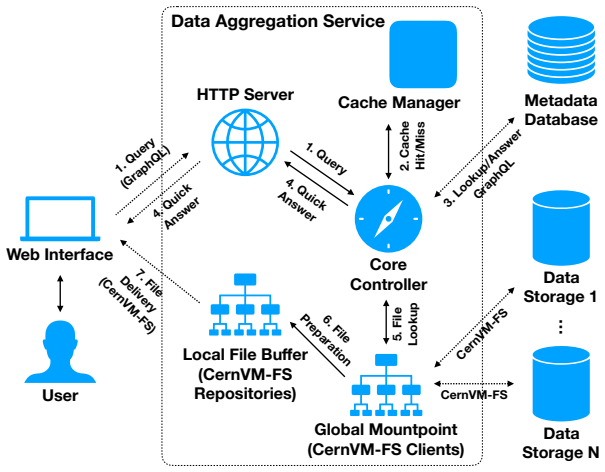
The central object is the Data Aggregation Service, whose key component is the Core Controller. The mechanism runs on a Global Mount Point populated by CernVM-FS repositories for each experiment's storage, a Metadata Database queried through GraphQL, and a Redis-based Cache Manager keyed by MD5 query checksums. When a user query arrives, the Core Controller registers it, checks the cache, forwards to the Metadata Database for a quick answer, then assembles the full file set into a Local File Buffer and exports it as a named CernVM-FS repository that the user can mount or download as an archive.
What would settle it
Try integrating a third storage system that serves data only through a query API with no underlying file system, and check whether the Global Mount Point can still deliver files. If such a system cannot be exposed as a CernVM-FS repository, or if running the Extractor changes an experiment's output files, the aggregation model fails as stated.
Extended reading notes
Core claim
The Data Aggregation Service connects all distributed services of APPDS together to find necessary data and deliver them to users on demand. The design separates metadata from data: an Extractor is injected into each experiment's pipeline to harvest file metadata into a global Metadata Database; queries are answered from that database, and actual files are delivered via CernVM-FS repositories mounted in a Global Mount Point. The service uses a query pipeline with Redis-based caching, GraphQL for flexible queries, and a Core Controller that orchestrates quick responses and full-file preparation. The paper claims this architecture causes no load to computing resources at experiment sites and no interference with existing data storage systems.
Load-bearing premise
The design assumes every experiment's files can be wrapped for delivery by an Adapter built on CernVM-FS and mounted in a Global Mount Point, and that the injected Extractor leaves the experiment's normal pipeline unaffected.
Editorial extensions
If this is right
- Users can issue one query across all connected experiments without knowing each experiment's storage interface.
- Experiment collaborations can keep their data-processing pipelines and storage stacks unchanged.
- Repeated queries are answered from cache without hitting the Metadata Database again.
- Data transfer to users happens on demand via CernVM-FS mounts, so experiment sites only serve payload when a user actually accesses a file.
- Adding a new experiment reduces to installing an Extractor and an Adapter that exposes its files via CernVM-FS.
Reading between the lines
- The architecture's 'no load at sites' promise holds only if metadata extraction is far cheaper than data transfer; for high-rate experiments, the Extractor could become a bottleneck.
- The same aggregation pattern could apply to other disciplines with heterogeneous file-based storage, such as genomics or Earth observation, provided files can be exposed through a global POSIX-like mount.
- The reliance on file-level delivery means experiments whose primary data products are database tables or streaming events would need a different delivery layer.
- A testable extension is to benchmark query latency and cache hit rate as the number of experiments grows, to see whether the Metadata Database becomes a bottleneck.
Signed reviews
Editorial analysis
A structured set of objections, weighed in public.
Referee Report
Summary. The paper describes the Data Aggregation Service, a core component of the APPDS prototype for distributed astroparticle physics data storage. The service is designed to aggregate metadata from multiple experiment storage systems into a global metadata database, answer user queries via a GraphQL-based web interface, and deliver files on demand through a CernVM-FS-based global mount point. The architecture is presented with two design principles: no interference with existing experiment pipelines and no use of computing resources at storage sites for query processing. The paper reports a beta implementation tested against the TAIGA experiment storage system, with KASCADE-Grande support planned for the next release and proof-of-concept tests and benchmarks deferred until after the release.
Significance. If the described architecture works as intended, it would provide a lightweight, non-intrusive approach to unifying data access across astroparticle experiments, which is a real need in open science and multi-experiment data aggregation. The design choices—metadata extraction inserted into the pipeline, a central metadata database, and CernVM-FS for file delivery—are plausible and coherent on paper. The paper's strengths include a clear articulation of the design principles and a concrete system decomposition. However, the significance is currently limited by the absence of any measured validation: the central claim of universal connectivity and on-demand delivery rests entirely on an architecture description with no test results, no performance numbers, and only one experiment's storage system in the loop.
major comments (2)
- [Section 4, Conclusion] The abstract's central claim that the Data Aggregation Service 'connects all distributed services of APPDS together to find the necessary data and deliver them to users on demand' is not supported by the evidence presented. Section 4 states that the beta version is 'being tested' only against the TAIGA storage system, that KASCADE-Grande support is deferred to the next release, and that 'proof-of-concept tests and performance benchmarks are also planned after the release.' No test results, measured latencies, throughput figures, or correctness checks are reported. The paper should either include a basic validation of the query and delivery path (for example, a successful search-and-deliver workflow against TAIGA with timing data) or explicitly scope the contribution as a design description of a system under development, adjusting the abstract and claims accordingly.
- [Section 2 and 3, Adapter and CernVM-FS integration] The architecture's universal-connectivity claim hinges on the Adapter, described only as 'a wrapper of the CernVM-FS server' (Section 2). No interface, protocol, or compatibility constraints are given for how an arbitrary experiment storage system is exposed as a CernVM-FS repository. Since CernVM-FS is a publish-once, read-only distribution system rather than a generic storage-access layer, it is not obvious that non-POSIX systems such as dCache, HPSS, or object stores can be wrapped without significant staging or translation logic. The 'no interference' principle also depends on the Extractor's injection into the production pipeline, which is not described in enough detail to assess risk. The authors should specify the Adapter's API and data-flow model, state which storage systems are compatible, and either demonstrate a second integration or narrow the claim to the TAIGA file-based storage demonstrated in the paper.
minor comments (4)
- [Abstract] The acronym 'APDDS' in the abstract is a typo; it should be 'APPDS' as used throughout the paper and in the section titles.
- [Section 1] The phrase 'has been being developed' is grammatically awkward and should be rephrased; also 'Astroparticle Physics Distributed Date Storage' should be 'Data Storage' for consistency with the acronym.
- [Section 3.2, Fig. 2] Figure 2's components 'Global Mountpoint' and 'Local File Buffer' are terse; the text should explicitly define these terms before the figure is referenced, since a reader may not immediately see how they relate to CernVM-FS repositories and the delivery mechanism.
- [References] Reference [7] cites the CernVM paper, but the text refers to 'CernVM-FS' specifically; the authors should cite the CernVM-FS publication or technical documentation to point readers to the filesystem layers described.
Circularity Check
No circularity found: the paper is an engineering description with no parametric fits, derivation chain, or load-bearing self-citation.
full rationale
The manuscript describes the architecture and implementation of a Data Aggregation Service for the APPDS prototype. It contains no equations, no fitted parameters, and no derived predictions that could reduce to inputs by construction. The central claim is that the service connects distributed storage instances through an Adapter based on CernVM-FS, a metadata database, a cache manager, and a global mount point. The design is presented as a system description, and the only evaluative statements are explicitly deferred ('the proof-of-concept tests and performance benchmarks are also planned after the release'). There are no self-citations used as load-bearing evidence; the references to CernVM-FS, GraphQL, Redis, and the experiment collaborations are external technology citations that support context, not mathematical premises. The skeptical concern that the Adapter is underspecified and that only TAIGA has been tested is a support gap in the architecture's universality claim, not circularity. Since the paper makes no derivation chain, there is nothing for the claimed result to be equivalent to, and the appropriate circularity score is 0.
Assumptions & free parameters
assumptions (2)
- domain assumption Each experiment can provide a metadata description (MDD) that fully and correctly describes the searchable fields of its data files.
- domain assumption Existing storage systems can be wrapped by an Adapter built on CernVM-FS without requiring changes to the underlying storage, and all such repositories can be mounted in a single Global Mount Point.
Cite this review
Pith. "Pith review of Data Aggregation In The Astroparticle Physics Distributed Data Storage." pith.science (2026). https://pith.science/paper/3SWN3Y3K
@misc{pith2026190801554,
  author       = {Pith},
  title        = {Pith review of: Data Aggregation In The Astroparticle Physics Distributed Data Storage},
  year         = {2026},
  howpublished = {\url{https://pith.science/paper/3SWN3Y3K}},
  note         = {Machine review of arXiv:1908.01554}
}
read the original abstract
German-Russian Astroparticle Data Life Cycle Initiative is an international project whose aim is to develop a distributed data storage system that aggregates data from the storage systems of different astroparticle experiments. The prototype of such a system, which is called the Astroparticle Physics Distributed Data Storage (APPDS), has been being developed. In this paper, the Data Aggregation Service, one of the core services of APDDS, is presented. The Data Aggregation Service connects all distributed services of APPDS together to find the necessary data and deliver them to users on demand.
Figures

Reference graph
Works this paper leans on
-
[1]
et al.: The TAIGA experiment: From cosmic-ray to gamma-ray astronomy in the Tunka valley
Bundev N. et al.: The TAIGA experiment: From cosmic-ray to gamma-ray astronomy in the Tunka valley. In: Nuclear Instruments and Methods in Physics Research Section A: Accelerators, Spectrometers, Detectors and Associated Equipment February 2017, vol. 845, pp 330-333. doi:10.1016/j.nima.2016.06.041
-
[2]
et al.: The KASCADE-Grande Experiment
Apel W.D. et al.: The KASCADE-Grande Experiment. In: Nuclear Instruments and Methods in Physics Research Section A 620 April 2010: pp 202-216. doi:10.1016/j.nima.2010.03.147
-
[3]
Anderhub H. et al.: MAGIC Collaboration. In: 31st International Cosmic Ray Conference (ICRC 2009). doi:10.15161/oar.it/1446204371.89
arXiv 2009
-
[4]
https://www.cta-observatory.org/
Cherenkov Telescope Array: Exploring the Universe at the Highest Energies. https://www.cta-observatory.org/
-
[5]
Very Energetic Radiation Imaging Telescope Array System https://veritas.sao.arizona.edu
-
[6]
https://www.mpi-hd.mpg.de/hfm/HESS/
High Energy Stereoscopic System. https://www.mpi-hd.mpg.de/hfm/HESS/
-
[7]
In: Journal of Physics: Conference Series 219 (2010) 042003
Buncic P., Aguado Sanchez C., Blomer., Franco L., Harutyunian A., Mato P., Yao Y.: CernVM – a virtual software appliance for LHC applications. In: Journal of Physics: Conference Series 219 (2010) 042003. doi:10.1088/1742-6596/219/4/042003
-
[8]
Th.: Architectural Styles and the Design of Network-based Software Architectures
Fielding R. Th.: Architectural Styles and the Design of Network-based Software Architectures. https://www.ics.uci.edu/ fielding/pubs/dissertation/fielding\_dissertation.pdf
Show all 12 references
-
[9]
https://graphql.org
Facebook Inc.: GraphQL. https://graphql.org
-
[10]
https://redis.io/documentation
Redis Labs: Redis documentation. https://redis.io/documentation
-
[11]
, " * write output.state after.block = add.period write
ENTRY address author booktitle chapter doi edition editor eid howpublished institution journal key month note number organization pages publisher school series title type url volume year label INTEGERS output.state before.all mid.sentence after.sentence after.block FUNCTION in...
-
[12]
write newline
" write newline "" before.all 'output.state := FUNCTION n.dashify 't := "" t empty not t #1 #1 substring "-" = t #1 #2 substring "--" = not "--" * t #2 global.max substring 't := t #1 #1 substring "-" = "-" * t #2 global.max substring 't := while if t #1 #1 substring * t #2 gl...
Reviewed August 14, 2026 · model on record in the stance chip above.
Discussion (0). Continue with ORCID to comment.