REVIEW 4 major objections 5 minor 12 references
Quantum Bayesian inference with Suport vector states for intrusion detection
T0 review · 4 major / 5 minor · reviewed 2026-08-06 · deepseek-v4-flash
Pith's one-line read The paper claims that a three-qubit circuit whose gates encode prior and conditional probabilities can reproduce the joint, marginal, and conditional distributions of a three-variable intrusion-detection Bayesian network, with posterior…
desk verdict A textbook three-qubit Bayesian network encoding with no new technique, internally inconsistent results, and no code; the central claim of correct inference is unsupported. read the letter →
The pith
A machine-rendered reading of the paper's core claim, the machinery that carries it, and where it could break.
The reading
What carries the argument
The carrying mechanism is the controlled $Y$-rotation encoding of a conditional probability table. A prior $p$ maps to the rotation angle $\theta = 2\arcsin(\sqrt{p})$ so that the squared amplitude of $|1\rangle$ equals $p$, and each conditional entry $P(\text{child}|\text{parents})$ becomes a $CR_Y$ gate whose control qubits are the parent variables. Because all gates are unitary and the circuit is never measured, the final statevector stores the entire joint distribution in its squared amplitudes. Symbolic post-selection, which filters basis states matching the evidence and renormalizes, plays the role of the Bayes update without collapsing the state; this is what allows many conditional queries to be answered from one simulation.
What would settle it
Run the described construction with explicit values for $P(X)$, $P(Y)$, and every entry of $P(FA|X,Y)$; enumerate the same network classically and compare each of the eight squared amplitudes to the product $P(X)P(Y)P(FA|X,Y)$. If any entry departs from the classical value by more than the reported 2–3 percent, or if the final marginal $P(X=1)$ differs from the originally encoded prior, the encoding is not faithful and the extracted posteriors are not genuine Bayesian updates.
Extended reading notes
Core claim
At the center of the paper is a three-variable network: network spike $X$, system vulnerability $Y$, and false alarm $FA$. The marginals $P(X)$ and $P(Y)$ are encoded first with single-qubit $R_Y$ rotations using $\theta = 2\arcsin(\sqrt{p})$, and the false-alarm qubit receives controlled rotations that encode the entries of $P(FA|X,Y)$. Simulating the circuit yields an eight-amplitude statevector, and the squared moduli are taken as the joint distribution $P(X,Y,FA)$. Conditioning on evidence such as $X=1$ is performed by summing squared amplitudes over matching basis states and renormalizing; the paper reports posterior values such as $P(Y=1|X=1)=0.68$ and $P(FA=1|Y=1)=0.74$, with the bitstring $111$ dominating the distribution. Fidelity checks against classical conditional calculations are reported to agree within 2–3 percent, which the paper presents as evidence that the circuit captures the intended conditional causality.
Load-bearing premise
The load-bearing premise is that the circuit's sequence of $R_Y$ rotations for priors followed by controlled rotations for conditionals exactly reproduces the analyst's Bayesian network, so that the squared amplitudes of the final statevector really are the intended joint distribution.
Editorial extensions
If this is right
- Any Bayesian network with known conditional probability tables can be assembled from the same primitives, since every CPT entry becomes one controlled rotation and the joint distribution is recovered by squaring amplitudes.
- Because conditioning is done symbolically on a single statevector, one simulation answers arbitrarily many conditional queries without re-running the circuit.
- The reported concentration of probability mass on a few bitstrings, with $111$ dominant in high-risk settings, gives analysts a sparse, inspectable explanation of how evidence propagates through the network.
- The stated 2–3 percent agreement with classical conditional calculations sets a concrete accuracy benchmark for future circuit-based Bayesian inference methods.
Reading between the lines
- Editorial extension: the paper never verifies that the final marginals of $X$ and $Y$ match the priors it encoded, so the reader cannot rule out that later controlled rotations have overwritten part of the intended distribution; a direct comparison of initial and final marginals would settle this.
- Editorial extension: the 2–3 percent fidelity gap implies the encoding is approximate even in the paper's own benchmark, so the central claim should be read as approximate Bayesian reproduction rather than exact amplitude encoding.
- Editorial extension: the same pipeline is easy to test on a product-state CPT; if $FA$ is made independent of $X$ and $Y$, the final state should remain separable, and appearance of entanglement would mean the circuit introduces spurious causal dependence.
- Editorial extension: because statevector simulation stores $2^n$ amplitudes, the method's practical value for larger networks depends on moving to real hardware or approximate sampling, neither of which the paper demonstrates.
Editorial analysis
A structured set of objections, weighed in public.
Referee Report
Summary. The paper proposes a quantum Bayesian inference pipeline for an intrusion detection scenario. Three binary variables (network spike X, system vulnerability Y, and false alarm FA) are mapped to qubits; priors are encoded with RY rotations, conditional dependencies with controlled CRY rotations, and the joint distribution is extracted from a simulated statevector. Posteriors are computed by symbolic post-selection and renormalization. The authors report joint, marginal, and conditional distributions and claim agreement with classical Bayesian calculations within 2-3%, concluding that the method demonstrates feasible and interpretable quantum-native inference for security applications.
Significance. If the encoding were exact and the validation were consistent, this would be a clean pedagogical demonstration of state-preparation for a three-variable Bayesian network and of posterior extraction by post-selection. The paper correctly explains the standard RY/CRY construction and the relation between amplitudes and probabilities, and the symbolic post-selection idea is clearly stated. However, the manuscript offers no new algorithmic or theoretical insight beyond textbook state preparation, and the results as reported are internally contradictory. The lack of a full circuit specification, the unexplained 2-3% discrepancy in a noiseless statevector simulation, and the mutually inconsistent figures mean the central claim of correct and faithful Bayesian inference is not supported.
major comments (4)
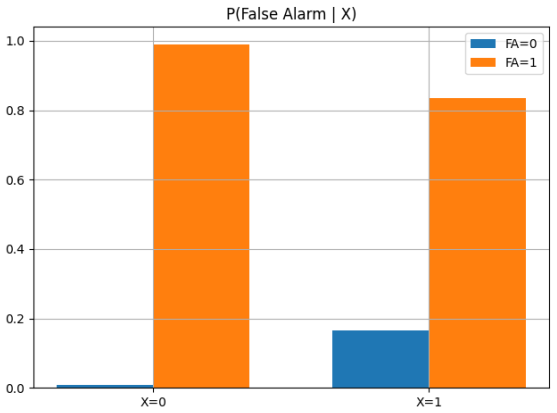
- [§5 and Figures 8–10] The reported results are mutually inconsistent. Figure 8 and Figure 9 state that P(X=0,Y=1)=0.59 is the dominant cell, whereas Figure 4 states that the 2-bit outcome '01' is 'nearly suppressed' and '00' occurs with highest frequency; if these figures refer to different variable pairs or different simulation runs, that is not disclosed. In addition, Figure 1 indicates P(FA=1|X=0) approaches 1, whereas Figure 10 gives P(FA=1)≈0.93 and P(X=0)≈0.67, which cannot be reconciled with a 'more balanced' conditional at X=1 unless P(FA=1|X=1) is also very high. Since the paper's conclusion that 'the inference engine correctly captured conditional causality' rests on these visualizations, the contradictions invalidate the reported validation.
- [§4.1 and §5] Section 4.1 explicitly prepares X and Y as independent marginals with RY rotations and states that at this stage no entanglement is present; no later operation on the X or Y qubits is described anywhere in Section 4. Under that construction the final state must have P(X,Y)=P(X)P(Y) exactly. Section 5 nevertheless claims a 'strong dependency was encoded between X and Y', and Figure 8 reports P(X=0,Y=1)=0.59 and P(X=1,Y=1)=0.26. With the Figure 10 marginals P(X=0)≈0.67 and P(Y=1)>0.85, the product distribution would give values close to these reported cells, but not equal to them. The paper neither supplies the circuit that creates the extra dependency nor quantifies this discrepancy, and the text is therefore internally contradictory about the model's central structure.
- [§5, 'Additional fidelity tests'] The paper reports that cross-validating simulated posteriors with classical conditional calculations confirms 'alignment within 2-3%' in all benchmark cases. In a noiseless statevector simulation, if the circuit exactly implemented the stated priors and CPT, the extracted probabilities should agree with classical Bayes to floating-point precision. A systematic 2-3% discrepancy implies either that the circuit does not implement the claimed Bayesian network or that the classical reference does not match the model. This directly undermines the abstract's claim that the method 'yields joint, marginal, and conditional probabilities aligned with causal structure'. The full circuit, the gate parameters, and the classical reference computation must be provided before this claim can be assessed.
- [§4.2–4.3] The encoding of the CPT for P(FA|X,Y) is not specified to the level needed to verify correctness. The text says that multi-controlled gates 'are decomposed into Toffoli-based networks' and that 'direct implementation is often used', but it does not give the circuit, the control conditions for rows where a parent equals 0, the ordering of the controlled rotations, or an algebraic proof that the final target-qubit amplitude for each control configuration equals the square root of the corresponding CPT entry. Since this encoding is the load-bearing step of the method, the absence of a verifiable construction is a serious gap.
minor comments (5)
- [Title] The title contains a typo: 'Suport' should be 'Support'.
- [§5] Figure 10 is referenced in the text before Figure 9, and the figure numbering appears out of order; the manuscript should renumber the figures consistently.
- [§2] The mathematical notation is sometimes corrupted in the rendering, e.g., the summation limits appear as '2n−1X' rather than a proper sum; the authors should ensure all equations typeset correctly.
- [§4.5] The statement that classical Bayesian updating 'irreversibly conditions on evidence' is conceptually misleading; classical Bayesian updating does not destroy the prior distribution, and conditioning is not an irreversible physical operation.
- [§5] The paper repeatedly reports qualitative behavior ('often holding the highest probability amplitude', 'consistently peaked above 0.6') without giving a table of the specific priors, CPT entries, rotation angles, and resulting probabilities for a single run; such a table would make the results reproducible and checkable.
Circularity Check
The inferred joint and conditional distributions are wired in by construction: RY/CRY angles are defined as the inverse of the user-chosen priors and CPT entries, and the Section 5 fidelity test compares the circuit output to classical Bayes computed from those same hand-set probabilities.
-
self definitional
[Section 4.1 (Eq. θ = 2 arcsin(√p)), Section 4.2 (CRY encoding of CPT rows), Section 5 (claim of captured causality)]
"θ = 2 arcsin(√p) ... This ensures |⟨1|q⟩|^2 = p, aligning the quantum state’s measurement probability with the classical marginal. ... when encoding P (F A| X = 1, Y= 0) = p, the rotation angle θ applied to the F A qubit is: θ = 2 arcsin(√p). This ensures that the resulting quantum amplitude for the F A qubit being in state |1⟩ is √p, and |ci|^2 = p after measurement."
The posterior, marginal, and joint probabilities reported as 'results' are not derived or predicted; they are the input priors and CPT entries mapped through their defining inverse functions. Because the rotation angles are computed from the target probabilities via θ = 2 arcsin(√p), the squared amplitudes of the final statevector reproduce those same target probabilities by construction. The later statement that 'the inference engine correctly captured conditional causality' is therefore a restatement of the encoding choices, not an independent finding.
-
fitted input called prediction
[Section 5, fidelity test paragraph]
"Additional fidelity tests were conducted by cross-validating simulated posteriors with classical conditional calculations, confirming alignment within 2-3% in all benchmark cases."
The 'classical conditional calculations' are computed from the same user-specified priors and CPTs that were inserted into the RY and CRY gate angles. Agreement with those calculations is thus a self-consistency check, not validation against independent data or an external benchmark. The reported 2-3% mismatch is particularly telling: for an exact statevector simulation of a pure state with no noise, a faithful encoding should agree to floating-point precision, so the tolerance actually measures encoding error, not inference quality.
full rationale
The paper's central pipeline is a round-trip: the authors choose prior probabilities and conditional probability table entries, invert them with θ = 2 arcsin(√p) to set RY/CRY rotations, simulate the resulting pure state, read off the squared amplitudes, and then verify that the read-off probabilities match classical Bayes applied to the originally chosen numbers. No independent benchmark, real-world dataset, or out-of-sample prediction is involved, so the 'feasibility and interpretability' demonstration reduces by construction to internal consistency of the encoding. The 2-3% fidelity discrepancy in Section 5 additionally undermines the Section 4.4 claim that 'the approach is both exact and scalable,' though that is a correctness concern rather than an additional circularity. I found no load-bearing self-citation: the cited works by the authors ([3], [4]) only motivate quantum machine learning and are not used to justify the inference claim, and there is no imported uniqueness theorem. The score of 6 reflects that the main claimed result — correct Bayesian inference — is forced by the definition of the encoding, while the paper still contains independent (but unshown) engineering content in the circuit assembly recipe. The absence of the full circuit diagram, gate ordering, and concrete CPT parameters prevents even the internal-consistency claim from being fully verifiable from the text.
Assumptions & free parameters
free parameters (3)
- Prior probability P(X=1) =
not disclosed (implied ≈0.33 from reported marginals)
- Prior probability P(Y=1) =
not disclosed (implied ≈0.85 from reported marginals)
- Conditional probabilities P(FA|X,Y) =
not disclosed
assumptions (4)
- standard math Born rule: squared amplitude equals probability
- domain assumption Unitary gate implementation of RY/CRY on a 3-qubit register
- standard math Symbolic post-selection via amplitude filtering is equivalent to classical conditioning
- ad hoc to paper The chosen priors and CPTs are representative of intrusion detection scenarios
Cite this review
Pith. "Pith review of Quantum Bayesian inference with Suport vector states for intrusion detection." pith.science (2026). https://pith.science/paper/3T7ON7EM
@misc{pith2026250700403,
  author       = {Pith},
  title        = {Pith review of: Quantum Bayesian inference with Suport vector states for intrusion detection},
  year         = {2026},
  howpublished = {\url{https://pith.science/paper/3T7ON7EM}},
  note         = {Machine review of arXiv:2507.00403}
}
read the original abstract
We present a quantum Bayesian inference method for intrusion detection, using explicitly constructed quantum circuits and statevector simulation. Prior and conditional probabilities are encoded via unitary gates, and posterior distributions are extracted through symbolic post-selection. Applied to a scenario with network spikes, system vulnerabilities, and false alarms, the method yields joint, marginal, and conditional probabilities aligned with causal structure. Our results demonstrate the feasibility and interpretability of quantum-native inference for information security applications
Figures


Figures from the paper (7 more)


Reference graph
Works this paper leans on
-
[1]
Intrusion Detection Quantum Sensor Networks,
M. Nagy and N. Nagy, “Intrusion Detection Quantum Sensor Networks,” Sensors, vol. 22, no. 21, p. 8092, 2022
work page 2022
-
[2]
Towards Quantum-Enhanced Machine Learning for Net- work Intrusion Detection,
A. Gouveia and M. Correia, “Towards Quantum-Enhanced Machine Learning for Net- work Intrusion Detection,” in 19th IEEE Symposium on Network Computing and Ap- plications, 2020
work page 2020
-
[3]
Autoencoder-based learning of Quantum phase transitions in the two-component Bose-Hubbard model
I. S. Chowdhury, B. P. Akhouri, S. Haque, and E. Howard, “Autoencoder-Based Learn- ing of Quantum Phase Transitions in the Two-Component Bose-Hubbard Model,”arXiv preprint arXiv:2409.18480, 2024
work page Pith review arXiv 2024
-
[4]
Holographic Renormalization with Machine Learning,
E. Howard, “Holographic Renormalization with Machine Learning,” in Emerging Tech- nologies in Data Mining and Information Security, vol. 164, J. Tavares et al., Eds. Springer, pp. 269–278, 2021
work page 2021
-
[5]
Advancements in Quantum Machine Learning for Intrusion Detection: A Comprehensive Overview
E. Payares and J. C. Mart ´ ınez-Santos, “Advancements in Quantum Machine Learning for Intrusion Detection: A Comprehensive Overview” in Exploring Cyber Criminals and Data Privacy Measures2023
-
[6]
Quantum Machine Learning for Network Intrusion Detection Systems: A Systematic Literature Review,
O. K. Nicesio et al., “Quantum Machine Learning for Network Intrusion Detection Systems: A Systematic Literature Review,” in IEEE 2nd International Conference on AI in Cybersecurity (ICAIC), 2023
work page 2023
-
[7]
J. Biamonte et al., “Quantum machine learning,” Nature, vol. 549, pp. 195–202, 2017
work page 2017
-
[8]
M. Schuld and F. Petruccione, Supervised Learning with Quantum Computers. Springer, 2018. 19
work page 2018
Show all 12 references
-
[9]
Machine learning & artificial intelligence in the quantum domain: a review,
V. Dunjko and H. J. Briegel, “Machine learning & artificial intelligence in the quantum domain: a review,” Rep. Prog. Phys., vol. 81, no. 7, 2018
2018
-
[10]
Quantum circuit learning,
K. Mitarai, M. Negoro, M. Kitagawa, and K. Fujii, “Quantum circuit learning,” Phys. Rev. A, vol. 98, no. 3, 2018
2018
-
[11]
Quantum Bayesian Inference in Quasiprobability Representations,
C. Aw, K. Onggadinata, D. Kaszlikowski, and V. Scarani, “Quantum Bayesian Inference in Quasiprobability Representations,” PRX Quantum, vol. 4, no. 2, 2023
2023
-
[12]
Quantum Bayesian Computation,
N. Polson, V. Sokolov, and J. Xu, “Quantum Bayesian Computation,” arXiv preprint arXiv:2208.08068v2, 2023. 20
2023 arXiv
Reviewed August 6, 2026 · model on record in the stance chip above.
Discussion (0). Continue with ORCID to comment.