REVIEW 3 major objections 6 minor 52 references
Regge poles of analogous rotating black holes in binary Bose-Einstein condensates: The gapped excitations
T0 review · 3 major / 6 minor · reviewed 2026-08-06 · deepseek-v4-flash
Pith's one-line read A localized mass-shell perturbation splits each Regge pole of a draining bathtub vortex into inner and outer branches, linking black-hole spectral instability to a tabletop Bose-Einstein condensate scattering experiment.
desk verdict A credible within-subfield extension of Regge-pole instability to a binary BEC analog, with a genuinely new co-rotating vs counter-rotating stability asymmetry, but the numerics need convergence documentation before I would bet on the bifurcations. read the letter →
The pith
A machine-rendered reading of the paper's core claim, the machinery that carries it, and where it could break.
The reading
What carries the argument
The central object is the Regge pole: a complex angular momentum $m=\mathrm{Re}\,m+i\,\mathrm{Im}\,m$ at which the incoming-wave coefficient at infinity vanishes for fixed real frequency, so the scattering amplitude has a pole after converting the partial-wave sum into a contour integral. The machinery that carries the argument is a modified continued-fraction method built on a radial-series expansion about a matching point $b>r_0+1/\alpha$ outside the bump, with initial coefficients obtained by integrating the radial equation from the horizon to $b$ and a four-term recurrence reduced by Gaussian elimination to the continued-fraction condition. The paper judges stability by comparing the relative pole displacement $|\Delta\lambda_{\pm,n}^{(\epsilon)}/\lambda_{\pm,n}^{(0)}|$ with the perturbation amplitude $\epsilon$. A separate semiclassical calculation perturbs null geodesics by a small constant mass term and produces the deflection angle and interference-wavelength shift used to interpret the scattering imprints.
What would settle it
Repeat the modified continued-fraction computation with explicit truncation order and convergence tolerance over the same parameter grid ($\omega=0.1,1.0$; $r_0=10$ to $100$; $\epsilon=10^{-3}$ to $10^{-1}$; $\alpha=3/2$). If the bifurcation positions or overtaking-jump locations move with truncation order, or if the pole-residue sum fails to reproduce the partial-wave scattering amplitude, the claimed destabilization is a numerical artifact. In the laboratory, a low-frequency planar-wave scattering experiment on a binary-BEC vortex with a localized Rabi-coupling bump should show the large-angle deviation from the unperturbed interference pattern; its absence over the full angular range would falsify the paper's central prediction.
Extended reading notes
Core claim
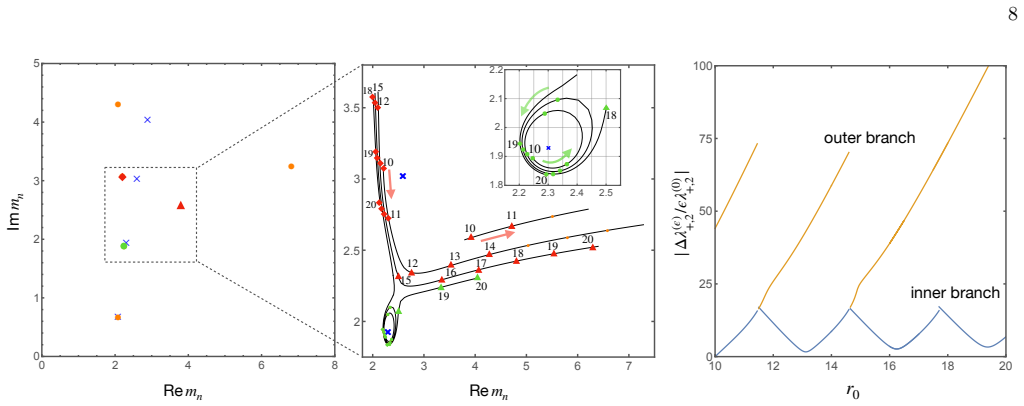
In the complex angular momentum plane, the unperturbed Regge poles split into an inner branch, with smaller $|\mathrm{Re}\,m|$, and an outer branch, with larger $|\mathrm{Re}\,m|$, as soon as the bump perturbation is switched on. The paper takes this bifurcation as a sign of destabilization: a pole is unstable when $|\Delta\lambda_{\pm,n}^{(\epsilon)}/\lambda_{\pm,n}^{(0)}|\gg\epsilon$. As the perturbation amplitude grows from $10^{-3}$ to $10^{-1}$, the onset of bifurcation moves from higher overtones toward the fundamental mode; in the rotating background it reaches the fundamental for counter-rotating modes while the co-rotating modes remain more resistant. Shifting the bump position $r_0$ drives large migrations and overtaking jumps, with relative pole displacements as large as $70\epsilon$ for the second overtone at $\omega=1.0$ and $50\epsilon$ for the first overtone at $\omega=0.1$. These events leave imprints on the scattering amplitude: overtone migration shows up at small scattering angles and fundamental-pole migration at large scattering angles, which the paper connects to the scattering interference pattern in the condensate.
Load-bearing premise
The whole bifurcation picture rests on the unverified assumption that the numerical procedure finds the true resonance positions for every displayed bump position, width, strength, and frequency; the paper reports no convergence checks.
Editorial extensions
If this is right
- For $\ell=0$ the perturbed spectrum stays symmetric, $m_{+n}^{(\epsilon)}=-m_{-n}^{(\epsilon)}$; for $\ell=1$ the rotation breaks that symmetry and the counter-rotating branch destabilizes first.
- The destabilization criterion separates stable from unstable poles: ratios far above $\epsilon$ mark bifurcated poles, and as $\epsilon$ rises the bifurcation onset travels from high overtones down to the fundamental mode.
- In the rotating background, counter-rotating fundamental poles show overtaking jumps near $r_0=30,60,95$ at low frequency, while co-rotating fundamental poles trace closed trajectories with much smaller relative displacements.
- Complex angular momentum decomposition attributes the extra scattering oscillations to the outer-branch poles and the fundamental pole; the inner-branch contribution is subdominant in the rotating case.
- For $\omega=0.1$, the perturbed scattering amplitude deviates from the unperturbed one at essentially all scattering angles, with the largest effects at small angles from overtone destabilization and at large angles from fundamental destabilization.
Reading between the lines
- If the bifurcation picture holds, the onset curve in the $(\epsilon,r_0)$ plane becomes a sharp experimental prediction: a cold-atom experiment could map where the counter-rotating fundamental pole first jumps and compare that curve with the continued-fraction calculation.
- The semiclassical wavelength shift, $\lambda\approx\pi/(2\omega r_E)-(\epsilon/E^2)(\hat a_-/\bar a_-+\hat a_+/\bar a_+)\pi/(8\omega^2 r_E^2)$, is an independent observable; phase-sensitive imaging of the interference pattern could probe the mass-shell effect even where individual pole bifurcations are hard to resolve.
- Because the destabilization criterion is scale-free, the same environmental-bump model applied to astrophysical rotating black holes would predict analogous overtaking jumps in the retrograde channel; the BEC vortex is the only controlled system in which that prediction could be tested.
- A natural extension would vary both $\epsilon$ and $\omega$ at fixed $\alpha=3/2$ to map the frequency boundary where the fundamental Regge pole first destabilizes, checking whether the co-rotating/counter-rotating asymmetry persists across the whole frequency range.
Editorial analysis
A structured set of objections, weighed in public.
Referee Report
Summary. The manuscript studies Regge poles in the draining bathtub vortex analog of a rotating black hole, modeled in a two-component Bose-Einstein condensate with a spatially dependent Rabi-induced mass term mu_s^2(r)=epsilon sech^2[alpha(r-r0)]. The authors first compute a semiclassical scattering amplitude for a homogeneous mass perturbation, then numerically obtain the Regge-pole spectrum using a modified continued fraction method. They report a bifurcation of the spectrum into inner and outer branches, interpret this as spectral destabilization under the criterion |Delta lambda/lambda| >> epsilon, and find that corotating modes are more stable than counterrotating ones. They also track pole migration with changing r0, identify overtaking jumps, and show corresponding imprints on the differential scattering amplitude at small and large scattering angles.
Significance. If the numerical results are robust, the paper provides a concrete tabletop analog system for black-hole spectral instability, with falsifiable predictions: the epsilon-scaling criterion, the angular-region dependence of the scattering imprint, and the co/counterrotating asymmetry. The use of the complex angular momentum method to connect pole branches to scattering observables is a strength, as is the benchmarking of the unperturbed Regge poles against Ref. [31]. However, the central bifurcation and overtaking-jump claims rest on a numerical method whose convergence and accuracy are not documented, and the semiclassical comparison is asserted rather than demonstrated. These gaps prevent the claims from being fully supported at present.
major comments (3)
- [Appendix A, Figs. 4-7] The central numerical claim rests entirely on the modified continued fraction method, but no convergence tests are reported. The paper does not state the truncation order of the continued fraction (A14), the number of Gaussian-elimination steps, the chosen matching point b (only constrained by b>r0+1/alpha), or the accuracy of the horizon-to-b integration that sets a0 and a1 in (A7)-(A8). The reference to Ref. [52] for the minimal-solution condition is not a demonstration for the present potential and parameter range, which includes r0 up to 100, omega=0.1 and 1.0, and epsilon down to 1e-3. Since bifurcations and overtaking jumps in Figs. 4-7 could in principle be numerical artifacts of an inadequately converged or improperly matched series solution, please provide convergence tests with respect to truncation order, matching point b, and integration tolerance, and state the achieved absolute accuracy of the Regge-pole locations.
- [Section III, after Eq. (43)] The text states that the semiclassical results with a small spatially independent mass perturbation 'qualitatively agree with the full numerical studies,' but no comparison is shown. Fig. 3 is a semiclassical, homogeneous-mass calculation, while Figs. 8 and 11 are full numerical calculations with the spatially dependent bump (9) that vanishes at infinity. Because the semiclassical interpretation is used to explain the scattering-angle dependence of the perturbation effect, this agreement should be quantified by overlaying the semiclassical and numerical cross sections for the same parameters, or the claim should be explicitly qualified as an analogy rather than an agreement.
- [Section IV B, Figs. 5-7] The identification of 'overtaking jumps' is inferred from sequences of roots as r0 is increased by Delta r0=1, but the paper does not describe the root-tracking procedure or how it distinguishes a genuine pole crossing or branch switch from a discontinuity caused by the numerical solver. This distinction is load-bearing for the destabilization claim. Please specify the tracking algorithm, and demonstrate that the jumps persist under increased truncation and varied matching points, for example by verifying continuity of the residues or by cross-checking a few trajectories with an independent method.
minor comments (6)
- [Eq. (46)] The definition lambda_(epsilon)_(±,n)=m_(epsilon)_(±,n) l is problematic for the nonrotating case l=0, where it would give lambda=0 and an undefined ratio. This is presumably a typo, and the definition should be clarified.
- [Section IV A] The phrase 'modified continuous fraction method' should be 'modified continued fraction method.'
- [Appendix A] The reference to 'series expansion (S34)' should refer to Eq. (A1).
- [Appendix A, Eqs. (A3)-(A6)] The notation for the azimuthal index and the circulation is inconsistent: l and m appear in the recurrence coefficients in a way that is not clearly connected to the l and m used in Eq. (8). Please make the notation uniform.
- [Fig. 3] The axis labels in the right panel appear garbled ('log10|dphi/dsigma|||dphi/dsigma|epsilon-...'); please fix the LaTeX.
- [Section V] For the unperturbed Regge poles and scattering amplitudes, the paper says they are consistent with Ref. [31] but gives no quantitative comparison. A brief statement of the achieved accuracy would be helpful.
Circularity Check
No circularity: RP bifurcations are computed outputs, not fitted inputs; self-citations are prior independent model/benchmark sources.
full rationale
The derivation chain is not circular. The central result — bifurcation, migration, and overtaking jumps of Regge poles under a sech^2 mass-shell perturbation — is obtained by numerically solving Eq. (7) with the modified continued fraction method (A2)-(A14). The quantities |Delta(lambda)/lambda| ~ 50-70 epsilon are outputs of the root-finding procedure, not parameters fitted to those values; epsilon, alpha, r0, and omega are inputs fixed in advance. The destabilization criterion |Delta(lambda)/lambda| >> epsilon is an external benchmark imported from Ref. [39], and the interpretation of bifurcation as destabilization is taken from Refs. [32,33]; neither is derived from the paper's own fitted values. The unperturbed Regge pole spectrum and the low-frequency scattering amplitudes are checked against the independent external results of Ref. [31]. The BEC model is cited from the authors' own Ref. [22], but that is a prior refereed publication with independent experimental grounding in Refs. [23-26], and it is not the target result of this paper; no uniqueness theorem or ansatz is smuggled in through self-citation. The only flagged weakness is numerical validation: Appendix A states 'Regarding to the issue of convergence of series expansion (S34), we refer the study of Ref. [52] where mentioned that a_k is a minimal solution to the recurrence relation when b/2 < r0 + 1/alpha < b', but no truncation order, matching-point convergence, or accuracy estimates are shown. That is a potential numerical-artifact risk, not a circular reduction, and therefore does not raise the circularity score. Accordingly, the paper receives 0: no significant circularity.
Assumptions & free parameters
free parameters (5)
- epsilon (mass-shell amplitude) =
10^-2 (also 10^-3 and 10^-1 in Fig. 4)
- alpha (inverse bump width) =
3/2
- r0 (bump position) =
10 to 100 (scanned)
- omega (frequency) =
1.0 and 0.1
- ell (vortex winding number or circulation) =
0 and 1
assumptions (5)
- domain assumption The binary BEC equations (1) reduce to a single massive Klein-Gordon equation (2) under equal densities and couplings rho1=rho2=rho, theta1=theta2=theta, g11=g22=g, g12<g, with effective mass m_eff^2=2 m_a c Omega/rho.
- domain assumption Thomas-Fermi approximation and constant density rho~rho_infty far from the vortex core, r >> R_TF, with c^2~(g-g12)rho/m_a.
- ad hoc to paper Small Rabi coupling: Omega is small so epsilon=2d Omega0=10^-2 is a perturbation, and in Sec. III the energy regime E~1/r_E >> sqrt(epsilon) holds so E^2~omega^2.
- domain assumption The Regge pole destabilization criterion |Delta lambda/lambda| >> epsilon from Refs. [32,39] transfers from Schwarzschild and dirty black holes to the draining bathtub analog system.
- standard math Minimal-solution convergence of the continued fraction (A14) for b/2 < r0+1/alpha < b, per Ref. [52].
Cite this review
Pith. "Pith review of Regge poles of analogous rotating black holes in binary Bose-Einstein condensates: The gapped excitations." pith.science (2026). https://pith.science/paper/3TUOBQPI
@misc{pith2026250715403,
  author       = {Pith},
  title        = {Pith review of: Regge poles of analogous rotating black holes in binary Bose-Einstein condensates: The gapped excitations},
  year         = {2026},
  howpublished = {\url{https://pith.science/paper/3TUOBQPI}},
  note         = {Machine review of arXiv:2507.15403}
}
read the original abstract
In this paper, we study the spectrum of the Regge poles (RPs), which are the counterparts of quasinormal modes, in a draining bathtub vortex within a two-component Bose-Einstein condensate (BEC) system. We study the gapped excitations of the condensate with the spatially dependent energy gap term using a spatially tunable Rabi coupling, which will be treated as a perturbation. This model serves as an analogue of a rotating black hole surrounded by an environmental mass shell. We first compute the semiclassical scattering amplitude with the spatially independent mass effect due to the orbital interference. In the case of the mass-shell, bifurcation of the spectrum is observed, resulting in the destabilization of the RPs. We also study the migration of RPs by shifting the bump position. Our results show that the RPs of the co-rotating modes exhibit greater stability than those of the counter-rotating modes. Large migration and overtaking jumps of the overtone (fundamental RP) leave an imprint on the scattering amplitude at small (large) scattering angles. This can be observed in the scattering interference pattern in experiments.
Figures


Figures from the paper (8 more)


Reference graph
Works this paper leans on
-
[22]
W.-C. Syu and D.-S. Lee, Acoustic quasibound states and tachyonic instabilities from binary bose-einstein conden- sates, Phys. Rev. D110, 044017 (2024)
work page 2024
-
[31]
S. R. Dolan and E. S. Oliveira, Scattering by a draining bathtub vortex, Phys. Rev. D87, 124038 (2013)
work page 2013
- [52]
-
[1]
Berti, V
E. Berti, V. Cardoso, and A. O. Starinets, Quasinor- mal modes of black holes and black branes, Classical and Quantum Gravity26, 163001 (2009)
2009
-
[2]
R. A. Konoplya and A. Zhidenko, Quasinormal modes of black holes: From astrophysics to string theory, Rev. Mod. Phys.83, 793 (2011)
2011
-
[3]
A. Folacci and M. Ould El Hadj, Regge pole description of scattering of scalar and electromagnetic waves by a schwarzschild black hole, Phys. Rev. D99, 104079 (2019)
work page 2019
-
[4]
E. Barausse, V. Cardoso, and P. Pani, Can environmental effects spoil precision gravitational-wave astrophysics?, Phys. Rev. D89, 104059 (2014)
work page 2014
-
[5]
V. Cardoso and A. Maselli, Constraints on the astrophys- ical environment of binaries with gravitational-wave ob- servations, Astron. Astrophys.644, A147 (2020)
work page 2020
Show all 52 references
-
[6]
McGee, A
S. McGee, A. Sesana, and A. Vecchio, Linking gravita- tional waves and x-ray phenomena with joint lisa and athena observations, Nature Astronomy4, 26 (2020)
2020
-
[7]
Cardoso, I
V. Cardoso, I. P. Carucci, P. Pani, and T. P. Sotiriou, Black holes with surrounding matter in scalar-tensor the- ories, Phys. Rev. Lett.111, 111101 (2013)
2013
-
[8]
Cardoso, I
V. Cardoso, I. P. Carucci, P. Pani, and T. P. Sotiriou, Matter around kerr black holes in scalar-tensor theories: Scalarization and superradiant instability, Phys. Rev. D 88, 044056 (2013)
2013
-
[9]
Lingetti, E
G. Lingetti, E. Cannizzaro, and P. Pani, Superradiant instabilities by accretion disks in scalar-tensor theories, Phys. Rev. D106, 024007 (2022)
2022
-
[10]
Visser, Acoustic black holes: horizons, ergospheres and hawking radiation, Classical and Quantum Gravity 15, 1767 (1998)
M. Visser, Acoustic black holes: horizons, ergospheres and hawking radiation, Classical and Quantum Gravity 15, 1767 (1998)
1998
-
[11]
Richartz, A
M. Richartz, A. Prain, S. Liberati, and S. Weinfurtner, Rotating black holes in a draining bathtub: Superradi- ant scattering of gravity waves, Phys. Rev. D91, 124018 (2015)
2015
-
[12]
Torres, S
T. Torres, S. Patrick, A. Coutant, M. Richartz, E. W. Tedford, and S. Weinfurtner, Rotational superradiant scattering in a vortex flow, Nature Physics13, 833 (2017)
2017
-
[13]
Torres, S
T. Torres, S. Patrick, M. Richartz, and S. Weinfurtner, Quasinormal mode oscillations in an analogue black hole experiment, Phys. Rev. Lett.125, 011301 (2020)
2020
-
[14]
Berti, L
A. Berti, L. Giacomelli, and I. Carusotto, Superradiant phononic emission from the analog spin ergoregion in a two-component bose–einstein condensate, C. R. Physique 24, 1 (2023)
2023
-
[15]
Patrick, A
S. Patrick, A. Geelmuyden, S. Erne, C. F. Barenghi, and S. Weinfurtner, Quantum vortex instability and black hole superradiance, Phys. Rev. Res.4, 033117 (2022)
2022
-
[16]
U. R. Fischer and R. Sch¨ utzhold, Quantum simulation of cosmic inflation in two-component bose-einstein conden- sates, Phys. Rev. A70, 063615 (2004). 14
2004
-
[17]
Liberati, M
S. Liberati, M. Visser, and S. Weinfurtner, Naturalness in an emergent analogue spacetime, Phys. Rev. Lett.96, 151301 (2006)
2006
-
[18]
Visser and S
M. Visser and S. Weinfurtner, Massive klein-gordon equa- tion from a bose-einstein-condensation-based analogue spacetime, Phys. Rev. D72, 044020 (2005)
2005
-
[19]
Syu, D.-S
W.-C. Syu, D.-S. Lee, and C.-Y. Lin, Analogous hawking radiation and quantum entanglement in two-component bose-einstein condensates: The gapped excitations, Phys. Rev. D106, 044016 (2022)
2022
-
[20]
Syu and D.-S
W.-C. Syu and D.-S. Lee, Analogous hawking radiation from gapped excitations in a transonic flow of binary bose-einstein condensates, Phys. Rev. D107, 084049 (2023)
2023
-
[21]
Syu, D.-S
W.-C. Syu, D.-S. Lee, and C.-Y. Lin, Analogue stochas- tic gravity phenomena in two-component bose-einstein condensates: Sound cone fluctuations, Phys. Rev. D99, 104011 (2019)
2019
-
[23]
J. H. Kim, D. Hong, and Y. Shin, Observation of two sound modes in a binary superfluid gas, Phys. Rev. A 101, 061601 (2020)
2020
-
[24]
Cominotti, A
R. Cominotti, A. Berti, A. Farolfi, A. Zenesini, G. Lam- poresi, I. Carusotto, A. Recati, and G. Ferrari, Observa- tion of massless and massive collective excitations with faraday patterns in a two-component superfluid, Phys. Rev. Lett.128, 210401 (2022)
2022
-
[25]
Hamner, J
C. Hamner, J. J. Chang, P. Engels, and M. A. Hoefer, Generation of dark-bright soliton trains in superfluid- superfluid counterflow, Phys. Rev. Lett.106, 065302 (2011)
2011
-
[26]
Hamner, Y
C. Hamner, Y. Zhang, J. J. Chang, C. Zhang, and P. En- gels, Phase winding a two-component bose-einstein con- densate in an elongated trap: Experimental observa- tion of moving magnetic orders and dark-bright solitons, Phys. Rev. Lett.111, 264101 (2013)
2013
-
[27]
Finazzi and R
S. Finazzi and R. Parentani, Black hole lasers in bose– einstein condensates, New Journal of Physics12, 095015 (2010)
2010
-
[28]
Coutant and R
A. Coutant and R. Parentani, Black hole lasers, a mode analysis, Phys. Rev. D81, 084042 (2010)
2010
-
[29]
Coutant, F
A. Coutant, F. Michel, and R. Parentani, Dynamical instabilities and quasi-normal modes, a spectral analy- sis with applications to black-hole physics, Classical and Quantum Gravity33, 125032 (2016)
2016
-
[30]
S. R. Dolan, L. A. Oliveira, and L. C. B. Crispino, Res- onances of a rotating black hole analogue, Phys. Rev. D 85, 044031 (2012)
2012
-
[32]
Torres, From black hole spectral instability to stable observables, Phys
T. Torres, From black hole spectral instability to stable observables, Phys. Rev. Lett.131, 111401 (2023)
2023
-
[33]
Torres, M
T. Torres, M. O. E. Hadj, S.-Q. Hu, and R. Gregory, Regge pole description of scattering by dirty black holes, Phys. Rev. D107, 064028 (2023)
2023
-
[34]
T. A. S. Cardoso and M. Richartz, Dissipative quantum vortices and superradiant scattering, Phys. Rev. A106, 063310 (2022)
2022
-
[35]
C. J. Myatt, E. A. Burt, R. W. Ghrist, E. A. Cornell, and C. E. Wieman, Production of two overlapping bose- einstein condensates by sympathetic cooling, Phys. Rev. Lett.78, 586 (1997)
1997
-
[36]
D. S. Hall, M. R. Matthews, J. R. Ensher, C. E. Wieman, and E. A. Cornell, Dynamics of component separation in a binary mixture of bose-einstein condensates, Phys. Rev. Lett.81, 1539 (1998)
1998
-
[37]
S. B. Papp, J. M. Pino, and C. E. Wieman, Tunable mis- cibility in a dual-species bose-einstein condensate, Phys. Rev. Lett.101, 040402 (2008)
2008
-
[38]
S. Tojo, Y. Taguchi, Y. Masuyama, T. Hayashi, H. Saito, and T. Hirano, Controlling phase separation of binary bose-einstein condensates via mixed-spin-channel fesh- bach resonance, Phys. Rev. A82, 033609 (2010)
2010
-
[39]
M. H.-Y. Cheung, K. Destounis, R. P. Macedo, E. Berti, and V. Cardoso, Destabilizing the fundamental mode of black holes: The elephant and the flea, Phys. Rev. Lett. 128, 111103 (2022)
2022
-
[40]
Courty, K
A. Courty, K. Destounis, and P. Pani, Spectral instabil- ity of quasinormal modes and strong cosmic censorship, Phys. Rev. D108, 104027 (2023)
2023
-
[41]
K. W. Ford and J. A. Wheeler, Semiclassical description of scattering, Annals of Physics7, 259 (1959)
1959
-
[42]
H. M. Nussenzveig, Diffraction Effects in Semiclassical Scattering, Montroll Memorial Lecture Series in Mathematical Physics (Cambridge University Press, 1992)
1992
-
[43]
Hsieh, D.-S
T. Hsieh, D.-S. Lee, and C.-Y. Lin, Strong gravitational lensing by kerr and kerr-newman black holes, Phys. Rev. D103, 104063 (2021)
2021
-
[44]
Wang, D.-S
C.-Y. Wang, D.-S. Lee, and C.-Y. Lin, Null and timelike geodesics in the kerr-newman black hole exterior, Phys. Rev. D106, 084048 (2022)
2022
-
[45]
Hsieh, D.-S
T. Hsieh, D.-S. Lee, and C.-Y. Lin, Throat effects on strong gravitational lensing in kerr-like wormholes, Phys. Rev. D111, 044051 (2025)
2025
-
[46]
R. G. Newton, Scattering Theory of Waves and Particles (Springer Berlin, Heidelberg, 1982)
1982
-
[47]
L. T. de Paula, P. H. C. Siqueira, R. P. Macedo, and M. Richartz, Pseudospectrum of rotating analogue black holes (2025), arXiv:2504.00106 [gr-qc]
2025 arXiv
-
[48]
De Luca, B
V. De Luca, B. Khek, J. Khoury, and M. Trodden, Tidal love numbers of analog black holes, Phys. Rev. D111, 044069 (2025)
2025
-
[49]
L. Hui, A. Joyce, R. Penco, L. Santoni, and A. R. Solomon, Static response and love numbers of schwarzschild black holes, Journal of Cosmology and As- troparticle Physics2021(04), 052
-
[50]
Chakraborty, E
S. Chakraborty, E. Maggio, M. Silvestrini, and P. Pani, Dynamical tidal love numbers of kerr-like compact ob- jects, Phys. Rev. D110, 084042 (2024)
2024
-
[51]
E. W. Leaver, Quasinormal modes of reissner-nordstr¨ om black holes, Phys. Rev. D41, 2986 (1990)
1990
Reviewed August 6, 2026 · model on record in the stance chip above.
Discussion (0). Continue with ORCID to comment.