REVIEW 2 major objections 1 minor 42 references
Autoregressive Processes on Riemannian Manifolds
T0 review · 2 major / 1 minor · reviewed 2026-06-25 · grok-4.3
Pith's one-line read R-AR(1) model on Riemannian manifolds has strongly consistent Fréchet mean and autoregressive estimators
desk verdict The paper defines an R-AR(1) model on Riemannian manifolds and supplies a supporting SLLN for Fréchet means of ergodic Markov chains to get estimator consistency. read the letter →
The pith
A machine-rendered reading of the paper's core claim, the machinery that carries it, and where it could break.
The reading
What carries the argument
The strong law of large numbers for the sample Fréchet mean set of ergodic Markov chains in proper metric spaces, which provides the foundation for consistency in the R-AR(1) model.
What would settle it
Finding an ergodic Markov chain on a proper metric space for which the sample Fréchet mean set does not converge almost surely would falsify the strong law of large numbers and the resulting consistency.
Extended reading notes
Core claim
The central discovery is the R-AR(1) model defined by parameters μ representing the intrinsic central tendency as the Fréchet mean and φ controlling stationarity and ergodicity, together with the proof that the sample Fréchet mean set of ergodic Markov chains in proper metric spaces satisfies a strong law of large numbers, which establishes the strong consistency of the model estimators.
Load-bearing premise
The observed process must be generated by an ergodic Markov chain defined on a proper metric space.
Editorial extensions
If this is right
- Estimators of the Fréchet mean and autoregressive parameter are strongly consistent.
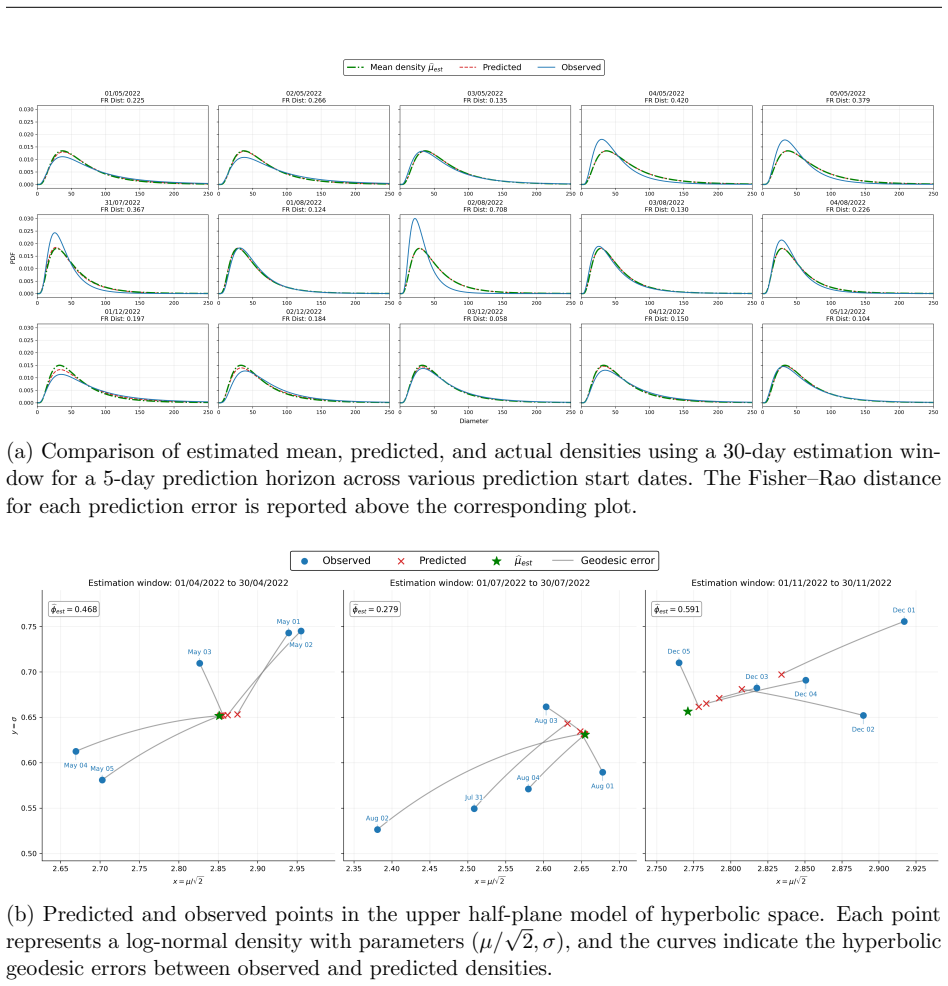
- The model can be applied to mean-reverting dynamics in nonlinear geometries such as the hyperbolic plane.
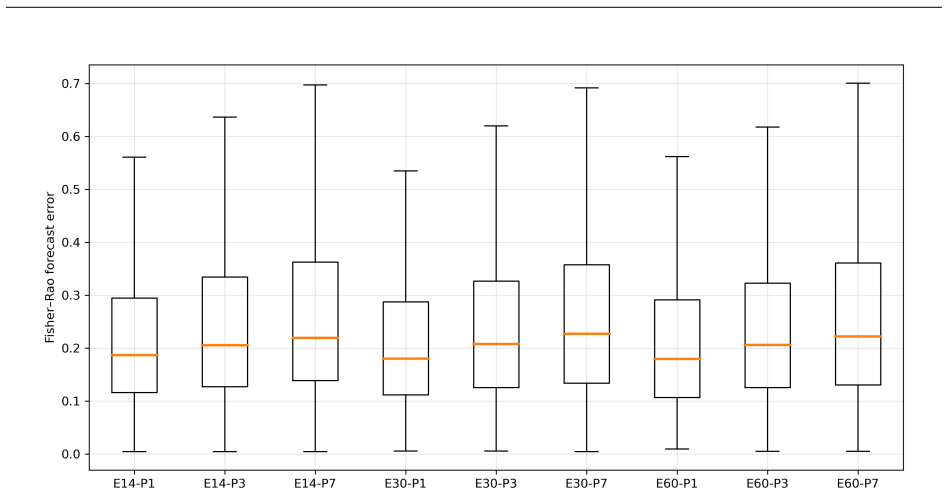
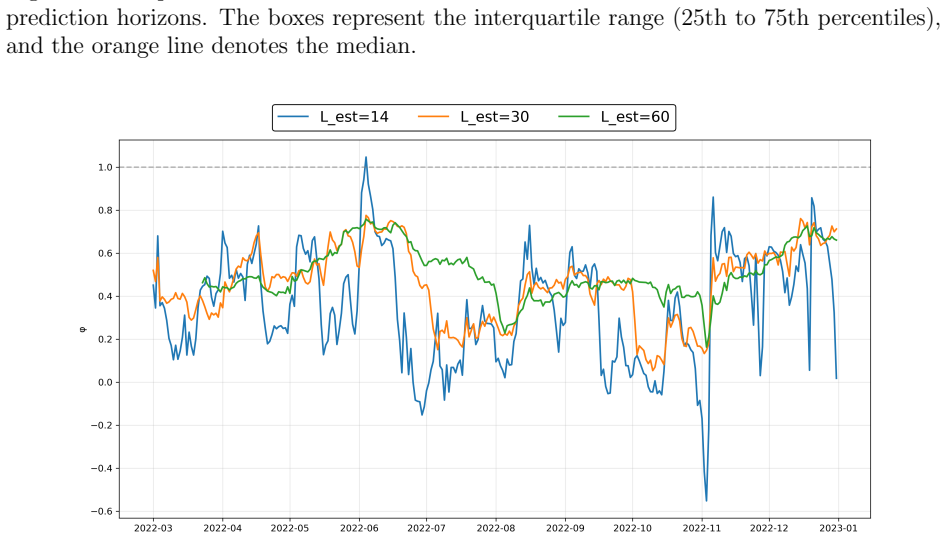
- It enables analysis of manifold-valued data like aerosol size distributions on the Fisher-Rao manifold.
- The approach generalizes classical discrete-time stochastic processes to manifold-valued observations.
Reading between the lines
- The SLLN result could support consistency proofs for other statistics on manifolds under Markov dependence.
- Extensions to higher-order autoregressive models on manifolds may follow similar ergodicity arguments.
- The framework suggests potential for forecasting or simulation of manifold time series with mean reversion.
- Connections might exist to geometric statistics methods for dependent data.
Editorial analysis
A structured set of objections, weighed in public.
Referee Report
Summary. The paper introduces a Riemannian autoregressive (R-AR) model of order one on a manifold, parameterized by the Fréchet mean μ and autoregressive coefficient φ that controls stationarity and ergodicity. It establishes a strong law of large numbers for the sample Fréchet mean set of ergodic Markov chains on proper metric spaces, which is invoked to obtain strong consistency of the estimators for μ and φ. The claims are illustrated by simulations in the hyperbolic plane and an application to aerosol size distributions on the Fisher-Rao manifold.
Significance. If the SLLN holds under the stated ergodicity condition, the work supplies a useful extension of classical AR(1) models to manifold-valued time series and a general consistency tool for dependent data on metric spaces that could apply beyond this model.
major comments (2)
- [Abstract] Abstract: the SLLN result is asserted as the foundation for estimator consistency, but the text supplies no explicit statement of the theorem, no proof details, and no list of assumptions beyond ergodicity of the Markov chain; the central consistency claim therefore cannot be verified.
- [Model definition] Model definition: ergodicity is stated to be controlled by φ, yet the precise contraction or contraction-mapping condition on φ (required for the SLLN to apply) is not given; this assumption is load-bearing for both the Markov-chain property and the consistency conclusion.
minor comments (1)
- [Abstract] The abstract mentions numerical simulations and one application but provides no quantitative results, figures, or tables; these should be summarized with key metrics if they support the claims.
Simulated Author's Rebuttal
We thank the referee for their careful reading and constructive comments on the manuscript. We respond to each major comment below.
read point-by-point responses
-
Referee: [Abstract] Abstract: the SLLN result is asserted as the foundation for estimator consistency, but the text supplies no explicit statement of the theorem, no proof details, and no list of assumptions beyond ergodicity of the Markov chain; the central consistency claim therefore cannot be verified.
Authors: The abstract is a concise summary of the contributions. The explicit statement of the SLLN theorem (including its proof and the full set of assumptions, which center on ergodicity of the Markov chain on a proper metric space) is given in the main body of the paper. The estimator consistency follows from applying this theorem to the R-AR process. To address the concern about verifiability from the abstract alone, we will revise the abstract to briefly reference the ergodicity assumption and the proper metric space setting. revision: yes
-
Referee: [Model definition] Model definition: ergodicity is stated to be controlled by φ, yet the precise contraction or contraction-mapping condition on φ (required for the SLLN to apply) is not given; this assumption is load-bearing for both the Markov-chain property and the consistency conclusion.
Authors: We agree that the precise condition on φ should be stated explicitly. The model requires that the autoregressive map induced by φ is a contraction with Lipschitz constant strictly less than 1 with respect to the Riemannian distance; this guarantees the Markov chain is ergodic and thereby enables the SLLN. We will add this explicit contraction-mapping condition (and the resulting admissible range for φ) to the model definition section in the revision. revision: yes
Circularity Check
No significant circularity identified
full rationale
The derivation defines the R-AR(1) model via Fréchet mean μ and coefficient φ, establishes that the process is an ergodic Markov chain (with ergodicity controlled by φ), and invokes a separately proved general SLLN for the sample Fréchet mean set of ergodic Markov chains on proper metric spaces to obtain strong consistency. The SLLN is presented as an independent general theorem whose hypotheses are the standard ergodicity condition; it is not obtained by fitting parameters from the target estimators or by self-citation chains. No equation or step reduces the claimed consistency result to a tautology or to a fitted input renamed as a prediction.
Assumptions & free parameters
free parameters (2)
- μ
- φ
assumptions (1)
- domain assumption The observed process is an ergodic Markov chain on a proper metric space.
Cite this review
Pith. "Pith review of Autoregressive Processes on Riemannian Manifolds." pith.science (2026). https://pith.science/paper/3VIM6SWI
@misc{pith2026260624771,
  author       = {Pith},
  title        = {Pith review of: Autoregressive Processes on Riemannian Manifolds},
  year         = {2026},
  howpublished = {\url{https://pith.science/paper/3VIM6SWI}},
  note         = {Machine review of arXiv:2606.24771}
}
abstract
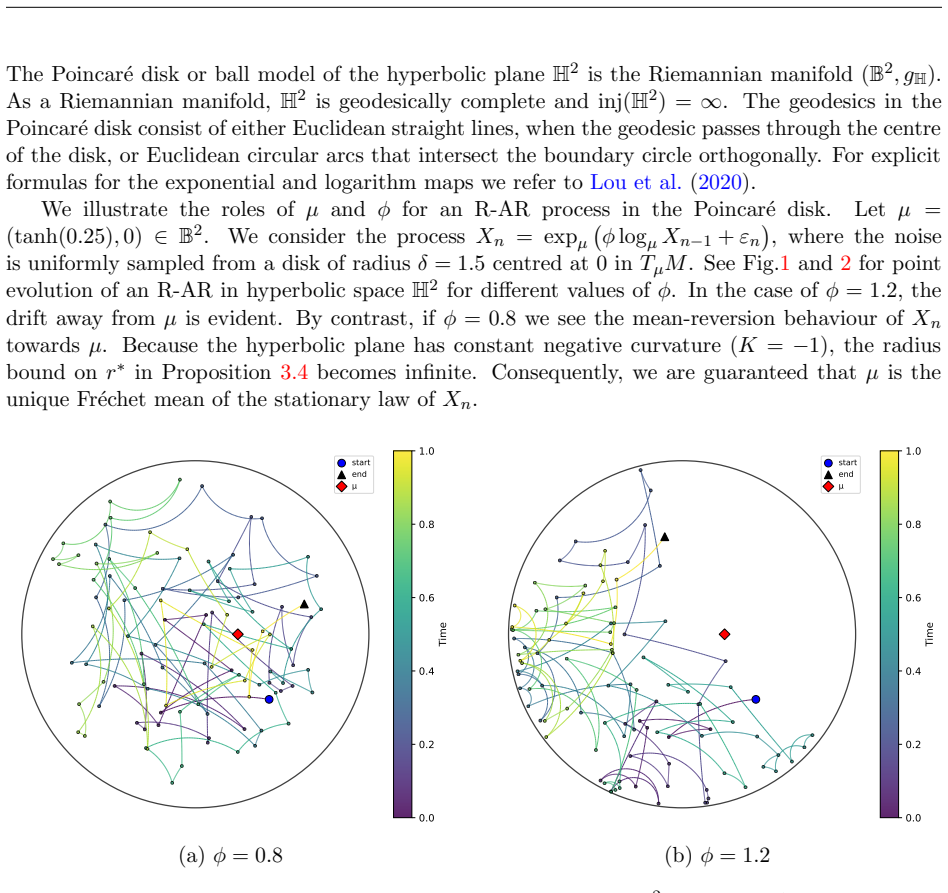
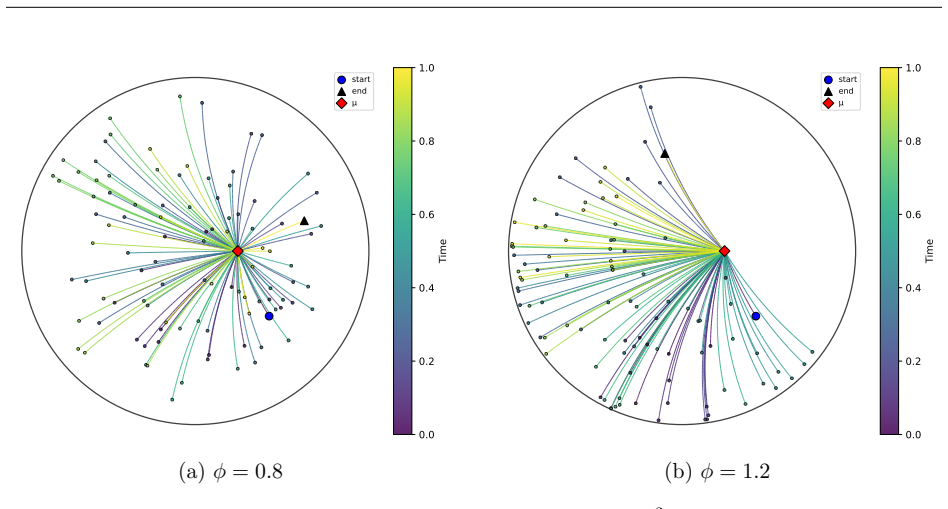
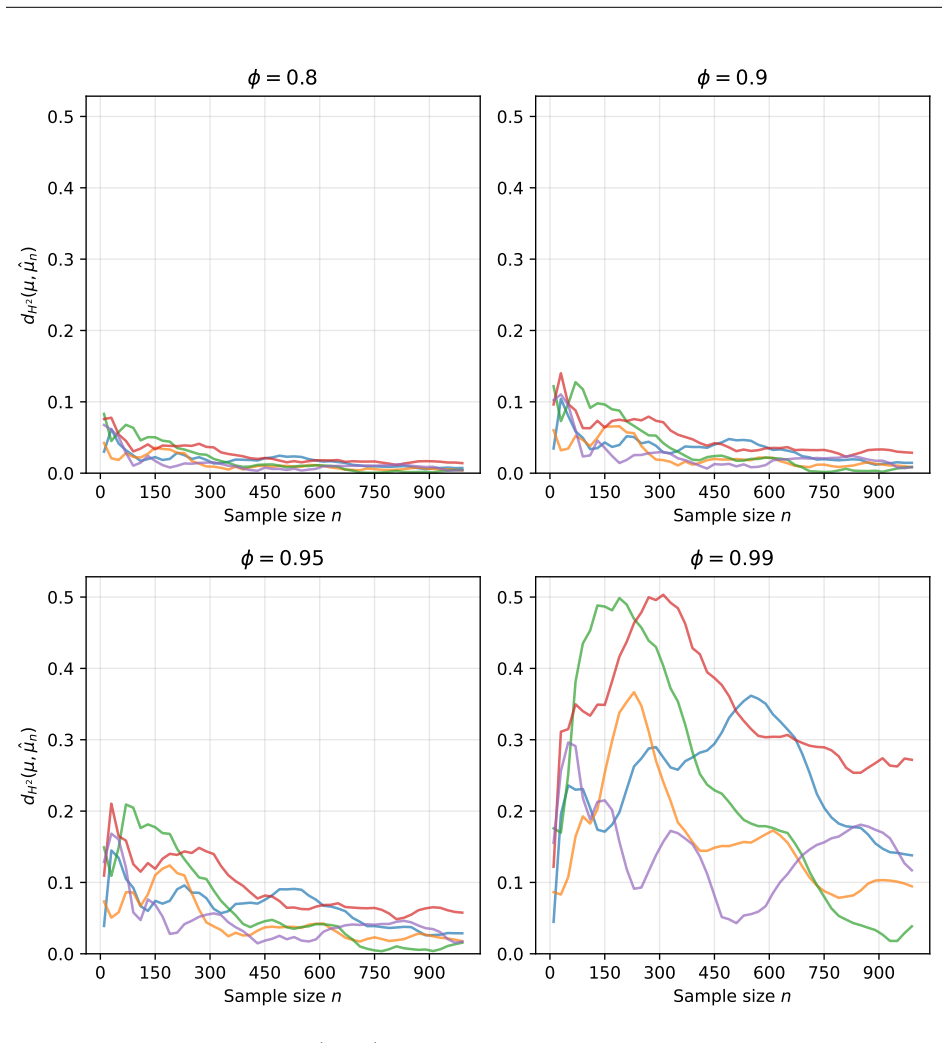
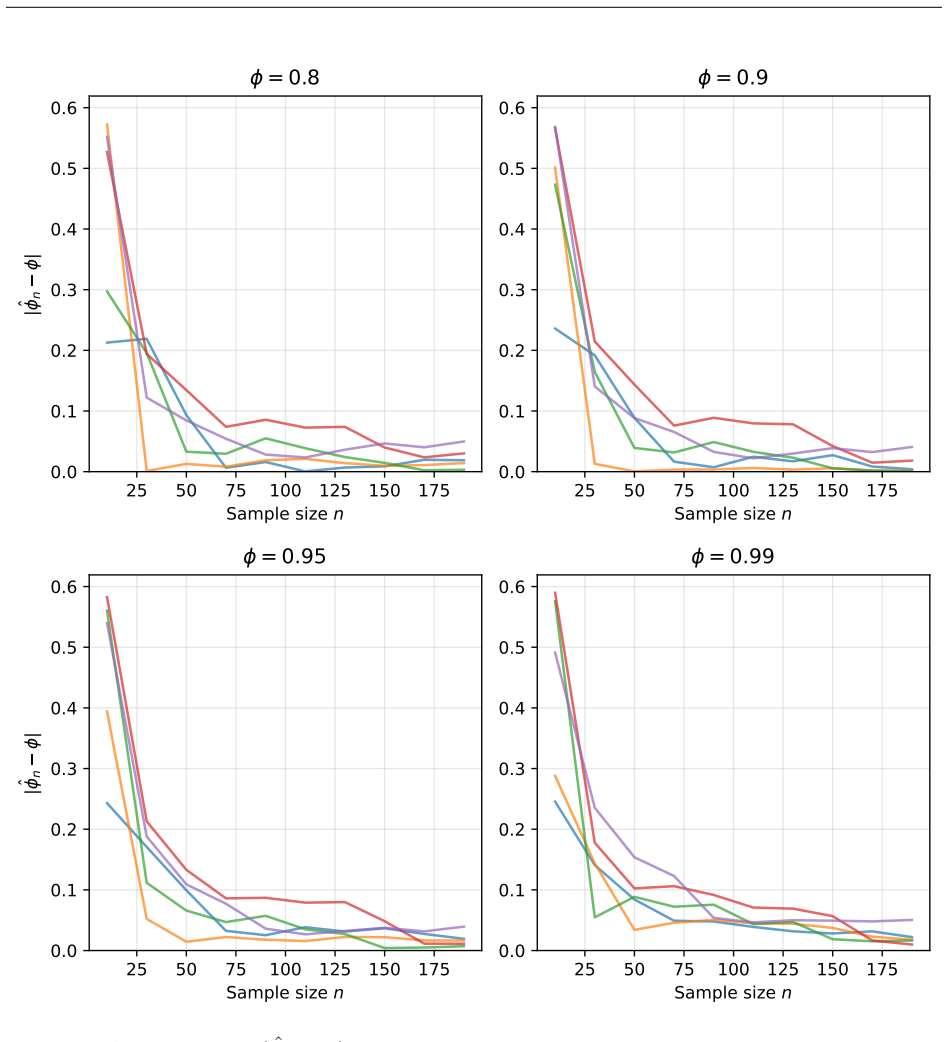
This paper introduces a Riemannian autoregressive (R-AR) model of order one, generalising classical discrete-time stochastic processes to manifold-valued data. The model is based on two parameters, a parameter $\mu$ representing the intrinsic central tendency as the Fr\'echet mean and an autoregressive parameter $\phi$ controlling the stationarity and ergodic properties. Due to the inherent dependence structure of the R-AR process, the estimation procedure for these parameters necessitates new asymptotic results for dependent processes on manifolds. Thus, we establish a strong law of large numbers for the sample Fr\'echet mean set of ergodic Markov chains in proper metric spaces. By proving this general consistency result, we move beyond the limitations of classical i.i.d. theory to provide the mathematical foundation required for the strong consistency of our proposed estimators. The framework is validated through numerical simulations in the hyperbolic plane and an application to aerosol size distributions on the Fisher-Rao manifold, demonstrating how the proposed model can characterise mean-reverting dynamics in nonlinear geometries.
Figures
Figures from the paper (4 more)
Reference graph
Works this paper leans on
-
[1]
Lecture Notes, Trieste , year=
Toponogov’s theorem and applications , author=. Lecture Notes, Trieste , year=
-
[2]
Math in the Black Forest: Workshop on New Directions in Shape Analysis
Math in the Black Forest: Workshop on New Directions in Shape Analysis , author=. arXiv preprint arXiv:1811.01370 , year=
-
[3]
arXiv preprint arXiv:2405.03778 , year=
An Autoregressive Model for Time Series of Random Objects , author=. arXiv preprint arXiv:2405.03778 , year=
-
[4]
2016 , publisher=
Nonparametric statistics on manifolds and their applications to object data analysis , author=. 2016 , publisher=
2016
-
[5]
2008 , publisher=
Riemannian geometry and geometric analysis , author=. 2008 , publisher=
2008
-
[6]
2018 , publisher=
Introduction to Riemannian manifolds , author=. 2018 , publisher=
2018
-
[7]
The Annals of Statistics , volume=
Large sample theory of intrinsic and extrinsic sample means on manifolds , author=. The Annals of Statistics , volume=. 2003 , publisher=
2003
-
[8]
2022 , publisher=
Markov Chains on Metric Spaces , author=. 2022 , publisher=
2022
Show all 42 references
-
[9]
SIAM review , volume=
Iterated random functions , author=. SIAM review , volume=. 1999 , publisher=
1999
-
[10]
Journal of Applied Probability , volume=
Limit theorems for iterated random functions , author=. Journal of Applied Probability , volume=. 2004 , publisher=
2004
-
[11]
2009 , publisher=
Directional statistics , author=. 2009 , publisher=
2009
-
[12]
Signal Processing , volume=
Riemannian geometry for the statistical analysis of diffusion tensor data , author=. Signal Processing , volume=. 2007 , publisher=
2007
-
[13]
Fr. Les. Annales de l'institut Henri Poincar
-
[14]
2002 , publisher=
Stochastic analysis on manifolds , author=. 2002 , publisher=
2002
-
[15]
2014 , publisher=
Stochastic differential equations and diffusion processes , author=. 2014 , publisher=
2014
-
[16]
, author=
AUTO-REGRESSIVE MOVING-AVERAGE DISCRETE-TIME DYNAMICAL SYSTEMS AND AUTOCORRELATION FUNCTIONS ON REAL-VALUED RIEMANNIAN MATRIX MANIFOLDS. , author=. Discrete & Continuous Dynamical Systems-Series B , volume=
-
[17]
Journal of Econometrics , volume=
Spherical autoregressive models, with application to distributional and compositional time series , author=. Journal of Econometrics , volume=. 2024 , publisher=
2024
-
[18]
2012 , publisher=
Introduction to smooth manifolds , author=. 2012 , publisher=
2012
-
[19]
Communications on pure and applied mathematics , volume=
Riemannian center of mass and mollifier smoothing , author=. Communications on pure and applied mathematics , volume=. 1977 , publisher=
1977
-
[20]
Riemannian
Afsari, Bijan , journal=. Riemannian
-
[21]
2003 , publisher=
Probability measures on metric spaces of nonpositive curvature , author=. 2003 , publisher=
2003
-
[22]
1995 , publisher=
Random dynamical systems , author=. 1995 , publisher=
1995
-
[23]
Large sample theory of intrinsic and extrinsic sample means on manifolds—II , author=
-
[24]
arXiv preprint arXiv:2002.09427 , year=
Central limit theorems for Markov chains based on their convergence rates in Wasserstein distance , author=. arXiv preprint arXiv:2002.09427 , year=
2002
-
[25]
1995 , publisher=
Riemannian geometry: a modern introduction , author=. 1995 , publisher=
1995
-
[26]
Journal of Mathematical Imaging and Vision , volume=
Intrinsic statistics on Riemannian manifolds: Basic tools for geometric measurements , author=. Journal of Mathematical Imaging and Vision , volume=. 2006 , publisher=
2006
-
[27]
Journal of aerosol medicine and pulmonary drug delivery , volume=
Particle size distributions , author=. Journal of aerosol medicine and pulmonary drug delivery , volume=. 2020 , publisher=
2020
-
[28]
Boreal environment research , volume=
Evaluation of an automatic algorithm for fitting the particle number size distributions , author=. Boreal environment research , volume=. 2005 , publisher=
2005
-
[29]
Information Geometry , volume=
On closed-form expressions for the Fisher--Rao distance , author=. Information Geometry , volume=. 2024 , publisher=
2024
-
[30]
Differentiating through the fr
Lou, Aaron and Katsman, Isay and Jiang, Qingxuan and Belongie, Serge and Lim, Ser-Nam and De Sa, Christopher , booktitle=. Differentiating through the fr. 2020 , organization=
2020
-
[31]
2016 , publisher=
Information geometry and its applications , author=. 2016 , publisher=
2016
-
[32]
2022 , publisher=
Aerosol technology: properties, behavior, and measurement of airborne particles , author=. 2022 , publisher=
2022
-
[33]
2016 , publisher=
Atmospheric chemistry and physics: from air pollution to climate change , author=. 2016 , publisher=
2016
-
[34]
The Hausdorff metric topology, the Attouch-Wets topology and the measurability of set-valued functions , author=. J. Convex Anal , volume=
-
[35]
Limit theorems for Fr
Evans, Steven N and Jaffe, Adam Q , journal=. Limit theorems for Fr. 2024 , publisher=
2024
-
[36]
2000 , publisher=
Linear processes in function spaces: theory and applications , author=. 2000 , publisher=
2000
-
[37]
Computational Statistics & Data Analysis , volume=
Manifold-valued models for analysis of EEG time series data , author=. Computational Statistics & Data Analysis , volume=. 2025 , publisher=
2025
-
[38]
Proceedings of the IEEE conference on computer vision and pattern recognition , pages=
Rolling rotations for recognizing human actions from 3d skeletal data , author=. Proceedings of the IEEE conference on computer vision and pattern recognition , pages=
-
[39]
International Conference on Geometric Science of Information , pages=
Ridge Regression for Manifold-Valued Time-Series with Application to Hurricane Forecasting , author=. International Conference on Geometric Science of Information , pages=. 2025 , organization=
2025
-
[40]
2017 , publisher=
ECG time series variability analysis: engineering and medicine , author=. 2017 , publisher=
2017
-
[41]
2020 , publisher=
Time series in economics and finance , author=. 2020 , publisher=
2020
-
[42]
arXiv preprint arXiv:2509.02074 , year=
On the Kolmogorov-Feller weak law of large numbers for Frechet mean on non-compact symmetric spaces , author=. arXiv preprint arXiv:2509.02074 , year=
Reviewed June 25, 2026 · model on record in the stance chip above.
Discussion (0). Continue with ORCID to comment.