REVIEW 2 major objections 42 references
A Theory of Saddle Escape in Deep Nonlinear Networks
T0 review · 2 major / 0 minor · reviewed 2026-07-01 · grok-4.3
Pith's one-line read An exact identity for Frobenius-norm imbalance in deep nonlinear networks reduces saddle escape to a scalar ODE whose time scale depends on bottleneck layer count r rather than total depth L.
desk verdict Exact identity on Frobenius norm imbalance is new and general, but the r-2 escape scaling rests on an unquantified approximate balance law. read the letter →
The pith
A machine-rendered reading of the paper's core claim, the machinery that carries it, and where it could break.
The reading
What carries the argument
Exact identity for the imbalance of Frobenius norms of layer weight matrices; it classifies activations into four universality classes and, together with the approximate balance law, reduces the matrix flow to a scalar ODE on the permutation-symmetric submanifold.
What would settle it
Numerical experiments that vary the number r of bottleneck layers while holding total depth L fixed and measure an escape-time scaling that deviates from epsilon to the power of minus (r minus 2).
Extended reading notes
Core claim
The authors establish an exact identity for the imbalance of Frobenius norms of the layer weight matrices that is valid for any smooth activation function and any differentiable loss function. When restricted to the permutation-symmetric submanifold and combined with an approximate balance law, this identity reduces the high-dimensional matrix flow to a one-dimensional ODE. The resulting critical-depth escape time is governed by the exponent r-2, where r counts the layers at the bottleneck scale rather than the total depth L. The same scaling is recovered under He-normal initialization with r bottleneck layers rescaled by epsilon, and the predictions agree closely with numerical simulations.
Load-bearing premise
The approximate balance law on the permutation-symmetric submanifold must hold in order to reduce the full matrix flow to the scalar ODE.
Editorial extensions
If this is right
- Escape time from saddles is independent of total depth L and is controlled only by the bottleneck layer count r.
- Activation functions are grouped into four universality classes according to the form taken by the norm-imbalance identity.
- The r-2 exponent is recovered under He-normal initialization once the r bottleneck layers are rescaled by epsilon.
- The scalar-ODE reduction produces predictions that match numerical simulations of the training dynamics.
Reading between the lines
- If the approximate balance law holds beyond the symmetric submanifold, the scalar reduction could simplify analysis of training phases that begin from asymmetric initializations.
- The four universality classes suggest that activation choice could be used to adjust the escape exponent without altering network depth or width.
- The critical-depth result implies that optimization speed near saddles is set by the narrowest scale rather than overall network size.
- The same reduction technique might be applied to other phases of gradient flow once an analogous balance law is identified.
Signed reviews
Editorial analysis
A structured set of objections, weighed in public.
Referee Report
Summary. The paper derives an exact identity for the imbalance of Frobenius norms of layer weight matrices that holds for arbitrary smooth activations and differentiable losses, using it to classify activations into four universality classes. On the permutation-symmetric submanifold this identity is combined with an approximate balance law to reduce the matrix dynamics to a scalar ODE, producing the escape-time scaling τ★ = Θ(ε^{-(r-2)}) controlled by bottleneck depth r rather than total depth L. The same exponent is recovered under He-normal initialization with r rescaled bottleneck layers (where the symmetry manifold is preserved but not attracting), and the predictions are reported to agree closely with simulations.
Significance. If the approximate balance law can be shown to hold with controlled error in the relevant small-ε regime, the exact identity and resulting critical-depth scaling would constitute a substantive advance in the analysis of saddle escape for deep nonlinear networks, moving beyond the well-understood linear and shallow cases. The parameter-free character of the identity itself is a clear strength.
major comments (2)
- [abstract] Abstract (paragraph on reduction to scalar ODE): the headline scaling τ★ = Θ(ε^{-(r-2)}) is obtained only after invoking an unspecified 'approximate balance law' on the permutation-symmetric submanifold; no error bound, scaling regime, or estimate of the neglected terms is supplied. If those terms are O(ε^α) with α < r-2 they can dominate the leading balance and change both the exponent and the claim that only r (not L) governs escape.
- [abstract] Abstract (He-normal initialization paragraph): the statement that the r-2 exponent is recovered when the symmetry manifold is preserved but not attracting does not address whether the same approximate balance law remains valid or whether the neglected terms again affect the leading-order scaling; this is load-bearing for the universality of the critical-depth law.
Simulated Author's Rebuttal
We thank the referee for the careful reading and for identifying the exact identity as a strength. We respond point-by-point to the major comments on the approximate balance law.
read point-by-point responses
-
Referee: [abstract] Abstract (paragraph on reduction to scalar ODE): the headline scaling τ★ = Θ(ε^{-(r-2)}) is obtained only after invoking an unspecified 'approximate balance law' on the permutation-symmetric submanifold; no error bound, scaling regime, or estimate of the neglected terms is supplied. If those terms are O(ε^α) with α < r-2 they can dominate the leading balance and change both the exponent and the claim that only r (not L) governs escape.
Authors: We agree that the manuscript invokes the approximate balance law without supplying a rigorous error bound or explicit scaling regime for the neglected terms. The law follows from combining the exact imbalance identity with the observation that, on the permutation-symmetric submanifold under small initialization, the layer norms remain close; the resulting scalar ODE is therefore a leading-order reduction. Simulations across multiple activations and depths show that the neglected terms remain subdominant and do not alter the r-2 exponent or the independence from total depth L. In revision we will add a paragraph after the reduction derivation that states the working assumptions, reports the observed numerical error scaling, and clarifies that the claim concerns the leading-order escape time. This is a partial revision because a fully rigorous a-priori bound is not supplied. revision: partial
-
Referee: [abstract] Abstract (He-normal initialization paragraph): the statement that the r-2 exponent is recovered when the symmetry manifold is preserved but not attracting does not address whether the same approximate balance law remains valid or whether the neglected terms again affect the leading-order scaling; this is load-bearing for the universality of the critical-depth law.
Authors: Under He-normal initialization with r rescaled bottleneck layers the flow exactly preserves the symmetry manifold, so the same exact identity applies and the identical reduction to the scalar ODE is used. Additional simulations (to be added) confirm that the approximate balance law continues to hold with error of the same order as in the attracting case, yielding the same r-2 scaling. The revision will expand the relevant paragraph and abstract sentence to note this numerical verification explicitly, thereby supporting the universality statement. Again this is partial because the error control remains numerical rather than analytic. revision: partial
- A rigorous, a-priori error bound establishing that the neglected terms in the approximate balance law are o(ε^{r-2}) throughout the small-ε regime (required for a fully controlled proof of the leading-order scaling).
Circularity Check
No significant circularity; derivation chain is self-contained
full rationale
The paper states an exact identity for Frobenius-norm imbalance that holds for arbitrary smooth activations and differentiable losses, then invokes a separate approximate balance law on the permutation-symmetric submanifold to obtain the scalar ODE and the τ★ = Θ(ε^{-(r-2)}) scaling. No step reduces the claimed result to its own inputs by construction, no fitted parameter is relabeled as a prediction, and no load-bearing premise rests on a self-citation chain. The approximate law is an additional assumption whose error is not quantified in the provided text, but this is a question of rigor rather than circularity; the central identity and reduction steps remain independent of the final scaling law.
Assumptions & free parameters
assumptions (1)
- domain assumption Approximate balance law on the permutation-symmetric submanifold
Cite this review
Pith. "Pith review of A Theory of Saddle Escape in Deep Nonlinear Networks." pith.science (2026). https://pith.science/paper/3VKFXRQM
@misc{pith2026260501288,
  author       = {Pith},
  title        = {Pith review of: A Theory of Saddle Escape in Deep Nonlinear Networks},
  year         = {2026},
  howpublished = {\url{https://pith.science/paper/3VKFXRQM}},
  note         = {Machine review of arXiv:2605.01288}
}
abstract
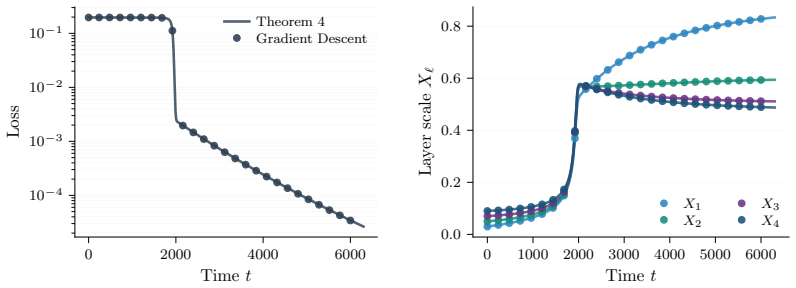
In deep networks with small initialization, training exhibits long plateaus separated by sharp feature-acquisition transitions. Whereas shallow nonlinear networks and deep linear networks are well studied, extending these analyses to deep nonlinear networks remains challenging. We derive an exact identity for the imbalance of Frobenius norms of layer weight matrices that holds for any smooth activation and any differentiable loss and use this to classify activation functions into four universality classes. On the permutation-symmetric submanifold, the identity combines with an approximate balance law to reduce the full matrix flow to a scalar ODE, giving a critical-depth escape time law $\tau_\star = \Theta(\varepsilon^{-(r-2)})$ governed by the number $r$ of layers at the bottleneck scale rather than the total depth $L$. We find that this same $r-2$ exponent is recovered under He-normal initialization with $r$ bottleneck layers rescaled by $\varepsilon$, where the symmetry manifold is preserved by the flow but not attracting. We find close agreement between our theory and numerical simulations.
Figures


Figures from the paper (2 more)


Reference graph
Works this paper leans on
-
[1]
Emmanuel Abbe, Enric Boix-Adserà, and Theodor Misiakiewicz. Sgd learning on neural net- works: leap complexity and saddle-to-saddle dynamics.ArXiv, abs/2302.11055, 2023. URL https://api.semanticscholar.org/CorpusID:257078637
-
[2]
Emmanuel Abbe, Enric Boix-Adsera, and Theodor Misiakiewicz. The merged-staircase prop- erty: a necessary and nearly sufficient condition for sgd learning of sparse functions on two- layer neural networks, 2024. URLhttps://arxiv.org/abs/2202.08658
-
[3]
High-dimensional dynamics of generalization error in neural networks
Madhu S. Advani and Andrew M. Saxe. High-dimensional dynamics of generalization error in neural networks, 2017. URLhttps://arxiv.org/abs/1710.03667
work page Pith review arXiv 2017
-
[4]
Escaping mediocrity: how two-layer networks learn hard generalized linear models with sgd, 2024
Luca Arnaboldi, Florent Krzakala, Bruno Loureiro, and Ludovic Stephan. Escaping medi- ocrity: how two-layer networks learn hard generalized linear models with sgd, 2024. URL https://arxiv.org/abs/2305.18502
-
[5]
On the Optimization of Deep Networks: Implicit Acceleration by Overparameterization
Sanjeev Arora, Nadav Cohen, and Elad Hazan. On the optimization of deep networks: Implicit acceleration by overparameterization, 2018. URLhttps://arxiv.org/abs/1802.06509
work page Pith review arXiv 2018
-
[6]
Why gradient clipping accel- erates training: A theoretical justification for adaptivity
Sanjeev Arora, Nadav Cohen, Wei Hu, and Yuping Luo. Implicit regularization in deep matrix factorization, 2019. URLhttps://arxiv.org/abs/1905.13655
-
[7]
Online stochastic gradient descent on non-convex losses from high-dimensional inference, 2021
Gerard Ben Arous, Reza Gheissari, and Aukosh Jagannath. Online stochastic gradient descent on non-convex losses from high-dimensional inference, 2021. URLhttps://arxiv.org/ abs/2003.10409
-
[8]
High-dimensional limit theorems for sgd: Effective dynamics and critical scaling, 2023
Gerard Ben Arous, Reza Gheissari, and Aukosh Jagannath. High-dimensional limit theorems for sgd: Effective dynamics and critical scaling, 2023. URLhttps://arxiv.org/abs/ 2206.04030
Show all 42 references
-
[9]
Simon, and Cengiz Pehlevan
Alexander Atanasov, Alexandru Meterez, James B. Simon, and Cengiz Pehlevan. The opti- mization landscape of sgd across the feature learning strength, 2025. URLhttps://arxiv. org/abs/2410.04642
2025
-
[10]
Simon, and Arthur Jacot
Ioannis Bantzis, James B. Simon, and Arthur Jacot. Saddle-to-saddle dynamics in deep relu networks: Low-rank bias in the first saddle escape, 2026. URLhttps://arxiv.org/abs/ 2505.21722
2026 arXiv
-
[11]
Learning by on-line gradient descent.Journal of Physics A: Mathematical and General, 28:643–656, 02 1995
Michael Biehl and H Schwarze. Learning by on-line gradient descent.Journal of Physics A: Mathematical and General, 28:643–656, 02 1995. doi: 10.1088/0305-4470/28/3/018
1995 doi
-
[12]
Weight-space symmetry in deep networks gives rise to permutation saddles, connected by equal-loss valleys across the loss landscape, 2019
Johanni Brea, Berfin Simsek, Bernd Illing, and Wulfram Gerstner. Weight-space symmetry in deep networks gives rise to permutation saddles, connected by equal-loss valleys across the loss landscape, 2019. URLhttps://arxiv.org/abs/1907.02911
2019 arXiv
-
[13]
Lipschitz flow-box theorem, 2006
Craig Calcaterra and Axel Boldt. Lipschitz flow-box theorem, 2006. URLhttps://arxiv. org/abs/math/0305207
2006 arXiv
-
[14]
On lazy training in differentiable program- ming, 2020
Lenaic Chizat, Edouard Oyallon, and Francis Bach. On lazy training in differentiable program- ming, 2020. URLhttps://arxiv.org/abs/1812.07956
2020
-
[15]
Du, Wei Hu, and Jason D
Simon S. Du, Wei Hu, and Jason D. Lee. Algorithmic regularization in learning deep homoge- neous models: Layers are automatically balanced.Advances in Neural Information Processing Systems, 2018-December:384–395, 2018. ISSN 1049-5258. Publisher Copyright: © 2018 Cur- ran Assoc...
2018
-
[16]
Effect of batch learning in multilayer neural networks
Kenji Fukumizu. Effect of batch learning in multilayer neural networks. InInternational Con- ference on Neural Information Processing, 1998. URLhttps://api.semanticscholar. org/CorpusID:605683. 10
1998
-
[17]
Sebastian Goldt, Madhu S Advani, Andrew M Saxe, Florent Krzakala, and Lenka Zdeborová. Dynamics of stochastic gradient descent for two-layer neural networks in the teacher–student setup*.Journal of Statistical Mechanics: Theory and Experiment, 2020(12):124010, December
2020
-
[18]
doi: 10.1088/1742-5468/abc61e
ISSN 1742-5468. doi: 10.1088/1742-5468/abc61e. URLhttp://dx.doi.org/10. 1088/1742-5468/abc61e
-
[19]
Delving deep into rectifiers: Sur- passing human-level performance on imagenet classification, 2015
Kaiming He, Xiangyu Zhang, Shaoqing Ren, and Jian Sun. Delving deep into rectifiers: Sur- passing human-level performance on imagenet classification, 2015. URLhttps://arxiv. org/abs/1502.01852
2015 arXiv
-
[20]
A. C. Hindmarsh and L. R. Petzold. LSODA, ordinary differential equation solver for stiff or non-stiff system. Nuclear Energy Agency of the OECD (NEA), Sep 2005. URLhttps: //www.osti.gov/etdeweb/biblio/21352532
2005
-
[21]
Horn and Charles R
Roger A. Horn and Charles R. Johnson.Matrix Analysis. Cambridge University Press, 1990. ISBN 0521386322. URLhttp://www.amazon.com/Matrix-Analysis-Roger-Horn/ dp/0521386322%3FSubscriptionId%3D192BW6DQ43CK9FN0ZGG2%26tag%3Dws% 26linkCode%3Dxm2%26camp%3D2025%26creative%3D165953%26...
1990
-
[22]
Saddle-to- saddle dynamics in deep linear networks: Small initialization training, symmetry, and sparsity,
Arthur Jacot, François Ged, Berfin ¸ Sim¸ sek, Clément Hongler, and Franck Gabriel. Saddle-to- saddle dynamics in deep linear networks: Small initialization training, symmetry, and sparsity,
-
[23]
URLhttps://arxiv.org/abs/2106.15933
-
[24]
Gradient descent aligns the layers of deep linear networks, 2019
Ziwei Ji and Matus Telgarsky. Gradient descent aligns the layers of deep linear networks, 2019. URLhttps://arxiv.org/abs/1810.02032
2019 arXiv
-
[25]
Kakade, and Michael I
Chi Jin, Rong Ge, Praneeth Netrapalli, Sham M. Kakade, and Michael I. Jordan. How to escape saddle points efficiently, 2017. URLhttps://arxiv.org/abs/1703.00887
2017 arXiv
-
[26]
Directional convergence near small initializations and saddles in two-homogeneous neural networks, 2024
Akshay Kumar and Jarvis Haupt. Directional convergence near small initializations and saddles in two-homogeneous neural networks, 2024. URLhttps://arxiv.org/abs/2402.09226
2024
-
[27]
Daniel Kunin, Javier Sagastuy-Brena, Surya Ganguli, Daniel L. K. Yamins, and Hidenori Tanaka. Neural mechanics: Symmetry and broken conservation laws in deep learning dy- namics, 2021. URLhttps://arxiv.org/abs/2012.04728
2021
-
[28]
Get rich quick: exact solutions reveal how unbalanced initializations pro- mote rapid feature learning
Daniel Kunin, Allan Raventós, Clémentine Dominé, Feng Chen, David Klindt, Andrew Saxe, and Surya Ganguli. Get rich quick: exact solutions reveal how unbalanced initializations pro- mote rapid feature learning. InProceedings of the 38th International Conference on Neural Inform...
2024
-
[29]
Simon, Michael R
Daniel Kunin, Giovanni Luca Marchetti, Feng Chen, Dhruva Karkada, James B. Simon, Michael R. DeWeese, Surya Ganguli, and Nina Miolane. Alternating gradient flows: A the- ory of feature learning in two-layer neural networks, 2025. URLhttps://arxiv.org/abs/ 2506.06489
2025
-
[30]
A mean field view of the landscape of two-layer neural networks.Proceedings of the National Academy of Sciences, 115(33), 2018
Song Mei, Andrea Montanari, and Phan-Minh Nguyen. A mean field view of the landscape of two-layer neural networks.Proceedings of the National Academy of Sciences, 115(33), 2018. ISSN 1091-6490. doi: 10.1073/pnas.1806579115. URLhttp://dx.doi.org/10.1073/ pnas.1806579115
2018 doi
-
[31]
Convergence and implicit bias of gradient flow on overparametrized linear networks, 2022
Hancheng Min, Salma Tarmoun, René Vidal, and Enrique Mallada. Convergence and implicit bias of gradient flow on overparametrized linear networks, 2022. URLhttps://arxiv.org/ abs/2105.06351
2022
-
[32]
Saddle-to-saddle dynamics in diagonal linear networks,
Scott Pesme and Nicolas Flammarion. Saddle-to-saddle dynamics in diagonal linear networks,
-
[33]
URLhttps://arxiv.org/abs/2304.00488
-
[34]
Hamprecht, Yoshua Bengio, and Aaron Courville
Nasim Rahaman, Aristide Baratin, Devansh Arpit, Felix Draxler, Min Lin, Fred A. Hamprecht, Yoshua Bengio, and Aaron Courville. On the spectral bias of neural networks, 2019. URL https://arxiv.org/abs/1806.08734. 11
2019 arXiv
-
[35]
Dynamics of on-line gradient descent learning for multilayer neural networks
David Saad and Sara Solla. Dynamics of on-line gradient descent learning for multilayer neural networks. 04 1999
1999
-
[36]
Saxe, James L
Andrew M. Saxe, James L. McClelland, and Surya Ganguli. Exact solutions to the nonlinear dynamics of learning in deep linear neural networks, 2014. URLhttps://arxiv.org/abs/ 1312.6120
2014 arXiv
-
[37]
Saxe, Shagun Sodhani, and Sam Lewallen
Andrew M. Saxe, Shagun Sodhani, and Sam Lewallen. The neural race reduction: Dynamics of abstraction in gated networks, 2022. URLhttps://arxiv.org/abs/2207.10430
2022
-
[38]
Simon, Maksis Knutins, Liu Ziyin, Daniel Geisz, Abraham J
James B. Simon, Maksis Knutins, Liu Ziyin, Daniel Geisz, Abraham J. Fetterman, and Joshua Albrecht. On the stepwise nature of self-supervised learning, 2023. URLhttps://arxiv. org/abs/2303.15438
2023
-
[39]
Geometry of the loss landscape in overparameterized neural net- works: Symmetries and invariances, 2021
Berfin ¸ Sim¸ sek, François Ged, Arthur Jacot, Francesco Spadaro, Clément Hongler, Wulfram Gerstner, and Johanni Brea. Geometry of the loss landscape in overparameterized neural net- works: Symmetries and invariances, 2021. URLhttps://arxiv.org/abs/2105.12221
2021
-
[40]
Noether’s learning dynamics: Role of symmetry breaking in neural networks, 2021
Hidenori Tanaka and Daniel Kunin. Noether’s learning dynamics: Role of symmetry breaking in neural networks, 2021. URLhttps://arxiv.org/abs/2105.02716. 12 A Proof and Extension of Theorem 1 We give the derivation of Theorem 1, state the matrix-valued refinement, and record the...
2021
-
[41]
strict hierarchy
=O(∥X∥ L+q−1)sharply; the sharpness argument of (24) (withh (q) σ ̸= 0 for every Class B activation used in this paper) shows the bound is attained, not merely an upper bound. Proposition 13 is the nonlinear analog of deep-linear balance: the Class B bound holds to order ∥X∥ L...
-
[42]
At each quadrature node, the forward trajectory ˙xν =f ν(xν)and backward adjoint˙p ν =−(∂ xfν)⊤pν are integrated jointly. The Jacobian∂ xfν is constructed analytically in closed form from the reduced-variable equations of motion (layer scales, off-block amplitudes, cross-block...
Reviewed July 1, 2026 · model on record in the stance chip above.
Discussion (0). Continue with ORCID to comment.