Current status of the High-Resolution Multi-Object Spectrograph (MOS-HR) for the Wide-field Spectroscopic Telescope
Pith reviewed 2026-07-03 05:17 UTC · model grok-4.3
The pith
The HR-MOS module for the WST has defined optical fiber specifications, multiplex capability, modular architecture, envelope dimensions, mass estimates, and structural analysis from trade-off studies.
A machine-rendered reading of the paper's core claim, the machinery that carries it, and where it could break.
Core claim
The HR-MOS module has defined constructive parameters including optical fiber specifications, multiplex capability, modular architecture, envelope dimensions, mass estimates, and structural analysis addressing mechanical stability for high-resolution multi-object spectroscopy on the WST.
What carries the argument
The modular architecture of the spectrograph, developed through trade-off studies that balance scientific requirements against technical constraints of mass and volume.
If this is right
- The spectrograph can operate with the stated fiber specifications and multiplex capability within the defined envelope.
- Mechanical stability is addressed by the structural analysis to meet performance requirements.
- The design parameters derived from science cases enable the module to support the telescope's survey goals.
- Mass estimates allow integration into the overall 12-meter facility without violating budgets.
Where Pith is reading between the lines
- The modular approach could allow incremental upgrades or replication for other wavelength ranges on the same telescope.
- If mass budgets are met, the design reduces engineering risk for the full WST project schedule.
- Similar parameter definitions might serve as a template for high-resolution modules on other large spectroscopic telescopes.
Load-bearing premise
The optical design and mechanical structure resulting from the trade-off studies will satisfy the critical mass and volume budgets while meeting the performance requirements for high-resolution multi-object spectroscopy on the WST.
What would settle it
A calculation or test showing that the estimated mass or volume exceeds the allocated budget for the module, or that the optical performance falls short of the required resolution and multiplex.
Figures
read the original abstract
The Wide-field Spectroscopic Telescope (WST) is a planned 12-meter class dedicated spectroscopic facility for massive spectroscopic surveys. This paper presents the current status of Work Package 4.5, the High Resolution Multi-Object Spectrograph (HR-MOS) module. We describe the international team organization and optical design resulting from extensive trade-off studies, presenting its evolution driven by scientific requirements and technical constraints. Design parameters derived from science cases and astronomical community requirements are detailed. Given the critical importance of mass and volume budgets, we present envelope dimensions and mass estimates for HR-MOS. The spectrograph constructive parameters are defined, including optical fiber specifications, multiplex capability, and modular architecture. Finally, we present the structural analysis addressing mechanical stability and performance requirements for this high-resolution multi-object spectrograph.
Editorial analysis
A structured set of objections, weighed in public.
Referee Report
Summary. The manuscript presents the current status of Work Package 4.5, the High-Resolution Multi-Object Spectrograph (HR-MOS) module for the Wide-field Spectroscopic Telescope (WST). It covers the international team organization, the optical design resulting from trade-off studies, design parameters derived from science cases, envelope dimensions and mass estimates, optical fiber specifications, multiplex capability, modular architecture, and structural analysis addressing mechanical stability and performance requirements.
Significance. If the reported design parameters, envelope dimensions, mass estimates, and structural analysis are accurate, the paper supplies a useful progress snapshot on instrument development for a planned 12 m spectroscopic facility. Such status reports help the community track trade-off decisions and constraint management (particularly mass/volume budgets) for high-resolution multi-object spectroscopy.
Simulated Author's Rebuttal
We thank the referee for their positive assessment of the manuscript and recommendation to accept. No major comments were raised in the report.
Circularity Check
No circularity: descriptive status report with no derivations or predictions
full rationale
The manuscript is a progress snapshot enumerating design parameters (fiber specs, multiplex, envelope dimensions, mass estimates, modular architecture) and noting that trade-off studies and structural analysis were performed. No equations, quantitative predictions, fitted parameters, or self-referential claims appear in the provided text or abstract. The central content is a list of chosen constructive parameters derived from external science cases and community requirements, with no reduction of any result to its own inputs by construction. This matches the default expectation of a non-circular engineering status report.
Axiom & Free-Parameter Ledger
Reference graph
Works this paper leans on
-
[1]
This capability addresses a broad spectrum of astrophysical science cases, including characterization of planetary system host stars, and precision cosmology
INTRODUCTION The Wide-field Spectroscopic Telescope (WST) is a proposed dedicated 12-meter class spectroscopic facility designed to conduct large-scale, multi-object spectroscopic surveys of the sky.¹ Within the WST instrument suite, the High-Resolution Multi-Object Spectrograph (MOS-HR), developed under Work Package 4.5 (WP4.5), is designed to simultaneo...
2000
-
[2]
* andrea.tozzi@inaf.it; phone +390552752282; www.arcetri.inaf.it • INS-6 – Resolving power: R ≥ 40,000, averaged over the covered wavelength range and field position
SCIENTIFIC REQUIREMENTS The top-level requirements for MOS-HR are extracted from the WST Phase A High Level Requirements document.⁵ The most relevant requirements driving the optical and mechanical design are: • INS-5 – Multiplexing: ≥ 2000 simultaneous targets per field, achieved by deploying multiple identical spectrograph modules. * andrea.tozzi@inaf.i...
2000
-
[3]
A modular architecture of multiple identical spectrograph units, each serving a fiber sub-set, is therefore mandatory
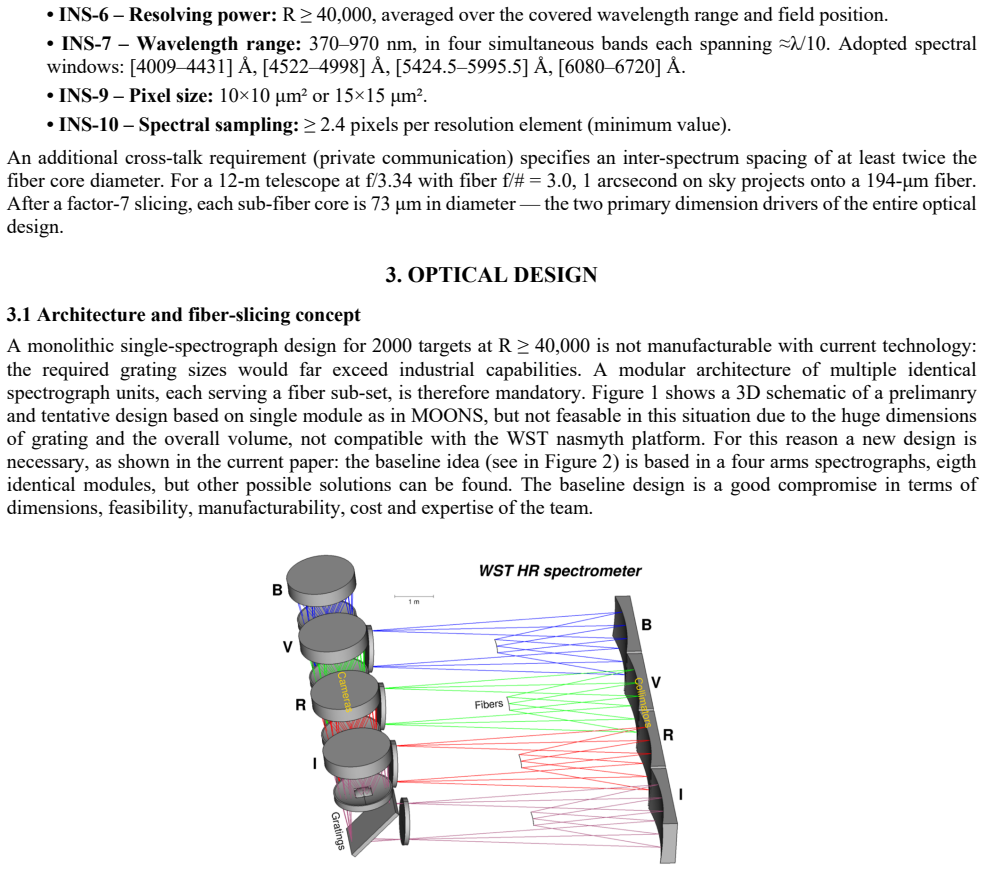
OPTICAL DESIGN 3.1 Architecture and fiber-slicing concept A monolithic single-spectrograph design for 2000 targets at R ≥ 40,000 is not manufacturable with current technology: the required grating sizes would far exceed industrial capabilities. A modular architecture of multiple identical spectrograph units, each serving a fiber sub-set, is therefore mand...
2000
-
[4]
The collimator spherical mirror (bottom) is folded by the flat mirror
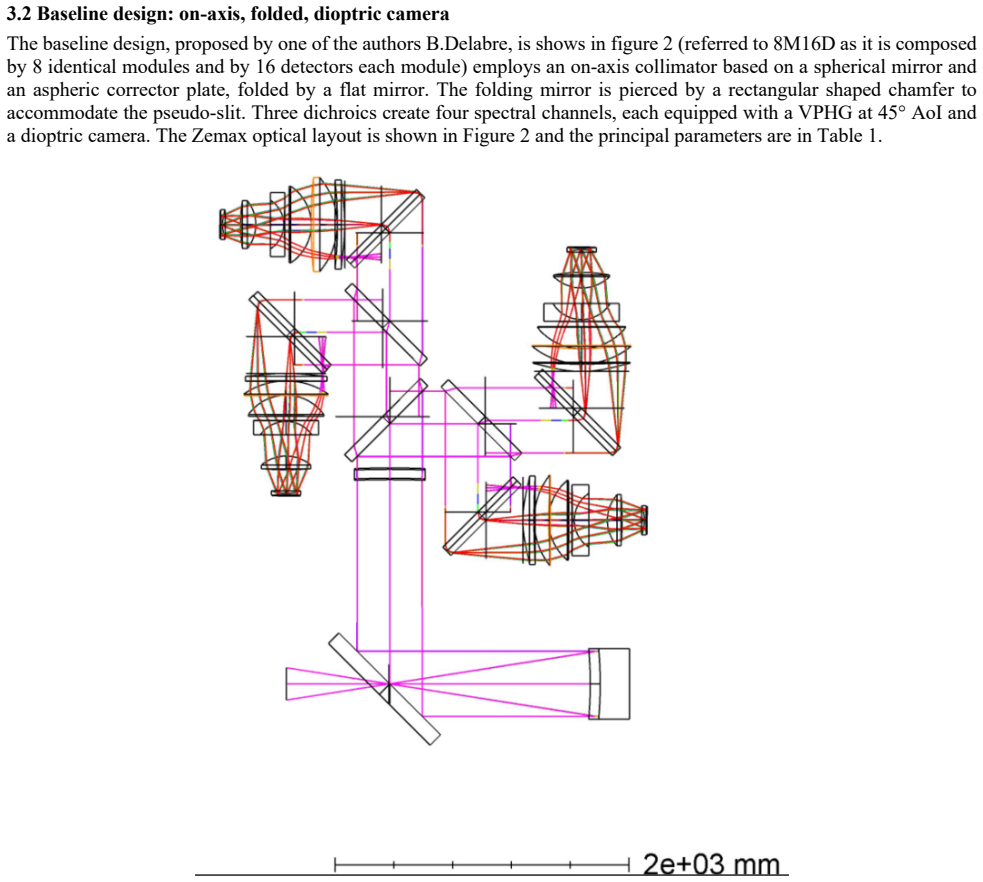
Zemax optical layout of the baseline MOS-HR design (on-axis, folded, dioptric camera). The collimator spherical mirror (bottom) is folded by the flat mirror. The four channels (B blue, V/G yellow-green, R red, I pink) each feature a VPHG and a 6-lens dioptric camera. Scale bar: 2000 mm. This solution is the one called 8M16D: 8 identical moduls, for 16 det...
2000
-
[5]
Six to eight spectrograph modules are required to reach the multiplexing target of 2000 targets (see Section 7)
MECHANICAL DESIGN AND MASS/VOLUME BUDGET 4.1 Modular architecture and platform layout The mechanical design and analysis is deeply described in [8], but here a brief description is furnished. Six to eight spectrograph modules are required to reach the multiplexing target of 2000 targets (see Section 7). Modules are paired on a shared vertical optical benc...
2000
-
[6]
One dark fiber per group is assumed for cross-talk separation
Required number of spectrograph modules to reach ≥ 2000 targets as a function of the number of fibers per object (slicer factor), for fiber pitches of 100 μm (blue) and 120 μm (green). One dark fiber per group is assumed for cross-talk separation. With 7 fibers per target and 100 μm pitch, 6–7 modules are sufficient. With a 266-mm slit, 100-μm fiber pitch...
2000
-
[7]
INAF Large Grant 2023 WST: the Wide-dield Spectroscopic Telescope
CONCLUSIONS WP4.5 has made significant progress in defining the MOS-HR design for WST. The trade-off study, structured across six categories with more than 20 weighted parameters, clearly identifies the on-axis, folded, dioptric camera configuration as the preferred baseline. This design achieves an average resolving power R = 42,686, mean throughput 47–5...
2025
-
[8]
The Wide-field Spectroscopic Telescope (WST) Science White Paper,
de Jong, R. S., et al., “The Wide-field Spectroscopic Telescope (WST) Science White Paper,” arXiv:2403.05398 (2024)
arXiv 2024
-
[9]
WST-00039_1 WST MOS-HR Trade-off Report,
Munari, M., et al., “WST-00039_1 WST MOS-HR Trade-off Report,” WST internal document v. 1DRAFT1 (Feb. 2026)
2026
-
[10]
MOS-HR Throughput Budget Dioptric Model,
Munari, M., et al., “MOS-HR Throughput Budget Dioptric Model,” WST internal document (2026)
2026
-
[11]
MOS-HR Throughput Budget Catadioptric Model,
Bacon, R., et al., “MOS-HR Throughput Budget Catadioptric Model,” WST internal document (2026)
2026
-
[12]
WST Phase A — High Level Requirements,
Gonzalez, O., et al., “WST Phase A — High Level Requirements,” v. 1DRAFT3, WST internal document (2025)
2025
-
[13]
MOONS: The Multi-Object Optical and Near-infrared Spectrograph for the VLT,
Cirasuolo, M., et al., “MOONS: The Multi-Object Optical and Near-infrared Spectrograph for the VLT,” Proc. SPIE 9147, 91470N (2014). https://doi.org/10.1117/12.2056012
-
[14]
ANDES, the high resolution spectrograph for the ELT,
Marconi, A., et al., “ANDES, the high resolution spectrograph for the ELT,” Proc. SPIE 12184, 1218424 (2022). https://doi.org/10.1117/12.2628689
discussion (0)
Sign in with ORCID, Apple, or X to comment. Anyone can read and Pith papers without signing in.