REVIEW 5 major objections 7 minor 16 references
A Novel Kalman Filter Based Shilling Attack Detection Algorithm
T0 review · 5 major / 7 minor · reviewed 2026-08-14 · deepseek-v4-flash
Pith's one-line read A Kalman filter that compares predicted and actual rating sums can locate shilling attacks and trace them to the users who launched them.
desk verdict A genuine new pairing of recursive smoothing with a two-deviation rule for shilling-attack detection, but the empirical case is weaker than the abstract claims: no attack-free control, thresholds tuned on the test curves, and the 'Kalman filter' is essentially a rolling average. read the letter →
The pith
A machine-rendered reading of the paper's core claim, the machinery that carries it, and where it could break.
The reading
What carries the argument
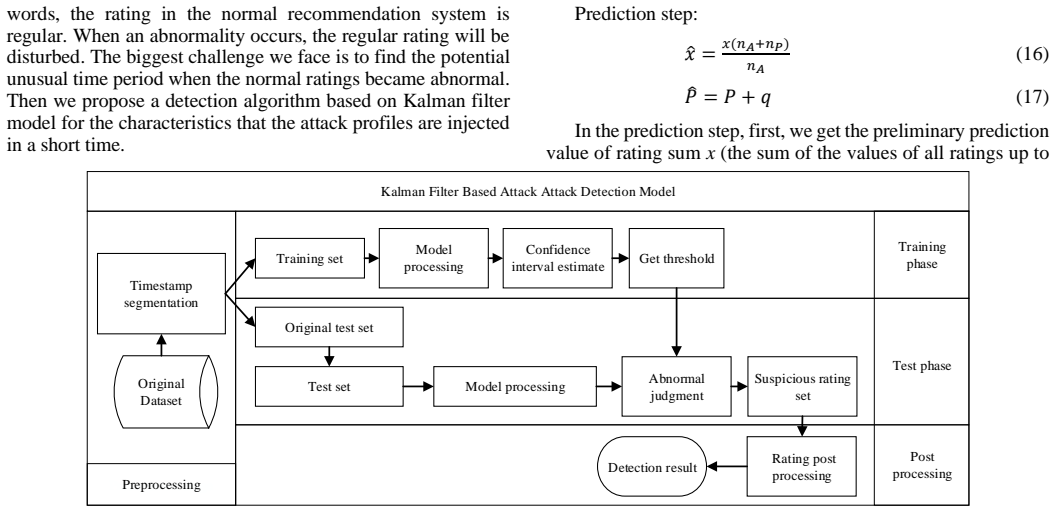
RDAKF (Rating Detection Adapted Kalman Filter) is a state-estimation filter that tracks the running sum of ratings over time blocks instead of a user preference vector. In the prediction step, after $n_A$ ratings have been processed, the predicted sum for the next block of size $n_P$ is $\hat{x}=x\,(n_A+n_P)/n_A$, with predicted uncertainty $\hat{P}=P+q$. In the update step, the observation $z$ is the actual sum of ratings in the current block, the Kalman gain $K_g=\hat{P}/(\hat{P}+r)$ blends the prediction with the observation, and the state and uncertainty are updated to $x^+=\hat{x}+K_g(z-\hat{x})$ and $P^+=(1-K_g)\hat{P}$. Deviations are computed as $v=(x+z)-\hat{x}$ and $v_A=v/n_P$; thresholds come from confidence-interval estimates of these deviations on a training set. The double-exceedance rule—both $v$ and $v_A$ beyond their thresholds—is what triggers an attack declaration.
What would settle it
Apply RDAKF to an attack-free rating log that contains natural bursts of genuine ratings (for example, many users rating a newly released item in the same block) and count how often both $v$ and $v_A$ cross the 99% and 90% confidence thresholds; a non-negligible false-positive rate would show the double-exceedance rule cannot separate attacks from normal bursts.
Extended reading notes
Core claim
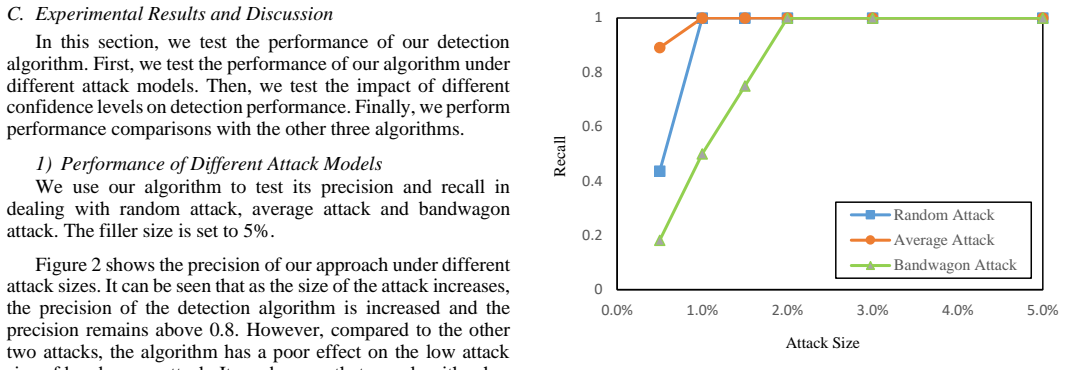
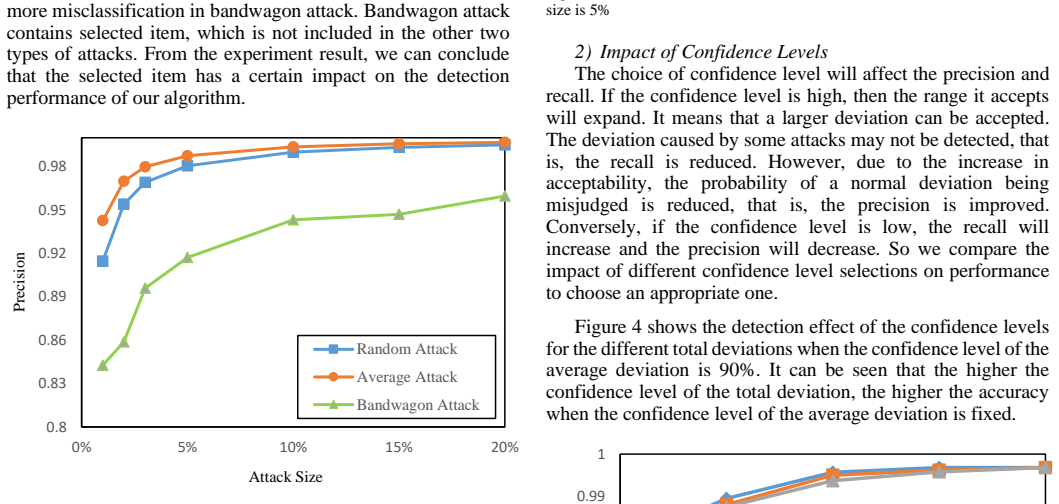
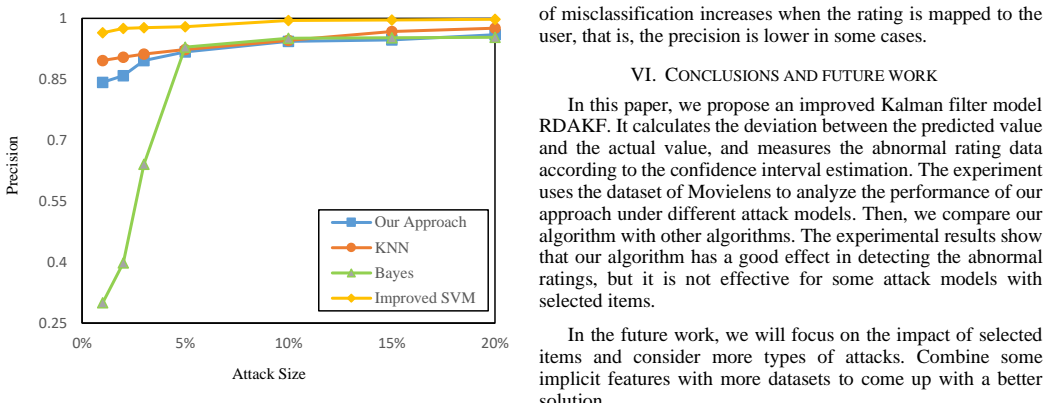
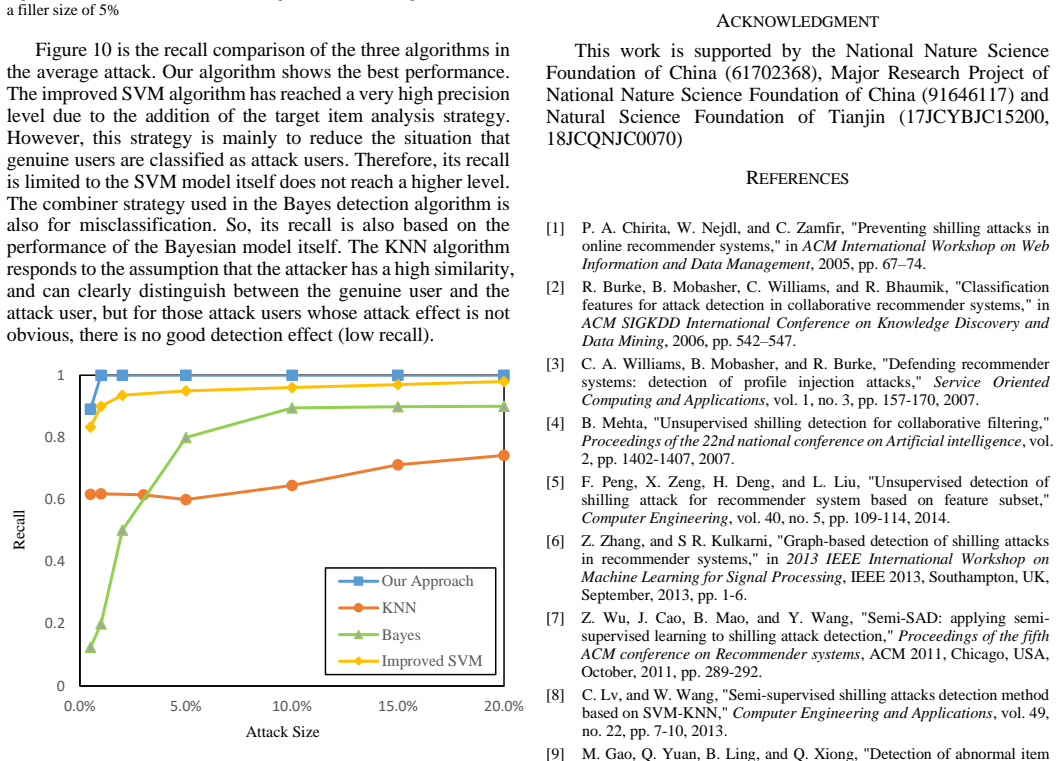
The central discovery is that a shilling attack reveals itself through a temporary break in a recommender's rating stream rather than through the shape of user profiles. When the Kalman-filter prediction of the sum of ratings in a time block is compared with the actual sum, an attack window is where both the total deviation $v$ and the per-rating average deviation $v_A$ exceed trained confidence thresholds. Under the paper's stability assumption, that double exceedance is the signature of injected profiles, and filtering the flagged window for extreme ratings (maximum for a push attack, minimum for a nuke attack) recovers the attackers. The paper reports that this approach outperforms KNN, Bayes, and improved SVM baselines in precision and recall on the tested attack types, with the limitation that bandwagon attacks, which include a selected item, degrade detection performance.
Load-bearing premise
The load-bearing premise is that genuine users' rating behavior is basically stable across time blocks and attacks are injected centrally in a short period, so when both total and average deviations exceed confidence thresholds the system must be under attack.
Editorial extensions
If this is right
- Because the method compares block-level rating sums rather than user feature vectors, detection can be applied to new data without retraining a user classifier; only the deviation thresholds need to be trained.
- Higher attack size raises precision, and the paper's experiments keep precision above 0.8 for random and average attacks at a filler size of 5%.
- Bandwagon attacks, which include a selected item, produce lower precision and recall than random or average attacks, so the presence of selected items is a recognized weak point.
- If attackers give the target item a non-extreme rating, the post-processing step will discard that rating, so the method will miss the attacking users even if the attack window is correctly flagged.
Reading between the lines
- The same block-sum deviation logic could be applied to other aggregate signals on platforms—clicks, views, likes—where fake activity is injected in bursts, making RDAKF a generic burst-anomaly detector rather than a recommender-specific one.
- Running the filter online is natural: each block updates the state, so the method could flag attacks in near real time if block size is small; the paper itself does not discuss streaming deployment.
- A testable boundary case is a distributed attack that spreads fake profiles over many time blocks: both deviations would be diluted, and the concentrated-in-time premise predicts the method would miss it.
Signed reviews
Editorial analysis
A structured set of objections, weighed in public.
Referee Report
Summary. The paper proposes a Kalman-filter-based shilling attack detection method (RDAKF). Ratings are aggregated into time blocks; a Kalman-style recursion predicts the cumulative rating sum, and the residual between the predicted and actual sum is used to define a total deviation v and an average deviation v_A = v/n_P. Thresholds for both deviations are derived from confidence-interval estimation on training deviations. An attack window is declared only when both deviations exceed their thresholds, and users who gave extreme ratings in that window are flagged as attackers. Experiments on the MovieLens 100K dataset inject push attacks (random, average, bandwagon) at various sizes and report precision/recall, comparing against KNN, Bayes, and improved SVM baselines. The central claim is that the proposed method achieves substantially better detection performance than traditional methods.
Significance. If validated, the approach would offer a lightweight, item-centric, time-aware alternative to user-profile-based shilling detection, exploiting the observation that injected profiles arrive in short bursts. The method is simple and has the practical virtue of not requiring per-user feature engineering. The paper also ships a concrete algorithmic pipeline (prediction, deviation, thresholding, post-processing) that is easy to reproduce. However, the reported evidence is not yet sufficient to support the abstract's claim of 'much better detection performance': there is no attack-free control, the threshold levels are selected using the test data, and the statistical justification for the confidence intervals is not established for the recursive residuals actually used. The strengths are the clear formulation of the two-deviation decision rule and the item-centric perspective, but these are undermined by the validation gaps.
major comments (5)
- [V.C (with IV.D)] The central evaluation is missing an attack-free control. Section V.A states that the original data is treated as genuine user data and attacks are injected into the test set; all precision/recall numbers in Figures 2-10 measure detection against those injected profiles. The decision rule in IV.D only fires when both v and v_A exceed thresholds, so the false-positive rate on ordinary, attack-free data is never measured. Since v_A = v/n_P (Eq. 23) is a nonlinear rescaling, a short block containing a few extreme genuine ratings can produce a large v_A, while a large block of ordinary ratings can produce a large v; the joint threshold therefore has no calibrated false-positive rate without a control. Without such a control, the reported high precision could be an artifact of thresholds that catch only the deliberately injected burst, and the paper's core premise that genuine rating behavior is 'basically stable' is not actually evidenced.
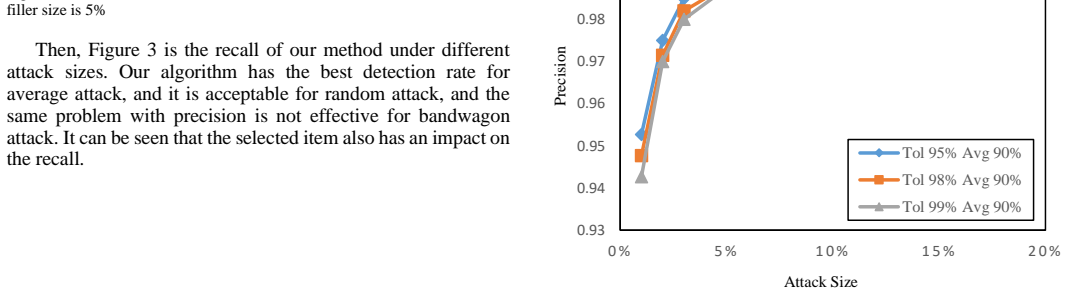
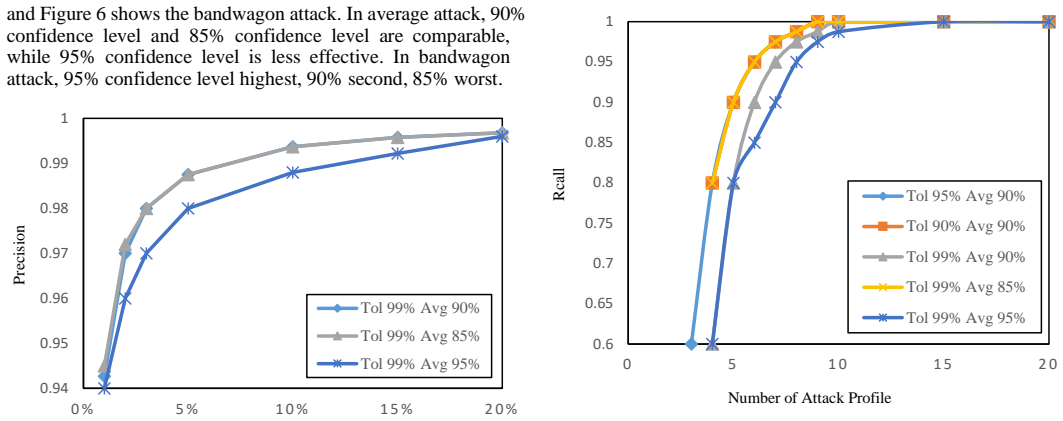
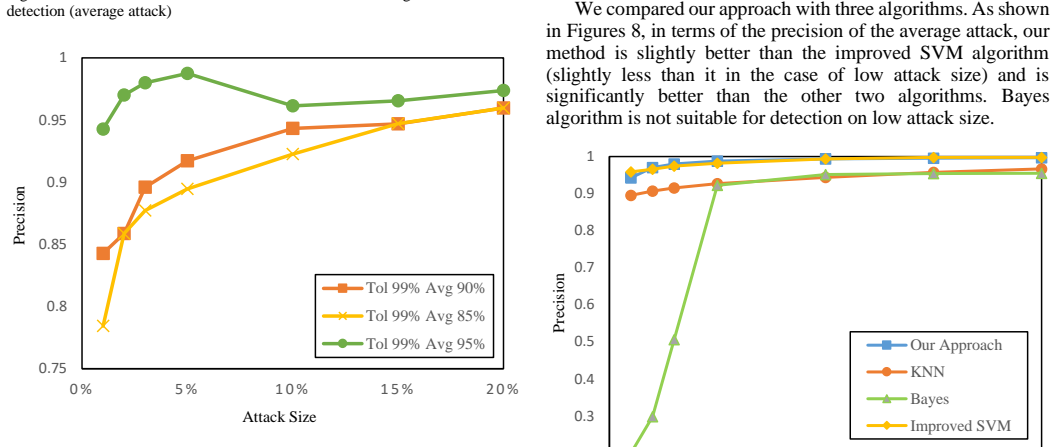
- [V.A and V.C.2 (Figs. 4-7)] The confidence levels that determine the detection thresholds appear to be selected after inspecting the detection results on the same test data. Section V.A reports 'Total deviation selects 99% confidence and average deviation selects 90% confidence,' and Section V.C.2 explains the choice by comparing precision/recall curves in Figures 4-7 for combinations such as Tol 95%/Avg 90%, Tol 99%/Avg 85%, etc. These figures are generated on the attacked test sets, so the threshold choice is fitted to the evaluation data. The manuscript should specify a fully training-only threshold selection procedure (e.g., held-out validation) and then report performance on a test set not used in any threshold choice; otherwise the reported precision/recall are optimistically biased.
- [III.C and IV.E] The confidence-interval argument does not apply to the deviations as defined. Section III.C justifies interval estimation by the central limit theorem for sample means, but v and v_A are not sample means: they are residuals of a recursive filter. Because the predicted sum x̂ in Eq. (16) accumulates all past ratings, successive deviations are autocorrelated, violating the independence assumption behind the z-based confidence limits in Eqs. (13)-(14). Applying the resulting upper bounds as per-sample thresholds in IV.E therefore does not give the stated 99% or 90% coverage. The paper should either justify the distribution of the deviations empirically (e.g., with histograms and autocorrelation checks on attack-free training data) or replace the confidence-interval calibration with an empirical quantile calibration, and should report the achieved false-alarm rate.
- [IV.C] The model parameters q and r, and the initial state, are set by assertion rather than estimation. The text says 'we assume that q and r in (17) and (18) are 1,' following the standard-normal assumption of the earlier recommendation model. However, the deviations used for thresholding depend on the filter behavior, and no sensitivity analysis is reported for q, r, P0, or the initial n_A. The initial values of P and n_A at the start of the training and test phases are never specified, although Eq. (16) and the update step (21) depend on them, especially in the first few time blocks. The paper should state the initialization and report how the results vary with q and r; otherwise the claimed robustness is not established.
- [IV.A] The load-bearing assumption that genuine users' rating behavior is 'basically stable' over time is asserted but never tested. The entire detection logic treats any period with both deviations abnormal as an attack, but natural rating bursts, seasonal popularity, or item-specific life-cycle effects could produce exactly that pattern. The item classification in III.D partially acknowledges heterogeneity across items, yet the detection model pools ratings without accounting for item type or block-level variation. A minimal test would be to run the full pipeline on attack-free test data and report the false-alarm rate and the distribution of v and v_A; this is the same missing control noted above but deserves emphasis because it is the empirical basis for the paper's central premise.
minor comments (7)
- [Abstract and Keywords] There is a typo in the abstract ('In t his paper') and a misspelling in the keywords ('dectection' should be 'detection').
- [IV.C, Eq. (16)] The text says '[(n_A + n_P)/n_P] is equivalent to F_t,' but the ratio as written is (n_A + n_P)/n_A in Eq. (16); please clarify which expression is intended and define all variables consistently.
- [IV.D, Eq. (22)] Eq. (22) defines y = x + z, but x is the state (predicted sum) while z is the observation for the current block; the notation is confusing because y is then compared with x̂, and the roles of x, y, and z should be made explicit in the text.
- [V.A] The description of the training set is vague: 'We used 100 items including 5328 deviations as training set for training.' It is unclear how these 100 items were selected, how the 5328 deviations arise, and how the training set relates to the 54 four-day time blocks and to the test set; please specify the exact split.
- [Figures 2 and 3] The horizontal axes of Figures 2 and 3 are inconsistent: Figure 2 covers attack sizes 0-20% while Figure 3 covers 0-5%, making it difficult to compare precision and recall across the same conditions; please use a common attack-size range.
- [Figure 7] The y-axis label in Figure 7 is 'Rcall' (missing 'e'); please correct the label.
- [V.C.2] The text says 'the higher the confidence level of the total deviation, the higher the precision' and 'the recall is almost the same,' but Figure 7 shows noticeable recall variation across combinations; please qualify this statement with the actual ranges shown.
Circularity Check
Reported performance is partly selection-on-test: confidence thresholds are chosen from the same attack-injected test curves that are later reported as the method's precision/recall.
-
fitted input called prediction
[Section V.C.2 (Impact of Confidence Levels), after Figs. 4-7; threshold values set in Section V.A]
"Based on the above comparison, for the confidence level of the total deviation, the higher the confidence level, the higher the precision. The recall is almost the same, so we choose a 99% confidence level."
Figures 4-7 plot precision/recall for alternative confidence-level pairs, computed on the same attack-injected test data whose final precision/recall is later reported in Section V.C.3. The 99% total and 90% average thresholds are chosen by inspecting these curves, i.e., the decision thresholds are selected using the evaluation labels. Reporting the performance of the selected configuration on the same test set is therefore not an independent prediction: the claimed 'much better detection performance' is partly a result of model selection on the test set, not a fixed method's out-of-sample accuracy. The selection is discrete and the Kalman deviations are still computed from a separate training set, so this is partial, not total, circularity.
full rationale
There is no full derivation-level circularity: the Kalman prediction/update equations (16)-(21) are standard, the deviations (22)-(23) compare predicted and actual rating sums, and the thresholds are in principle trained from a separate deviation training set. There is no load-bearing self-citation chain or imported uniqueness theorem. The main circularity concern is methodological: the confidence levels (99% total, 90% average) are selected after inspecting precision/recall curves on the same attack-injected test set used for the final comparisons, so the reported superiority over KNN, Bayes, and SVM is partly optimized on the evaluation data. Additionally, the paper never reports an attack-free false-alarm rate, so the core premise that genuine rating behavior is 'basically stable' (Section IV.A) is asserted rather than tested; that is a correctness risk rather than a circularity. On balance, one partial selection-on-test circularity raises the score to 4, but the detector retains independent content in its Kalman-based deviation mechanism and threshold training procedure.
Assumptions & free parameters
free parameters (5)
- time_block_length_days =
4
- q =
1
- r =
1
- total_deviation_confidence =
0.99
- average_deviation_confidence =
0.90
assumptions (5)
- domain assumption Genuine user rating behavior is basically stable over time.
- domain assumption Attacks are injected centrally in a short period of time.
- domain assumption Deviations between predicted and observed rating sums are approximately normal, so z-based confidence upper bounds are valid thresholds.
- domain assumption Attackers rate the target item with the extreme score, and non-extreme ratings in a suspicious period are genuine.
- ad hoc to paper Kalman noise parameters q and r equal 1.
Cite this review
Pith. "Pith review of A Novel Kalman Filter Based Shilling Attack Detection Algorithm." pith.science (2026). https://pith.science/paper/3WNGXLB6
@misc{pith2026190806968,
  author       = {Pith},
  title        = {Pith review of: A Novel Kalman Filter Based Shilling Attack Detection Algorithm},
  year         = {2026},
  howpublished = {\url{https://pith.science/paper/3WNGXLB6}},
  note         = {Machine review of arXiv:1908.06968}
}
read the original abstract
Collaborative filtering has been widely used in recommendation systems to recommend items that users might like. However, collaborative filtering based recommendation systems are vulnerable to shilling attacks. Malicious users tend to increase or decrease the recommended frequency of target items by injecting fake profiles. In this paper, we propose a Kalman filter-based attack detection model, which statistically analyzes the difference between the actual rating and the predicted rating calculated by this model to find the potential abnormal time period. The Kalman filter filters out suspicious ratings based on the abnormal time period and identifies suspicious users based on the source of these ratings. The experimental results show that our method performs much better detection performance for the shilling attack than the traditional methods.
Figures
Figures from the paper (5 more)
Reference graph
Works this paper leans on
-
[1]
Preventing shilling attacks in online recommender systems,
P. A. Chirita, W. Nejdl, and C. Zamfir, "Preventing shilling attacks in online recommender systems," in ACM International Workshop on Web Information and Data Management, 2005, pp. 67–74
work page 2005
-
[2]
Classification features for attack detection in collaborative recommender systems,
R. Burke, B. Mobasher, C. Williams, and R. Bhaumik, "Classification features for attack detection in collaborative recommender systems, " in ACM SIGKDD International Conference on Knowledge Discovery and Data Mining, 2006, pp. 542–547
work page 2006
-
[3]
Defending recommender systems: detection of profile injection attacks ,
C. A. Williams, B. Mobasher, and R. Burke, "Defending recommender systems: detection of profile injection attacks ," Service Oriented Computing and Applications, vol. 1, no. 3, pp. 157-170, 2007
work page 2007
-
[4]
Unsupervised shilling d etection for collaborative filtering ,
B. Mehta, "Unsupervised shilling d etection for collaborative filtering ," Proceedings of the 22nd national conference on Artificial intelligence, vol. 2, pp. 1402-1407, 2007
work page 2007
-
[5]
Unsupervised detection of shilling attack for recommender system based on feature subset,
F. Peng, X . Zeng, H . Deng, and L. Liu , "Unsupervised detection of shilling attack for recommender system based on feature subset," Computer Engineering, vol. 40, no. 5, pp. 109-114, 2014
work page 2014
-
[6]
Graph-based detection of shilling attacks in recommender systems ,
Z. Zhang, and S R. Kulkarni , "Graph-based detection of shilling attacks in recommender systems ," in 2013 IEEE International Workshop on Machine Learning for Signal Processing, IEEE 2013, Southampton, UK, September, 2013, pp. 1-6
work page 2013
-
[7]
Semi-SAD: applying semi - supervised learning to shilling attack detection,
Z. Wu , J. Cao, B. Mao, and Y. Wang , "Semi-SAD: applying semi - supervised learning to shilling attack detection," Proceedings of the fifth ACM conference on Recommender systems, ACM 2011, Chicago, USA, October, 2011, pp. 289-292
work page 2011
-
[8]
Semi-supervised shilling attacks detection method based on SVM-KNN,
C. Lv, and W. Wang, "Semi-supervised shilling attacks detection method based on SVM-KNN," Computer Engineering and Applications, vol. 49, no. 22, pp. 7-10, 2013
work page 2013
Show all 16 references
-
[9]
Detection of abnormal item based on time intervals for recommender systems,
M. Gao, Q. Yuan, B. Ling, and Q. Xiong, "Detection of abnormal item based on time intervals for recommender systems," The Scientific World Journal, vol. 2014, pp. 1-8, 2014
2014
-
[10]
Detecting abnormal profiles in collaborative filtering recommender systems ,
Z. Yang, and Z . Cai, "Detecting abnormal profiles in collaborative filtering recommender systems ," Journal of Intelligent I nformation Systems, vol. 48, no. 3, pp. 499-518, 2017
2017
-
[11]
Shilling attack detection in collaborative recommender systems using a meta learning strategy,
W. Bhebe, and O. P. Kogeda, "Shilling attack detection in collaborative recommender systems using a meta learning strategy," 2015 International 0.25 0.4 0.55 0.7 0.85 1 0% 5% 10% 15% 20% Precision Attack Size Our Approach KNN Bayes Improved SVM 0 0.2 0.4 0.6 0.8 1 0.0% 5.0% 10...
2015
-
[12]
SVM-TIA a shilling attack detection method based on SVM and target item analysis in recommender systems,
W. Zhou, J. Wen, Q. Xiong, M. Gao, and J. Zeng, "SVM-TIA a shilling attack detection method based on SVM and target item analysis in recommender systems," Neurocomputing ,vol. 210, pp. 197-205, 2016
2016
-
[13]
Collaborative recommendation: A robustness analysis ,
M. O'Mahony, N. Hurley, N. Kushmerick, and G. Silvestre, "Collaborative recommendation: A robustness analysis ," ACM Transactions on Internet Technology, vol. 4, no. 4, pp. 344-377, 2004
2004
-
[14]
Toward trustworthy recommender systems: An analysis of attack models and algorithm robustness,
B. Mobasher, R. Burke , R. Bhaumik, and C. Williams, "Toward trustworthy recommender systems: An analysis of attack models and algorithm robustness," ACM Transactions on Internet Technology, vol. 7, no. 4, pp. 23-60, 2007
2007
-
[15]
Recommendation system based on prediction of user preference changes ,
K. Inuzuka, T. Hayashi, and T. Takagi, "Recommendation system based on prediction of user preference changes ," 2016 IEEE/WIC/ACM International Conference on Web Intelligence (WI) , Omaha, USA, October, 2016, pp. 192-199
2016
-
[16]
Profile injection attack detection for securing collaborative recommender systems ,
C. Williams, and B . Mobasher, "Profile injection attack detection for securing collaborative recommender systems ," DePaul University CTI Technical Report, 2006, pp. 1-47
2006
Reviewed August 14, 2026 · model on record in the stance chip above.
Discussion (0). Continue with ORCID to comment.