Beyond Euclidean Prototypes: Spectral Disentanglement and Geodesic Matching for Few-Shot Medical Image Segmentation
Pith reviewed 2026-05-20 11:46 UTC · model grok-4.3
The pith
SGP-Net disentangles features into frequency bands and matches them via geodesic diffusion to fix cue mixing and manifold blindness in few-shot medical segmentation.
A machine-rendered reading of the paper's core claim, the machinery that carries it, and where it could break.
Core claim
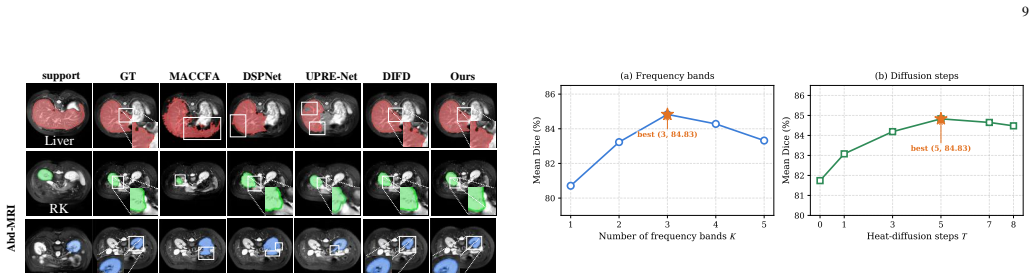
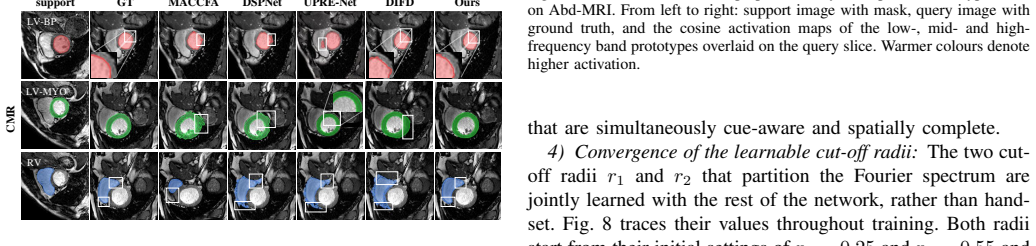
By decomposing support and query features into low-, mid-, and high-frequency bands with learnable radial Fourier filters to produce three independent prototypes per class, and then replacing cosine similarity with a differentiable heat-diffusion approximation of geodesic distance on the feature affinity graph, the method produces more consistent activations inside target regions and suppresses leakage into neighboring tissues.
What carries the argument
The Spectral-Geodesic Prototype Module, whose Spectral Prototype Bank decomposes features via learnable radial Fourier filters into disentangled frequency-band prototypes and whose Geodesic Matcher propagates similarity along a feature affinity graph using heat diffusion.
If this is right
- Support-query mismatches on one cue no longer propagate indiscriminately to the others.
- Matching signals remain consistent inside connected low-contrast regions instead of fragmenting.
- Off-manifold look-alikes in adjacent tissues produce suppressed responses.
- Three separate prototypes per class become available for shape, texture, and boundary cues.
- The overall pipeline remains end-to-end differentiable and reports competitive Dice on standard FSMIS benchmarks.
Where Pith is reading between the lines
- The frequency-band separation could be inspected post-training by reconstructing images from each band alone to verify cue isolation.
- The same spectral-geodesic idea might transfer to other few-shot dense prediction tasks where feature manifolds are similarly structured.
- If the radial filters prove stable across datasets, the method could reduce reliance on heavy data augmentation or post-processing steps.
- Extending the affinity graph to include spatial coordinates might further tighten the manifold distance for very small organs.
Load-bearing premise
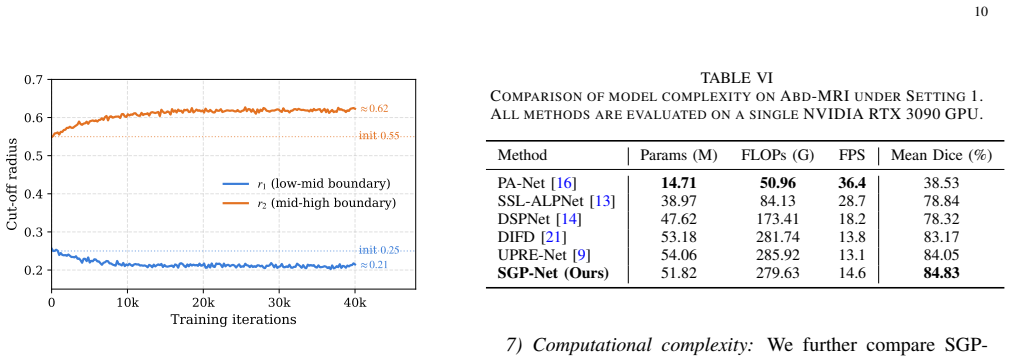
Learnable radial Fourier filters will cleanly separate support and query features into low-, mid-, and high-frequency bands that each encode a distinct cue such as shape, texture, or boundary.
What would settle it
An experiment in which the learned frequency bands fail to show distinct semantic content when visualized or ablated, or in which replacing the geodesic matcher with plain cosine similarity yields no drop in Dice score on the same backbone.
Figures




read the original abstract
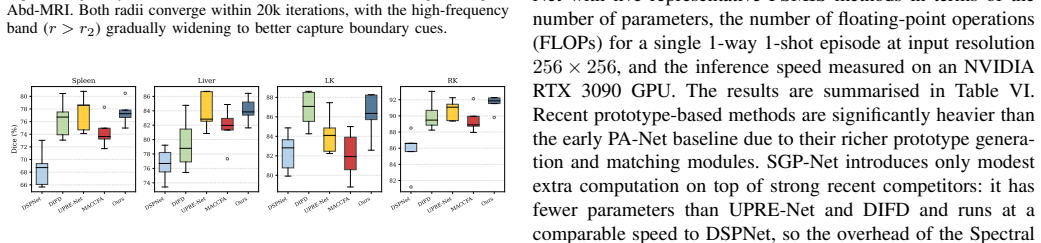
Few-Shot Medical Image Segmentation (FSMIS) aims to delineate novel anatomical targets from one or a few annotated support images, addressing the annotation scarcity in medical imaging. Notwithstanding recent advancements, current prototype-based methods are bottlenecked by two coupled limitations: 1) cue entanglement, where a single spatial-domain prototype is forced to summarise organ silhouette, parenchymal texture and boundary appearance simultaneously, so any support-query mismatch on one cue propagates indiscriminately to the others; and 2) topology-blind matching, where cosine similarity measures distance in the ambient Euclidean space and ignores the connectivity of the underlying feature manifold, causing fragmented activations inside low-contrast organs and leakage into neighbouring tissues. To this end, we propose Spectral-Geodesic Prototype Network (SGP-Net), built around a Spectral-Geodesic Prototype Module with two coupled components. A Spectral Prototype Bank (SPB) decomposes support and query features into low-, mid- and high-frequency bands via learnable radial Fourier filters, yielding three disentangled prototypes per class that separately encode shape, texture and boundary cues. A Geodesic Matcher (GM) then replaces cosine similarity with a differentiable heat-diffusion approximation of geodesic distance, propagating matching signals along a feature affinity graph so that on-manifold pixels accumulate consistent responses while off-manifold look-alikes are suppressed. Experiments on three public FSMIS benchmarks demonstrate that SGP-Net achieves competitive performance against recent state-of-the-art methods.
Editorial analysis
A structured set of objections, weighed in public.
Referee Report
Summary. The manuscript introduces SGP-Net for few-shot medical image segmentation. It identifies cue entanglement in single spatial prototypes and topology-blind Euclidean matching as key limitations. The proposed Spectral-Geodesic Prototype Module uses a Spectral Prototype Bank to decompose support and query features into low-, mid-, and high-frequency bands via learnable radial Fourier filters, producing three class prototypes that separately encode shape, texture, and boundary information, followed by a Geodesic Matcher that replaces cosine similarity with a differentiable heat-diffusion approximation of geodesic distance on a feature affinity graph. Experiments on three public FSMIS benchmarks are reported to show competitive performance against recent state-of-the-art methods.
Significance. If the spectral decomposition reliably isolates the claimed cues and the geodesic matching improves on-manifold consistency, the approach could provide a useful extension to prototype-based few-shot segmentation in medical imaging. The combination of frequency-domain disentanglement with manifold-aware matching is a coherent response to the stated bottlenecks and may generalize beyond the evaluated benchmarks.
major comments (1)
- The central motivation for the Spectral Prototype Bank rests on the claim that learnable radial Fourier filters produce independent low-, mid-, and high-frequency prototypes encoding shape, texture, and boundary cues respectively. No orthogonality constraint, auxiliary loss, or cue-specific supervision is described to enforce band independence or specialization. Without such mechanisms the filters may converge to correlated partitions, leaving the prototypes entangled and weakening the rationale for replacing standard Euclidean matching.
minor comments (1)
- The abstract would be strengthened by including at least one quantitative result (e.g., mean Dice score and comparison to a named baseline) to support the competitive-performance claim.
Simulated Author's Rebuttal
We thank the referee for the detailed and constructive review. We address the single major comment below and indicate the changes planned for the revised manuscript.
read point-by-point responses
-
Referee: The central motivation for the Spectral Prototype Bank rests on the claim that learnable radial Fourier filters produce independent low-, mid-, and high-frequency prototypes encoding shape, texture, and boundary cues respectively. No orthogonality constraint, auxiliary loss, or cue-specific supervision is described to enforce band independence or specialization. Without such mechanisms the filters may converge to correlated partitions, leaving the prototypes entangled and weakening the rationale for replacing standard Euclidean matching.
Authors: We acknowledge that the current manuscript does not describe an explicit orthogonality constraint, auxiliary loss, or cue-specific supervision to enforce independence among the frequency bands. The Spectral Prototype Bank relies on learnable radial Fourier filters whose radial support is partitioned into low-, mid-, and high-frequency ranges by construction; the filters are jointly optimized end-to-end with the segmentation objective. While this design encourages specialization through the distinct frequency supports, we agree that without additional regularization the learned filters could in principle become correlated. To strengthen the justification, the revised manuscript will include (i) a quantitative analysis of pairwise correlations between the three prototypes across training epochs and (ii) visualizations of the learned filter responses on representative support images. These additions will clarify the extent of cue disentanglement achieved in practice and will be placed in a new subsection of the method and in the supplementary material. revision: partial
Circularity Check
No significant circularity; derivation is self-contained architectural proposal
full rationale
The paper proposes SGP-Net with Spectral Prototype Bank using learnable radial Fourier filters to produce frequency-band prototypes and a Geodesic Matcher based on heat-diffusion approximation. These are presented as novel design choices whose effectiveness is evaluated via experiments on three independent public FSMIS benchmarks. No equations reduce a claimed prediction to a fitted parameter by construction, no uniqueness theorem is imported from self-citation, and no ansatz is smuggled via prior work by the same authors. The central performance claim rests on external benchmark results rather than tautological redefinition of inputs.
Axiom & Free-Parameter Ledger
free parameters (1)
- learnable radial Fourier filters
axioms (2)
- domain assumption Low-, mid-, and high-frequency bands separately encode shape, texture, and boundary cues
- domain assumption Heat-diffusion on the feature affinity graph approximates geodesic distance for matching
invented entities (2)
-
Spectral Prototype Bank
no independent evidence
-
Geodesic Matcher
no independent evidence
Lean theorems connected to this paper
-
IndisputableMonolith/Cost/FunctionalEquation.leanwashburn_uniqueness_aczel unclear?
unclearRelation between the paper passage and the cited Recognition theorem.
Spectral Prototype Bank decomposes ... into low-, mid- and high-frequency bands via learnable radial Fourier filters, yielding three disentangled prototypes per class that separately encode shape, texture and boundary cues.
-
IndisputableMonolith/Foundation/AlexanderDuality.leanalexander_duality_circle_linking unclear?
unclearRelation between the paper passage and the cited Recognition theorem.
Geodesic Matcher ... differentiable heat-diffusion approximation of geodesic distance
What do these tags mean?
- matches
- The paper's claim is directly supported by a theorem in the formal canon.
- supports
- The theorem supports part of the paper's argument, but the paper may add assumptions or extra steps.
- extends
- The paper goes beyond the formal theorem; the theorem is a base layer rather than the whole result.
- uses
- The paper appears to rely on the theorem as machinery.
- contradicts
- The paper's claim conflicts with a theorem or certificate in the canon.
- unclear
- Pith found a possible connection, but the passage is too broad, indirect, or ambiguous to say the theorem truly supports the claim.
Reference graph
Works this paper leans on
-
[1]
Z. Zhang, Q. Ma, Y . Zhang, Z. Chen, J. Chen, and H. Zheng, “Interteach: A novel approach for semi-supervised medical image segmentation using cooperative teacher-student networks,”IEEE Transactions on Circuits and Systems for Video Technology, 2024. 11
work page 2024
-
[2]
Cross-hierarchical decoding with sam for semi-supervised medical image segmentation,
H. Chi, M. Liu, J. Wang, X. Gao, G. Luo, B. Zhang, and W. Liu, “Cross-hierarchical decoding with sam for semi-supervised medical image segmentation,”IEEE Transactions on Circuits and Systems for Video Technology, 2025
work page 2025
-
[3]
M. Hou, Z. Huang, D. Zhong, Z. Yu, X. Li, J. Wang, Y . Yan, and Y . Liu, “Eliminating domain-related confounding factors in cross-domain one- shot medical image segmentation via causal inference,”Medical Image Analysis, p. 104037, 2026
work page 2026
-
[4]
U-net: Convolutional networks for biomedical image segmentation,
O. Ronneberger, P. Fischer, and T. Brox, “U-net: Convolutional networks for biomedical image segmentation,” inInternational Conference on Medical image computing and computer-assisted intervention. Springer, 2015, pp. 234–241
work page 2015
-
[5]
TransUNet: Transformers Make Strong Encoders for Medical Image Segmentation
J. Chen, Y . Lu, Q. Yu, X. Luo, E. Adeli, Y . Wang, L. Lu, A. L. Yuille, and Y . Zhou, “Transunet: Transformers make strong encoders for medical image segmentation,”arXiv preprint arXiv:2102.04306, 2021
work page internal anchor Pith review Pith/arXiv arXiv 2021
-
[6]
Swin-unet: Unet-like pure transformer for medical image segmenta- tion,
H. Cao, Y . Wang, J. Chen, D. Jiang, X. Zhang, Q. Tian, and M. Wang, “Swin-unet: Unet-like pure transformer for medical image segmenta- tion,” inEuropean conference on computer vision. Springer, 2022, pp. 205–218
work page 2022
-
[7]
U-kan makes strong backbone for medical image segmentation and generation,
C. Li, X. Liu, W. Li, C. Wang, H. Liu, Y . Liu, Z. Chen, and Y . Yuan, “U-kan makes strong backbone for medical image segmentation and generation,” inProceedings of the AAAI conference on artificial intelli- gence, vol. 39, no. 5, 2025, pp. 4652–4660
work page 2025
-
[8]
Tbconvl-net: A hybrid deep learning architecture for robust medical image segmentation,
S. Iqbal, T. M. Khan, S. S. Naqvi, A. Naveed, and E. Meijering, “Tbconvl-net: A hybrid deep learning architecture for robust medical image segmentation,”Pattern Recognition, vol. 158, p. 111028, 2025
work page 2025
-
[9]
J. Hu, T. Zhou, K. Huang, Y . Zhou, H. Zhang, B. Fan, and H. Fu, “Uncertainty-guided prototype reliability enhancement network for few- shot medical image segmentation,”IEEE Transactions on Medical Imaging, 2025
work page 2025
-
[10]
Controllable relation disentanglement for few-shot class-incremental learning,
Y . Zhou, R. Hong, Y . Guo, L. Liu, S. Hao, and H. Zhang, “Controllable relation disentanglement for few-shot class-incremental learning,”IEEE Transactions on Circuits and Systems for Video Technology, 2025
work page 2025
-
[11]
Conditional self-supervised learning for few-shot learning,
Y . An, H. Xue, and X. Zhao, “Conditional self-supervised learning for few-shot learning,”IEEE Transactions on Circuits and Systems for Video Technology, 2026
work page 2026
-
[12]
Magnet: Multi-level feature guidance net- work for few-shot fine-grained image classification,
P. Jia, G. Gou, and Y . Cheng, “Magnet: Multi-level feature guidance net- work for few-shot fine-grained image classification,”Signal Processing, vol. 235, p. 110031, 2025
work page 2025
-
[13]
Self-supervision with superpixels: Training few-shot medical image segmentation without annotation,
C. Ouyang, C. Biffi, C. Chen, T. Kart, H. Qiu, and D. Rueckert, “Self-supervision with superpixels: Training few-shot medical image segmentation without annotation,” inEuropean conference on computer vision. Springer, 2020, pp. 762–780
work page 2020
-
[14]
Few- shot medical image segmentation with high-fidelity prototypes,
S. Tang, S. Yan, X. Qi, J. Gao, M. Ye, J. Zhang, and X. Zhu, “Few- shot medical image segmentation with high-fidelity prototypes,”Medical Image Analysis, vol. 100, p. 103412, 2025
work page 2025
-
[15]
Prototypical networks for few-shot learning,
J. Snell, K. Swersky, and R. Zemel, “Prototypical networks for few-shot learning,”Advances in neural information processing systems, vol. 30, 2017
work page 2017
-
[16]
Panet: Few-shot image semantic segmentation with prototype alignment,
K. Wang, J. H. Liew, Y . Zou, D. Zhou, and J. Feng, “Panet: Few-shot image semantic segmentation with prototype alignment,” inproceedings of the IEEE/CVF international conference on computer vision, 2019, pp. 9197–9206
work page 2019
-
[17]
Prior guided feature enrichment network for few-shot segmentation,
Z. Tian, H. Zhao, M. Shu, Z. Yang, R. Li, and J. Jia, “Prior guided feature enrichment network for few-shot segmentation,”IEEE transactions on pattern analysis and machine intelligence, vol. 44, no. 2, pp. 1050–1065, 2020
work page 2020
-
[18]
Self- supervised learning for few-shot medical image segmentation,
C. Ouyang, C. Biffi, C. Chen, T. Kart, H. Qiu, and D. Rueckert, “Self- supervised learning for few-shot medical image segmentation,”IEEE Transactions on Medical Imaging, vol. 41, no. 7, pp. 1837–1848, 2022
work page 2022
-
[19]
S. Hansen, S. Gautam, S. A. Salahuddin, M. Kampffmeyer, and R. Jenssen, “Adnet++: A few-shot learning framework for multi-class medical image volume segmentation with uncertainty-guided feature refinement,”Medical Image Analysis, vol. 89, p. 102870, 2023
work page 2023
-
[20]
Few- shot medical image segmentation via generating multiple representative descriptors,
Z. Cheng, S. Wang, T. Xin, T. Zhou, H. Zhang, and L. Shao, “Few- shot medical image segmentation via generating multiple representative descriptors,”IEEE Transactions on Medical Imaging, vol. 43, no. 6, pp. 2202–2214, 2024
work page 2024
-
[21]
Dual interspersion and flexible deployment for few-shot medical image segmentation,
Z. Cheng, S. Wang, Y . Long, T. Zhou, H. Zhang, and L. Shao, “Dual interspersion and flexible deployment for few-shot medical image segmentation,”IEEE Transactions on Medical Imaging, 2025
work page 2025
-
[22]
Mask correction and contrastive feature aggregation for few- shot medical image segmentation,
Q. Chi, Y . Liu, Y . Zhang, Z. Liu, F. Wu, J. L. Dillenseger, and H. Shu, “Mask correction and contrastive feature aggregation for few- shot medical image segmentation,”Pattern Recognition, p. 113790, 2026
work page 2026
-
[23]
Q-net: Query-informed few-shot medical image segmentation,
Q. Shen, Y . Li, J. Jin, and B. Liu, “Q-net: Query-informed few-shot medical image segmentation,” inProceedings of SAI Intelligent Systems Conference. Springer, 2023, pp. 610–628
work page 2023
-
[24]
Ntrenet++: Unleashing the power of non-target knowledge for few-shot semantic segmentation,
Y . Liu, N. Liu, Y . Wu, H. Cholakkal, R. M. Anwer, X. Yao, and J. Han, “Ntrenet++: Unleashing the power of non-target knowledge for few-shot semantic segmentation,”IEEE Transactions on Circuits and Systems for Video Technology, vol. 35, no. 5, pp. 4314–4328, 2024
work page 2024
-
[25]
J. Leng, Z. Zhao, C. Tian, Z. Chen, G. Wang, and X. Liu, “Multi-modal few-shot semantic segmentation based on triple attention mechanism and hierarchical decoding transformer,”IEEE Transactions on Circuits and Systems for Video Technology, 2025
work page 2025
-
[26]
One-Shot Learning for Semantic Segmentation
A. Shaban, S. Bansal, Z. Liu, I. Essa, and B. Boots, “One-shot learning for semantic segmentation,”arXiv preprint arXiv:1709.03410, 2017
work page internal anchor Pith review Pith/arXiv arXiv 2017
-
[27]
Part-aware prototype network for few-shot semantic segmentation,
Y . Liu, X. Zhang, S. Zhang, and X. He, “Part-aware prototype network for few-shot semantic segmentation,” inEuropean conference on com- puter vision. Springer, 2020, pp. 142–158
work page 2020
-
[28]
Adaptive prototype learning and allocation for few-shot segmentation,
G. Li, V . Jampani, L. Sevilla-Lara, D. Sun, J. Kim, and J. Kim, “Adaptive prototype learning and allocation for few-shot segmentation,” inProceedings of the IEEE/CVF conference on computer vision and pattern recognition, 2021, pp. 8334–8343
work page 2021
-
[29]
Learning what not to segment: A new perspective on few-shot segmentation,
C. Lang, G. Cheng, B. Tu, and J. Han, “Learning what not to segment: A new perspective on few-shot segmentation,” inProceedings of the IEEE/CVF conference on computer vision and pattern recognition, 2022, pp. 8057–8067
work page 2022
-
[30]
Hypercorrelation squeeze for few-shot segmentation,
J. Min, D. Kang, and M. Cho, “Hypercorrelation squeeze for few-shot segmentation,” inProceedings of the IEEE/CVF international conference on computer vision, 2021, pp. 6941–6952
work page 2021
-
[31]
Mianet: Aggregating unbiased instance and general information for few-shot semantic seg- mentation,
Y . Yang, Q. Chen, Y . Feng, and T. Huang, “Mianet: Aggregating unbiased instance and general information for few-shot semantic seg- mentation,” inProceedings of the IEEE/CVF Conference on Computer Vision and Pattern Recognition, 2023, pp. 7131–7140
work page 2023
-
[32]
Dual-guided prototype alignment network for few-shot medical image segmentation,
Y . Shen, W. Fan, C. Wang, W. Liu, W. Wang, Q. Zhang, and D. Zhou, “Dual-guided prototype alignment network for few-shot medical image segmentation,”IEEE Transactions on Instrumentation and Measurement, vol. 73, pp. 1–13, 2024
work page 2024
-
[33]
Famnet: Frequency-aware matching network for cross-domain few-shot medical image segmentation,
Y . Bo, Y . Zhu, L. Li, and H. Zhang, “Famnet: Frequency-aware matching network for cross-domain few-shot medical image segmentation,” in Proceedings of the AAAI conference on artificial intelligence, vol. 39, no. 2, 2025, pp. 1889–1897
work page 2025
-
[34]
‘squeeze & excite’guided few-shot segmentation of volumetric images,
A. G. Roy, S. Siddiqui, S. P ¨olsterl, N. Navab, and C. Wachinger, “‘squeeze & excite’guided few-shot segmentation of volumetric images,” Medical image analysis, vol. 59, p. 101587, 2020
work page 2020
-
[35]
L. Sun, C. Li, X. Ding, Y . Huang, Z. Chen, G. Wang, Y . Yu, and J. Paisley, “Few-shot medical image segmentation using a global cor- relation network with discriminative embedding,”Computers in biology and medicine, vol. 140, p. 105067, 2022
work page 2022
-
[36]
Few-shot medical image segmentation with cycle-resemblance attention,
H. Ding, C. Sun, H. Tang, D. Cai, and Y . Yan, “Few-shot medical image segmentation with cycle-resemblance attention,” inProceedings of the IEEE/CVF winter conference on applications of computer vision, 2023, pp. 2488–2497
work page 2023
-
[37]
Prototype-guided graph reasoning network for few-shot medical image segmentation,
W. Huang, J. Hu, J. Xiao, Y . Wei, X. Bi, and B. Xiao, “Prototype-guided graph reasoning network for few-shot medical image segmentation,” IEEE Transactions on Medical Imaging, vol. 44, no. 2, pp. 761–773, 2024
work page 2024
-
[38]
S. Hansen, S. Gautam, R. Jenssen, and M. Kampffmeyer, “Anomaly detection-inspired few-shot medical image segmentation through self- supervision with supervoxels,”Medical Image Analysis, vol. 78, p. 102385, 2022
work page 2022
-
[39]
Few-shot medical image segmentation via a region-enhanced prototypical transformer,
Y . Zhu, S. Wang, T. Xin, and H. Zhang, “Few-shot medical image segmentation via a region-enhanced prototypical transformer,” inInter- national conference on medical image computing and computer-assisted intervention. Springer, 2023, pp. 271–280
work page 2023
-
[40]
Y . Zhu, S. Wang, T. Xin, Z. Zhang, and H. Zhang, “Partition-a-medical- image: Extracting multiple representative subregions for few-shot med- ical image segmentation,”IEEE Transactions on Instrumentation and Measurement, vol. 73, pp. 1–12, 2024
work page 2024
-
[41]
Spenet: Self-guided prototype enhancement network for few-shot medical image segmentation,
C. Fan, X. Jia, A. Xiao, H. Yu, Z. Yang, D. Yang, H. Xu, Y . Huang, and L. Wang, “Spenet: Self-guided prototype enhancement network for few-shot medical image segmentation,” inInternational Conference on Medical Image Computing and Computer-Assisted Intervention. Springer, 2025, pp. 584–593
work page 2025
-
[42]
Y . Wu, Q. Qin, W. Hu, J. Hu, Y . Ren, and W. Zhang, “Few-shot medical image segmentation via dual-stream feature extractor and detail- enhanced prototype transformer,”Knowledge-Based Systems, p. 115709, 2026
work page 2026
-
[43]
Edge-aware multi-prototype learning for few-shot medical 12 image segmentation,
Y . Wang, C. Yue, H. Sun, P. Zhu, H. Yu, Y . Jiang, P. Qian, K. Xia, and Y . Zhang, “Edge-aware multi-prototype learning for few-shot medical 12 image segmentation,”Biomedical Signal Processing and Control, vol. 113, p. 108918, 2026
work page 2026
-
[44]
H. Wu, F. Xiao, and C. Liang, “Dual contrastive learning with anatomical auxiliary supervision for few-shot medical image segmentation,” in European Conference on Computer Vision. Springer, 2022, pp. 417– 434
work page 2022
-
[45]
Lms-net: A learned mumford-shah network for binary few-shot medical image segmentation,
S. Zhang, F. Jia, X. Li, H. Zhang, J. Shi, L. Ma, and S. Ying, “Lms-net: A learned mumford-shah network for binary few-shot medical image segmentation,”Medical Image Analysis, vol. 105, p. 103676, 2025
work page 2025
-
[46]
Chaos challenge- combined (ct-mr) healthy abdominal organ segmentation,
A. E. Kavur, N. S. Gezer, M. Barıs ¸, S. Aslan, P.-H. Conze, V . Groza, D. D. Pham, S. Chatterjee, P. Ernst, S. ¨Ozkanet al., “Chaos challenge- combined (ct-mr) healthy abdominal organ segmentation,”Medical image analysis, vol. 69, p. 101950, 2021
work page 2021
-
[47]
Miccai multi-atlas labeling beyond the cranial vault–workshop and challenge,
B. Landman, Z. Xu, J. Igelsias, M. Styner, T. Langerak, and A. Klein, “Miccai multi-atlas labeling beyond the cranial vault–workshop and challenge,” inProc. MICCAI multi-atlas labeling beyond cranial vault—workshop challenge, vol. 5. Munich, Germany, 2015, p. 12
work page 2015
-
[48]
Multivariate mixture model for cardiac segmentation from multi-sequence mri,
X. Zhuang, “Multivariate mixture model for cardiac segmentation from multi-sequence mri,” inInternational Conference on Medical Image Computing and Computer-Assisted Intervention. Springer, 2016, pp. 581–588
work page 2016
-
[49]
Microsoft coco: Common objects in context,
T.-Y . Lin, M. Maire, S. Belongie, J. Hays, P. Perona, D. Ramanan, P. Doll ´ar, and C. L. Zitnick, “Microsoft coco: Common objects in context,” inEuropean conference on computer vision. Springer, 2014, pp. 740–755
work page 2014
-
[50]
M. Hou, Z. Huang, Z. Yu, X. Li, J. Wang, Y . Yan, Y . Liu, and H. Gregersen, “Overcoming limitations in one-shot semantic segmenta- tion via adaptive visual-text guided prototype relationship optimization,” IEEE Transactions on Circuits and Systems for Video Technology, 2025. Penghao Jiareceived the M.E. degree in computer technology from Chongqing Univer...
work page 2025
discussion (0)
Sign in with ORCID, Apple, or X to comment. Anyone can read and Pith papers without signing in.