VegSim: A Geospatial World Model for Scenario-Conditioned Vegetation Simulation
Pith reviewed 2026-06-26 12:00 UTC · model grok-4.3
The pith
VegSim enables one model to both forecast vegetation NDVI under observed weather and simulate responses under any user-specified meteorological forcing by conditioning recurrent latent dynamics on future inputs.
A machine-rendered reading of the paper's core claim, the machinery that carries it, and where it could break.
Core claim
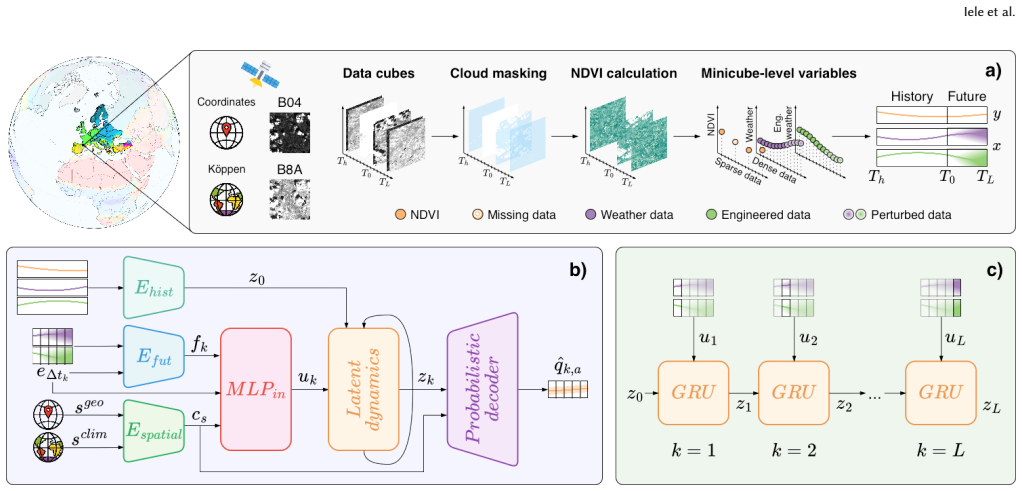
VegSim infers a latent vegetation state from sparse satellite-derived NDVI histories, past meteorological covariates, and static spatial context, propagates it forward under future weather forcing through recurrent latent dynamics, and decodes predictive NDVI quantiles at each lead time. Because future forcing enters as a controllable input, the same trained model supports probabilistic forecasting under observed weather and conditional simulation under user-defined meteorological forcing, without supervision on scenario responses.
What carries the argument
Recurrent latent dynamics that propagate an inferred vegetation state when supplied with future meteorological forcing as a controllable input.
If this is right
- The model delivers strong point and probabilistic NDVI accuracy against time-series and Earth-observation baselines on in-distribution and shifted data.
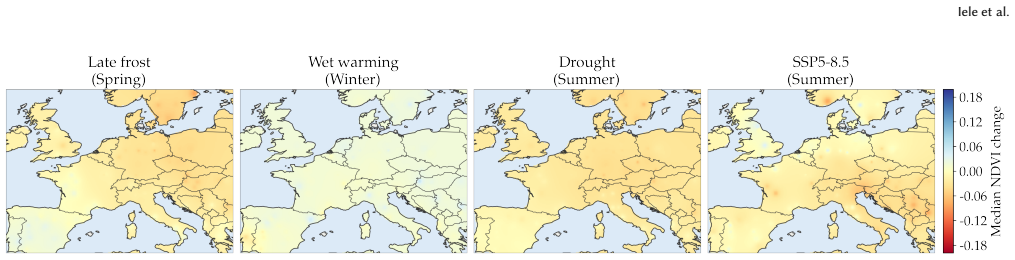
- It generates spatially coherent vegetation response maps under four distinct meteorological scenarios across Europe.
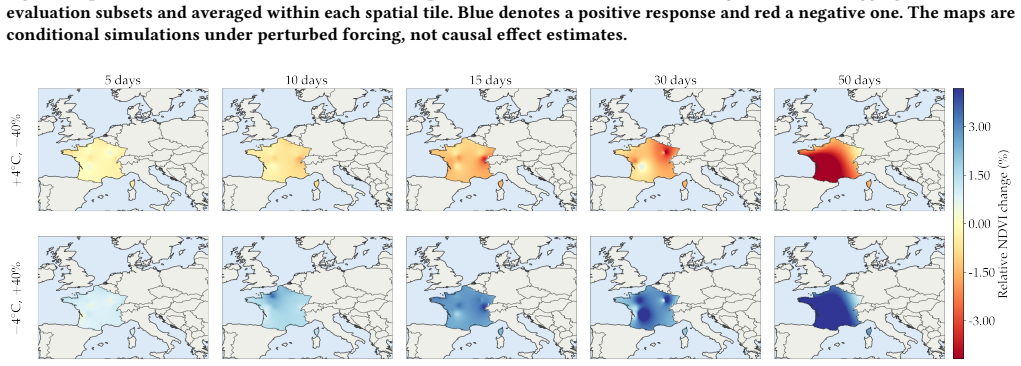
- Case-study output for France in summer 2022 matches documented sensitivities to temperature and precipitation.
- A compact architecture suffices to handle the geospatial conditioning and multi-step propagation.
Where Pith is reading between the lines
- The same conditioning mechanism could be applied to other Earth-system variables whose responses depend on controllable external drivers.
- Operational users could run rapid what-if tests for specific drought or heat events on chosen regions without collecting new labeled scenario data.
- Coupling the latent state to outputs from climate models would allow exploration of longer-term vegetation trajectories under projected forcings.
- The lack of explicit scenario supervision implies the network has extracted general response rules rather than memorizing observed weather-vegetation pairs.
Load-bearing premise
Dynamics learned only from historical weather trajectories will correctly predict vegetation responses when the same model is later driven by meteorological sequences that never appeared in training.
What would settle it
A test in which the model is driven by a meteorological sequence absent from training and its NDVI quantile predictions deviate substantially from independent ground measurements of vegetation state under that same sequence.
Figures
read the original abstract
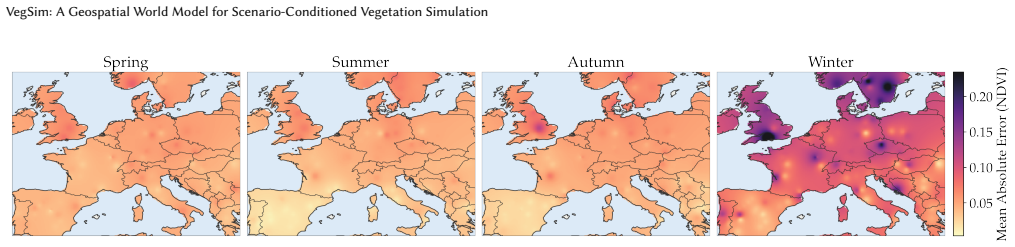
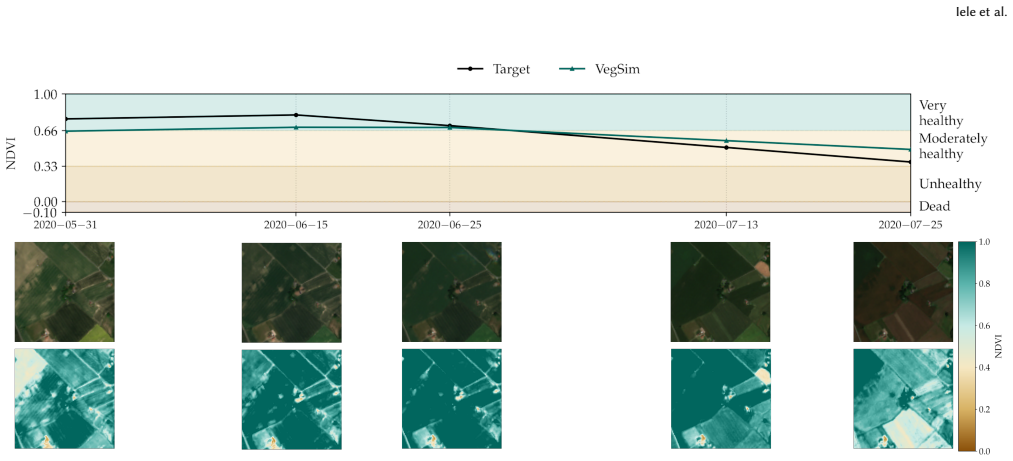
Vegetation monitoring under climate stress requires answering not only how it will evolve given the expected weather, but how it would respond to alternative meteorological conditions. Forecasting models return the expected vegetation state for the observed weather and cannot answer these scenario-conditioned questions, because future weather is fixed to the recorded trajectory. We present VegSim, a geospatial world model for scenario-conditioned vegetation simulation. VegSim infers a latent vegetation state from sparse satellite-derived NDVI histories, past meteorological covariates, and static spatial context, propagates it forward under future weather forcing through recurrent latent dynamics, and decodes predictive NDVI quantiles at each lead time. Because future forcing enters as a controllable input, the same trained model supports probabilistic forecasting under observed weather and conditional simulation under user-defined meteorological forcing, without supervision on scenario responses. We evaluate VegSim on GreenEarthNet across in-distribution data and spatial, temporal, and joint spatial-temporal shift, where it achieves strong point and probabilistic accuracy against time series and Earth observation forecasting baselines while using a compact architecture. We then simulate vegetation responses across Europe under four meteorological scenarios, and in a France summer 2022 case study, obtaining spatially coherent patterns consistent with known sensitivity to temperature and precipitation. The code is available at https://github.com/arco-group/vegsim.
Editorial analysis
A structured set of objections, weighed in public.
Referee Report
Summary. The paper presents VegSim, a geospatial world model that infers a latent vegetation state from sparse satellite NDVI histories, past meteorological covariates, and static spatial context. It propagates this state forward via recurrent latent dynamics conditioned on future weather forcing and decodes probabilistic NDVI quantile predictions. The model is trained only on historical observed trajectories yet is claimed to support both standard probabilistic forecasting and scenario-conditioned simulation under arbitrary user-specified meteorological inputs, without any supervision on counterfactual responses. Evaluation on GreenEarthNet reports strong point and probabilistic accuracy versus baselines across in-distribution, spatial, temporal, and joint shifts; additional Europe-wide scenario simulations and a France 2022 case study are presented as producing spatially coherent outputs consistent with known temperature and precipitation sensitivities. Code is released at the provided GitHub repository.
Significance. If the recurrent dynamics generalize reliably to unseen meteorological sequences, the work would provide a compact, controllable world model for vegetation that directly addresses scenario-based questions in climate-impact studies. The open code and focus on distribution shifts are positive features; the absence of parameter-free derivations or machine-checked proofs is noted but does not detract from potential utility if the core generalization claim is substantiated.
major comments (1)
- [Evaluation / Results] Evaluation section (and abstract): the reported accuracy results cover in-distribution data plus spatial, temporal, and joint shifts on GreenEarthNet, but these perturbations do not alter the meteorological forcing distribution itself. The France 2022 case study is described only qualitatively. Because the central claim is that the same recurrent dynamics support reliable conditional simulation under arbitrary user-specified forcings never seen in training, the lack of quantitative held-out counterfactual validation or physical constraints directly undermines confidence in the scenario-simulation capability.
minor comments (2)
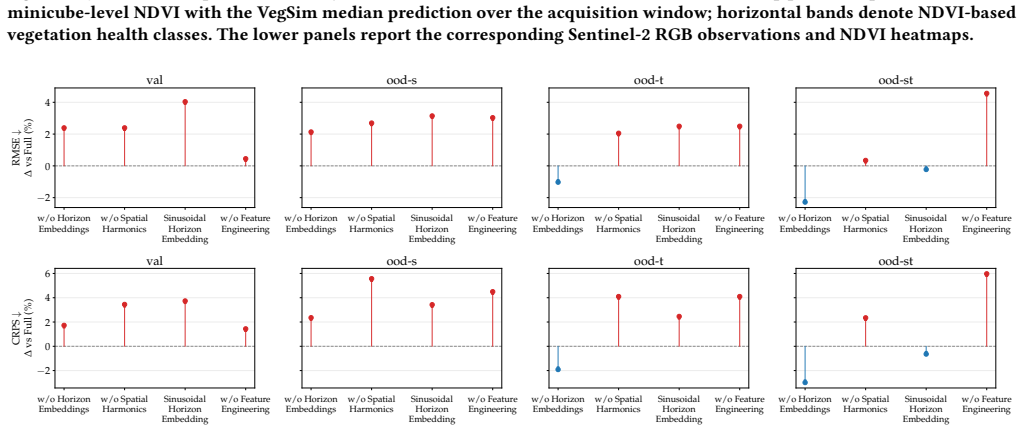
- [Abstract] Abstract: quantitative tables, error-bar details, and ablation results are referenced but not shown; the full manuscript should ensure these appear with clear metrics (e.g., CRPS, quantile scores) and baseline comparisons.
- [Methods] Notation: the distinction between the latent state update under observed versus user-specified forcing should be made explicit in the methods equations to avoid ambiguity about what is learned versus assumed.
Simulated Author's Rebuttal
We thank the referee for the constructive feedback on VegSim. We address the major comment regarding evaluation of the scenario-simulation capability below, acknowledging the limitations of our current quantitative results while clarifying the scope of the claims.
read point-by-point responses
-
Referee: [Evaluation / Results] Evaluation section (and abstract): the reported accuracy results cover in-distribution data plus spatial, temporal, and joint shifts on GreenEarthNet, but these perturbations do not alter the meteorological forcing distribution itself. The France 2022 case study is described only qualitatively. Because the central claim is that the same recurrent dynamics support reliable conditional simulation under arbitrary user-specified forcings never seen in training, the lack of quantitative held-out counterfactual validation or physical constraints directly undermines confidence in the scenario-simulation capability.
Authors: We agree that the reported quantitative results on GreenEarthNet use observed meteorological trajectories (even under spatial, temporal, and joint shifts) and do not constitute held-out counterfactual validation under completely novel forcing distributions. The France 2022 case study and Europe-wide scenario simulations are presented qualitatively, showing spatially coherent patterns consistent with known vegetation sensitivities. Direct quantitative evaluation of arbitrary user-specified forcings is not feasible, as no ground-truth observations exist for such counterfactual trajectories. The model's design conditions the recurrent latent dynamics explicitly on the meteorological input, enabling simulation under any provided forcing after training on historical data; however, this relies on the learned dynamics generalizing beyond the training forcing distribution. We will revise the manuscript to (1) explicitly state in the Evaluation and Discussion sections that quantitative results are limited to observed forcings and (2) add a dedicated limitations paragraph clarifying the assumptions and lack of physical constraints or counterfactual benchmarks for out-of-distribution meteorological inputs. These changes will temper the claims around reliability for arbitrary scenarios while preserving the demonstration of controllability. revision: partial
Circularity Check
No circularity: model trained on observed trajectories and applied to new forcings
full rationale
The paper trains recurrent latent dynamics exclusively on historical weather-NDVI pairs from GreenEarthNet and then applies the same dynamics to user-specified future forcings. No equation or claim reduces a simulation output to a fitted parameter by construction, nor does any load-bearing step rely on a self-citation whose content is itself unverified. Evaluation metrics are computed on held-out observed trajectories (in-distribution and shifts), while the scenario-conditioned use case is presented as an extrapolation whose validity is left to external validation. The derivation chain therefore remains self-contained against the training distribution and does not collapse into its own inputs.
Axiom & Free-Parameter Ledger
Reference graph
Works this paper leans on
-
[1]
Abdul Fatir Ansari, Oleksandr Shchur, Jaris Küken, Andreas Auer, Boran Han, Pedro Mercado, Syama Sundar Rangapuram, Huibin Shen, Lorenzo Stella, Xiyuan Zhang, Mononito Goswami, Shubham Kapoor, Danielle C. Maddix, Pablo Guerron, Tony Hu, Junming Yin, Nick Erickson, Prateek Mutalik Desai, Hao Wang, Huzefa Rangwala, George Karypis, Yuyang Wang, and Michael B...
Pith/arXiv arXiv 2025
-
[2]
Vitus Benson, Claire Robin, Christian Requena-Mesa, Lazaro Alonso, Nuno Carvalhais, José Cortés, Zhihan Gao, Nora Linscheid, Mélanie Weynants, and Markus Reichstein. 2024. Multi-modal Learning for Geospatial Vegetation Fore- casting. InProceedings of the IEEE/CVF Conference on Computer Vision and Pattern Recognition. 27788–27799
2024
-
[3]
Zhi-Ting Chen, Hong-Yan Liu, Chong-Yang Xu, Xiu-Chen Wu, Bo-Yi Liang, Jing Cao, and Deliang Chen. 2022. Deep learning projects future warming-induced vegetation growth changes under SSP scenarios.Advances in Climate Change Research13, 2 (2022), 251–257. VegSim: A Geospatial World Model for Scenario-Conditioned Vegetation Simulation
2022
-
[4]
Kyunghyun Cho, Bart van Merriënboer, Caglar Gulcehre, Dzmitry Bahdanau, Fethi Bougares, Holger Schwenk, and Yoshua Bengio. 2014. Learning Phrase Representations using RNN Encoder–Decoder for Statistical Machine Translation. InProceedings of the 2014 Conference on Empirical Methods in Natural Language Processing. Association for Computational Linguistics, ...
-
[5]
Codrut,-Andrei Diaconu, Sudipan Saha, Stephan Günnemann, and Xiao Xiang Zhu. 2022. Understanding the role of weather data for earth surface forecasting using a ConvLSTM-based model. InProceedings of the IEEE/CVF conference on computer vision and pattern recognition. 1362–1371
2022
-
[6]
Thibault Guinaldo, Aurore Voldoire, Robin Waldman, Stéphane Saux Picart, and Hervé Roquet. 2023. Response of the sea surface temperature to heatwaves during the France 2022 meteorological summer.Ocean Science19, 3 (2023), 629–647
2023
-
[7]
David Ha and Jürgen Schmidhuber. 2018. Recurrent world models facilitate policy evolution.Advances in neural information processing systems31 (2018)
2018
-
[8]
Danijar Hafner, Jurgis Pasukonis, Jimmy Ba, and Timothy Lillicrap. 2025. Mas- tering diverse control tasks through world models.Nature640, 8059 (2025), 647–653
2025
-
[9]
Jerry L Hatfield and John H Prueger. 2015. Temperature extremes: Effect on plant growth and development.Weather and climate extremes10 (2015), 4–10
2015
-
[10]
Sepp Hochreiter and Jürgen Schmidhuber. 1997. Long short-term memory. Neural computation9, 8 (1997), 1735–1780
1997
-
[11]
Anthony Hu, Lloyd Russell, Hudson Yeo, Zak Murez, George Fedoseev, Alex Kendall, Jamie Shotton, and Gianluca Corrado. 2023. Gaia-1: A generative world model for autonomous driving.arXiv preprint arXiv:2309.17080(2023)
Pith/arXiv arXiv 2023
-
[12]
Irene Iele, Giulia Romoli, Daniele Molino, Elena Mulero Ayllón, Filippo Ruffini, Paolo Soda, and Matteo Tortora. 2026. Probabilistic NDVI Forecasting from Sparse Satellite Time Series and Weather Covariates.arXiv preprint arXiv:2602.17683 (2026)
Pith/arXiv arXiv 2026
-
[13]
Hassan Ismail Fawaz, Benjamin Lucas, Germain Forestier, Charlotte Pelletier, Daniel F Schmidt, Jonathan Weber, Geoffrey I Webb, Lhassane Idoumghar, Pierre- Alain Muller, and François Petitjean. 2020. Inceptiontime: Finding alexnet for time series classification.Data Mining and Knowledge Discovery34, 6 (2020), 1936–1962
2020
-
[14]
Ming Jin, Shiyu Wang, Lintao Ma, Zhixuan Chu, James Zhang, Xiaoming Shi, Pin- Yu Chen, Yuxuan Liang, Yuan-Fang Li, Shirui Pan, et al. 2024. Time-LLM: Time Series Forecasting by Reprogramming Large Language Models. InInternational conference on learning representations, Vol. 2024. 23857–23880
2024
-
[15]
Diederik P Kingma and Jimmy Ba. 2014. Adam: A method for stochastic opti- mization.arXiv preprint arXiv:1412.6980(2014)
Pith/arXiv arXiv 2014
-
[16]
Klaus-Rudolf Kladny, Marco Milanta, Oto Mraz, Koen Hufkens, and Benjamin D Stocker. 2024. Enhanced prediction of vegetation responses to extreme drought using deep learning and Earth observation data.Ecological Informatics80 (2024), 102474
2024
-
[17]
Roger Koenker and Gilbert Bassett. 1978. Regression Quantiles.Econometrica46, 1 (1978), 33–50. doi:10.2307/1913643
-
[18]
International Journal of Forecasting 36, 167–177
Bryan Lim, Sercan O. Arik, Nicolas Loeff, and Tomas Pfister. 2021. Temporal Fusion Transformers for Interpretable Multi-horizon Time Series Forecasting.In- ternational Journal of Forecasting37, 4 (2021), 1748–1764. doi:10.1016/j.ijforecast. 2021.03.012
-
[19]
Yong Liu, Tengge Hu, Haoran Zhang, Haixu Wu, Shiyu Wang, Lintao Ma, and Mingsheng Long. 2023. itransformer: Inverted transformers are effective for time series forecasting.arXiv preprint arXiv:2310.06625(2023)
Pith/arXiv arXiv 2023
-
[20]
Yuxi Lu, Biao Wu, Zhidong Li, Kunqi Li, Chenya Huang, Huacan Wang, Qizhen Lan, Ronghao Chen, Ling Chen, and Bin Liang. 2025. Remote Sensing-Oriented World Model.arXiv preprint arXiv:2509.17808(2025)
arXiv 2025
-
[21]
Lucas Maes, Quentin Le Lidec, Damien Scieur, Yann LeCun, and Randall Balestriero. 2026. Leworldmodel: Stable end-to-end joint-embedding predic- tive architecture from pixels.arXiv preprint arXiv:2603.19312(2026)
Pith/arXiv arXiv 2026
-
[22]
João PA Martins, Sara Caetano, Carlos Pereira, Emanuel Dutra, and Rita M Cardoso. 2024. A satellite view of the exceptionally warm summer of 2022 over Europe.Natural Hazards and Earth System Sciences24, 4 (2024), 1501–1520
2024
-
[23]
Ben Mildenhall, Pratul P Srinivasan, Matthew Tancik, Jonathan T Barron, Ravi Ramamoorthi, and Ren Ng. 2021. NeRF: Representing scenes as neural radiance fields for view synthesis.Commun. ACM65, 1 (2021), 99–106
2021
-
[24]
David Montero, César Aybar, Chaonan Ji, Guido Kraemer, Maximilian Söchting, Khalil Teber, and Miguel D Mahecha. 2024. On-demand earth system data cubes. InIGARSS 2024-2024 IEEE International Geoscience and Remote Sensing Symposium. IEEE, 7529–7532
2024
-
[25]
David Montero, Guido Kraemer, Anca Anghelea, César Aybar, Gunnar Brandt, Gustau Camps-Valls, Felix Cremer, Ida Flik, Fabian Gans, Sarah Habershon, et al
-
[26]
Environmental Data Science3 (2024), e27
Earth system data cubes: Avenues for advancing earth system research. Environmental Data Science3 (2024), e27
2024
-
[27]
Ignacio Oguiza. 2023. tsai - A state-of-the-art deep learning library for time series and sequential data. Github. https://github.com/timeseriesAI/tsai
2023
-
[28]
Olivares, Cristian Challú, Federico Garza, Max Mergenthaler Canseco, and Artur Dubrawski
Kin G. Olivares, Cristian Challú, Federico Garza, Max Mergenthaler Canseco, and Artur Dubrawski. 2022. NeuralForecast: User friendly state-of-the-art neural forecasting models. PyCon Salt Lake City, Utah, US 2022. https://github.com/ Nixtla/neuralforecast
2022
-
[29]
Christian Requena-Mesa, Vitus Benson, Markus Reichstein, Jakob Runge, and Joachim Denzler. 2021. EarthNet2021: A large-scale dataset and challenge for Earth surface forecasting as a guided video prediction task.. InProceedings of the IEEE/CVF Conference on Computer Vision and Pattern Recognition. 1132–1142
2021
-
[30]
Claire Robin, Christian Requena-Mesa, Vitus Benson, Lazaro Alonso, Jeran Poehls, Nuno Carvalhais, and Markus Reichstein. 2022. Learning to forecast vegetation greenness at fine resolution over Africa with ConvLSTMs.arXiv preprint arXiv:2210.13648(2022)
arXiv 2022
-
[31]
Oleksandr Shchur, Caner Turkmen, Nick Erickson, Huibin Shen, Alexander Shirkov, Tony Hu, and Yuyang Wang. 2023. AutoGluon-TimeSeries: AutoML for Probabilistic Time Series Forecasting. InInternational Conference on Automated Machine Learning
2023
-
[32]
Srinivasan, Ben Mildenhall, Sara Fridovich-Keil, Nithin Raghavan, Utkarsh Singhal, Ravi Ramamoorthi, Jonathan T
Matthew Tancik, Pratul P. Srinivasan, Ben Mildenhall, Sara Fridovich-Keil, Nithin Raghavan, Utkarsh Singhal, Ravi Ramamoorthi, Jonathan T. Barron, and Ren Ng
-
[33]
InAdvances in Neural Information Processing Systems, Vol
Fourier Features Let Networks Learn High Frequency Functions in Low Dimensional Domains. InAdvances in Neural Information Processing Systems, Vol. 33. 7537–7547
-
[34]
Claudia Tebaldi, Kevin Debeire, Veronika Eyring, Erich Fischer, John Fyfe, Pierre Friedlingstein, Reto Knutti, Jason Lowe, Brian O’Neill, Benjamin Sanderson, et al. 2021. Climate model projections from the scenario model intercomparison project (ScenarioMIP) of CMIP6.Earth System Dynamics12, 1 (2021), 253–293
2021
-
[35]
Matteo Tortora, Francesco Conte, Gianluca Natrella, and Paolo Soda. 2026. MAT- Net: Multi-Level Fusion Transformer-Based Model for Day-Ahead PV Generation Forecasting.Frontiers in Artificial Intelligence(2026)
2026
-
[36]
Gomez, Lukasz Kaiser, and Illia Polosukhin
Ashish Vaswani, Noam Shazeer, Niki Parmar, Jakob Uszkoreit, Llion Jones, Aidan N. Gomez, Lukasz Kaiser, and Illia Polosukhin. 2017. Attention Is All You Need. InAdvances in Neural Information Processing Systems, Vol. 30
2017
-
[37]
Yuxuan Wang, Haixu Wu, Jiaxiang Dong, Guo Qin, Haoran Zhang, Yong Liu, Yunzhong Qiu, Jianmin Wang, and Mingsheng Long. 2024. TimeXer: Empowering transformers for time series forecasting with exogenous variables.Advances in Neural Information Processing Systems37 (2024), 469–498
2024
-
[38]
Philipp Wu, Alejandro Escontrela, Danijar Hafner, Pieter Abbeel, and Ken Gold- berg. 2023. Daydreamer: World models for physical robot learning. InConference on robot learning. PMLR, 2226–2240
2023
-
[39]
Linrui Xu, Zhongan Wang, Fei Shen, Gang Xu, Huiping Zhuang, Ming Li, and Haifeng Li. 2026. RS-WorldModel: a Unified Model for Remote Sensing Under- standing and Future Sense Forecasting.arXiv preprint arXiv:2603.14941(2026)
arXiv 2026
-
[40]
Sijie Zhao, Hao Chen, Xueliang Zhang, Pengfeng Xiao, and Lei Bai. 2025. VegeDiff: Latent Diffusion Model for Geospatial Vegetation Forecasting.IEEE Transactions on Geoscience and Remote Sensing63 (2025), 4410214. doi:10.1109/TGRS.2025. 3564317
-
[41]
Haoyi Zhou, Shanghang Zhang, Jieqi Peng, Shuai Zhang, Jianxin Li, Hui Xiong, and Wancai Zhang. 2021. Informer: Beyond Efficient Transformer for Long Sequence Time-Series Forecasting. InProceedings of the AAAI Conference on Artificial Intelligence, Vol. 35. 11106–11115. doi:10.1609/aaai.v35i12.17325
discussion (0)
Sign in with ORCID, Apple, or X to comment. Anyone can read and Pith papers without signing in.