REVIEW 3 major objections 5 minor 3 cited by
AI and Deep Learning for Terahertz Ultra-Massive MIMO: From Model-Driven Approaches to Foundation Models
T0 review · 3 major / 5 minor · reviewed 2026-08-11 · deepseek-v4-flash
Pith's one-line read A single compact neural network that learns the score function of terahertz UM-MIMO wireless channels could serve as a shared foundation for channel estimation, data detection, CSI compression, and data augmentation, replacing many…
desk verdict A useful roadmap review whose central raw-signal training claim for a CSI foundation model has a real technical gap; the rest is solid and it deserves peer review. read the letter →
The pith
A machine-rendered reading of the paper's core claim, the machinery that carries it, and where it could break.
The reading
What carries the argument
The load-bearing object is the score network, $\mathbf{s}_\theta(\mathbf{h}) \approx \nabla_{\mathbf{h}} \log p(\mathbf{h})$, a neural estimator of the channel score function. The score function is connected to the MMSE denoiser through Tweedie's formula, which lets the same network serve as the non-linear estimator inside OAMP and other approximate-message-passing algorithms; this connection is what makes the prior open-ended. Training uses denoising score matching when clean channels exist and SURE or GSURE losses when only raw received signals $\mathbf{y} = \mathbf{M}\mathbf{h} + \mathbf{n}$ are available. The paper also relies on fixed-point networks, which turn iterative algorithms into contractive learned operators with convergence guarantees, as the interface for plugging the score prior into model-driven deep learning.
What would settle it
A measurement campaign at a terahertz UM-MIMO testbed that counts resolvable multipaths as array aperture and bandwidth scale: if the number of significant paths grows with system scale or environment complexity so that no compact score model matches the empirical channel distribution, the foundation-model premise fails. A simpler experiment: train the proposed score network on raw pilots from a measured indoor terahertz channel and compare channel-estimation NMSE against least-squares and sample-MMSE estimators; if the score-based prior does not beat these baselines across SNR, the central claim is not supported.
Extended reading notes
Core claim
The central discovery, proposed rather than experimentally established, is that the score function of terahertz UM-MIMO channels can be learned once and reused everywhere. The score function is the gradient of the log-density of the channel distribution, a vector field pointing toward more probable channel states. Trained by denoising score matching on clean channel data or, via SURE and GSURE losses, directly on raw noisy and incomplete received pilots, the score network becomes an open-ended Bayesian prior. With it, a designer can perform prior sampling to synthesize channels, posterior sampling to estimate channels from measurements, sequential sampling to compress and reconstruct CSI, and joint sampling for tasks such as combined channel estimation and data detection. The paper demonstrates the concept in a near-field 1024-antenna UM-MIMO channel estimation case study, where the score-based prior plugged into an OAMP fixed-point network approaches the oracle MMSE bound.
Load-bearing premise
Terahertz UM-MIMO channels can be captured by a compact generative model because they have few significant multipaths, making their effective dimension much smaller than the antenna count; if real channels are not that low-dimensional, the score prior will be too weak to support the promised transceiver modules.
Editorial extensions
If this is right
- A single pretrained score network replaces task-specific channel estimation, detection, and compression networks, cutting training and deployment cost.
- Transceiver modules can be designed without clean channel labels: SURE and GSURE losses allow training from raw received pilots, which matters when ground-truth channels are hard to measure.
- Model-driven deep learning and foundation models compose: the score prior plugs into OAMP and AMP as an MMSE denoiser, so convergence-guaranteed algorithms can use a learned prior.
- Data augmentation from the prior reduces the need for large measurement campaigns, directly addressing the hard-to-measure problem.
- Conditional score networks using labels such as weather, line-of-sight status, or position let one model serve many sites and scenarios without retraining.
Reading between the lines
- The paper leaves implicit that the same score prior could extend beyond transceiver modules to joint sensing and communication, localization, and environment mapping, since those tasks also depend on the channel distribution; the paper's non-exhaustive sampling list invites this extension.
- A testable near-term extension is to pre-train the score network on synthetic channels generated by a site-specific ray tracer, then fine-tune it on raw received pilots using low-rank adaptation; this would test whether measurement burden can be reduced further than the paper's case study.
- If the compactness claim holds, CSI foundation models could be shared across base stations through federated low-rank adaptation, preserving privacy while adapting to each site; the paper mentions federated LoRA but does not develop this for terahertz UM-MIMO.
Signed reviews
Editorial analysis
A structured set of objections, weighed in public.
Referee Report
Summary. This paper is a research-roadmap review for applying AI and deep learning to terahertz ultra-massive MIMO (UM-MIMO) systems. It identifies three challenges, termed "hard-to-compute," "hard-to-model," and "hard-to-measure," and proposes three roadmaps: (1) model-driven deep learning based on fixed point networks and neural calibration, with steps for algorithmic frameworks, basis algorithms, loss design, and neural architecture; (2) a "CSI foundation model" that learns the score function of wireless channels and uses it as a shared generative prior for estimation, compression, detection, and other transceiver tasks; and (3) applications of large language models to estimation, optimization, search, network management, and protocol understanding. The paper includes two model-driven case studies (beam-focusing and data detection) and one CSI foundation model case study (channel estimation), all reproduced from the authors' prior peer-reviewed work. The central original proposal is that a single compact score-based generative model, trained on either clean channels or raw received signals, can serve as an open-ended prior for many physical-layer tasks.
Significance. If the CSI foundation model concept works as envisioned, it would be a substantial step toward unifying transceiver design in 6G systems: a single learned channel prior could replace task-specific networks, reducing training and deployment cost. The paper also provides a useful synthesis of model-driven DL techniques, including fixed point networks, neural calibration, SURE/GSURE losses, graph neural networks, hypernetworks, transform-domain learning, and NeRF2/Gaussian splatting, and connects them to terahertz-specific channel properties such as the hybrid-field effect, beam squint, and array-of-subarrays architecture. The explicitly identified open problems in Section 5 are honest about the scarcity of real terahertz measurements and the unresolved scalability issues. However, the paper makes no new derivations, and its case-study evidence is entirely reproduced from prior simulations; the load-bearing novelty is the roadmap for training a generative prior from corrupted measurements, and that roadmap currently has an internal technical gap.
major comments (3)
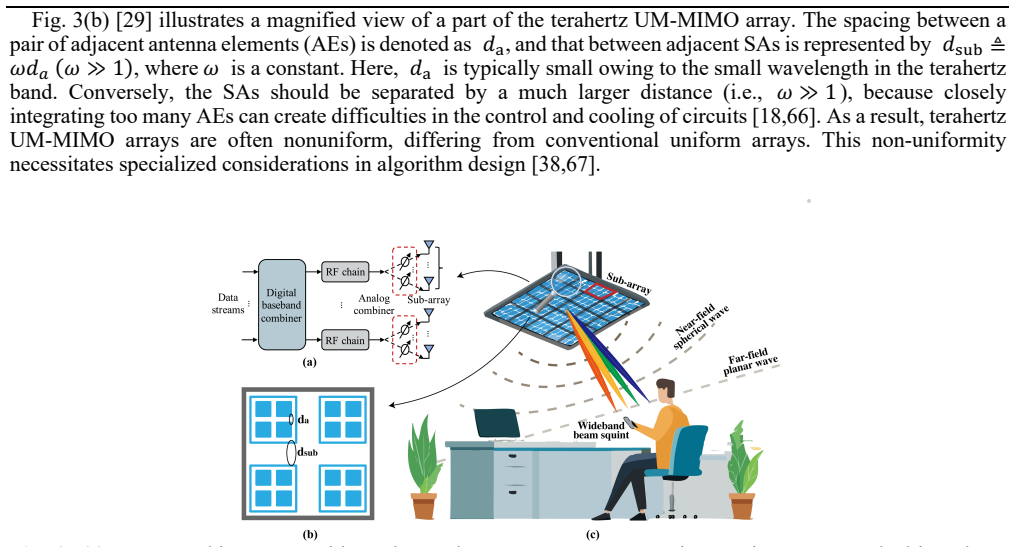
- [Section 4.2.1] The raw-signal training pathway asserts: "the (prior) score function ∇_h log p(h) can be estimated using empirical Bayesian methods based on the SURE loss" for y = h + n and via GSURE for y = Mh + n. This conflates the score of the noisy measurement density with the clean-channel score. SURE/GSURE and Stein-type unbiased risk estimators provide, at a fixed noise variance, the MMSE denoiser E[h|y] via Tweedie's formula; they do not provide ∇_h log p(h) across the noise schedule t → 0 that a score-based generative prior requires. Adding synthetic noise to y only yields scores at total noise levels greater than or equal to the observation noise level, so the low-noise portion of the diffusion schedule needed for generation and joint sampling is not identifiable from one noisy observation per channel without additional deconvolution or modeling assumptions. This is a load-bearing gap because the hard-to-measure motivation of the CSI foundation model depends on training from corrupted measurements, and the case study in Section 4.2.5 trains only a denoiser, not a generative score model. The authors should either weaken the claim to "MMSE denoiser at the operating noise level" or provide a concrete method for obtaining the full score schedule from noisy data.
- [Section 4.2.5] The case study presented as a CSI foundation model demonstration trains a denoising auto-encoder on y = h + n and then uses Tweedie's formula to obtain an MMSE denoiser for the OAMP framework. This validates a denoiser-based plug-and-play prior at a fixed noise level, but it does not demonstrate the generative capabilities central to the roadmap: prior sampling for data augmentation, posterior sampling for inverse problems, sequential sampling for compression, or joint sampling for cross-module design are not implemented or evaluated. The text states "we train the score network s_θ(h) by using denoising auto-encoders based on y [94]" and then immediately derives a denoiser; there is no evidence that the learned network can be sampled as a score-based generative model. The authors should explicitly position this case study as a denoiser-only instantiation and identify which parts of the roadmap remain unvalidated.
- [Section 2.2.2 and Section 4.2.1] The compactness and sample-efficiency of the CSI foundation model rest on the premise that "the effective dimensionality of high-frequency wireless channels is small because of the limited number of paths" (Section 4.2.1). The paper cites a measurement at 300 GHz with five multipaths (Section 2.2.2), but it simultaneously emphasizes hybrid-field effects, spatial non-stationarity, and wideband beam squint, which complicate sparse representations and may increase the intrinsic complexity of the channel distribution. The roadmap would be strengthened by formulating this as a falsifiable hypothesis, for example by specifying how the sample complexity of score matching scales with the number of paths and array size, rather than presenting the low-dimensionality claim as an established fact. As written, the reader cannot tell whether the "compact" foundation model is a design principle or an empirical conjecture.
minor comments (5)
- [Section 4.2] The subsection numbering is duplicated: both "Conditioning" and "Site-specific adaptation" are numbered 4.2.2. The second should be 4.2.3.
- [Abstract] The abstract states "Four essential steps are outlined: general frameworks, conditioning, site-specific adaptation, joint design of CSI foundation models, and model-driven DL," but this lists five items. The list should be reduced to four, as in Section 4.2, or the sentence should be rephrased.
- [Fig. 8 caption] The caption defines the under-sampling ratio as "the number of columns in measurement matrix M divided by its number of rows," which describes an over-sampling ratio for a fat measurement matrix. If the intended quantity is the usual compressive-sensing ratio M/N (rows/columns), the definition should be corrected for consistency with the literature.
- [References] Reference [154] is missing from the reference list, and the in-text citation sequence jumps from [153] to [155] in Section 4.2. The numbering should be corrected.
- [Section 3] In the sentence "we discuss the manifestation of these challenges in terahertz UM-MIMO systems, this explains the motivation for integrating DL with terahertz UM-MIMO systems," a comma splice is used; it should be rephrased as two sentences or joined with a semicolon.
Circularity Check
No significant circularity: the paper is a roadmap/review whose components are external results or credited prior simulations, and the only contentious step is a feasibility gap, not a definitional reduction.
full rationale
This is a research-roadmap review, not a derivation, so the standard circularity reductions (output defined in terms of input, fitted parameter renamed as a prediction, self-citation used as a uniqueness theorem) do not occur. The model-driven DL frameworks are recommendations built on external results (Banach fixed-point theorem, OAMP/AMP, SURE/GSURE, Tweedie's formula) and on the authors' own previously published, peer-reviewed simulations (Refs. [38], [85], [94], [99], [102]); those citations are concrete algorithms and simulations with stated system models, not an unverified self-citation chain, and the paper explicitly credits reprinted figures to those sources. The one load-bearing step that deserves scrutiny is Section 4.2.1's statement that SURE/GSURE loss estimates the clean-channel prior score ∇_h log p(h) from y=h+n or y=Mh+n; as written, SURE and Tweedie provide a denoiser and the score of the noisy measurement density, not the full clean-channel score across a diffusion schedule needed for generative sampling. This is an under-supported feasibility/correctness claim in a proposal, not a circular equivalence: the object is over-claimed, not defined into existence by the loss. The paper's own stated limitations (e.g., no beam-squint effect in the case study, NeRF2's latency) are scoping remarks. No quoted equation equates a predicted quantity to its fitted input, so no enumerated circularity pattern can be exhibited; score 0.
Assumptions & free parameters
assumptions (5)
- domain assumption Transceiver designs share a common foundation, the wireless channel.
- domain assumption Terahertz UM-MIMO channels have low effective dimensionality because the number of multipaths is limited.
- ad hoc to paper Learnable modules in fixed point networks can be trained to be contractive without sacrificing approximation quality.
- domain assumption The score function of wireless channels can be estimated from raw received signals via SURE and GSURE losses under the fat measurement model y = Mh + n.
- domain assumption Pretrained large language models can provide useful solutions for wireless estimation, optimization, search, network management, and protocol understanding.
Cite this review
Pith. "Pith review of AI and Deep Learning for Terahertz Ultra-Massive MIMO: From Model-Driven Approaches to Foundation Models." pith.science (2026). https://pith.science/paper/3WSTLHU5
@misc{pith2026241209839,
  author       = {Pith},
  title        = {Pith review of: AI and Deep Learning for Terahertz Ultra-Massive MIMO: From Model-Driven Approaches to Foundation Models},
  year         = {2026},
  howpublished = {\url{https://pith.science/paper/3WSTLHU5}},
  note         = {Machine review of arXiv:2412.09839}
}
read the original abstract
This study explored the transformative potential of artificial intelligence (AI) in addressing the challenges posed by terahertz ultra-massive multiple-input multiple-output (UM-MIMO) systems. It begins by outlining the characteristics of terahertz UM-MIMO systems and identifies three primary challenges for transceiver design: computational complexity, modeling difficulty, and measurement limitations. The study posits that AI provides a promising solution to these challenges. Three systematic research roadmaps are proposed for developing AI algorithms tailored to terahertz UM-MIMO systems. The first roadmap, model-driven deep learning (DL), emphasizes the importance of leveraging available domain knowledge and advocates the adoption of AI only to enhance bottleneck modules within an established signal processing or optimization framework. Four essential steps are discussed: algorithmic frameworks, basis algorithms, loss-function design, and neural architecture design. The second roadmap presents channel state information (CSI) foundation models, aimed at unifying the design of different transceiver modules by focusing on their shared foundation, that is, the wireless channel. The training of a single compact foundation model is proposed to estimate the score function of wireless channels, which serve as a versatile prior for designing a wide variety of transceiver modules. Four essential steps are outlined: general frameworks, conditioning, site-specific adaptation, joint design of CSI foundation models, and model-driven DL. The third roadmap aims to explore potential directions for applying pretrained large language models (LLMs) to terahertz UM-MIMO systems. Several application scenarios are envisioned, including LLM-based estimation, optimization, search, network management, and protocol understanding. Finally, the study highlights open problems and future research directions.
Figures


Figures from the paper (5 more)


Forward citations
Cited by 3 Pith papers
-
A look at adversarial attacks on radio waveforms from discrete latent space
A VQVAE's discrete reconstruction substantially reduces the effectiveness of adversarial attacks on high-SNR radio waveform classifiers.
-
Large Language Model Enabled Multi-Task Physical Layer Network
A single fine-tuned LLM backbone with task-specific encoders, decoders, and text prompts performs three physical-layer wireless tasks with accuracy close to dedicated single-task networks.
-
Multimodal Deep Learning-Empowered Beam Prediction in Future THz ISAC Systems
A softmax-gated weighted fusion of vision and GPS features improves top-1 beam prediction accuracy on two DeepSense6G scenarios compared with unimodal and concatenation baselines.
Reference graph
Works this paper leans on
-
[11]
FCC takes steps to open spectrum horizons for new services and technologies
Federal Communications Commission (FCC). FCC takes steps to open spectrum horizons for new services and technologies. Neil: Federal Communications Commission; 2018. [12] Petrov V, Kurner T, Hosako I. IEEE 802.15.3d: first standardization efforts for sub-terahertz band communications toward 6G. IEEE Commun Mag 2020;58(11):28–33. [13] Marzetta TL. Noncooper...
work page 2018
-
[35]
ML detection without CSI for constant-weight codes in THz communications with strong phase noise
Wu Y, Koch JD, Vossiek M, Schober R, Gerstacker W. ML detection without CSI for constant-weight codes in THz communications with strong phase noise. In: Proceedings of IEEE Global Communications Conference; 2022 Dec 4–8; Rio de Janeiro, Brazil. New York City: IEEE; 2022. p. 831–6. [36] Bicais S, Dore JB. Design of digital communications for strong phase n...
work page 2022
-
[59]
Terahertz band communication: an old problem revisited and research directions for the next decade
Akyildiz IF, Han C, Hu Z, Nie S, Jornet JM. Terahertz band communication: an old problem revisited and research directions for the next decade. IEEE Trans Commun 2022;70(6):4250–85. [60] Bodet D, Hall J, Masihi A, Thawdar N, Melodia T, Restuccia F, et al. Data signals for deep learning applications in terahertz communications. Comput Netw 2024;254:110800....
work page 2022
-
[83]
Sionna: an open-source library for next-generation physical layer research
Hoydis J, Cammerer S, Aoudia FA, Vem A, Binder N, Marcus G, et al. Sionna: an open-source library for next-generation physical layer research. 2022. arXiv:220311854. [84] Cui M, Wu Z, Lu Y, Wei X, Dai L. Near-field MIMO communications for 6G: fundamentals, challenges, potentials, and future directions. IEEE Commun Mag 2023;61(1):40–6. [85] Yu W, Ma Y, He ...
work page 2022
-
[106]
Quantized compressed sensing with score-based generative models
Meng X, Kabashima Y. Quantized compressed sensing with score-based generative models. In: Proceedings of the Eleventh International Conference on Learning Representations ICLR 2023; 2023 May 1–5; Kigali, Rwanda. New York City: IEEE; 2023. [107] Elata N, Michaeli T, Elad M. Adaptive compressed sensing with diffusion-based posterior sampling. In: Proceeding...
arXiv 2023
-
[130]
Generalized SURE for exponential families: applications to regularization
Eldar YC. Generalized SURE for exponential families: applications to regularization. IEEE Trans Signal Process 2009;57(2):471–81. [131] Yu W, He H, Yu X, Song S, Zhang J, Letaief KB. Blind performance prediction for deep learning based ultra-massive MIMO channel estimation. In: Proceedings of IEEE International Conference on Communications; 2023 May 28–Ju...
work page 2009
-
[153]
Denoising diffusion probabilistic models
Ho J, Jain A, Abbeel P. Denoising diffusion probabilistic models. In: Proceedings of the 34th International Conference on Neural Information Processing Systems; 2020 Dec 6–12; Vancouver, BC, Canada. Red Hook: Curran Associates Inc.; 2020. p. 6840–51. [155] Alikhani S, Charan G, Alkhateeb A. Large wireless model (LWM): a foundation model for wireless chann...
arXiv 2020
-
[177]
Federated low-rank adaptation for large models fine-tuning over wireless networks
Sun H, Tian H, Ni W, Zheng J, Niyato D, Zhang P. Federated low-rank adaptation for large models fine-tuning over wireless networks. IEEE Trans Wirel Commun 2025;24(1):659–75. [178] Kang T, Wang Z, He H, Zhang J, Song S, Letaief KB. Federated low-rank adaptation with differential privacy over wireless networks. 2024. arXiv:241107806. [179] Zhang K, He H, S...
arXiv 2025
Reviewed August 11, 2026 · model on record in the stance chip above.
Discussion (0). Continue with ORCID to comment.