REVIEW 4 major objections 4 minor 50 references
Zero-Clustering Geometry in Realistic Fractional Quantum Hall Wave Functions
T0 review · 4 major / 4 minor · reviewed 2026-08-07 · deepseek-v4-flash
Pith's one-line read The zero displacement ratio ζ diagnoses the Laughlin phase, and its statistics identify the ν=1/5 Coulomb ground state as a composite-fermion fluid at effective filling 1/3.
desk verdict New zero-displacement ratio is a solid diagnostic; the CFF wave function is promising but the 'almost perfect' overlap claim rests on a fitted parameter at N≤6. read the letter →
The pith
A machine-rendered reading of the paper's core claim, the machinery that carries it, and where it could break.
The reading
What carries the argument
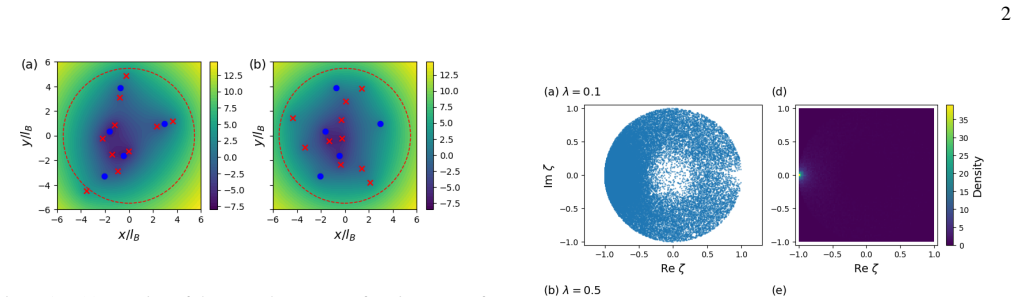
The central object is the zero displacement ratio $\zeta = (z_1 - z_e)/(z_2 - z_e)$, a complex number comparing the displacements from an electron at $z_e$ to its two nearest non-Pauli zeros. The non-Pauli zeros are the $m-1$ extra zeros, beyond the one required by the Pauli principle, that a Laughlin wave function at filling $1/m$ places at each frozen electron; they are the carriers of correlation. The ratio is bounded by the unit circle, with $|\zeta|=1$ meaning the two zeros are equidistant from the electron, $\zeta=-1$ meaning they sit diametrically opposite (the Laughlin hallmark), and $\zeta=1$ avoided because zeros repel each other. The machinery is statistical: the paper accumulates $\zeta$ over thousands of randomly fixed electron configurations, plots its density, and tracks the argument distribution $P(\phi)$ and its kurtosis as an order parameter. For $\nu=1/5$, the ratio is generalized to $\zeta_{ij}$ for the $i$-th and $j$-th nearest zeros, and the construction $\Psi_{\mathrm{CFF}} = \prod_{i<j}(z_i-z_j)^2\,\Psi_{1/3\,\mathrm{fluid}}(\lambda)$ is the wave-function ansatz whose parent state is tuned near the $\nu^*=1/3$ transition so that short-range crystalline correlations complement the liquid.
What would settle it
Compute the overlap $O$ between $\Psi_{\mathrm{CFF}}$ built from the $\nu^*=1/3$ parent at $\lambda=\lambda_{\mathrm{opt}}$ and the exact $\nu=1/5$ Coulomb ground state for $N=7$-$10$ in disk or spherical geometry; if $O$ falls below the overlap of the Laughlin state or of the composite-fermion crystal state as $N$ grows, the claim that the $\nu=1/5$ state is a composite-fermion fluid rather than a crystal-tinged Laughlin state fails. A second check is the $\zeta$ density map: if at larger $N$ the two-vortex-composite-fermion map no longer matches the $\nu=1/3$ electron map, the geometrical argument for two-vortex binding is not robust.
Extended reading notes
Core claim
The paper's central discovery is that the geometry of non-Pauli zeros around individual electrons is a quantitative diagnostic of topological order in fractional quantum Hall states. Concretely, it defines $\zeta = (z_1 - z_e)/(z_2 - z_e)$ for each electron, where $z_1$ and $z_2$ are the two nearest non-Pauli zeros; in a Laughlin-like state the two zeros sit nearly opposite one another, giving a sharp peak near $\zeta = -1$, whereas repulsion between zeros and electrons keeps the ratio away from $0$ and $1$. On the torus, as the $V_3$ pseudopotential is switched on against $V_1$, the argument distribution $P(\phi)$ changes from a sharp peak at $\phi=\pi$ to a flat plateau at $\eta_c\approx 0.4$, and its kurtosis drops to about $2$, matching the closure of the ground-state energy gap; the paper reads this as the $\zeta$ statistics functioning as an order parameter for the collapse of the $\nu=1/3$ Laughlin phase. At $\nu=1/5$, the pure Coulomb ground state does not bind four zeros per electron in the Laughlin square pattern; instead two zeros bind tightly while the outer two meander, indicating composite fermions carrying two vortices at effective filling $\nu^*=1/3$. Defining $\Psi_{\mathrm{CFF}} = \prod_{i<j}(z_i-z_j)^2\,\Psi_{1/3\,\mathrm{fluid}}(\lambda)$, with the parent fluid taken at a mixing parameter $\lambda_{\mathrm{opt}}\approx 1.09$, the overlap with the exact $\nu=1/5$ Coulomb ground state reaches $0.999988$, $0.999131$, $0.997742$, and $0.985935$ for $N=3,4,5,6$, uniformly better than the model Laughlin wave function and better than the artificial crystallite-embedded composite-fermion crystal for $N=3$-$5$. The $\zeta$ density map for these two-vortex composite fermions closely resembles that of electrons at $\nu=1/3$, which the paper takes as direct evidence that the $\nu=1/5$ Coulomb state is a composite-fermion fluid.
Load-bearing premise
The load-bearing premise is that the two nearest non-Pauli zeros around each electron can be unambiguously identified as belonging to that electron; in the $\nu=1/5$ Coulomb case the two outer zeros can wander so far that they come closer to a different electron, so the $\zeta$ statistics and the composite-fermion-fluid comparison depend on that nearest-neighbor assignment.
Editorial extensions
If this is right
- The $\nu=1/5$ Coulomb ground state for $N=3$-$6$ electrons is better described as a fluid of two-vortex composite fermions at effective filling $1/3$ than as a Laughlin $1/5$ liquid or a crystallite-embedded composite-fermion crystal: the CFF overlap is $0.999988$, $0.999131$, $0.997742$, $0.985935$, versus $0.985392$, $0.947491$, $0.909861$, $0.842390$ for the Laughlin state.
- The zero displacement ratio can serve as an order parameter: on the torus the kurtosis of $P(\phi)$ drops from its Laughlin value to about $2$ at $\eta_c\approx 0.4$, the same coupling at which the ground-state energy gap closes, marking the collapse of Laughlin order into a charge-ordered phase.
- A generalized ratio $\zeta_{ij}$ shows that at $\nu=1/5$ the four zeros per electron do not form the Laughlin square pattern under Coulomb interaction; only two zeros bind tightly, so the picture of four evenly bound zeros is not the right zeroth-order description.
- The CFF construction with $\lambda$ tuned near the $\nu^*=1/3$ parent transition provides a variational family that captures the crystalline correlations present in the short-distance Coulomb ground state without explicitly embedding a lattice.
- The near-perfect agreement at $N=3$-$5$ suggests the composite-fermion-fluid description, not the composite-fermion-crystal mixture, already reveals the thermodynamic nature of the $\nu=1/5$ state at tiny sizes.
Reading between the lines
- At larger $N$ or on different geometries the nearest-neighbor assignment used to define $\zeta$ may become ambiguous because the two outer zeros in the $\nu=1/5$ case can wander closer to a different electron; testing the order parameter there would show whether the assignment, not the physics, is what limits the method.
- The fact that $\lambda_{\mathrm{opt}}\approx 1.09$ sits just below the $\nu^*=1/3$ parent transition suggests a general variational principle: realistic low-filling quantum Hall states inherit near-critical correlations from their parent state, and tuning the parent toward its own phase boundary is a tunable handle even when the final filling is deep in the liquid regime.
- The same zero-clustering statistics could be applied to fractional Chern insulators, where there are no Landau levels and the meaning of zeros is less direct; if the $\zeta$ signature survives there, it would supply a local wave-function diagnostic for topological order in lattice systems.
Signed reviews
Editorial analysis
A structured set of objections, weighed in public.
Referee Report
Summary. The manuscript develops a geometrical diagnostic for fractional quantum Hall states based on the complex ratio ζ = (z1 - z_e)/(z2 - z_e) between the two nearest non-Pauli zeros around a fixed electron. The authors show that in the ν=1/3 Laughlin phase the distribution of ζ peaks near -1, that this peak flattens at a V1-V3 transition at η_c≈0.4 in agreement with the closing of the ground-state gap, and that at ν=1/5 the Coulomb ground state exhibits a hierarchy in which only two vortices are tightly bound per electron. They then construct a composite-fermion fluid trial state Ψ_CFF = ∏(z_i-z_j)^2 Ψ_{1/3,fluid}(λ) and report overlaps with the exact ν=1/5 Coulomb ground state that exceed the Laughlin overlap and are near unity when λ is tuned per system size.
Significance. If the central claim survives scrutiny, the zero displacement ratio would be a useful, computationally simple diagnostic for Laughlin-type order, and the CFF wave function at ν=1/5 would provide a physically motivated alternative to the CF crystal construction that has been the standard variational description at short distances. The manuscript's strongest evidence is partly parameter-free: the un-fitted CCFF overlaps in Table I exceed the Laughlin overlaps for all N=3-6, and the ζ distribution is raw wave-function data rather than a fit. The algebraic flux-attachment procedure allows exact overlaps for N≤6, and the near size-independence of λ_opt (1.088, 1.085, 1.083, 1.099) is encouraging. However, the load-bearing 'almost perfect' overlap claim is not parameter-free, and the zero-assignment ambiguity in the ν=1/5 regime weakens the interpretive part of the paper.
major comments (4)
- [Composite-fermion fluids at ν=1/5, Table I] The 'almost perfect' agreement is an in-sample variational result. For each N, λ_opt is obtained by maximizing the overlap with the exact Coulomb ground state on that same system, so the O_VCFF column records optimized maxima rather than predictive agreements. The un-fitted CCFF overlaps (0.995733, 0.983465, 0.954991, 0.893517 for N=3-6) decrease steadily, which shows that the parameter-free part of the claim weakens with N. Please provide a predictive test: use a single fixed λ (for example the average λ_opt ≈ 1.09, or λ = 1) and report overlaps for all available N up to 7 or 8, or otherwise demonstrate that the fitted improvement is not merely an artifact of per-size optimization. Without this, the concluding statement that the CFF construction 'reveals the true thermodynamic nature at tiny sizes' is not supported.
- [Supplement Sec. II and Fig. S3(d); main Fig. 4(d)] The zero-to-electron assignment that underlies the 2CF claim is fragile at λ=1. Fig. S3(d) shows that the 3rd and 4th nearest zeros are no longer unambiguously closer than the 5th nearest zero, and the main text acknowledges that the outer zeros 'meander around farther away.' Because the ζ statistics for the 2CFs in Fig. 5 are computed from these assigned zeros, the conclusion that exactly two vortices are tightly bound may depend on the nearest-neighbor criterion. Please quantify the stability of the assignment, for example by testing alternative assignment rules, by tracking the fraction of configurations in which the nearest-neighbor ordering is ambiguous, or by showing that the ζ density maps are insensitive to the choice of the two 'next NN' zeros. If the assignment is not robust, the qualitative motivation for Eq. (3) should be softened.
- [Evolution of zeros during the collapse of the ν=1/3 Laughlin phase, Fig. 3] The order-parameter claim is based on a single system size, N=6, on the torus. The kurtosis K drops at η_c≈0.4 and the gap closes at the same η_c, which is suggestive, but there is no finite-size scaling and no estimate of the uncertainty in the location of the kurtosis drop. Please show data for at least one or two other system sizes (for example N=4, 5, 7, or 8) or a finite-size extrapolation of the transition point. If this is not available, the text should be revised to call the kurtosis an indicative diagnostic rather than an order parameter.
- [Composite-fermion fluids at ν=1/5] The comparison with the CF crystal construction of Ref. [34] is not quantitative. The text states that 'our CFF wave function at λ_opt shows consistently better overlaps for N=3-5,' but Table I does not include the corresponding CF crystal overlaps reported by Chang et al. Since this comparison is the basis for the claim that the fluid construction overcomes the short-distance competition between liquid and crystal orders, the CF crystal overlap values from Ref. [34] should be listed explicitly, or the claim should be rephrased as a qualitative statement.
minor comments (4)
- [Abstract and Table I] The abstract says the CFF state agrees almost perfectly for 3-5 electrons, while Table I reports N=3-6; please harmonize the wording (for example, '3-6 electrons').
- [Supplement, Fig. S5 caption] The phrase 'electron desity' should read 'electron density.'
- [Composite-fermion fluids at ν=1/5] The text reports λ_opt = 1.091 ± 0.008 but Table I lists four values without uncertainties; please state explicitly how the mean and standard error are computed from the per-size values.
- [Fig. 3(d)] The kurtosis K is a functional of the distribution rather than a physical order parameter; consider using the term 'diagnostic' or 'indicator' in the caption and text to avoid confusion with Landau-type order parameters.
Circularity Check
The 'almost perfect' CFF overlap at ν=1/5 is an in-sample optimum over λ_opt chosen per system size, so the central quantitative agreement is a fitted maximum rather than a prediction; independent zero-statistics and λ=1 overlaps keep the circularity partial.
-
fitted input called prediction
[Eq. (3), Table I, and the surrounding text in 'Composite-fermion fluids at ν=1/5']
"The VCFF state is constructed from the ν*=1/3 parent ground state with λ=λ_opt that maximizes the overlap with the exact ground state. ... The variation of λ allows us to further improve the overlap between the CFF state and the Coulomb ground state. The optimal tuning λ_opt = 1.091±0.008 is almost size-independent ... Therefore, our CFF construction reveals the true thermodynamic nature at tiny sizes."
The reported 'almost perfect' agreement is O_VCFF, obtained by choosing λ_opt at each N to maximize O(λ)=|⟨Ψ_CFF(λ)|Ψ_exact⟩| on the exact ground state whose nature is being claimed. Hence the headline overlap is, by construction, the maximum of a one-parameter fit to that same state, not a predicted overlap. The near-size-independence of λ_opt is post-hoc evidence but does not make the in-sample maximum an out-of-sample test. The parameter-free CCFF column and the ζ-distribution maps are independent evidence for the CF-fluid family, so the paper does not reduce entirely to the fit, but the strongest quantitative claim ('agrees almost perfectly', 'reveals the true thermodynamic nature at tiny sizes') is a fitted maximum.
full rationale
The ζ definition and the ν=1/3 transition diagnostic are self-contained numerical analyses: Eq. (2) is an empirical ratio, and the kurtosis drop at η_c≈0.4 coincides with the gap closure without any fitted parameter. The ν=1/5 CF-fluid conclusion has two ingredients. The zero-clustering comparison in Fig. 5 is raw wave-function data and is not circular. The CFF ansatz Eq. (3) is a variational family; the CCFF column (λ=1) is parameter-free and does beat the Laughlin state at N=3–6, which is genuine independent support. However, the headline 'agrees almost perfectly' is taken from the O_VCFF column, where λ_opt is fitted to maximize the overlap with the exact state for each N. Thus the central quantitative agreement is an in-sample variational maximum, not a prediction. The paper transparently labels λ_opt, but then uses it to claim the thermodynamic nature is revealed at tiny sizes, so the circularity is partial rather than total. No load-bearing self-citation chain or imported uniqueness theorem is present; references to the authors' prior PCA and anisotropic-work papers are supporting remarks, not the argument's foundation.
Assumptions & free parameters
free parameters (1)
- λ_opt =
1.088 (N=3), 1.085 (N=4), 1.083 (N=5), 1.099 (N=6)
assumptions (4)
- domain assumption The wave function is holomorphic in electron coordinates up to a ubiquitous Gaussian factor (lowest Landau level).
- ad hoc to paper The zeros of the many-body wave function for fixed positions of N-1 electrons can be computed and assigned to individual electrons via nearest-neighbor distance.
- domain assumption Composite fermion construction: attaching an even number of flux quanta maps the many-body problem at ν to an effective lower filling ν* (Jain sequence).
- domain assumption The ground-state energy gap closing at η_c ≈ 0.4 marks the Laughlin-to-charge-order transition; the torus three-fold degeneracy is used to isolate center-of-mass zeros.
invented entities (1)
-
Composite fermion fluid (CFF) wave function
Cite this review
Pith. "Pith review of Zero-Clustering Geometry in Realistic Fractional Quantum Hall Wave Functions." pith.science (2026). https://pith.science/paper/3WSUORH3
@misc{pith2026260804395,
  author       = {Pith},
  title        = {Pith review of: Zero-Clustering Geometry in Realistic Fractional Quantum Hall Wave Functions},
  year         = {2026},
  howpublished = {\url{https://pith.science/paper/3WSUORH3}},
  note         = {Machine review of arXiv:2608.04395}
}
abstract
The clustering pattern of zeros in the ground state of a fractional quantum Hall system is a defining feature of its topological properties. We analyze the geometrical fluctuations of the zeros around individual electrons and propose to use the displacement ratio of the zeros to visualize and measure the distance of a realistic state to a model wave function. The distribution of the zero displacement ratio behaves like an order parameter in the transition from a Laughlin phase to a topologically trivial one. The statistical comparison between quantum Hall states belonging to different Jain sequences leads to a composite fermion fluid description of the $\nu = 1/5$ ground state with long-range Coulomb interaction that agrees almost perfectly for as few as $3$-$5$ electrons, overcoming the long-standing difficulties of accommodating the competing liquid and crystal orders at short distances.
Figures


Figures from the paper (2 more)


Reference graph
Works this paper leans on
- [34]
-
[1]
R. B. Laughlin, Anomalous quantum hall effect: An incom- pressible quantum fluid with fractionally charged excitations, Phys. Rev. Lett.50, 1395 (1983)
1983
-
[2]
F. D. M. Haldane, Fractional quantization of the hall effect: A hierarchy of incompressible quantum fluid states, Phys. Rev. Lett.51, 605 (1983)
1983
-
[3]
B. I. Halperin, Theory of the quantized hall conductance, Helv. Phys. Acta56, 75 (1983)
work page 1983
-
[4]
J. K. Jain, Composite-fermion approach for the fractional quan- tum hall effect, Phys. Rev. Lett.63, 199 (1989)
work page 1989
-
[5]
Moore and N
G. Moore and N. Read, Nonabelions in the fractional quantum hall effect, Nucl. Phys. B360, 362 (1991)
1991
-
[6]
N. Read and E. Rezayi, Beyond paired quantum hall states: Parafermions and incompressible states in the first excited lan- dau level, Phys. Rev. B59, 8084 (1999)
work page 1999
-
[7]
M. Greiter, X.-G. Wen, and F. Wilczek, Paired hall states, Nucl. Phys. B374, 567 (1992)
work page 1992
Show all 50 references
-
[8]
S. H. Simon, E. H. Rezayi, and N. R. Cooper, Generalized quantum hall projection hamiltonians, Phys. Rev. B75, 075318 (2007)
2007
-
[9]
B. A. Bernevig and F. D. M. Haldane, Model fractional quan- tum hall states and jack polynomials, Phys. Rev. Lett.100, 246802 (2008)
2008
-
[10]
B. A. Bernevig and F. D. M. Haldane, Generalized clustering conditions of jack polynomials at negative jack parameterα, Phys. Rev. B77, 184502 (2008)
2008
-
[11]
Wen and Z
X.-G. Wen and Z. Wang, Classification of symmetric polyno- mials of infinite variables: Construction of abelian and non- abelian quantum hall states, Phys. Rev. B77, 235108 (2008)
2008
-
[12]
Wen and Z
X.-G. Wen and Z. Wang, Topological properties of abelian and non-abelian quantum hall states classified using patterns of ze- ros, Phys. Rev. B78, 155109 (2008)
2008
-
[13]
F. D. M. Haldane, Geometrical description of the fractional quantum hall effect, Phys. Rev. Lett.107, 116801 (2011)
2011
-
[14]
R.-Z. Qiu, F. D. M. Haldane, X. Wan, K. Yang, and S. Yi, Model anisotropic quantum hall states, Phys. Rev. B85, 115308 (2012)
2012
-
[15]
H. Wang, R. Narayanan, X. Wan, and F. Zhang, Fractional quantum hall states in two-dimensional electron systems with anisotropic interactions, Phys. Rev. B86, 035122 (2012)
2012
-
[16]
Yoshioka, B
D. Yoshioka, B. I. Halperin, and P. A. Lee, Ground state of two- dimensional electrons in strong magnetic fields and1 3 quantized hall effect, Phys. Rev. Lett.50, 1219 (1983)
1983
-
[17]
Yoshioka,The Quantum Hall Effect(Springer, Berlin, 2002) p
D. Yoshioka,The Quantum Hall Effect(Springer, Berlin, 2002) p. 69
2002
-
[18]
R. B. Laughlin, Elementary theory: The incompressible quan- tum fluid, inThe Quantum Hall Effect, edited by R. E. Prange and S. M. Girvin (Springer, New York, 1990) p. 278
1990
-
[19]
However, the effect is weak as we are interested in the displacement between an electron and its nearest zeros
Monte Carlo sampling of electron positions suggests that their distribution is more uniform than the uncorrelated Poisson dis- tribution [18]. However, the effect is weak as we are interested in the displacement between an electron and its nearest zeros
-
[20]
F. D. M. Haldane and E. H. Rezayi, Finite-size studies of the incompressible state of the fractionally quantized hall effect and its excitations, Phys. Rev. Lett.54, 237 (1985)
1985
-
[21]
Oganesyan and D
I. Oganesyan and D. A. Huse, Localization of interacting fermions at high temperature, Phys. Rev. B75, 155111 (2007). 6
2007
-
[22]
Kusmierz and G
B. Kusmierz and G. J. Sreejith, Cluster-cluster correlations beyond the laughlin state, (2021), arXiv:2106.07235 [cond- mat.str-el]
2021 arXiv
-
[23]
See the Supplemental Material for the zero displacement ra- tio of a three-electron Laughlin state atν= 1/3, the detailed evolution of the ratio distribution atν= 1/5, and the com- posite fermion fluid wave function for Coulomb interaction at ν= 1/5
-
[24]
Regnault, J
N. Regnault, J. Maciejko, S. A. Kivelson, and S. L. Sondhi, Evidence of a fractional quantum hall nematic phase in a mi- croscopic model, Phys. Rev. B96, 035150 (2017)
2017
-
[25]
Misguich, T
G. Misguich, T. Jolicoeur, and T. Mizusaki, Bubble phase at ν= 1 3 for spinless hollow-core interaction, Phys. Rev. B102, 245107 (2020)
2020
-
[26]
F. D. M. Haldane and E. H. Rezayi, Periodic laughlin-jastrow wave functions for the fractional quantized hall effect, Phys. Rev. B31, 2529 (1985)
1985
-
[27]
Greiter, V
M. Greiter, V . Schnells, and R. Thomale, Laughlin states and their quasiparticle excitations on the torus, Phys. Rev. B93, 245156 (2016)
2016
-
[28]
P. K. Lam and S. M. Girvin, Liquid-solid transition and the frac- tional quantum-hall effect, Phys. Rev. B30, 473(R) (1984)
1984
-
[29]
K. Yang, F. D. M. Haldane, and E. H. Rezayi, Wigner crystals in the lowest landau level at low-filling factors, Phys. Rev. B64, 081301(R) (2001)
2001
-
[30]
A. M. Läuchli, E. J. Bergholtz, and M. Haque, Entanglement scaling of fractional quantum hall states through geometric de- formations, New J. Phys.12, 075004 (2010)
2010
-
[31]
A. C. Archer, K. Park, and J. K. Jain, Competing crystal phases in the lowest landau level, Phys. Rev. Lett.111, 146804 (2013)
2013
-
[32]
Yi and H
H. Yi and H. A. Fertig, Laughlin-jastrow-correlated wigner crystal in a strong magnetic field, Phys. Rev. B58, 4019 (1998)
1998
-
[33]
Chang, G
C.-C. Chang, G. S. Jeon, and J. K. Jain, Microscopic verifica- tion of topological electron-vortex binding in the lowest landau- level crystal state, Phys. Rev. Lett.94, 016809 (2005)
2005
-
[35]
K. Sun, Z. Gu, H. Katsura, and S. Das Sarma, Nearly flatbands with nontrivial topology, Phys. Rev. Lett.106, 236803 (2011)
2011
-
[36]
Tang, J.-W
E. Tang, J.-W. Mei, and X.-G. Wen, High-temperature frac- tional quantum hall states, Phys. Rev. Lett.106, 236802 (2011)
2011
-
[37]
Neupert, L
T. Neupert, L. Santos, C. Chamon, and C. Mudry, Fractional quantum hall states at zero magnetic field, Phys. Rev. Lett.106, 236804 (2011)
2011
-
[38]
D. N. Sheng, Z.-C. Gu, K. Sun, and L. Sheng, Fractional quan- tum Hall effect in the absence of Landau levels, Nature Com- mun.2, 389 (2011)
2011
-
[39]
Regnault and B
N. Regnault and B. A. Bernevig, Fractional chern insulator, Phys. Rev. X1, 021014 (2011)
2011
-
[40]
S. A. Parameswaran, R. Roy, and S. L. Sondhi, Fractional quan- tum hall physics in topological flat bands, Comptes Rendus Physique14, 816 (2013)
2013
-
[41]
E. J. Bergholtz and Z. Liu, Topological flat band models and fractional chern insulators, Int. J. Mod. Phys. B27, 1330017 (2013)
2013
-
[42]
Liu and E
Z. Liu and E. J. Bergholtz, Recent developments in fractional chern insulators, inEncyclopedia of Condensed Matter Physics (Second Edition), edited by T. Chakraborty (Academic Press, Oxford, 2024) second edition ed., pp. 515–538
2024
-
[43]
Y . Xie, A. T. Pierce, J. M. Park, D. E. Parker, E. Khalaf, P. Led- with, Y . Cao, S. H. Lee, S. Chen, P. R. Forrester,et al., Frac- tional chern insulators in magic-angle twisted bilayer graphene, Nature600, 439 (2021)
2021
-
[44]
J. Cai, E. Anderson, C. Wang, X. Zhang, X. Liu, W. Holtzmann, Y . Zhang, F. Fan, T. Taniguchi, K. Watanabe, Y . Ran, T. Cao, L. Fu, D. Xiao, W. Yao, and X. Xu, Signatures of fractional quantum anomalous Hall states in twisted MoTe2, Nature622, 63 (2023)
2023
-
[45]
Y . Zeng, Z. Xia, K. Kang, J. Zhu, P. Knüppel, C. Vaswani, K. Watanabe, T. Taniguchi, K. F. Mak, and J. Shan, Thermody- namic evidence of fractional chern insulator in moiré MoTe2, Nature622, 69 (2023)
2023
-
[46]
H. Park, J. Cai, E. Anderson, Y . Zhang, J. Zhu, X. Liu, C. Wang, W. Holtzmann, C. Hu, Z. Liu, T. Taniguchi, K. Watanabe, J.-H. Chu, T. Cao, L. Fu, W. Yao, C.-Z. Chang, D. Cobden, D. Xiao, and X. Xu, Observation of fractionally quantized anomalous hall effect, Nature622, 74 (2023)
2023
-
[47]
F. Xu, Z. Sun, T. Jia, C. Liu, C. Xu, C. Li, Y . Gu, K. Watan- abe, T. Taniguchi, B. Tong, J. Jia, Z. Shi, S. Jiang, Y . Zhang, X. Liu, and T. Li, Observation of integer and fractional quantum anomalous hall effects in twisted bilayer MoTe2, Phys. Rev. X 13, 031037 (2023)
2023
-
[48]
Z. Lu, T. Han, Y . Yao, A. P. Reddy, J. Yang, J. Seo, K. Watan- abe, T. Taniguchi, L. Fu, and L. Ju, Fractional quantum anoma- lous hall effect in multilayer graphene, Nature626, 759 (2024)
2024
-
[49]
T. Li, J. Liu, J. Xie, and X. Lu, Fractional quantum anomalous hall effect in moiré fractional chern insulators, Nature Materials 10.1038/s41563-026-02649-9 (2026)
2026 doi
-
[50]
ZERO-CLUSTERING GEOMETRY IN REALISTIC FRACTIONAL QUANTUM HALL W A VE FUNCTIONS
N. Jiang, S. Ke, H. Ji, H. Wang, Z.-X. Hu, and X. Wan, Princi- pal component analysis of the geometry in anisotropic quantum hall states, Phys. Rev. B102, 115140 (2020). 7 SUPPLEMENTARY MATERIAL FOR “ZERO-CLUSTERING GEOMETRY IN REALISTIC FRACTIONAL QUANTUM HALL W A VE FUNCTION...
2020
Reviewed August 7, 2026 · model on record in the stance chip above.
Discussion (0). Continue with ORCID to comment.