Plasma frequency waves in Earth's electron foreshock
Pith reviewed 2026-06-27 07:13 UTC · model grok-4.3
The pith
Small-scale density perturbations are crucial to Langmuir wave evolution and radio wave generation in Earth's electron foreshock.
A machine-rendered reading of the paper's core claim, the machinery that carries it, and where it could break.
Core claim
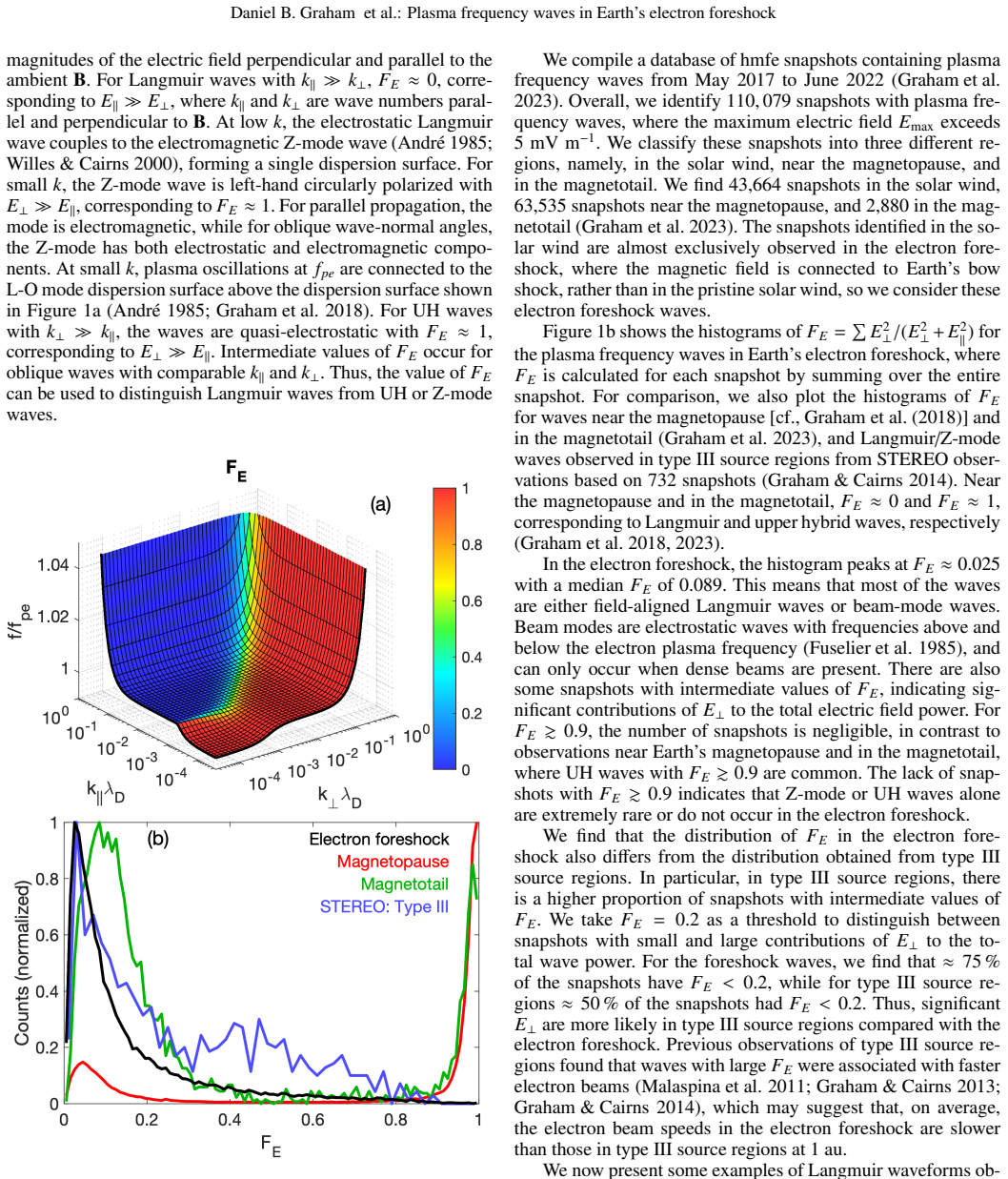
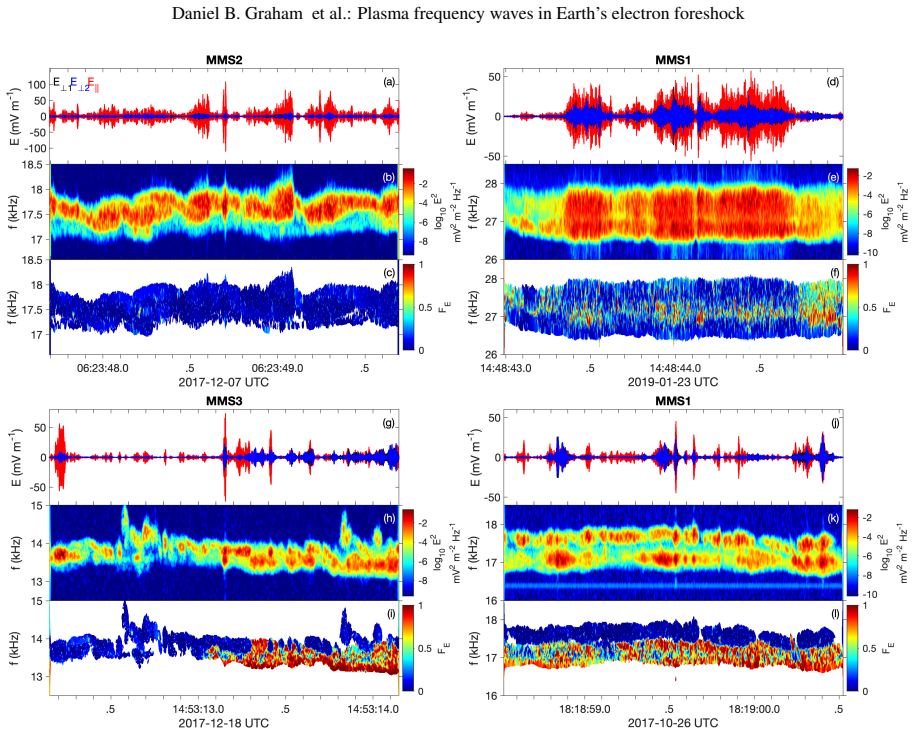
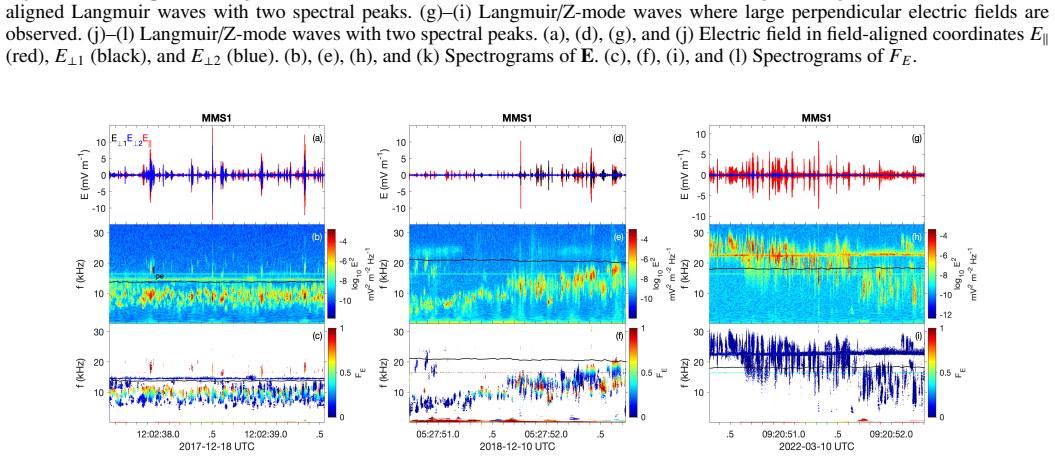
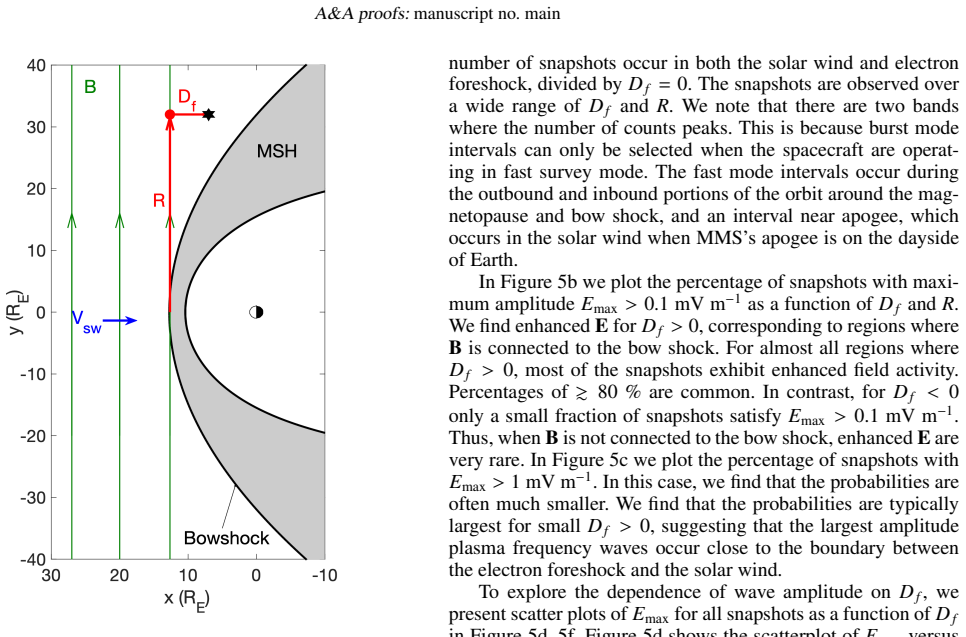
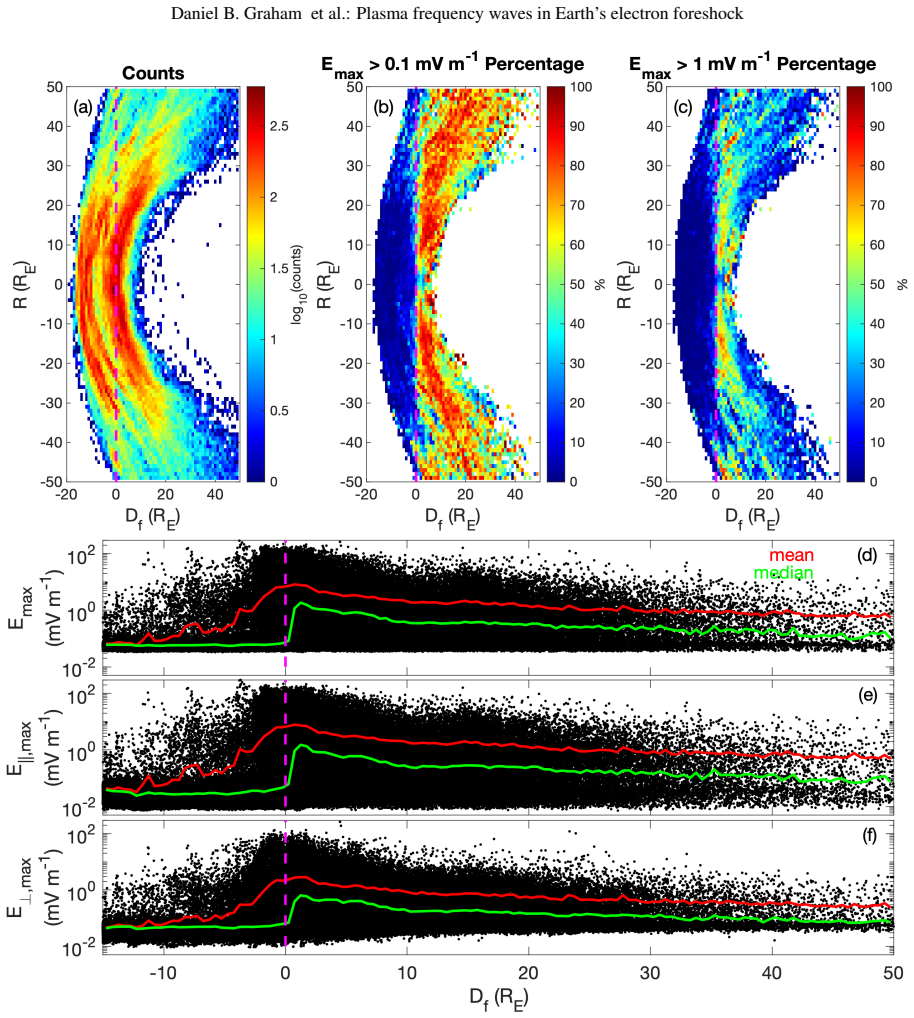
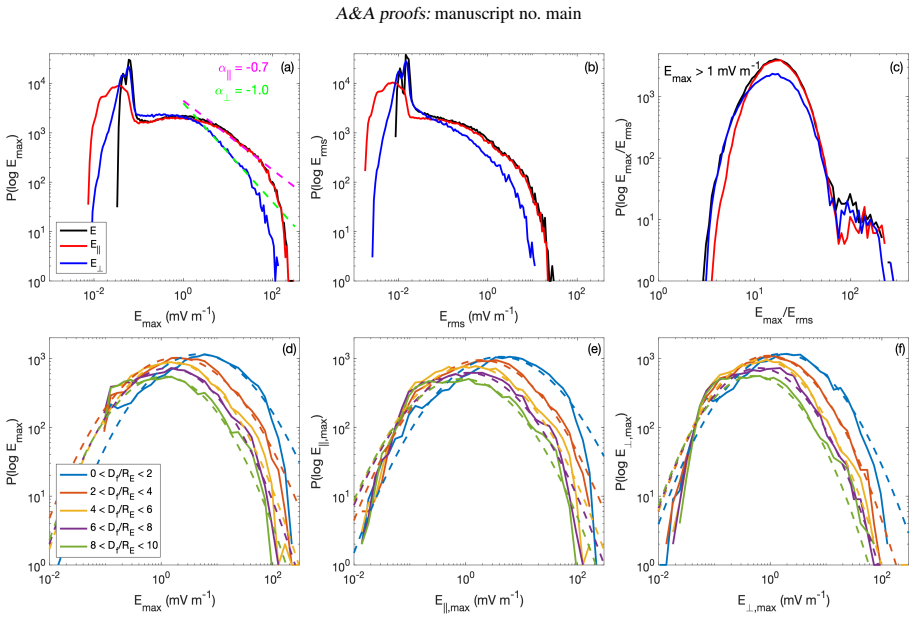
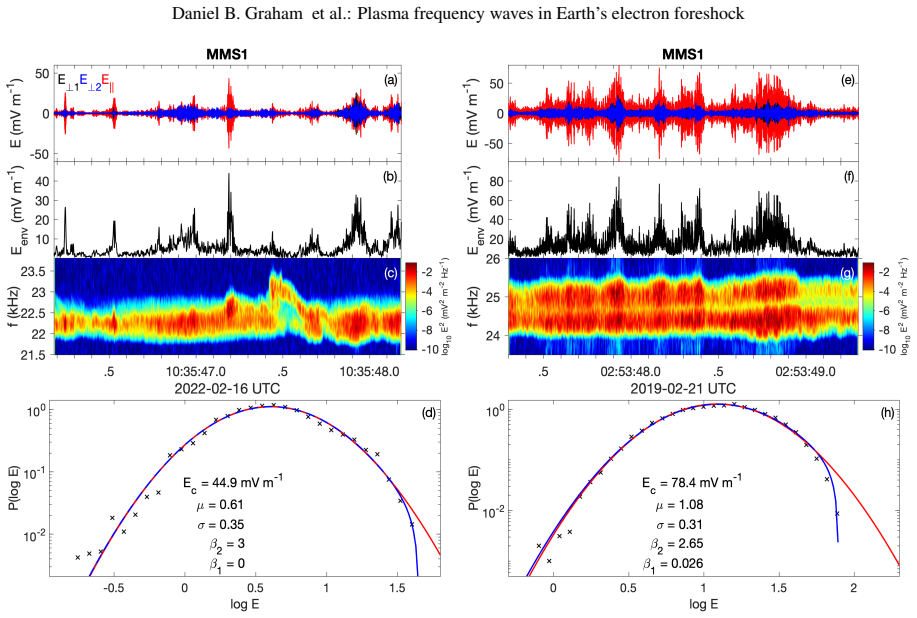
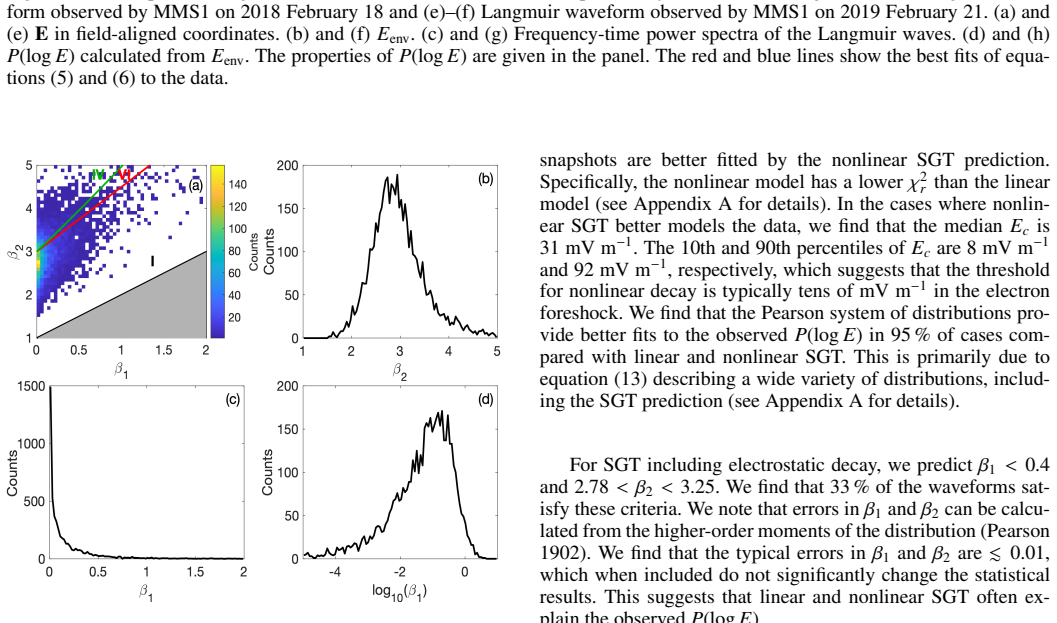
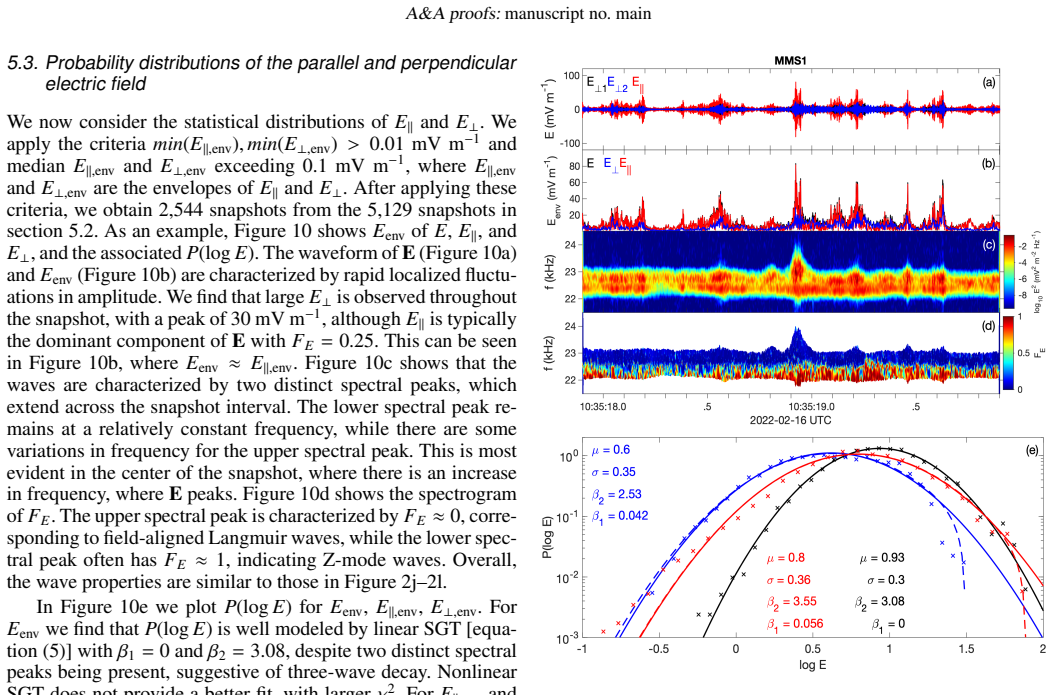
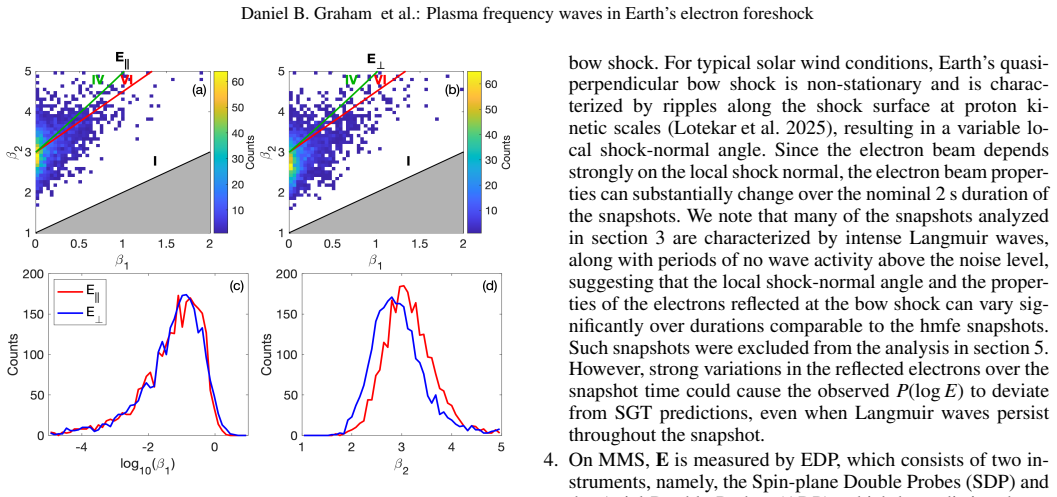
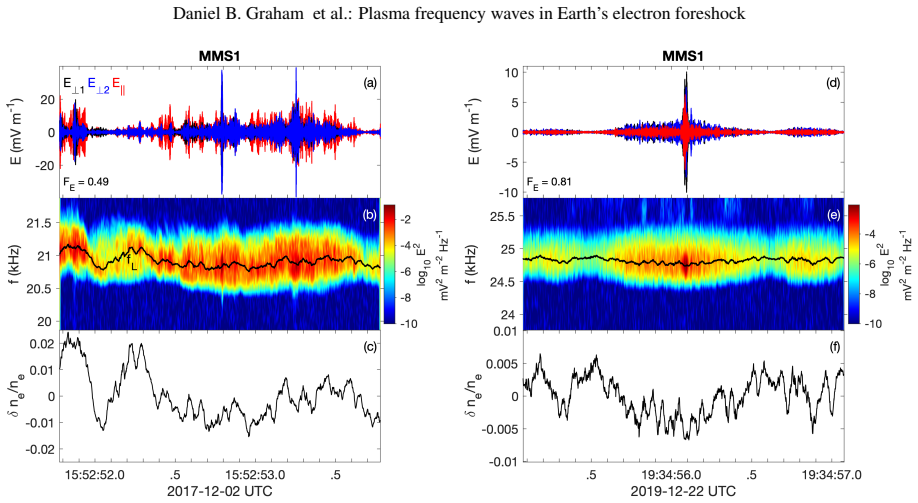
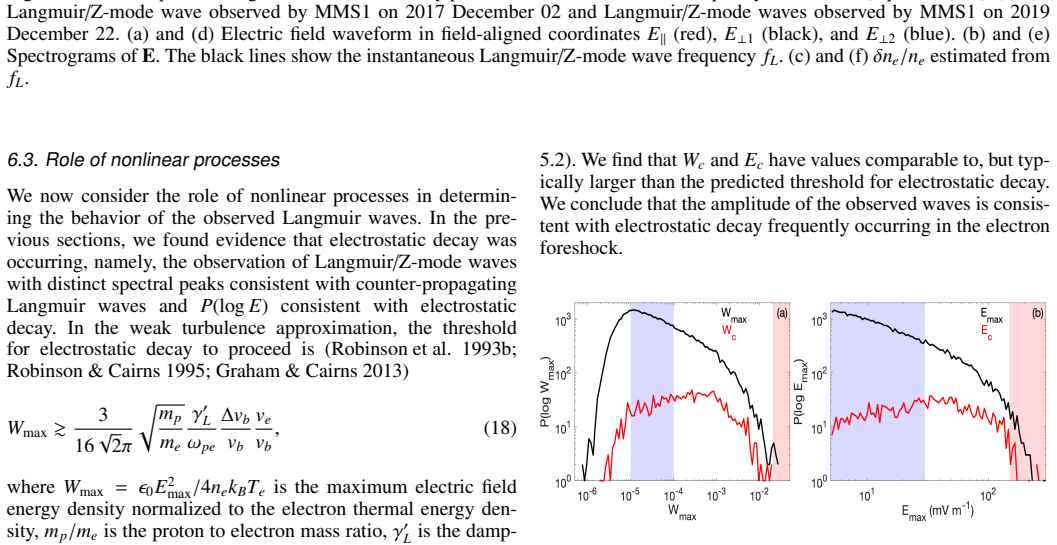
Distinct spectral peaks near the electron plasma frequency often appear, along with large perpendicular electric field components consistent with Z-mode waves. Electric field amplitudes are largest near the foreshock boundary, and both parallel and perpendicular components exhibit close to log-normal probability distributions. These observations align with Stochastic Growth Theory and indicate that small-scale density perturbations, in addition to nonlinear three-wave decay, are crucial to the evolution of Langmuir waves and the generation of radio waves.
What carries the argument
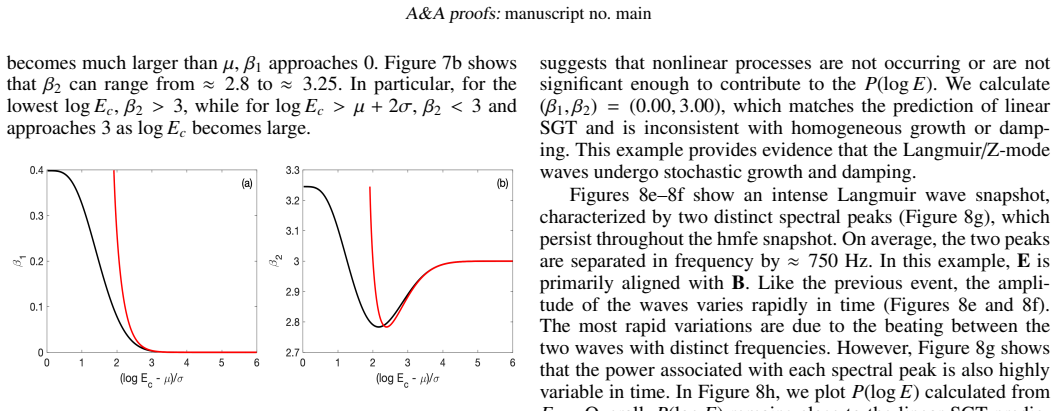
Stochastic Growth Theory, which predicts log-normal electric field distributions arising from random interactions between waves and small-scale density fluctuations during amplification.
If this is right
- Langmuir wave amplitudes peak near the boundary between the electron foreshock and the solar wind.
- Nonlinear electrostatic decay and reflection off density gradients produce the observed spectral features.
- The same density-fluctuation effects operate on Langmuir waves in the solar wind that source Type II and Type III radio bursts.
- Both parallel and perpendicular electric field components follow log-normal statistics.
Where Pith is reading between the lines
- Incorporating density-fluctuation effects into beam-instability models could improve predictions of radio emission efficiency in other space plasmas.
- Direct comparison of wave amplitude with simultaneous high-resolution density measurements would test the relative contribution of stochastic growth versus decay processes.
- The results suggest that radio-burst source regions elsewhere may require similar statistical treatment of wave growth in fluctuating media.
Load-bearing premise
The observed spectral peaks, perpendicular electric field components, and log-normal distributions can be attributed unambiguously to beam-mode, Langmuir, and Z-mode waves under Stochastic Growth Theory without dominant contributions from other modes or effects.
What would settle it
A dataset in which the electric field probability distributions deviate from log-normal form or in which perpendicular components are shown to arise mainly from modes other than Z-mode would undermine the central attribution.
Figures
read the original abstract
At Earth's quasi-perpendicular bow shock, electrons can be reflected and accelerated to high velocities, forming beams. These beams excite Langmuir and beam-mode waves, which can then be converted to radio waves. We aim to understand the properties and evolution of Langmuir waves excited in the electron foreshock region using the Magnetospheric Multiscale (MMS) mission. We use fields and particle data from the four MMS spacecraft to investigate the properties of Langmuir/Z-mode waves in Earth's electron foreshock. MMS provides extended high-resolution snapshots of the three-dimensional electric field, enabling detailed analysis of wave properties. Probability distributions of the electric field are used to investigate the evolution of the waves and the role of density fluctuations. Distinct spectral peaks near the electron plasma frequency are often observed, suggestive of simultaneous observations of beam-mode and Langmuir waves, as well as nonlinear electrostatic decay of Langmuir waves or reflection off density gradients. In addition, the electric fields often have large perpendicular components, consistent with Z-mode waves. The statistical results show that the electric fields are largest near the electron foreshock boundary with the solar wind. Both the parallel and perpendicular components of the electric field exhibit close to log-normal probability distribution functions, consistent with predictions from Stochastic Growth Theory. These results suggest that small-scale density perturbations in the ambient plasma, in addition to nonlinear three-wave decay, are crucial to the evolution of Langmuir waves and the generation of radio waves. These results apply to Langmuir waves in the solar wind, such as in Type II and Type III solar radio burst source regions, where the same density fluctuations are expected and large-amplitude Langmuir waves with similar properties are observed.
Editorial analysis
A structured set of objections, weighed in public.
Referee Report
Summary. The manuscript reports an observational analysis of Langmuir and Z-mode waves in Earth's electron foreshock using high-resolution three-dimensional electric field and particle data from the four MMS spacecraft. It identifies distinct spectral peaks near the electron plasma frequency interpreted as simultaneous beam-mode and Langmuir waves or signatures of nonlinear electrostatic decay/reflection off density gradients; large perpendicular electric field components consistent with Z-mode waves; and log-normal probability distribution functions for both parallel and perpendicular electric field components, stated to be consistent with Stochastic Growth Theory predictions. Electric fields are reported largest near the foreshock-solar wind boundary. The central conclusion is that small-scale density perturbations in the ambient plasma, in addition to nonlinear three-wave decay, are crucial to Langmuir wave evolution and radio wave generation, with applicability to Type II/III solar radio burst source regions.
Significance. If the mode identifications and statistical attributions hold after methodological clarification, the work would provide useful MMS-based constraints on wave evolution in foreshock regions and support the combined role of density fluctuations and nonlinear processes in radio emission. The high-resolution 3D field snapshots are a clear observational strength for this class of study.
major comments (3)
- [Abstract] Abstract: The assertion that the observed log-normal PDFs of the electric field components are 'consistent with predictions from Stochastic Growth Theory' and thereby indicate that 'small-scale density perturbations ... are crucial' provides no quantitative goodness-of-fit metric, comparison against alternative multiplicative distributions, or exclusion of other processes capable of producing log-normality; this attribution is load-bearing for the central claim.
- [Abstract] Abstract: The interpretations of 'distinct spectral peaks near the electron plasma frequency' as suggestive of beam-mode/Langmuir waves plus nonlinear decay or reflection, and of 'large perpendicular components' as consistent with Z-mode, are presented without any description of peak identification criteria, polarization analysis methods, error bars, or controls for instrumental artifacts and selection bias.
- [Abstract] Abstract: The conclusion that density perturbations are crucial (in addition to nonlinear decay) rests entirely on the above indirect statistical inferences; the manuscript contains no direct density-fluctuation measurements or explicit model-data comparisons that would test this inference.
minor comments (1)
- The abstract is lengthy and could be tightened by moving some interpretive language to the discussion section.
Simulated Author's Rebuttal
We thank the referee for the thorough and constructive review. The comments highlight areas where the abstract and supporting analysis can be clarified and strengthened. We address each major comment below and will revise the manuscript accordingly.
read point-by-point responses
-
Referee: [Abstract] Abstract: The assertion that the observed log-normal PDFs of the electric field components are 'consistent with predictions from Stochastic Growth Theory' and thereby indicate that 'small-scale density perturbations ... are crucial' provides no quantitative goodness-of-fit metric, comparison against alternative multiplicative distributions, or exclusion of other processes capable of producing log-normality; this attribution is load-bearing for the central claim.
Authors: We agree that a quantitative goodness-of-fit assessment would strengthen the attribution. In the revised manuscript we will add a Kolmogorov-Smirnov test (or equivalent) comparing the observed distributions to a log-normal form, together with a brief comparison against a normal distribution and a power-law tail. We will also expand the discussion of why Stochastic Growth Theory specifically predicts log-normality via multiplicative density-fluctuation effects, while acknowledging that log-normality alone does not uniquely prove the mechanism. revision: yes
-
Referee: [Abstract] Abstract: The interpretations of 'distinct spectral peaks near the electron plasma frequency' as suggestive of beam-mode/Langmuir waves plus nonlinear decay or reflection, and of 'large perpendicular components' as consistent with Z-mode, are presented without any description of peak identification criteria, polarization analysis methods, error bars, or controls for instrumental artifacts and selection bias.
Authors: The full manuscript describes the spectral and polarization analysis in the Data and Methods section, but the abstract is too terse. We will revise the abstract to include a concise statement of the peak-identification threshold (relative to background), the use of the three-component electric-field data for polarization, and a note on MMS instrument calibration and artifact checks. A short methods subsection will be added or expanded to document selection criteria and any bias controls. revision: yes
-
Referee: [Abstract] Abstract: The conclusion that density perturbations are crucial (in addition to nonlinear decay) rests entirely on the above indirect statistical inferences; the manuscript contains no direct density-fluctuation measurements or explicit model-data comparisons that would test this inference.
Authors: We acknowledge that the study does not contain direct density-fluctuation measurements; the inference is drawn from the observed log-normal statistics matching Stochastic Growth Theory expectations. In revision we will add an explicit limitations paragraph noting the absence of simultaneous high-resolution density data and will reference existing foreshock density-fluctuation studies. We will also include a brief qualitative comparison with published SGT-based simulations, while stating that a full quantitative model-data comparison lies outside the scope of this observational paper. revision: partial
Circularity Check
No circularity: observational consistency checks against external SGT predictions
full rationale
This is a purely observational study using MMS spacecraft data to report statistical properties (spectral peaks, polarization, log-normal E-field PDFs) of foreshock waves. The central claims are framed as 'consistent with' and 'suggestive of' prior Stochastic Growth Theory and nonlinear decay models; no new equations are derived, no parameters are fitted inside the paper and then relabeled as predictions, and no self-citation chain supplies the load-bearing justification. The analysis therefore remains self-contained against external benchmarks and receives the default non-circularity finding.
Axiom & Free-Parameter Ledger
axioms (1)
- domain assumption Stochastic Growth Theory predictions for log-normal electric field distributions in plasmas with density fluctuations
Reference graph
Works this paper leans on
-
[1]
R., Parks, G
Anderson, R. R., Parks, G. K., Eastman, T. E., Gurnett, D. A., & Frank, L. A. 1981, Journal of Geophysical Research: Space Physics, 86, 4493
1981
-
[2]
Andr \'e , M. 1985, J. Plasma. Phys., 33, 1
1985
-
[3]
2025, Astronomy and Astrophysics, 699, L6
Annenkov , V., Krafft , C., Volokitin , A., & Savoini , P. 2025, Astronomy and Astrophysics, 699, L6
2025
-
[4]
D., Burgess, D., Kellogg, P
Bale, S. D., Burgess, D., Kellogg, P. J., Goetz, K., & Monson, S. J. 1997, Journal of Geophysical Research: Space Physics, 102, 11281
1997
-
[5]
D., Kellogg, P
Bale, S. D., Kellogg, P. J., Goetz, K., & Monson, S. J. 1998, Geophys. Res. Lett., 25, 9
1998
-
[6]
Space Science Reviews
Bale , S. D., Ullrich , R., Goetz , K., et al. 2008, "Space Science Reviews", 136, 529
2008
-
[7]
L., Kaiser , M
Bougeret , J. L., Kaiser , M. L., Kellogg , P. J., et al. 1995, Space Science Reviews, 71, 231
1995
-
[8]
Cairns , I. H. 1987, Journal of Geophysical Research, 92, 2329
1987
-
[9]
Cairns, I. H. 1987, J. P lasma P hys., 38, 169
1987
-
[10]
Cairns , I. H. 1987, J. P lasma P hys., 38, 179
1987
-
[11]
Cairns, I. H. 1988, Journal of Geophysical Research: Space Physics, 93, 3958
1988
-
[12]
Cairns, I. H. 1989, Physics of Fluids B: Plasma Physics, 1, 204
1989
-
[13]
Cairns , I. H. & Layden , A. 2018, Physics of Plasmas, 25, 082309
2018
-
[14]
Cairns, I. H. & Melrose, D. B. 1985, J. Geophys. Res., 90, 6637
1985
-
[15]
Cairns, I. H. & Menietti, J. D. 2001, Journal of Geophysical Research: Space Physics, 106, 29515
2001
-
[16]
Cairns, I. H. & Robinson, P. A. 1992, Geophysical Research Letters, 19, 2187
1992
-
[17]
Cairns , I. H. & Robinson , P. A. 1995, Astrophysical Journal, 453, 959
1995
-
[18]
Cairns, I. H. & Robinson, P. A. 1997, Geophysical Research Letters, 24, 369
1997
-
[19]
Cairns , I. H. & Robinson , P. A. 1999, Phys. Rev. Lett., 82, 3066
1999
-
[20]
H., Robinson, P
Cairns, I. H., Robinson, P. A., & Anderson, R. R. 2000, Geophysical Research Letters, 27, 61
2000
-
[21]
H., Robinson, P
Cairns, I. H., Robinson, P. A., Anderson, R. R., & Strangeway, R. J. 1997, Journal of Geophysical Research: Space Physics, 102, 24249
1997
-
[22]
H., Robinson, P
Cairns, I. H., Robinson, P. A., & Smith, N. I. 1998, Journal of Geophysical Research: Space Physics, 103, 287
1998
-
[23]
H., Trevett, W., & Graham, D
Cairns, I. H., Trevett, W., & Graham, D. B. 2026, Advances in Space Research, 77, 6530
2026
-
[24]
M., Muschietti , L., & Goldman , M
Celnikier , L. M., Muschietti , L., & Goldman , M. V. 1987, Astronomy and Astrophysics, 181, 138
1987
-
[25]
E., Lindqvist, P.-A., Torbert, R
Ergun, R. E., Lindqvist, P.-A., Torbert, R. B., et al. 2022, MMS 1 Electric Double Probe (EDP) Axial Double Probe, Spin Plane Double Probe (ADP-SDP) Three-Dimensional HMFE Electric Field, Level 2 (L2), Burst Mode, 0.01525878906 ms Data [Dataset] (NASA Space Physics Data Facility)
2022
-
[26]
E., Malaspina, D
Ergun, R. E., Malaspina, D. M., Cairns, I. H., et al. 2008, Phys. R ev. L ett., 101, 051101
2008
-
[27]
E., Tucker , S., Westfall , J., et al
Ergun , R. E., Tucker , S., Westfall , J., et al. 2016, Space Sci. Rev., 199, 167
2016
-
[28]
Field, G. B. 1956, Astrophys. J., 124, 555
1956
-
[29]
Filbert, P. C. & Kellogg, P. J. 1979, Journal of Geophysical Research: Space Physics, 84, 1369
1979
-
[30]
2025, Astrophysical Journal Letters, 985, L29
Form \'a nek , T., Santol \' k , O., Sou c ek , J., et al. 2025, Astrophysical Journal Letters, 985, L29
2025
-
[31]
A., Gurnett , D
Fuselier , S. A., Gurnett , D. A., & Fitzenreiter , R. J. 1985, J. Geophys.Res., 90, 3935
1985
-
[32]
A., Lewis , W
Fuselier , S. A., Lewis , W. S., Schiff , C., et al. 2016, Space Science Reviews, 199, 77
2016
-
[33]
J., Giles, B
Gershman, D. J., Giles, B. L., Pollock, C. J., Moore, T. E., & Burch, J. L. 2022 a , MMS 1 Fast Plasma Investigation, Dual Electron Spectrometer (FPI, DES) Distribution Moments, Level 2 (L2), Burst Mode, 30 ms Data [Dataset] (NASA Space Physics Data Facility)
2022
-
[34]
J., Giles, B
Gershman, D. J., Giles, B. L., Pollock, C. J., Moore, T. E., & Burch, J. L. 2022 b , MMS 1 Fast Plasma Investigation, Dual Ion Spectrometer (FPI, DIS) Distribution Moments, Level 2 (L2), Burst Mode, 0.15 s Data [Dataset] (NASA Space Physics Data Facility)
2022
-
[35]
Graham, D. B. 2026, Plasma frequency waves in Earth's electron foreshock (v1.0.1) [ S oftware] (Zenodo)
2026
-
[36]
Graham, D. B. & Cairns, I. H. 2013, J. Geophys. Res., 118, 3968
2013
-
[37]
Graham , D. B. & Cairns , I. H. 2014, J. Geophys. Res., 119, 2430
2014
-
[38]
B., Cairns, I
Graham, D. B., Cairns, I. H., Prabhakar, D. R., et al. 2012, J. Geophys. Res., 117, A09107
2012
-
[39]
B., Khotyaintsev, Y
Graham, D. B., Khotyaintsev, Y. V., & Andr \'e , M. 2023, Journal of Geophysical Research: Space Physics, 128, e2023JA031900
2023
-
[40]
B., Vaivads, A., Khotyaintsev, Y
Graham, D. B., Vaivads, A., Khotyaintsev, Y. V., et al. 2018, Journal of Geophysical Research: Space Physics, 123, 2630
2018
-
[41]
Gurnett , D. A. & Anderson , R. R. 1976, Science, 194, 1159
1976
-
[42]
Gurnett, D. A. & Anderson, R. R. 1977, Journal of Geophysical Research (1896-1977), 82, 632
1977
-
[43]
2011, Phys
Henri, P., Meyer-Vernet, N., Briand, C., & Donato, S. 2011, Phys. Plasmas, 18, 082308
2011
-
[44]
Hospodarsky, G. B. & Gurnett, D. A. 1995, Geophysical Research Letters, 22, 1161
1995
-
[45]
Khotyaintsev, Y., Vaivads, A., Johansson, E. P. G., et al. 2024, irfu/irfu-matlab: v1.16.3 [Software]
2024
-
[46]
H., & Robinson, P
Kim, E.-H., Cairns, I. H., & Robinson, P. A. 2007, Phys. Rev. Lett., 99, 015003
2007
-
[47]
M., Bonnell, J., Powell, S., Wahlund, J.-E., & Holback, B
Kintner, P. M., Bonnell, J., Powell, S., Wahlund, J.-E., & Holback, B. 1995, Geophysical Research Letters, 22, 287
1995
-
[48]
& Savoini , P
Krafft , C. & Savoini , P. 2024, Astrophysical Journal Letters, 964, L30
2024
-
[49]
S., & Krasnoselskikh , V
Krafft , C., Volokitin , A. S., & Krasnoselskikh , V. V. 2015, Astrophysical Journal, 809, 176
2015
-
[50]
V., Dudok de Wit, T., & Bale, S
Krasnoselskikh, V. V., Dudok de Wit, T., & Bale, S. D. 2011, Annales Geophysicae, 29, 613
2011
-
[51]
V., Lobzin , V
Krasnoselskikh , V. V., Lobzin , V. V., Musatenko , K., et al. 2007, Journal of Geophysical Research (Space Physics), 112, A10109
2007
-
[52]
H., & Knock, S
Kuncic, Z., Cairns, I. H., & Knock, S. A. 2004, Journal of Geophysical Research: Space Physics, 109
2004
-
[53]
2022, Astrophysical Journal, 927, 95
Larosa , A., Dudok de Wit , T., Krasnoselskikh , V., et al. 2022, Astrophysical Journal, 927, 95
2022
-
[54]
H., Li, B., & Robinson, P
Layden, A., Cairns, I. H., Li, B., & Robinson, P. A. 2013, Phys. Rev. Lett., 110, 185001
2013
-
[55]
A., & Cairns, I
Li, B., Robinson, P. A., & Cairns, I. H. 2006, Physics of Plasmas, 13, 082305
2006
-
[56]
P., Levedahl , W
Lin , R. P., Levedahl , W. K., Lotko , W., Gurnett , D. A., & Scarf , F. L. 1986, Astrophysical Journal, 308, 954
1986
-
[57]
P., Potter, D
Lin, R. P., Potter, D. W., Gurnett, D. A., & Scarf, F. L. 1981, Astrophys. J., 251, 364
1981
-
[58]
B., et al
Lindqvist , P.-A., Olsson , G., Torbert , R. B., et al. 2016, Space Sci. Rev., 199, 137
2016
-
[59]
V., Graham, D
Lotekar, A., Khotyaintsev, Y. V., Graham, D. B., et al. 2025, Geophysical Research Letters, 52, e2025GL116121
2025
-
[60]
D., Chust , T., et al
Maksimovic , M., Bale , S. D., Chust , T., et al. 2020, Astronomy and Astrophysics, 642, A12
2020
-
[61]
M., Cairns, I
Malaspina, D. M., Cairns, I. H., & Ergun, R. E. 2010, J. Geophys. Res., 115, A01101
2010
-
[62]
M., Cairns , I
Malaspina , D. M., Cairns , I. H., & Ergun , R. E. 2011, Geophys. Res. Lett., 38, L13101
2011
-
[63]
M., Kellogg , P
Malaspina , D. M., Kellogg , P. J., Bale , S. D., & Ergun , R. E. 2010, Astrophysical Journal, 711, 322
2010
-
[64]
M., Li, B., Cairns, I
Malaspina, D. M., Li, B., Cairns, I. H., et al. 2009, Journal of Geophysical Research: Space Physics, 114, A12101
2009
-
[65]
P., Carlson, C
McFadden, J. P., Carlson, C. W., & Boehm, M. H. 1986, Journal of Geophysical Research: Space Physics, 91, 12079
1986
-
[66]
V., & D \'e cr \'e au , P
Musatenko , K., Lobzin , V., Soucek , J., Krasnoselskikh , V. V., & D \'e cr \'e au , P. 2007, Planetary and Space Science, 55, 2273
2007
-
[67]
2004, Computational Statistics & Data Analysis, 47, 1
Nagahara, Y. 2004, Computational Statistics & Data Analysis, 47, 1
2004
-
[68]
A., Russell , C
Newbury , J. A., Russell , C. T., Phillips , J. L., & Gary , S. P. 1998, Journal of Geophysical Research , 103, 9553
1998
-
[69]
L., Cairns, I
Nulsen, A. L., Cairns, I. H., & Robinson, P. A. 2007, Journal of Geophysical Research: Space Physics, 112
2007
-
[70]
& Freund, H
Papadopoulos, K. & Freund, H. P. 1978, Geophys. Res. Lett., 5, 881
1978
-
[71]
1895, Philosophical Transactions of the Royal Society of London Series A, 186, 343
Pearson , K. 1895, Philosophical Transactions of the Royal Society of London Series A, 186, 343
-
[72]
1900, The London, Edinburgh, and Dublin Philosophical Magazine and Journal of Science, 50, 157
Pearson, K. 1900, The London, Edinburgh, and Dublin Philosophical Magazine and Journal of Science, 50, 157
1900
-
[73]
1902, Philosophical Transactions of the Royal Society of London
Pearson, K. 1902, Philosophical Transactions of the Royal Society of London. Series A, Containing Papers of a Mathematical or Physical Character, 198, 235
1902
-
[74]
2003, Nonlinear Processes in Geophysics, 10, 323
Podladchikova , O., Lefebvre , B., Krasnoselskikh , V., & Podladchikov , V. 2003, Nonlinear Processes in Geophysics, 10, 323
2003
-
[75]
J., Krafft , C., & Savoini , P
Polanco-Rodr \' guez , F. J., Krafft , C., & Savoini , P. 2025, Astrophysical Journal Letters, 982, L24
2025
-
[76]
2016, Space Sci
Pollock , C., Moore , T., Jacques , A., et al. 2016, Space Sci. Rev., 199, 331
2016
-
[77]
Robinson , P. A. 1991, Physics of Fluids B, 3, 545
1991
-
[78]
Robinson , P. A. 1992, Solar Physics, 139, 147
1992
-
[79]
Robinson , P. A. 1995, Physics of Plasmas, 2, 1466
1995
-
[80]
Robinson , P. A. 1997, Reviews of Modern Physics, 69, 507
1997
discussion (0)
Sign in with ORCID, Apple, or X to comment. Anyone can read and Pith papers without signing in.