REVIEW 6 major objections 5 minor 67 references
Less Data Less Tokens: Multilingual Unification Learning for Efficient Test-Time Reasoning in LLMs
T0 review · 6 major / 5 minor · reviewed 2026-08-15 · deepseek-v4-flash
Pith's one-line read The paper claims that multilingual unification learning—training on whole-solution and step-wise mixed chains of thought in several languages—lets a reasoning LLM match or beat single-language baselines with fewer training samples and…
desk verdict Plausible idea, unreliable evidence: multilingual/code-switched CoT for data-efficient reasoning SFT is worth exploring, but the paper's numbers are internally inconsistent and the key comparisons are uncontrolled or fitted. read the letter →
The pith
A machine-rendered reading of the paper's core claim, the machinery that carries it, and where it could break.
The reading
What carries the argument
The load-bearing mechanism is the multilingual unification corpus: for each source question, a solution-level chain of thought in the original language, a translated solution-level chain of thought, and a step-wise code-switched chain of thought in which reflective fragments (signaled by words like 'Wait' or 'Hmm') are randomly translated and enclosed in language tokens. Training on this mixture teaches the model to associate reflective reasoning with alternate languages, and the mixture is what converts language choice into a reusable source of reasoning diversity. A decoding intervention adjusts the logit values of language tokens at inference, allowing the trained model to be steered into a preferred reasoning language. The mechanism's work is to make language a controllable and data-generating dimension of long reasoning.
What would settle it
Keep the same 651 questions and the same training pipeline, but replace every translated chain of thought and every code-switched trace with a matched-length English paraphrase that preserves the underlying steps and contains no language alternation. If this English-control model reaches the same AIME24, MATH500, and GPQA scores with the same inference-token counts, the multilingual structure is not the cause; if it falls short, the multilingual data is doing the work.
Extended reading notes
Core claim
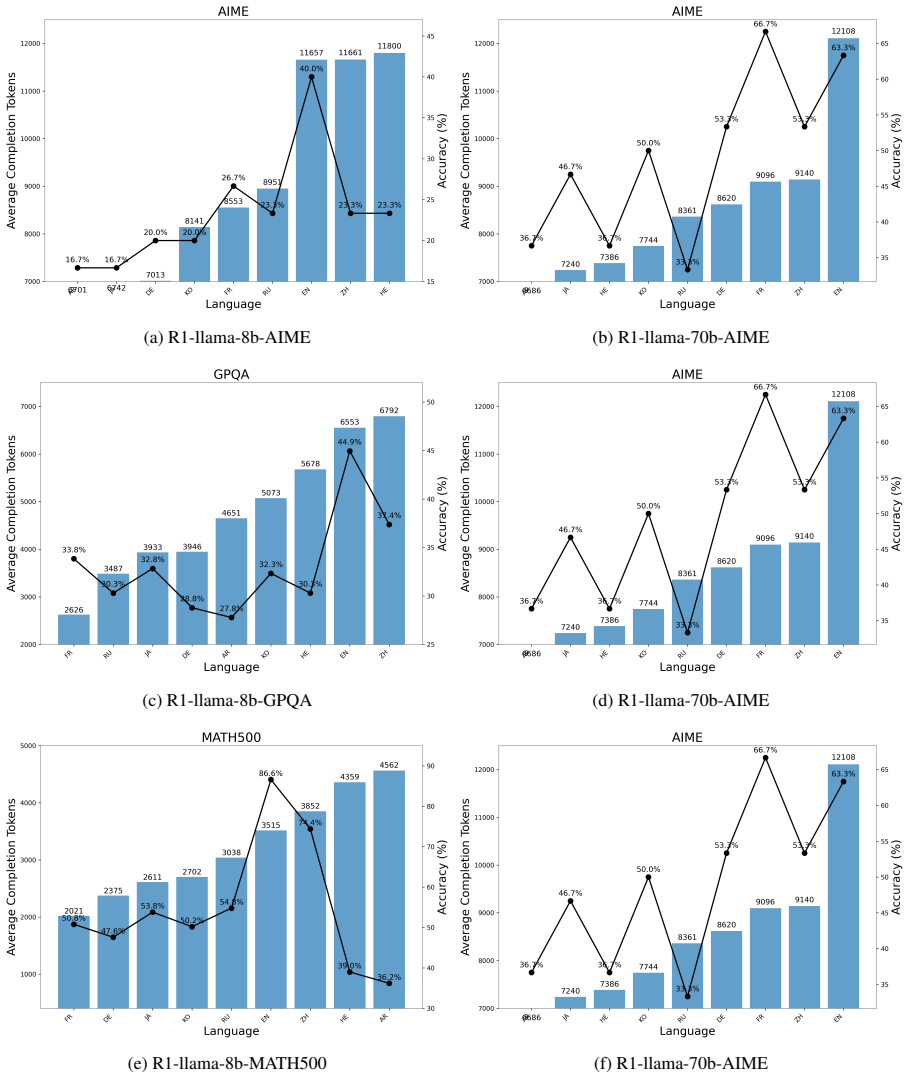
The central claim is that multilingual chain-of-thought annotation is a data-efficient and token-efficient augmentation. Reasoning paths vary across languages, with different accuracy and token counts for the same question, and a model exposed to those varied paths learns the problem's structure more cheaply than a model given more English samples. Concretely, the multilingual unification model trained from 651 questions augmented with whole-solution CoTs in four languages plus step-wise code-switched traces scores 63.3 on AIME24, 93.0 on MATH500, and 60.0 on GPQA, while the single-language 1,000-sample baseline scores 56.0, 93.0, and 59.6. The paper also reports an inflection point near 30 curated questions and finds that training across more language families raises accuracy and lowers token use.
Load-bearing premise
The load-bearing premise is that the translated chains of thought and step-wise code-switched mixtures faithfully encode genuine cross-lingual reasoning diversity; the paper itself notes that translation quality was not rigorously evaluated.
Editorial extensions
If this is right
- With only six source questions rendered multilingually, long-reasoning performance rises by roughly 20% over the base model.
- With 651 questions, the multilingual recipe matches or exceeds the 1,000-question single-language recipe on AIME24, MATH500, and GPQA while using fewer inference tokens.
- Training across more language families yields higher accuracy and lower token usage than training within a single language family.
- A decoding intervention can steer the model's reasoning into another language and reach higher AIME24 accuracy, making language a controllable inference-time variable.
- The multilingual benefit shrinks as training data grows, so the method is most valuable in the low-data regime.
Reading between the lines
- If the real driver is reasoning-trace diversity rather than language identity, then any way of diversifying traces—multi-prompt, multi-expert, or multi-format—should reproduce part of the effect; this is testable by replacing language switching with format switching.
- Because translation quality was not rigorously checked, a portion of the gain may come from the regularizing noise of code-switched text rather than from semantically meaningful cross-lingual reasoning; the token-efficiency claim would need to survive a clean-translation control.
- Tokenizer differences across languages could inflate or deflate the reported token savings; measuring reasoning length in characters or another language-neutral unit would separate semantic concision from tokenization artifacts.
- The paper's orthogonality claim suggests multilingual augmentation could be stacked with other low-data selection strategies, and that combination is a natural next test.
Signed reviews
Editorial analysis
A structured set of objections, weighed in public.
Referee Report
Summary. The paper proposes L2, a multilingual unification learning method that augments a small seed of high-quality reasoning samples (6, 651, or 1,000 examples) with multilingual chain-of-thought data and step-wise code-switched data, then fine-tunes Qwen2.5-32B to improve reasoning accuracy while reducing inference tokens. A decoding intervention that boosts or suppresses language-boundary tokens is also introduced. The main claims are that multilingual learning reduces the required training data and the number of inference tokens while maintaining comparable performance, and that the approach is orthogonal to other data-efficient methods. The evaluation is on AIME24, MATH500, and GPQA Diamond, with additional pilot studies across nine languages.
Significance. The problem addressed, namely reducing both data annotation cost and test-time compute for long chain-of-thought reasoning, is timely and of broad interest, and the idea that multilingual data diversity could serve as a source of sample and token efficiency is worth investigating. However, the paper's central quantitative claims are not supported by its own tables: headline numbers in the abstract and introduction are inconsistent with the reported results, the matched-scale controls show essentially null multilingual gains, and the decoding-intervention evidence is selected on the test set. The paper does not ship code, data, machine-checked proofs, or parameter-free derivations, and the only detailed artifact is an appendix case study. If the claims could be established with proper controlled baselines and held-out validation, the contribution would be meaningful; in its current form, the evidence is not commensurate with the claims.
major comments (6)
- [§4.3, Table 1; §1] The abstract and introduction claim that only six samples improve long reasoning by 20% and that L2 reaches comparable 53% with 651 samples, but these values cannot be reconciled with Tables 1 and 2. In Table 1, L2−32B−Mo1^10_6 scores 23.3 AIME24, 87.4 MATH500, and 49.5 GPQA, while the base model Qwen2.5-32b* scores 26.7, 84.0, and 49.0; the claimed improvements of 16.6%, 18.2%, and 12% do not match these numbers, and AIME actually decreases. The '53%' figure does not correspond to any reported accuracy on AIME24, MATH500, or GPQA. Since the 'less data' claim rests on these numbers, this inconsistency is load-bearing.
- [§4.4, Table 2; §4.3, Table 1] Table 2 shows L2−32b−Mo1^4_6 at 0.33 on AIME24 and L2−32b−Mo1^9_6 at 0.23, implying that increasing from four to nine languages hurts performance, yet Table 1 reports L2−32B−Mo1^10_6 at 23.3 on AIME24. This contradictory pattern is not discussed and undermines the paper's claim that more language families improve accuracy, as asserted around Figure 6. The discrepancy must be resolved because the language-scaling result is central to the method's motivation.
- [§4.6, Table 3] The matched-scale controls in Table 3 do not support the 'less data' claim. At 651 samples, L2−32b−MS1^4_651 gives 0.63 AIME24, 0.60 GPQA, and 0.93 MATH500, essentially identical to the single-language baseline Qwen2.5-32b-S1 651 (0.63, 0.56, 0.93). The headline comparison with s1-32B in Table 1 relies on published s1 numbers rather than an in-pipeline baseline, conflating evaluation differences with method differences. With only 30 AIME24 problems, a 3-point gap is one question, and no confidence intervals, seeds, or significance tests are reported.
- [§4.8] The decoding intervention result of 73.3% on AIME24 is selected by tuning k∈{2,4} after evaluating on the test set itself, and α and β are free parameters adjusted on the same benchmark. This makes the token-efficiency and accuracy evidence circular; there is no held-out validation showing that the intervention generalizes. The paper should either pre-register these hyperparameters or evaluate the intervention on a separate benchmark.
- [§4.3 footnote 3; §3.2] Footnote 3 reports that MATH500 numbers were manually corrected for 8–12 problems after format-based validation failed; without a complete correction log or the full list of corrected examples, the exact parity numbers (e.g., 93.0 vs 93.0 and 95.0 vs 93.0) cannot be reproduced. Additionally, Section 3.2 states that translation quality was 'not rigorously evaluated'; because the paper attributes the gains to cross-lingual diversity, the lack of any translation-quality validation leaves the proposed mechanism unsupported.
- [§3.1; abstract; §4.6] The abstract and introduction state that L2 is orthogonal to other data-efficient methods, but the experiments only apply L2 augmentation to data from s1 and Bespoke-Stratos; no experiment combines L2 with an existing data-selection or budget-forcing method, and Section 3.1 explicitly says the datasets are not combined. The orthogonality claim is therefore unsupported by the experiments as presented.
minor comments (5)
- [Table 1 and Table 2] There are formatting errors in the tables: Table 1 contains '1/93.0' in the MATH500 column, and Table 2 shows '0.490.85' without a separator.
- [Figures 3 and 4] Figures 3 and 4 have identical captions ('Comparison of reasoning strategies: mixed Chinese-English reasoning...') despite displaying different content, which confuses the reader.
- [§4.2] Section 4.2 mentions evaluation on Graduate Entrance Exam tasks, but no results for this dataset appear in Table 1 or elsewhere in the main text; please clarify or remove the reference.
- [§3.3] The paper introduces special language boundary tokens but never specifies how they are added to the vocabulary or initialized during fine-tuning; this detail is needed for reproducibility.
- [Throughout] No code, data release statement, random seeds, top-p sampling details, or hyperparameter ranges are provided, which hampers independent verification of the reported results.
Circularity Check
Peripheral decoding-intervention result is test-set-tuned; central SFT claim remains independent.
-
fitted input called prediction
[Section 4.8 / RQ5, Figure 7]
"We vary the parameter k∈{2,4,6} to examine its impact on the model’s behavior. Our findings show that a higher intervention ratio makes it more likely for the model to shift its reasoning into another language (zh). When k= 2 or k= 4 , the model can effectively switch between multiple languages, reaching an accuracy of 73.3% on the AIME24 dataset."
The decoding intervention hyperparameters (the top-k cutoff and, per Section 3.4, the intervention ratio alpha) are searched directly on the AIME24 test set. The reported 73.3% is the best accuracy among the k values tried, not the out-of-sample accuracy of a fixed intervention. Presenting this selected maximum as the method's performance reduces the 'prediction' to the test-set grid search by construction: the same benchmark is used both to choose k and to report the resulting accuracy. This does not make the main SFT comparisons in Table 1/3 circular, but it makes the RQ5 decoding-intervention evidence statistically forced rather than predicted.
full rationale
The paper's main SFT pipeline is not circular: multilingual CoT data are produced by external APIs (DeepSeek, GPT-4o) from fixed seed questions, training follows standard SFT, and the headline comparisons on AIME24/MATH500/GPQA are evaluated on held-out benchmarks against fixed baselines. There are no load-bearing self-citations; no reference is by the present authors. The one construction-like step is in RQ5 (Section 4.8): the decoding intervention's k (and alpha from Section 3.4) are varied on AIME24 and the best accuracy, 73.3%, is reported, so this number is a test-set-tuned maximum rather than a prediction of a fixed intervention. The MATH500 footnote (Section 4.3), where 8-12 standard answers are manually corrected after validator failures, and the Section 3.2 admission that translation quality was 'not rigorously evaluated' are measurement-validity limitations rather than circular derivations; the uncontrolled cross-paper comparison with s1 is an empirical weakness, not circularity. Score 5 reflects one peripheral reduces-by-construction result while the central SFT claim retains independent content.
Assumptions & free parameters
free parameters (3)
- alpha (intervention ratio) =
not specified in main text
- beta (logit adjustment magnitude) =
not specified in main text
- k (top-k cutoff for language tokens) =
2, 4, 6 tested; best reported
assumptions (4)
- domain assumption Multilingual CoT annotations generated by the DeepSeek API are correct and diverse enough for SFT.
- ad hoc to paper Step-wise code-switching with language boundary tokens preserves reasoning and enables cross-lingual generalization.
- domain assumption Qwen2.5-32B is a suitable base model and its multilingual abilities will not be disrupted by SFT on the curated data.
- domain assumption AIME24 (30 problems), GPQA, and MATH500 with manual label corrections are reliable evaluation sets.
invented entities (1)
-
Special language boundary tokens
Cite this review
Pith. "Pith review of Less Data Less Tokens: Multilingual Unification Learning for Efficient Test-Time Reasoning in LLMs." pith.science (2026). https://pith.science/paper/3XFT7KF5
@misc{pith2026250618341,
  author       = {Pith},
  title        = {Pith review of: Less Data Less Tokens: Multilingual Unification Learning for Efficient Test-Time Reasoning in LLMs},
  year         = {2026},
  howpublished = {\url{https://pith.science/paper/3XFT7KF5}},
  note         = {Machine review of arXiv:2506.18341}
}
abstract
This paper explores the challenges of test-time scaling of large language models (LLMs), regarding both the data and inference efficiency. We highlight the diversity of multi-lingual reasoning based on our pilot studies, and then introduce a novel approach, \(L^2\) multi-lingual unification learning with a decoding intervention strategy for further investigation. The basic idea of \(L^2\) is that the reasoning process varies across different languages, which may be mutually beneficial to enhance both model performance and efficiency. In specific, there are two types of multi-lingual data: the entire long chain-of-thought annotations in different languages and the step-wise mixture of languages. By further tuning based on them, we show that even small amounts of data can significantly improve reasoning capabilities. Our findings suggest that multilingual learning reduces both the required data and the number of inference tokens while maintaining a comparable performance. Furthermore, \(L^2\) is orthogonal to other data efficient methods. Thus, we also emphasize the importance of diverse data selection. The \(L^2\) method offers a promising solution to the challenges of data collection and test-time compute efficiency in LLMs.
Figures


Figures from the paper (8 more)



Reference graph
Works this paper leans on
-
[1]
ceil(sqrt(b)) <= k <= b - 1
-
[3]
Yangzhen Wu, Zhiqing Sun, Shanda Li, Sean Welleck, and Yiming Yang
Sampling-efficient test-time scaling: Self- estimating the best-of-n sampling in early decoding. Yangzhen Wu, Zhiqing Sun, Shanda Li, Sean Welleck, and Yiming Yang. 2025. Inference scaling laws: An empirical analysis of compute-optimal inference for problem-solving with language models. Yixin Ye, Zhen Huang, Yang Xiao, Ethan Chern, Shijie Xia, and Pengfei...
work page 2025
-
[4]
k ≡ 1 mod4 and k ≡ 1 mod3: k ≡ 1 mod4, k ≡ 1 mod3. Then k ≡ 1 mod12 (since if k ≡ 1 mod4 and mod3, then k ≡ 1 mod lcm(4,3)=12). Therefore, the four solutions mod12 are k ≡ 0,1,4,9 mod12. Therefore, in the interval [ceil(sqrt(13)),12], which is [4,12], the valid k's are: k=4,5,6,7,8,9,10,11,12. Check which of these are ≡ 0,1,4,9 mod12. k=4:4 ≡ 4 mod12. Val...
-
[5]
k ≡ 0 mod3,5 and ≡ 1 mod2: k ≡ 0 mod15 and ≡ 1 mod2: k=15m ≡ 1 mod2 =>15m ≡ 1m ≡ 1 mod2 =>m ≡ 1 mod2. So m=2n +1. Then k=15(2n +1)=30n +15 ≡ 15 mod30
-
[6]
(k^2 - k)/(b - 1) is between 1 and b - 1 inclusive. So the key is that (k^2 - k) must be divisible by (b - 1), and the result d1 must be a valid digit in base b. Therefore, for each k in the range ceil(sqrt(b)) to b - 1, check if (k^2 - k) is divisible by (b - 1), and if the resulting d1 is between 1 and b - 1. But since d1 = (k^2 - k)/(b - 1), and d1 mus...
-
[7]
(k^2 - k) is divisible by (b - 1)
-
[8]
(k^2 - k)/(b - 1) >= 1 Which translates to k^2 - k >= b - 1. Therefore, combining these, for each k from ceil(sqrt(b)) to b - 1, we need: (k^2 - k) is divisible by (b - 1) and k^2 - k >= b - 1. But since k >= ceil(sqrt(b)), let's check if k^2 - k >= b - 1. If k >= sqrt(b), then k^2 >= b, so k^2 - k >= b - k. But since k >= 2 (because b >= 2, ceil(sqrt(b))...
-
[9]
(k^2 -k) is divisible by (b -1)
Show all 67 references
-
[10]
Therefore, for each k from ceil(sqrt(b)) to b -1, check these two conditions
d1=(k^2 -k)/(b -1) is between 1 and b -1 inclusive. Therefore, for each k from ceil(sqrt(b)) to b -1, check these two conditions. The number of such k's is the number of b-beautiful numbers. Therefore, the problem reduces to finding the smallest b >=2 such that the number of k ...
-
[11]
k ≡ 0 mod4 and k ≡ 0 mod3: solution is k ≡ 0 mod12
-
[12]
Wait, we need k ≡ 0 mod4 and k ≡ 1 mod3
k ≡ 0 mod4 and k ≡ 1 mod3: solution is k ≡ 8 mod12 (since 8 ≡ 0 mod4 and 8 ≡ 2 mod3? Wait, 8 mod3=2, so 8 ≡ 2 ≡ -1 mod3. Wait, we need k ≡ 0 mod4 and k ≡ 1 mod3. Let's solve: k ≡ 0 mod4 k ≡ 1 mod3 Let k=4m. Then 4m ≡ 1 mod3 => m ≡ 1 mod3. So m=3n +1. Therefore, k=4*(3n +1)=12n...
-
[13]
k ≡ 1 mod4 and k ≡ 0 mod3: k ≡ 1 mod4, k ≡ 0 mod3. k=4m +1. Then 4m +1 ≡ 0 mod3 =>4m ≡ -1 mod3 => m ≡ 2 mod3 (since 4 ≡ 1 mod3, so 1m ≡ -1 mod3 =>m ≡ 2 mod3). Therefore, m=3n +2. Therefore, k=4(3n +2) +1=12n +9. Therefore, k ≡ 9 mod12
-
[15]
k ≡ 0 mod2 and k ≡ 0 mod7: k ≡ 0 mod14
-
[16]
k ≡ 0 mod2 and k ≡ 1 mod7: k ≡ 8 mod14 (since 8 ≡ 0 mod2, 8 ≡ 1 mod7)
-
[17]
k ≡ 1 mod2 and k ≡ 0 mod7: k ≡ 7 mod14 等等, 7 mod 2 = 1 ,对吗?因为 7 是奇数。所以 7 ≡ 1 mod 2 。因此, k ≡ 7 mod 14 。
-
[18]
Therefore, solutions are k ≡ 0,1,7,8 mod14
k ≡ 1 mod2 and k ≡ 1 mod7: k ≡ 1 mod14. Therefore, solutions are k ≡ 0,1,7,8 mod14. In the interval [ceil(sqrt(15))≈4,14], the numbers are4,5,6,7,8,9,10,11,12,13,14. Check which are ≡ 0,1,7,8 mod14: 16 / 35 k=7 ≡ 7 mod14 k=8 ≡ 8 mod14 k=14 ≡ 0 mod14 k=1 ≡ 1 mod14 (but 1<4, so ...
-
[19]
k ≡ 0 mod3 and k ≡ 0 mod7: k ≡ 0 mod21 等等, 0 mod 3 是 0 , 0 mod 7 也是 0 。因此, k ≡ 0 mod 21 。
-
[20]
k ≡ 1 mod7 and k ≡ 0 mod3
k ≡ 0 mod3 and k ≡ 1 mod7: Solve k=3m=7n +1. k ≡ 1 mod7 and k ≡ 0 mod3. Let k=7n +1. Then 7n +1 ≡ 0 mod3 =>7n ≡ -1 mod3 => n ≡ -1 mod3 (since7 ≡ 1 mod3). So n ≡ 2 mod3. Thus, n=3p +2. Then k=7*(3p +2)+1=21p +15. Therefore, k ≡ 15 mod21
-
[21]
So 3m +1=7n
k ≡ 1 mod3 and k ≡ 0 mod7: k=3m +1=7n. So 3m +1=7n. Then 3m ≡ -1 mod7 =>3m ≡ 6 mod7 =>m ≡ 2 mod7. So m=7p +2. Then k=3*(7p +2)+1=21p +7. Thus, k ≡ 7 mod21. 等等, 3*(7p + 2) + 1 = 21p + 6 + 1 = 21p + 7 。因此, k ≡ 7 mod 21 。
-
[22]
Therefore, solutions are k ≡ 0,1,7,15 mod21
k ≡ 1 mod3 and k ≡ 1 mod7: k ≡ 1 mod21. Therefore, solutions are k ≡ 0,1,7,15 mod21. 17 / 35 In the interval [ceil(sqrt(22))≈5,21], the numbers are5,...,21. Check k ≡ 0,1,7,15,21 mod21. k=7,15,21 ≡ 0,7,15 mod21. Check k=7: (49 -7)/21=42/21=2. d1=2, d2=7 -2=5. n=49. In base22,4...
-
[23]
等等, 0 mod 4 和 0 mod 5 的解是 k ≡ 0 mod 20 。
k ≡ 0 mod4 and k ≡ 0 mod5: k ≡ 0 mod20. 等等, 0 mod 4 和 0 mod 5 的解是 k ≡ 0 mod 20 。
-
[24]
Solve k=4m=5n +1
k ≡ 0 mod4 and k ≡ 1 mod5. Solve k=4m=5n +1. Then 4m ≡ 1 mod5 =>4m ≡ 1 mod5 =>m ≡ 4^{-1} mod5. Since44=16 ≡ 1 mod5, so inverse of4 is4. Thus, m ≡ 41=4 mod5. Thus, m=5p +4. Then k=4*(5p +4)=20p +16. Therefore, k ≡ 16 mod20
-
[25]
k=4m +1=5n
k ≡ 1 mod4 and k ≡ 0 mod5. k=4m +1=5n. So 4m +1=5n. Then4m ≡ -1 mod5 =>4m ≡ 4 mod5 =>m ≡ 1 mod5. So m=5p +1. Then k=4*(5p +1)+1=20p +5. Therefore, k ≡ 5 mod20. 18 / 35
-
[26]
k ≡ 1 mod4 and k ≡ 1 mod5 =>k ≡ 1 mod20
k ≡ 1 mod4 and k ≡ 1 mod5. k ≡ 1 mod4 and k ≡ 1 mod5 =>k ≡ 1 mod20. Thus, solutions are k ≡ 0,1,5,16 mod20. In the interval [ceil(sqrt(21))≈5,20], the numbers are5,...,20. Check k ≡ 0,1,5,16 mod20: k=5 ≡ 5 mod20 k=16 ≡ 16 mod20 k=20 ≡ 0 mod20 k=1 ≡ 1 mod20 (but 1<5, excluded) ...
-
[27]
k ≡ 0 mod3 and k ≡ 0 mod5: k ≡ 0 mod15
-
[28]
3m ≡ 1 mod5
k ≡ 0 mod3 and k ≡ 1 mod5: Solve k=3m=5n +1. 3m ≡ 1 mod5. 32=6 ≡ 1 mod5, so m ≡ 2 mod5. m=5p +2. Then k=3(5p +2)=15p +6. Thus, k ≡ 6 mod15. 19 / 35 等等, 6 mod 3 = 0 , 6 mod 5 = 1 。正确。
-
[29]
3m +1 ≡ 0 mod5 =>3m ≡ -1 ≡ 4 mod5
k ≡ 1 mod3 and k ≡ 0 mod5: Solve k=3m +1=5n. 3m +1 ≡ 0 mod5 =>3m ≡ -1 ≡ 4 mod5. Multiply both sides by2 (inverse of3 mod5 is2, since32=6 ≡ 1 mod5). So m ≡ 8 ≡ 3 mod5. m=5p +3. Then k=3(5p +3)+1=15p +10. Thus, k ≡ 10 mod15. 等等, 10 mod 3 = 1 , 10 mod 5 = 0 。正确。
-
[30]
Thus, solutions are k ≡ 0,1,6,10 mod15
k ≡ 1 mod3 and k ≡ 1 mod5: k ≡ 1 mod15. Thus, solutions are k ≡ 0,1,6,10 mod15. In the interval [ceil(sqrt(16))=4,15], numbers are4,...,15. Check k ≡ 0,1,6,10 mod15: k=6,10,15 ≡ 6,10,0 mod15. k=6: (36 -6)/15=30/15=2. d1=2, d2=6 -2=4. n=36. In base16,36=2*16 +4=32 +4=36. Digits...
-
[31]
k ≡ 0 mod2 and k ≡ 0 mod3: k ≡ 0 mod6
-
[32]
k ≡ 0 mod2 and k ≡ 1 mod3: k ≡ 4 mod6 (since 4 ≡ 0 mod2, 4 ≡ 1 mod3)
-
[33]
k ≡ 1 mod2 and k ≡ 0 mod3: k ≡ 3 mod6
-
[34]
20 / 35 Thus, solutions are k ≡ 0,1,3,4 mod6
k ≡ 1 mod2 and k ≡ 1 mod3: k ≡ 1 mod6. 20 / 35 Thus, solutions are k ≡ 0,1,3,4 mod6. In the interval [ceil(sqrt(7))≈3,6], numbers are3,4,5,6. Check k ≡ 0,1,3,4 mod6: k=3 ≡ 3 mod6 k=4 ≡ 4 mod6 k=6 ≡ 0 mod6 Check k=3: (9 -3)/6=6/6=1. d1=1, d2=3 -1=2. n=9. In base7,9=1*7 +2=7 +2=...
-
[35]
So k=0 mod210
k ≡ 0 mod2,3,5,7: k ≡ 0 mod210. So k=0 mod210. In [0,210), this is0. But0 is excluded since k>=ceil(sqrt(211))=15. So excluded
-
[36]
So k=30m ≡ 1 mod7
k ≡ 0 mod2,3,5 and ≡ 1 mod7: Solve k ≡ 0 mod(235)=30 and k ≡ 1 mod7. So k=30m ≡ 1 mod7. 30 ≡ 2 mod7, so 2m ≡ 1 mod7. Multiply both sides by inverse of2 mod7, which is4 (since24=8 ≡ 1 mod7). So m ≡ 4 mod7. Thus, m=7n +4. Then k=30(7n +4)=210n +120. Therefore, k ≡ 120 mod210. Si...
-
[37]
0 (excluded as before)
-
[38]
1 (since k ≡ 1 mod2,3,5,7: k ≡ 1 mod210)
-
[39]
等等,也许我们可以枚举所有可能的组合: For each prime factor, choose k ≡ 0 or1 modp
Numbers like 120 (as above), etc. 等等,也许我们可以枚举所有可能的组合: For each prime factor, choose k ≡ 0 or1 modp. So for primes2,3,5,7: Each prime can be either0 or1, so16 combinations. Compute each combination:
-
[40]
k=0 (excluded)
All zeros: k ≡ 0 mod2,3,5,7 =>k ≡ 0 mod210. k=0 (excluded)
-
[41]
k=1 (excluded, <15)
All ones: k ≡ 1 mod2,3,5,7 =>k ≡ 1 mod210. k=1 (excluded, <15)
-
[42]
Similarly, compute others
0 mod2, 0 mod3, 0 mod5, 1 mod7: k ≡ 120 mod210 as above. Similarly, compute others. For example: 0 mod2,0 mod3,1 mod5,1 mod7: Compute k ≡ 0 mod6, k ≡ 1 mod5, k ≡ 1 mod7.● Compute k ≡ 0 mod6 and k ≡ 1 mod5 and k ≡ 1 mod7. First, k ≡ 0 mod6 and k ≡ 1 mod5. Let k=6m=5n +1. Then6m...
-
[43]
等等, 120 。 Similarly, other combinations will result in numbers like36, etc
k ≡ 1 mod2,3,5,7:1 等等,不对。等等, k ≡ 1 mod 2,3,5,7 : k ≡ 1 mod 210 ,因此 k = 1 。 Other solutions: For example, k ≡ 0 mod2,3,5 and ≡ 1 mod7: as above, k ≡ 120 mod210. 等等, 120 。 Similarly, other combinations will result in numbers like36, etc. So likely, the solutions less than15 are ...
-
[44]
k ≡ 0 mod2,3,5: k ≡ 0 mod30
-
[45]
Solve k=6m ≡ 1 mod5 =>6m ≡ 1 mod5 =>m ≡ 1 mod5
k ≡ 0 mod2,3 and ≡ 1 mod5: k ≡ 0 mod6 and ≡ 1 mod5. Solve k=6m ≡ 1 mod5 =>6m ≡ 1 mod5 =>m ≡ 1 mod5. So m=5n +1. Then k=6*(5n +1)=30n +6 ≡ 6 mod30. 23 / 35
-
[46]
Solve k=10m ≡ 1 mod3 =>10m ≡ 1 mod3 =>m ≡ 1 mod3
k ≡ 0 mod2,5 and ≡ 1 mod3: k ≡ 0 mod10 and ≡ 1 mod3. Solve k=10m ≡ 1 mod3 =>10m ≡ 1 mod3 =>m ≡ 1 mod3. So m=3n +1. Then k=10*(3n +1)=30n +10 ≡ 10 mod30. 等等, 10 mod 3 = 1 。因此, 10 ≡ 1 mod 3 。所以,这是正确的。
-
[47]
Solve k ≡ 1 mod3,5 and ≡ 0 mod2
k ≡ 0 mod2 and ≡ 1 mod3,5: k ≡ 0 mod2 and ≡ 1 mod3,5. Solve k ≡ 1 mod3,5 and ≡ 0 mod2. Find k ≡ 1 mod15 and ≡ 0 mod2. Solve k=15m +1 ≡ 0 mod2 =>15m +1 ≡ m +1 mod2 ≡ 0 =>m ≡ 1 mod2. So m=2n +1. Then k=15* (2n +1)+1=30n +16 ≡ 16 mod30. Similarly, other combinations:
-
[49]
Solve k ≡ 1 mod2,5 and ≡ 0 mod3
k ≡ 0 mod3 and ≡ 1 mod2,5: k ≡ 0 mod3 and ≡ 1 mod2,5. Solve k ≡ 1 mod2,5 and ≡ 0 mod3. k ≡ 1 mod10 and ≡ 0 mod3. Solve k=10m +1 ≡ 0 mod3 =>10m +1 ≡ m +1 ≡ 0 mod3 =>m ≡ 2 mod3. So m=3n +2. Then k=10*(3n +2)+1=30n +21 ≡ 21 mod30
-
[50]
Solve k ≡ 0 mod5 and ≡ 1 mod6
k ≡ 0 mod5 and ≡ 1 mod2,3: k ≡ 0 mod5 and ≡ 1 mod2,3. Solve k ≡ 0 mod5 and ≡ 1 mod6. k=5m ≡ 1 mod6. 5m ≡ 1 mod 6 。由于 5 ≡ -1 mod 6 ,因此⽅程变为 -m ≡ 1 mod 6 ,即 m ≡ 5 mod 6 。所以, m = 6n + 5 。接着, k = 5*(6n + 5) = 30n + 25 ≡ 25 mod 30 。
-
[51]
Thus, the8 solutions mod30 are0,6,10,15,16,21,25,30
k ≡ 1 mod2,3,5: k ≡ 1 mod30. Thus, the8 solutions mod30 are0,6,10,15,16,21,25,30. 等等, 0 和 30 是相同的。所以这些解为: 0, 6, 10, 15, 16, 21, 25, 1 (因为当 k=1 时,模 30 下的结果是 1 )。等等,不对。等等,第 8 个解是 \(k \equiv 1 \mod 30\) 。所以这些解 是 \(k \equiv 0, 1, 6, 10, 15, 16, 21, 25 \mod 30\) 。 But in the interv...
-
[52]
k ≡ 0 mod2,3,7: k ≡ 0 mod42. 等待:
-
[53]
等等,这样会得到以下 8 种组合: For each prime, choose 0 or1: 0,0,0:0 mod42.● 等等,这会引发⼀些疑惑。我们来枚举所有组合吧:
0 mod2,3,7:0 mod42. 等等,这样会得到以下 8 种组合: For each prime, choose 0 or1: 0,0,0:0 mod42.● 等等,这会引发⼀些疑惑。我们来枚举所有组合吧:
-
[54]
等等,这⾥可能需要同时满⾜以下条件: k mod 2 = 0 , k mod 3 = 0 , k mod 7 = 0 。因此, k ≡ 0 mod 42 。
0 mod2,0 mod3,0 mod7:0 mod42. 等等,这⾥可能需要同时满⾜以下条件: k mod 2 = 0 , k mod 3 = 0 , k mod 7 = 0 。因此, k ≡ 0 mod 42 。
-
[55]
Solve k=6m ≡ 1 mod7
0 mod2,0 mod3,1 mod7:0 mod6,1 mod7. Solve k=6m ≡ 1 mod7. 6m ≡ 1 mod7. 6 ≡ -1 mod7, so -m ≡ 1 mod7 =>m ≡ -1 ≡ 6 mod7. So m=7n +6. Then k=6*(7n +6)=42n +36 ≡ 36 mod42
-
[56]
So k ≡ 0 mod14
0 mod2,1 mod3,0 mod7:0 mod2,0 mod7. So k ≡ 0 mod14. Also,1 mod3. Solve k=14m ≡ 1 mod3. 14 ≡ 2 mod3, so2m ≡ 1 mod3 =>m ≡ 2 mod3. So m=3n +2. Then k=14*(3n +2)=42n +28 ≡ 28 mod42. 等等, 28 mod 3 = 1 ,因为 28 ÷ 3 = 9 ... 1 。所以, 28 ≡ 1 mod 3 。这是正确的。 25 / 35
-
[57]
Solve k ≡ 1 mod3,1 mod7, and0 mod2
0 mod2,1 mod3,1 mod7:0 mod2,1 mod3,1 mod7. Solve k ≡ 1 mod3,1 mod7, and0 mod2. k ≡ 1 mod21 and0 mod2. Since21 is odd, k ≡ 1 mod21 and0 mod2. But1 ≡ 1 mod21 and0 mod2, which is impossible. Therefore, no solution here. 等等,这有点让⼈困惑。我们来仔细看看。 k ≡ 1 mod3 and1 mod7: k ≡ 1 mod21. k ≡ 0...
-
[58]
Similarly, impossible
1 mod2,0 mod3,0 mod7:1 mod2,0 mod21. Similarly, impossible. Because0 mod21 is even, but1 mod2 is odd. Therefore, no solution
-
[59]
Solve k ≡ 1 mod2,0 mod3,1 mod7
1 mod2,0 mod3,1 mod7:1 mod2,0 mod3,1 mod7. Solve k ≡ 1 mod2,0 mod3,1 mod7. k ≡ 1 mod2 and0 mod3. Let k=3m ≡ 1 mod2. 3m ≡ 1 mod2 =>m ≡ 1 mod2. So m=2n +1. Then k=3*(2n +1)=6n +3 ≡ 3 mod6. Also, k ≡ 1 mod7. So6n +3 ≡ 1 mod7 =>6n ≡ -2 ≡ 5 mod7. Multiply both sides by inverse of6 ...
-
[60]
Solve k ≡ 1 mod2,1 mod3,0 mod7
1 mod2,1 mod3,0 mod7:1 mod2,1 mod3,0 mod7. Solve k ≡ 1 mod2,1 mod3,0 mod7. k ≡ 1 mod2 and1 mod3. Then k ≡ 4 mod6. Also, k ≡ 0 mod7. Solve k=7m ≡ 4 mod6. 7m ≡ m ≡ 4 mod6. So m ≡ 4 mod6. m=6n +4. Then k=7*(6n +4)=42n +28 ≡ 28 mod42. Check k=28: 28 mod2=0 ≡ 1 mod2? No. Wait, 28 i...
-
[61]
Solve k ≡ 1 mod2,1 mod3,1 mod7
1 mod2,1 mod3,1 mod7:1 mod2,1 mod3,1 mod7. Solve k ≡ 1 mod2,1 mod3,1 mod7. Which is k ≡ 1 mod lcm(2,3,7)=42. So k ≡ 1 mod42. Thus, solutions are k ≡ 0,7,15,21,28,35,42 ≡ 0 mod42, but k=7,15,21,28,35,1. But in the interval [7,42], the solutions are7,15,21,28,35,42. However,42 i...
-
[62]
等等,第四种组合是⽆效的。
Invalid. 等等,第四种组合是⽆效的。
-
[63]
6.15 mod42
Invalid. 6.15 mod42. 7.7 mod42. 等等,第七种是 。 8.1 mod42. But in the interval [7,42], the valid solutions are7,15,21,28,35. But35 is invalid as above. Similarly,21: k=21: Check k=21. For p=2:21 ≡ 1 mod2. For p=3:21 ≡ 0 mod3. For p=7:21 ≡ 0 mod7. Therefore, for p=3 and p=7,21 ≡ 0 mo...
-
[64]
2.1 mod210
0 mod210. 2.1 mod210. 3.0 mod2,3,5 and1 mod7:30*1=30 mod210. 等等,不对: Wait, for k ≡ 0 mod2,3,5 and1 mod7. As before, k=30m ≡ 1 mod7. 30 除以 7 的余数为 2 ,因此 \( 30m \equiv 2m \equiv 1 \pmod{7} \) 。求解 \( m \) : \( 2m \equiv 1 \pmod{7} \) ,其解为 \( m \equiv 4 \pmod{7} \) ,因为 \( 2 \times 4...
-
[65]
\( n \) is a two-digit number in base \( b \), i.e., \( b \leq n \leq b^2 - 1 \)
-
[66]
Key steps:
The sum of the digits of \( n \) in base \( b \) equals \( \sqrt{n} \). Key steps:
-
[67]
For \( n \) to be a two-digit number in base \( b \), \( n \) must be a perfect square \( k^2 \) where \( k \) is an integer such that \( \lceil \sqrt{b} \rceil \leq k \leq b - 1 \)
-
[68]
This translates to the condition that \( (k^2 - k) \) is divisible by \( (b - 1) \)
The digits of \( k^2 \) in base \( b \) must sum to \( k \). This translates to the condition that \( (k^2 - k) \) is divisible by \( (b - 1) \). To find the smallest \( b \) such that there are more than ten such \( k \), we need \( (b - 1) \) to have many divisors. The number...
-
[2023]
Xin Huang, Tarun Kumar Vangani, Zhengyuan Liu, Bowei Zou, and Ai Ti Aw
Not all languages are created equal in llms: Improving multilingual capability by cross-lingual- thought prompting. Xin Huang, Tarun Kumar Vangani, Zhengyuan Liu, Bowei Zou, and Ai Ti Aw. 2025. Adacot: Rethink- ing cross-lingual factual reasoning through adaptive chain-of-thou...
2025 arXiv
-
[2025]
Zhiwen Ruan, Yixia Li, He Zhu, Longyue Wang, Wei- hua Luo, Kaifu Zhang, Yun Chen, and Guanhua Chen
Can you map it to english? the role of cross- lingual alignment in multilingual performance of llms. Zhiwen Ruan, Yixia Li, He Zhu, Longyue Wang, Wei- hua Luo, Kaifu Zhang, Yun Chen, and Guanhua Chen. 2025. Layalign: Enhancing multilingual rea- soning in large language models ...
2025 arXiv
Reviewed August 15, 2026 · model on record in the stance chip above.
Discussion (0). Continue with ORCID to comment.