REVIEW 4 major objections 5 minor 2 cited by
Incentivizing Multimodal Reasoning in Large Models for Direct Robot Manipulation
T0 review · 4 major / 5 minor · reviewed 2026-08-15 · deepseek-v4-flash
Pith's one-line read ReasonManip shows that a 7B multimodal model can drive direct robot manipulation by predicting each next gripper pose in language after being fine-tuned on only 65 teacher dialogues and reinforced with GRPO in simulation.
desk verdict The paper has a genuinely useful idea in the axis-based pose representation and a striking data-efficiency result, but the central claim that system-2 reasoning drives performance is not actually tested. read the letter →
The pith
A machine-rendered reading of the paper's core claim, the machinery that carries it, and where it could break.
The reading
What carries the argument
The load-bearing object is the axis-based rotation representation; the load-bearing mechanism is the two-stage training loop. Each object part is encoded as a 12-tuple: Cartesian center $(x,y,z)$, bounding-box dimensions $(l,w,h)$, and three PCA-derived orthogonal unit vectors — the longitudinal axis (largest eigenvector), the normal axis (smallest eigenvector), and the binormal axis given by their cross product. Gripper poses are described the same way, with the rotation matrix reconstructed from the axis vectors by a fixed formula, which turns orientation reasoning from opaque Euler angles into vector arithmetic the model can perform in text. The training loop first supervises a 7B LMM on 65 multi-round dialogues produced by a 72B teacher under human guidance, then runs GRPO inside SIMPLER with binary task success as reward, rewarding text that checks collisions, detects misalignment, and corrects poses before every executed action.
What would settle it
Run ReasonManip on the same SIMPLER tasks while corrupting only the supplied scene state — add Gaussian noise to object positions, or remove part of an object's point cloud so its PCA axes become unstable — while leaving the visual observation unchanged. If success collapses in proportion to the corruption, the policy is carried by the external numbers rather than by the model's spatial reasoning; the paper's own Appendix F names incomplete point clouds as a failure condition. A complementary check is to attempt tasks on symmetric objects such as a perfect cube or sphere, where the PCA axis representation is ambiguous or degenerate, and count the resulting failures.
Extended reading notes
Core claim
ReasonManip establishes that next-goal gripper poses can be produced as plain text through explicit, step-by-step spatial reasoning, provided the spatial action space is re-encoded from Euler angles into three orthogonal unit vectors (longitudinal, binormal, and normal axes) computed from point-cloud PCA of each object part. On this formulation, high-level task decomposition, mid-level goal analysis, and low-level pose estimation all happen in a single dialogue pass in one unified language format. Fine-tuned on 65 teacher dialogues and then refined with GRPO inside SIMPLER, the 7B model reaches an average 45.4% success across seven SIMPLER tasks, transfers zero-shot to unseen MetaWorld environments (96.7% on grasping, where RT-1-X, Octo-base, and OpenVLA all score 0%), keeps near-identical success when the camera view changes, and drives a real UR5 arm at 40–50% success on three tasks, outperforming even real-world-fine-tuned OpenVLA and pi0. The authors attribute this generalization to the mathematical, appearance-invariant form of the task and to GRPO, which they argue mitigates SFT overfitting and induces written reasoning behaviors such as collision checks, failure detection, and self-correction before each action.
Load-bearing premise
The load-bearing premise is that accurate, complete quantitative scene state — every object part's position, bounding-box size, and three PCA-derived orientation axes, plus the gripper pose — is supplied to the model in text at every dialogue turn; the paper itself (Appendix F) acknowledges failure when point clouds are incomplete, and if this perception layer is noisy or wrong, the reasoning and the executed actions fail regardless of the language model's quality.
Editorial extensions
If this is right
- A single language interface can carry all levels of control: task decomposition, goal analysis, and concrete pose estimation happen in one reasoning pass, so no separate planner or action decoder is required.
- Manipulation policies can be trained with far less data — 65 dialogues plus simulator reinforcement — than the millions of demonstrations typically used for VLA models.
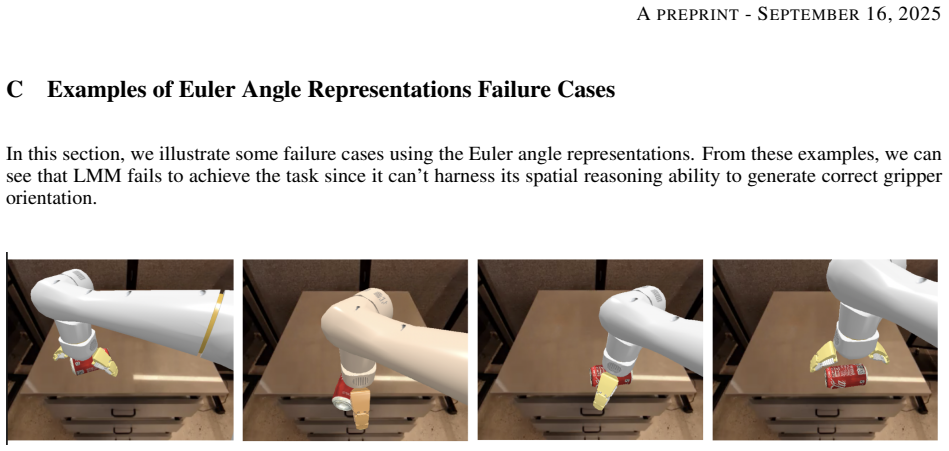
- The axis representation is itself a performance lever: reformatting all orientations as Euler angles in the same training setup drops lift-coke-can success from 96.7% to 42.0% in the paper's comparison.
- Policies that reason over quantitative state rather than raw appearance transfer zero-shot across simulators and to a real robot, and their success is nearly unchanged under large camera-view changes.
- Every executed action is accompanied by a written rationale, so failures can be traced back to a specific reasoning step rather than an opaque action tensor.
Reading between the lines
- The practical ceiling of this paradigm sits in the perception front-end, not the reasoning model: because the policy receives, rather than computes, the quantitative state, the reported successes presuppose accurate segmentation and PCA, so point-cloud completion or better pose estimation might buy more robot-level robustness than a larger language model would.
- The formulation is naturally limited to tasks decomposable into a short sequence of discrete absolute poses, such as pick, place, push, and close; continuous or trajectory-sensitive skills such as wiping or pouring would need the hybrid scheme the authors sketch, switching between deliberate next-goal reasoning and high-frequency direct generation.
- Since GRPO is run per-task rather than jointly (the authors note severe task conflict with only 65 samples), a meaningful stress test would be training on all tasks together and measuring how much of the out-of-distribution transfer survives.
- An independent ablation would isolate the sources of the gain: applying the same dialogue-and-axis format to an open 7B VLA without GRPO would show how much of the sim-to-real transfer comes from the representation itself versus from reinforcement-driven exploration.
Signed reviews
Editorial analysis
A structured set of objections, weighed in public.
Referee Report
Summary. The paper proposes ReasonManip, a 7B large multimodal model that performs tabletop robot manipulation by predicting next-goal gripper poses in natural language using a novel axis-based rotation representation. The training pipeline consists of (i) collecting 65 multi-round reasoning dialogues from Qwen2.5-VL-72B with human guidance, (ii) supervised fine-tuning of Qwen2.5-VL-7B, and (iii) Group Relative Policy Optimization (GRPO) inside the SIMPLER simulator with a binary success reward. The authors claim that the resulting model exhibits system-2 reasoning behaviors, achieves high out-of-distribution generalization to MetaWorld, transfers to a real UR5 robot, and offers transparent interpretability. Experiments compare ReasonManip with RT-1-X, Octo, OpenVLA, and pi0 on SIMPLER, MetaWorld, and a real-world setup, reporting success rates that generally favor ReasonManip, alongside a small ablation of the axis representation versus Euler angles.
Significance. If the claims were fully supported, the paper would introduce a compelling paradigm: using language as a unified action and reasoning interface for manipulation, with extreme data efficiency (65 demonstrations), zero-shot transfer across simulators, and interpretable step-by-step control. The axis-based rotation representation and the GRPO-in-the-loop training recipe are potentially valuable. The paper also honestly states some limitations in Appendix F. However, the central attribution of the reported success to system-2 reasoning is currently unsubstantiated: the comparisons are confounded by privileged numeric state input, the reasoning tokens are never ablated, and the OOD claims are weakened by per-task GRPO training. The ideas are interesting and the topic is timely, but the evidence as presented does not yet support the strong conclusions.
major comments (4)
- [Sec. 3.2, Tables 1-3] The performance comparison against VLA baselines is confounded because ReasonManip receives privileged quantitative scene information (object centers, bounding-box dimensions, PCA-derived axes, and gripper pose) as text at every dialogue turn, whereas RT-1-X, Octo, OpenVLA, and pi0 receive only images. The reported success-rate advantages therefore cannot be attributed to reasoning or the language interface; a model that simply maps state vectors to goal poses might achieve comparable results. The paper should include a controlled comparison where baselines receive an equivalent state representation (e.g., as additional input tokens or via the same perception module), or an ablation in which ReasonManip is evaluated without textual scene information.
- [Sec. 3.4, Sec. 4.5, Eq. (3)] The central claim that system-2 reasoning drives performance is not supported by causal evidence. The SFT loss in Eq. (2) trains on teacher-generated reasoning, and the GRPO loss in Eq. (3) rewards only binary task success, never the quality or causal role of the reasoning text. The model could learn to emit correct actions while producing fluent but post-hoc rationalizations. The qualitative examples in Sec. 4.5 and Fig. 8 illustrate failure detection and self-correction, but they do not show that the reasoning tokens are load-bearing. An ablation that removes, corrupts, or decouples the <think> tokens—for instance, training an action-only variant or replacing reasoning text with fixed filler during inference—should be performed. Without such an ablation, the paper's stated three advantages (OOD generalization, sim-to-real transfer, interpretability) cannot be causally credited to the reasoning process.
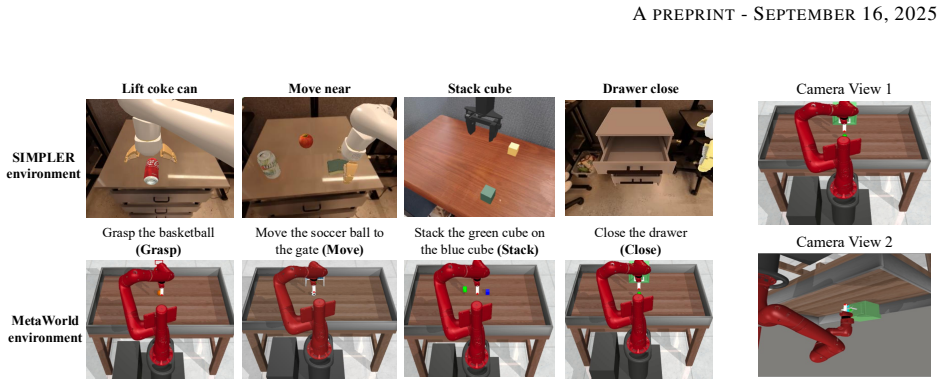
- [Appendix A, Table 2] The out-of-distribution generalization claim is weakened by the fact that GRPO is trained per task. Appendix A states: 'We use the GRPO to train for each of the specific tasks, since we observe severe task conflict based on the limited quantity of SFT training samples.' The MetaWorld tasks in Table 2 are described as 'resembling those in SIMPLER' (Grasp, Move, Stack, Close), i.e., they are the same task types across different simulators and embodiments, not unseen task categories. The abstract's wording 'exceptional generalizability to out-of-distribution environments, objects, and tasks' is therefore not supported for the 'tasks' component. Please clarify what is claimed to generalize and provide evidence for generalization to genuinely novel task types, or adjust the claims accordingly.
- [Tables 1-4] None of the reported success rates include confidence intervals or statistical significance tests, which matters because several headline differences are small relative to the trial counts (50 trials per SIMPLER task, 30 per MetaWorld task, 10 per real-world task). For example, Table 2 shows Move improving from 23.3% to 30.0% and Close from 20% to 40% after GRPO; with 30 trials, these differences are within plausible sampling noise. Similarly, Table 1 reports many values in the 30-45% range with no error bars. The authors should report per-trial variability (e.g., bootstrap confidence intervals over episodes) and, where possible, the number of independent evaluation seeds.
minor comments (5)
- [Sec. 2] There are naming typos: 'Deekseek-R1' should be 'DeepSeek-R1' and 'GPRO' should be 'GRPO'.
- [Fig. 3] The caption of Figure 3 is incomplete; the bottom-left subplots showing Euler angles are not described in the caption, and the figure contains dense inline text that is hard to read. Please expand the caption and simplify the figure.
- [Eq. (3)] The notation in Eq. (3) is inconsistent: 'at.i' appears in the policy ratio but 'at,i' in the loss sum; also the definition of clip(·) is written in a compressed way. Please clean up the typography.
- [Appendix A] Please report the GRPO hyperparameters more completely, including the group size K, the number of update epochs per task, and whether rewards include any shaping beyond the binary success flag.
- [Sec. 4.4] The real-world experiments would benefit from reporting the accuracy of the support-query segmentation module, since the method's failures are attributed in Appendix F to incomplete point clouds. Without this, it is unclear whether the 40-50% real-world success rates are limited by perception, reasoning, or control.
Circularity Check
No circular derivation: the pose predictions are trained against external simulator success and tested on unseen environments, with only auxiliary self-citations.
full rationale
ReasonManip's central chain is empirical rather than definitional. The teacher dialogues are produced by an external 72B LMM with human guidance (Sec. 3.3), SFT is cross-entropy on those dialogues (Eq. 2), and GRPO uses a binary task-success reward from the SIMPLER simulator (Eq. 3). The output next-goal gripper pose is parsed from the model's answer and executed; it is not by construction identical to the scene-state input, and the MetaWorld/real-robot evaluations use environments not seen during training, so the claimed generalization is an external test rather than a restatement of the training objective. The axis-representation advantage is directly tested against Euler (Table 5). The only self-citations ([10], [36], [37]) support auxiliary components — a segmentation network and a motivation about open-world segmentation being unsatisfactory — and do not carry the core claim. The absence of a reasoning-token ablation (or a reward that specifically scores reasoning quality) leaves the attribution of success to 'system-2 reasoning' as an open experimental question, but it is not circular: the GRPO reward does not contain the reasoning text as a target, and the reasoning tokens are not fitted to the evaluation metric. Similarly, Appx. F's stated failure mode under incomplete point clouds is an external dependency, not a fitted-input circularity. No step reduces to its own input by construction.
Assumptions & free parameters
assumptions (5)
- domain assumption Tabletop manipulation tasks can be decomposed into a sequence of discrete next-goal gripper end poses.
- domain assumption Accurate quantitative scene information (positions, dimensions, axes, gripper state) is available at each step.
- domain assumption The binary simulator success signal is a sufficient reward for learning policies that generalize.
- standard math Gripper orientation can be reconstructed from predicted longitudinal and binormal axes via the standard orthonormal-basis formula.
- domain assumption A 7B LMM can learn spatial reasoning from a 72B teacher's dialogues and GRPO.
Cite this review
Pith. "Pith review of Incentivizing Multimodal Reasoning in Large Models for Direct Robot Manipulation." pith.science (2026). https://pith.science/paper/3XU5UE5F
@misc{pith2026250512744,
  author       = {Pith},
  title        = {Pith review of: Incentivizing Multimodal Reasoning in Large Models for Direct Robot Manipulation},
  year         = {2026},
  howpublished = {\url{https://pith.science/paper/3XU5UE5F}},
  note         = {Machine review of arXiv:2505.12744}
}
read the original abstract
Recent Large Multimodal Models have demonstrated remarkable reasoning capabilities, especially in solving complex mathematical problems and realizing accurate spatial perception. Our key insight is that these emerging abilities can naturally extend to robotic manipulation by enabling LMMs to directly infer the next goal in language via reasoning, rather than relying on a separate action head. However, this paradigm meets two main challenges: i) How to make LMMs understand the spatial action space, and ii) How to fully exploit the reasoning capacity of LMMs in solving these tasks. To tackle the former challenge, we propose a novel task formulation, which inputs the current states of object parts and the gripper, and reformulates rotation by a new axis representation instead of traditional Euler angles. This representation is more compatible with spatial reasoning and easier to interpret within a unified language space. For the latter challenge, we design a pipeline to utilize cutting-edge LMMs to generate a small but high-quality reasoning dataset of multi-round dialogues that successfully solve manipulation tasks for supervised fine-tuning. Then, we perform reinforcement learning by trial-and-error interactions in simulation to further enhance the model's reasoning abilities for robotic manipulation. Our resulting reasoning model built upon a 7B backbone, named ReasonManip, demonstrates three notable advantages driven by its system-2 level reasoning capabilities: i) exceptional generalizability to out-of-distribution environments, objects, and tasks; ii) inherent sim-to-real transfer ability enabled by the unified language representation shared across domains; iii) transparent interpretability connecting high-level reasoning and low-level control. Extensive experiments demonstrate the effectiveness of the proposed paradigm and its potential to advance LMM-driven robotic manipulation.
Figures


Figures from the paper (12 more)





Forward citations
Cited by 2 Pith papers
-
Mixture of Horizons in Action Chunking
A gated mixture of multiple action-chunk horizons in a shared full-attention transformer improves VLA manipulation success and enables consensus-based early stopping.
-
When Vision Overrides Language: Evaluating and Mitigating Counterfactual Failures in VLAs
VLAs fail most counterfactual instructions because vision shortcuts dominate language; the new LIBERO-CF benchmark quantifies this, and CAG, an inference-time action mixer, improves grounding and success.
Reference graph
Works this paper leans on
-
[1]
Michael Ahn, Anthony Brohan, Noah Brown, Yevgen Chebotar, Omar Cortes, Byron David, Chelsea Finn, Chuyuan Fu, Keerthana Gopalakrishnan, Karol Hausman, et al. Do as i can, not as i say: Grounding language in robotic affordances.arXiv preprint arXiv:2204.01691, 2022
arXiv 2022
-
[2]
Qwen2.5-vl technical report.arXiv preprint arXiv:2502.13923, 2025
Shuai Bai, Keqin Chen, Xuejing Liu, Jialin Wang, Wenbin Ge, Sibo Song, Kai Dang, Peng Wang, Shijie Wang, Jun Tang, Humen Zhong, Yuanzhi Zhu, Mingkun Yang, Zhaohai Li, Jianqiang Wan, Pengfei Wang, Wei Ding, Zheren Fu, Yiheng Xu, Jiabo Ye, Xi Zhang, Tianbao Xie, Zesen Cheng, Hang Zhang, Zhibo Yang, Haiyang Xu, and Junyang Lin. Qwen2.5-vl technical report.ar...
arXiv 2025
-
[3]
pi_0: A vision-language-action flow model for general robot control
Kevin Black, Noah Brown, Danny Driess, Adnan Esmail, Michael Equi, Chelsea Finn, Niccolo Fusai, Lachy Groom, Karol Hausman, Brian Ichter, et al. pi_0: A vision-language-action flow model for general robot control. arXiv preprint arXiv:2410.24164, 2024
-
[4]
Rt-1: Robotics transformer for real-world control at scale.arXiv preprint arXiv:2212.06817, 2022
Anthony Brohan, Noah Brown, Justice Carbajal, Yevgen Chebotar, Joseph Dabis, Chelsea Finn, Keerthana Gopalakrishnan, Karol Hausman, Alex Herzog, Jasmine Hsu, et al. Rt-1: Robotics transformer for real-world control at scale.arXiv preprint arXiv:2212.06817, 2022
arXiv 2022
-
[5]
Anthony Brohan, Noah Brown, Justice Carbajal, Yevgen Chebotar, Xi Chen, Krzysztof Choromanski, Tianli Ding, Danny Driess, Avinava Dubey, Chelsea Finn, et al. Rt-2: Vision-language-action models transfer web knowledge to robotic control.arXiv preprint arXiv:2307.15818, 2023
arXiv 2023
-
[6]
Xiaoyu Chen, Junliang Guo, Tianyu He, Chuheng Zhang, Pushi Zhang, Derek Cathera Yang, Li Zhao, and Jiang Bian. Igor: Image-goal representations are the atomic control units for foundation models in embodied ai.arXiv preprint arXiv:2411.00785, 2024
arXiv 2024
-
[7]
Yi Chen, Yuying Ge, Yizhuo Li, Yixiao Ge, Mingyu Ding, Ying Shan, and Xihui Liu. Moto: Latent motion token as the bridging language for robot manipulation.arXiv preprint arXiv:2412.04445, 2024
arXiv 2024
-
[8]
Cheng Chi, Siyuan Feng, Yilun Du, Zhenjia Xu, Eric Cousineau, Benjamin Burchfiel, and Shuran Song. Diffusion policy: Visuomotor policy learning via action diffusion.arXiv preprint arXiv:2303.04137, 2023
arXiv 2023
Show all 50 references
-
[9]
Dynamo: In-domain dynamics pretraining for visuo.Motor Control, 2024
ZJ Cui, H Pan, A Iyer, S Haldar, and L Pinto. Dynamo: In-domain dynamics pretraining for visuo.Motor Control, 2024
2024
-
[10]
Fineclip: Self-distilled region-based clip for better fine-grained understanding.Advances in Neural Information Processing Systems, 2024
Zhiwu Lu Dong Jing, Xiaolong He et al. Fineclip: Self-distilled region-based clip for better fine-grained understanding.Advances in Neural Information Processing Systems, 2024
2024
-
[11]
Palm-e: An embodied multimodal language model.arXiv preprint arXiv:2303.03378, 2023
Danny Driess, Fei Xia, Mehdi SM Sajjadi, Corey Lynch, Aakanksha Chowdhery, Brian Ichter, Ayzaan Wahid, Jonathan Tompson, Quan Vuong, Tianhe Yu, et al. Palm-e: An embodied multimodal language model.arXiv preprint arXiv:2303.03378, 2023
2023 arXiv
-
[12]
Bridge data: Boosting generalization of robotic skills with cross-domain datasets.arXiv preprint arXiv:2109.13396, 2021
Frederik Ebert, Yanlai Yang, Karl Schmeckpeper, Bernadette Bucher, Georgios Georgakis, Kostas Daniilidis, Chelsea Finn, and Sergey Levine. Bridge data: Boosting generalization of robotic skills with cross-domain datasets.arXiv preprint arXiv:2109.13396, 2021
2021 arXiv
-
[13]
Deepseek-r1: Incentivizing reasoning capability in llms via reinforcement learning.arXiv preprint arXiv:2501.12948, 2025
Daya Guo, Dejian Yang, Haowei Zhang, Junxiao Song, Ruoyu Zhang, Runxin Xu, Qihao Zhu, Shirong Ma, Peiyi Wang, Xiao Bi, et al. Deepseek-r1: Incentivizing reasoning capability in llms via reinforcement learning.arXiv preprint arXiv:2501.12948, 2025
2025 arXiv
-
[14]
Deep residual learning for image recognition
Kaiming He, Xiangyu Zhang, Shaoqing Ren, and Jian Sun. Deep residual learning for image recognition. In Proceedings of the IEEE conference on computer vision and pattern recognition, pages 770–778, 2016
2016
-
[15]
Lora: Low-rank adaptation of large language models.ICLR, 1(2):3, 2022
Edward J Hu, Yelong Shen, Phillip Wallis, Zeyuan Allen-Zhu, Yuanzhi Li, Shean Wang, Lu Wang, Weizhu Chen, et al. Lora: Low-rank adaptation of large language models.ICLR, 1(2):3, 2022
2022
-
[16]
Reinforce++: A simple and efficient approach for aligning large language models.arXiv preprint arXiv:2501.03262, 2025
Jian Hu. Reinforce++: A simple and efficient approach for aligning large language models.arXiv preprint arXiv:2501.03262, 2025
2025 arXiv
-
[17]
An embodied generalist agent in 3d world.arXiv preprint arXiv:2311.12871, 2023
Jiangyong Huang, Silong Yong, Xiaojian Ma, Xiongkun Linghu, Puhao Li, Yan Wang, Qing Li, Song-Chun Zhu, Baoxiong Jia, and Siyuan Huang. An embodied generalist agent in 3d world.arXiv preprint arXiv:2311.12871, 2023. 10 APREPRINT- SEPTEMBER16, 2025
2023 arXiv
-
[18]
V oxposer: Composable 3d value maps for robotic manipulation with language models.arXiv preprint arXiv:2307.05973, 2023
Wenlong Huang, Chen Wang, Ruohan Zhang, Yunzhu Li, Jiajun Wu, and Li Fei-Fei. V oxposer: Composable 3d value maps for robotic manipulation with language models.arXiv preprint arXiv:2307.05973, 2023
2023 arXiv
-
[19]
Rekep: Spatio-temporal reasoning of relational keypoint constraints for robotic manipulation.arXiv preprint arXiv:2409.01652, 2024
Wenlong Huang, Chen Wang, Yunzhu Li, Ruohan Zhang, and Li Fei-Fei. Rekep: Spatio-temporal reasoning of relational keypoint constraints for robotic manipulation.arXiv preprint arXiv:2409.01652, 2024
2024 arXiv
-
[20]
Openai o1 system card.arXiv preprint arXiv:2412.16720, 2024
Aaron Jaech, Adam Kalai, Adam Lerer, Adam Richardson, Ahmed El-Kishky, Aiden Low, Alec Helyar, Aleksander Madry, Alex Beutel, Alex Carney, et al. Openai o1 system card.arXiv preprint arXiv:2412.16720, 2024
2024 arXiv
-
[21]
macmillan, 2011
Daniel Kahneman.Thinking, fast and slow. macmillan, 2011
2011
-
[22]
Openvla: An open-source vision-language-action model
Moo Jin Kim, Karl Pertsch, Siddharth Karamcheti, Ted Xiao, Ashwin Balakrishna, Suraj Nair, Rafael Rafailov, Ethan Foster, Grace Lam, Pannag Sanketi, Quan Vuong, Thomas Kollar, Benjamin Burchfiel, Russ Tedrake, Dorsa Sadigh, Sergey Levine, Percy Liang, and Chelsea Finn. Openvla...
2024 arXiv
-
[23]
Lisa: Reasoning segmentation via large language model
Xin Lai, Zhuotao Tian, Yukang Chen, Yanwei Li, Yuhui Yuan, Shu Liu, and Jiaya Jia. Lisa: Reasoning segmentation via large language model. InProceedings of the IEEE/CVF Conference on Computer Vision and Pattern Recognition, pages 9579–9589, 2024
2024
-
[24]
Vision-language foundation models as effective robot imitators.arXiv preprint arXiv:2311.01378, 2023
Xinghang Li, Minghuan Liu, Hanbo Zhang, Cunjun Yu, Jie Xu, Hongtao Wu, Chilam Cheang, Ya Jing, Weinan Zhang, Huaping Liu, et al. Vision-language foundation models as effective robot imitators.arXiv preprint arXiv:2311.01378, 2023
2023 arXiv
-
[25]
Evaluating real-world robot manipulation policies in simulation.arXiv preprint arXiv:2405.05941, 2024
Xuanlin Li, Kyle Hsu, Jiayuan Gu, Karl Pertsch, Oier Mees, Homer Rich Walke, Chuyuan Fu, Ishikaa Lunawat, Isabel Sieh, Sean Kirmani, Sergey Levine, Jiajun Wu, Chelsea Finn, Hao Su, Quan Vuong, and Ted Xiao. Evaluating real-world robot manipulation policies in simulation.arXiv ...
2024 arXiv
-
[26]
Open-vocabulary semantic segmentation with mask-adapted clip
Feng Liang, Bichen Wu, Xiaoliang Dai, Kunpeng Li, Yinan Zhao, Hang Zhang, Peizhao Zhang, Peter Vajda, and Diana Marculescu. Open-vocabulary semantic segmentation with mask-adapted clip. InProceedings of the IEEE/CVF Conference on Computer Vision and Pattern Recognition, pages ...
2023
-
[27]
Code as policies: Language model programs for embodied control
Jacky Liang, Wenlong Huang, Fei Xia, Peng Xu, Karol Hausman, Brian Ichter, Pete Florence, and Andy Zeng. Code as policies: Language model programs for embodied control. In2023 IEEE International Conference on Robotics and Automation (ICRA), pages 9493–9500. IEEE, 2023
2023
-
[28]
Swin transformer: Hierarchical vision transformer using shifted windows
Ze Liu, Yutong Lin, Yue Cao, Han Hu, Yixuan Wei, Zheng Zhang, Stephen Lin, and Baining Guo. Swin transformer: Hierarchical vision transformer using shifted windows. InProceedings of the IEEE/CVF international conference on computer vision, pages 10012–10022, 2021
2021
-
[29]
Sgdr: Stochastic gradient descent with warm restarts.arXiv preprint arXiv:1608.03983, 2016
Ilya Loshchilov and Frank Hutter. Sgdr: Stochastic gradient descent with warm restarts.arXiv preprint arXiv:1608.03983, 2016
2016 arXiv
-
[30]
Decoupled weight decay regularization.arXiv preprint arXiv:1711.05101, 2017
Ilya Loshchilov and Frank Hutter. Decoupled weight decay regularization.arXiv preprint arXiv:1711.05101, 2017
2017 arXiv
-
[31]
Open x-embodiment: Robotic learning datasets and rt-x models.arXiv preprint arXiv:2310.08864, 2023
Abby O’Neill, Abdul Rehman, Abhinav Gupta, Abhiram Maddukuri, Abhishek Gupta, Abhishek Padalkar, Abraham Lee, Acorn Pooley, Agrim Gupta, Ajay Mandlekar, et al. Open x-embodiment: Robotic learning datasets and rt-x models.arXiv preprint arXiv:2310.08864, 2023
-
[32]
Proximal policy optimization algorithms.arXiv preprint arXiv:1707.06347, 2017
John Schulman, Filip Wolski, Prafulla Dhariwal, Alec Radford, and Oleg Klimov. Proximal policy optimization algorithms.arXiv preprint arXiv:1707.06347, 2017
2017 arXiv
-
[33]
Deepseekmath: Pushing the limits of mathematical reasoning in open language models.arXiv preprint arXiv:2402.03300, 2024
Zhihong Shao, Peiyi Wang, Qihao Zhu, Runxin Xu, Junxiao Song, Xiao Bi, Haowei Zhang, Mingchuan Zhang, YK Li, Y Wu, et al. Deepseekmath: Pushing the limits of mathematical reasoning in open language models.arXiv preprint arXiv:2402.03300, 2024
2024 arXiv
-
[34]
Hi robot: Open-ended instruction following with hierarchical vision-language-action models.arXiv preprint arXiv:2502.19417, 2025
Lucy Xiaoyang Shi, Brian Ichter, Michael Equi, Liyiming Ke, Karl Pertsch, Quan Vuong, James Tanner, Anna Walling, Haohuan Wang, Niccolo Fusai, et al. Hi robot: Open-ended instruction following with hierarchical vision-language-action models.arXiv preprint arXiv:2502.19417, 2025
2025 arXiv
-
[35]
Computing euler angles from a rotation matrix.Retrieved on August, 6(2000):39–63, 1999
Gregory G Slabaugh. Computing euler angles from a rotation matrix.Retrieved on August, 6(2000):39–63, 1999. 11 APREPRINT- SEPTEMBER16, 2025
2000
-
[36]
Geomanip: Geometric constraints as general interfaces for robot manipulation.arXiv preprint arXiv:2501.09783, 2025
Weiliang Tang, Jia-Hui Pan, Yun-Hui Liu, Masayoshi Tomizuka, Li Erran Li, Chi-Wing Fu, and Mingyu Ding. Geomanip: Geometric constraints as general interfaces for robot manipulation.arXiv preprint arXiv:2501.09783, 2025
2025 arXiv
-
[37]
Overcoming support dilution for robust few-shot semantic segmentation.arXiv preprint arXiv:2501.13529, 2025
Weiling Tang, Biqi Yang, Pheng-Ann Heng, Yun-Hui Liu, and Chi-Wing Fu. Overcoming support dilution for robust few-shot semantic segmentation.arXiv preprint arXiv:2501.13529, 2025
2025 arXiv
-
[38]
Octo: An open-source generalist robot policy.arXiv preprint arXiv:2405.12213, 2024
Octo Model Team, Dibya Ghosh, Homer Walke, Karl Pertsch, Kevin Black, Oier Mees, Sudeep Dasari, Joey Hejna, Tobias Kreiman, Charles Xu, et al. Octo: An open-source generalist robot policy.arXiv preprint arXiv:2405.12213, 2024
2024 arXiv
-
[39]
Llama 2: Open foundation and fine-tuned chat models
Hugo Touvron, Louis Martin, Kevin Stone, Peter Albert, Amjad Almahairi, Yasmine Babaei, Nikolay Bashlykov, Soumya Batra, Prajjwal Bhargava, Shruti Bhosale, et al. Llama 2: Open foundation and fine-tuned chat models. arXiv preprint arXiv:2307.09288, 2023
2023 arXiv
-
[40]
Bridgedata v2: A dataset for robot learning at scale
Homer Rich Walke, Kevin Black, Tony Z Zhao, Quan Vuong, Chongyi Zheng, Philippe Hansen-Estruch, An- dre Wang He, Vivek Myers, Moo Jin Kim, Max Du, et al. Bridgedata v2: A dataset for robot learning at scale. In Conference on Robot Learning, pages 1723–1736. PMLR, 2023
2023
-
[41]
Dart-llm: Dependency-aware multi-robot task decomposition and execution using large language models.arXiv preprint arXiv:2411.09022, 2024
Yongdong Wang, Runze Xiao, Jun Younes Louhi Kasahara, Ryosuke Yajima, Keiji Nagatani, Atsushi Yamashita, and Hajime Asama. Dart-llm: Dependency-aware multi-robot task decomposition and execution using large language models.arXiv preprint arXiv:2411.09022, 2024
2024 arXiv
-
[42]
Q-learning.Machine learning, 8:279–292, 1992
Christopher JCH Watkins and Peter Dayan. Q-learning.Machine learning, 8:279–292, 1992
1992
-
[43]
Chain-of-thought prompting elicits reasoning in large language models.Advances in neural information processing systems, 35:24824–24837, 2022
Jason Wei, Xuezhi Wang, Dale Schuurmans, Maarten Bosma, Fei Xia, Ed Chi, Quoc V Le, Denny Zhou, et al. Chain-of-thought prompting elicits reasoning in large language models.Advances in neural information processing systems, 35:24824–24837, 2022
2022
-
[44]
An Yang, Baosong Yang, Beichen Zhang, Binyuan Hui, Bo Zheng, Bowen Yu, Chengyuan Li, Dayiheng Liu, Fei Huang, Haoran Wei, et al. Qwen2. 5 technical report.arXiv preprint arXiv:2412.15115, 2024
2024 arXiv
-
[45]
Deepcritic: Deliberate critique with large language models.arXiv preprint arXiv:2505.00662, 2025
Wenkai Yang, Jingwen Chen, Yankai Lin, and Ji-Rong Wen. Deepcritic: Deliberate critique with large language models.arXiv preprint arXiv:2505.00662, 2025
2025 arXiv
-
[46]
Latent action pretraining from videos.arXiv preprint arXiv:2410.11758, 2024
Seonghyeon Ye, Joel Jang, Byeongguk Jeon, Sejune Joo, Jianwei Yang, Baolin Peng, Ajay Mandlekar, Reuben Tan, Yu-Wei Chao, Bill Yuchen Lin, et al. Latent action pretraining from videos.arXiv preprint arXiv:2410.11758, 2024
2024 arXiv
-
[47]
Dapo: An open-source llm reinforcement learning system at scale, 2025
Qiying Yu, Zheng Zhang, Ruofei Zhu, Yufeng Yuan, Xiaochen Zuo, Yu Yue, Tiantian Fan, Gaohong Liu, Lingjun Liu, Xin Liu, Haibin Lin, Zhiqi Lin, Bole Ma, Guangming Sheng, Yuxuan Tong, Chi Zhang, Mofan Zhang, Wang Zhang, Hang Zhu, Jinhua Zhu, Jiaze Chen, Jiangjie Chen, Chengyi Wa...
2025 arXiv
-
[48]
Meta-world: A benchmark and evaluation for multi-task and meta reinforcement learning
Tianhe Yu, Deirdre Quillen, Zhanpeng He, Ryan Julian, Karol Hausman, Chelsea Finn, and Sergey Levine. Meta-world: A benchmark and evaluation for multi-task and meta reinforcement learning. InConference on robot learning, pages 1094–1100. PMLR, 2020
2020
-
[49]
Robotic control via embodied chain-of-thought reasoning.arXiv preprint arXiv:2407.08693, 2024
Michał Zawalski, William Chen, Karl Pertsch, Oier Mees, Chelsea Finn, and Sergey Levine. Robotic control via embodied chain-of-thought reasoning.arXiv preprint arXiv:2407.08693, 2024
2024 arXiv
-
[50]
put on" task,
Haoyu Zhen, Xiaowen Qiu, Peihao Chen, Jincheng Yang, Xin Yan, Yilun Du, Yining Hong, and Chuang Gan. 3d-vla: A 3d vision-language-action generative world model.arXiv preprint arXiv:2403.09631, 2024. 12 APREPRINT- SEPTEMBER16, 2025 A Implementation Details of the Experiments Tr...
2024 arXiv
Reviewed August 15, 2026 · model on record in the stance chip above.
Discussion (0). Continue with ORCID to comment.