REVIEW 4 major objections 6 minor 65 references
Opt-In Art: Learning Art Styles Only from Few Examples
T0 review · 4 major / 6 minor · reviewed 2026-08-12 · deepseek-v4-flash
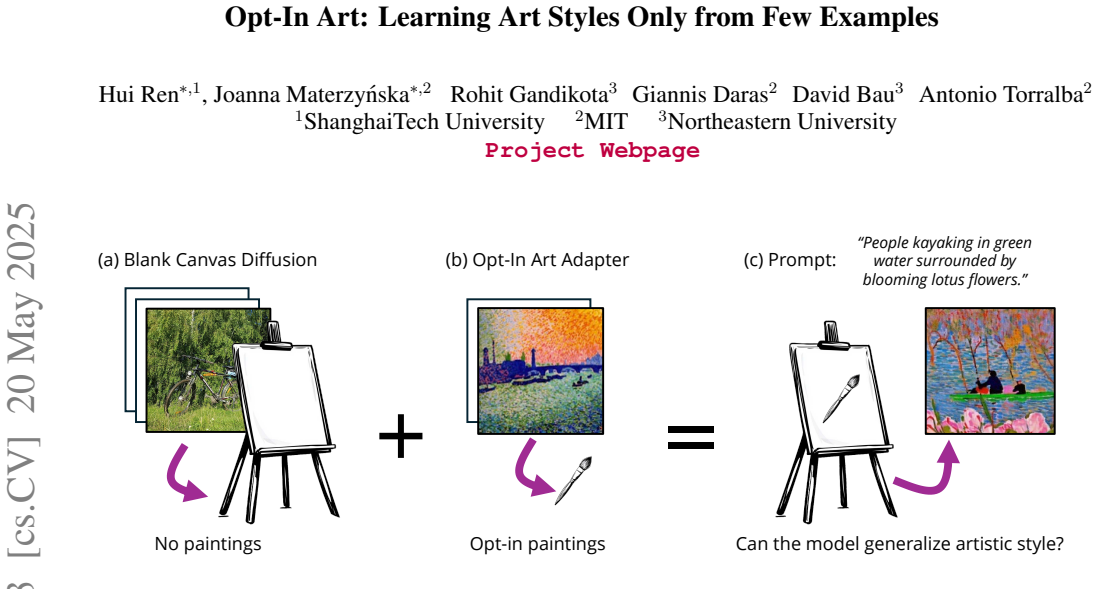
Pith's one-line read A diffusion model trained exclusively on photographs can learn to imitate a painter's style from as few as nine examples, matching models whose training data contained hundreds of millions of art images.
desk verdict A well-executed empirical study with a genuinely new setup and a real result, but the style-generalization claim rests on circular evaluation; it deserves peer review with requests for held-out tests. read the letter →
The pith
A machine-rendered reading of the paper's core claim, the machinery that carries it, and where it could break.
The reading
What carries the argument
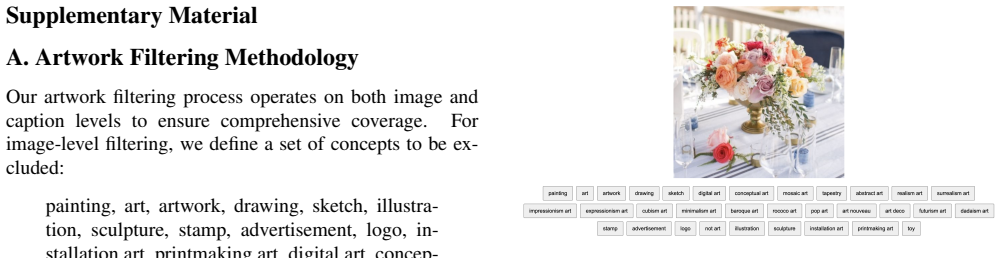
The argument rests on two engineered components. First, the Blank Canvas Dataset and Diffusion model: a two-stage filter (caption keyword blocking plus CLIP cosine-similarity thresholding against art-related terms) removes paintings and other visual art from the SAM-LLava-Captions10M photo corpus, and the VAE and U-Net are trained from scratch on the remaining photographs with a BERT text encoder, deliberately avoiding CLIP so no visual art knowledge leaks through the text embedding. Second, the Art Style Adapter: a LoRA fine-tune applied only to the U-Net's up blocks, trained with a style loss $\|\epsilon_{\theta\cup\theta'}(X_t, C^*, t) - \epsilon\|^2$ and a content loss $\|\epsilon_{\theta\cup\theta'}(X_t, C, t) - \epsilon_\theta(X_t, C, t)\|^2$, where $C^* = C + \text{''in the style of } V^* \text{ art''}$; the content loss keeps style and content disentangled, and at inference the adapter's injection timestep controls stylization strength. This combination isolates style as a low-rank residual that can be learned from a few examples.
What would settle it
A concrete experiment: take two identical latent-diffusion backbones trained on the same 9 million photographs, but add 5% of the very art images the filter excludes to one version's pretraining; apply the same LoRA adapter for a fixed style (say, van Gogh) to both and compare CSD style scores. If the art-added model scores materially higher, prior artistic exposure is doing work the paper denies; if the scores are flat, the no-art-prior claim holds. A sharper probe is to remove the 0.71% residual art images from the photo-only training set and re-run adaptation: under the paper's thesis, style fidelity should be unchanged.
Extended reading notes
Core claim
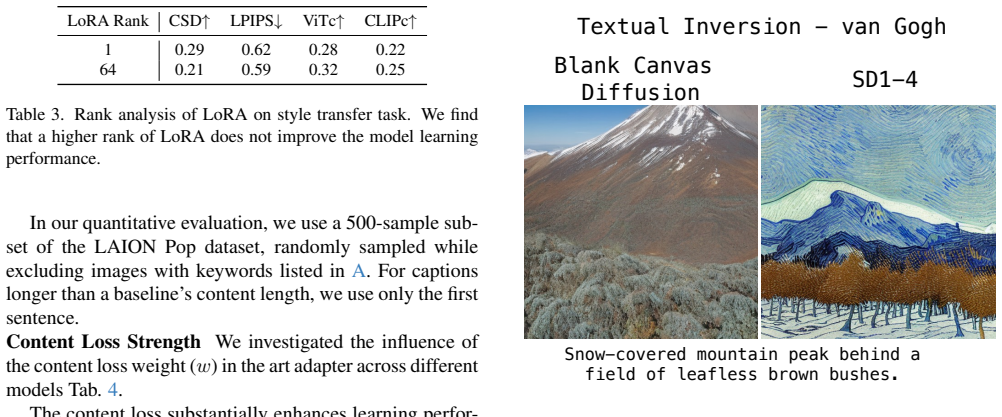
The paper's central claim is that artistic style is not a latent capacity that requires large-scale prior exposure to paintings; it can be assembled from a photograph-only backbone plus a small, carefully selected set of style exemplars. Post-adaptation, Blank Canvas Diffusion with the Art Style Adapter achieves style fidelity comparable to Stable Diffusion 1.4 on image stylization and artistic generation, and controlled experiments that fix architecture and data scale show no significant difference between models pretrained on art-containing versus art-free 100,000-image subsets (CSD 0.32 versus 0.35). Training-free style transfer methods such as StyleAligned work well on Stable Diffusion but fail on Blank Canvas Diffusion, whereas the adapter succeeds on the art-free backbone, indicating that the LoRA adapter supplies the style signal that the pretraining withheld. Data attribution analysis shows that both natural photographs and the few style examples contribute to the generated images, supporting the view that style emerges from reorganizing photographic priors rather than from memorizing paintings.
Load-bearing premise
The claim depends on the assumption that the photograph-only training set truly contains no meaningful artistic style prior, but manual inspection found 71 art-related images (0.71%) in a 10,000-image sample and the paper concedes that photography itself carries aesthetic choices, so 'no prior exposure to paintings' is an approximation.
Editorial extensions
If this is right
- Art-style licensing can become truly opt-in: a base model can be trained with no paintings at all, and a rights-holder can approve a small set of reference works that a LoRA adapter then turns into a usable style.
- Training-data restrictions alone will not prevent style replication, since 9 to 50 examples suffice to mimic a style; the paper argues copyright discussions must therefore address attribution and consent rather than only dataset curation.
- Training-free style-transfer methods (StyleAligned, StyleID) succeed on art-rich backbones and fail on Blank Canvas Diffusion, showing that those methods exploit stylistic priors baked into pretraining; the adapter closes that gap without such priors.
- The content loss (weight $w=50$) lifts style score from 0.14 to 0.29 on the stylization task, demonstrating that separating style from content is what makes few-example style learning stable and transferable.
- A controlled pretraining experiment with fixed architecture and 100,000-image datasets (art-free versus art-containing) yields nearly identical adaptation quality, isolating prior art exposure as irrelevant to the adapter's success.
Reading between the lines
- The paper's own statistics—71 art-related images (0.71%) in a 10,000-sample manual inspection of the filtered dataset, predominantly sculptures—mean 'no prior art' is an approximation; a sharper test would measure style fidelity as the residual art fraction is varied toward zero, predicting a flat curve if the thesis holds.
- The data attribution results suggest the mechanism is style as a transformation of photographic priors rather than memory of paintings; a direct probe would be to train the adapter on a backbone pretrained on synthetic non-scene images (textures, noise) and check whether any artistic style survives, which would reveal how much of the effect depends on real-world photographic structure.
- The finding that a deterministic adapter on an art-free backbone rivals an art-trained model complicates the 'memorization' narrative of diffusion models: if style can be composed from natural-image priors plus a few examples, then resemblance to an artist may not require any copying of the artist's works, which would shift legal and technical debates from training-data provenance to the few-shot
Editorial analysis
A structured set of objections, weighed in public.
Referee Report
Summary. The paper investigates whether a text-to-image diffusion model pretrained exclusively on photographs can learn an artistic style from a small number of examples. The authors construct Blank Canvas Diffusion, a latent diffusion model trained from scratch on the Blank Canvas Dataset, a filtered subset of SAM-LLaVA-Captions10M from which captions and CLIP scores are used to remove paintings and other non-photographic art. Style adaptation is performed with a LoRA adapter trained on 9 to 50 manually curated paintings per artist using a style loss plus a content-preservation loss. Evaluation uses the Contrastive Style Descriptor (CSD) against the adaptation set, content metrics (ViT-c, CLIP), a Mechanical Turk user study, and data attribution. The central claim is that a model with no prior exposure to paintings can match the style fidelity of Stable Diffusion 1.4, suggesting that artistic style generation is not contingent on artistic pretraining.
Significance. If the central claim holds, the paper is significant for two communities: it challenges the assumption that artistic style generation requires large-scale exposure to art in pretraining, and it informs copyright/opt-in debates by showing that few-shot adaptation can replicate a style. The paper has several genuine strengths: the pretraining data is deliberately and transparently filtered, the VAE and U-Net are trained from scratch with a language-only text encoder to avoid art leakage from CLIP, the authors report a manual audit of residual art content, they include a controlled filtering experiment (Section 6.2), and they supplement automatic metrics with a user study and a real-artist interview. These choices make the empirical setup more informative than a typical style-transfer paper. However, the evaluation is currently too weak to support the strongest form of the claim, because style fidelity is measured against the same images used for adaptation and no held-out-artist evaluation is reported.
major comments (4)
- [Section 6.2 (CSD metric)] The automatic style metric is computed as the mean CSD score between a generated image and images from the Art-Adaptation set, which is the same set used to train the LoRA adapter via Eq. (3). This makes the style-fidelity evaluation circular: a model that overfits or memorizes the adaptation examples can score high without generalizing to unseen works by the same artist. The abstract's phrase 'generalize an artistic style' (Fig. 1) therefore is not actually tested. Please add a held-out evaluation using paintings by the same artist that were not used for adapter training, and compare against a memorization baseline (e.g., a model that retrieves or copies the closest training example).
- [Section 6.2 (user study)] The user study asks participants to compare outputs against 'three reference images showing the style of an artist,' but the paper does not state whether these reference images are disjoint from the adapter training set. If they are the same as the training examples, the preference results face the same circularity as the CSD metric. Please specify this explicitly and, ideally, run the study with held-out reference artworks so that the question is about style generalization rather than example matching.
- [Abstract, Section 4, Section 7] The claim of 'no prior exposure to paintings' or 'without access to any painting-related content' is stronger than the evidence. Table 1 reports that manual inspection of a 10,000-image sample of the final Blank Canvas Dataset still finds 71 art-related images (0.71%), and Section 7 concedes that photography itself carries inherent artistic style. The BERT text encoder also has linguistic knowledge of art concepts. I recommend qualifying the claim to 'minimal exposure to non-photographic art' and adding an analysis (e.g., removing the residual 0.71% or measuring sensitivity to them) to show that the residual art does not drive the adaptation results.
- [Section 6.2 (Data Attribution)] The data attribution results are interpreted as evidence that the adapter 'generalizes' and that natural images contribute to style generation, but the top attributed images in Fig. 9 frequently include Art-Style Examples, which is exactly what would be expected if the generated image is close to the training set. Without a baseline (e.g., attribution for a model trained to copy the adaptation set, or comparison of attribution to held-out works), the data attribution does not distinguish style abstraction from example memorization. This concern does not invalidate the method, but it means the attribution analysis does not currently support the generalization claim.
minor comments (6)
- [Table 1 and Section 4.1] The text says 'Post-filtering analysis ... revealed only 72 images' while Table 1 reports 71; please align the numbers.
- [Equation (1)] The noise term should be √(β_t)ε under the standard DDPM parameterization; as written, the variance of the added noise is β_t^2, not β_t.
- [Figure 5 caption] The caption appears garbled (e.g., '?㗃!'), likely a rendering issue; please ensure the final PDF displays the equation and loss terms correctly.
- [Section 6.2 (few-shot curation)] The manual curation of '9 to 50 paintings ... with similar color composition, brushstroke techniques, and artistic content' makes the adaptation set unusually homogeneous; please discuss how the results might change if the few-shot examples are less curated or more diverse.
- [Section 6.2 (user study details)] Please specify in the user study description how many reference images were shown per artist and how many evaluation rounds each worker completed, so that the reported percentages can be interpreted.
- [Section 6.2 (baseline description)] The statement that 'baselines rely on extensive Stable Diffusion 1.4 training on large art-rich datasets' is accurate but should also acknowledge that StyleAligned uses a single reference image while the proposed adapter uses multiple style references; Section K already mentions this, but it should be stated in the main evaluation.
Circularity Check
Style-fidelity evaluation is computed against the same Art-Adaptation set used to train the adapter, so the quantitative 'generalization' claim is partially circular.
-
fitted input called prediction
[Sec. 5, Eq. (3) and Sec. 6.2, 'Art Style Adaptation']
"For a given target artistic image, we define the following loss: LS(θ′) =∥ϵθ∪θ′(Xt, C∗, t) − ϵ|∥2 , (3) ... We refer to this loss as style loss. ... To evaluate art style similarity, we use the Contrastive Style Descriptor (CSD) [54] ... For each sample, we compute the mean CSD score between a generated image and images from the Art-Adaptation set."
The Art-Style Adapter is optimized on the Art-Adaptation set A (Eq. 3), and the headline automatic style metric is the mean CSD between a generated image and images from that same set A. A model that overfits or memorizes its 9-50 training paintings will therefore score high on CSD without demonstrating style generalization. The paper explicitly claims generalization ('we find that it is possible to adapt a model that is trained without paintings to generalize an artistic style'), but no held-out same-artist images, no cross-artist discrimination test, and no memorization baseline are reported.
full rationale
The paper is largely self-contained: Blank Canvas Diffusion is trained from scratch on a filtered photograph dataset, the LoRA adapter is a standard open adaptation method, and comparisons to CommonCanvas, SD1.4, StyleAligned, and other baselines are external. No load-bearing self-citation chain or imported uniqueness theorem is present. The central circularity is confined to the style-fidelity evaluation: the quantitative CSD score and, in all likelihood, the user-study references are drawn from the same small Art-Adaptation set on which the adapter was trained. That makes the 'style score' a training-set-similarity measure by construction, so the paper's quantitative claim of matching art-trained models on style is not a held-out test of style generalization. The qualitative figure-level outputs, the data-attribution analysis, and the Alan Kenny interview do provide some independent evidence that a style has been acquired, which prevents a score of 8 or 10. A held-out same-artist evaluation or memorization baseline would remove the circularity.
Assumptions & free parameters
free parameters (8)
- Content loss weight w =
50
- LoRA rank =
1
- LoRA scale =
1.0
- CLIP art-filter threshold =
17
- Adapter start timestep =
800 for image stylization, 0 for artistic generation
- Style example set size =
9 to 50 per artist, average 21.88
- Adapter training steps =
1,000
- VAE training mixture =
104,145 SAM images plus 115,294 filtered COCO images
assumptions (5)
- ad hoc to paper The two-stage filtering (caption keywords plus CLIP similarity below threshold 17) removes essentially all non-photographic visual art from the training set.
- domain assumption BERT text encoder contains no visual or pixel-level art knowledge.
- domain assumption SA-1B images are photographs captured by cameras and are suitable as an art-free pretraining source.
- domain assumption Contrastive Style Descriptor (CSD) is a valid measure of artistic style similarity.
- domain assumption The user study provides reliable judgments after filtering out workers who failed the reliability task.
Cite this review
Pith. "Pith review of Opt-In Art: Learning Art Styles Only from Few Examples." pith.science (2026). https://pith.science/paper/3Y55EHJX
@misc{pith2026241200176,
  author       = {Pith},
  title        = {Pith review of: Opt-In Art: Learning Art Styles Only from Few Examples},
  year         = {2026},
  howpublished = {\url{https://pith.science/paper/3Y55EHJX}},
  note         = {Machine review of arXiv:2412.00176}
}
read the original abstract
We explore whether pre-training on datasets with paintings is necessary for a model to learn an artistic style with only a few examples. To investigate this, we train a text-to-image model exclusively on photographs, without access to any painting-related content. We show that it is possible to adapt a model that is trained without paintings to an artistic style, given only few examples. User studies and automatic evaluations confirm that our model (post-adaptation) performs on par with state-of-the-art models trained on massive datasets that contain artistic content like paintings, drawings or illustrations. Finally, using data attribution techniques, we analyze how both artistic and non-artistic datasets contribute to generating artistic-style images. Surprisingly, our findings suggest that high-quality artistic outputs can be achieved without prior exposure to artistic data, indicating that artistic style generation can occur in a controlled, opt-in manner using only a limited, carefully selected set of training examples.
Figures


Figures from the paper (32 more)






Reference graph
Works this paper leans on
-
[1]
Jane Andersen. Andersen v. stability ai: The landmark case unpacking the copyright risks of ai image generators. NYU Journal of Intellectual Property and Entertainment Law ,
-
[2]
In- structpix2pix: Learning to follow image editing instructions
Tim Brooks, Aleksander Holynski, and Alexei A Efros. In- structpix2pix: Learning to follow image editing instructions. In Proceedings of the IEEE/CVF Conference on Computer Vision and Pattern Recognition, pages 18392–18402, 2023. 6
2023
-
[3]
Extracting training data from diffu- sion models
Nicolas Carlini, Jamie Hayes, Milad Nasr, Matthew Jagiel- ski, Vikash Sehwag, Florian Tramer, Borja Balle, Daphne Ip- polito, and Eric Wallace. Extracting training data from diffu- sion models. In 32nd USENIX Security Symposium (USENIX Security 23), pages 5253–5270, 2023. 2
2023
-
[4]
Towards memorization-free diffusion models
Chen Chen, Daochang Liu, and Chang Xu. Towards memorization-free diffusion models. In Proceedings of the IEEE/CVF Conference on Computer Vision and Pattern Recognition, pages 8425–8434, 2024. 2
2024
-
[5]
Pixart-α: Fast training of dif- fusion transformer for photorealistic text-to-image synthesis,
Junsong Chen, Jincheng Yu, Chongjian Ge, Lewei Yao, Enze Xie, Yue Wu, Zhongdao Wang, James Kwok, Ping Luo, Huchuan Lu, and Zhenguo Li. Pixart-α: Fast training of dif- fusion transformer for photorealistic text-to-image synthesis,
-
[6]
Jiwoo Chung, Sangeek Hyun, and Jae-Pil Heo. Style injec- tion in diffusion: A training-free approach for adapting large- scale diffusion models for style transfer. In Proceedings of the IEEE/CVF Conference on Computer Vision and Pattern Recognition (CVPR), pages 8795–8805, 2024. 16
work page 2024
-
[7]
Style injec- tion in diffusion: A training-free approach for adapting large- scale diffusion models for style transfer
Jiwoo Chung, Sangeek Hyun, and Jae-Pil Heo. Style injec- tion in diffusion: A training-free approach for adapting large- scale diffusion models for style transfer. In Proceedings of the IEEE/CVF Conference on Computer Vision and Pattern Recognition, pages 8795–8805, 2024. 3
2024
- [8]
Show all 65 references
-
[9]
Stable diffusion v1-4 model card, 2022
CompVis. Stable diffusion v1-4 model card, 2022. 5
2022
-
[10]
Diffusionshield: A wa- termark for copyright protection against generative diffusion models
Yingqian Cui, Jie Ren, Han Xu, Pengfei He, Hui Liu, Lichao Sun, Yue Xing, and Jiliang Tang. Diffusionshield: A wa- termark for copyright protection against generative diffusion models. arXiv preprint arXiv:2306.04642, 2023. 2
2023 arXiv
-
[11]
Multiresolution textual inversion
Giannis Daras and Alexandros G Dimakis. Multiresolution textual inversion. arXiv preprint arXiv:2211.17115, 2022. 3
2022 arXiv
-
[12]
Ambient diffu- sion: Learning clean distributions from corrupted data
Giannis Daras, Kulin Shah, Yuval Dagan, Aravind Gol- lakota, Alex Dimakis, and Adam Klivans. Ambient diffu- sion: Learning clean distributions from corrupted data. Ad- vances in Neural Information Processing Systems , 36:288– 313, 2023. 2
2023
-
[13]
Consistent diffusion meets tweedie: Training ex- act ambient diffusion models with noisy data
Giannis Daras, Alexandros G Dimakis, and Constantinos Daskalakis. Consistent diffusion meets tweedie: Training ex- act ambient diffusion models with noisy data. arXiv preprint arXiv:2404.10177, 2024. 2
2024 arXiv
-
[14]
Bert: Pre-training of deep bidirectional trans- formers for language understanding, 2019
Jacob Devlin, Ming-Wei Chang, Kenton Lee, and Kristina Toutanova. Bert: Pre-training of deep bidirectional trans- formers for language understanding, 2019. 4, 5
2019
-
[15]
Image quilting for texture synthesis and transfer
Alexei A Efros and William T Freeman. Image quilting for texture synthesis and transfer. In Seminal Graphics Papers: Pushing the Boundaries, Volume 2, pages 571–576. 2023. 3
2023
-
[16]
Art and the science of generative ai
Ziv Epstein, Aaron Hertzmann, Investigators of Human Cre- ativity, Memo Akten, Hany Farid, Jessica Fjeld, Morgan R Frank, Matthew Groh, Laura Herman, Neil Leach, et al. Art and the science of generative ai. Science, 380(6650):1110– 1111, 2023. 1, 2
2023
-
[17]
Bermano, Gal Chechik, and Daniel Cohen-Or
Rinon Gal, Yuval Alaluf, Yuval Atzmon, Or Patashnik, Amit H. Bermano, Gal Chechik, and Daniel Cohen-Or. An image is worth one word: Personalizing text-to-image gen- eration using textual inversion, 2022. 3
2022
-
[18]
Erasing concepts from diffusion models, 2023
Rohit Gandikota, Joanna Materzynska, Jaden Fiotto- Kaufman, and David Bau. Erasing concepts from diffusion models, 2023. 1, 2
2023
-
[19]
Unified concept editing in dif- fusion models
Rohit Gandikota, Hadas Orgad, Yonatan Belinkov, Joanna Materzy´nska, and David Bau. Unified concept editing in dif- fusion models. arXiv preprint arXiv:2308.14761, 2023. 2
2023 arXiv
-
[20]
Com- moncanvas: Open diffusion models trained on creative- commons images
Aaron Gokaslan, A Feder Cooper, Jasmine Collins, Lan- dan Seguin, Austin Jacobson, Mihir Patel, Jonathan Fran- kle, Cory Stephenson, and V olodymyr Kuleshov. Com- moncanvas: Open diffusion models trained on creative- commons images. In Proceedings of the IEEE/CVF Con- ference ...
2024
-
[21]
Getty images v
Sophia Goosens. Getty images v. stability ai: The implica- tions for uk copyright law and licensing, 2024. Accessed: 2025-03-05. 2
2024
-
[22]
This artist is dominating ai-generated art
Melissa Heikkil ¨a. This artist is dominating ai-generated art. and he’s not happy about it.MIT Technology Review, 125(6): 9–10, 2022. 7
2022
-
[23]
Selective amnesia: A continual learning approach to forgetting in deep generative models,
Alvin Heng and Harold Soh. Selective amnesia: A continual learning approach to forgetting in deep generative models,
-
[24]
Style aligned image generation via shared atten- tion
Amir Hertz, Andrey V oynov, Shlomi Fruchter, and Daniel Cohen-Or. Style aligned image generation via shared atten- tion. In Proceedings of the IEEE/CVF Conference on Com- puter Vision and Pattern Recognition , pages 4775–4785,
-
[25]
The choices hidden in photography
Aaron Hertzmann. The choices hidden in photography. Jour- nal of Vision, 22(11):10–10, 2022. 8
2022
-
[26]
Image analogies
Aaron Hertzmann, Charles E Jacobs, Nuria Oliver, Brian Curless, and David H Salesin. Image analogies. In Sem- inal Graphics Papers: Pushing the Boundaries, Volume 2 , pages 557–570. 2023. 3
2023
-
[27]
Classifier-free diffusion guidance, 2022
Jonathan Ho and Tim Salimans. Classifier-free diffusion guidance, 2022. 13 9
2022
-
[28]
Denoising diffu- sion probabilistic models, 2020
Jonathan Ho, Ajay Jain, and Pieter Abbeel. Denoising diffu- sion probabilistic models, 2020. 1, 3
2020
-
[29]
All but one: Surgical concept erasing with model preservation in text-to- image diffusion models
Seunghoo Hong, Juhun Lee, and Simon S Woo. All but one: Surgical concept erasing with model preservation in text-to- image diffusion models. In Proceedings of the AAAI Con- ference on Artificial Intelligence, pages 21143–21151, 2024. 2
2024
-
[30]
Hu, Yelong Shen, Phillip Wallis, Zeyuan Allen- Zhu, Yuanzhi Li, Shean Wang, Lu Wang, and Weizhu Chen
Edward J. Hu, Yelong Shen, Phillip Wallis, Zeyuan Allen- Zhu, Yuanzhi Li, Shean Wang, Lu Wang, and Weizhu Chen. Lora: Low-rank adaptation of large language models, 2021. 3, 5
2021
-
[31]
Visual style prompting with swapping self- attention
Jaeseok Jeong, Junho Kim, Yunjey Choi, Gayoung Lee, and Youngjung Uh. Visual style prompting with swapping self- attention. arXiv preprint arXiv:2402.12974, 2024. 3, 16
2024 arXiv
-
[32]
Cpsample: Classifier protected sampling for guarding training data during diffusion
Joshua Kazdan, Hao Sun, Jiaqi Han, Felix Petersen, and Stefano Ermon. Cpsample: Classifier protected sampling for guarding training data during diffusion. arXiv preprint arXiv:2409.07025, 2024. 2
2024 arXiv
-
[33]
Diffu- sionclip: Text-guided diffusion models for robust image ma- nipulation
Gwanghyun Kim, Taesung Kwon, and Jong Chul Ye. Diffu- sionclip: Text-guided diffusion models for robust image ma- nipulation. In Proceedings of the IEEE/CVF conference on computer vision and pattern recognition, pages 2426–2435,
-
[34]
Berg, Wan-Yen Lo, Piotr Doll ´ar, and Ross Girshick
Alexander Kirillov, Eric Mintun, Nikhila Ravi, Hanzi Mao, Chloe Rolland, Laura Gustafson, Tete Xiao, Spencer White- head, Alexander C. Berg, Wan-Yen Lo, Piotr Doll ´ar, and Ross Girshick. Segment anything, 2023. 4
2023
-
[35]
Ablating con- cepts in text-to-image diffusion models
Nupur Kumari, Bingliang Zhang, Sheng-Yu Wang, Eli Shechtman, Richard Zhang, and Jun-Yan Zhu. Ablating con- cepts in text-to-image diffusion models. In Proceedings of the IEEE/CVF International Conference on Computer Vi- sion, pages 22691–22702, 2023. 2
2023
-
[36]
Multi-concept customization of text-to-image diffusion, 2023
Nupur Kumari, Bingliang Zhang, Richard Zhang, Eli Shechtman, and Jun-Yan Zhu. Multi-concept customization of text-to-image diffusion, 2023. 14
2023
-
[37]
Mace: Mass concept erasure in diffu- sion models
Shilin Lu, Zilan Wang, Leyang Li, Yanzhu Liu, and Adams Wai-Kin Kong. Mace: Mass concept erasure in diffu- sion models. In Proceedings of the IEEE/CVF Conference on Computer Vision and Pattern Recognition , pages 6430– 6440, 2024. 2
2024
-
[38]
Disguised copyright infringement of latent diffusion models
Yiwei Lu, Matthew YR Yang, Zuoqiu Liu, Gautam Kamath, and Yaoliang Yu. Disguised copyright infringement of latent diffusion models. arXiv preprint arXiv:2404.06737, 2024. 2
2024 arXiv
-
[39]
One-dimensional adapter to rule them all: Concepts diffusion models and erasing applications
Mengyao Lyu, Yuhong Yang, Haiwen Hong, Hui Chen, Xuan Jin, Yuan He, Hui Xue, Jungong Han, and Guiguang Ding. One-dimensional adapter to rule them all: Concepts diffusion models and erasing applications. In Proceedings of the IEEE/CVF Conference on Computer Vision and Pattern R...
2024
-
[40]
A watermark-conditioned diffusion model for ip protection
Rui Min, Sen Li, Hongyang Chen, and Minhao Cheng. A watermark-conditioned diffusion model for ip protection. arXiv preprint arXiv:2403.10893, 2024. 2
2024 arXiv
-
[41]
Direct unlearning optimization for robust and safe text- to-image models
Yong-Hyun Park, Sangdoo Yun, Jin-Hwa Kim, Junho Kim, Geonhui Jang, Yonghyun Jeong, Junghyo Jo, and Gayoung Lee. Direct unlearning optimization for robust and safe text- to-image models. arXiv preprint arXiv:2407.21035 , 2024. 2
2024 arXiv
-
[42]
Styleclip: Text-driven manipulation of stylegan imagery
Or Patashnik, Zongze Wu, Eli Shechtman, Daniel Cohen-Or, and Dani Lischinski. Styleclip: Text-driven manipulation of stylegan imagery. In Proceedings of the IEEE/CVF inter- national conference on computer vision , pages 2085–2094,
-
[43]
Circumventing concept erasure meth- ods for text-to-image generative models
Minh Pham, Kelly O Marshall, Niv Cohen, Govind Mittal, and Chinmay Hegde. Circumventing concept erasure meth- ods for text-to-image generative models. In The Twelfth In- ternational Conference on Learning Representations , 2023. 2, 14
2023
-
[44]
Robust concept erasure using task vectors
Minh Pham, Kelly O Marshall, Chinmay Hegde, and Niv Cohen. Robust concept erasure using task vectors. arXiv preprint arXiv:2404.03631, 2024. 2
2024 arXiv
-
[45]
Dead- iff: An efficient stylization diffusion model with disentan- gled representations
Tianhao Qi, Shancheng Fang, Yanze Wu, Hongtao Xie, Ji- awei Liu, Lang Chen, Qian He, and Yongdong Zhang. Dead- iff: An efficient stylization diffusion model with disentan- gled representations. In Proceedings of the IEEE/CVF Con- ference on Computer Vision and Pattern Recognit...
2024
-
[46]
Learning transferable visual models from natural language supervision, 2021
Alec Radford, Jong Wook Kim, Chris Hallacy, Aditya Ramesh, Gabriel Goh, Sandhini Agarwal, Girish Sastry, Amanda Askell, Pamela Mishkin, Jack Clark, Gretchen Krueger, and Ilya Sutskever. Learning transferable visual models from natural language supervision, 2021. 4
2021
-
[47]
High-resolution image syn- thesis with latent diffusion models, 2022
Robin Rombach, Andreas Blattmann, Dominik Lorenz, Patrick Esser, and Bj¨orn Ommer. High-resolution image syn- thesis with latent diffusion models, 2022. 3, 4, 5
2022
-
[48]
Dreambooth: Fine tuning text-to-image diffusion models for subject-driven generation, 2023
Nataniel Ruiz, Yuanzhen Li, Varun Jampani, Yael Pritch, Michael Rubinstein, and Kfir Aberman. Dreambooth: Fine tuning text-to-image diffusion models for subject-driven generation, 2023. 3, 14
2023
-
[49]
Laion pop: 600,000 high-resolution images with detailed descriptions, 2023
Christoph Schuhmann and Peter Bevan. Laion pop: 600,000 high-resolution images with detailed descriptions, 2023. 6
2023
-
[50]
Laion-5b: An open large-scale dataset for training next generation image-text models
Christoph Schuhmann, Romain Beaumont, Richard Vencu, Cade Gordon, Ross Wightman, Mehdi Cherti, Theo Coombes, Aarush Katta, Clayton Mullis, Mitchell Worts- man, et al. Laion-5b: An open large-scale dataset for training next generation image-text models. Advances in neural in- f...
2022
-
[51]
This artist is dominating ai-generated art
Tom Simonite. This artist is dominating ai-generated art. and he’s not happy about it. MIT Technology Review, 2022. 2
2022
-
[52]
Styledrop: Text-to-image generation in any style
Kihyuk Sohn, Nataniel Ruiz, Kimin Lee, Daniel Castro Chin, Irina Blok, Huiwen Chang, Jarred Barber, Lu Jiang, Glenn Entis, Yuanzhen Li, et al. Styledrop: Text-to-image generation in any style. arXiv preprint arXiv:2306.00983 ,
-
[53]
Diffusion art or digital forgery? investigating data replication in diffusion models
Gowthami Somepalli, Vasu Singla, Micah Goldblum, Jonas Geiping, and Tom Goldstein. Diffusion art or digital forgery? investigating data replication in diffusion models. In Pro- ceedings of the IEEE/CVF Conference on Computer Vision and Pattern Recognition, pages 6048–6058, 2023. 1, 2
2023
-
[54]
Measuring style similarity in diffusion models
Gowthami Somepalli, Anubhav Gupta, Kamal Gupta, Shra- may Palta, Micah Goldblum, Jonas Geiping, Abhinav Shri- vastava, and Tom Goldstein. Measuring style similarity in diffusion models. arXiv preprint arXiv:2404.01292 , 2024. 1, 2, 6
2024 arXiv
-
[55]
Spawning ai, 2023
Spawning AI Team. Spawning ai, 2023. 2 10
2023
-
[56]
Plug-and-play diffusion features for text-driven image-to-image translation
Narek Tumanyan, Michal Geyer, Shai Bagon, and Tali Dekel. Plug-and-play diffusion features for text-driven image-to-image translation. InProceedings of the IEEE/CVF Conference on Computer Vision and Pattern Recognition (CVPR), pages 1921–1930, 2023. 6, 14
1921
-
[57]
Instantstyle: Free lunch towards style-preserving in text-to-image generation
Haofan Wang, Matteo Spinelli, Qixun Wang, Xu Bai, Zekui Qin, and Anthony Chen. Instantstyle: Free lunch towards style-preserving in text-to-image generation. arXiv preprint arXiv:2404.02733, 2024. 3, 16
2024 arXiv
-
[58]
Evaluating data attribution for text-to-image models
Sheng-Yu Wang, Alexei A Efros, Jun-Yan Zhu, and Richard Zhang. Evaluating data attribution for text-to-image models. In Proceedings of the IEEE/CVF International Conference on Computer Vision, pages 7192–7203, 2023. 7, 8
2023
-
[59]
A computational approach to studying aesthetic judgments of ambiguous artworks
Xi Wang, Zoya Bylinskii, Aaron Hertzmann, and Robert Pepperell. A computational approach to studying aesthetic judgments of ambiguous artworks. Psychology of Aesthet- ics, Creativity, and the Arts, 2023. 6
2023
-
[60]
De- tecting, explaining, and mitigating memorization in diffusion models
Yuxin Wen, Yuchen Liu, Chen Chen, and Lingjuan Lyu. De- tecting, explaining, and mitigating memorization in diffusion models. In The Twelfth International Conference on Learn- ing Representations, 2024. 2
2024
-
[61]
Artists land a win in class action law- suit against a.i
Richard Whiddington. Artists land a win in class action law- suit against a.i. companies. Artnet News, 2024. 1
2024
-
[62]
Defensive unlearning with adversarial training for robust concept erasure in diffusion models
Yimeng Zhang, Xin Chen, Jinghan Jia, Yihua Zhang, Chongyu Fan, Jiancheng Liu, Mingyi Hong, Ke Ding, and Sijia Liu. Defensive unlearning with adversarial training for robust concept erasure in diffusion models. arXiv preprint arXiv:2405.15234, 2024. 2
2024 arXiv
-
[63]
A recipe for watermarking dif- fusion models
Yunqing Zhao, Tianyu Pang, Chao Du, Xiao Yang, Ngai- Man Cheung, and Min Lin. A recipe for watermarking dif- fusion models. arXiv preprint arXiv:2303.10137, 2023. 2
2023 arXiv
-
[64]
painting
Jun-Yan Zhu, Taesung Park, Phillip Isola, and Alexei A Efros. Unpaired image-to-image translation using cycle- consistent adversarial networks. In Proceedings of the IEEE international conference on computer vision , pages 2223– 2232, 2017. 6 11 Supplementary Material A. Artwo...
2017
-
[2024]
Accessed: 2025-03-05. 2
2025
Reviewed August 12, 2026 · model on record in the stance chip above.
Discussion (0). Continue with ORCID to comment.