REVIEW 2 major objections 5 minor 3 references
Relighting Humans: Occlusion-Aware Inverse Rendering for Full-Body Human Images
T0 review · 2 major / 5 minor · reviewed 2026-08-14 · deepseek-v4-flash
Pith's one-line read Occlusion-aware relighting of full-body humans from one masked image is achievable by learning per-pixel SH light transport vectors with a CNN.
desk verdict A solid, novel TOG contribution on occlusion-aware relighting of full-body humans, but the quantitative transport claim is entangled with contaminated albedo ground truth. read the letter →
The pith
A machine-rendered reading of the paper's core claim, the machinery that carries it, and where it could break.
The reading
What carries the argument
The central object is the per-pixel light transport vector $\mathbf{T}$, a nine-coefficient spherical-harmonics vector that encodes the compound signal $V(\omega_i)\max(\mathbf{n}\cdot\omega_i,0)$ — visibility times cosine decay — following the precomputed-radiance-transfer formulation. Shading is then the dot product $E = \mathbf{T}\cdot\mathbf{L}$, where $\mathbf{L}$ contains the SH coefficients of the illumination. This object carries the argument because the convolutional network can learn $\mathbf{T}$ directly from appearance and silhouette, so self-occlusion is incorporated into relighting without reconstructing geometry or tracing visibility rays. The paper's demonstration that plausible $\mathbf{T}$ maps are inferable from a few hundred aligned scans is the core discovery.
What would settle it
Render a known 3D human scan with a measured HDR environment map using path tracing, then run the network on that single rendered image and compare the predicted light transport map, term by term, against the path-traced visibility-weighted transport. If the predicted transport reproduces the direction-dependent shadow structure under several rotated lighting environments, the occlusion claim is confirmed; if the transport only scales down concavities in a view-stationary way, the network has learned an ambient-occlusion-like heuristic, and relighting under a different light direction will fail.
Extended reading notes
Core claim
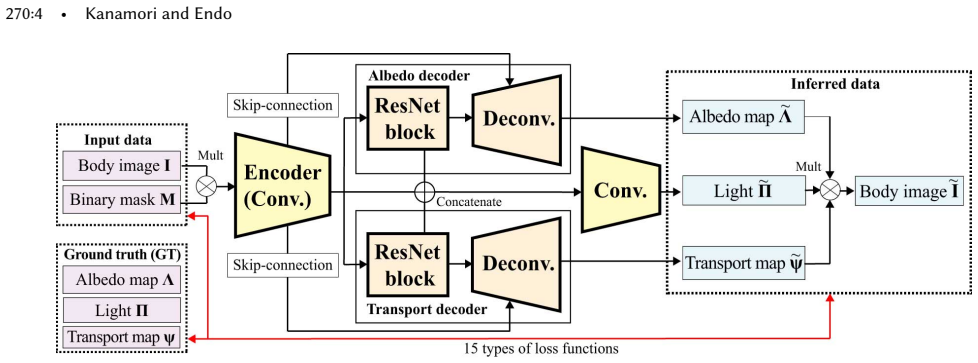
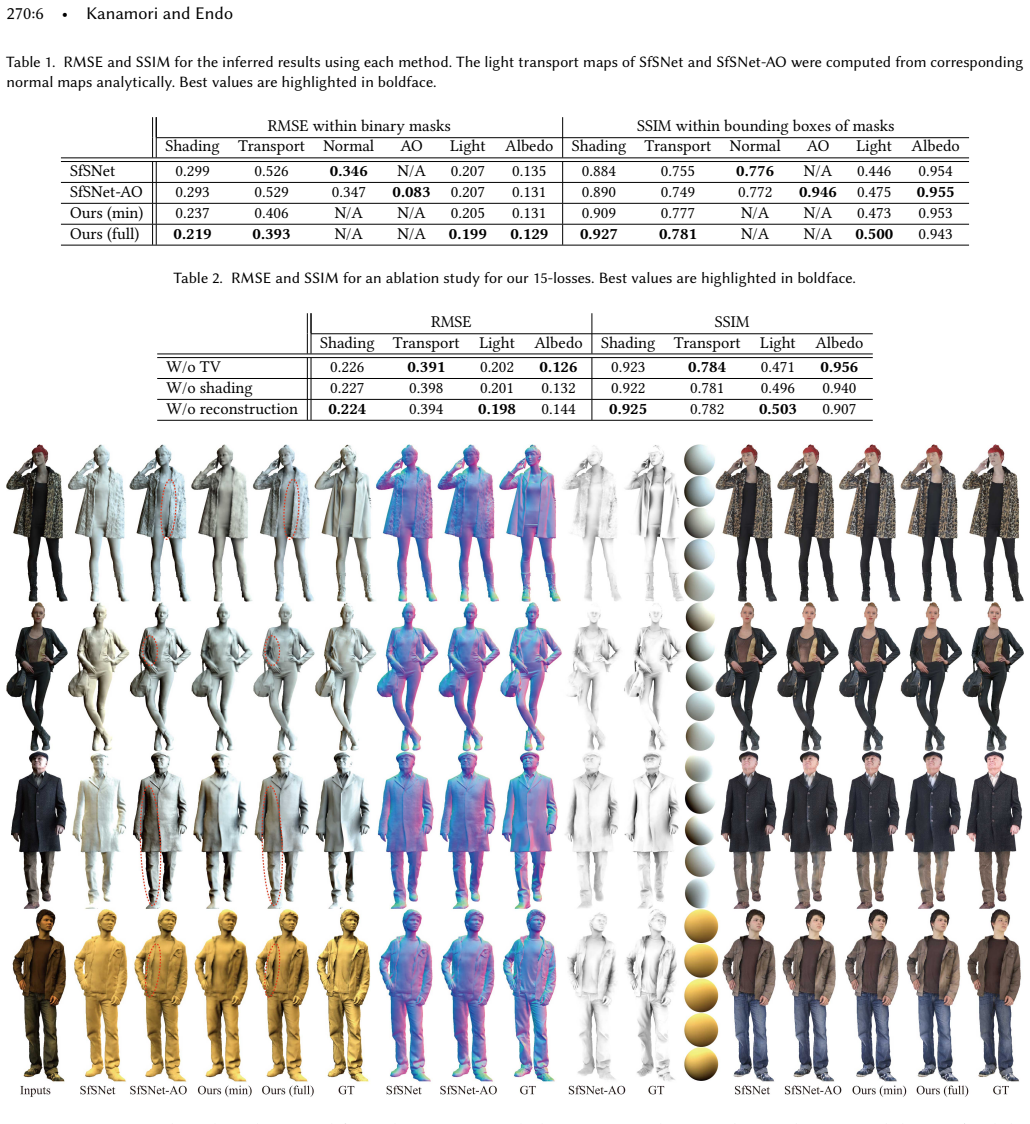
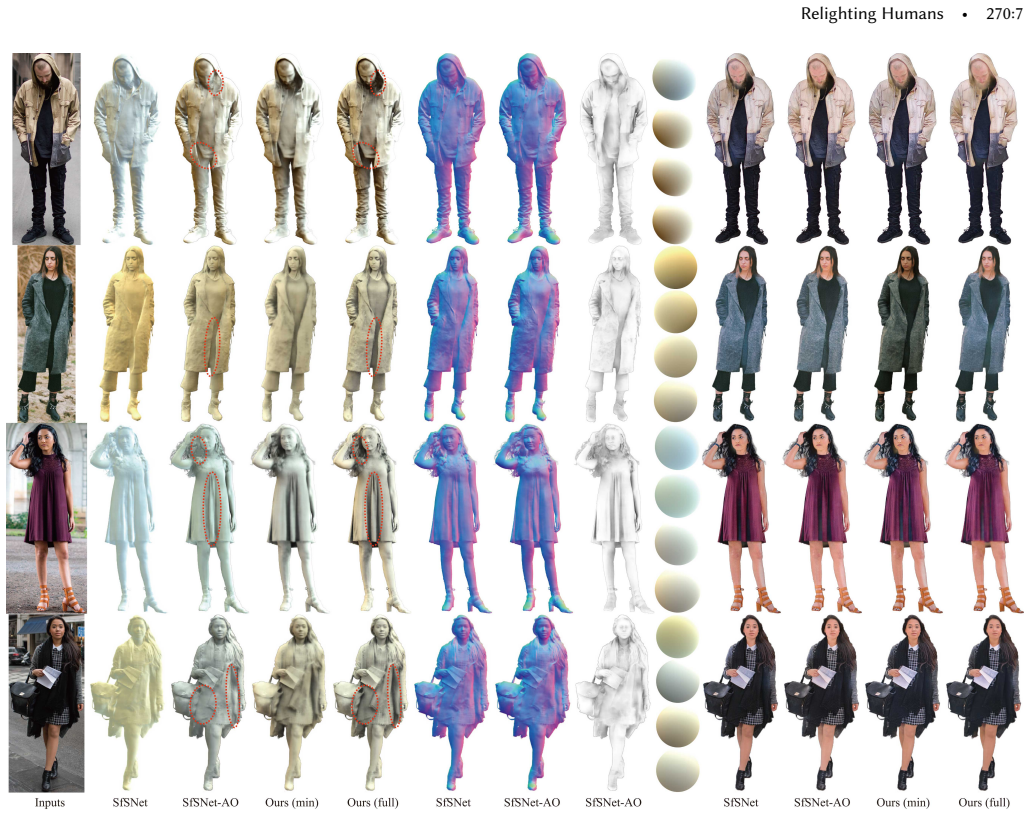
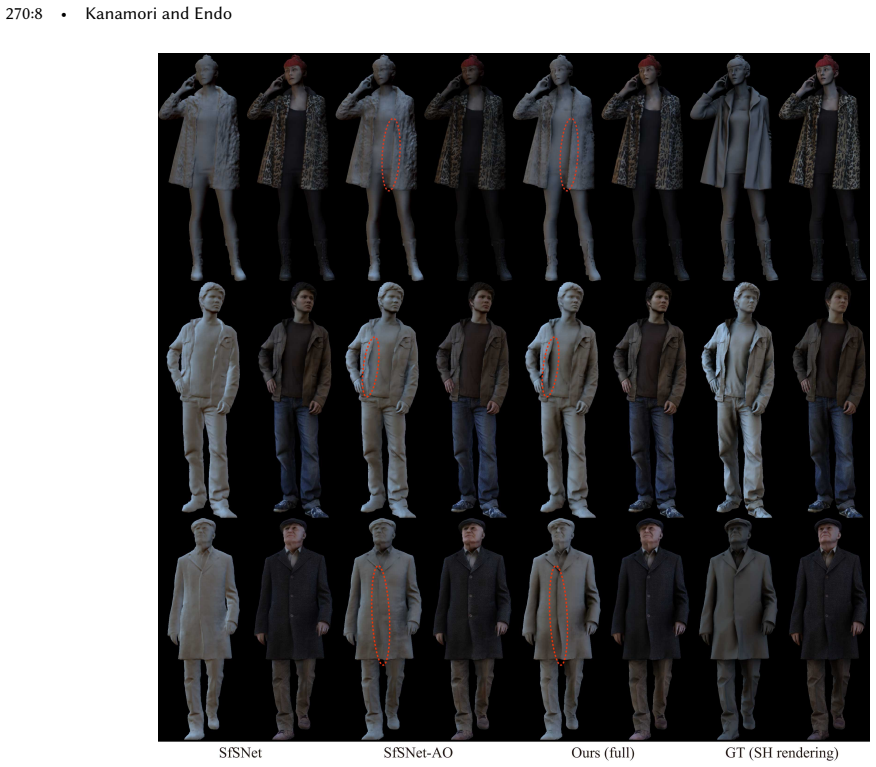
From a masked RGB portrait of a standing person, the method infers three things at once: a diffuse albedo map, a nine-coefficient spherical-harmonics description of the illumination, and a nine-channel light transport map. The transport map stores, for each pixel, the product of visibility and cosine falloff projected onto second-order spherical harmonics, so shading is a single dot product between the transport vector and the lighting vector, and occlusion is built into rendering rather than approximated afterward. The network is trained with fifteen L1 losses that constrain every combination of inferred and ground-truth albedo, transport, light, shading, and reconstructed image. On synthetic test figures and on real photographs, the inferred transport maps darken hollowed regions and capture details such as wrinkles, and the paper reports consistently lower RMSE and higher SSIM than the normal-based SH baseline and an ambient-occlusion-augmented baseline, except for one albedo SSIM number, where the full model's output is more distant from ground truth because it cancels the self-shadows baked into the ground-truth albedo.
Load-bearing premise
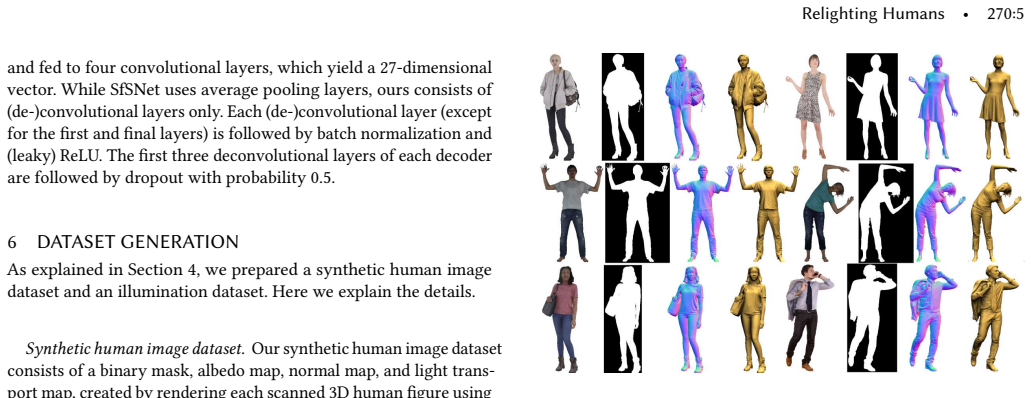
The load-bearing premise is that the synthetic albedo maps used as ground truth are clean surface color; in fact some of them still contain self-shadows from the scanning process, so the network may be learning to treat those baked-in shadows as color, and the reported error improvements may largely reflect better matching of contaminated labels rather than physically correct separation of albedo from shading.
Editorial extensions
If this is right
- Relighting a full-body photograph becomes a tiny per-pixel computation: dot product of the inferred transport vector with SH illumination, then multiply by albedo, so interactive relighting is possible after an inference step that takes about 0.43 seconds at 1024x1024 pixels.
- Self-shadowing appears where it belongs physically, in armpits, crotches, under the chin, and inside garment wrinkles, instead of a uniform brightness that makes concave regions look flat and washed out.
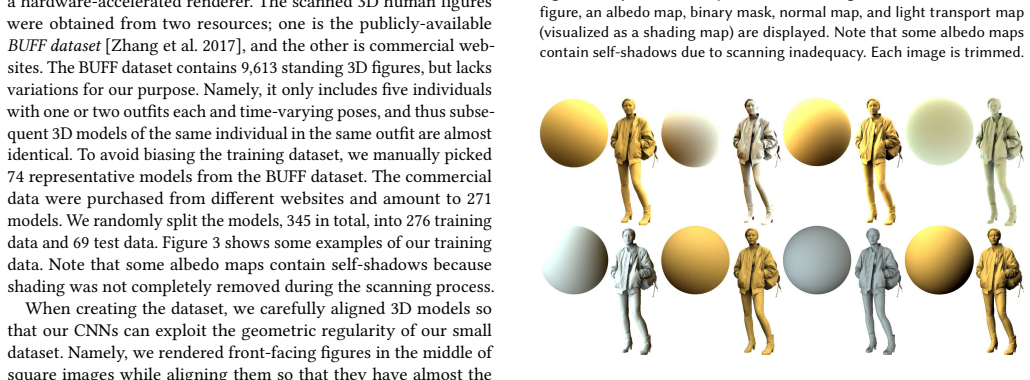
- Light can be transferred between two portraits by swapping their inferred SH illumination, giving a quick way to harmonize lighting across composited people.
- The method extends occlusion-aware inverse rendering from faces to clothed whole bodies without fitting a body model, so garment geometry and posture are captured through appearance and silhouette priors.
- Because masks alone yield plausible transport maps, the approach inherits a useful property: binary silhouette input is enough to recover rough concave structure even in the absence of texture cues.
Reading between the lines
- If the silhouette prior is as strong as the paper suggests, the same small-aligned-dataset recipe could be retargeted to other articulated categories with available 3D models, such as animals or robots; the main requirement would be a consistent canonical alignment rather than dataset size.
- The method's handling of unusual lights (nearest-neighbor illumination and albedo absorbing the error) implies a testable degradation curve: as the input environment moves further from the training light distribution, transport accuracy should fall first and albedo error should rise, a pattern the paper reports qualitatively but does not measure.
- A natural extension the authors do not run is to constrain the nine-channel transport output with a low-dimensional occlusion prior during self-supervised fine-tuning; their collapse result suggests the constraint would need to be stronger than a simple reconstruction loss.
- The contaminated ground-truth albedo means the reported quantitative gains may overstate physical correctness; a controlled capture with known lighting and multi-view geometry could separate learned occlusion from a heuristic darkening of concavities.
Signed reviews
Editorial analysis
A structured set of objections, weighed in public.
Referee Report
Summary. The manuscript proposes a CNN-based inverse rendering method for full-body human images. Given a masked RGB image, the network predicts a diffuse albedo map, second-order spherical-harmonics (SH) illumination, and a per-pixel nine-channel light transport map that encodes light occlusion, following the precomputed radiance transfer formulation of Sloan et al. (2002). Training uses a small synthetic dataset of rendered scanned 3D human figures (345 models) and an illumination dataset derived from the Laval Indoor HDR set, with fifteen L1 losses on the inferred albedo, transport, light, and various products thereof. The authors compare against SfSNet and SfSNet-AO, reporting quantitative RMSE/SSIM on a held-out synthetic test set and qualitative relighting results on real photographs. They also present ablations, a shape-from-mask experiment, and discussions of self-supervised learning failure and limitations such as diffuse-only albedo and sensitivity to unusual illuminations.
Significance. If the inferred nine-channel light transport maps genuinely encode per-pixel occlusion, the paper makes a useful contribution: it extends SH-based inverse rendering from faces to full human bodies with garments, and offers a fast relighting pipeline operating at 0.43 s per 1024x1024 image. The dataset curation, the multi-loss training setup, and the honest treatment of failure modes (self-supervised collapse, unusual lights) are strengths. However, the validation is currently insufficient to support the central claim. The ground-truth albedo is contaminated by residual self-shadows (stated in Section 6), and the quantitative evaluation is entirely in-distribution with no error bars or statistical tests. The paper does contain an ablation study and a shape-from-mask experiment, which are commendable, but the key evidence for occlusion-aware transport remains ambiguous.
major comments (2)
- [Section 6 and Section 7.1, Table 1] The ground-truth albedo contamination undermines the quantitative basis for the occlusion-aware transport claim. Section 6 states that 'some albedo maps contain self-shadows because shading was not completely removed during the scanning process,' and Section 7.1 explains the lower albedo SSIM of Ours(full) by saying that it 'better cancels the baked-in shadings.' In the synthetic image formation I = albedo * (transport * light), a baked-in shadow is multiplicatively indistinguishable from an occlusion-induced transport effect under a single training light. The network may therefore fold residual shadows into the inferred transport or light, and the transport RMSE improvement (0.393 vs. 0.529 for SfSNet-AO in Table 1) could improve coincidentally without corresponding to physically correct occlusion. This is an interpretation, not a measurement. Please provide a controlled test: either re-render the 3D models with known clean albedo and path-traced visibility to obtain clean ground-truth transport, or include a quantitative path-traced relighting comparison under held-out illuminations. Without such evidence, Table 1 does not establish the central claim.
- [Section 7.1, Table 1, Figures 5-8] The quantitative evaluation is in-distribution only and lacks error bars or significance tests. The test set is generated by the same renderer, the same 3D model sources, and the same illumination preprocessing as the training set, so the reported RMSE/SSIM values reflect within-distribution performance. The gains over SfSNet-AO are modest (shading RMSE 0.219 vs. 0.293; albedo SSIM for Ours(full) is lower than for SfSNet), and the claim that the method 'accomplishes more realistic relighting' is supported mainly by qualitative real-photo comparisons. Please report variance across training runs or bootstrap confidence intervals, and include a quantitative cross-domain evaluation (e.g., a different synthetic human dataset or a controlled real-image test with known geometry/illumination). The path-traced comparisons mentioned in Section 7.2 as available in the supplemental material should be quantified in the main paper.
minor comments (5)
- [Section 3.1] The text 'where Yl,m are SH with l ≥ 0,−l ≤ m ≤ l, and m ≤ 2' contains a typo: the final condition should be 'l ≤ 2', not 'm ≤ 2'.
- [Section 7.1] The description of the evaluation metrics could be clearer: the paper states that RMSE is computed within binary masks while SSIM is computed within bounding boxes of masks. Please explain the rationale for using different regions for the two metrics.
- [Section 7.2] The path-traced reference comparison is only mentioned as being in the supplemental material. At least one quantitative path-traced metric (e.g., RMSE or SSIM under relighting) should appear in the main text to support the qualitative relighting claims.
- [Section 8] The sitting-pose evaluation states that the results are 'unexpectedly well' and bases this on visual inspection. A quantitative evaluation on sitting-pose data, even if small, would strengthen this claim.
- [Section 8, Self-supervised learning] The explanation for the self-supervised fine-tuning collapse ('This is probably because our light transport maps have much larger degrees of freedom...') is plausible but speculative. Consider supporting it with an experiment that varies the output dimensionality or regularization.
Circularity Check
No circularity: the method is supervised regression against independently rendered synthetic ground truth, and the acknowledged albedo contamination is a data-quality limitation rather than a circular step.
full rationale
The paper's derivation chain is a standard supervised-learning pipeline. Synthetic inputs are generated as I = albedo * (transport * light) from scanned 3D models (Sections 4 and 6), and the CNNs are trained with 15 L1 losses comparing inferred albedo, light transport, light, shading, and reconstructed images to those independent ground-truth renderings. No predicted quantity is defined in terms of itself: the light transport maps are not derived from the network's own albedo or light outputs, nor are the evaluation metrics computed from the fitted training targets. The SH/PRT formulation is explicitly attributed to external works (Basri and Jacobs 2003; Ramamoorthi and Hanrahan 2001; Sloan et al. 2002), and the only self-citation (Endo et al. 2017) is a non-load-bearing suggestion for future training-light enrichment. The acknowledged residual self-shadows in scanned albedo maps (Section 6) and the interpretive explanation for the lower albedo SSIM of Ours(full) (Section 7.1) are validation-quality concerns, not circular reasoning: the network is neither fitting a parameter that is then renamed as a prediction nor relying on a self-citation chain to justify its central claim. The central claim is empirically testable against held-out synthetic ground truth and qualitative real-photo comparisons, so no step reduces by construction to its own inputs.
Assumptions & free parameters
free parameters (4)
- CNN weights (all encoder/decoder parameters) =
trained on 276 synthetic images for 60 epochs
- Loss weights for 15 L1 losses =
all set to 1
- Illumination dataset curation =
50 clusters from 2,144 HDR maps; 40 train / 10 test
- Training pose alignment =
standing figures, centered, same vertical size, 5% padding
assumptions (4)
- standard math Second-order spherical harmonics capture most irradiance on convex surfaces
- standard math Visibility times cosine can be precomputed as SH and applied as a dot product with SH illumination
- domain assumption Rendered images from scanned 3D human models are a valid proxy for real full-body photographs
- domain assumption Albedo ground truth from 3D scans is free of shading
Cite this review
Pith. "Pith review of Relighting Humans: Occlusion-Aware Inverse Rendering for Full-Body Human Images." pith.science (2026). https://pith.science/paper/3Y6O37GE
@misc{pith2026190802714,
  author       = {Pith},
  title        = {Pith review of: Relighting Humans: Occlusion-Aware Inverse Rendering for Full-Body Human Images},
  year         = {2026},
  howpublished = {\url{https://pith.science/paper/3Y6O37GE}},
  note         = {Machine review of arXiv:1908.02714}
}
read the original abstract
Relighting of human images has various applications in image synthesis. For relighting, we must infer albedo, shape, and illumination from a human portrait. Previous techniques rely on human faces for this inference, based on spherical harmonics (SH) lighting. However, because they often ignore light occlusion, inferred shapes are biased and relit images are unnaturally bright particularly at hollowed regions such as armpits, crotches, or garment wrinkles. This paper introduces the first attempt to infer light occlusion in the SH formulation directly. Based on supervised learning using convolutional neural networks (CNNs), we infer not only an albedo map, illumination but also a light transport map that encodes occlusion as nine SH coefficients per pixel. The main difficulty in this inference is the lack of training datasets compared to unlimited variations of human portraits. Surprisingly, geometric information including occlusion can be inferred plausibly even with a small dataset of synthesized human figures, by carefully preparing the dataset so that the CNNs can exploit the data coherency. Our method accomplishes more realistic relighting than the occlusion-ignored formulation.
Figures

Figures from the paper (9 more)


Reference graph
Works this paper leans on
-
[2009]
In Sixth IEEE International Conference on Advanced Video and Signal Based Surveillance (A VSS 2009)
A 3D Face Model for Pose and Illumination Invariant Face Recognition. In Sixth IEEE International Conference on Advanced Video and Signal Based Surveillance (A VSS 2009). 296–301. Ravi Ramamoorthi and Pat Hanrahan. 2001. An efficient representation for irradi- ance environment maps. In Proceedings of the 28th Annual Conference on Computer Graphics and Int...
work page 2002
-
[2013]
Multiple Light Source Estimation in a Single Image. Comput. Graph. Forum 32, 8 (2013), 170–182. Zhaoliang Lun, Matheus Gadelha, Evangelos Kalogerakis, Subhransu Maji, and Rui Wang. 2017. 3D Shape Reconstruction from Sketches via Multi-view Convolutional Networks. In 2017 International Conference on 3D Vision (3DV 2017) . Takuya Narihira, Michael Maire, an...
work page 2013
-
[2015]
High-quality hair modeling from a single portrait photo. ACM Trans. Graph. 34, 6 (2015), 204:1–204:10. Manmohan Krishna Chandraker and Ravi Ramamoorthi. 2011. What an image reveals about material reflectance. In IEEE International Conference on Computer Vision (ICCV 2011). 1076–1083. R. Danerek, Endri Dibra, A. Cengiz Öztireli, Remo Ziegler, and Markus H....
work page 2015
Reviewed August 14, 2026 · model on record in the stance chip above.
Discussion (0). Continue with ORCID to comment.