REVIEW 3 major objections 4 minor 117 references
Radial Drift and Concurrent Ablation of Boulder-Sized Objects
T0 review · 3 major / 4 minor · reviewed 2026-08-14 · deepseek-v4-flash
Pith's one-line read Meter-sized boulders can carry water ice about ten percent closer to the star than the classical snowline.
desk verdict A solid, honest parameter study of a neglected size regime, but the headline 10% snowline smearing is conditional on boulders surviving erosion, and the abstract oversells the disk-independence. read the letter →
The pith
A machine-rendered reading of the paper's core claim, the machinery that carries it, and where it could break.
The reading
What carries the argument
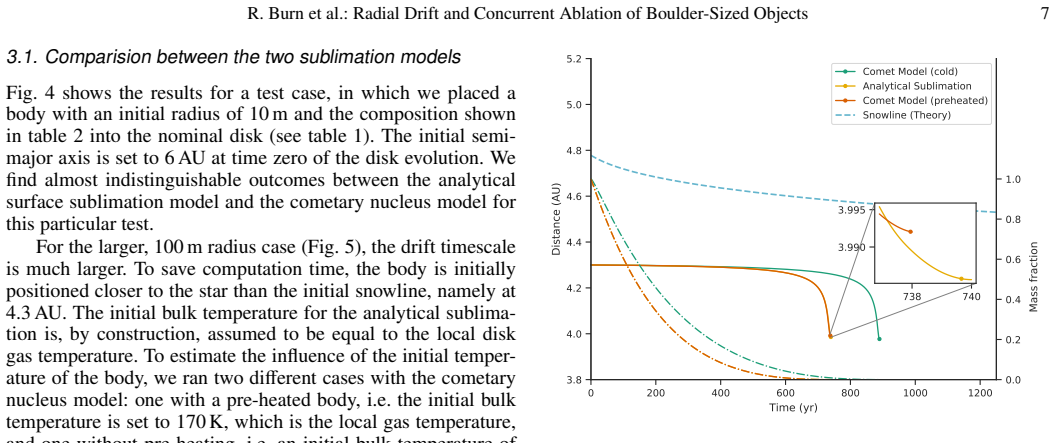
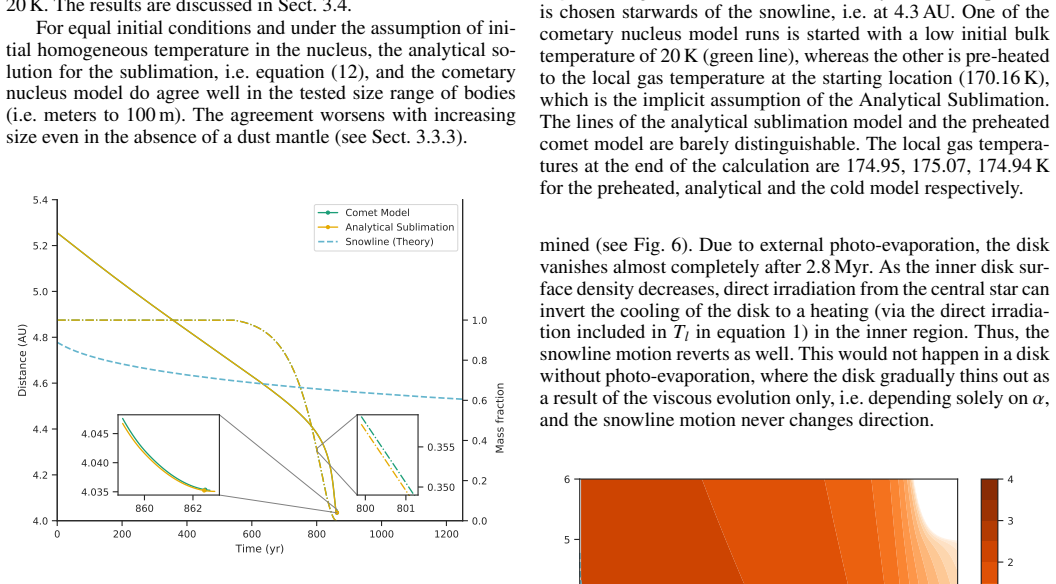
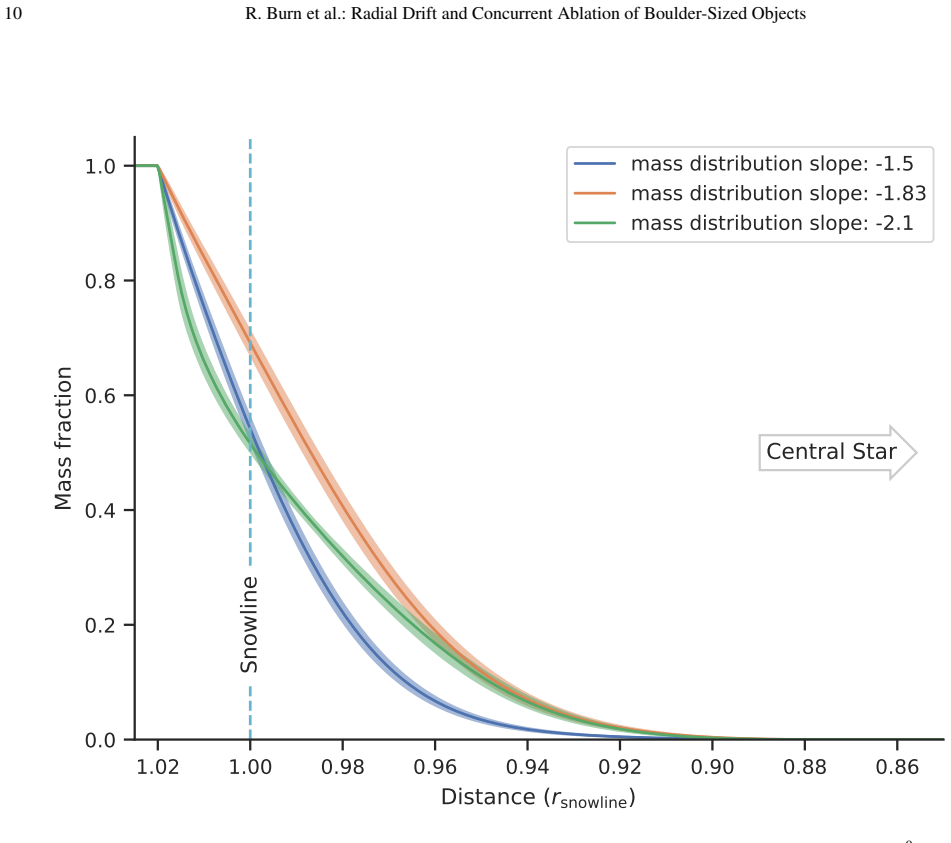
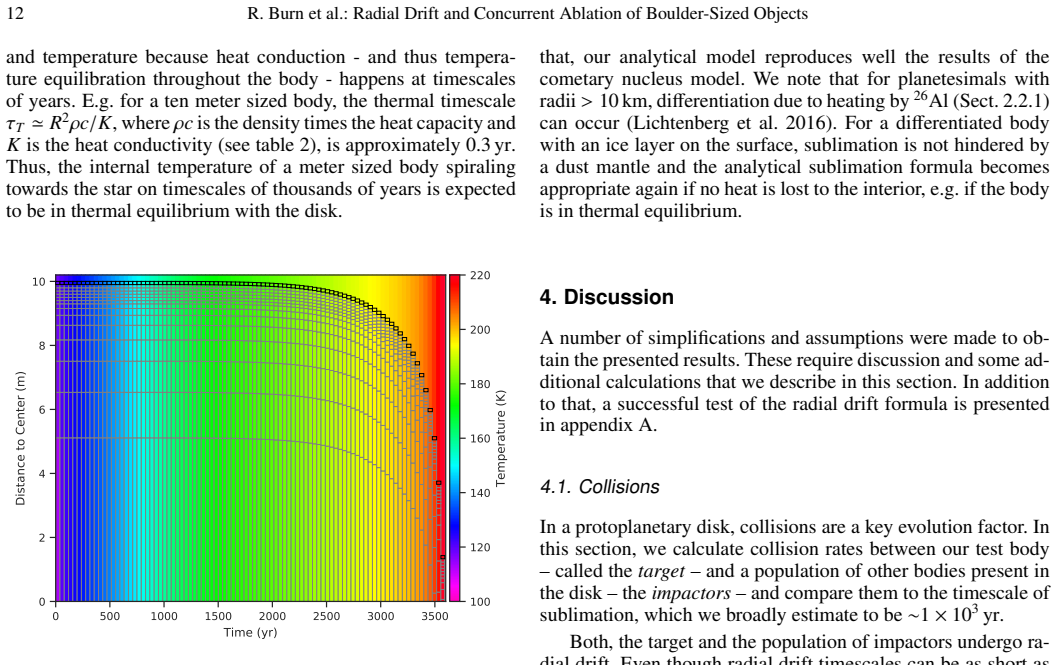
The argument runs on a race between two speeds: the radial drift speed of a solid body, computed from gas-drag stopping times in the Epstein, Stokes, and quadratic regimes, and the inward speed of the water snowline during disk evolution. On the ablation side, the Hertz-Knudsen-Langmuir formula $\phi(T)=P_s(T)/\sqrt{2\pi m_{\mathrm{H_2O}} R_g T}$ gives the free surface sublimation rate of water ice; because heat conduction equilibrates bodies below roughly 100 m within about a year, this surface formula alone tracks the full cometary-nucleus model. The feedback that carries the result is the drift-ablation loop: sublimation shrinks the radius, a smaller radius drifts faster, down to the fastest meter-size bodies, and faster drift brings the body into hotter regions, accelerating ablation until the body reaches the 10 cm disintegration limit.
What would settle it
The claim would be settled by measuring the impact-erosion lifetime of meter-sized icy bodies in the relevant velocity regime: if such bodies lose more than a few percent of their mass per year, they would disintegrate before crossing the snowline and the predicted ten-percent inward water-ice zone would not form; if erosion is much slower, the zone is expected. A complementary observation is a spatially resolved water-vapor or ice map just inside the snowline of a boulder-rich disk, looking for the predicted inward extension rather than a sharp cutoff.
Extended reading notes
Core claim
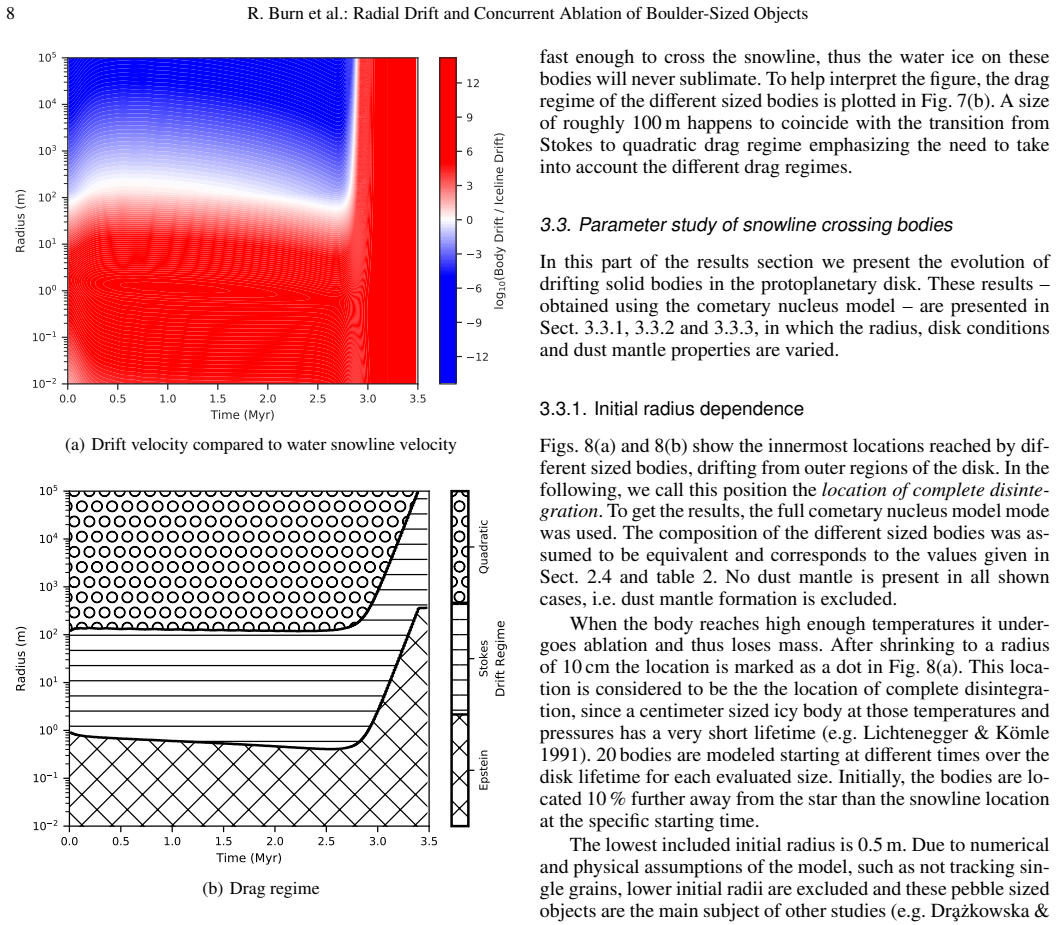
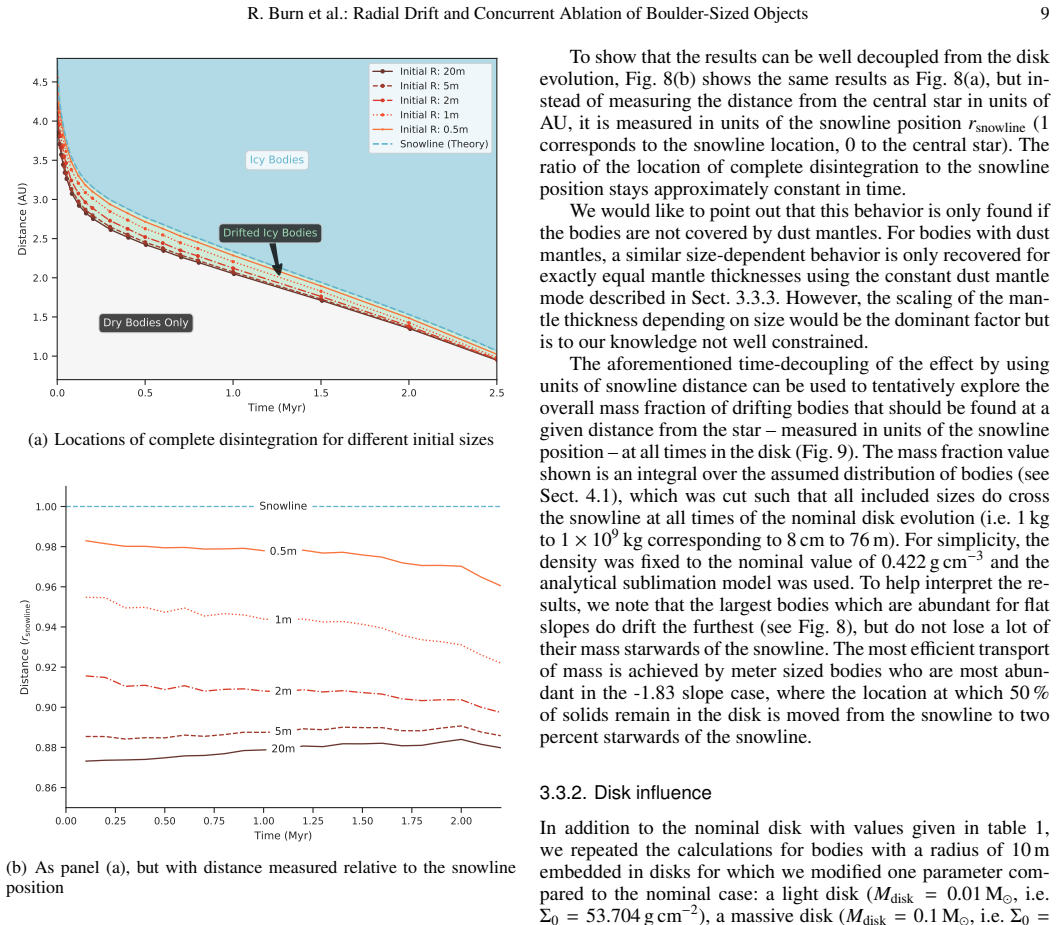
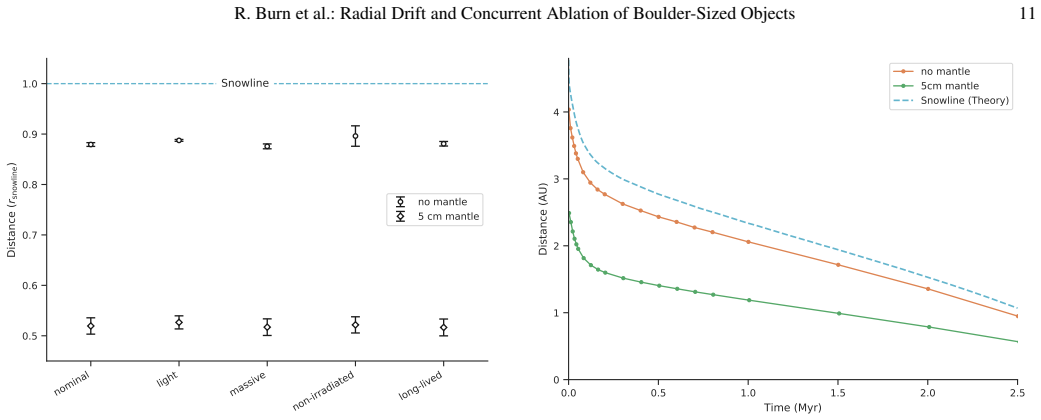
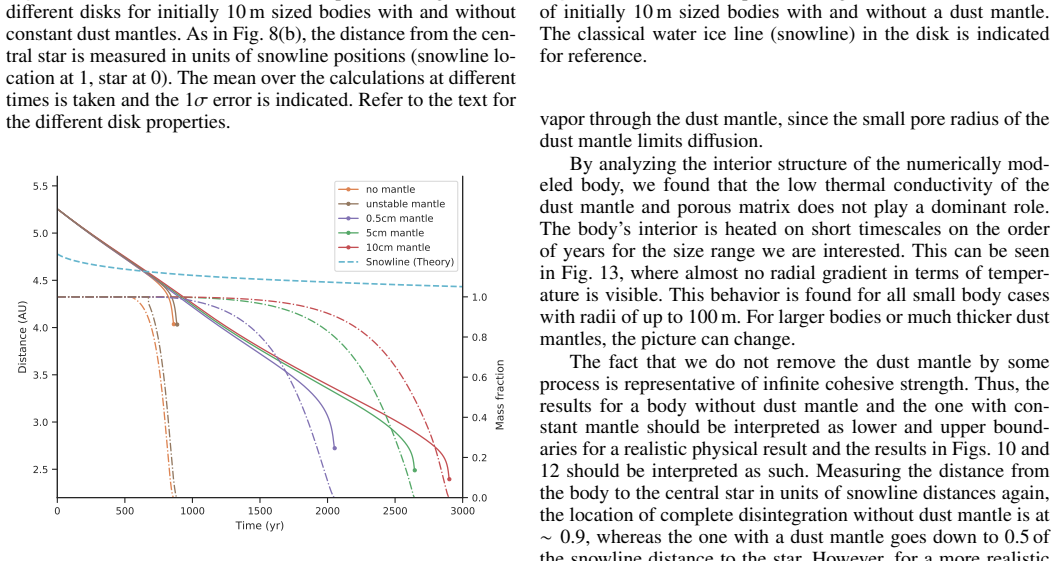
The central claim is that the dynamical snowline for water, the place where drifting solids actually lose their ice, is not the classical temperature-pressure snowline for bodies between about 1 m and 100 m. These bodies drift starward faster than the snowline moves inward, so they cross it; once inside, sublimation shrinks them and the smaller body drifts even faster, with the fastest drift near meter size, so they carry water inward until they shrink to roughly 10 cm and disintegrate. In the paper's terminology, the region polluted with water ice extends to ten percent closer to the star than the snowline location, and this result is nearly independent of disk mass, disk lifetime, and irradiation. A non-eroding dust mantle would let bodies reach about half the classical snowline distance, but the paper argues such mantles are stripped by collisions with pebble-sized objects. For homogeneous dust-water-ice bodies without a mantle, the paper finds the interior is isothermal on timescales of about a year, so the analytic Hertz-Knudsen-Langmuir sublimation expression reproduces the full numerical thermal model.
Load-bearing premise
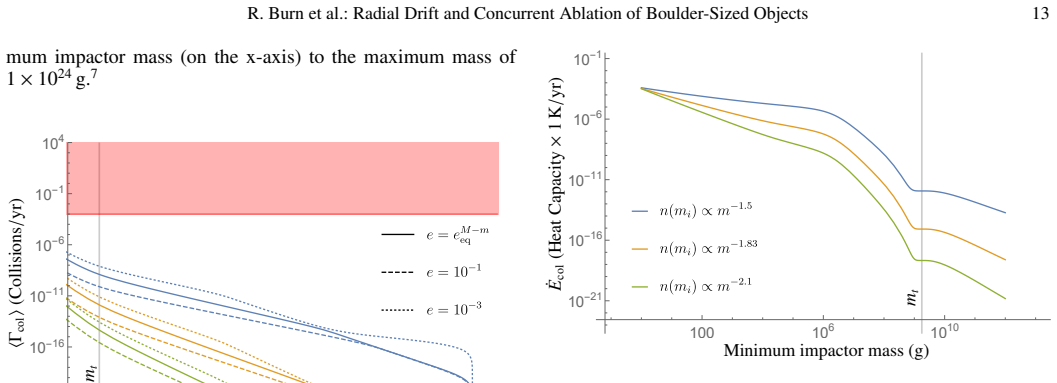
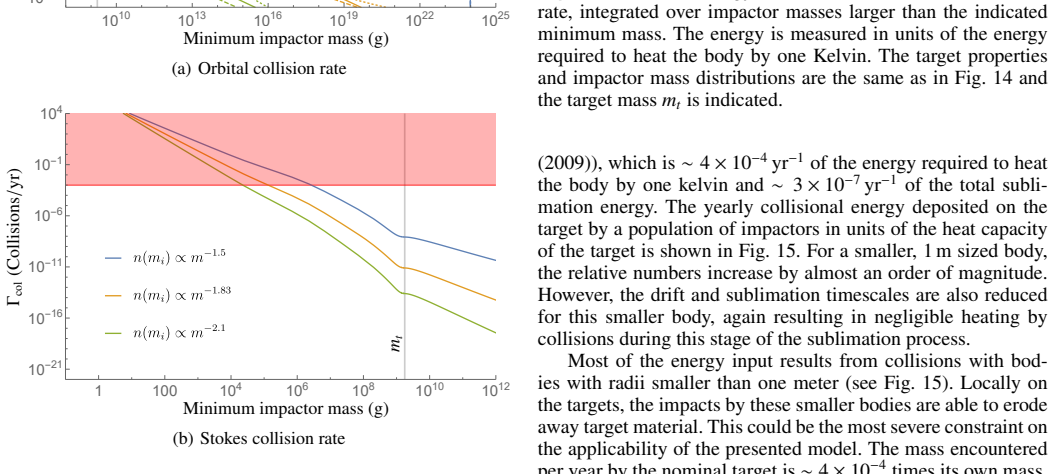
The load-bearing premise is that a drifting boulder survives intact while it crosses the snowline; the paper's own collision-rate calculation finds that with standard laboratory erosion rates a 10 m body loses roughly $8\times10^{-2}$ percent of its mass per year, making the collision-free assumption valid only for about ten years, far shorter than the hundreds to thousands of years of sublimation modeled.
Editorial extensions
If this is right
- The water ice available to planet formation begins about ten percent closer to the star than the classical snowline whenever meter-to-100 m bodies exist, so sharp-snowline disk models underestimate the inner water reservoir.
- The volatile flux carried by drifting boulders can be estimated from the boulder size distribution and composition and should be added to disk chemistry and planet formation models.
- For unmantled homogeneous dust-ice bodies up to 100 m, the analytic surface-sublimation formula can replace the full thermal model, reducing computational cost in future simulations.
- Because the disintegration location is nearly constant when measured in units of the snowline distance, the predicted inward pollution zone scales across disks with different masses and lifetimes.
- If a non-eroding dust mantle is present, icy bodies can reach about half the classical snowline distance, but pebble collisions should remove such mantles, keeping the unmantled result closer to reality.
Reading between the lines
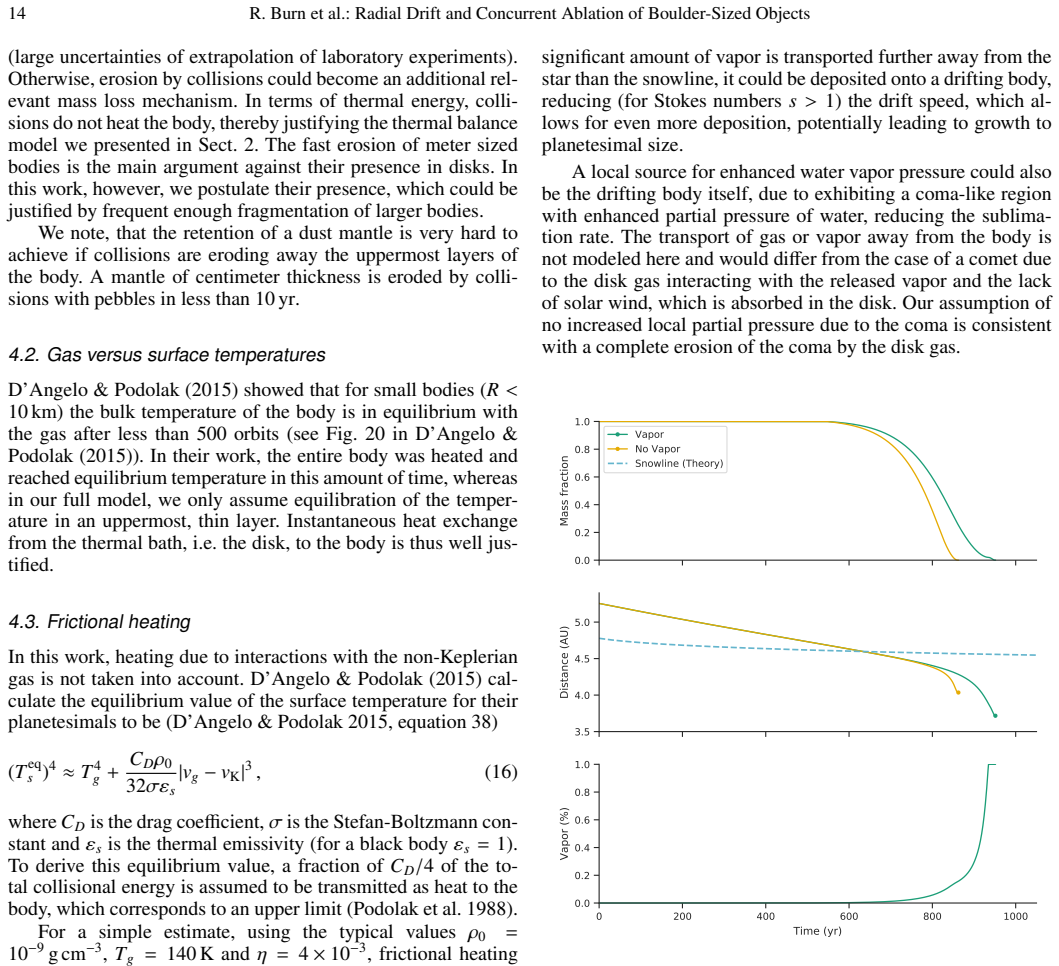
- If boulders are as abundant as the paper postulates, the water vapor they release just inside the snowline could locally raise the vapor pressure and slow further sublimation, potentially pushing the polluted region deeper inward than ten percent; the paper only tests this with an imposed vapor profile.
- A full coagulation-erosion model could remove boulders before they cross the snowline, which would turn the ten-percent zone into an upper limit; the paper identifies collisional erosion as its main uncertainty.
- The same drift-and-ablation mechanism should act on other volatiles with their own snowlines, such as CO2 or CO, and because each volatile has a different sublimation temperature, the smearing width should differ by species in a way that may be observable in resolved disk chemistry.
- The near time-independence of the result suggests a practical rule for planet formation codes: deposit water at roughly 0.9 times the snowline radius whenever boulders are present, rather than at the snowline itself.
Signed reviews
Editorial analysis
A structured set of objections, weighed in public.
Referee Report
Summary. This manuscript couples an α-disk evolution model to the radial drift of spherical, dusty-water-ice bodies and to two treatments of sublimation—an analytic Hertz-Knudsen-Langmuir surface-ablation formula and the full Marboeuf et al. (2012) cometary nucleus model—to ask how far inward of the classical H2O snowline drifting boulders can carry water ice. The authors find that bodies with radii between roughly 1 m and 100 m drift inward faster than the snowline moves and, in the absence of a dust mantle, shrink to 10 cm at distances about 10% inside the snowline, with the ratio remaining stable as the disk evolves. Disk mass, lifetime, and photo-evaporation affect this inward penetration at the percent level, but the non-irradiated disk case gives only about 3% inward penetration. The analytic sublimation formula is shown to reproduce the full thermal model for homogeneous bodies up to about 100 m in radius, and the authors separately assess dust-mantle, water-vapor, frictional-heating, and collision effects, identifying collisions with small impactors as the main limitation on the mechanism.
Significance. If the central result is accepted, the paper provides a concrete, quantitative mechanism for smearing the water snowline and for delivering water to terrestrial-planet-forming regions, with implications for disk chemistry, planetesimal formation, and exoplanet compositions. A genuine strength is that the 10% inward penetration is not a fitted parameter: it emerges from the coupled drift-sublimation simulations and is stable across several disk parameters. The validation of the analytic surface-sublimation expression against the full cometary nucleus model is also nontrivial, because the latter includes heat conduction and vapor diffusion that the former omits. The authors are transparent about their assumptions, including the collision caveat. The significance is nevertheless contingent on the survival of boulders against collisional erosion over the 10^2–10^3 yr drift phase: the paper's own Section 4.1 estimates a nominal erosion timescale of about 10 yr, so the headline claim currently applies to a restricted regime unless erosion is explicitly included in the trajectory calculation.
major comments (3)
- [Sec. 4.1] The collision analysis in Section 4.1 is load-bearing for the central claim. The authors state that the nominal 10 m target encounters about 4e-4 of its own mass per year in small impactors and, using the Windmark et al. (2012) erosion fit, loses about 8e-2% of its mass per year, making the collision-free assumption valid only on timescales of about 10 yr. This is one to two orders of magnitude shorter than the 10^2–10^3 yr sublimation/drift phase that produces the 10% inward penetration. Since erosion directly reduces the body's radius and mass, it can shorten the distance actually traveled before disintegration; this is not a peripheral parameter but a condition on the validity of the headline result. I recommend that the authors either add an erosion term to the radius-evolution equation (e.g., Eq. 14) and recompute the disintegration locations, or explicitly present the 10% result as conditional on the low-solid-surface-density or reduced-erosion regimes named in Section 4.1. The abstract and Conclusions currently state the 10% result without carrying this caveat forward.
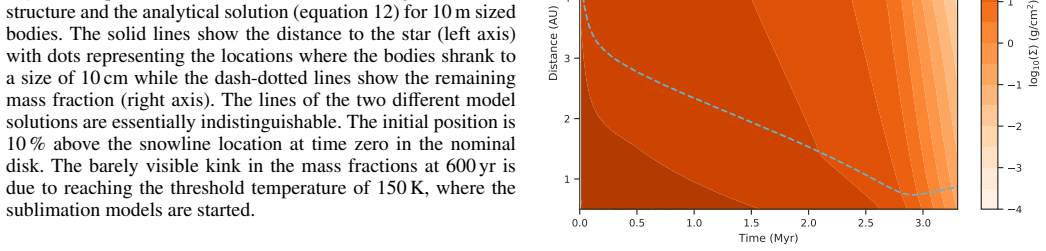
- [Sec. 3.3.2 / Fig. 10] The abstract and Conclusion item 1 state that the 10% inward penetration holds 'almost independently' of disk properties, but the non-irradiated disk in Fig. 10 reaches only about 3% inside the snowline, as acknowledged in Section 3.3.2. A factor-of-three difference between 10% and 3% is not a 'percent-level' effect relative to the headline value. The claim should be qualified to irradiated disks with the nominal pressure-gradient profile, or the reported range of inward penetration should be given explicitly (e.g., 3–10% depending on irradiation and pressure gradient).
- [Sec. 3.3.1 / Fig. 8] The '10%' inner boundary is defined by the adopted 'complete disintegration' radius of 10 cm, after which the body is assumed to have a very short lifetime. Since the total inward drift is integrated from the initial radius down to this cutoff, the reported inward penetration depends on the choice of R_stop = 10 cm. A convergence check with a smaller cutoff radius (e.g., 1 cm) or a stated estimate of the residual drift time below 10 cm would make the headline distance more robust. I expect the effect to be small because sub-meter bodies drift more slowly, but the sensitivity is not currently quantified.
minor comments (4)
- [Sec. 3.1 heading] The heading contains a typo: 'Comparision' should be 'Comparison'.
- [Fig. 7(a) caption] The caption for Fig. 7(a) should explain that the log-ratio is artificially set to 12 once the snowline starts moving outward; currently this is stated only in the main text.
- [Sec. 4.4] The sentence describing the no-vapor case as an 'upper boundary for the dynamical snowline location' is easy to misread. Since the presence of vapor slows sublimation and lets the body penetrate further inward, the no-vapor result is an outer (more conservative) limit on the dynamical snowline; please rephrase for clarity.
- [Sec. 2.4.2] The initial placement of bodies at 10% outside the snowline is justified as a relaxation condition, but the manuscript does not explicitly state that the pre-sublimation drift from farther out has no effect on the resulting disintegration position because sublimation is inactive below the 150 K threshold. A sentence stating this explicitly would remove a possible concern about the initial condition.
Circularity Check
No significant circularity: the 10% inward-snowline penetration is a simulation output from independent drift and sublimation physics, not a fitted or self-referential quantity.
full rationale
The central result (1–100 m boulders cross the snowline and disintegrate near 0.9 r_snowline) follows from time integration of a standard α-disk drift formula (Eq. 8, based on Weidenschilling/Adachi/Nakagawa) and a sublimation law (Eq. 12, Hertz-Knudsen-Langmuir). The snowline position is computed independently from disk temperature and pressure, and the sublimation threshold is fixed a priori. The 10% figure is not an input parameter: bodies are initially placed 10% outside the snowline only to relax initial transients, and the final disintegration radii (Fig. 8) vary with body size (0.5 m disintegrates near 1.0, larger bodies near 0.9), so the result is not the initial condition echoed back. The comparison between the analytic ablation model and the Marboeuf et al. (2012) comet code is partly by construction—both share Eq. (12) at the surface—but the full model adds heat conduction, vapor diffusion, and mantle physics, so the agreement is a nontrivial test of the internal-isothermality assumption rather than a tautology. The paper's own Sect. 4.1 collision estimate (erosion timescale ~10 yr vs. sublimation phase 100–1000 yr) is a serious physical-validity caveat, but it is an environmental assumption, not a circular derivation: it states that the result holds only if erosion is suppressed, which is a falsifiable condition rather than a fit of the predicted distance. No fitted parameter is renamed as a prediction, and no load-bearing conclusion depends on an unverified self-citation; the cited Marboeuf et al. (2012) model is used with its equations stated and is not doing the work of the 10% result alone.
Assumptions & free parameters
free parameters (4)
- R_stop (complete disintegration radius) =
0.1 m
- T_threshold (sublimation activation temperature) =
150 K
- Initial body offset from snowline =
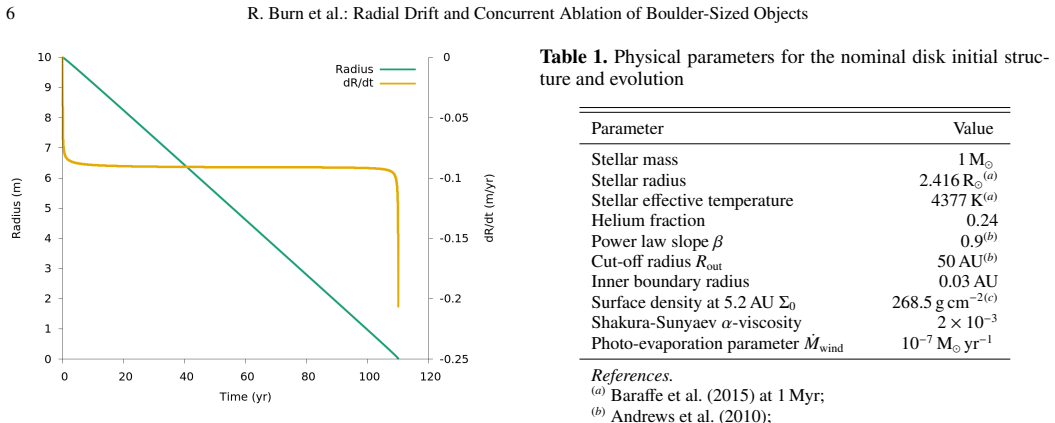
10% beyond snowline (1.1 x rsnowline)
- Constant dust mantle thickness =
5 cm nominal; 0.5 and 10 cm variants
assumptions (5)
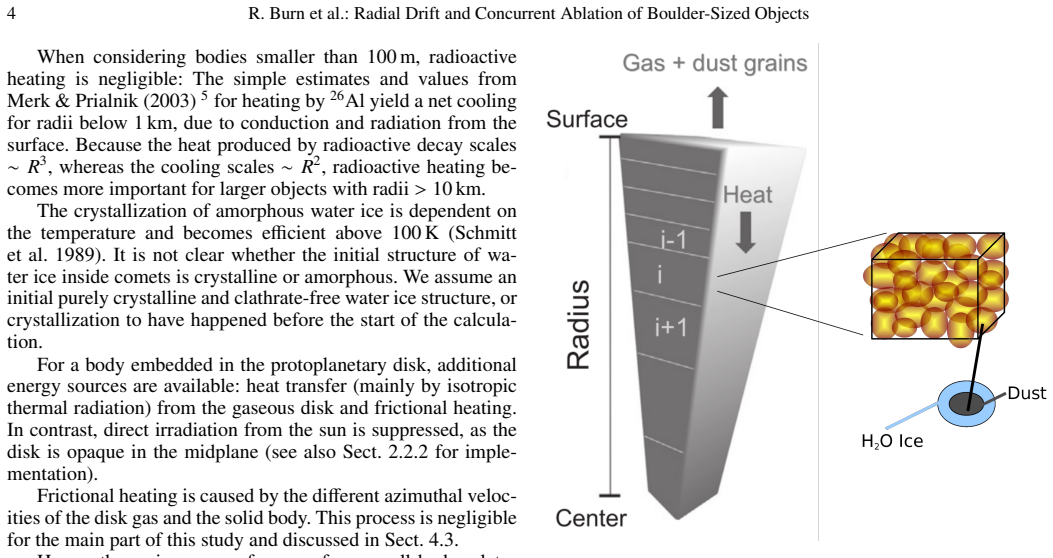
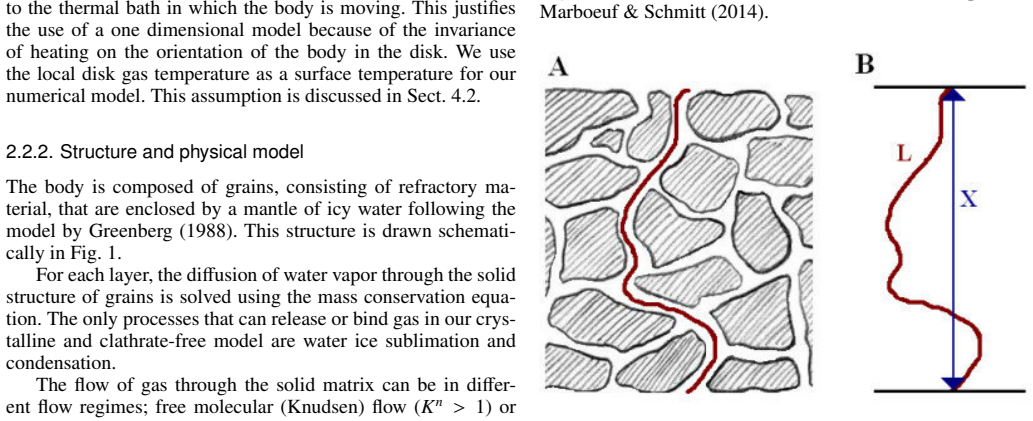
- domain assumption Body is a homogeneous sphere of dust and crystalline water ice, with no other volatiles, amorphous ice, or clathrates.
- domain assumption The body's surface temperature equals the local midplane gas temperature and the interior is isothermal for radii below 100 m on circular orbits.
- domain assumption Water vapor partial pressure around the body is zero, so sublimation follows the free Hertz-Knudsen-Langmuir rate.
- domain assumption Collisional erosion is negligible during the drift and sublimation phase.
- domain assumption No dust mantle forms on the body in the nominal cases; all freed dust is lost.
Cite this review
Pith. "Pith review of Radial Drift and Concurrent Ablation of Boulder-Sized Objects." pith.science (2026). https://pith.science/paper/3YDI4XFZ
@misc{pith2026190802513,
  author       = {Pith},
  title        = {Pith review of: Radial Drift and Concurrent Ablation of Boulder-Sized Objects},
  year         = {2026},
  howpublished = {\url{https://pith.science/paper/3YDI4XFZ}},
  note         = {Machine review of arXiv:1908.02513}
}
read the original abstract
Context. The composition of a protoplanetary disk at a given location does not only depend on temperature and pressure but also on the time dependent transport of matter, such as radial drift of solid bodies, which could release water and other volatile species before disintegration or accretion onto a larger body with potentially considerable implications for the composition of planets. Aims. We perform a parameter study focused on the water depletion of different sized bodies able to cross the water snowline by gas induced radial drift. Methods. Either the analytical Hertz-Knudsen-Langmuir sublimation formula assuming equilibrium temperature within the body or a more involved, numerical model for the internal thermal evolution is coupled with an alpha-disk model. Different properties of the disk and the embedded body are explored. Results. Bodies with radii up to 100 meter drift faster towards the central star than the water snowline, hence, cross it. The region that can be reached before complete disintegration - and is therefore polluted with H2O ice - extends to 10 percent closer to the star than the snowline location. The extent of this polluted region could be multiple times larger in the presence of a dust mantle, which is, however, unlikely to form due to frequent collisions with smaller-than centimeter sized objects. Conclusions. Given a significant abundance of meter sized boulders in protoplanetary disks, the transport of water by radial drift of these bodies towards regions closer to the star than the snowline is not negligible and this flux of volatiles can be estimated for a given distribution of solid body sizes and compositions. A simple expression for surface sublimation is applicable for a homogeneous body consisting of only dust and water ice without a dust mantle.
Figures
Figures from the paper (12 more)
Reference graph
Works this paper leans on
-
[1]
, " * write output.state after.block = add.period write newline
ENTRY address archiveprefix author booktitle chapter edition editor howpublished institution eprint journal key month note number organization pages publisher school series title type volume year label extra.label sort.label short.list INTEGERS output.state before.all mid.sentence after.sentence after.block FUNCTION init.state.consts #0 'before.all := #1 ...
-
[2]
write newline
" write newline "" before.all 'output.state := FUNCTION n.dashify 't := "" t empty not t #1 #1 substring "-" = t #1 #2 substring "--" = not "--" * t #2 global.max substring 't := t #1 #1 substring "-" = "-" * t #2 global.max substring 't := while if t #1 #1 substring * t #2 global.max substring 't := if while FUNCTION word.in bbl.in " " * FUNCTION format....
-
[3]
1976, Progress of Theoretical Physics, 56, 1756
Adachi, I., Hayashi, C., & Nakazawa, K. 1976, Progress of Theoretical Physics, 56, 1756
1976
-
[4]
R., Seager, S., & Elkins-Tanton, L
Adams, E. R., Seager, S., & Elkins-Tanton, L. 2008, ApJ, 673, 1160
2008
-
[5]
2013, A & A, 558, A109
Alibert, Y., Carron, F., Fortier, A., et al. 2013, A & A, 558, A109
2013
-
[6]
2005, A & A, 434, 343
Alibert, Y., Mordasini, C., Benz, W., & Winisdoerffer, C. 2005, A & A, 434, 343
2005
-
[7]
M., Wilner, D
Andrews, S. M., Wilner, D. J., Hughes, A. M., Qi, C., & Dullemond, C. P. 2010, ApJ, 723, 1241
2010
-
[8]
Armitage, P. J. 2019, in From Protoplanetary Disk. to Planet Form. Saas-Fee Adv. Course 45. Swiss Soc. Astrophys. Astron., ed. M. Audard, M. R. Meyer, & Y. Alibert (Berlin, Heidelberg: Springer Berlin Heidelberg), 1--150
2019
Show all 117 references
-
[9]
2015, A & A, 577, A42
Baraffe, I., Homeier, D., Allard, F., & Chabrier, G. 2015, A & A, 577, A42
2015
-
[10]
Bell, K. R. & Lin, D. N. C. 1994, ApJ, 427, 987
1994
-
[11]
Belton, M. J. 2015, Icarus, 245, 87
2015
-
[12]
& Asphaug, E
Benz, W. & Asphaug, E. 1999, Icarus, 141, 5
1999
-
[13]
M., Trilling, D
Bernstein, G. M., Trilling, D. E., Allen, R. L., et al. 2004, Astron. J., 128, 1364
2004
-
[14]
2016, Space Sci
Birnstiel, T., Fang, M., & Johansen, A. 2016, Space Sci. Rev., 205, 41
2016
-
[15]
2018, Sp
Blum, J. 2018, Sp. Sci Rev, 214, 52
2018
-
[16]
F., Bro z , M., O'Brien, D
Bottke, W. F., Bro z , M., O'Brien, D. P., et al. 2015, in Asteroids IV, ed. P. Michel, F. E. DeMeo, & W. F. Bottke (University of Arizona Press), 701--724
2015
-
[17]
F., Durda, D
Bottke, W. F., Durda, D. D., Nesvorn \' y , D., et al. 2005, Icarus, 175, 111
2005
-
[18]
Brin, G. D. & Mendis, D. A. 1979, ApJ, 229, 402
1979
-
[19]
Carman, P. C. 1956, Flow of Gases Through Porous Media (London: Butterworths Scientific Publications)
1956
-
[20]
2008, Icarus, 198, 256
Chambers, J. 2008, Icarus, 198, 256
2008
-
[21]
A., Casassus, S., Tobin, J., et al
Cieza, L. A., Casassus, S., Tobin, J., et al. 2016, Nature, 535, 258
2016
-
[22]
Coleman, G. A. L. & Nelson, R. P. 2016, MNRAS, 457, 2480
2016
-
[23]
& Podolak, M
D'Angelo, G. & Podolak, M. 2015, ApJ, 806, 203
2015
-
[24]
Davidsson, B. J. & Skorov, Y. V. 2002, Icarus, 159, 239
2002
-
[25]
& Miller, D
Delsemme, A. & Miller, D. 1971, Planet. Space Sci., 19, 1229
1971
-
[26]
J., Estrada, P
Desch, S. J., Estrada, P. R., Kalyaan, A., & Cuzzi, J. N. 2017, ApJ, 840, 86
2017
-
[27]
Dohnanyi, J. S. 1969, J. Geophys. Res., 74, 2531
1969
-
[28]
2015, A & A, 577, A83
Dorn, C., Khan, A., Heng, K., et al. 2015, A & A, 577, A83
2015
-
[29]
z kowska, J
Dr a \. z kowska, J. & Alibert, Y. 2017, A & A, 608, A92
2017
-
[30]
Eistrup, C., Walsh, C., & van Dishoeck, E. F. 2016, A & A, 595, A83
2016
-
[31]
Fanale, F. P. & Salvail, J. R. 1987, Icarus, 72, 535
1987
-
[32]
1999, A & A, 352, 327
Fern \' a ndez, J., Tancredi, G., Rickman, H., & Licandro, J. 1999, A & A, 352, 327
1999
-
[33]
Fern \' a ndez, J. A. & Morbidelli, A. 2006, Icarus, 185, 211
2006
-
[34]
2013, Icarus, 226, 1138
Fern \' a ndez, Y., Kelley, M., Lamy, P., et al. 2013, Icarus, 226, 1138
2013
-
[35]
2013, A & A, 549, A44
Fortier, A., Alibert, Y., Carron, F., Benz, W., & Dittkrist, K.-M. 2013, A & A, 549, A44
2013
-
[36]
& Schmitt, B
Fray, N. & Schmitt, B. 2009, Planet. Space Sci., 57, 2053
2009
-
[37]
Gillon, M., Triaud, A. H. M. J., Demory, B.-O., et al. 2017, Nature, 542, 456
2017
-
[38]
J., Davis, D
Gladman, B. J., Davis, D. R., Neese, C., et al. 2009, Icarus, 202, 104
2009
-
[39]
& Tremaine, S
Goldreich, P. & Tremaine, S. 1979, ApJ, 233, 857
1979
-
[40]
Greenberg, J. M. 1988, in Dust Universe, ed. M. Bailey & D. Williams, Vol. 1 (Cambridge University Press), 121--143
1988
-
[41]
& Lissauer, J
Greenzweig, Y. & Lissauer, J. J. 1990, Icarus, 87, 40
1990
-
[42]
& Lissauer, J
Greenzweig, Y. & Lissauer, J. J. 1992, Icarus, 100, 440
1992
-
[43]
L., Demory, B.-O., Gillon, M., et al
Grimm, S. L., Demory, B.-O., Gillon, M., et al. 2018, A & A, 613, A68
2018
-
[44]
2016, A & A, 588, A112
Guidi, G., Tazzari, M., Testi, L., et al. 2016, A & A, 588, A112
2016
-
[45]
& Kenyon, S
Hartmann, L. & Kenyon, S. J. 1996, Annual Review of Astronomy and Astrophysics, 34, 207
1996
-
[46]
1882, Annalen d
Hertz, H. 1882, Annalen d. Physik, 253, 177
-
[47]
Hill, G. W. 1878, Am. J. Math., 1, 5
-
[48]
F., Benkhoff, J., Capria, M.-T., et al
Huebner, W. F., Benkhoff, J., Capria, M.-T., et al. 2006, Heat and Gas Diffusion in Comet Nuclei , Vol. SR-004 (Published for the International Space Science Institute, Bern, Switzerland, by ESA Publications Division, Noordwijk, The Netherlands)
2006
-
[49]
& Guillot, T
Hueso, R. & Guillot, T. 2005, A & A, 442, 703
2005
-
[50]
1990, Icarus, 88, 129
Ida, S. 1990, Icarus, 88, 129
1990
-
[51]
& Guillot, T
Ida, S. & Guillot, T. 2016, A & A, 596, L3
2016
-
[52]
& Nakazawa, K
Ida, S. & Nakazawa, K. 1989, A & A, 224, 303
1989
-
[53]
W., & Kokubo, E
Inaba, S., Tanaka, H., Nakazawa, K., Wetherill, G. W., & Kokubo, E. 2001, Icarus, 149, 235
2001
-
[54]
Jutzi, M., Michel, P., Benz, W., & Richardson, D. C. 2010, Icarus, 207, 54
2010
-
[55]
1981, Icarus, 47, 320
Klinger, J. 1981, Icarus, 47, 320
1981
-
[56]
1909, Annalen d
Knudsen, M. 1909, Annalen d. Physik, 333, 75
1909
-
[57]
Kossacki, K. J. & Szutowicz, S. 2006, Planet. Space Sci., 54, 15
2006
-
[58]
W., Dominik, C., & Tielens, A
Krijt, S., Ormel, C. W., Dominik, C., & Tielens, A. G. G. M. 2015, A & A, 574, A83
2015
-
[59]
2016, A & A, 591, A32
Lethuillier, A., Le Gall , A., Hamelin, M., et al. 2016, A & A, 591, A32
2016
-
[60]
J., Gerya, T
Lichtenberg, T., Golabek, G. J., Gerya, T. V., & Meyer, M. R. 2016, Icarus, 274, 350
2016
-
[61]
& K \" o mle, N
Lichtenegger, H. & K \" o mle, N. 1991, Icarus, 90, 319
1991
-
[62]
& Pringle, J
Lynden-Bell, D. & Pringle, J. E. 1974, MNRAS, 168, 603
1974
-
[63]
1998, New Astron., 3, 411
Makino, J., Fukushige, T., Funato, Y., & Kokubo, E. 1998, New Astron., 3, 411
1998
-
[64]
& Schmitt, B
Marboeuf, U. & Schmitt, B. 2014, Icarus, 242, 225
2014
-
[65]
2012, A & A, 542, A82
Marboeuf, U., Schmitt, B., Petit, J.-M., Mousis, O., & Fray, N. 2012, A & A, 542, A82
2012
-
[66]
2014, A & A, 570, A35
Marboeuf, U., Thiabaud, A., Alibert, Y., Cabral, N., & Benz, W. 2014, A & A, 570, A35
2014
-
[67]
W., Isaacson, H., Howard, A
Marcy, G. W., Isaacson, H., Howard, A. W., et al. 2014, Astrophys. J. Suppl. Series, 210, 20
2014
-
[68]
1990, ApJ, 356, 682
Mekler, Y., Prialnik, D., & Podolak, M. 1990, ApJ, 356, 682
1990
-
[69]
& Prialnik, D
Merk, R. & Prialnik, D. 2003, Earth. Moon. Planets, 92, 359
2003
-
[70]
& Rickman, H
Morbidelli, A. & Rickman, H. 2015, A & A, 583, A43
2015
-
[71]
1986, Icarus, 67, 375
Nakagawa, Y., Sekiya, M., & Hayashi, C. 1986, Icarus, 67, 375
1986
-
[72]
& Nakagawa, Y
Nakamoto, T. & Nakagawa, Y. 1994, ApJ, 421, 640
1994
-
[73]
1989 a , A & A, 220, 293
Nakazawa, K., Ida, S., & Nakagawa, Y. 1989 a , A & A, 220, 293
1989
-
[74]
1989 b , A & A, 221, 342
Nakazawa, K., Ida, S., & Nakagawa, Y. 1989 b , A & A, 221, 342
1989
-
[75]
2016, Astrophys
Nomura, H., Tsukagoshi, T., Kawabe, R., et al. 2016, Astrophys. J. Lett., 819, L7
2016
-
[76]
M., Mcgloughlin, T., & Walsh, M
O'Connell, B. M., Mcgloughlin, T., & Walsh, M. 2010, Biomed. Eng. Online, 9, 15
2010
-
[77]
1999, Icarus, 137, 152
Ohtsuki, K. 1999, Icarus, 137, 152
1999
-
[78]
\" O pik, E. J. 1951, Proc. R. Irish Acad. Sect. A Math. Phys. Sci., 54, 165
1951
-
[79]
Ormel, C. W. & Cuzzi, J. N. 2007, A & A, 466, 413
2007
-
[80]
& Schlichting, H
Pan, M. & Schlichting, H. E. 2012, ApJ, 747, 113
2012
-
[81]
2016, Nature, 530, 63
P \" a tzold, M., Andert, T., Hahn, M., et al. 2016, Nature, 530, 63
2016
-
[82]
B., & Reynolds, R
Podolak, M., Pollack, J. B., & Reynolds, R. T. 1988, Icarus, 73, 163
1988
-
[83]
2004, in Comets II, ed
Prialnik, D., Benkhoff, J., & Podolak, M. 2004, in Comets II, ed. M. Festou, H. U. Keller, & H. A. Weaver (University of Arizona Press), 359--387
2004
-
[84]
Pringle, J. E. 1981, Annual Review of Astronomy and Astrophysics, 19
1981
-
[85]
E., Cridland, A
Pudritz, R. E., Cridland, A. J., & Alessi, M. 2018, in Handb. Exopl., 1st edn., ed. H. Deeg & J. Belmonte (Springer), 46
2018
-
[86]
I., Andrews, S
Qi, C., \" O berg, K. I., Andrews, S. M., et al. 2015, ApJ, 813, 128
2015
-
[87]
I., Wilner, D
Qi, C., \" O berg, K. I., Wilner, D. J., et al. 2013, Science, 341, 630
2013
-
[88]
Rafikov, R. R. 2004, Astron. J., 128, 1348
2004
-
[89]
Ribas, \' A ., Mer \' i n, B., Bouy, H., & Maud, L. T. 2014, A & A, 561, A54
2014
-
[90]
A., & Gustafson, B
Rickman, H., Fernandez, J. A., & Gustafson, B. A. S. 1990, A & A, 237, 524
1990
-
[91]
Rogers, L. A. & Seager, S. 2010, ApJ, 712, 974
2010
-
[92]
& Johansen, A
Ros, K. & Johansen, A. 2013, A & A, 552, A137
2013
-
[93]
Safronov, V. S. 1969, Evoliutsiia doplanetnogo oblaka. (Evolution of the Protoplanetary Cloud and Formation of the Earth and Planets) (Moscow: Nauka [Translation 1972, NASA TT F-677])
1969
-
[94]
Schmitt, B., Espinasse, S., Grim, R. J. A., Greenberg, J. M., & Klinger, J. 1989, Phys. Mech. Cometary Mater., 302, 65
1989
-
[95]
& Ormel, C
Schoonenberg, D. & Ormel, C. W. 2017, A & A, 602, A21
2017
-
[96]
2008, ApJ, 682, 697
Schorghofer, N. 2008, ApJ, 682, 697
2008
-
[97]
R., Bergin, E
Schwarz, K. R., Bergin, E. A., Cleeves, L. I., et al. 2016, ApJ, 823, 91
2016
-
[98]
Shakura, N. I. & Sunyaev, R. A. 1973, A & A, 24, 337
1973
-
[99]
Shul'man, L. M. 1972, Symposium - Int. Astron. Union, 45, 271
1972
-
[100]
L., et al
Sierks, H., Barbieri, C., Lamy, P. L., et al. 2015, Science, 347, aaa1044
2015
-
[101]
N., McKinnon, W
Singer, K. N., McKinnon, W. B., Gladman, B., et al. 2019, Science, 363, 955
2019
-
[102]
Stevenson, D. J. & Lunine, J. I. 1988, Icarus, 75, 146
1988
-
[103]
Stewart, S. T. & Leinhardt, Z. M. 2009, ApJ, 691, L133
2009
-
[104]
& Lin, D
Takeuchi, T. & Lin, D. N. C. 2002, ApJ, 581, 1344
2002
-
[105]
1996, Icarus, 123, 450
Tanaka, H., Inaba, S., & Nakazawa, K. 1996, Icarus, 123, 450
1996
-
[106]
A., Rickman, H., & Licandro, J
Tancredi, G., Fern \' a ndez, J. A., Rickman, H., & Licandro, J. 2006, Icarus, 182, 527
2006
-
[107]
2015, A & A, 580, A30
Thiabaud, A., Marboeuf, U., Alibert, Y., Leya, I., & Mezger, K. 2015, A & A, 580, A30
2015
-
[108]
2003, Icarus, 161, 431
Thommes, E., Duncan, M., & Levison, H. 2003, Icarus, 161, 431
2003
-
[109]
& Armitage, P
Veras, D. & Armitage, P. J. 2004, MNRAS, 347, 613
2004
-
[110]
F., Doty, S
Visser, R., van Dishoeck, E. F., Doty, S. D., & Dullemond, C. P. 2009, A & A, 495, 881
2009
-
[111]
Ward, W. R. 1997, Icarus, 126, 261
1997
-
[112]
Washburn, E. R. 1928, J. Chem. Educ., 5, 96
1928
-
[113]
Weidenschilling, S. J. 1977, MNRAS, 180, 57
1977
-
[114]
Whipple, F. L. 1972, From Plasma to Planet, 211
1972
-
[115]
2012, A & A, 540, A73
Windmark, F., Birnstiel, T., G \" u ttler, C., et al. 2012, A & A, 540, A73
2012
-
[116]
Youdin, A. N. & Lithwick, Y. 2007, Icarus, 192, 588
2007
-
[117]
2003, Icarus, 163, 263
Zahnle, K., Schenk, P., Levison, H., & Dones, L. 2003, Icarus, 163, 263
2003
Reviewed August 14, 2026 · model on record in the stance chip above.
Discussion (0). Continue with ORCID to comment.