REVIEW 2 major objections 5 minor 37 references
Perturbed Field Ionization for Improved State Selectivity
T0 review · 2 major / 5 minor · reviewed 2026-08-14 · deepseek-v4-flash
Pith's one-line read A small, genetic-algorithm-optimized perturbation to the field ionization ramp separates overlapping Rydberg state signals, making state fractions quantitative and enabling a dipole-dipole measurement.
desk verdict A real extension of the DFI technique with a convincing state-separation demonstration, but the quantitative dipole-dipole result rests on a linear-decomposition assumption they never validate on known mixtures. read the letter →
The pith
A machine-rendered reading of the paper's core claim, the machinery that carries it, and where it could break.
The reading
What carries the argument
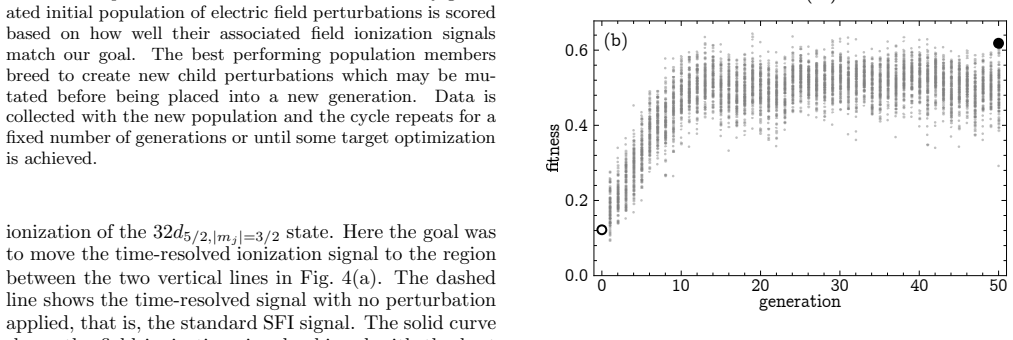
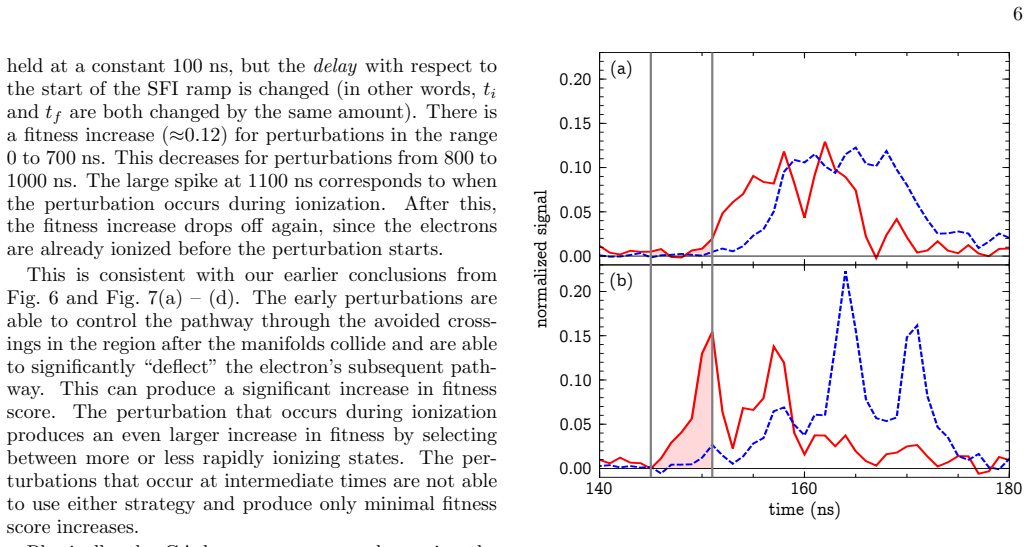
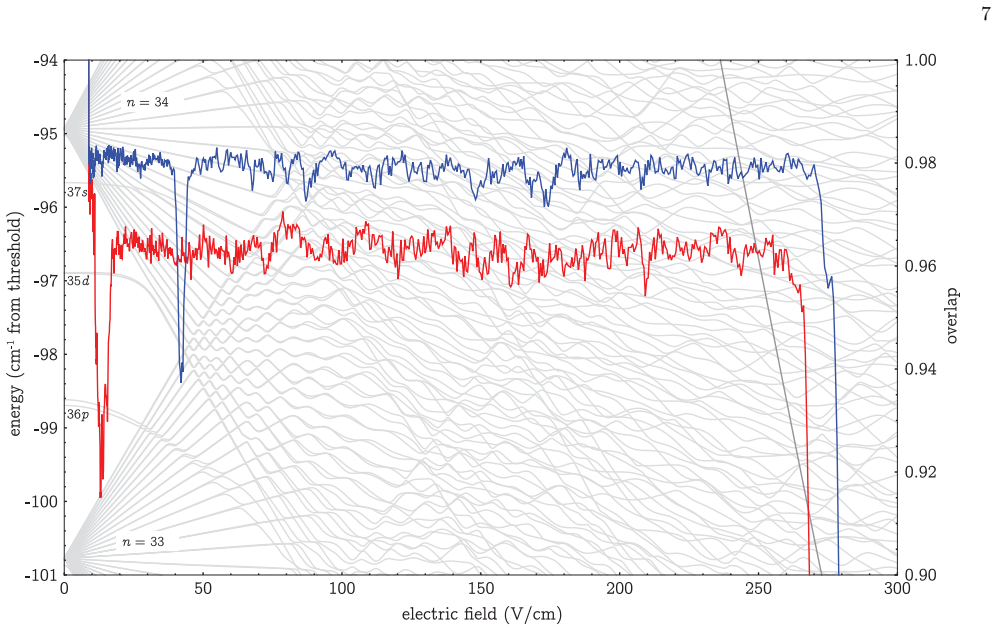
The central object is the directed-field-ionization (DFI) ramp: the usual high-voltage ionizing ramp with a small perturbing waveform (about 1000 voltage values at 1 ns resolution) that a genetic algorithm evolves. The GA uses elitism, tournament selection, uniform crossover, and mutation to maximize a fitness score — here, the fraction of $s$-state signal arriving in a fixed early time gate while keeping $p$-state leakage low. The mechanism that makes this work is phase-coherent traversal of avoided crossings in the Stark map: the perturbation can sweep the field back and forth through the same crossing several times, and the GA adjusts the timing (hence the accumulated phase) so that multiple traversals add coherently, transferring population between blue states (slow ionization) and red states (fast ionization). The mathematical identity that converts the optimized signal into a population is Eq. (1), $f_{es} = (f_e - f_p)/(f_s - f_p)$, which assumes the gate signal is a linear, interference-free mixture of the two single-state signals.
What would settle it
Excite a sample to a known mixture of $36p_{3/2}$ and $37s_{1/2}$ (for example, by driving a resonant microwave transition between the two states), measure the DFI gate fraction, and vary the relative phase of the two states; if the $s$-state fraction inferred from Eq. (1) changes with phase, or disagrees with the known mixture under phase averaging, the interference-free premise is false.
Extended reading notes
Core claim
The central claim is that a genetic-algorithm-optimized perturbation to a field ionization ramp can make the time-resolved ionization signal of the $37s_{1/2}$ state land in a region where the $36p_{3/2}$ state sends almost nothing (27.2% of s signal vs 2.1% of p signal), converting an overlapping, semi-quantitative signal into a separate, countable one. This lets the experimenter write the fraction of $s$-state in an unknown mixture as $f_{es} = (f_e - f_p)/(f_s - f_p)$, where $f_e$ is the measured fraction of total signal in the gate and $f_s$, $f_p$ are the single-state fractions. Applying that formula after a 9 µs interaction window, the paper reports quantitative field-tuned resonances for the $36p_{3/2}+36p_{3/2} \rightarrow 36s_{1/2}+37s_{1/2}$ dipole-dipole exchange, with three peaks corresponding to the $|m_j|$ combinations of the interacting pair. The deeper discovery is physical: the GA succeeds by using the ramping perturbation to traverse individual avoided crossings multiple times, shifting population between slowly-ionizing 'blue' and rapidly-ionizing 'red' Stark states near the ionization threshold, so the control is a coherent, phase-sensitive manipulation of the ionization pathway, not just a voltage adjustment.
Load-bearing premise
The load-bearing premise is that the optimized gate is free of quantum interference between the $s$-state and $p$-state ionization paths, so the gate fraction is a linear combination of the two single-state fractions (Eq. 1), a premise the paper assumes rather than verifies on mixtures of known composition.
Editorial extensions
If this is right
- SFI can be upgraded from a qualitative to a quantitative state-population probe for pairs of states whose signals overlap, as long as the GA can find a gate with sufficiently different single-state fractions.
- Quantitative studies of dipole-dipole resonances are possible even when initial and final states have nearly identical unperturbed ionization pathways, as demonstrated for the 36p3/2 + 36p3/2 to 36s1/2 + 37s1/2 transition.
- The glitch-scan method maps which avoided crossings most affect each state's ionization signal, giving a physical guide for choosing where perturbations should act.
- The identified mechanism — switching population between blue and red Stark states near ionization — gives a general design heuristic for state-selective field ionization beyond the specific rubidium states studied.
- As the authors point out, the same control over the electron's exit path could shape electron beams from Rydberg-atom ionization, for example to narrow their energy spread.
Reading between the lines
- If the interference-free assumption behind Eq. (1) survives calibration on known mixtures, DFI could become a routine quantitative diagnostic in Rydberg-gas and ultracold-plasma experiments, where overlapping ionization signals have long been a bottleneck.
- The same gate could be used as a phase-sensitive detector: preparing a coherent s-p superposition and watching the gate fraction oscillate with the relative phase would turn the nuisance interference of SFI into a measurement resource.
- A testable extension is to vary the relative phase between the s and p states (by a resonant microwave pulse) and check that the gate fraction stays constant; a phase-dependent answer would require a corrected, interference-aware model of the gate.
- The GA's convergence to similar perturbations across runs suggests an underlying optimization landscape with a preferred basin near ionization; mapping that landscape could yield semi-analytic design rules for gate-shaped ionizing ramps without brute-force evolution.
Signed reviews
Editorial analysis
A structured set of objections, weighed in public.
Referee Report
Summary. This manuscript describes directed field ionization (DFI), in which a genetic algorithm optimizes a small perturbing voltage added to the field-ionization ramp so that the time-resolved ionization signal of a chosen Rydberg state is moved into a desired time gate. The authors demonstrate the technique on single states, use repeated optimizations and glitch scans to identify which Stark-map regions matter, and then apply DFI to separate the overlapping ionization signals of 37s1/2 and 36p3/2. Using Eq. (1), which linearly unmixes the gated signal into s- and p-state contributions, they report quantitative measurements of the 36p3/2 + 36p3/2 -> 36s1/2 + 37s1/2 dipole-dipole resonances. The paper also provides pseudocode for the genetic algorithm and a link to open-source code.
Significance. The method is potentially valuable: DFI offers a way to recover Rydberg state distributions when conventional SFI signals overlap, and the glitch-scan diagnostic is a nice way to localize the avoided crossings that control ionization. The single-state GA optimization is supported by time-dependent Schrodinger simulations that reproduce the experimental fitness plateau (about 60% versus 65%), and the authors make their source code available, which aids reproducibility. If the linear unmixing in Eq. (1) were validated on known mixtures and the dipole-dipole data were given with uncertainties, the quantitative claim would be a solid contribution to Rydberg-state metrology. As it stands, the central quantitative application rests on an untested assumption that the gated signal from an s/p mixture is an interference-free linear sum of the single-state signals.
major comments (2)
- [Section IV, Eq. (1)] The linear mixture model, which in effect sets the gated signal fraction to f_e = f_s * x + f_p * (1 - x) and then solves for x, is never validated on samples of known composition. In Sec. VI the authors explicitly state that for standard SFI a mixture signal is not a simple sum because of interference between common ionization paths, and in Sec. IV the DFI gate is justified only as 'likely' to use a pathway distinct from the p-state. No measurement on known s/p mixtures is reported, so the magnitude of any cross-term in the DFI gate is unknown. This matters because the headline quantitative result, the 37s fraction extracted in Fig. 10(b), is obtained entirely from Eq. (1). I ask the authors to calibrate Eq. (1) on mixtures with independently known s/p fractions, or to bound the cross-term using their simulation with variable relative phase, and to state how the chosen gate is verified to be free of common-path interference.
- [Section VI, Fig. 10(b)] The central quantitative panel, the field scan of the 37s fraction, has no error bars, no statement of how many experimental runs were averaged, and no statistical test or line-shape fit. The three resonances are identified, but the amplitudes, which are the quantitative output that DFI is claimed to enable, cannot be assessed without uncertainties. In addition, the stochastic GA means that the calibration quantities f_s and f_p in Eq. (1) have run-to-run variability that should be propagated into the reported fractions. Please report repeated measurements with standard errors or confidence intervals on each point and on the extracted resonance amplitudes.
minor comments (5)
- [Eq. (1)] Equation (1) is typeset ambiguously (fe - fp / fs - fp) and uses fs both for the gated fraction of the s-state signal and for the inferred s-state fraction in the mixture; please use distinct symbols and parenthesize the denominator.
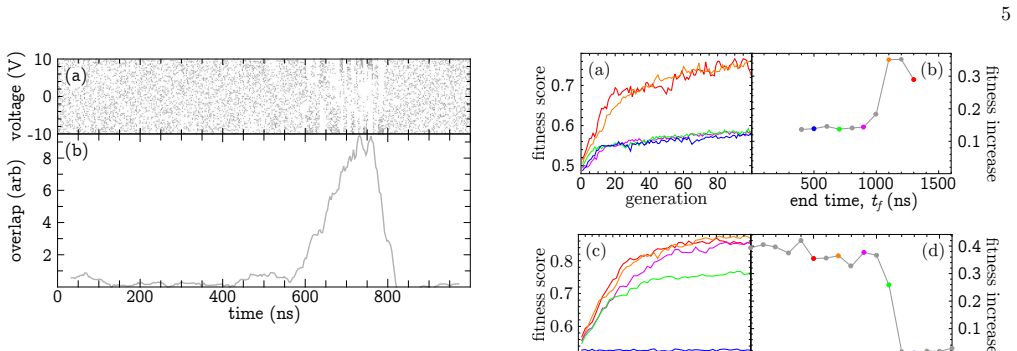
- [Fig. 9] The caption says 'overlap' but does not define how the overlap is normalized or what threshold is considered a dip; please define the quantity plotted.
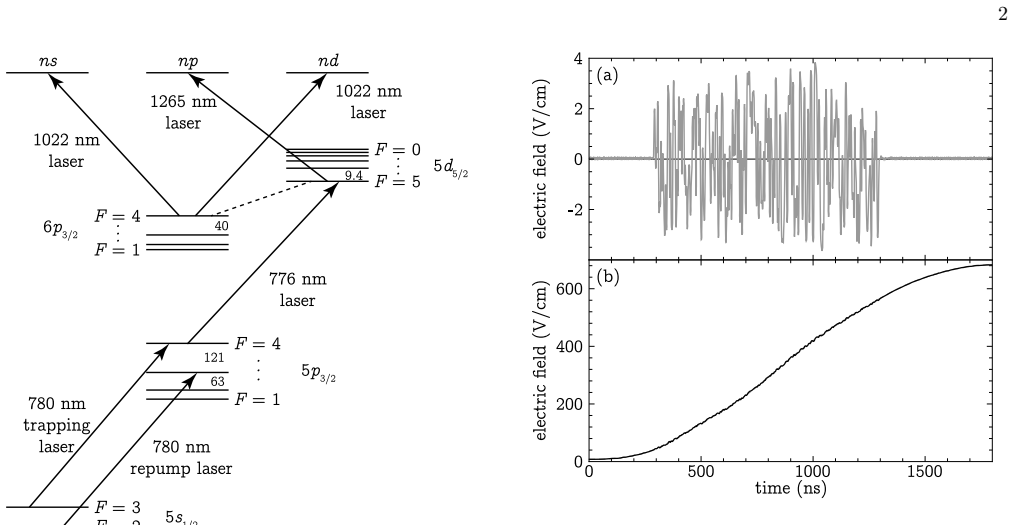
- [Section II] The text uses both 1265 nm and 1256 nm for the np excitation laser (compare Section II with the Fig. 1 caption); please make this consistent.
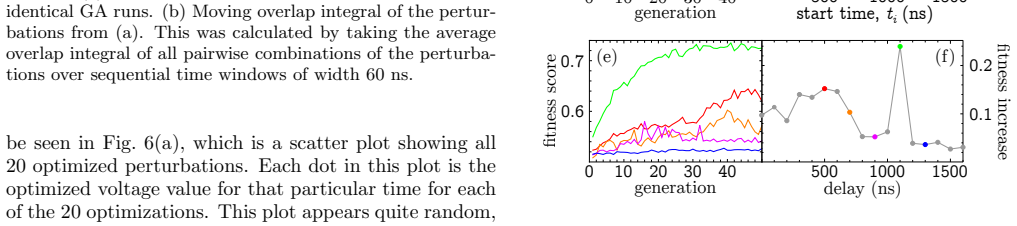
- [Fig. 7] Panels (a), (c), and (e) refer to colors that are not listed in a legend; a legend or explicit color-to-parameter mapping is needed for the reader to interpret the traces.
- [Appendix, Fig. 11] In the pseudocode, the mutation loop (lines 38-45) modifies population[i][j] before the assignment population = children on line 46, so as written the mutations are applied to the old generation and then discarded; this contradicts the text in Sec. VIII and should be corrected so that the children are mutated.
Circularity Check
No circularity found: Eq. (1) is a standard calibration identity, and the DFI measurements are new empirical results that do not reduce to their own inputs.
full rationale
The only algebraic step in the paper is Eq. (1), fes = (fe - fp)/(fs - fp), which estimates the s-state fraction in a mixture. This is a two-component linear-unmixing formula: fs and fp are measured from pure 37s and 36p signals, fe is measured from the mixture signal, and solving for the s-fraction is a calibration inversion rather than a prediction whose content was already contained in the inputs. The GA optimizes a contrast objective, maximizing the s signal in the gate while minimizing the p signal, and the resulting fs = 27% and fp = 2% are measured outcomes, not fitted parameters that force the subsequent dipole-dipole amplitudes. The paper's own caveat that the standard SFI mixture signal is not a simple sum because of common-path interference identifies a possible validity limitation of Eq. (1), but the same caveat is the motivation for using DFI, and the claimed linearity of the DFI gate is an empirical assumption rather than a circular definition. Self-citations to refs. [25], [26], and [28] describe the prior GA framework and interference calculations, but this paper provides its own pseudocode, glitch scans, simulations, and a new dipole-dipole measurement; those results are not obtained by citing the prior work. No step reduces to an equivalent of its own inputs.
Assumptions & free parameters
free parameters (2)
- Gate time window for s/p separation =
not stated numerically (Fig. 8 gate)
- Target gate for single-state optimization (Fig. 4) =
5 ns to 40 ns
assumptions (3)
- domain assumption Time-dependent Schrödinger equation with a truncated Stark basis (629 states) and semiclassical ionization rates describes the ionization pathway.
- domain assumption The genetic algorithm in simulation and experiment converge to representative optima.
- standard math Standard quantum mechanics (Stark effect, avoided crossings, Landau-Zener dynamics) applies to the Rydberg electron.
Cite this review
Pith. "Pith review of Perturbed Field Ionization for Improved State Selectivity." pith.science (2026). https://pith.science/paper/3YMVINBE
@misc{pith2026190809052,
  author       = {Pith},
  title        = {Pith review of: Perturbed Field Ionization for Improved State Selectivity},
  year         = {2026},
  howpublished = {\url{https://pith.science/paper/3YMVINBE}},
  note         = {Machine review of arXiv:1908.09052}
}
abstract
Selective field ionization is used to determine the state or distribution of states to which a Rydberg atom is excited. By evolving a small perturbation to the ramped electric field using a genetic algorithm, the shape of the time-resolved ionization signal can be controlled. This allows for separation of signals from pairs of states that would be indistinguishable with unperturbed selective field ionization. Measurements and calculations are presented that demonstrate this technique and shed light on how the perturbation directs the pathway of the electron to ionization. Pseudocode for the genetic algorithm is provided. Using the improved resolution afforded by this technique, quantitative measurements of the $36p_{3/2}+36p_{3/2}\rightarrow 36s_{1/2}+37s_{1/2}$ dipole-dipole interaction are made.
Figures

Figures from the paper (7 more)



Reference graph
Works this paper leans on
-
[1]
Gallagher, Rydberg Atoms (Cambridge Uni- versity Press, Cambridge ; New York, 1994)
Thomas F. Gallagher, Rydberg Atoms (Cambridge Uni- versity Press, Cambridge ; New York, 1994)
work page 1994
-
[2]
Ex- citation of an Atomic Electron to a Coherent Superposition of Macroscopically Distinct States,
Michael W. Noel and Jr. Stroud, C. R., “Ex- citation of an Atomic Electron to a Coherent Superposition of Macroscopically Distinct States,” Phys. Rev. Lett. 77, 1913–1916 (1996)
work page 1996
-
[3]
Ramsey interference in strongly driven Ry- dberg systems,
R. R. Jones, C. S. Raman, D. W. Schumacher, and P. H. Bucksbaum, “Ramsey interference in strongly driven Ry- dberg systems,” Phys. Rev. Lett. 71, 2575–2578 (1993)
work page 1993
-
[4]
Excitation of Rydberg wave packets with chirped laser pulses,
J. Precl ´ ıkov´ a, M. Koz´ ak, D. Fregenal, Ø. Frette, B. Hamre, B. T. Hjertaker, J. P. Hansen, and L. Kocbach, “Excitation of Rydberg wave packets with chirped laser pulses,” Phys. Rev. A 86, 063418 (2012)
work page 2012
-
[5]
Resonant inhibition of multiphoton ionization,
J. G. Story, D. I. Duncan, and T. F. Gal- lagher, “Resonant inhibition of multiphoton ionization,” Phys. Rev. Lett. 70, 3012–3015 (1993)
work page 1993
-
[6]
Short-pulse microwave ionization of Na Rydberg atoms,
M. Gatzke, B. Broers, L. D. Noordam, R. B. Watkins, and T. F. Gallagher, “Short-pulse microwave ionization of Na Rydberg atoms,” Phys. Rev. A 50, 2502–2507 (1994)
work page 1994
-
[7]
Far-Infrared Multiphoton Ionization of Lithium Rydberg Atoms Bypassing a Cooper Minimum,
J. H. Hoogenraad, R. B. Vrijen, P. W. van Amers- foort, A. F. G. van der Meer, and L. D. Noor- dam, “Far-Infrared Multiphoton Ionization of Lithium Rydberg Atoms Bypassing a Cooper Minimum,” Phys. Rev. Lett. 75, 4579–4582 (1995)
work page 1995
-
[8]
Quan- tum interference in microwave multiphoton transitions,
M. Gatzke, R. B. Watkins, and T. F. Gallagher, “Quan- tum interference in microwave multiphoton transitions,” Phys. Rev. A 51, 4835–4841 (1995)
work page 1995
Show all 37 references
-
[9]
Chirped-pulse multiphoton transitions between Ryd- 11 berg states,
C. W. S. Conover, M. C. Doogue, and F. J. Struwe, “Chirped-pulse multiphoton transitions between Ryd- 11 berg states,” Phys. Rev. A 65, 033414 (2002)
2002
-
[10]
State-selective Rydberg excitation with femtosecond pulses,
M. Koz´ ak, J. Precl ´ ıkov´ a, D. Fregenal, and J. P. Hansen, “State-selective Rydberg excitation with femtosecond pulses,” Phys. Rev. A 87, 043421 (2013)
2013
-
[11]
Shaping an atomic electron wave packet,
Michael W. Noel and C. R. Stroud, “Shaping an atomic electron wave packet,” Opt. Express 1, 176 (1997)
1997
-
[12]
Measurement of the quantum state of electronic wave packets,
R. R. Jones and M. B. Campbell, “Measurement of the quantum state of electronic wave packets,” Phys. Rev. A 61, 013403 (1999)
1999
-
[13]
Half-cycle-pulse- train induced state redistribution of Rydberg atoms,
P. K. Mandal and A. Speck, “Half-cycle-pulse- train induced state redistribution of Rydberg atoms,” Phys. Rev. A 81, 013401 (2010)
2010
-
[14]
Excited Atoms in Strong Microwaves: Classical Resonances and Lo- calization in Experimental Final-State Distributions,
James E. Bayfield and David W. Sokol, “Excited Atoms in Strong Microwaves: Classical Resonances and Lo- calization in Experimental Final-State Distributions,” Phys. Rev. Lett. 61, 2007–2010 (1988)
1988
-
[15]
Population Trapping in Extremely Highly Excited States in Microwave Ionization,
Michael W. Noel, W. M. Griffith, and T. F. Gallagher, “Population Trapping in Extremely Highly Excited States in Microwave Ionization,” Phys. Rev. Lett. 83, 1747–1750 (1999)
1999
-
[16]
Formation of Rydberg Atoms in an Expanding Ultracold Neutral Plasma,
T. C. Killian, M. J. Lim, S. Kulin, R. Dumke, S. D. Bergeson, and S. L. Rolston, “Formation of Rydberg Atoms in an Expanding Ultracold Neutral Plasma,” Phys. Rev. Lett. 86, 3759–3762 (2001)
2001
-
[17]
Heating and cooling of electrons in an ultracold neutral plasma using Rydberg atoms,
E. V. Crockett, R. C. Newell, F. Robicheaux, and D. A. Tate, “Heating and cooling of electrons in an ultracold neutral plasma using Rydberg atoms,” Phys. Rev. A 98, 043431 (2018)
2018
-
[18]
Spatially Resolved Ob- servation of Dipole-Dipole Interaction between Rydberg Atoms,
C. S. E. van Ditzhuijzen, A. F. Koenderink, J. V. Hern´ andez, F. Robicheaux, L. D. Noordam, and H. B. van Linden van den Heuvell, “Spatially Resolved Ob- servation of Dipole-Dipole Interaction between Rydberg Atoms,” Phys. Rev. Lett. 100, 243201 (2008)
2008
-
[19]
Dipole- dipole interaction between rubidium Rydberg atoms,
Emily Altiere, Donald P. Fahey, Michael W. Noel, Rachel J. Smith, and Thomas J. Carroll, “Dipole- dipole interaction between rubidium Rydberg atoms,” Phys. Rev. A 84, 053431 (2011)
2011
-
[20]
Dipole-dipole resonanc e line shapes in a cold Rydberg gas,
B. G. Richards and R. R. Jones, “Dipole-dipole resonanc e line shapes in a cold Rydberg gas,” Phys. Rev. A 93, 042505 (2016)
2016
-
[21]
Line shapes and time dynamics of the Forster resonances between two Rydberg atoms in a time-varying electric field,
E. A. Yakshina, D. B. Tretyakov, I. I. Beterov, V. M. Entin, C. Andreeva, A. Cinins, A. Markovski, Z. Iftikhar, A. Ekers, and I. I. Ryabtsev, “Line shapes and time dynamics of the Forster resonances between two Rydberg atoms in a time-varying electric field,” Phys. Rev. A 94, 0...
2016
-
[22]
Excitonlike exchange in two-photon transitions of pairs of cold Rb Rydberg atoms,
Jeonghun Lee, Phatthamon Kongkhambut, and T. F. Gallagher, “Excitonlike exchange in two-photon transitions of pairs of cold Rb Rydberg atoms,” Phys. Rev. A 96, 061401 (2017)
2017
-
[23]
Dia- batic Field Ionization of Highly Excited Sodium Atoms,
T. H. Jeys, G. W. Foltz, K. A. Smith, E. J. Beiting, F. G. Kellert, F. B. Dunning, and R. F. Stebbings, “Dia- batic Field Ionization of Highly Excited Sodium Atoms,” Phys. Rev. Lett. 44, 390 (1980)
1980
-
[24]
Classical subharmonic resonances in microwave ionization of lithium Rydberg atoms,
Michael W. Noel, W. M. Griffith, and T. F. Gallagher, “Classical subharmonic resonances in microwave ionization of lithium Rydberg atoms,” Phys. Rev. A 62, 063401 (2000)
2000
-
[25]
Quantum control via a genetic algorithm of the field ionization pathway of a Rydberg electron,
Vincent C. Gregoric, Xinyue Kang, Zhimin Cheryl Liu, Zoe A. Rowley, Thomas J. Carroll, and Michael W. Noel, “Quantum control via a genetic algorithm of the field ionization pathway of a Rydberg electron,” Phys. Rev. A 96, 023403 (2017)
2017
-
[26]
Im- proving the state selectivity of field ionization with quan- tum control,
Vincent C. Gregoric, Jason J. Bennett, Bianca R. Gualtieri, Ankitha Kannad, Zhimin Cheryl Liu, Zoe A. Rowley, Thomas J. Carroll, and Michael W. Noel, “Im- proving the state selectivity of field ionization with quan- tum control,” Phys. Rev. A 98, 063404 (2018)
2018
-
[27]
Excitation of Rydberg states in rubidium with near infrared diode lasers,
Donald P. Fahey and Michael W. Noel, “Excitation of Rydberg states in rubidium with near infrared diode lasers,” Opt. Express 19, 17002 (2011)
2011
-
[28]
Quantum interference in the field ionization of Rydberg atoms,
Rachel Feynman, Jacob Hollingsworth, Michael Vennet- tilli, Tamas Budner, Ryan Zmiewski, Donald P. Fahey, Thomas J. Carroll, and Michael W. Noel, “Quantum interference in the field ionization of Rydberg atoms,” Phys. Rev. A 92, 043412 (2015)
2015
-
[29]
A hy- drogen atom in a uniform electric field. III,
R. J. Damburg and V. V. Kolosov, “A hy- drogen atom in a uniform electric field. III,” J. Phys. B: At. Mol. Phys. 12, 2637 (1979)
1979
-
[30]
Manipulating ionization path in a Stark map: Stringent schemes for the se- lective field ionization in highly excited Rb Rydberg,
M Tada, Y Kishimoto, M Shibata, K Kominato, S Ya- mada, T Haseyama, I Ogawa, H Funahashi, K Ya- mamoto, and S Matsuki, “Manipulating ionization path in a Stark map: Stringent schemes for the se- lective field ionization in highly excited Rb Rydberg,” Phys. Lett. A 303, 285 (2002)
2002
-
[31]
L-state se- lective field ionization of rubidium Rydberg states,
A. G¨ urtler and W. J. van der Zande, “L-state se- lective field ionization of rubidium Rydberg states,” Phys. Lett. A 324, 315 (2004)
2004
-
[32]
Enhancing SFI with a GA: Github.com/mawxcarroll/directed-field-ionization,
Thomas J. Carroll, Vincent C. Gregoric, and Michael W. Noel, “Enhancing SFI with a GA: Github.com/mawxcarroll/directed-field-ionization,” (2019)
2019
-
[33]
Quantum Inter- ference Effects in Field-Ionization - Applica- tion to the Measurement of the Fine-Structure Splitting of Highly Excited Na2d States,
G. Leuchs and H. Walther, “Quantum Inter- ference Effects in Field-Ionization - Applica- tion to the Measurement of the Fine-Structure Splitting of Highly Excited Na2d States,” Z. Phys. A.-Hadrons Nuclei 293, 93–101 (1979)
1979
-
[34]
High-flux monochromatic ion and electron beams based on laser- cooled atoms,
L. Kime, A. Fioretti, Y. Bruneau, N. Porfido, F. Fuso, M. Viteau, G. Khalili, N. ˇSanti´ c, A. Gloter, B. Rasser, P. Sudraud, P. Pillet, and D. Comparat, “High-flux monochromatic ion and electron beams based on laser- cooled atoms,” Phys. Rev. A 88, 033424 (2013)
2013
-
[35]
Field ioniza- tion of Rydberg atoms for high-brightness electron and ion beams,
A. J. McCulloch, R. W. Speirs, J. Grimmel, B. M. Sparkes, D. Comparat, and R. E. Scholten, “Field ioniza- tion of Rydberg atoms for high-brightness electron and ion beams,” Phys. Rev. A 95, 063845 (2017)
2017
-
[36]
Forced field ionization of Rydberg states for the production of monochromatic beams,
E. Moufarej, M. Vielle-Grosjean, G. Khalili, A. J. McCulloch, F. Robicheaux, Y. J. Picard, and D. Comparat, “Forced field ionization of Rydberg states for the production of monochromatic beams,” Phys. Rev. A 95, 043409 (2017)
2017
-
[37]
(A Bradford Book, Cambridge, Mass., 1998)
Melanie Mitchell, An Introduction to Genetic Algorithms , reprint edition ed. (A Bradford Book, Cambridge, Mass., 1998)
1998
Reviewed August 14, 2026 · model on record in the stance chip above.
Discussion (0). Continue with ORCID to comment.