REVIEW 5 major objections 4 minor 69 references
Higher-order topological phase without crystalline symmetry
T0 review · 5 major / 4 minor · reviewed 2026-08-14 · deepseek-v4-flash
Pith's one-line read This paper claims that higher-order topological phases with robust gapless hinges and corners can exist in three dimensions without crystalline symmetry, protected instead by subsystem symmetries, and derives a general symmetry-based…
desk verdict Subsystem symmetry is a plausible substitute for crystalline symmetry in higher-order topology, but the explicit models have sign errors and the no-go mapping is a sketch, so the paper needs major revision before the claims hold. read the letter →
The pith
A machine-rendered reading of the paper's core claim, the machinery that carries it, and where it could break.
The reading
What carries the argument
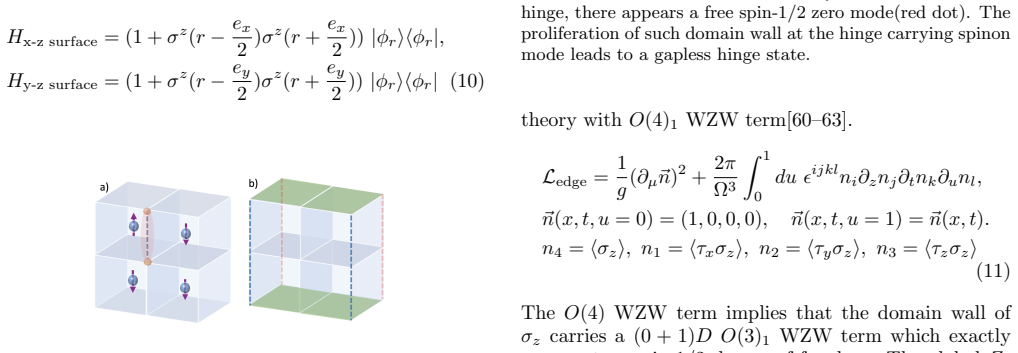
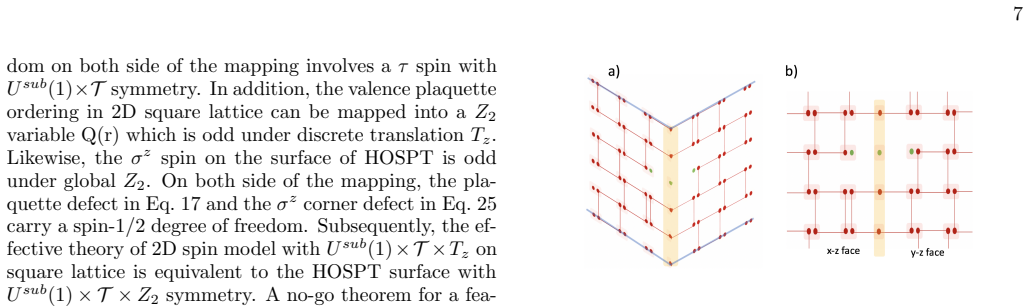
The central object is the decorated hinge-wall condensate. Sigma-z domain-wall configurations of a Z2 paramagnet form the 'walls'; each x-y domain wall is decorated with a 2D higher-order topological phase whose corners carry spin-1/2, and each z-hinge defect—an intersection line of two orthogonal domain walls—is decorated with an AKLT chain (or a Kitaev chain in the fermionic version). The proof has two further pillars: the O(4)1 Wess-Zumino-Witten nonlinear sigma model for the hinge, whose topological term forbids a gapped symmetric ground state, and a mapping of the xz and yz surfaces to a 2D square lattice with a valence-plaquette order parameter Q(r), a Z2 variable odd under translation along z. A large-gauge-transformation argument on a z-row of that lattice shows that a row with odd spin per site admits no featureless gapped ground state, converting the lower-dimensional no-go theorem into an ungappability statement for the hinge.
What would settle it
Find a symmetric local perturbation that fully gaps the z-hinge of the solvable bosonic model—on a geometry with a single exposed hinge—without breaking U_sub(1) × T × Z2 or gapping the side surfaces; the paper predicts no such perturbation exists. Equivalently, construct a featureless gapped ground state on a 2D square lattice with one spin-1/2 per site, conserved U(1) charge per row, and translation symmetry along the row; finding one would refute the Lieb-Schultz-Mattis type obstruction, while an explicit operator map from that defective row to the hinge would confirm it.
Extended reading notes
Core claim
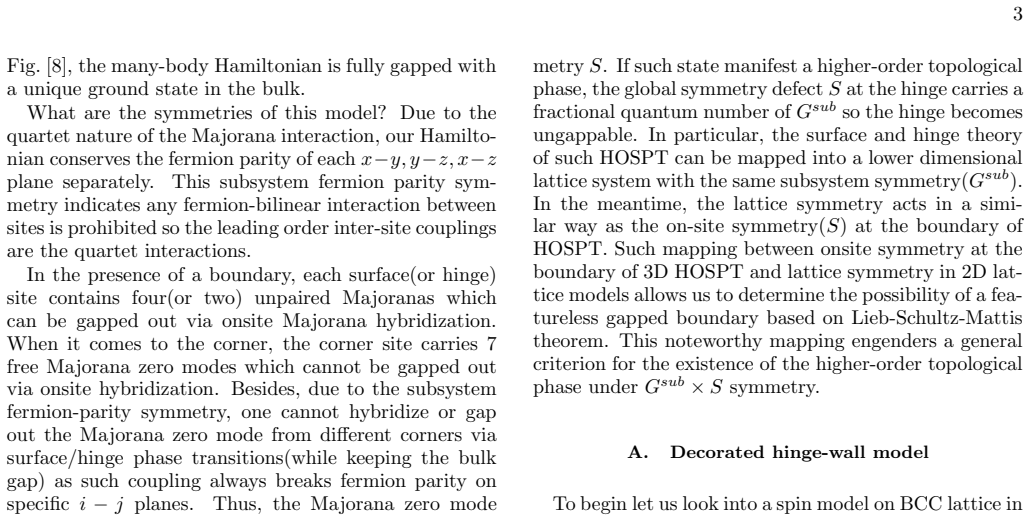
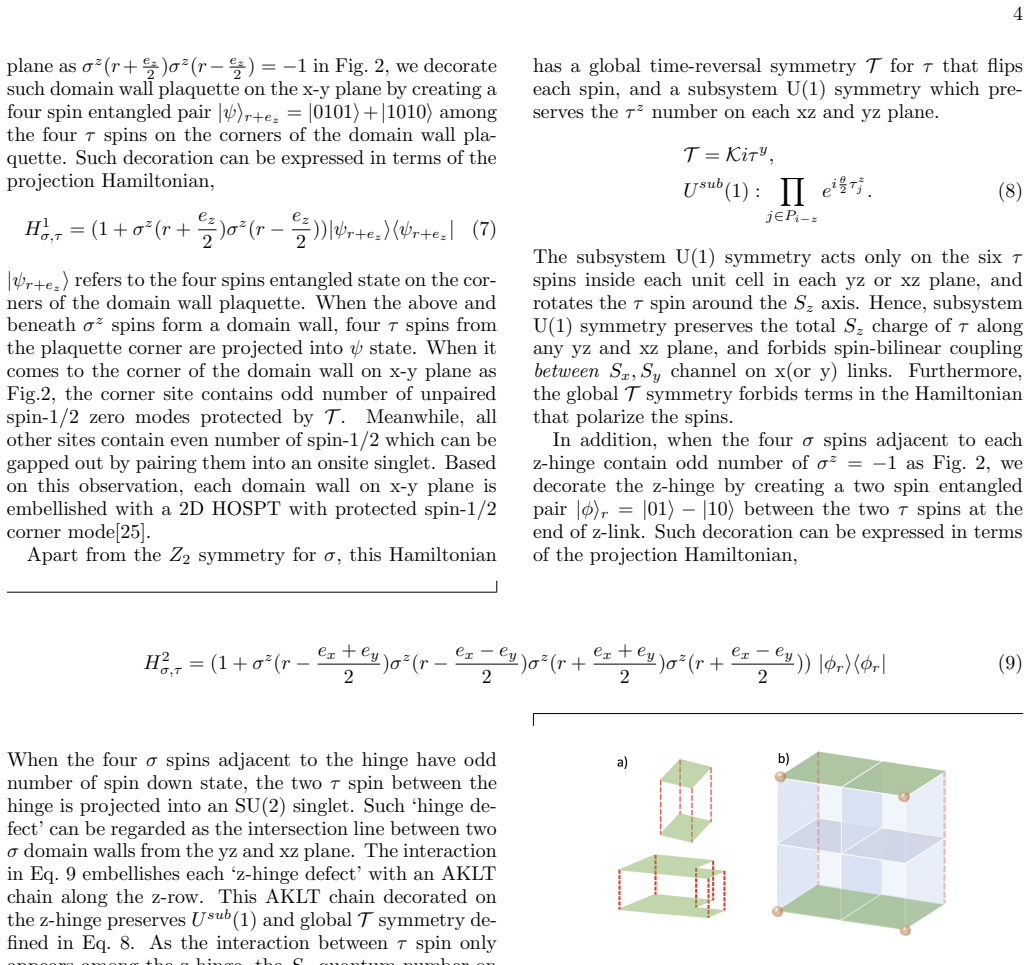
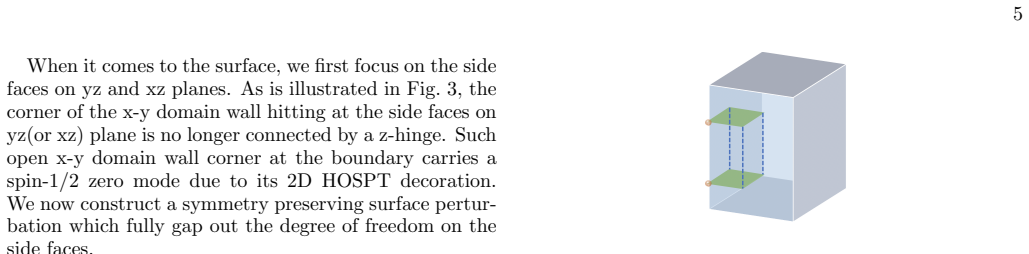
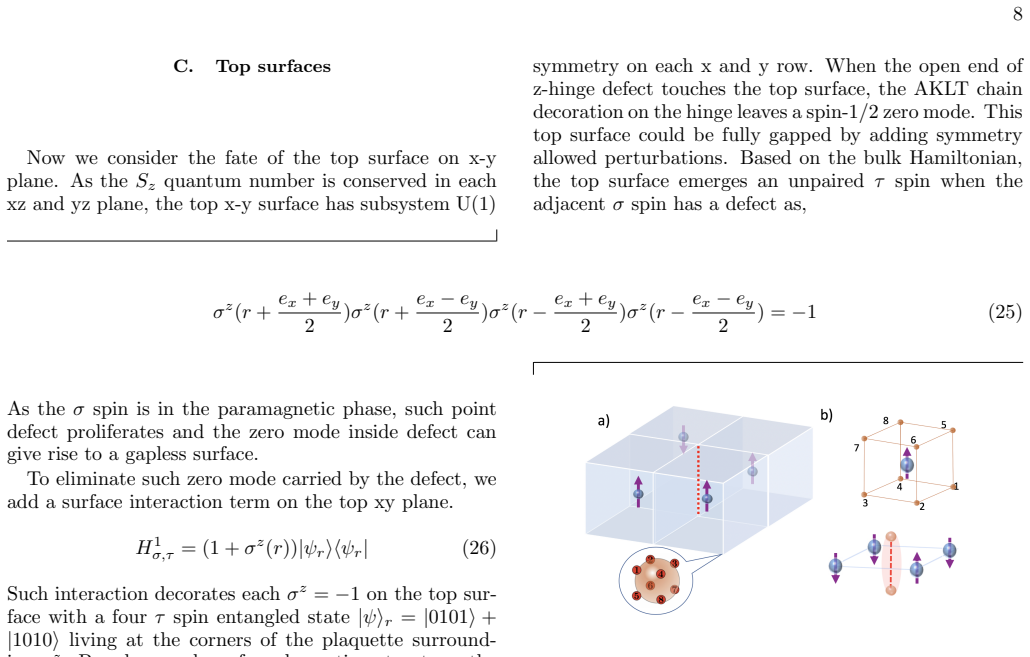
On the paper's own terms, the central discovery is that higher-order topological order can be protected by subsystem symmetry rather than spatial symmetry. In the bosonic model, cube centers carry Z2 Ising spins in a paramagnetic phase; when sigma-z domain walls form, the tau spins on plaquette corners are projected into a four-spin entangled valence-plaquette state, so each x-y domain wall carries a two-dimensional higher-order topological phase with spin-1/2 corner modes, while z-hinge defects are decorated with AKLT chains. The condensate of these decorated domain walls has a unique gapped bulk, fully gapped side and top surfaces, and an ungappable z-hinge whose low-energy description is a 1+1D O(4) nonlinear sigma model with a Wess-Zumino-Witten term. The surface theory is mapped to a 2D square lattice with two spin-1/2 per site, and a flux-insertion argument shows that any row carrying odd spin per site—the situation corresponding to the hinge—forbids a featureless gapped ground state. This Lieb-Schultz-Mattis type obstruction becomes the paper's general criterion: whenever a 3D boundary with subsystem symmetry G_sub and global symmetry S maps to a lower-dimensional lattice whose symmetries forbid a unique gapped ground state, the hinge must be gapless regardless of the microscopic Hamiltonian. A fermionic analogue with Majorana corner or hinge modes protected by subsystem fermion parity is built from commuting Fidkowski-Kitaev-type quartic interactions, confirming that the phenomenon is intrinsic to strongly interacting systems.
Load-bearing premise
The argument's load-bearing premise is that the surface of the 3D higher-order topological phase can be exactly represented by the 2D square-lattice model with two spin-1/2 per site, so that the hinge corresponds to a defect line with odd spin per site; the paper argues this mapping at the level of defects and symmetries but does not give an explicit operator-level equivalence, and if that correspondence fails the no-go conclusion for the hinge does not follow.
Editorial extensions
If this is right
- If the central claim is correct, strongly interacting 3D systems with subsystem symmetry are a genuine home for higher-order topology, including phases with no non-interacting band-theory counterpart.
- The paper's Lieb-Schultz-Mattis type criterion gives a Hamiltonian-independent diagnostic: check whether the boundary maps to a lower-dimensional lattice with an odd-spin-per-row obstruction rather than solving the bulk.
- The decorated hinge-wall construction yields exactly solvable models with gapped surfaces and gapless hinges, so the phase can be verified directly by ground-state or entanglement calculations in these models.
- The fermionic version implies that Majorana corner or hinge modes can be stabilized purely by interaction and subsystem parity conservation, without crystalline symmetry or free-fermion topology.
- The same decorated-defect logic is expected to extend to other subsystem symmetries, such as fractal or higher-planar symmetries, offering a route to classifying subsystem-protected higher-order phases.
Reading between the lines
- This construction suggests that gauging the subsystem symmetry turns these higher-order topological phases into symmetry-enriched fracton phases; the hinge-wall condensate closely parallels membrane-cage-net pictures, so explicit defect and anyon data could likely be extracted from the solvable models.
- A direct numerical test would be to compute the open-boundary spectrum of the solvable model on a geometry with a single z-hinge: a protected spin-1/2 or Majorana zero mode at the hinge ends, robust to all symmetric perturbations, would confirm the prediction.
- The Lieb-Schultz-Mattis style mapping may transfer to other dimensionalities, giving a quick symmetry-only diagnostic: any boundary whose low-energy description is a lattice model with half-filling per row should signal an obstructed higher-order boundary.
- One could search numerically for a featureless gapped state on a 2D square lattice with one spin-1/2 per site, subsystem U(1) charge conserved per row, and translation invariance; the paper's logic predicts none exists, and an explicit search would sharpen the boundary of the no-go theorem.
Editorial analysis
A structured set of objections, weighed in public.
Referee Report
Summary. This paper proposes a class of three-dimensional higher-order topological phases (HOSPTs) that are protected by subsystem symmetries rather than by crystalline symmetries. The central construction is a decorated hinge-wall condensate on a BCC lattice: an Ising paramagnet is placed in a superposition of closed domain-wall configurations, and each domain-wall membrane or hinge defect is decorated with a lower-dimensional SPT state (2D HOSPT plaquettes or AKLT chains in the bosonic version; Majorana clusters or Kitaev chains in the fermionic version). This is claimed to yield gapped surfaces separated by robust gapless hinges or corners. The paper also presents a general criterion based on a generalized Lieb-Schultz-Mattis (LSM) theorem: mapping the 3D HOSPT boundary to a 2D lattice model with subsystem symmetry and translation symmetry, an LSM obstruction in the 2D model implies the absence of a featureless gapped boundary (and hence the ungappable nature of the hinge) in the 3D system.
Significance. If the construction is made rigorous, the paper would establish a genuinely new class of strongly interacting higher-order topological phases that do not rely on crystalline symmetry, with a potentially universal LSM-type criterion for their existence. The proposed connection between subsystem-symmetric HOSPTs and fracton order is timely and interesting. The paper contains concrete model proposals and identifies an explicit WZW description of the hinge mode, which are valuable. However, in its present form the central claims are not fully substantiated: the Hamiltonian definitions contain operator-level inconsistencies, the exact solvability of the decorated models is asserted rather than proven, and the LSM no-go mapping is described only by analogy. These issues are load-bearing for the paper's main conclusions.
major comments (5)
- [II, Eqs. (1) and (3)] Equation (1) defines H1 as a product of four Majoranas, H1 = η5η6η7η8 + η1η2η3η4, but Eq. (3) claims it equals (nΨ−1)^2 + (nΨ′−1)^2. These operators are not equal: for a complex-fermion pair c=(γ1+iγ2)/2, the operator (n−1)^2 equals (1−iγ1γ2)/2, which is quadratic in the Majoranas, whereas the term γ1γ2γ3γ4 is quartic and carries no such reduction. This is a load-bearing inconsistency because the entire cluster-model solvability and the subsequent mapping to the spin degrees of freedom in Eq. (4) depend on H1 having the stated form.
- [III.A, Eqs. (7) and (9)] The projection Hamiltonians in Eqs. (7) and (9) contain the prefactors (1+σz(r+ez/2)σz(r−ez/2)) and (1+σz(...)σz(...)σz(...)σz(...)). On the configurations they are designed to enforce, namely domain walls or hinge defects where the corresponding product equals −1, these prefactors evaluate to zero, so the terms do not impose the intended |ψ⟩ or |φ⟩ state. The same sign issue appears in Eq. (10) and Eq. (26). A sign correction (e.g., 1−product) is likely what was intended, but as written the decorated hinge-wall Hamiltonian does not realize the claimed ground-state structure.
- [III.B, Eqs. (14)–(24)] The central LSM no-go argument is incomplete. The paper asserts that the xz/yz surface theory with Usub(1)×T×Z2 can be mapped into a 2D square-lattice model with two spins per site and translation Tz, but no operator-level mapping is constructed. The flux-insertion proof in Eqs. (22)–(24) establishes an obstruction only for that 2D lattice model when a row has an odd number of spins per site. The hinge of the 3D HOSPT is a 1D boundary of a 3D system, not a fixed row of an infinite 2D lattice; surface reconstructions could in principle move the relevant domain-wall endpoint off the hinge and remove the half-filled row. Without an explicit mapping showing that every symmetric surface perturbation is represented by a fixed half-filled row, the no-go theorem does not transfer to the hinge.
- [III.A, Hamiltonian around Eq. (6)] The claim that the decorated hinge-wall Hamiltonian is exactly solvable with a unique gapped ground state is not supported by a commutativity or ground-state check. The transverse-field term Hσ=−∑σxi depends on σx and does not commute with the σz-dependent projectors in Eqs. (7)–(9). The paper does not demonstrate that the ground state is the equal-weight superposition of all closed domain-wall configurations with the specified τ/Majorana decorations, which is a second load-bearing gap because the hinge-wall condensate picture and the topological protection argument rely on this ground-state structure.
- [III.B, Refs. [27] and [45]] The paper's motivating open question (Ref. [27]) and the generalized LSM theorem for subsystem symmetry (Ref. [45]) are both cited as "To appear". Because the proposed no-go criterion is the central conceptual result, the manuscript should either state and prove the needed LSM theorem in an appendix or cite a publicly available preprint. Without this, the reader cannot independently verify the load-bearing assumption that the 2D subsystem LSM obstruction is applicable.
minor comments (4)
- [I, after Eq. (1)] In the Introduction, the sentence describing subsystems says "the subsystems can be lines ( d = 1), planes( d = 1)"; the second "d=1" should read "d=2" for planes.
- [III.B, Eq. (15)] The quantity Q(r) is defined as the difference of two numbers P∈{0,1}, so it takes values in {−1,0,1}; the text calls it a Z2 variable. This should be clarified by a sharper definition (for example, by specifying that P is valued in ±1 on the two sublattices or by defining an appropriate mod-2 quantity).
- [III.B, Eq. (22)] The notation ẑ in the flux-insertion operator exp(2πi/Lz ∑_{r∈i-th row} ẑ n_r) is nonstandard and ambiguous; it should be a coordinate or a vector label, not a unit vector, in the exponent.
- [III.A, Fig. 2 and text after Eq. (6)] The text says "the cube corner carries six spin-1/2 degrees of freedom", but a cube has eight corners; in Section II the corresponding model uses eight Majoranas. The number of τ spins per cube and how they are shared between adjacent cubes should be explained consistently.
Circularity Check
No significant circularity: the explicit models and the LSM-type no-go argument are self-contained, and the to-appear self-citations are not load-bearing.
full rationale
The paper's central claims are constructive rather than reductions of outputs to inputs. The decorated hinge-wall Hamiltonians in Secs. II and III.A are explicit commuting-projector-type models whose ground states are described as domain-wall condensates decorated with lower-dimensional SPT states; the corner or hinge zero modes are then read off from unpaired Majoranas or spin-1/2 degrees of freedom, not obtained from a fitted parameter or from a pre-imported conclusion. The only claim with no-go status, the ungappability argument in Sec. III.B, is supported by a standard flux-insertion LSM argument applied to a row with odd spin-1/2 per site (Eqs. 22-24); that derivation is self-contained and does not use any quantity fitted elsewhere in the paper. The two to-appear self-citations, Refs. [27] and [45], are used to state the open question and to advertise a generalized subsystem-symmetric LSM theorem, but the specific no-go proof in Sec. III.B does not rest on either citation, and the standard LSM references [46]-[54] provide independent grounding. The mapping from the 3D HOSPT surface to a 2D square-lattice model (around Eqs. 15-17) is asserted rather than derived; if that mapping fails, the no-go conclusion would not follow. That is a possible gap in rigor, but it is an unproven equivalence, not a circular reduction. Separately, the projector prefactors in Eqs. (7) and (9) are written as (1+sigma_z sigma_z') and vanish on the very domain-wall configurations they are meant to enforce, which is a technical sign-related concern about exact solvability, not a circularity. Overall, no prediction or theorem in the paper reduces by construction to its own inputs; the appropriate circularity score is 0.
Assumptions & free parameters
assumptions (5)
- standard math Generalized Lieb-Schultz-Mattis theorem excludes featureless gapped unique ground states in certain D-dimensional lattice models with internal and lattice symmetries.
- ad hoc to paper The low-energy theory of the 3D HOSPT surface with U_sub(1)xT xZ2 is exactly equivalent to a 2D square lattice model with U_sub(1)xT and lattice translation T_z.
- ad hoc to paper The decorated hinge-wall Hamiltonian has a unique gapped ground state given by the superposition of closed sigma domain walls with the specified tau or Majorana decorations.
- domain assumption The hinge is described by an O(4)_1 WZW nonlinear sigma model whose domain wall carries a spin-1/2 zero mode.
- domain assumption Subsystem U(1) or fermion parity symmetry remains exact on every relevant plane or row in the full Hamiltonian including surface terms.
Cite this review
Pith. "Pith review of Higher-order topological phase without crystalline symmetry." pith.science (2026). https://pith.science/paper/3ZFUBQRR
@misc{pith2026190804299,
  author       = {Pith},
  title        = {Pith review of: Higher-order topological phase without crystalline symmetry},
  year         = {2026},
  howpublished = {\url{https://pith.science/paper/3ZFUBQRR}},
  note         = {Machine review of arXiv:1908.04299}
}
abstract
A wide variety of higher-order symmetry protected topological phase(HOSPT) with gapless corners or hinges had been proposed as a descendant of topological crystalline insulator protected by spatial symmetry. In this work, we address a new class of higher-order topological state which does not require crystalline symmetries but instead relies on subsystem symmetry for protection. We propose several strong interacting models with gapless hinge or corner based on a `decorated hinge-wall condensate' picture. The hinge-wall, which appears as the defect configuration of $Z_2$ paramagnet is decorated with lower-dim SPT state. Such unique hinge-wall decoration structure leads to gapped surfaces separated by gapless hinges. The non-trivial nature of the hinge modes can be captured by a $1+1$D conformal field theory with a Wess-Zumino-Witten term. Besides, we establish a no-go theorem to demonstrate the ungappable nature of the hinge by making a connection between generalized Lieb-Schultz-Mattis theorem and the boundary anomaly of HOSPT state. This universal correspondence engenders a comprehensive criterion to determine the existence of HOSPT under certain symmetry regardless of the microscopic Hamiltonian.
Figures

Figures from the paper (5 more)

Reference graph
Works this paper leans on
- [27]
-
[45]
Huan He, Yizhi You, Abhinav Prem, To appear
-
[1]
Fu, Physical Review Letters 106, 106802 (2011)
L. Fu, Physical Review Letters 106, 106802 (2011)
2011
-
[2]
T. H. Hsieh, H. Lin, J. Liu, W. Duan, A. Bansil, and L. Fu, Nature communications 3, 982 (2012)
work page 2012
- [3]
-
[4]
Ando and L
Y. Ando and L. Fu, Annu. Rev. Condens. Matter Phys. 6, 361 (2015)
2015
-
[5]
Slager, A
R.-J. Slager, A. Mesaros, V. Juriˇ ci´ c, and J. Zaanen, Nature Physics 9, 98 (2013)
2013
-
[6]
Topological Order and Symmetry Anomaly on the Surface of Topological Crystalline Insulators
S. Hong and L. Fu, arXiv preprint arXiv:1707.02594 (2017)
work page Pith review arXiv 2017
Show all 69 references
-
[7]
Qi and L
Y. Qi and L. Fu, Physical review letters 115, 236801 (2015)
2015
-
[8]
Huang, H
S.-J. Huang, H. Song, Y.-P. Huang, and M. Hermele, Physical Review B 96, 205106 (2017)
2017
-
[9]
J. C. Teo and T. L. Hughes, Physical review letters 111, 047006 (2013)
2013
-
[10]
Song, S.-J
H. Song, S.-J. Huang, L. Fu, and M. Hermele, Physical Review X 7, 011020 (2017)
2017
-
[11]
Watanabe, H
H. Watanabe, H. C. Po, and A. Vishwanath, arXiv preprint arXiv:1707.01903 (2017)
2017 arXiv
-
[12]
H. C. Po, A. Vishwanath, and H. Watanabe, Nature 10 Communications 8, 50 (2017)
2017
-
[13]
Isobe and L
H. Isobe and L. Fu, Physical Review B92, 081304 (2015)
2015
-
[14]
W. A. Benalcazar, B. A. Bernevig, and T. L. Hughes, Science 357, 61 (2017)
2017
-
[15]
W. A. Benalcazar, B. A. Bernevig, and T. L. Hughes, Physical Review B 96, 245115 (2017)
2017
-
[16]
Langbehn, Y
J. Langbehn, Y. Peng, L. Trifunovic, F. von Oppen, and P. W. Brouwer, Physical review letters 119, 246401 (2017)
2017
-
[17]
Z. Song, Z. Fang, and C. Fang, Physical review letters 119, 246402 (2017)
2017
-
[18]
Dwivedi, C
V. Dwivedi, C. Hickey, T. Eschmann, and S. Trebst, arXiv preprint arXiv:1803.08922 (2018)
2018 arXiv
-
[19]
Tiwari, M.-H
A. Tiwari, M.-H. Li, B. Bernevig, T. Neupert, and S. Parameswaran, arXiv preprint arXiv:1905.11421 (2019)
2019 arXiv
- [20]
-
[21]
Y. You, T. Devakul, F. Burnell, and T. Neupert, Phys- ical Review B 98, 235102 (2018)
2018
-
[22]
C. W. Peterson, W. A. Benalcazar, T. L. Hughes, and G. Bahl, Nature 555, 346 (2018)
2018
-
[23]
Schindler, A
F. Schindler, A. M. Cook, M. G. Vergniory, Z. Wang, S. S. Parkin, B. A. Bernevig, and T. Neupert, Science advances 4, eaat0346 (2018)
2018
-
[24]
Serra-Garcia, V
M. Serra-Garcia, V. Peri, R. S¨ usstrunk, O. R. Bilal, T. Larsen, L. G. Villanueva, and S. D. Huber, Nature 555, 342 (2018)
2018
-
[25]
Y. You, D. Litinski, and F. von Oppen, arXiv preprint arXiv:1810.10556 (2018)
2018 arXiv
-
[26]
Laubscher, D
K. Laubscher, D. Loss, and J. Klinovaja, arXiv preprint arXiv:1905.00885 (2019)
2019 arXiv
-
[28]
Xu and J
C. Xu and J. E. Moore, Phys. Rev. Lett. 93, 047003 (2004)
2004
-
[29]
Y. You, T. Devakul, F. Burnell, and S. Sondhi, Physical Review B 98, 035112 (2018)
2018
-
[30]
Devakul, Y
T. Devakul, Y. You, F. Burnell, and S. Sondhi, arXiv preprint arXiv:1805.04097 (2018)
2018 arXiv
-
[31]
Vijay, J
S. Vijay, J. Haah, and L. Fu, Phys. Rev. B Condens. Matter 94, 235157 (2016)
2016
-
[32]
Y. You, T. Devakul, F. Burnell, and S. Sondhi, arXiv preprint arXiv:1805.09800 (2018)
2018 arXiv
-
[33]
Devakul, D
T. Devakul, D. J. Williamson, and Y. You, arXiv preprint arXiv:1808.05300 (2018)
2018 arXiv
- [34]
- [35]
- [36]
-
[37]
Huang, A
S.-J. Huang, A. Prem, H. Song, and M. Hermele, Bul- letin of the American Physical Society (2018)
2018
-
[38]
A. Prem, M. Pretko, and R. Nandkishore, arXiv preprint arXiv:1709.09673 (2017)
2017 arXiv
-
[39]
H. Song, A. Prem, S.-J. Huang, and M. A. Martin- Delgado, arXiv preprint arXiv:1805.06899 (2018)
2018 arXiv
-
[40]
Y. You, T. Devakul, S. Sondhi, and F. Burnell, arXiv preprint arXiv:1904.11530 (2019)
2019 arXiv
-
[41]
Slagle, D
K. Slagle, D. Aasen, and D. Williamson, SciPost Physics 6, 043 (2019)
2019
-
[42]
D. J. Williamson, Physical Review B 94, 155128 (2016)
2016
-
[43]
D. J. Williamson, Phys. Rev. B Condens. Matter 94, 155128 (2016)
2016
-
[44]
Shirley, K
W. Shirley, K. Slagle, and X. Chen, SciPost Physics 6, 015 (2019)
2019
-
[46]
Oshikawa, Physical review letters 84, 1535 (2000)
M. Oshikawa, Physical review letters 84, 1535 (2000)
2000
-
[47]
M. B. Hastings, Physical review b 69, 104431 (2004)
2004
-
[48]
D. V. Else and R. Thorngren, arXiv preprint arXiv:1907.08204 (2019)
2019 arXiv
- [49]
-
[50]
Cheng, Physical Review B 99, 075143 (2019)
M. Cheng, Physical Review B 99, 075143 (2019)
2019
-
[51]
C.-M. Jian, Z. Bi, and C. Xu, Physical Review B 97, 054412 (2018)
2018
-
[52]
Bultinck and M
N. Bultinck and M. Cheng, Physical Review B98, 161119 (2018)
2018
-
[53]
T. H. Hsieh, G. B. Hal´ asz, and T. Grover, Physical re- view letters 117, 166802 (2016)
2016
-
[54]
Thorngren and D
R. Thorngren and D. V. Else, Physical Review X 8, 011040 (2018)
2018
-
[55]
Fidkowski and A
L. Fidkowski and A. Kitaev, Physical Review B 81, 134509 (2010)
2010
-
[56]
Fidkowski and A
L. Fidkowski and A. Kitaev, Physical review b83, 075103 (2011)
2011
-
[57]
W. A. Benalcazar, T. Li, and T. L. Hughes, arXiv preprint arXiv:1809.02142 (2018)
2018 arXiv
- [58]
- [59]
-
[60]
Bi, Y.-Z
Z. Bi, Y.-Z. You, and C. Xu, Physical Review B 90, 081110 (2014)
2014
-
[61]
Xu and T
C. Xu and T. Senthil, Physical Review B 87, 174412 (2013)
2013
-
[62]
Levin and Z.-C
M. Levin and Z.-C. Gu, Physical Review B 86, 115109 (2012)
2012
-
[63]
X. Chen, F. Wang, Y.-M. Lu, and D.-H. Lee, Nuclear Physics B 873, 248 (2013)
2013
-
[64]
Xu and A
C. Xu and A. W. Ludwig, Physical review letters 110, 200405 (2013)
2013
-
[65]
There is a factor since there are two hardcore bosons(spin-1/2) per site
-
[66]
Bradlyn, L
B. Bradlyn, L. Elcoro, M. G. Vergniory, J. Cano, Z. Wang, C. Felser, M. I. Aroyo, and B. A. Bernevig, Phys. Rev. B 97, 035138 (2018)
2018
-
[67]
Schindler, A
F. Schindler, A. M. Cook, M. G. Vergniory, Z. Wang, S. S. Parkin, B. A. Bernevig, and T. Neupert, arXiv preprint arXiv:1708.03636 (2017)
2017 arXiv
-
[68]
Trifunovic and P
L. Trifunovic and P. Brouwer, ArXiv e-prints (2018), arXiv:1805.02598 [cond-mat.mes-hall]
2018 arXiv
-
[69]
The domain wall corner is the intersection point between three domain walls from xy,xz,yz planes
Reviewed August 14, 2026 · model on record in the stance chip above.
Discussion (0). Continue with ORCID to comment.