Anomalous Air Showers and What They Reveal About Hadronic Interactions and Cosmic-ray Masses
Pith reviewed 2026-07-02 17:30 UTC · model grok-4.3
The pith
Double-bump air shower profiles observed by SKA-Low can constrain hadronic interaction properties and cosmic-ray mass composition.
A machine-rendered reading of the paper's core claim, the machinery that carries it, and where it could break.
Core claim
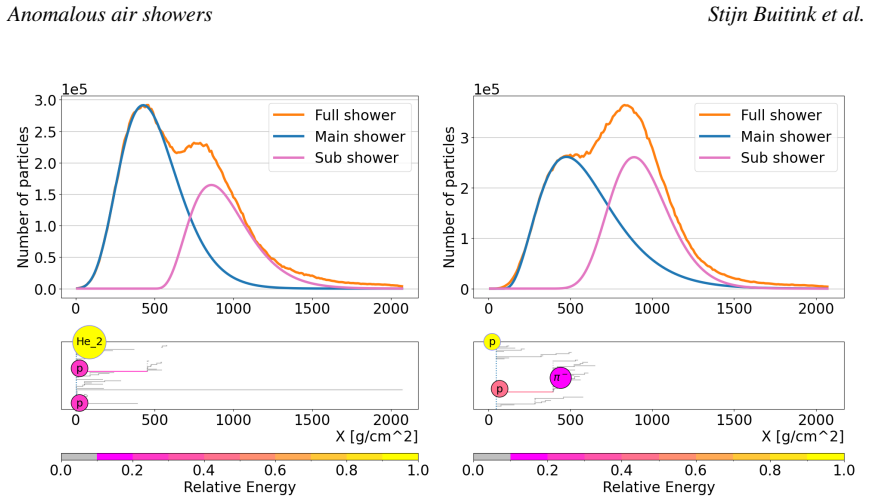
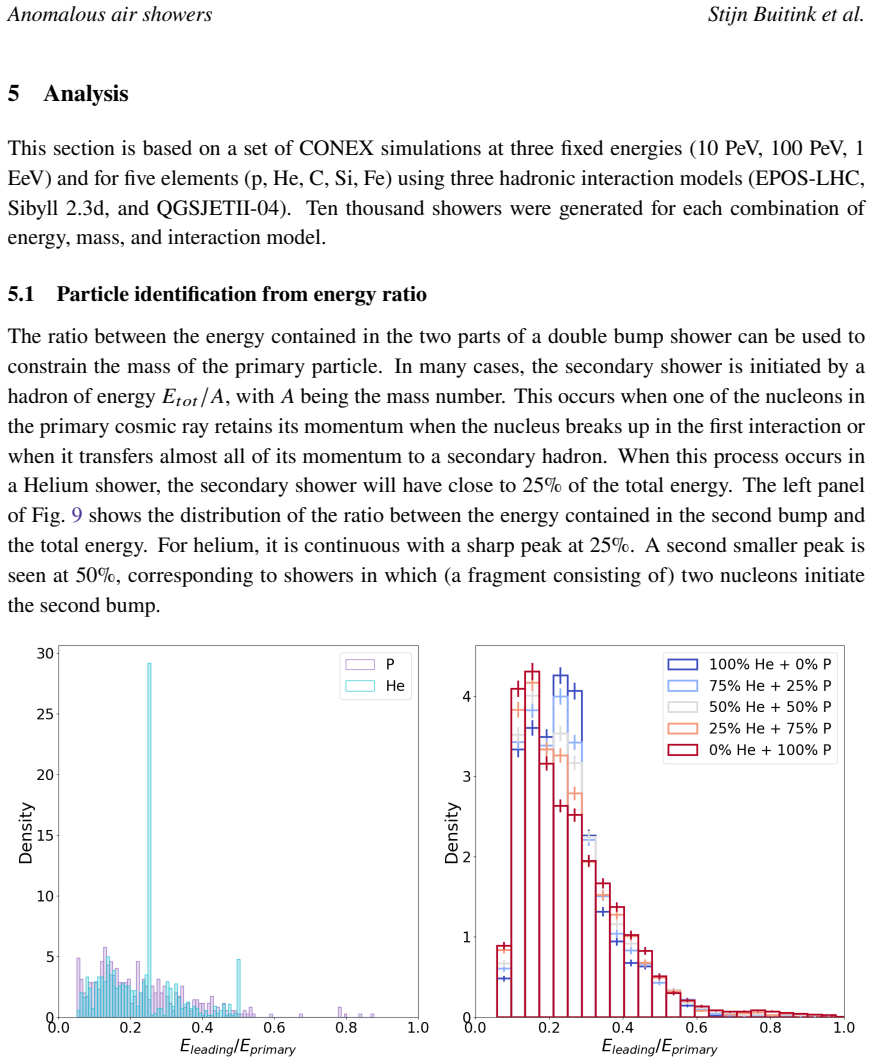
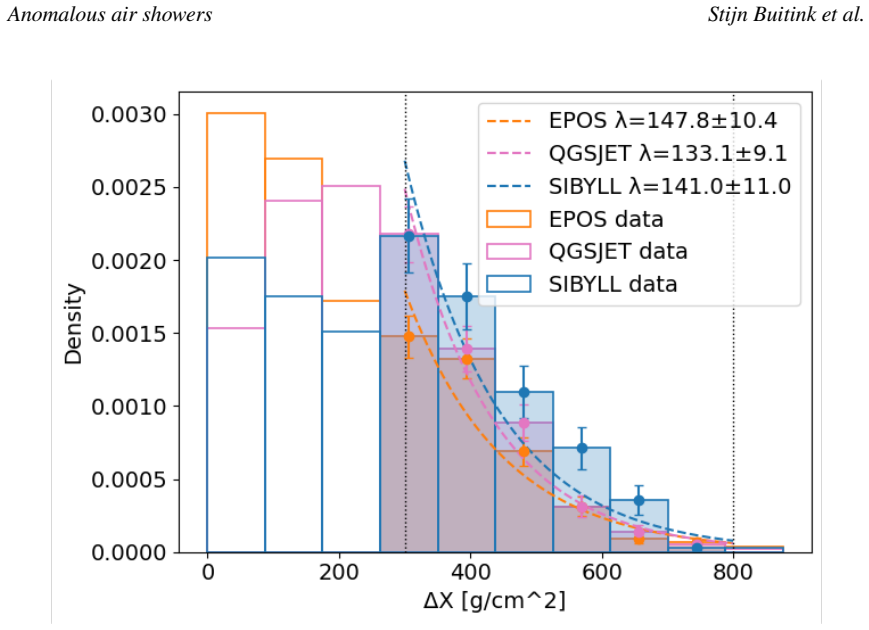
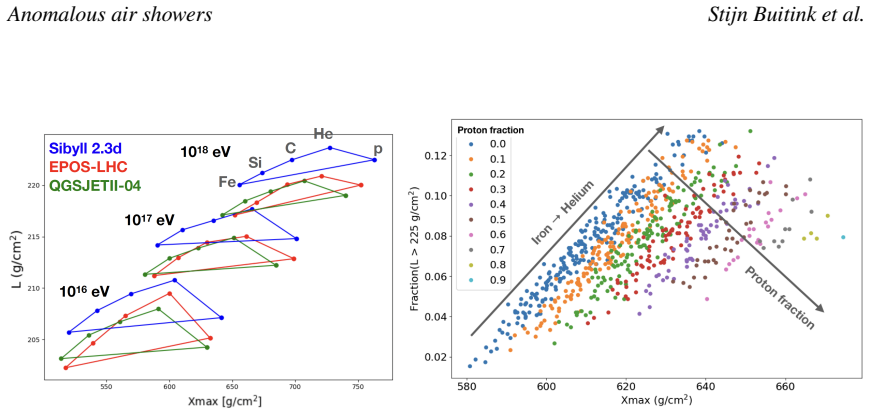
After the first interaction, secondary particles retain a significant fraction of the energy and can produce recognizable sub-showers as secondary bumps in the longitudinal profile. SKA-Low's antenna density and bandwidth enable resolution of these double-bump and other anomalous developments, which can then be used to place constraints on hadronic interaction properties and to determine the mass composition of cosmic rays.
What carries the argument
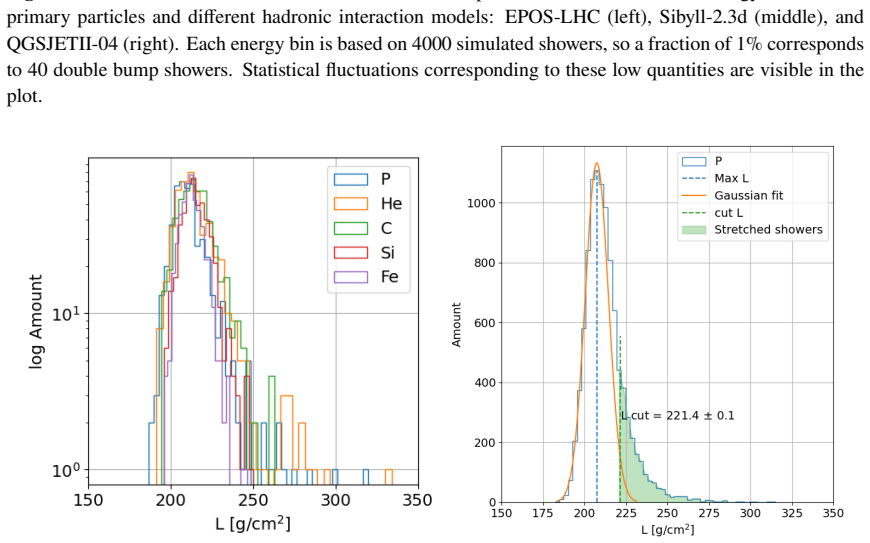
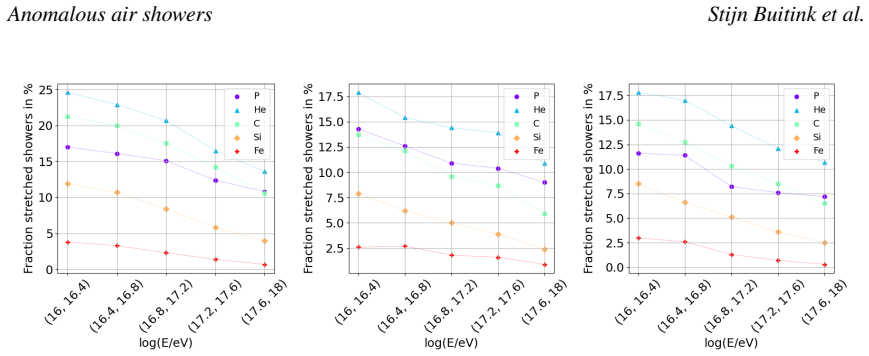
Double-bump showers and other anomalous longitudinal developments in the reconstructed shower profile.
If this is right
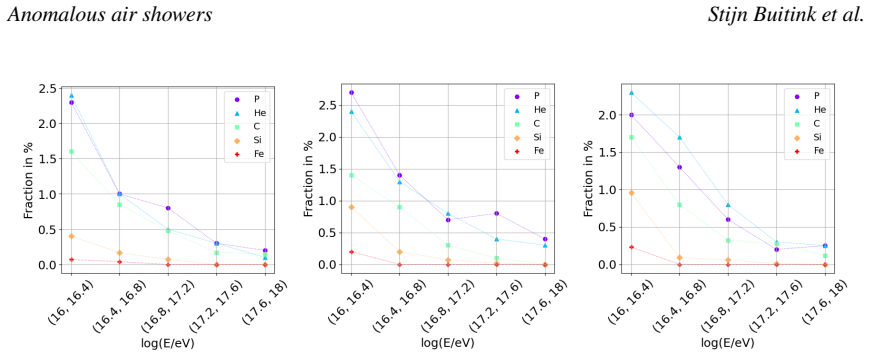
- Hadronic interaction models can be tested and refined using the frequency and properties of resolved double-bump events.
- Mass composition estimates in the transition region gain an independent handle that reduces reliance on Xmax alone.
- Source identification for cosmic rays improves once both interaction uncertainties and mass uncertainties are lowered.
Where Pith is reading between the lines
- The same double-bump technique could be cross-checked against independent observables such as muon content or radio signal timing at the same array.
- If double bumps prove rarer or more common than current models predict, it would point to adjustments in interaction lengths or particle production at the first interaction.
- Arrays with comparable resolution at higher energies could extend the method beyond the transition region.
Load-bearing premise
That simulated double-bump profiles accurately represent real observations and that the hadronic interaction models in those simulations are close enough to reality for the resulting constraints to be meaningful.
What would settle it
A statistically significant difference between the rate or shape of double-bump profiles measured in real SKA-Low data and the distributions predicted by current simulations for any assumed mass composition would falsify the claim that these profiles can be used to derive reliable constraints.
Figures
read the original abstract
The identification of the sources and acceleration mechanisms of cosmic rays require precise measurements of their mass composition. Currently, the most reliable method is to measure the atmospheric depth at which cosmic ray air showers in our atmosphere reach their maximum (\Xmax). However, the hadronic interaction properties that govern the longitudinal development of air showers are not precisely known, which is a major source of systematic uncertainty on the mass composition. SKA-Low will observe cosmic rays in the 10$^{16}$ - 10$^{18}$ eV energy range with unprecedented resolution and bandwidth. This allows for a much more detailed reconstruction of the longitudinal shower evolution, which can be used to gain better understanding of the hadronic interactions, as well as the primary mass composition. After the first interaction of the cosmic ray with an atom in an air molecule, the secondary particles still carry a significant fraction of the total energy. When one of these particle travels very far before interacting again, it produces a sub-shower that can be recognized as a secondary bump in the longitudinal profile. Simulations have demonstrated that SKA-Low can resolve such double bump profiles by virtue of its high antenna density and broad bandwidth. In this chapter, we demonstrate how double-bump showers and other anomalous longitudinal developments can be used to constrain hadronic interaction properties, and to determine the mass composition of cosmic rays in the Galactic-to-extragalactic transition region.
Editorial analysis
A structured set of objections, weighed in public.
Referee Report
Summary. The manuscript proposes that SKA-Low observations of cosmic-ray air showers (10^16–10^18 eV) can resolve double-bump longitudinal profiles arising from long-lived secondary particles, and that these anomalous profiles can be used to constrain hadronic interaction properties and primary mass composition in the Galactic-to-extragalactic transition region. The central claim rests on the assertion that simulations have already demonstrated SKA-Low’s ability to resolve such features via its antenna density and bandwidth.
Significance. If the simulated double-bump signatures prove robust and the underlying hadronic models are sufficiently accurate, the approach could furnish independent constraints on hadronic cross-sections and leading-particle spectra while reducing X_max systematics on mass composition. The manuscript supplies no quantitative simulation outputs, detection efficiencies, or resolution metrics, so the practical significance cannot yet be evaluated.
major comments (2)
- [Abstract] Abstract: the statement that 'simulations have demonstrated that SKA-Low can resolve such double bump profiles' is unsupported by any numerical results, error estimates, or validation metrics (e.g., reconstructed X_max precision, bump-separation threshold, or false-positive rate). Without these, the resolvability claim cannot be assessed.
- [Abstract] Abstract (and implied methods): the proposed constraints on hadronic interactions are derived from profiles generated with the same current hadronic models whose deficiencies are to be constrained. If those models systematically mis-estimate the relevant cross-sections or energy fractions in the 10^16–10^18 eV range, the simulated signatures will not correspond to real SKA-Low data, rendering the constraints either circular or inapplicable.
minor comments (1)
- The text refers to 'this chapter' while presenting a self-contained argument; clarify whether this is an excerpt from a larger work and ensure all necessary simulation details are included.
Simulated Author's Rebuttal
We thank the referee for the constructive comments on our manuscript. We address each major point below and have revised the abstract and added clarifying text in the discussion to improve rigor.
read point-by-point responses
-
Referee: [Abstract] Abstract: the statement that 'simulations have demonstrated that SKA-Low can resolve such double bump profiles' is unsupported by any numerical results, error estimates, or validation metrics (e.g., reconstructed X_max precision, bump-separation threshold, or false-positive rate). Without these, the resolvability claim cannot be assessed.
Authors: We agree that the abstract statement requires explicit quantitative support, which is not provided in the current version. The claim draws from the known antenna density and bandwidth of SKA-Low, but we acknowledge the need for metrics. We will revise the abstract to qualify the statement and add a new subsection with simulation outputs, including reconstructed X_max precision, minimum resolvable bump separation, and false-positive rates for double-bump identification. revision: yes
-
Referee: [Abstract] Abstract (and implied methods): the proposed constraints on hadronic interactions are derived from profiles generated with the same current hadronic models whose deficiencies are to be constrained. If those models systematically mis-estimate the relevant cross-sections or energy fractions in the 10^16–10^18 eV range, the simulated signatures will not correspond to real SKA-Low data, rendering the constraints either circular or inapplicable.
Authors: This is a valid concern about model dependence. Our approach uses current models only to generate baseline predictions of anomalous profile rates under varying assumptions for interaction lengths and energy fractions. Observed deviations in SKA-Low data from these predictions will then constrain or falsify specific model parameters. We have added a paragraph in the discussion clarifying that mismatches between data and predictions directly highlight deficiencies in the hadronic models, enabling iterative refinement rather than assuming model accuracy a priori. revision: yes
Circularity Check
No circularity: forward-looking observational proposal with no self-referential derivations
full rationale
The paper proposes using SKA-Low observations of double-bump and anomalous longitudinal profiles to constrain hadronic interaction properties and cosmic-ray mass composition in the 10^16-10^18 eV range. It references simulations showing resolvability but presents no equations, fitted parameters, or predictions that reduce by construction to the paper's own inputs. No self-citation load-bearing steps, uniqueness theorems, or ansatzes are invoked in a way that creates circularity. The argument is a prospective strategy relying on future data, not a closed derivation equivalent to its assumptions. This matches the default non-circular case for methodological papers.
Axiom & Free-Parameter Ledger
Reference graph
Works this paper leans on
-
[1]
2019 , eprint=
Anticipated Performance of the Square Kilometre Array -- Phase 1 (SKA1) , author=. 2019 , eprint=
2019
-
[2]
2015 , publisher=
Advancing Astrophysics with the Square Kilometre Array (AASKA14) , author=. 2015 , publisher=
2015
-
[3]
and Buitink, Stijn and Butler, David and Dallier, Richard and Ekers, Ron D
Huege, Tim and Bray, Justin D. and Buitink, Stijn and Butler, David and Dallier, Richard and Ekers, Ron D. and Enßlin, Torsten and Falcke, Heino and Haungs, Andreas and James, Clancy W. and Martin, Lilian and Mitra, Pragati and Mulrey, Katharine and Nelles, Anna and Revenu, Benoît and Scholten, Olaf and Schröder, Frank G. and Tingay, Steven and Winchen, T...
-
[4]
EPOS LHC-R : up-to-date hadronic model for EAS simulations
Pierog, Tanguy and Werner, Klaus. EPOS LHC-R : up-to-date hadronic model for EAS simulations. PoS. 2023. doi:10.22323/1.444.0230
-
[5]
Adriani, O. and others. Measurement of energy flow, cross section and average inelasticity of forward neutrons produced in s = 13 TeV proton-proton collisions with the LHCf Arm2 detector. JHEP. 2020. doi:10.1007/JHEP07(2020)016. arXiv:2003.02192
-
[6]
The Forward Physics Facility at the HL-LHC and its Synergies with Astroparticle Physics
Soldin, Dennis. The Forward Physics Facility at the HL-LHC and its Synergies with Astroparticle Physics. 22nd International Symposium on Very High Energy Cosmic Ray Interactions. 2024. arXiv:2501.04714
-
[7]
Ulrich, R. M. , year =. Measurement of the proton-air cross section using hybrid data of the Pierre Auger Observatory , doi =
-
[8]
A Heitler model of extensive air showers
Matthews, J. A Heitler model of extensive air showers. Astropart. Phys. 2005. doi:10.1016/j.astropartphys.2004.09.003
-
[9]
International Cosmic Ray Conference , year = 1977, series =
Reliability of the Method of Constant Intensity Cuts for Reconstructing the Average Development of Vertical Showers. International Cosmic Ray Conference , year = 1977, series =
1977
-
[10]
S. Andringa and R. Conceição and M. Pimenta , keywords =. Mass composition and cross-section from the shape of cosmic ray shower longitudinal profiles , journal =. 2011 , issn =. doi:https://doi.org/10.1016/j.astropartphys.2010.10.002 , url =
-
[11]
Radio detection of cosmic ray air showers in the digital era , volume=
Huege, Tim , year=. Radio detection of cosmic ray air showers in the digital era , volume=. doi:10.1016/j.physrep.2016.02.001 , journal=
-
[12]
Anomalous Longitudinal Shower Profiles and Hadronic Interactions
Baus, Colin and Engel, Ralph and Pierog, Tanguy and Ulrich, Ralf and Unger, Michael. Anomalous Longitudinal Shower Profiles and Hadronic Interactions. 32nd International Cosmic Ray Conference. 2011. doi:10.7529/ICRC2011/V02/1130. arXiv:1111.0504
work page internal anchor Pith review Pith/arXiv arXiv doi:10.7529/icrc2011/v02/1130 2011
-
[13]
sibyll: An event generator for simulation of high energy cosmic ray cascades , author =. Phys. Rev. D , volume =. 1994 , month =. doi:10.1103/PhysRevD.50.5710 , url =
-
[14]
Ostapchenko, S. , year=. QGSJET-II: towards reliable description of very high energy hadronic interactions , volume=. Nuclear Physics B - Proceedings Supplements , publisher=. doi:10.1016/j.nuclphysbps.2005.07.026 , number=
-
[15]
Cosmic Rays from the Knee to the Highest Energies
Blumer, Johannes and Engel, Ralph and Horandel, Jorg R. Cosmic Rays from the Knee to the Highest Energies. Prog. Part. Nucl. Phys. 2009. doi:10.1016/j.ppnp.2009.05.002. arXiv:0904.0725
work page internal anchor Pith review Pith/arXiv arXiv doi:10.1016/j.ppnp.2009.05.002 2009
-
[16]
Measurements of the Cosmic Ray Composition with Air Shower Experiments
Kampert, Karl-Heinz and Unger, Michael. Measurements of the Cosmic Ray Composition with Air Shower Experiments. Astropart. Phys. 2012. doi:10.1016/j.astropartphys.2012.02.004. arXiv:1201.0018
work page internal anchor Pith review Pith/arXiv arXiv doi:10.1016/j.astropartphys.2012.02.004 2012
-
[17]
Detection of the Characteristic Pion-Decay Signature in Supernova Remnants
Ackermann, M. and others. Detection of the Characteristic Pion-Decay Signature in Supernova Remnants. Science. 2013. doi:10.1126/science.1231160. arXiv:1302.3307
work page internal anchor Pith review Pith/arXiv arXiv doi:10.1126/science.1231160 2013
-
[18]
Thoudam, S. and others , title =. doi:10.1051/0004-6361/201628894
-
[19]
A large light-mass component of cosmic rays at 10^{17} - 10^{17.5} eV from radio observations
Buitink, S. and others. A large light-mass component of cosmic rays at 10^ 17 - 10^ 17.5 eV from radio observations. Nature. 2016. doi:10.1038/nature16976. arXiv:1603.01594
work page internal anchor Pith review Pith/arXiv arXiv doi:10.1038/nature16976 2016
-
[20]
Corstanje, A. and others. Depth of shower maximum and mass composition of cosmic rays from 50 PeV to 2 EeV measured with the LOFAR radio telescope. Phys. Rev. D. 2021. doi:10.1103/PhysRevD.103.102006. arXiv:2103.12549
-
[21]
Abdul Halim, A. and others. Demonstrating Agreement between Radio and Fluorescence Measurements of the Depth of Maximum of Extensive Air Showers at the Pierre Auger Observatory. Phys. Rev. Lett. 2024. doi:10.1103/PhysRevLett.132.021001. arXiv:2310.19963
-
[22]
doi:10.1063/1.4807534 , Journal =
-
[23]
Corstanje, A. and others , journal =. 2025 , month =. doi:10.1103/l8mt-994v , url =. 2504.16873 , archivePrefix=
-
[24]
Buitink, S. and others. Method for high precision reconstruction of air shower X_ max using two-dimensional radio intensity profiles. Phys. Rev. D. 2014. doi:10.1103/PhysRevD.90.082003. arXiv:1408.7001
work page internal anchor Pith review Pith/arXiv arXiv doi:10.1103/physrevd.90.082003 2014
-
[25]
Cosmic ray observations with the Square Kilometre Array
Buitink, Stijn and others. Cosmic ray observations with the Square Kilometre Array. PoS. 2025
2025
-
[26]
Desmet, Mitja and Buitink, Stijn and Huege, Tim and Watanabe, Keito. SMIET: Fast and accurate synthesis of radio pulses from extensive air shower using simulated templates. Astropart. Phys. 2026. doi:10.1016/j.astropartphys.2025.103182. arXiv:2505.10459
-
[27]
Analytic calculation of radio emission from parametrized extensive air showers: A tool to extract shower parameters , author =. Phys. Rev. D , volume =. 2018 , month =. doi:10.1103/PhysRevD.97.023005 , url =
-
[28]
Scholten, O. and others. Aperture correction for beamforming in the radiometric detection of ultrahigh energy cosmic rays. Phys. Rev. D. 2024. doi:10.1103/PhysRevD.110.103036. arXiv:2411.12324
-
[29]
and others
Watanabe, K. and others. Interferometric analysis of air-shower radio emission in the near field with an information field theory approach. 2025
2025
-
[30]
and others
Corstanje, A. and others. Origins of cosmic rays in the Galactic-extragalactic transition energy range. 2025
2025
-
[31]
Radio interferometry applied to the observation of cosmic-ray induced extensive air showers
Schoorlemmer, Harm and Carvalho, Washington R. Radio interferometry applied to the observation of cosmic-ray induced extensive air showers. Eur. Phys. J. C. 2021. doi:10.1140/epjc/s10052-021-09925-9. arXiv:2006.10348
-
[32]
and others , title = "
Heck, D. and others , title = ". CORSIKA: a Monte Carlo code to simulate extensive air showers., by Heck, D.; Knapp, J.; Capdevielle, J. N.; Schatz, G.; Thouw, T.. Forschungszentrum Karlsruhe GmbH, Karlsruhe (Germany)., Feb 1998, V + 90 p., TIB Hannover, D-30167 Hannover (Germany). , publisher =
1998
-
[33]
A new look at the statistical model identification
Akaike, H. A new look at the statistical model identification. IEEE Trans. Automatic Control. 1974. doi:10.1109/TAC.1974.1100705
-
[34]
Corstanje, A. and others. A high-precision interpolation method for pulsed radio signals from cosmic-ray air showers. JINST. 2023. doi:10.1088/1748-0221/18/09/P09005. arXiv:2306.13514
-
[35]
Primary cosmic radiation and extensive air showers
Peters, B. Primary cosmic radiation and extensive air showers. Nuovo Cim. 1961. doi:10.1007/bf02783106
-
[36]
Apel, W. D. and others. Kneelike structure in the spectrum of the heavy component of cosmic rays observed with KASCADE-Grande. Phys. Rev. Lett. 2011. doi:10.1103/PhysRevLett.107.171104. arXiv:1107.5885
work page internal anchor Pith review Pith/arXiv arXiv doi:10.1103/physrevlett.107.171104 2011
-
[37]
Abdul Halim, A. and others. Inference of the Mass Composition of Cosmic Rays with Energies from 1018.5 to 1020 \, \, eV Using the Pierre Auger Observatory and Deep Learning. Phys. Rev. Lett. 2025. doi:10.1103/PhysRevLett.134.021001. arXiv:2406.06315
-
[38]
Universality of electron-positron distributions in extensive air showers
Lafebre, S. and Engel, R. and Falcke, H. and Horandel, J. and Huege, T. and Kuijpers, J. and Ulrich, R. Universality of electron-positron distributions in extensive air showers. Astropart. Phys. 2009. doi:10.1016/j.astropartphys.2009.02.002. arXiv:0902.0548
work page internal anchor Pith review Pith/arXiv arXiv doi:10.1016/j.astropartphys.2009.02.002 2009
-
[39]
Aab, Alexander and others. Measurement of the average shape of longitudinal profiles of cosmic-ray air showers at the Pierre Auger Observatory. JCAP. 2019. doi:10.1088/1475-7516/2019/03/018. arXiv:1811.04660
work page internal anchor Pith review Pith/arXiv arXiv doi:10.1088/1475-7516/2019/03/018 2019
-
[40]
Aab, A. and others. Observation of a Large-scale Anisotropy in the Arrival Directions of Cosmic Rays above 8 10^ 18 eV. Science. 2017. doi:10.1126/science.aan4338. arXiv:1709.07321
work page internal anchor Pith review Pith/arXiv arXiv doi:10.1126/science.aan4338 2017
-
[41]
Hadronic Multiparticle Production at Ultra-High Energies and Extensive Air Showers
Ulrich, Ralf and Engel, Ralph and Unger, Michael. Hadronic Multiparticle Production at Ultra-High Energies and Extensive Air Showers. Phys. Rev. D. 2011. doi:10.1103/PhysRevD.83.054026. arXiv:1010.4310
work page internal anchor Pith review Pith/arXiv arXiv doi:10.1103/physrevd.83.054026 2011
-
[42]
1984 , publisher=
The quantum theory of radiation , author=. 1984 , publisher=
1984
-
[43]
Hare and Sjoerd Bouma and Stijn Buitink and others , title =
Brian M. Hare and Sjoerd Bouma and Stijn Buitink and others , title =. 2026 , publisher =
2026
-
[44]
2026 , publisher =
Stijn Buitink and Vital De Henau and Sjoerd Bouma and others , title =. 2026 , publisher =
2026
-
[45]
2026 ,publisher =
Keito Watanabe and author2 and author3 and author4 and author5 ,title =. 2026 ,publisher =
2026
-
[46]
2026 ,publisher =
Arthur Corstanje and author2 and author3 and author4 and author5 ,title =. 2026 ,publisher =
2026
-
[47]
2026 , publisher =
Anna Nelles and Philipp Laub and Haoning He and otherscabl , title =. 2026 , publisher =
2026
discussion (0)
Sign in with ORCID, Apple, or X to comment. Anyone can read and Pith papers without signing in.