REVIEW 3 major objections 5 minor 47 references
Rare events in generalized L\'evy Walks and the Big Jump principle
T0 review · 3 major / 5 minor · reviewed 2026-08-14 · deepseek-v4-flash
Pith's one-line read A single big jump determines the full rare-event tail of generalized Lévy walks.
desk verdict Solid extension of the big jump heuristic to generalized Lévy walks with explicit tail formulas and good simulation support; the main caveat is that the central principle remains unproved. read the letter →
The pith
A machine-rendered reading of the paper's core claim, the machinery that carries it, and where it could break.
The reading
What carries the argument
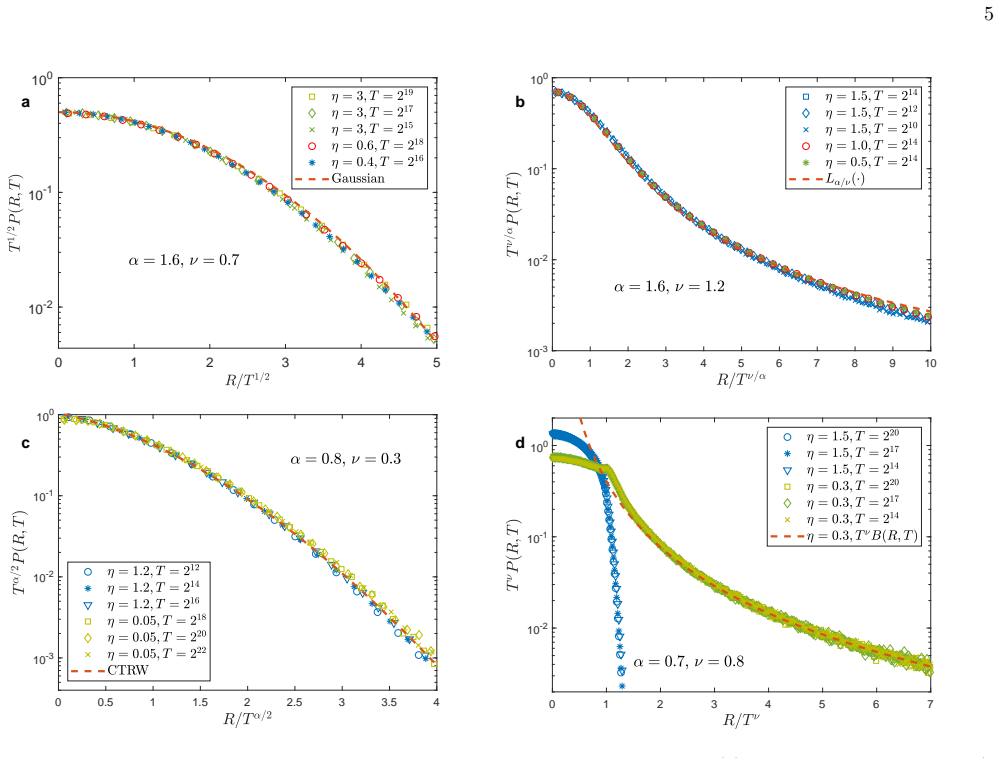
The central object is the generalized Lévy walk, defined by step durations $\lambda(t)\sim t^{-1-\alpha}$ and intra-step motion $r(T)=r(T_i)+c_i t_i^{\nu-\eta}(T-T_i)^\eta$, whose two exponents $\nu$ and $\eta$ respectively set how step length grows with duration and how the walker accelerates or decelerates inside the step. The engine of the argument is the big-jump rate formula, Eq. (3), which splits the far tail into the rate $p_{\rm tot}(t,T_w)$ at which a jump is attempted and the single-jump propagator $P(R|T,t,T_w)$; two geometric contributions are summed, one where the walker is still inside the big jump at the observation time and one where the jump was completed earlier. This machinery produces the scaling function $F(x)$ and the power-law tails, and it identifies the light-cone boundary $R=cT^\nu$ as the origin of the non-analyticities.
What would settle it
Direct simulation can settle it: for fixed $\alpha,\nu,\eta$ in a predicted big-jump regime, plot $R^{1+\alpha/(\nu-\eta)}P(R,T)$ against scaled $R/T^\nu$ for several large $T$; the curves should show the predicted power-law prefactor, and the scaling function must have the predicted cusp at $R=cT^\nu$. Observing a clean power-law tail in a regime where the paper says the big jump does not apply, or a smooth tail where a cusp is predicted, would refute the claim.
Extended reading notes
Core claim
The paper claims that for $R\gg\ell(T)$ the tail $B(R,T)$ of the position PDF of a generalized Lévy walk is exactly the single-big-jump integral $B(R,T)=\int dt\int_0^T dT_w\, p_{\rm tot}(t,T_w)P(R|T,t,T_w)$, in which $p_{\rm tot}(t,T_w)=n_R(T_w)\lambda(t)$ is the rate of attempts to make a jump of duration $t$ and $P(R|T,t,T_w)$ propagates the walker during that one jump. In the regime $\alpha>1$, $\nu>1/2$ this yields $B(R,T)=T^{-(\alpha-1+\nu)}F(R/(cT^\nu))$, with $F$ continuous but non-differentiable at $x=1$ for $\eta\neq\nu$ and discontinuous for $\eta=\nu$. In the regimes $\alpha>1,\nu<1/2,\eta<\nu$ and $\alpha<1,\eta<\nu$ the tail is a pure power law $B(R,T)\sim T^{\alpha\eta/(\nu-\eta)+1}/R^{1+\alpha/(\nu-\eta)}$, so the single-step dynamics exponent $\eta$ enters the rare-event tail explicitly. When no single jump can reach beyond the bulk scaling length, the paper argues that the big-jump estimate does not apply and the tail is either zero at the light cone or exponentially suppressed.
Load-bearing premise
The load-bearing premise is the big-jump ansatz, Eq. (3): for $R\gg\ell(T)$ the tail of the distribution is equal to the integral over all single jumps, with the motion before and after the big jump neglected; the paper states this scheme is heuristic and leaves its rigorous derivation open.
Editorial extensions
If this is right
- The far tail no longer shares the universality of the bulk: it depends explicitly on all three exponents $\alpha$, $\nu$, and $\eta$.
- For $\eta<\nu$ in the $\alpha>1,\nu<1/2$ and $\alpha<1$ regimes, the tail is a pure power law, so rare events are scale-invariant.
- In the $\alpha>1$, $\nu>1/2$ regime, the scaling function $F(x)$ is non-analytic at $x=R/(cT^\nu)=1$, meaning the finite-velocity horizon of the walk creates a cusp or discontinuity in the tail.
- For moment order $q>\alpha/(\nu-\eta)$, the moments diverge and empirical averages depend on the number of realizations, producing strong anomalous diffusion with a piecewise-linear exponent $\gamma(q)$.
- Where a single jump cannot reach beyond the bulk scaling length, the big-jump tail formulas fail and deviations are exponentially suppressed or absent.
Reading between the lines
- Beyond the paper: the tail exponent $1+\alpha/(\nu-\eta)$ suggests that rare-event measurements could be inverted to read out the microscopic acceleration exponent $\eta$ once $\alpha$ and $\nu$ are known from the bulk, turning tail shape into a dynamical probe.
- Beyond the paper: the criterion distinguishing big-jump from non-big-jump regimes, namely whether one step can exceed the scaling length, likely generalizes to other heavy-tailed observables such as released energies or financial losses wherever a single draw dominates the extreme.
- Beyond the paper: finite-time simulations should show the cusp at $R=cT^\nu$ rounding over a width controlled by $T$; measuring that rounding is a testable finite-time correction absent from the asymptotic $T\to\infty$ formulas.
- Beyond the paper: because moments diverge for $q>\alpha/(\nu-\eta)$, empirical averages over few realizations are not reproducible, so median or typical-value estimators would remain stable and could serve as better risk measures.
Signed reviews
Editorial analysis
A structured set of objections, weighed in public.
Referee Report
Summary. The paper studies generalized Lévy walks, in which step durations are drawn from a power-law distribution λ(t) ∼ t^{-1-α} and the intra-step motion is r(T) = r(T_i) + c_i t_i^{ν-η} (T − T_i)^η. It derives the bulk scaling of the position PDF by Fourier-Laplace methods, obtaining the four regimes in Eq. (7), and then uses the single-big-jump rate ansatz, Eq. (3), to predict the far tail B(R,T) for R ≫ ℓ(T). The main results are the scaling form Eq. (8) with a non-analytic scaling function F(x), the pure power-law tails in Eqs. (9) and (10), the regime classification in Table 1, and the anomalous moment exponents in Eq. (11). All analytical predictions are compared with numerical simulations.
Significance. If the tail formulas are correct, the paper establishes a genuinely non-universal structure for rare events in a broad class of Lévy walks: the far tail depends on all three exponents α, ν, and η, and exhibits non-analytic behavior at R = cT^ν. This goes beyond earlier results for standard Lévy walks and for the η=ν case, and the moment analysis connects the single-big-jump mechanism to strong anomalous diffusion. The manuscript's strengths include explicit, parameter-free calculations in the SI, correct reduction to known limits (standard Lévy walks and the η=ν case), and systematic numerical tests with no fitted parameters. Its main weakness is that the central single-big-jump ansatz is stated heuristically and is not derived or bounded; this limits the claimed 'exactness' of the tail predictions.
major comments (3)
- [Results §1, Eq. (3); Discussion, p. 9] The load-bearing step is the ansatz B(R,T) = ∫dt∫dT_w n_R(T_w)λ(t)P(R|T,t,T_w), in which all jumps before and after the big jump are neglected. The manuscript explicitly calls the rate approach heuristic (Discussion, p. 9) and calls P(R|T,t,T_w) a heuristic expression (Methods, p. 10), yet the Abstract and Section 3 describe the resulting tails as 'exact'. No argument is supplied that multi-jump paths contribute subdominantly for R ≫ ℓ(T), nor is the error from replacing the exact renewal density by its asymptotic form bounded. Since Eqs. (8)–(10), Table 1, and the moment exponents (11) all inherit their validity from Eq. (3), the authors should either provide a derivation or a quantitative bound for the ansatz, or consistently present the tail results as heuristic predictions rather than exact forms.
- [SI Eqs. (32)–(37); main Eqs. (9)–(10)] The derivations of the tail formulas replace the jump-attempt rate n_R(T_w) = d⟨N(T_w)⟩/dT_w by its asymptotic form over the entire integration range 0 < T_w < T. For α > 1, ptot(t,T_w) = λ(t)/⟨t⟩ is used even for T_w near 0 and near T, where the renewal density has transients and boundary effects. For α < 1, Eq. (37) uses n_R(T_w) = C_α T_w^{α-1}, which is singular at T_w = 0. These transient and boundary contributions are never estimated. The authors should show that the boundary terms are subleading in the regime R ≫ ℓ(T), or explicitly state that the leading-order tail has not been rigorously established.
- [Results §4, Eq. (11); Fig. 5] The prediction that moments with q > α/(ν−η) diverge relies on the tail being exactly a pure power law B(R,T) ∼ T^{...} R^{-1-α/(ν−η)} for arbitrarily large R. If the single-big-jump ansatz receives corrections at very large R from multi-step paths, such as the coherent many-step processes mentioned in the text for η ≥ ν, the divergence could be modified or cut off. The NR dependence in Fig. 5 is consistent with divergence, but it does not by itself establish the asymptotic claim. The manuscript should state precisely what assumption about the far tail is needed for the infinite-moment result, and should soften the claim if that assumption is only heuristic.
minor comments (5)
- [Fig. 2 caption] Panel (b) of Figure 2 lists the same parameters as panel (a), α = 1.6 and ν = 0.7, yet the two panels are described as showing qualitatively different scaling regimes (Gaussian versus superdiffusive Lévy scaling). This appears to be a typo; please correct the parameter values in the caption.
- [SI Eq. (35)] The expression for B0(R,T) in the η > ν case contains the factor '( R/ctν )', which is ambiguous: it should presumably be (R/(cT^ν))^{1/ν} or a similarly explicit combination of R, T, and ν. Please fix the typographical error and verify the resulting x-dependence of F(x).
- [Abstract vs. Discussion] The Abstract states that the big jump principle gives 'the exact form of the tails', while the Discussion states that the scheme is heuristic and a rigorous derivation is open. These statements should be harmonized so that the reader is not misled about the status of the results.
- [Results §3, p. 8] The sentence 'Clearly these processes are exponentially suppressed and very difficult to be observed' asserts a quantitative claim about multi-step coherent paths without proof or citation. If this exponential suppression is important for justifying the regime where Eq. (3) does not apply, it should be substantiated.
- [SI Eq. (23)] In the definition of γ(k,s), the integrand uses λ(t') but the integration variable in the inner integral is t2; the variable t' is not defined. Please use t2 consistently.
Circularity Check
No significant circularity: the tail formulas are explicit evaluations of the stated single-big-jump ansatz plus exact single-jump kinematics, with no fitted parameters passed off as predictions.
full rationale
The derivation chain is self-contained once the stated single-big-jump ansatz is accepted. Equation (3) is introduced explicitly as a heuristic rate approach citing the authors' prior work [15], and the paper does not present it as a theorem. The subsequent calculation substitutes the exact single-jump propagator P(R|T,t,Tw) = δ(R−ct^{ν−η}(T−Tw)^η)θ(t−(T−Tw)) + δ(R−ct^ν)θ((T−Tw)−t) and the explicit duration law λ(t)=τ_0^α t^{−1−α} into Eq. (3). Equations (32)-(37) are ordinary integrations over these inputs, and the resulting scaling functions and power-law tails in Eqs. (8)-(10) contain no fitted parameters and do not reuse the target quantity as an input. The bulk scaling in Eqs. (6)-(7) comes from standard Fourier-Laplace asymptotics and is independent of the big-jump calculation. The moment exponents in Eq. (11) follow from inserting the derived B(R,T) into Eq. (2); they are not extracted from the simulations that test them. The only legitimate concern is that the central ansatz Eq. (3) is inherited from the same group's earlier work and is left unproved; the Discussion explicitly calls the scheme heuristic and leaves rigorous derivation open. That is a genuine rigor limitation and a possible correctness risk, but it is not circularity: no equation is equivalent by definition to its own output, no fitted parameter is renamed as a prediction, and the numerical simulations provide an external check. Therefore the circularity score is 0.
Assumptions & free parameters
free parameters (1)
- C_α prefactor
assumptions (4)
- domain assumption Big jump principle: for R ≫ ℓ(T), P(R,T) is dominated by the single-jump integral B(R,T) in Eq. (3), with all other jumps neglected.
- standard math Renewal rate asymptotics: n_R(T_w)=1/⟨t⟩ for α>1, and n_R(T_w)=C_α T_w^{α-1}/τ_0^α for α<1.
- standard math Tauberian/scaling limit of Laplace-Fourier transforms of the renewal equation to leading order in small s and k.
- domain assumption The generalized Lévy walk microdynamics: step durations λ(t) ∼ τ_0^α t^{-1-α} and intra-step motion r(T)-r(T_i)=c_i t_i^{ν-η}(T-T_i)^η.
Cite this review
Pith. "Pith review of Rare events in generalized L\'evy Walks and the Big Jump principle." pith.science (2026). https://pith.science/paper/3ZXHIEOI
@misc{pith2026190810975,
  author       = {Pith},
  title        = {Pith review of: Rare events in generalized L\'evy Walks and the Big Jump principle},
  year         = {2026},
  howpublished = {\url{https://pith.science/paper/3ZXHIEOI}},
  note         = {Machine review of arXiv:1908.10975}
}
read the original abstract
The prediction and control of rare events is an important task in disciplines that range from physics and biology, to economics and social science. The Big Jump principle deals with a peculiar aspect of the mechanism that drives rare events. According to the principle, in heavy-tailed processes a rare huge fluctuation is caused by a single event and not by the usual coherent accumulation of small deviations. We consider generalized L\'evy walks, a class of stochastic processes with power law distributed step durations, which model complex microscopic dynamics in the single stretch. We derive the bulk of the probability distribution and using the big jump principle, the exact form of the tails that describes rare events. We show that the tails of the distribution present non-universal and non-analytic behaviors, which depend crucially on the dynamics of the single step. The big jump estimate also provides a physical explanation of the processes driving the rare events, opening new possibilities for their correct prediction.
Figures


Figures from the paper (3 more)


Reference graph
Works this paper leans on
-
[1]
The Big Jump principle The big jump principle applies to systems where a rare fluctua tion of a stochastic variable is driven by a single extreme event, that we call the big jump. We introduce the pri nciple with the rate approach [15], an heuristic formulation which allows for an easy extension beyond the st andard case of sum of independent and identical...
-
[2]
Generalized Lévy walks: microscopic dynamics and the bul k of the distribution The generalized Lévy walk [28, 29] is a model of anomalous tra nsport with acceleration and deceleration along the microscopic trajectories, an effect that is often encounter ed in experiments [25, 26]. In this model, the stochastic variable ti drawn from the broad PDF λ(ti) defi...
-
[3]
Generalized Lévy walks and the Big Jump: tails and rare eve nts Let us now derive the tail B(R, T ) by applying the big jump principle. According to Eq. (3), we h ave to find the rate of attempts for the big jump, and the form of all the pr ocesses that, in a single jump, bring the walker in R ≫ ℓ(T ) at time T. We ignore the motion before and after the bi...
-
[4]
We introduce the exponents γ(q) defined as ⟨Rq(T )⟩ ∼ T γ(q)
The Moments of the distribution We now study the moments of the distribution of R, which are related to quantities typically measured in expe ri- ments. We introduce the exponents γ(q) defined as ⟨Rq(T )⟩ ∼ T γ(q). If γ(q) is not simply proportional to q, this is what is called strongly anomalous diffusion [30, 32]. Here γ(q) is evaluated taking into accoun...
-
[5]
E. J. Gumbel, Statistics of extremes Dover Publications, Mineola (2004)
work page 2004
-
[6]
den Hollander, Large Deviations American Mathematical Society (2008)
F. den Hollander, Large Deviations American Mathematical Society (2008)
work page 2008
-
[7]
Extreme Events in Nature and Society , edited by S. Albeverio, V. Jentsch, and H. Kantz (Springer, Berlin, 2005)
work page 2005
-
[8]
Large Deviations in Physics: The legacy of the Law of Large Nu mbers edited by A. Vulpiani, F. Cecconi, M. Cancini, A. Puglisi, and D. Vergni. Lecture Notes in Physics 995 (2014)
work page 2014
Show all 47 references
-
[9]
Embrechts, C
P. Embrechts, C. Kappelberg, T. Mikosch, Modelling Extremal Events for Insurance and Finance , Springer (1997)
1997
-
[10]
de Arcangelis, C
L. de Arcangelis, C. Godano, J. R. Grasso, E. Lippiello Statistical physics approach to earthquake occurrence and forecasting, Phys. Rep. 628, 1 (2016)
2016
-
[11]
S. M. Papalexiou and D. Koutsoyiannis Battle of extreme v alue distributions: A global survey on extreme daily rainfa ll Wat. Res. 49, 187 (2013)
2013
-
[12]
V. P. Chistyakov, A Theorem on Sums of Independent Positive Random Variables a nd Its Applications to Branching Random Processes, Theory of Probab. Appl, 9 640 (1964)
1964
-
[13]
S. Foss, D. Korshunov, S. Zachary, An introduction to heavy tailed and subexponential distrib utions, Springer (2013)
2013
-
[14]
Denisov, A
D. Denisov, A. B. Dieker, V. Shneer Large deviations for random walks under sub-exponentialit y: the big-jump domain. Ann. Probab. 36 1946-1991 (2008)
2008
-
[15]
Geluk, Q
J. Geluk, Q. Tang Asymptotic Tail Probabilities of Sums of Dependent Subexpo nential Random Variables, J. Theor. Probab. 22 871 (2009)
2009
-
[16]
Bertin, and M
E. Bertin, and M. Clusel, Generalized extreme value statistics and sum of correlated variables, J. Phys. A.: Math. Theor. 39, 7607 (2006)
2006
-
[17]
Burioni, L
R. Burioni, L. Caniparoli, A. Vezzani Lévy walks and scaling in quenched disordered media , Phys. Rev. E 81, 060101(R) (2010)
2010
-
[18]
Burioni, E
R. Burioni, E. Ubaldi A. Vezzani, Superdiffusion and transport in two-dimensional systems wi th Lévy-like quenched disorder, Phys. Rev. E 89, 022135 (2014)
2014
-
[19]
Vezzani, E
A. Vezzani, E. Barkai, R. Burioni, Single-big-jump principle in physical modeling Phys. Rev. E 100 012108 (2019)
2019
-
[20]
Gardiner, Stochastic methods, Springer (2009)
C. Gardiner, Stochastic methods, Springer (2009)
2009
-
[21]
W. Wang, A. Vezzani, R. Burioni, E. Barkai, Transport in disordered systems: the single big jump approa ch Phys. Rev. Research 1, 033172 (2019)
2019
-
[22]
Burioni, G
R. Burioni, G. Gradenigo, A. Sarracino, A. Vezzani, A. V ulpiani Rare events and scaling properties in field-induced anoma- lous dynamics J. Stat. Mech. P09022 (2013)
2013
-
[23]
Shlesinger, B.J
M.F. Shlesinger, B.J. West, J. Klafter, Lévy dynamics of enhanced diffusion: Application to turbule nce Phys. Rev. Lett. 58, 110 (1987)
1987
-
[24]
Zumofen, J
G. Zumofen, J. Klafter Scale-invariant motion in intermittent chaotic systems , Phys. Rev. E 47, 851 (1993)
1993
-
[25]
Zaburdaev, S
V. Zaburdaev, S. Denisov, J. Klafter Lévy walks , Rev. Mod. Phys. 87, 483 (2015)
2015
-
[26]
Y. Sagi, M. Brook, I. Almog, N. Davidson, Observation of Anomalous Diffusion and Fractional Self-Sim ilarity in One Dimension, Phys. Rev. Lett. 108, 093002 (2012)
2012
-
[27]
Boffetta, I.M
G. Boffetta, I.M. Sokolov Relative Dispersion in Fully Developed Turbulence: The Ric hardson ’s Law and Intermittency Corrections, Phys. Rev. Lett. 88, 094501 (2002)
2002
-
[28]
M. S. Song, H.C. Moon, J. Jeon, H. Park Neuronal messenger ribonucleoprotein transport follows a n aging Lévy walk , Nat. Comm. 9, 344 (2018)
2018
-
[29]
Ariel, A
G. Ariel, A. Rabani, S. Benisty, J. D. Partridge, R.M. Ha rshey, A. Beer Swarming bacteria migrate by Lévy Walk , Nat. Comm. 6, 8396 (2015)
2015
-
[30]
A. M. Reynolds Current status and future directions of Lévy walk research , Biology Open 2018 7: bio030106 (2018)
2018
-
[31]
Benichou, C
O. Benichou, C. Loverdo, M. Moreau, R. Voituriez Intermittent search strategies, Rev. Mod. Phys. 83, 81 (2011)
2011
-
[32]
Albers, G
T. Albers, G. Radons, Exact Results for the Nonergodicity of d-Dimensional Gener alized Lévy Walks, Phys. Rev. Lett. 120 104501 (2018)
2018
-
[33]
Bothe, F
M. Bothe, F. Sagues, I.M. Sokolov, Mean squared displacement in a generalized Lévy walk model , Phys. Rev. E 100 012117 (2019)
2019
-
[34]
Castiglione, A
P. Castiglione, A. Mazzino, P. Muratore-Ginanneschi, A. Vulpiani, On strong anomalous diffusion , Physica D 134 75 (1999)
1999
-
[35]
Cagnetta, G
F. Cagnetta, G. Gonnella, A. Mossa and S. Ruffo, Strong anomalous diffusion of the phase of a chaotic pendulum , EPL, 111, 10002 (2015)
2015
-
[36]
Vollmer, L
J. Vollmer, L. Rondoni, M. Tayyab, C. Giberti, C. Mejía- Monasterio, On a universality class of anomalous diffusion , arXiv:1903.12500 (2019)
2019 arXiv
-
[37]
S. N. Majumdar, M. R. Evans and R. K. P. Zia, Nature of the Condensate in Mass Transport Models Phys. Rev. Lett. 94 180601 (2005)
2005
-
[38]
Szavits-Nossan, M
J. Szavits-Nossan, M. R. Evans, and S. N. Majumdar, Constraint-Driven Condensation in Large Fluctuations of L inear Statistics, Phys. Rev. Lett. 112 020602 (2014)
2014
-
[39]
Filiasi, G
M. Filiasi, G. Livan, M. Marsili, M. Peressi, E. Vessell i and E. Zarinelli, On the concentration of large deviations for fat 12 tailed distributions, with application to financial data , J. Stat. Mech.: Theor. Exp. P09030 (2014)
2014
-
[40]
Corberi, Development and regression of a large fluctuation , Phys
F. Corberi, Development and regression of a large fluctuation , Phys. Rev. E 95 032136 (2017)
2017
-
[41]
Rebenshtok, S
A. Rebenshtok, S. Denisov, P. Hanggi, E. Barkai, Non-Normalizable Densities in Strong Anomalous Diffusion: Beyond the Central Limit Theorem , Phys. Rev. Lett. 112, 110601 (2014)
2014
-
[42]
W. L. Wang, M. Hoell and E. Barkai, (to be published)
-
[43]
Aghion, D.A
E. Aghion, D.A. Kessler, E. Barkai, Asymptotic densities from the modified Montroll-Weiss equa tion for coupled CTR Ws , Eur. Phys. J. B 91 17 (2018)
2018
-
[44]
Bouchaud and A
J.P. Bouchaud and A. Georges Anomalous diffusion in disordered media: Statistical mecha nisms, models and physical applications, Phys. Rep. 195 127-293 (1990)
1990
-
[45]
W. Wang, J. H. P. Schulz, W. Deng, E. Barkai Renewal theory with fat tailed distributed sojourn times: t ypical versus rare Phys. Rev. E 98, 042139 (2018)
2018
-
[46]
Gal and D
N. Gal and D. Weihs, Experimental evidence of strong anomalous diffusion in livi ng cells Phys. Rev. E 81 , 020903(R) (2010)
2010
-
[47]
Fouxon and P
I. Fouxon and P. Ditlevsen, Refined central limit theorem and infinite density tail of the Lorentz gas from Levy walk , arXiv:1908.03094 (2019) Supplementary Information Short distance scaling Here we derive the bulk behavior of the PDF P (R, T ) for the generalized Lévy Walk mo...
2019 arXiv
Reviewed August 14, 2026 · model on record in the stance chip above.
Discussion (0). Continue with ORCID to comment.