REVIEW 4 major objections 6 minor 57 references
Crystal forming ability of amorphous refractory metals under nanoindentation: a molecular dynamics study
T0 review · 4 major / 6 minor · reviewed 2026-07-30 · grok-4.5
Pith's one-line read Under nanoindentation, amorphous refractory metals crystallize to bcc at rates ranked V > Mo > Nb > Ta > W, with resistance set by cohesive bond strength rather than thermodynamic driving force.
desk verdict Careful five-element indentation MD with a usable operational CFA metric; the ranking is real inside the protocol, but transferability is limited by potentials and by early order already baked into the glasses. read the letter →
The pith
A machine-rendered reading of the paper's core claim, the machinery that carries it, and where it could break.
The reading
What carries the argument
Crystal forming ability (CFA): the maximum slope of a logistic fit of persistent bcc fraction versus indentation depth. It converts the sigmoidal depth response into a single comparable rate of transformation per unit indenter advance, allowing rank-order comparison across elements and velocities under one loading geometry.
What would settle it
Repeat the same indentation protocol with independent potentials (or ab initio MD on smaller cells) for at least V and W: if the CFA order reverses or CFA·v ceases to be nearly constant, the ranking and velocity claim fail.
Extended reading notes
Core claim
Across melt-quenched amorphous V, Nb, Mo, Ta and W indented at 300 K, a localised amorphous-to-bcc transformation proceeds by bulk nucleation, growth and coalescence. Operational crystal forming ability, the maximum slope of the logistic bcc-fraction-versus-depth curve, ranks V > Mo > Nb > Ta > W and scales as CFA ∝ v^(−m) with mean m ≈ 1.08, so CFA·v is nearly constant. Resistance follows cohesive bond strength (Spearman ρs = −1.00 with Ecoh) rather than bulk thermodynamic driving force, which is largest for W; transforming atoms show excess local shear strain and non-affine displacement, not hydrostatic pressure.
Load-bearing premise
The five classical interatomic potentials, checked mainly on liquid pair distances and crystal ground-state properties, are assumed to rank the true amorphous-to-bcc transformation kinetics under indentation even though velocities are far above experiment and amorphous free energies are not validated.
Editorial extensions
If this is right
- Contact-driven devitrification of monatomic refractory glasses can be compared with one normalised depth-domain metric rather than alloy-specific thermal GFA descriptors.
- Because CFA·v is nearly constant, depth-domain rankings largely reflect the conversion of depth into elapsed time; material differences appear mainly in the small departures from m = 1.
- Design of amorphous refractory coatings for wear or contact should weight cohesive energy (rearrangement cost) more than bulk crystallisation free energy when estimating crystallisation risk.
- Terminal grain size and completeness are set by persistent nucleus density and coalescence, so a high-CFA glass need not finish with the most complete polycrystalline zone.
- Early bcc-like fraction at shallow depth is a practical predictor of transition sharpness and half-transformation depth within this series.
Reading between the lines
- If cohesion, not bulk drive, controls resistance, alloying that stiffens bonds without raising the amorphous–bcc free-energy gap may suppress contact crystallisation more effectively than classical GFA heuristics suggest.
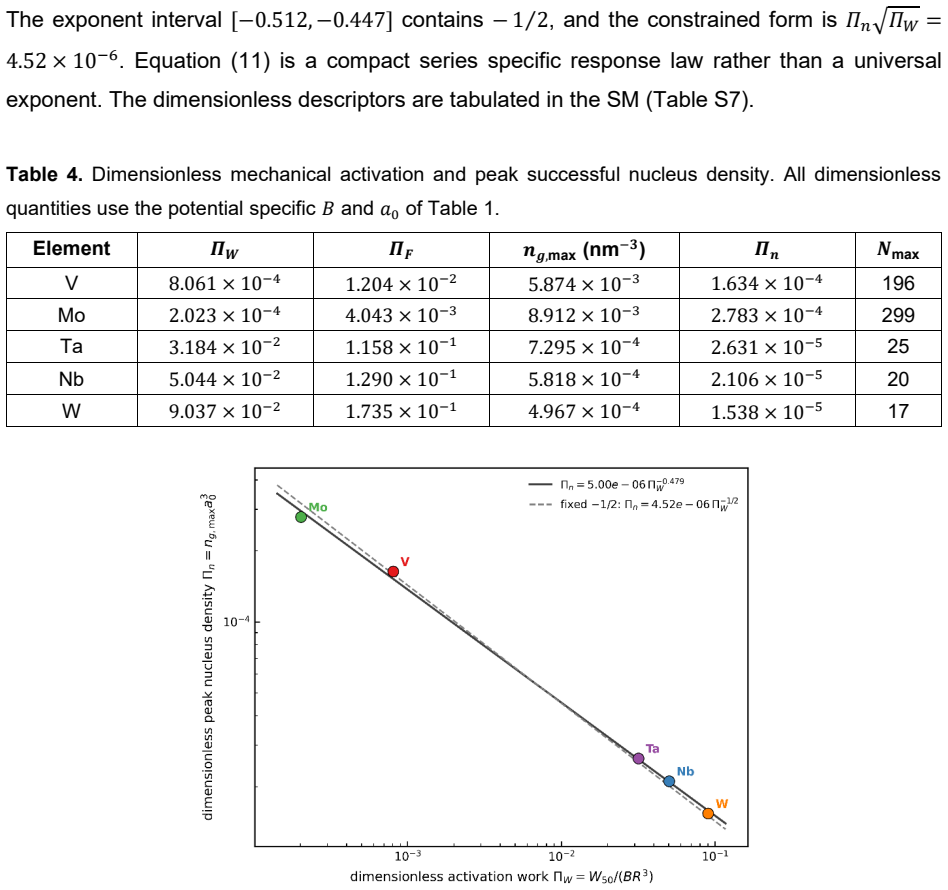
- The near-square-root link between dimensionless activation work and peak nucleus density is a compact series correlation that invites checks on other bcc metals or tip radii before being treated as a nucleation law.
- Experimental nanoindentation plus cross-sectional TEM or synchrotron mapping on melt-quenched or vapour-deposited monatomic refractory films could test whether the V-to-W CFA order survives at laboratory rates.
Signed reviews
Editorial analysis
A structured set of objections, weighed in public.
Referee Report
Summary. The manuscript reports large-scale MD nanoindentation of melt-quenched amorphous V, Nb, Mo, Ta and W at 300 K. After benchmarking each classical potential against ab initio liquid g(r), the authors define an operational crystal forming ability (CFA) as the maximum slope of a logistic fit to the persistent bcc fraction versus indentation depth. CFA ranks V > Mo > Nb > Ta > W (roughly a factor of four at the reference velocity), scales as CFA ∝ v^{-m} with mean m ≈ 1.08 so that CFA·v is nearly constant, and is argued to track cohesive energy rather than bulk thermodynamic driving force (largest for W). Transforming atoms show excess non-affine displacement and local shear strain; early bcc-like order predicts depth-response sharpness and h50; dimensionless activation work correlates with peak persistent nucleus density (≈ ΠW^{-1/2}); and a grain population balance closes the terminal microstructure. Time-matched no-indenter controls show no transformation.
Significance. If the ranking and mechanistic links hold beyond the five potentials and ultrafast rates used here, the work supplies the first common, normalised comparison of contact-driven devitrification across the monatomic bcc refractory series and a usable operational metric (CFA) for stress-assisted ordering where thermal GFA descriptors do not transfer. Methodological strengths that should be credited include ~2×10^6-atom cells, three independent glasses × ten seeds × three velocities, time-matched unloaded controls, explicit AIMD liquid g(r) RMSE/NRMSE reporting, PTM plus cluster-persistence filters, case–control Cohen’s d on D2min and shear, and algebraic population-balance closure to ~0.04% on terminal grain size. These make the study a serious, falsifiable baseline for coating stability under contact loading, even if the material-series interpretation remains potential- and protocol-bound.
major comments (4)
- [Abstract; Methods 2.1–2.3; Table 2; §4 Discussion; §5 Conclusions] The central series ranking (V > Mo > Nb > Ta > W) and the claim that resistance tracks cohesive bond strength rest on five distinct classical potentials validated mainly on 0 K crystal numbers and liquid g(r) nearest-neighbour length scale (Methods 2.1–2.3, Table 1–2). First-peak heights for V/Nb/Ta are 9–13% low; amorphous free energies and amorphous–bcc barriers are not checked against DFT or experiment; indentation velocities remain orders of magnitude above experiment. The Discussion acknowledges this, but the Abstract and Conclusions still present the ranking and Ecoh conclusion as properties of the refractory series. Either add a cross-potential check for at least one element, or reframe Abstract/Conclusions explicitly as potential- and protocol-specific rankings with the same caveats already in §4.
- [§3.8; Table 3; Eqs. (8)–(9); Figure 10] Table 3 shows ensemble-mean early bcc-like fraction at 0.1 nm spanning ~60× (Mo 6.44% vs W 0.11%), and Eqs. (8)–(9) show that this early-order index alone predicts nh and h50 with R² ≥ 0.965 (Q²_LOEO ≥ 0.915). That raises the load-bearing concern that the reported CFA order largely ranks how much crystal-like order each potential retains after the common quench, rather than an intrinsic element propensity under indentation. The manuscript should test whether CFA (or residual CFA after regressing out φ0.1) still orders the elements, or else state clearly that early retained order is the dominant predictor and that CFA is not independent of quench-state topology.
- [§3.7; Figure 9; SM Tables S2–S3; Abstract; §5] Figure 9a and the claim that resistance tracks Ecoh (Spearman ρs = −1.00, R² = 0.81) cannot isolate cohesion: SM Table S3 shows strong collinearity among Ecoh, γs, Lindemann, Debye and stiffness/cohesion descriptors on N = 5, and the bulk-only CNT diagnostic has essentially no power (SM Table S2, Fig. S6). With five collinear points, ρs = −1.00 is expected for any monotone scale and does not establish a causal or preferred material law. Soften the Abstract/§3.7/§5 wording from “tracks cohesive bond strength rather than the thermodynamic driving force” to a correlative statement within this potential set, and lead with the more robust negative result (bulk driving force largest for most resistant W) rather than a unique Ecoh mechanism.
- [§2.5; §3.3–3.4; Eqs. (2)–(3), (7); Figure 5; §4] CFA is defined in depth domain (Eqs. 2–3) under an evolving contact volume, mixed hydrostatic/deviatoric field and possible local heating. The near-unity velocity exponents (mean m = 1.08, Fig. 5) and the statement that CFA·v is nearly constant usefully show that the time-domain rate is almost velocity-independent over the simulated window, but they also mean the depth-domain ranking is largely a kinematic conversion of elapsed time. The manuscript should state more sharply what material content remains after that conversion (the between-element scatter of m, 0.97–1.18) and avoid language that treats CFA as a rate constant or inverse GFA.
minor comments (6)
- [Abstract; §3.3] Define CFA units consistently at first use: “100 × CFA in percentage points Å−1” appears late; Abstract quotes the ranking without units.
- [§2.5; §3.3; §3.8] Eq. (1) KJMA-like form and Eq. (2) logistic form are both used; a short sentence on why logistic CFA and KJMA nh/h50 are complementary would help non-specialist readers.
- [§3.2; Figure 3] Figure 3 shows one V trajectory; stating that the PE drop vs bcc rise is representative across elements (or pointing to SM) would strengthen the energy-relaxation claim.
- [§2.4] PTM RMSD cutoff 0.12 and cluster threshold of 100 atoms are operational; a one-sentence sensitivity note (or SM pointer) would help reproducibility.
- [Abstract; passim] Minor typography: “paren t body centred”, “localised amorphous”, inconsistent hyphenation of “bcc-like” / “non affine” / “time matched” across Abstract and main text.
- [§3.5–3.6; §3.10] SM Fig. S4–S9 are essential to the grain and Cohen’s d claims; ensure main-text callouts are complete so the narrative stands if SM is read second.
Circularity Check
Central CFA ranking is empirical MD output, but terminal-grain 'closure' is an algebraic identity and the N=5 early-order/activation-work 'predictions' are fits to the same trajectories that define the descriptors.
-
self definitional
[§3.10 Eqs. (12)–(14); Table 5; Fig. S9]
"Assuming equivalent spherical grains, the terminal microstructure closes as Πd³(1−C)Πn=6 fterminal/π … Eq. (14) reproduces the terminal dimensionless grain size within 0.04% for every element."
With C≡1−Nf/Nmax, Πn≡ng,max a0³, Πd≡deq,f/a0 and deq,f defined so that Nf·(π/6)deq,f³=fterminal VA, substitution yields Πd³(1−C)Πn=6 fterminal/π identically. The 0.04% residual is numerical round-off of that identity, not an independent check of nucleation–growth–coalescence physics.
-
fitted input called prediction
[§3.8 Eqs. (8)–(9); Table 3; Fig. 10]
"Across the five element trajectories the first analysed bcc like fraction spans almost two orders of magnitude and predicts both the effective depth exponent and the half transformation depth … nh=3/2+2.709 φ0.1^(−0.688), R²=0.982, QLOEO²=0.963 … h50=2.437 φ0.1^(−0.656) nm, R²=0.965, QLOEO²=0.915"
φ0.1, nh and h50 are all read from the same five ensemble-mean bcc-fraction curves. The power laws are ordinary fits on N=5; leave-one-element-out Q² only re-fits four of those five points. Calling this 'predicts' overstates an internal correlation among co-extracted descriptors as out-of-sample prediction.
2 more flagged steps
-
fitted input called prediction
[§3.9 Eqs. (10)–(11); Table 4; Fig. 11]
"The peak persistent nucleus density follows Πn=5.00×10^(−6) ΠW^(−0.479), R²=0.999, QLOO²=0.994 (N=5) … Equation (11) is a compact series specific response law rather than a universal exponent."
ΠW is built from the KJMA half-transformation depth of the same trajectories that supply ng,max. The log–log fit and LOO Q² are again internal consistency on the five points that define both axes; the near-−1/2 exponent is not an independent nucleation-theory derivation.
-
self definitional
[§3.4 Eq. (7); Discussion ¶ on CFA·v]
"CFA ≡ maxh(dξ/dh)=(1/v) maxt(dξ/dt) ∝ ν0/v exp(−ΔGeff*/kBT) … Because the exponents are close to unity, the product CFA·v is nearly constant, so the transformation rate expressed per unit time is almost independent of indenter velocity"
By the paper's own identity CFA=(1/v)·(time-domain rate), any velocity-independent time rate forces m=1 in CFA∝v^(−m). Reporting mean m=1.08 and 'CFA·v nearly constant' largely restates that kinematic conversion; the non-circular residue is only the small departure of m from 1 and the claim that the time rate itself is flat in v.
full rationale
The load-bearing material claims—CFA ranks V>Mo>Nb>Ta>W, CFA·v is nearly constant, transforming atoms carry excess shear/D2min, resistance correlates with Ecoh not bulk Δg—are direct outputs of the indentation trajectories under an operational definition of CFA (max slope of a logistic fit). That is measurement plus correlation, not a derivation that reduces to its inputs. Circularity appears only in secondary packaging: (i) the population-balance 'closure' that 'reproduces terminal dimensionless grain size within 0.04%' is an identity once equivalent-sphere diameter, coalescence fraction and number density are defined from the same grain census; (ii) Eqs. 8–9 and 11 fit nh, h50 and Πn to descriptors (φ0.1, ΠW) extracted from the same five ensemble-mean curves, then report leave-one-element-out Q² as if it were external prediction—the paper itself labels these 'series-specific' and 'internally assessed.' Equation 7's CFA=(1/v)·(dξ/dt) makes m≈1 partly kinematic; the real content is near velocity-independence of the time-domain rate, which the text largely acknowledges. No self-citation chain or uniqueness theorem carries the argument. Score 4 reflects partial fitted-input and one self-definitional closure without collapsing the central MD ranking.
Assumptions & free parameters
free parameters (8)
- PTM RMSD cutoff =
0.12
- Persistent cluster size threshold =
100 atoms
- Logistic CFA fit parameters (S1,S2,h0,Δx) =
per-trajectory
- Velocity power-law exponents m_i =
mean 1.08 (0.97–1.18)
- Early-order fit coefficients (Eqs. 8–9) =
2.709, −0.688; 2.437, −0.656
- Activation-work nucleus-density prefactor and exponent =
5.00×10^{-6}, exponent −0.479
- Broken-bond cohesion scale γs = Ecoh/(12 a0²) =
0.77–1.21 J m^{-2}
- Indenter radius and velocity set =
R=100 Å; v∈{0.075,0.15,0.30}
assumptions (5)
- domain assumption Selected EAM/ADP/FS potentials sufficiently transfer to melt-quench glasses and stress-driven bcc nucleation kinetics when liquid g(r) and 0 K crystal metrics are acceptable.
- domain assumption Polyhedral template matching with fixed RMSD plus a 100-atom persistence filter is a valid proxy for transformed bcc fraction and grain population.
- ad hoc to paper Depth-domain logistic/KJMA-like fits yield a meaningful material ranking despite evolving contact volume, local heating, and mixed hydrostatic/deviatoric fields.
- domain assumption Ultrafast MD quench (~10^13 K/s) and indentation rates still order relative CFA the same way experimental contact would.
- domain assumption Classical nucleation capillarity form and dimensionless work groups are appropriate interpretive scaffolds for indentation fields.
invented entities (3)
-
Crystal forming ability (CFA)
-
Early order index φ0.1
-
Dimensionless activation work ΠW and nucleus density Πn
Cite this review
Pith. "Pith review of Crystal forming ability of amorphous refractory metals under nanoindentation: a molecular dynamics study." pith.science (2026). https://pith.science/paper/3ZZYICCN
@misc{pith2026260726881,
  author       = {Pith},
  title        = {Pith review of: Crystal forming ability of amorphous refractory metals under nanoindentation: a molecular dynamics study},
  year         = {2026},
  howpublished = {\url{https://pith.science/paper/3ZZYICCN}},
  note         = {Machine review of arXiv:2607.26881}
}
abstract
Amorphous refractory metal coatings combine high hardness with chemical inertness, yet their metastability makes them prone to mechanically induced crystallisation (devitrification) under contact loading, and how readily such a glass re-orders to its parent body centred cubic (bcc) crystal is unknown across the refractory series. We prepared amorphous V, Nb, Mo, Ta and W by melt quenching to 300 K, validated each interatomic potential against ab initio liquid radial distribution functions, and probed them by large scale molecular dynamics nanoindentation. Indentation drives a localised amorphous to bcc transformation by bulk nucleation, growth and coalescence. A crystal forming ability (CFA), the maximum slope of the sigmoidal bcc fraction versus depth curve, spans about a factor of four and decreases as V > Mo > Nb > Ta > W; it falls with indenter velocity as CFA $\propto v^{-m}$ with a mean exponent of 1.08, so CFA$\cdot v$ is nearly constant and the transformation rate is almost velocity independent. Transforming atoms carry excess non affine displacement and local shear strain, not hydrostatic pressure, marking a shear associated displacive pathway; the bulk driving force is largest for the most resistant element, W, so resistance tracks cohesive bond strength rather than the thermodynamic driving force. Early bcc like order sets the sharpness and depth of the transition, whereas the mechanical work to half transformation sets the persistent nucleus density. A grain population balance links nucleation, growth and coalescence to a terminal microstructure whose completeness does not follow the CFA order.
Figures


Figures from the paper (9 more)



Reference graph
Works this paper leans on
-
[1]
Greer, Metallic glasses, Science 267 (1995) 1947 -1953
A.L. Greer, Metallic glasses, Science 267 (1995) 1947 -1953. https://doi.org/10.1126/science.267.5206.1947
arXiv 1995
-
[2]
Inoue, Stabilization of metallic supercooled liquid and bulk amorphous alloys, Acta Mater
A. Inoue, Stabilization of metallic supercooled liquid and bulk amorphous alloys, Acta Mater. 48 (2000) 279-306. https://doi.org/10.1016/S1359-6454(99)00300-6 25
-
[3]
C.A. Schuh, T.C. Hufnagel, U. Ramamurty, Mechanical behavior of amorphous alloys, Acta Mater. 55 (2007) 4067-4109. https://doi.org/10.1016/j.actamat.2007.01.052
-
[4]
H.W. Sheng, W.K. Luo, F.M. Alamgir, J.M. Bai, E. Ma, Atomic packing and short -to-medium- range order in metallic glasses, Nature 439 (2006) 419-425. https://doi.org/10.1038/nature04421
-
[5]
L. Zhong, J. Wang, H. Sheng, Z. Zhang, S.X. Mao, Formation of monatomic metallic glasses through ultrafast liquid quenching, Nature 512 (2014) 177 -180. https://doi.org/10.1038/nature13617
-
[6]
Y.C. Hu, J.T. Zhai, L.H. Liu, W.W. Zhang, H.Y. Bai, W.H. Wang, H. Tanaka, Monatomic glass formation through competing order balance, Nat. Commun. 16 (2025) 8183. https://doi.org/10.1038/s41467-025-63221-8
-
[7]
Argon, Plastic deformation in metallic glasses, Acta Metall
A.S. Argon, Plastic deformation in metallic glasses, Acta Metall. 27 (1979) 47 -58. https://doi.org/10.1016/0001-6160(79)90055-5
-
[8]
F. Spaepen , A microscopic mechanism for steady state inhomogeneous flow in metallic glasses, Acta Metall. 25 (1977) 407-415. https://doi.org/10.1016/0001-6160(77)90232-2
Show all 57 references
-
[9]
Falk, J.S
M.L. Falk, J.S. Langer, Dynamics of viscoplastic deformation in amorphous solids, Phys. Rev. E 57 (1998) 7192-7205. https://doi.org/10.1103/PhysRevE.57.7192
1998 doi
-
[10]
D. Pan, A. Inoue, T. Sakurai, M.W. Chen, Experimental characterization of shear transformation zones for plastic flow of bulk metallic glasses, Proc. Natl. Acad. Sci. U. S. A. 105 (2008) 14769-14772. https://doi.org/10.1073/pnas.0806051105
2008 doi
-
[11]
Schuh, T.G
C.A. Schuh, T.G. Nieh, A survey of instrumented indentation studies on metallic glasses, J. Mater. Res. 19 (2004) 46-57. https://doi.org/10.1557/jmr.2004.19.1.46
2004 doi
-
[12]
Oliver, G.M
W.C. Oliver, G.M. Pharr, Measurement of hardness and elastic modulus by instrumented indentation: advances in understanding and refinements to methodology, J. Mater. Res. 19 (2004) 3-20. https://doi.org/10.1557/jmr.2004.19.1.3
2004 doi
-
[13]
H. Chen, Y. He, G.J. Shiflet, S.J. Poon, Deformation-induced nanocrystal formation in shear bands of amorphous alloys, Nature 367 (1994) 541-543. https://doi.org/10.1038/367541a0
1994 doi
-
[14]
J.-J. Kim, Y. Choi, S. Suresh, A.S. Argon, Nanocrystallization during nanoindentation of a bulk amorphous metal alloy at room temperature, Science 295 (2002) 654 -657. https://doi.org/10.1126/science.1067453
2002 doi
-
[15]
Fornell, E
J. Fornell, E. Rossinyol, S. Surinach, M.D. Baro, W.H. Li, J. Sort, Enhanced mechanical properties in a Zr -based metallic glass caused by deformation -induced nanocrystallization, Scr. Mater. 62 (2010) 13-16. https://doi.org/10.1016/j.scriptamat.2009.09.014 26
2010 doi
-
[16]
Yoo, I.-C
B.-G. Yoo, I.-C. Choi, Y.-J. Kim, J.-Y. Suh, U. Ramamurty, J. -i. Jang, Further evidence for room temperature, indentation -induced nanocrystallization in a bulk metallic glass, Mater. Sci. Eng. A 545 (2012) 225-228. https://doi.org/10.1016/j.msea.2012.03.026
2012 doi
-
[17]
Z. Yan, Y. Hu, K. Song, F. Dai, J. He, J. Eckert, Vickers-indentation-induced crystallization in a metallic glass, Appl. Phys. Lett. 106 (2015) 101909. https://doi.org/10.1063/1.4915109
2015 doi
-
[18]
Kramer, D.J
M.J. Kramer, D.J. Sordelet, A.F. Bastarows , X. Tan, S.B. Biner, Absence of crystallization during cylindrical indentation of a Zr-based metallic glass, J. Non-Cryst. Solids 351 (2005) 2159-
2005
-
[19]
Kailer, Y.G
A. Kailer, Y.G. Gogotsi, K.G. Nickel, Phase transformations of silicon caused by contact loading, J. Appl. Phys. 81 (1997) 3057-3063. https://doi.org/10.1063/1.364340
1997 doi
-
[20]
Ivashchenko, P.E.A
V.I. Ivashchenko, P.E.A. Turchi, V.I. Shevchenko, Simulations of indentation-induced phase transformations in crystalline and amorphous silicon, Phys. Rev. B 78 (2008) 035205. https://doi.org/10.1103/PhysRevB.78.035205
2008 doi
-
[21]
Shi, M.L
Y. Shi, M.L. Falk, Stress -induced structural transformation and shear banding during simulated nanoindentation of a metallic glass, Acta Mater. 55 (2007) 4317 -4324. https://doi.org/10.1016/j.actamat.2007.03.029
2007 doi
-
[22]
Avila, S
K.E. Avila, S. Kuechemann, I. Alabd Alhafez, H.M. Urbassek, Shear -transformation zone activation during loading and unloading in nanoindentation of metallic glasses, Materials 12 (2019) 1477. https://doi.org/10.3390/ma12091477
2019 doi
-
[23]
D. Zhao, H. Zhao, B. Zhu, S. Wang, Investigation on hardening behavior of metallic glass under cyclic indentation loading via molecular dynamics simulation, Appl. Surf. Sci. 416 (2017) 14-23. https://doi.org/10.1016/j.apsusc.2017.04.125
2017 doi
-
[24]
Avila, V.H
K.E. Avila, V.H. Vardanyan, T. Zhu, S. Kuechemann, M. Smaga, H.M. Urbassek, Plasticity in cyclic indentation of a Cu-Zr-based bulk metallic glass after tensile loading: an experimental and molecular dynamics simulation study, J. Non -Cryst. Solids 617 (2023) 122486. https://do...
2023
-
[25]
C. Wang, J. Yu, J. Lai, B. Wang, F. Zhao, Z. Jiang, Z. Xiao, Shear-banding dynamic and self- repair mechanism of CuZr metallic glass subjected to cyclic nanoindentation: experiment and molecular dynamic simulation, Appl. Surf. Sci. 686 (2025) 162105. https://doi.org/10.1016/j....
2025
-
[26]
Reddy, M
K.V. Reddy, M. Meraj, S. Pal, Molecular dynamics simulation based investigation of strain induced crystallization of nickel metallic glass, Mater. Chem. Phys. 237 (2019) 121831. https://doi.org/10.1016/j.matchemphys.2019.121831
2019
-
[27]
R. Cao, Y. Deng, C. Deng, Hardening and crystallization in monatomic metallic glass during elastic cycling, J. Mater. Res. 30 (2015) 1820-1826. https://doi.org/10.1557/jmr.2015.130
2015 doi
-
[28]
Yavas, A
H. Yavas, A. Fraile, T. Huminiuc, H.S. Sen, E. Frutos, T. Polcar, Deformation -controlled design of metallic nanocomposites, ACS Appl. Mater. Interfaces 11 (2019) 46296 -46302. https://doi.org/10.1021/acsami.9b12235
2019 doi
-
[29]
Z.P. Lu, C.T. Liu, A new glass -forming ability criterion for bulk metallic glasses, Acta Mater. 50 (2002) 3501-3512. https://doi.org/10.1016/S1359-6454(02)00166-0
2002 doi
-
[30]
Zhang, M
K. Zhang, M. Wang, S. Papanikolaou, Y. Liu, J. Schroers, M.D. Shattuck, C.S. O’Hern, Computational studies of the glass-forming ability of model bulk metallic glasses, J. Chem. Phys. 139 (2013) 124503. https://doi.org/10.1063/1.4821637
2013 doi
-
[31]
Turnbull, Formation of crystal nuclei in liquid metals, J
D. Turnbull, Formation of crystal nuclei in liquid metals, J. Appl. Phys. 21 (1950) 1022-1028. https://doi.org/10.1063/1.1699435
1950 doi
-
[32]
Cohen, D
M.H. Cohen, D. Turnbull, Molecular transport in liquids and glasses, J. Chem. Phys. 31 (1959) 1164-1169. https://doi.org/10.1063/1.1730566
1959 doi
-
[33]
Plimpton, Fast parallel algorithms for short -range molecular dynamics, J
S. Plimpton, Fast parallel algorithms for short -range molecular dynamics, J. Comput. Phys. 117 (1995) 1-19. https://doi.org/10.1006/jcph.1995.1039
1995
-
[34]
Thompson, H.M
A.P. Thompson, H.M. Aktulga, R. Berger, D.S. Bolintineanu , W.M. Brown, P.S. Crozier, et al., LAMMPS: a flexible simulation tool for particle-based materials modeling at the atomic, meso, and continuum scales, Comput. Phys. Commun. 271 (2022) 108171. https://doi.org/10.1016/j....
2022
-
[35]
Daw, M.I
M.S. Daw, M.I. Baskes, Embedded -atom method: derivation and application to impurities, surfaces, and other defects in metals, Phys. Rev. B 29 (1984) 6443 -6453. https://doi.org/10.1103/PhysRevB.29.6443
1984 doi
-
[36]
Olsson, Semi -empirical atomistic study of point defect properties in bcc transition metals, Comput
P.A.T. Olsson, Semi -empirical atomistic study of point defect properties in bcc transition metals, Comput. Mater. Sci. 47 (2009) 135-145. https://doi.org/10.1016/j.commatsci.2009.06.025
2009 doi
-
[37]
Fellinger, H
M.R. Fellinger, H. Park, J.W. Wilkins, Force -matched embedded-atom method potential for niobium, Phys. Rev. B 81 (2010) 144119. https://doi.org/10.1103/PhysRevB.81.144119 28
2010 doi
-
[38]
Starikov, L.N
S.V. Starikov, L.N. Kolotova, A.Yu. Kuksin, D.E. Smirnova, V.I. Tseplyaev , Atomistic simulation of cubic and tetragonal phases of U-Mo alloy: structure and thermodynamic properties, J. Nucl. Mater. 499 (2018) 451-463. https://doi.org/10.1016/j.jnucmat.2017.11.047
2018 doi
-
[39]
Mishin, M.J
Y. Mishin, M.J. Mehl, D.A. Papaconstantopoulos, Phase stability in the Fe -Ni system: investigation by first -principles calculations and atomistic simulations, Acta Mater. 53 (2005) 4029-4041. https://doi.org/10.1016/j.actamat.2005.05.001
2005 doi
-
[40]
Finnis, J.E
M.W. Finnis, J.E. Sinclair, A simple empirical N -body potential for transition metals, Philos. Mag. A 50 (1984) 45-55. https://doi.org/10.1080/01418618408244210
1984 doi
-
[41]
Y. Chen, J. Fang, L. Liu, W. Hu, N. Gao, F. Gao, H. Deng, Development of the interatomic potentials for the W -Ta system, Comput. Mater. Sci. 163 (2019) 91 -99. https://doi.org/10.1016/j.commatsci.2019.03.021
2019 doi
-
[42]
Marinica, L
M.-C. Marinica, L. Ventelon, M.R. Gilbert, L. Proville, S.L. Dudarev, J. Marian, G. Bencteux, F. Willaime, Interatomic potentials for modelling radiation defects and dislocations in tungsten, J. Phys.: Condens. Matter 25 (2013) 395502. https://doi.org/10.1088/0953-8984/25/39/395502
2013 doi
-
[43]
Derlet, D
P.M. Derlet, D. Nguyen-Manh, S.L. Dudarev, Multiscale modeling of crowdion and vacancy defects in body -centered-cubic transition metals, Phys. Rev. B 76 (2007) 054107. https://doi.org/10.1103/PhysRevB.76.054107
2007 doi
-
[44]
Kittel, Introduction to Solid State Physics, 8th ed., Wiley, New York, 2005
C. Kittel, Introduction to Solid State Physics, 8th ed., Wiley, New York, 2005
2005
-
[45]
Hale, Z.T
L.M. Hale, Z.T. Trautt, C.A. Becker, Evaluating variability with atomistic simulations: the effect of potential and calculation methodology on the modeling of lattice and elastic constants, Modelling Simul. Mater. Sci. Eng. 26 (2018) 055003. https://doi.org/10.1088/1361-651X/aabc05
2018 doi
-
[46]
Debela, X.D
T.T. Debela, X.D. Wang, Q.P. Cao, D.X. Zhang, J.Z. Jiang, The crystallisation process of liquid vanadium studied by ab initio molecular dynamics, J. Phys.: Condens. Matter 26 (2014) 155101. https://doi.org/10.1088/0953-8984/26/15/155101
2014 doi
-
[47]
Debela, X.D
T.T. Debela, X.D. Wang, Q.P. Cao, Y.H. Lu, D.X. Zhang, H.-J. Fecht, H. Tanaka, J.Z. Jiang, Nucleation driven by orientational order in supercooled niobium as seen via ab initio molecular dynamics, Phys. Rev. B 89 (2014) 104205. https://doi.org/10.1103/PhysRevB.89.104205
2014 doi
-
[48]
Gonzalez, D.J
L.E. Gonzalez, D.J. Gonzalez, First principles determination of static, dynamic and electronic properties of some liquid 4d transition metals near melting, Int. J. Refract. Met. Hard Mater. 107 (2022) 105898. https://doi.org/10.1016/j.ijrmhm.2022.105898 29
2022
-
[49]
Gonzalez, L.E
D.J. Gonzalez, L.E. Gonzalez, An ab initio study of the static, dynamic and electronic properties of some liquid 5d transition metals near melting, Condens. Matter Phys. 26 (2023) 33601. https://doi.org/10.5488/cmp.26.33601
2023 doi
-
[50]
Jakse, O
N. Jakse, O. Le Bacq, A. Pasturel, Prediction of the local structure of liquid and supercooled tantalum, Phys. Rev. B 70 (2004) 174203. https://doi.org/10.1103/PhysRevB.70.174203
2004 doi
-
[51]
Stukowski, Visualization and analysis of atomistic simulation data with OVITO: the Open Visualization Tool, Modelling Simul
A. Stukowski, Visualization and analysis of atomistic simulation data with OVITO: the Open Visualization Tool, Modelling Simul. Mater. Sci. Eng. 18 (2010) 015012. https://doi.org/10.1088/0965-0393/18/1/015012
2010 doi
-
[52]
Larsen, S
P.M. Larsen, S. Schmidt, J. Schiotz, Robust structural identification via polyhedral template matching, Modelling Simul. Mater. Sci. Eng. 24 (2016) 055007. https://doi.org/10.1088/0965 - 0393/24/5/055007
2016 doi
-
[53]
Avrami, Kinetics of phase change
M. Avrami, Kinetics of phase change. I. General theory, J. Chem. Phys. 7 (1939) 1103-1112. https://doi.org/10.1063/1.1750380
1939 doi
-
[54]
Avrami, Kinetics of phase change
M. Avrami, Kinetics of phase change. II. Transformation-time relations for random distribution of nuclei, J. Chem. Phys. 8 (1940) 212-224. https://doi.org/10.1063/1.1750631
1940 doi
-
[55]
Johnson, R.F
W.A. Johnson, R.F. Mehl, Reaction kinetics in processes of nucleation and growth, Trans. Am. Inst. Min. Metall. Eng. 135 (1939) 416-442
1939
-
[56]
Cohen, Statistical Power Analysis for the Behavioral Sciences, 2nd ed., Lawrence Erlbaum Associates, Hillsdale, NJ, 1988
J. Cohen, Statistical Power Analysis for the Behavioral Sciences, 2nd ed., Lawrence Erlbaum Associates, Hillsdale, NJ, 1988. 1 Supplementary Material Crystal forming ability of amorphous refractory metals under nanoindentation: a molecular dynamics study P. Dwivedi1, A. Fraile...
1988
-
[2165]
https://doi.org/10.1016/j.jnoncrysol.2005.06.014
2005 doi
Reviewed July 30, 2026 · model on record in the stance chip above.
Discussion (0). Continue with ORCID to comment.