REVIEW 4 major objections 3 minor 56 references
Graphene Oxide Nanoparticles in the Interstellar Medium
T0 review · 4 major / 3 minor · reviewed 2026-08-14 · deepseek-v4-flash
Pith's one-line read Graphene oxide nanoparticles are proposed as the carrier of interstellar Extended Red Emission.
desk verdict A genuinely new ERE carrier candidate, honestly presented, but the abstract oversells the identification. read the letter →
The pith
A machine-rendered reading of the paper's core claim, the machinery that carries it, and where it could break.
The reading
What carries the argument
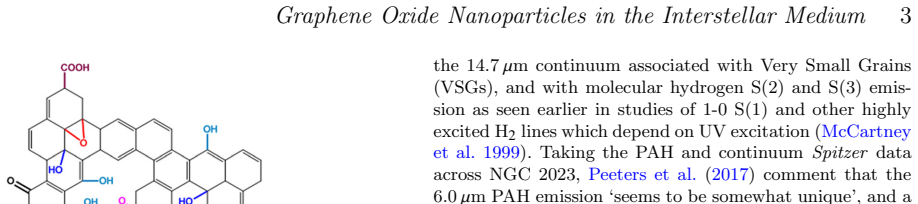
The central object is graphene oxide (GO), a single-layer graphene sheet bearing oxygen-containing groups—carbonyl (>C=O), epoxide (–O–), carboxyl (–COOH), and hydroxyl (–OH)—attached to the carbon framework. Its key property is that the oxygen sites open an optical band gap in otherwise gapless graphene, creating localized electronic states whose radiative recombination emits in the red part of the spectrum. The argument is carried by two comparisons: the overlap of GO photoluminescence with the Red Rectangle ERE profile, and the coincidence of ERE with the 6.0 µm carbonyl and 8 µm epoxy infrared features in NGC 2023, which ties the optical emission to oxygen chemistry on large carbon flakes.
What would settle it
Measure photoluminescence of size- and oxidation-controlled graphene oxide nanoparticles at cryogenic temperatures (10–100 K) under UV and broad-band excitation, and compare peak wavelength and width to ERE observations. If the emission shifts substantially, narrows, or disappears under these conditions, or if its quantum yield falls below the roughly 10% lower limit inferred for ERE, the proposed carrier fails; a spatial map of an ERE source in which the 6.0 µm and 8 µm features anticorrelate with ERE would also falsify the link.
Extended reading notes
Core claim
The paper's central claim is that emission from graphene oxide nanoparticles is the origin of ERE, and that these nanoparticles are a significant component of interstellar dust. In the Red Rectangle, the ERE peaks near 670 nm at 6 arcsec south and 645 nm at 10 arcsec south of HD 44179, closely matching the 630–660 nm photoluminescence of laboratory graphene oxide, with comparable width. The paper adds supporting evidence from space-based infrared spectra: the 6.0 µm band attributed to carbonyl C=O stretching and the broader 8 µm feature from epoxy C-O-C groups, whose spatial distributions in NGC 2023 follow the ERE rather than the usual polycyclic aromatic hydrocarbon bands. On this evidence the author proposes that oxidized graphene, formed by UV-driven decomposition of multilayer graphite oxide or by photo-removal of hydrogen from PAHs followed by oxygen attachment, is present wherever ERE is seen, and that its blue luminescence near 400 nm may have a separate astrophysical counterpart.
Load-bearing premise
The argument depends on the assumption that graphene oxide photoluminescence measured in the laboratory—for specific samples, laser-excited at room temperature—is representative of what interstellar GO nanoparticles emit under UV or broad-band excitation, at low interstellar temperatures, and at realistic particle sizes and oxidation levels.
Editorial extensions
If this is right
- ERE would be understood as luminescence from an identifiable, oxygen-bearing carbonaceous grain population rather than an unidentified material.
- The 6.0 µm and 8 µm astronomical emission features would gain a physical carrier—carbonyl and epoxy groups on graphene oxide—explaining why their spatial distributions differ from standard PAH bands.
- The unidentified Red Rectangle emission bands near 5800 and 6600 Å could be decomposition products of the ERE-emitting GO, linking two long-standing spectral mysteries.
- Interstellar GO formation would require UV irradiation, consistent with the established need for UV excitation of ERE, and would place GO nanoparticle sizes in the same range as very small grains being evaporated into PAHs.
- Oxygen incorporated into GO would become part of interstellar dust budgets, relevant to the known missing-oxygen problem in the diffuse interstellar medium.
Reading between the lines
- A direct extension of the proposal is a quantitative prediction: ERE peak wavelength should correlate with the relative strength of the 6.0 µm and 8 µm GO infrared features within a source, because more oxidized GO should emit at shorter wavelengths; existing Spitzer maps can test this.
- If GO is as widespread as ERE, the same nanoparticles may act as catalytic surfaces in interstellar clouds; the paper mentions catalytic reactions only in passing, but a large GO population would make surface-mediated formation of molecules such as H2 a natural follow-up to test.
- The GO carrier also suggests that the blue luminescence near 400 nm from sp2 carbon islands should appear in ERE sources, possibly as the astronomical Blue Luminescence, so a targeted search for a correlated 400 nm component would either strengthen or weaken the identification.
Signed reviews
Editorial analysis
A structured set of objections, weighed in public.
Referee Report
Summary. This Letter proposes that graphene oxide (GO) nanoparticles are the carrier of the long-unidentified Extended Red Emission (ERE) and constitute a significant component of interstellar dust. The argument rests on two pillars: (i) a qualitative comparison between laboratory photoluminescence (PL) spectra of GO (Gokus et al. 2009; Li et al. 2012) and ERE in the Red Rectangle at 6″ and 10″ south of HD 44179, and (ii) a claimed spatial and spectroscopic association of interstellar infrared features at 6.0 μm and near 8 μm with oxygen-containing functional groups in GO, using ISO and Spitzer data for the Red Rectangle and NGC 2023. The paper also discusses formation routes for interstellar GO, notes a blue 400 nm GO emission feature that might relate to astronomical Blue Luminescence, and suggests connections to unidentified Red Rectangle bands, the 2175 Å bump, and the missing oxygen problem.
Significance. If the identification were established, GO would be the first widely accepted ERE carrier, solving a forty-year-old problem in interstellar dust physics and linking carbonaceous nanoparticles to a broad set of observations. The proposal is attractive because it connects specific laboratory PL data to a recurrent astronomical spectral feature, and because it generates concrete, testable predictions. Credit is due for using independent laboratory spectra as external benchmarks, for noting explicitly in Section 4 that temperature and particle-size effects on GO emission are unknown, and for proposing laboratory experiments that could test the hypothesis. However, the evidence as presented is predominantly qualitative and the laboratory conditions differ substantially from those in interstellar ERE regions, so the central claim in the abstract outstrips the support in the body of the Letter.
major comments (4)
- [Section 2, Figs 1–2] The central spectral comparison is qualitative. Laboratory GO PL peaks at 630–660 nm and Red Rectangle ERE peaks at 670 nm (6″) and 645 nm (10″), but no line-profile fitting, no uncertainty analysis, and no quantitative similarity metric are provided. Because ERE is a broad feature whose peak and width vary widely between and within objects, an eye-level overlap of two broad emissions carries little discriminatory power. The authors should either perform a quantitative comparison using the same spectral binning and include FWHM values, or explicitly restrict the claim to 'a plausible candidate spectrum'.
- [Section 4 with Section 2] The laboratory PL data were obtained at room temperature with 473 nm laser excitation on supported GO flakes, whereas interstellar ERE is excited by UV photons (wavelengths short of ~118 nm in NGC 7023) and emitted by cold grains. The paper acknowledges in Section 4 that the effects of temperature and particle size on GO emission are unknown, and Cuong et al. (2011) directly show that GO PL peaks shift with temperature and reduction level. In addition, Gokus et al. (2009) show that their GO sample photobleaches under intense irradiation, and the required ~10% photon conversion efficiency of ERE has not been measured for GO under UV excitation. These gaps are load-bearing: until low-temperature, UV-excited, size-controlled GO PL is measured, the spectral match cannot support the abstract's claim that GO is the origin of ERE.
- [Section 3] The infrared evidence is not discriminative for GO specifically. The 6.0 μm feature is attributed by Peeters et al. (2002) to a C=O stretch in quinone-type PAHs, and Hsia et al. (2016) suggest an olefinic double-bond origin; ordinary oxygenated PAHs also contain carbonyl groups, so the presence of 6.0 μm emission does not distinguish GO from other oxygenated PAH species. The same band is used both as a fingerprint of GO and as supporting evidence for the GO–ERE association, a circularity. The 8 μm 'bump' in NGC 2023 is not a formally identified PAH band, and its spatial coincidence with the 6.0 μm feature is suggestive but not sufficient to identify a chemical carrier. A GO-specific infrared diagnostic or quantitative band-strength prediction is needed.
- [Abstract and Section 4] The claim that GO nanoparticles are 'a significant component of interstellar dust' is unsupported by any abundance or formation model. The two formation routes suggested in Section 4—UV decomposition of multilayer graphite oxide and photo-removal of H from PAHs followed by O addition—are stated without rates, yields, or destruction pathways, and no dust mass fraction is estimated from ERE intensities or infrared band strengths. At minimum, the abstract should be worded as a hypothesis rather than an established identification unless such a model is supplied.
minor comments (3)
- [Figure 1 caption] The caption describes the sample as 'GO produced by an oxygen plasma treatment of graphene', while Gokus et al. refer to oxidized graphene; the terminology should be clarified to match the original work exactly.
- [Section 3, first paragraph] The text notes that the ISO spectra cover a 14″×20″ aperture and therefore cannot be compared directly with the bipolar ERE distribution, but later comparisons use Spitzer data with a different field of view; these instrument and aperture differences should be stated explicitly where the spatial correlation is discussed.
- [Section 2, second paragraph] The statement that the laboratory PL and the Red Rectangle ERE have 'very similar' peak wavelength and FWHM would be more useful if the numerical FWHM values for the laboratory GO spectra were given, since only peak wavelengths are cited in the text.
Circularity Check
No significant circularity: the GO–ERE comparison rests on independent laboratory and astronomical spectra, with acknowledged untested assumptions rather than fitted inputs.
full rationale
The central claim is that graphene oxide nanoparticles emit the Extended Red Emission feature because laboratory photoluminescence spectra of graphene oxide (Gokus et al. 2009; Li et al. 2012) resemble Red Rectangle ERE (Witt & Boroson 1990). These are external benchmarks, not quantities derived from the ERE spectrum itself, and no parameter of the GO model is fitted to ERE and then renamed a prediction. The supporting infrared argument likewise compares the astronomical 6.0 and 8.0 µm features with independent GO absorption measurements and with NIST-based carbonyl stretching frequencies shifted by a literature value of 15 cm−1; this is an external consistency check, not a circular reduction. The paper explicitly states in Section 4 that temperature, particle size, and broad-band excitation effects on GO emission remain to be tested, which is an acknowledged limitation of the proposal rather than a circular step. The author's self-citations (Sarre 1991, 1995, 2006) concern diffuse interstellar bands and are not load-bearing for the ERE identification. No equation in the paper reduces the conclusion to its own inputs, so no circularity meeting the required evidentiary standard is present.
Assumptions & free parameters
assumptions (4)
- domain assumption ERE is luminescence of dust grains and is carbon-related, as inferred from its absence in oxygen-rich nebulae.
- domain assumption The 6.0 micrometer astronomical emission band is due to a C=O stretch in oxygenated aromatic molecules.
- domain assumption A 15 cm^-1 redward shift from gas-phase absorption to astronomical emission applies to carbonyl aromatics.
- ad hoc to paper GO can form in interstellar environments, either by UV decomposition of multilayer graphite oxide or by photo-removal of H from PAHs followed by O addition.
invented entities (1)
-
Interstellar graphene oxide nanoparticles
independent evidence
Cite this review
Pith. "Pith review of Graphene Oxide Nanoparticles in the Interstellar Medium." pith.science (2026). https://pith.science/paper/42AESMRN
@misc{pith2026190807787,
  author       = {Pith},
  title        = {Pith review of: Graphene Oxide Nanoparticles in the Interstellar Medium},
  year         = {2026},
  howpublished = {\url{https://pith.science/paper/42AESMRN}},
  note         = {Machine review of arXiv:1908.07787}
}
read the original abstract
Dust particles play a major role in the formation, evolution and chemistry of interstellar clouds, stars and planetary systems. Commonly identified forms include amorphous and crystalline carbon-rich particles and silicates. Also present in many astrophysical environments are polycyclic aromatic hydrocarbons (PAHs), detected through their infrared emission, and which are essentially small flakes of graphene. Astronomical observations over the past four decades have revealed a widespread unassigned Extended Red Emission (ERE) feature which is attributed to luminescence of dust grains. Numerous potential carriers for ERE have been proposed but none has gained general acceptance. In this Letter it is shown that there is a strong similarity between laboratory optical emission spectra of graphene oxide and ERE, leading to this proposal that emission from graphene oxide nanoparticles is the origin of ERE and that these are a significant component of interstellar dust. The proposal is supported by infrared emission features detected by the Infrared Space Observatory (ISO) and the Spitzer Space Telescope.
Figures

Reference graph
Works this paper leans on
-
[1]
Allamandola L. J., Sandford S. A., Wopenka B., 1987, @doi [Science] 10.1126/science.237.4810.56 , https://ui.adsabs.harvard.edu/abs/1987Sci...237...56A 237, 56
-
[2]
Bagri A., Mattevi C., Acik M., Chabal Y. J., Chhowalla M., Shenoy V. B., 2010, Nature Chemistry, 2, 581
work page 2010
-
[3]
Bauschlicher Charles W. J., Peeters E., Allamandola L. J., 2009, @doi [ ] 10.1088/0004-637X/697/1/311 , https://ui.adsabs.harvard.edu/abs/2009ApJ...697..311B 697, 311
-
[4]
Bern \'e O., et al., 2007, @doi [ ] 10.1051/0004-6361:20066282 , https://ui.adsabs.harvard.edu/abs/2007A&A...469..575B 469, 575
-
[5]
Bern \'e O., Joblin C., Rapacioli M., Thomas J., Cuillandre J. C., Deville Y., 2008, @doi [ ] 10.1051/0004-6361:20079158 , https://ui.adsabs.harvard.edu/abs/2008A&A...479L..41B 479, L41
-
[6]
Cesarsky D., Lequeux J., Ryter C., G \'e rin M., 2000, , https://ui.adsabs.harvard.edu/abs/2000A&A...354L..87C 354, L87
work page 2000
-
[7]
Chien C.-T., et al., 2012, Angewandte Chemie-International Edition, 51, 6662
work page 2012
-
[8]
Cohen M., et al., 1975, @doi [ ] 10.1086/153403 , http://adsabs.harvard.edu/abs/1975ApJ...196..179C 196, 179
Show all 56 references
-
[9]
A., Candian A., Bern \'e O., Tielens A
Croiset B. A., Candian A., Bern \'e O., Tielens A. G. G. M., 2016, @doi [ ] 10.1051/0004-6361/201527714 , https://ui.adsabs.harvard.edu/abs/2016A&A...590A..26C 590, A26
2016 doi
-
[10]
V., et al., 2011, @doi [App
Cuong T. V., et al., 2011, @doi [App. Phys. Lett.] 10.1063/1.3616142 , 99, 041905
2011 doi
-
[11]
Darbon S., Perrin J.-M., Sivan J.-P., 1999, , http://adsabs.harvard.edu/abs/1999A
1999
-
[12]
R., Park S., Bielawski C
Dreyer D. R., Park S., Bielawski C. W., Ruoff R. S., 2010, @doi [Chem. Soc. Rev.] 10.1039/b917103g , 39, 228
2010 doi
-
[13]
J., 1991, @doi [ ] 10.1038/353393b0 , https://ui.adsabs.harvard.edu/abs/1991Natur.353..393F 353, 393
Fossey S. J., 1991, @doi [ ] 10.1038/353393b0 , https://ui.adsabs.harvard.edu/abs/1991Natur.353..393F 353, 393
1991 doi
-
[14]
G., Witt A
Furton D. G., Witt A. N., 1990, @doi [ ] 10.1086/185871 , http://adsabs.harvard.edu/abs/1990ApJ...364L..45F 364, L45
1990 doi
-
[15]
G., Witt A
Furton D. G., Witt A. N., 1992, @doi [ ] 10.1086/171041 , http://adsabs.harvard.edu/abs/1992ApJ...386..587F 386, 587
1992 doi
-
[16]
Gao X., Jang J., Nagase S., 2010, J. Phys. Chem C, 114, 832
2010
-
[17]
Gokus T., et al., 2009, ACS nano, 3, 3963
2009
-
[18]
D., Witt A
Gordon K. D., Witt A. N., Friedmann B. C., 1998, @doi [ ] 10.1086/305571 , https://ui.adsabs.harvard.edu/abs/1998ApJ...498..522G 498, 522
1998 doi
-
[19]
Holmlid L., 2018, @doi [ ] 10.3847/1538-4357/aadda1 , http://adsabs.harvard.edu/abs/2018ApJ...866..107H 866, 107
2018 doi
-
[20]
Hsia C.-H., Sadjadi S., Zhang Y., Kwok S., 2016, @doi [ ] 10.3847/0004-637X/832/2/213 , https://ui.adsabs.harvard.edu/abs/2016ApJ...832..213H 832, 213
2016 doi
-
[21]
Krishnamoorthy K., Veerapandian M., Yun K., Kim S.-J., 2013, Carbon, 53, 38
2013
-
[22]
S.-Y., Witt A
Lai T. S.-Y., Witt A. N., Crawford K., 2017, @doi [ ] 10.1093/mnras/stx1124 , http://adsabs.harvard.edu/abs/2017MNRAS.469.4933L 469, 4933
2017 doi
-
[23]
Ledoux G., Guillois O., Huisken F., Kohn B., Porterat D., Reynaud C., 2001, @doi [ ] 10.1051/0004-6361:20011136 , https://ui.adsabs.harvard.edu/abs/2001A&A...377..707L 377, 707
2001 doi
-
[24]
K., Zhou X., Guo S., Wu N., 2012, @doi [J
Li M., Cushing S. K., Zhou X., Guo S., Wu N., 2012, @doi [J. Mat. Chem.] 10.1039/c2jm35417a , 22, 23374
2012 doi
-
[25]
M., Mele E
Luo Z., Vora P. M., Mele E. J., Johnson A. T. C., Kikkawa J. M., 2009 a, App. Phys. Lett. , 94
2009
-
[26]
A., Johnson A
Luo Z., Lu Y., Somers L. A., Johnson A. T. C., 2009 b, @doi [ JACS ] 10.1021/ja807934n , 131 , 898
2009 doi
-
[27]
McCartney M. S. K., Brand P. W. J. L., Burton M. G., Chrysostomou A., 1999, @doi [ ] 10.1046/j.1365-8711.1999.02602.x , 307, 315
1999
-
[28]
Peeters E., Hony S., Van Kerckhoven C., Tielens A. G. G. M., Allamandola L. J., Hudgins D. M., Bauschlicher C. W., 2002, @doi [ ] 10.1051/0004-6361:20020773 , https://ui.adsabs.harvard.edu/abs/2002A&A...390.1089P 390, 1089
2002 doi
-
[29]
W., Allamandola L
Peeters E., Bauschlicher C. W., Allamandola L. J., Tielens A. G. G. M., Ricca A., Wolfire M. G., 2017, @doi [ ] 10.3847/1538-4357/836/2/198 , 836, 198
2017 doi
-
[30]
Pilleri P., 2010, PhD thesis, L'Universit\'e de Toulouse
2010
-
[31]
Quirico E., Borg J., Raynal P., Montagnac G., d'Hendecourt L., 2005, Planetary and Space Science, 53, 1443
2005
-
[32]
M., Lee T
Rhee Y. M., Lee T. J., Gudipati M. S., Allamandola L. J., Head-Gordon M., 2007, @doi [Proceedings of the National Academy of Science] 10.1073/pnas.0609396104 , https://ui.adsabs.harvard.edu/abs/2007PNAS..104.5274R 104, 5274
2007 doi
-
[33]
1st Franco-British Meeting on the Physics and Chemistry of the Interstellar Medium, Newsletter on Analysis of Astronomical Spectra
Rouan D., Lecoupanec P., L\'eger A., 1995, in Jeffery C., ed., Proc. 1st Franco-British Meeting on the Physics and Chemistry of the Interstellar Medium, Newsletter on Analysis of Astronomical Spectra. No. 22 in 1. p. 37
1995
-
[34]
J., 1991, @doi [ ] 10.1038/351356a0 , https://ui.adsabs.harvard.edu/abs/1991Natur.351..356S 351, 356
Sarre P. J., 1991, @doi [ ] 10.1038/351356a0 , https://ui.adsabs.harvard.edu/abs/1991Natur.351..356S 351, 356
1991 doi
-
[35]
J., 2006, @doi [ Journal of Molecular Spectroscopy ] 10.1016/j.jms.2006.03.009 , https://ui.adsabs.harvard.edu/abs/2006JMoSp.238....1S 238, 1
Sarre P. J., 2006, @doi [ Journal of Molecular Spectroscopy ] 10.1016/j.jms.2006.03.009 , https://ui.adsabs.harvard.edu/abs/2006JMoSp.238....1S 238, 1
2006 doi
-
[36]
J., Miles J
Sarre P. J., Miles J. R., Scarrott S. M., 1995, @doi [Science] 10.1126/science.269.5224.674 , https://ui.adsabs.harvard.edu/abs/1995Sci...269..674S 269, 674
1995 doi
-
[37]
D., Witt A
Schmidt G. D., Witt A. N., 1991, @doi [ ] 10.1086/170826 , https://ui.adsabs.harvard.edu/abs/1991ApJ...383..698S 383, 698
1991 doi
-
[38]
D., Cohen M., Margon B., 1980, @doi [ ] 10.1086/183309 , https://ui.adsabs.harvard.edu/abs/1980ApJ...239L.133S 239, L133
Schmidt G. D., Cohen M., Margon B., 1980, @doi [ ] 10.1086/183309 , https://ui.adsabs.harvard.edu/abs/1980ApJ...239L.133S 239, L133
1980 doi
-
[39]
D., Evans A., Rawlings J
Scott A. D., Evans A., Rawlings J. M. C., 1994, @doi [ ] 10.1093/mnras/269.1.L21 , https://ui.adsabs.harvard.edu/abs/1994MNRAS.269L..21S 269, L21
1994 doi
-
[40]
L., Witt A
Smith T. L., Witt A. N., 2002, @doi [ ] 10.1086/324542 , https://ui.adsabs.harvard.edu/abs/2002ApJ...565..304S 565, 304
2002 doi
-
[41]
Szomoru A., Guhathakurta P., 1998, @doi [ ] 10.1086/311156 , https://ui.adsabs.harvard.edu/abs/1998ApJ...494L..93S 494, L93
1998 doi
-
[42]
Tielens A. G. G. M., 2008, @doi [ ] 10.1146/annurev.astro.46.060407.145211 , https://ui.adsabs.harvard.edu/abs/2008ARA&A..46..289T 46, 289
2008
-
[43]
Tielens A. G. G. M., 2013, @doi [Reviews of Modern Physics] 10.1103/RevModPhys.85.1021 , https://ui.adsabs.harvard.edu/abs/2013RvMP...85.1021T 85, 1021
2013 doi
-
[44]
P., Witt A
Vijh U. P., Witt A. N., Gordon K. D., 2005, @doi [ ] 10.1086/447763 , https://ui.adsabs.harvard.edu/abs/2005ApJ...633..262V 633, 262
2005 doi
-
[45]
E., 2019, in Linstrom P
Wallace W. E., 2019, in Linstrom P. J., Mallard W. G., eds, NIST Chemistry WebBook, NIST Standard Reference Database Number 69, https://doi.org/10.18434/T4D303. https://doi.org/10.18434/T4D303
2019 doi
-
[46]
N., 2014, in Cami J., Cox N
Witt A. N., 2014, in Cami J., Cox N. L. J., eds, IAU Symposium Vol. 297, The Diffuse Interstellar Bands. pp 173--179, @doi 10.1017/S1743921313015810
2014 doi
-
[47]
N., Boroson T
Witt A. N., Boroson T. A., 1990, @doi [ ] 10.1086/168752 , https://ui.adsabs.harvard.edu/abs/1990ApJ...355..182W 355, 182
1990 doi
-
[48]
N., Malin D
Witt A. N., Malin D. F., 1989, , 347, 25
1989
-
[49]
N., Schild R
Witt A. N., Schild R. E., 1988, @doi [ ] 10.1086/166054 , https://ui.adsabs.harvard.edu/abs/1988ApJ...325..837W 325, 837
1988 doi
-
[50]
N., Vijh U
Witt A. N., Vijh U. P., 2004, in Witt A. N., Clayton G. C., Draine B. T., eds, Astronomical Society of the Pacific Conference Series Vol. 309, Astrophysics of Dust. p. 115 ( @eprint arXiv astro-ph/0309674 )
2004 arXiv
-
[51]
N., Gordon K
Witt A. N., Gordon K. D., Vijh U. P., Sell P. H., Smith T. L., Xie R.-H., 2006, @doi [ ] 10.1086/498052 , https://ui.adsabs.harvard.edu/abs/2006ApJ...636..303W 636, 303
2006 doi
-
[52]
N., Mandel S., Sell P
Witt A. N., Mandel S., Sell P. H., Dixon T., Vijh U. P., 2008, @doi [ ] 10.1086/587131 , https://ui.adsabs.harvard.edu/abs/2008ApJ...679..497W 679, 497
2008 doi
-
[53]
Wopenka B., 1988, @doi [Earth and Planetary Science Letters] 10.1016/0012-821X(88)90079-9 , https://ui.adsabs.harvard.edu/abs/1988E&PSL..88..221W 88, 221
1988 doi
-
[54]
Yuan T., Meng T., He P., Shi Y., Li Y., Li X., Fan L., Yang S., 2019, J. Mat. Chem. , 7, 6820
2019
-
[55]
Springer
Zhao J., Liu L., Li F., 2015, Graphene Oxide, Physics and Applications. Springer
2015
-
[56]
write newline
" write newline "" before.all 'output.state := FUNCTION fin.entry write newline FUNCTION new.block output.state before.all = 'skip after.block 'output.state := if FUNCTION new.sentence output.state after.block = 'skip output.state before.all = 'skip after.sentence 'output.stat...
Reviewed August 14, 2026 · model on record in the stance chip above.
Discussion (0). Continue with ORCID to comment.