Neural Network Quantization by Learning Low-Loss Subspaces
Pith reviewed 2026-06-26 00:03 UTC · model grok-4.3
The pith
Direct quantization of the midpoint of a learned low-loss subspace matches the accuracy of quantization-aware training.
A machine-rendered reading of the paper's core claim, the machinery that carries it, and where it could break.
Core claim
Optimizing quantization-aware linear paths in weight space to minimize loss produces a subspace whose midpoint is, by construction, quantization-friendly; quantizing that midpoint directly yields performance comparable to quantization-aware training without employing the straight-through estimator or any explicit discretization step during the optimization.
What carries the argument
Quantization-aware linear paths in weight space, optimized to minimize loss; their midpoint is the central object that is shown to remain quantization-friendly by design.
If this is right
- Quantized models can be produced without running discretization or straight-through estimators inside the training loop.
- The same low-loss subspace supplies both the full-precision solution and a ready-to-quantize point.
- No separate post-training quantization step or fine-tuning is required after the subspace is learned.
- The approach decouples the discovery of a quantization-friendly weight region from the choice of bit-width or quantization scheme.
Where Pith is reading between the lines
- The same subspace construction might be reused for other forms of model compression such as pruning or low-rank approximation.
- If the midpoint property holds across different architectures, the method could reduce the need for architecture-specific quantization schedules.
- Testing the approach on very low bit-widths (2- or 3-bit) would reveal whether the subspace remains quantization-friendly when discretization error grows larger.
Load-bearing premise
Low-loss full-precision solutions lie in connected low-loss subspaces, and linear paths optimized inside those subspaces keep their midpoint friendly to later quantization.
What would settle it
On a standard benchmark such as ImageNet with ResNet-50, if the top-1 accuracy after direct 8-bit quantization of the learned midpoint falls more than 1 percent below the accuracy obtained by standard quantization-aware training, the central claim is falsified.
Figures
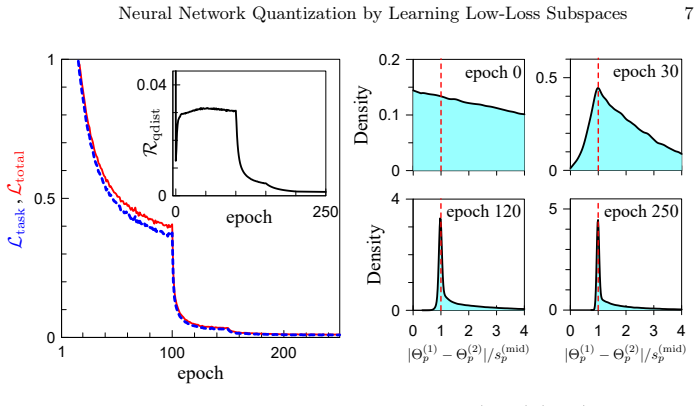
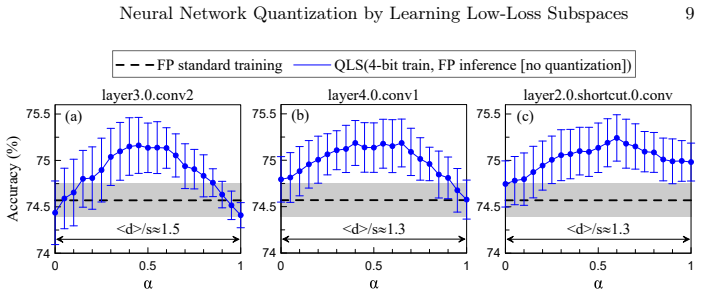

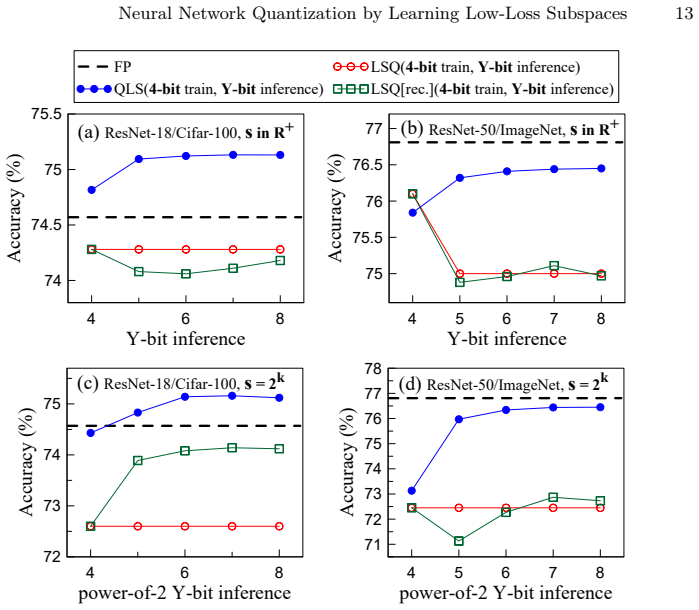
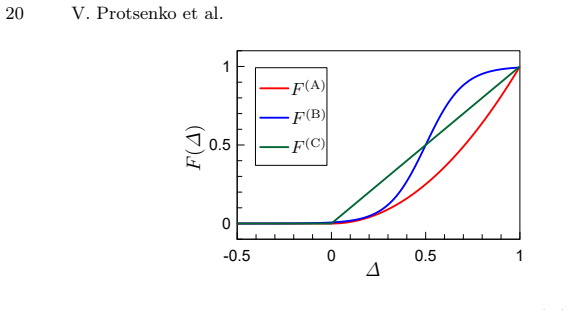


read the original abstract
Neural network quantization aims to find a discrete representation of parameters that preserves the performance of a full-precision (FP) model as faithfully as possible. Enforcing discrete constraints perturbs parameters away from a well-optimized minimum, generally resulting in performance degradation. Recent studies indicate that low-loss FP solutions are not isolated, but instead belong to connected low-loss subspaces of the loss landscape, where the loss maintains nearly the same minimum value. Models sampled from these subspaces are diverse and retain high accuracy. This raises the question: can a quantized model be constructed to lie within a low-loss subspace of the FP model, thereby automatically preserving performance? We address this question by learning quantization-aware linear paths in weight space optimized to minimize loss. We demonstrate that the midpoint of the resulting subspace is, by design, quantization-friendly and that its direct quantization yields performance comparable to that of quantization-aware training. The proposed procedure offers a novel perspective on weight quantization and, in contrast to conventional methods, neither relies on the straight-through estimator nor involves explicit discretization during training.
Editorial analysis
A structured set of objections, weighed in public.
Referee Report
Summary. The paper proposes learning quantization-aware linear paths in weight space, optimized solely to minimize full-precision (FP) loss without using the straight-through estimator (STE) or explicit discretization during training. Building on the existence of connected low-loss subspaces in the FP loss landscape, it claims that the midpoint of the resulting subspace is quantization-friendly by design, such that its direct (post-training) quantization achieves performance comparable to quantization-aware training (QAT).
Significance. If the central claim holds with supporting experiments, the work would provide a conceptually distinct route to quantization that sidesteps STE-related instabilities and discretization during optimization. It would also give a concrete use case for low-loss subspace connectivity results. However, the significance is currently difficult to assess because the manuscript provides no quantitative results, error bars, dataset details, or ablation studies in the available description.
major comments (1)
- [Abstract] Abstract: The claim that the midpoint is 'quantization-friendly by design' is not mechanistically justified by the stated procedure. The optimization minimizes FP loss along linear paths; quantization applies a rounding perturbation that is never incorporated (even approximately) into the objective. Low-loss connectivity guarantees that the midpoint retains low FP loss, but supplies no guarantee of reduced sensitivity to that specific perturbation relative to a conventional minimum. This directly undercuts the assertion that direct quantization will match QAT performance.
minor comments (1)
- The manuscript should clarify the precise parameterization of the linear paths (e.g., how the two endpoints are initialized and constrained) and the exact loss used for path optimization.
Simulated Author's Rebuttal
We thank the referee for their detailed review and constructive feedback on our work. We provide a point-by-point response to the major comment below.
read point-by-point responses
-
Referee: [Abstract] Abstract: The claim that the midpoint is 'quantization-friendly by design' is not mechanistically justified by the stated procedure. The optimization minimizes FP loss along linear paths; quantization applies a rounding perturbation that is never incorporated (even approximately) into the objective. Low-loss connectivity guarantees that the midpoint retains low FP loss, but supplies no guarantee of reduced sensitivity to that specific perturbation relative to a conventional minimum. This directly undercuts the assertion that direct quantization will match QAT performance.
Authors: We agree with the referee that the optimization procedure minimizes the full-precision loss and does not explicitly incorporate the quantization rounding into the objective function. The low-loss subspace connectivity indeed ensures that the midpoint has low FP loss, but does not automatically imply reduced sensitivity to quantization perturbations. Our assertion that the midpoint is 'quantization-friendly by design' was intended to convey that the learned subspace positions the midpoint in a region where direct quantization performs well, as validated by our experiments. However, we acknowledge that a stronger mechanistic explanation would strengthen the paper. We will revise the abstract to temper the 'by design' language and clarify that the performance comparability is demonstrated empirically. Additionally, we will add discussion in the main text on potential reasons why such subspaces yield quantization-robust points, such as the flatness of the loss landscape along the learned direction potentially mitigating small perturbations like rounding. revision: yes
Circularity Check
No circularity; derivation depends on external low-loss subspace literature
full rationale
The paper's central construction optimizes linear paths in weight space to minimize FP loss (explicitly without STE or discretization) and invokes the midpoint's quantization-friendliness via the external claim that low-loss FP solutions lie in connected subspaces. This relies on cited prior studies rather than any internal equation that defines the target property in terms of the optimization output or renames a fitted quantity as a prediction. No self-citation chain, ansatz smuggling, or self-definitional reduction appears in the provided text; the result is therefore not forced by the paper's own inputs.
Axiom & Free-Parameter Ledger
axioms (1)
- domain assumption Low-loss full-precision solutions belong to connected low-loss subspaces of the loss landscape
Reference graph
Works this paper leans on
-
[2]
arXiv preprint arXiv:2404.11769 (2024)
AskariHemmat, M., Jeddi, A., Hemmat, R.A., Lazarevich, I., Hoffman, A., Sah, S., Saboori, E., Savaria, Y., David, J.P.: Qgen: On the ability to generalize in quantization aware training. arXiv preprint arXiv:2404.11769 (2024)
- [3]
-
[4]
Estimating or Propagating Gradients Through Stochastic Neurons for Conditional Computation
Bengio, Y., Léonard, N., Courville, A.: Estimating or propagating gradi- ents through stochastic neurons for conditional computation. arXiv preprint arXiv:1308.3432 (2013)
work page internal anchor Pith review Pith/arXiv arXiv 2013
-
[5]
Advances in Neural Information Processing Systems32(2019)
Chen,S.,Wang,W.,Pan,S.J.:Metaquant:Learningtoquantizebylearningtopen- etrate non-differentiable quantization. Advances in Neural Information Processing Systems32(2019)
2019
-
[6]
Advances in neural information processing systems33, 5308–5317 (2020)
Chmiel,B.,Banner,R.,Shomron,G.,Nahshan,Y.,Bronstein,A.,Weiser,U.,etal.: Robust quantization: One model to rule them all. Advances in neural information processing systems33, 5308–5317 (2020)
2020
-
[7]
In: International conference on machine learning
Draxler, F., Veschgini, K., Salmhofer, M., Hamprecht, F.: Essentially no barriers in neural network energy landscape. In: International conference on machine learning. pp. 1309–1318. PMLR (2018)
2018
-
[8]
arXiv preprint arXiv:1902.08153 (2019)
Esser, S.K., McKinstry, J.L., Bablani, D., Appuswamy, R., Modha, D.S.: Learned step size quantization. arXiv preprint arXiv:1902.08153 (2019)
-
[9]
arXiv preprint arXiv:2511.04808 (2025)
Fan, R., Sandlund, B., Ko, L.M.: Sharp minima can generalize: A loss landscape perspective on data. arXiv preprint arXiv:2511.04808 (2025)
-
[10]
In: International Conference on Artificial Intelligence and Statistics
Ferbach, D., Goujaud, B., Gidel, G., Dieuleveut, A.: Proving linear mode connec- tivity of neural networks via optimal transport. In: International Conference on Artificial Intelligence and Statistics. pp. 3853–3861. PMLR (2024)
2024
-
[11]
Sharpness-Aware Minimization for Efficiently Improving Generalization
Foret, P., Kleiner, A., Mobahi, H., Neyshabur, B.: Sharpness-aware minimization for efficiently improving generalization. arXiv preprint arXiv:2010.01412 (2020)
work page internal anchor Pith review Pith/arXiv arXiv 2010
-
[12]
qualitatively characterizing neural network optimization problems
Frankle, J.: Revisiting" qualitatively characterizing neural network optimization problems". arXiv preprint arXiv:2012.06898 (2020)
-
[13]
In: International conference on machine learning
Frankle, J., Dziugaite, G.K., Roy, D., Carbin, M.: Linear mode connectivity and the lottery ticket hypothesis. In: International conference on machine learning. pp. 3259–3269. PMLR (2020)
2020
-
[14]
GPTQ: Accurate Post-Training Quantization for Generative Pre-trained Transformers
Frantar, E., Ashkboos, S., Hoefler, T., Alistarh, D.: Gptq: Accurate post- training quantization for generative pre-trained transformers. arXiv preprint arXiv:2210.17323 (2022)
work page internal anchor Pith review Pith/arXiv arXiv 2022
-
[15]
Topology and Geometry of Half-Rectified Network Optimization
Freeman, C.D., Bruna, J.: Topology and geometry of half-rectified network opti- mization. arXiv preprint arXiv:1611.01540 (2016) 16 V. Protsenko et al
work page internal anchor Pith review Pith/arXiv arXiv 2016
-
[16]
Advances in neural infor- mation processing systems31(2018)
Garipov, T., Izmailov, P., Podoprikhin, D., Vetrov, D.P., Wilson, A.G.: Loss sur- faces, mode connectivity, and fast ensembling of dnns. Advances in neural infor- mation processing systems31(2018)
2018
-
[17]
In: Low-Power Computer Vision, pp
Gholami, A., Kim, S., Dong, Z., Yao, Z., Mahoney, M.W., Keutzer, K.: A sur- vey of quantization methods for efficient neural network inference. In: Low-Power Computer Vision, pp. 291–326. Chapman and Hall/CRC (2022)
2022
-
[18]
Qualitatively characterizing neural network optimization problems
Goodfellow, I.J., Vinyals, O., Saxe, A.M.: Qualitatively characterizing neural net- work optimization problems. arXiv preprint arXiv:1412.6544 (2014)
work page internal anchor Pith review Pith/arXiv arXiv 2014
-
[19]
arXiv preprint arXiv:2510.10693 (2025)
Ichikawa, Y., Kashiwamura, S., Sakata, A.: High-dimensional learning dy- namics of quantized models with straight-through estimator. arXiv preprint arXiv:2510.10693 (2025)
-
[20]
Averaging Weights Leads to Wider Optima and Better Generalization
Izmailov, P., Podoprikhin, D., Garipov, T., Vetrov, D., Wilson, A.G.: Aver- aging weights leads to wider optima and better generalization. arXiv preprint arXiv:1803.05407 (2018)
work page internal anchor Pith review Pith/arXiv arXiv 2018
-
[21]
In: Proceedings of the IEEE conference on computer vision and pattern recognition
Jacob, B., Kligys, S., Chen, B., Zhu, M., Tang, M., Howard, A., Adam, H., Kalenichenko,D.:Quantizationandtrainingofneuralnetworksforefficientinteger- arithmetic-only inference. In: Proceedings of the IEEE conference on computer vision and pattern recognition. pp. 2704–2713 (2018)
2018
-
[22]
arXiv preprint arXiv:2410.06020 (2024)
Javed, S., Le, H., Salzmann, M.: Qt-dog: Quantization-aware training for domain generalization. arXiv preprint arXiv:2410.06020 (2024)
-
[23]
In: Proceedings of the 33rd ACM International Conference on Multimedia
Jiang, J., Meng, Y., Tang, C., Yu, H., Li, Q., Wang, Z., Zhu, W.: Quantization meets ood: Generalizable quantization-aware training from a flatness perspective. In: Proceedings of the 33rd ACM International Conference on Multimedia. pp. 11937–11946 (2025)
2025
-
[24]
arXiv preprint arXiv:2305.19510 (2023)
Karhadkar, K., Murray, M., Tseran, H., Montúfar, G.: Mildly overparameterized relu networks have a favorable loss landscape. arXiv preprint arXiv:2305.19510 (2023)
-
[25]
In: Proceedings of the IEEE/CVF international conference on computer vision
Kim, D., Lee, J., Ham, B.: Distance-aware quantization. In: Proceedings of the IEEE/CVF international conference on computer vision. pp. 5271–5280 (2021)
2021
-
[26]
Quantizing deep convolutional networks for efficient inference: A whitepaper
Krishnamoorthi, R.: Quantizing deep convolutional networks for efficient inference: A whitepaper. arXiv preprint arXiv:1806.08342 (2018)
work page internal anchor Pith review Pith/arXiv arXiv 2018
-
[27]
In: Proceedings of the IEEE/CVF conference on computer vision and pattern recognition
Lee, J., Kim, D., Ham, B.: Network quantization with element-wise gradient scal- ing. In: Proceedings of the IEEE/CVF conference on computer vision and pattern recognition. pp. 6448–6457 (2021)
2021
-
[28]
In: Proceedings of the IEEE/CVF International Conference on Computer Vision
Lee, T., Seo, K., Yoo, J., Yoon, S.W.: Understanding flatness in generative models: Its role and benefits. In: Proceedings of the IEEE/CVF International Conference on Computer Vision. pp. 4908–4917 (2025)
2025
-
[29]
In: Proceedings of the Computer Vision and Pattern Recognition Conference
Li, A., Zhuang, L., Long, X., Yao, M., Wang, S.: Seeking consistent flat minima for better domain generalization via refining loss landscapes. In: Proceedings of the Computer Vision and Pattern Recognition Conference. pp. 15349–15359 (2025)
2025
-
[30]
In: Findings of the association for computational linguistics: EMNLP 2024
Li, H., Ding, L., Fang, M., Tao, D.: Revisiting catastrophic forgetting in large lan- guage model tuning. In: Findings of the association for computational linguistics: EMNLP 2024. pp. 4297–4308 (2024)
2024
-
[31]
arXiv preprint arXiv:2205.131044(2022)
Li, T., Huang, Z., Tao, Q., Wu, Y., Huang, X.: Trainable weight averaging for fast convergence and better generalization. arXiv preprint arXiv:2205.131044(2022)
-
[32]
arXiv preprint arXiv:1909.13144 (2019)
Li, Y., Dong, X., Wang, W.: Additive powers-of-two quantization: An efficient non-uniform discretization for neural networks. arXiv preprint arXiv:1909.13144 (2019)
-
[33]
In: Computer Vision–ECCV 2020 Workshops: Glasgow, UK, August 23–28, 2020, Proceedings, Part III 16
Liu, J., Tang, J., Wu, G.: Residual feature distillation network for lightweight image super-resolution. In: Computer Vision–ECCV 2020 Workshops: Glasgow, UK, August 23–28, 2020, Proceedings, Part III 16. pp. 41–55. Springer (2020) Neural Network Quantization by Learning Low-Loss Subspaces 17
2020
-
[34]
Sharpness-aware quantization for deep neural networks
Liu,J.,Cai,J.,Zhuang,B.:Sharpness-awarequantizationfordeepneuralnetworks. arXiv preprint arXiv:2111.12273 (2021)
-
[35]
Advances in Neural Information Processing Systems 36, 12291–12311 (2023)
Liu, L., Dong, C., Liu, X., Yu, B., Gao, J.: Bridging discrete and backpropagation: Straight-through and beyond. Advances in Neural Information Processing Systems 36, 12291–12311 (2023)
2023
-
[36]
Relaxed Quantization for Discretized Neural Networks
Louizos, C., Reisser, M., Blankevoort, T., Gavves, E., Welling, M.: Relaxed quan- tization for discretized neural networks. arXiv preprint arXiv:1810.01875 (2018)
work page internal anchor Pith review Pith/arXiv arXiv 2018
-
[37]
arXiv preprint arXiv:2505.04877 (2025)
Ma, L., Ma, J., Zhou, Y., Xie, G., He, Q., Lu, Z.: Learning from loss landscape: Generalizable mixed-precision quantization via adaptive sharpness-aware gradient aligning. arXiv preprint arXiv:2505.04877 (2025)
-
[38]
In: Proceedings of the IEEE/CVF international conference on computer vision
Nagel, M., Baalen, M.v., Blankevoort, T., Welling, M.: Data-free quantization through weight equalization and bias correction. In: Proceedings of the IEEE/CVF international conference on computer vision. pp. 1325–1334 (2019)
2019
-
[39]
A White Paper on Neural Network Quantization
Nagel, M., Fournarakis, M., Amjad, R.A., Bondarenko, Y., Van Baalen, M., Blankevoort, T.: A white paper on neural network quantization. arXiv preprint arXiv:2106.08295 (2021)
work page internal anchor Pith review Pith/arXiv arXiv 2021
-
[40]
In: International Conference on Machine Learning
Nagel, M., Fournarakis, M., Bondarenko, Y., Blankevoort, T.: Overcoming oscil- lations in quantization-aware training. In: International Conference on Machine Learning. pp. 16318–16330. PMLR (2022)
2022
-
[41]
Machine Learning 110(11), 3245–3262 (2021)
Nahshan, Y., Chmiel, B., Baskin, C., Zheltonozhskii, E., Banner, R., Bronstein, A.M., Mendelson, A.: Loss aware post-training quantization. Machine Learning 110(11), 3245–3262 (2021)
2021
-
[42]
In: Proceedings of the IEEE/CVF Winter Conference on Applications of Computer Vision
Nunez, E., Horton, M., Prabhu, A., Ranjan, A., Farhadi, A., Rastegari, M.: Lcs: Learning compressible subspaces for efficient, adaptive, real-time network compres- sion at inference time. In: Proceedings of the IEEE/CVF Winter Conference on Applications of Computer Vision. pp. 3818–3827 (2023)
2023
-
[43]
IEEE Transactions on Neural Networks and Learning Systems35(12), 17164–17176 (2023)
Pei, Z., Yao, X., Zhao, W., Yu, B.: Quantization via distillation and contrastive learning. IEEE Transactions on Neural Networks and Learning Systems35(12), 17164–17176 (2023)
2023
-
[44]
In: Proceedings of the AAAI Conference on Artificial Intelligence
Shin, S., Park, J., Boo, Y., Sung, W.: Hlhlp: Quantized neural networks training for reaching flat minima in loss surface. In: Proceedings of the AAAI Conference on Artificial Intelligence. vol. 34, pp. 5784–5791 (2020)
2020
-
[45]
In: Proceedings of the IEEE/CVF Conference on Computer Vision and Pattern Recognition
Spallanzani, M., Leonardi, G.P., Benini, L.: Training quantised neural networks with ste variants: the additive noise annealing algorithm. In: Proceedings of the IEEE/CVF Conference on Computer Vision and Pattern Recognition. pp. 470–479 (2022)
2022
-
[46]
arXiv preprint arXiv:2007.12927 (2020)
Von Oswald, J., Kobayashi, S., Meulemans, A., Henning, C., Grewe, B.F., Sacramento, J.: Neural networks with late-phase weights. arXiv preprint arXiv:2007.12927 (2020)
-
[47]
arXiv preprint arXiv:2210.07171 (2022)
Wang, Z., Li, J.B., Qu, S., Metze, F., Strubell, E.: Squat: Sharpness-and quantization-aware training for bert. arXiv preprint arXiv:2210.07171 (2022)
-
[49]
In: International conference on machine learning
Wortsman, M., Ilharco, G., Gadre, S.Y., Roelofs, R., Gontijo-Lopes, R., Morcos, A.S., Namkoong, H., Farhadi, A., Carmon, Y., Kornblith, S., et al.: Model soups: averagingweightsofmultiplefine-tunedmodelsimprovesaccuracywithoutincreas- ing inference time. In: International conference on machine learning. pp. 23965– 23998. PMLR (2022)
2022
-
[50]
Towards Understanding Generalization of Deep Learning: Perspective of Loss Landscapes
Wu, L., Zhu, Z., et al.: Towards understanding generalization of deep learning: Perspective of loss landscapes. arXiv preprint arXiv:1706.10239 (2017) 18 V. Protsenko et al
work page internal anchor Pith review Pith/arXiv arXiv 2017
-
[51]
arXiv preprint arXiv:2511.01462 (2025)
Xia, P., Pang, J., Cai, T.: Efficiently training a flat neural network before it has been quantizated. arXiv preprint arXiv:2511.01462 (2025)
-
[52]
In: International conference on machine learning
Xiao,G.,Lin,J.,Seznec,M.,Wu,H.,Demouth,J.,Han,S.:Smoothquant:Accurate and efficient post-training quantization for large language models. In: International conference on machine learning. pp. 38087–38099. PMLR (2023)
2023
-
[53]
arXiv preprint arXiv:2204.12322 (2022)
Yao, H., Li, P., Cao, J., Liu, X., Xie, C., Wang, B.: Rapq: Rescuing accuracy for power-of-two low-bit post-training quantization. arXiv preprint arXiv:2204.12322 (2022)
-
[54]
arXiv preprint arXiv:1903.05662 (2019)
Yin, P., Lyu, J., Zhang, S., Osher, S., Qi, Y., Xin, J.: Understanding straight- through estimator in training activation quantized neural nets. arXiv preprint arXiv:1903.05662 (2019)
-
[55]
arXiv preprint arXiv:2412.15846 (2024)
Yu, C., Yang, S., Zhang, F., Ma, H., Wang, A., Li, E.P.: Improving quantization- aware training of low-precision network via block replacement on full-precision counterpart. arXiv preprint arXiv:2412.15846 (2024)
-
[56]
arXiv preprint arXiv:2506.10463 (2025)
Yun, S., Wong, A.: Starting positions matter: A study on better weight initializa- tion for neural network quantization. arXiv preprint arXiv:2506.10463 (2025)
-
[57]
arXiv preprint arXiv:2206.05916 (2022)
Zhang, K., Yin, M., Wang, Y.X.: Why quantization improves generalization: Ntk of binary weight neural networks. arXiv preprint arXiv:2206.05916 (2022)
-
[58]
arXiv preprint arXiv:2406.16988 (2024)
Zhou, Y., Chen, J., Cao, Q., Schürholt, K., Yang, Y.: Md tree: a model-diagnostic tree grown on loss landscape. arXiv preprint arXiv:2406.16988 (2024)
-
[59]
Zhou, Z., Sun, Y., Li, B., Wang, J., Wu, H., Wu, L., Yan, J.: How does local landscape geometry evolve in language model pre-training?
-
[60]
Neural Network Quantization by Learning Low-Loss Subspaces
Zimmer, M., Spiegel, C., Pokutta, S.: Sparse model soups: A recipe for improved pruning via model averaging. arXiv preprint arXiv:2306.16788 (2023) Supplemental Material to “Neural Network Quantization by Learning Low-Loss Subspaces” Vladimir Protsenko , Mikhalina Kharkevich , Alexander Vashchilko , and Vladimir Kryzhanovskiy Huawei, Montreal, Canada {pro...
-
[61]
ResNet-18 & ResNet-50 (TinyImageNet).Models are trained for 300 epochs with a batch size of 128
The batch size is 64, and Adam is used with the same weight decay as above. ResNet-18 & ResNet-50 (TinyImageNet).Models are trained for 300 epochs with a batch size of 128. The initial learning rate is 0.1 and is decayed to zero using a cosine scheduler. Optimization is performed using SGD with a weight decay of5×10 −4. ResNet-18 & ResNet-50 (ImageNet).Mo...
-
[62]
In: Proceedings of the IEEE conference on computer vision and pattern recognition workshops
Agustsson, E., Timofte, R.: Ntire 2017 challenge on single image super-resolution: Dataset and study. In: Proceedings of the IEEE conference on computer vision and pattern recognition workshops. pp. 126–135 (2017)
2017
-
[63]
Bevilacqua, M., Roumy, A., Guillemot, C., Alberi-Morel, M.L.: Low-complexity single-image super-resolution based on nonnegative neighbor embedding (2012)
2012
-
[64]
In: 2009 IEEE conference on computer vision and pattern recognition
Deng, J., Dong, W., Socher, R., Li, L.J., Li, K., Fei-Fei, L.: Imagenet: A large- scale hierarchical image database. In: 2009 IEEE conference on computer vision and pattern recognition. pp. 248–255. Ieee (2009)
2009
-
[65]
In: Proceedings of the IEEE conference on computer vision and pattern recognition
Huang, J.B., Singh, A., Ahuja, N.: Single image super-resolution from transformed self-exemplars. In: Proceedings of the IEEE conference on computer vision and pattern recognition. pp. 5197–5206 (2015)
2015
-
[66]
Adam: A Method for Stochastic Optimization
Kingma, D.P., Ba, J.: Adam: A method for stochastic optimization. arXiv preprint arXiv:1412.6980 (2014)
work page internal anchor Pith review Pith/arXiv arXiv 2014
-
[67]
Krizhevsky, A., Hinton, G., et al.: Learning multiple layers of features from tiny images (2009)
2009
-
[68]
CS 231N7(7), 3 (2015)
Le, Y., Yang, X., et al.: Tiny imagenet visual recognition challenge. CS 231N7(7), 3 (2015)
2015
-
[69]
In: Computer Vision–ECCV 2020 Workshops: Glasgow, UK, August 23–28, 2020, Proceedings, Part III 16
Liu, J., Tang, J., Wu, G.: Residual feature distillation network for lightweight image super-resolution. In: Computer Vision–ECCV 2020 Workshops: Glasgow, UK, August 23–28, 2020, Proceedings, Part III 16. pp. 41–55. Springer (2020)
2020
-
[70]
International journal of computer vision115, 211–252 (2015)
Russakovsky, O., Deng, J., Su, H., Krause, J., Satheesh, S., Ma, S., Huang, Z., Karpathy, A., Khosla, A., Bernstein, M., et al.: Imagenet large scale visual recog- nition challenge. International journal of computer vision115, 211–252 (2015)
2015
-
[71]
In: International Conference on Machine Learning
Wortsman, M., Horton, M.C., Guestrin, C., Farhadi, A., Rastegari, M.: Learning neural network subspaces. In: International Conference on Machine Learning. pp. 11217–11227. PMLR (2021)
2021
-
[72]
In: Curves and Surfaces: 7th International Conference, Avignon, France, June 24-30, 2010, Revised Selected Papers 7
Zeyde, R., Elad, M., Protter, M.: On single image scale-up using sparse- representations. In: Curves and Surfaces: 7th International Conference, Avignon, France, June 24-30, 2010, Revised Selected Papers 7. pp. 711–730. Springer (2012)
2010
discussion (0)
Sign in with ORCID, Apple, or X to comment. Anyone can read and Pith papers without signing in.