Diffusion Crossover: Defining Evolutionary Recombination in Diffusion Models via Noise Sequence Interpolation
Pith reviewed 2026-05-10 10:33 UTC · model grok-4.3
The pith
Diffusion models support evolutionary crossover by applying spherical interpolation to parent noise sequences in the reverse process.
A machine-rendered reading of the paper's core claim, the machinery that carries it, and where it could break.
Core claim
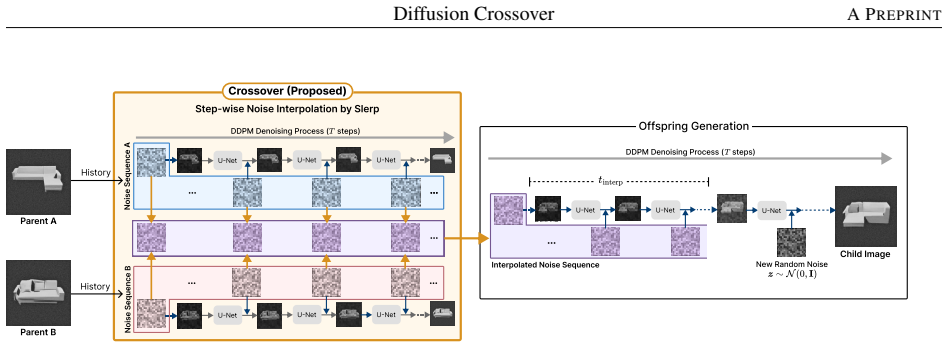
We propose Diffusion crossover, which formulates evolutionary recombination as step-wise interpolation of noise sequences in the reverse process of Denoising Diffusion Probabilistic Models (DDPMs). By applying spherical linear interpolation (Slerp) to the noise sequences associated with selected parent images, the proposed method generates offspring that inherit characteristics from both parents while preserving the geometric structure of the diffusion process. Furthermore, controlling the time-step range of interpolation enables a principled trade-off between diversity (exploration) and convergence (exploitation).
What carries the argument
Step-wise spherical linear interpolation (Slerp) of noise sequences from parent images during the DDPM reverse diffusion process, which acts as the explicit mechanism for evolutionary recombination.
If this is right
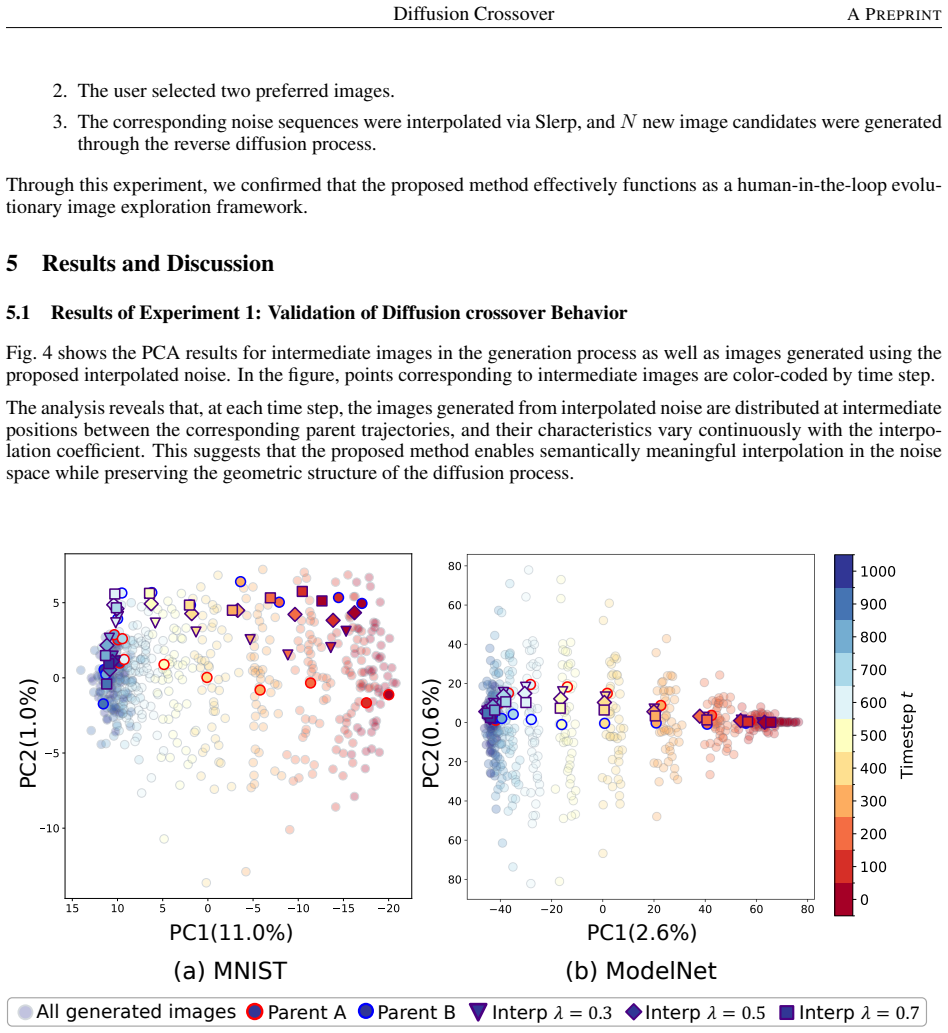
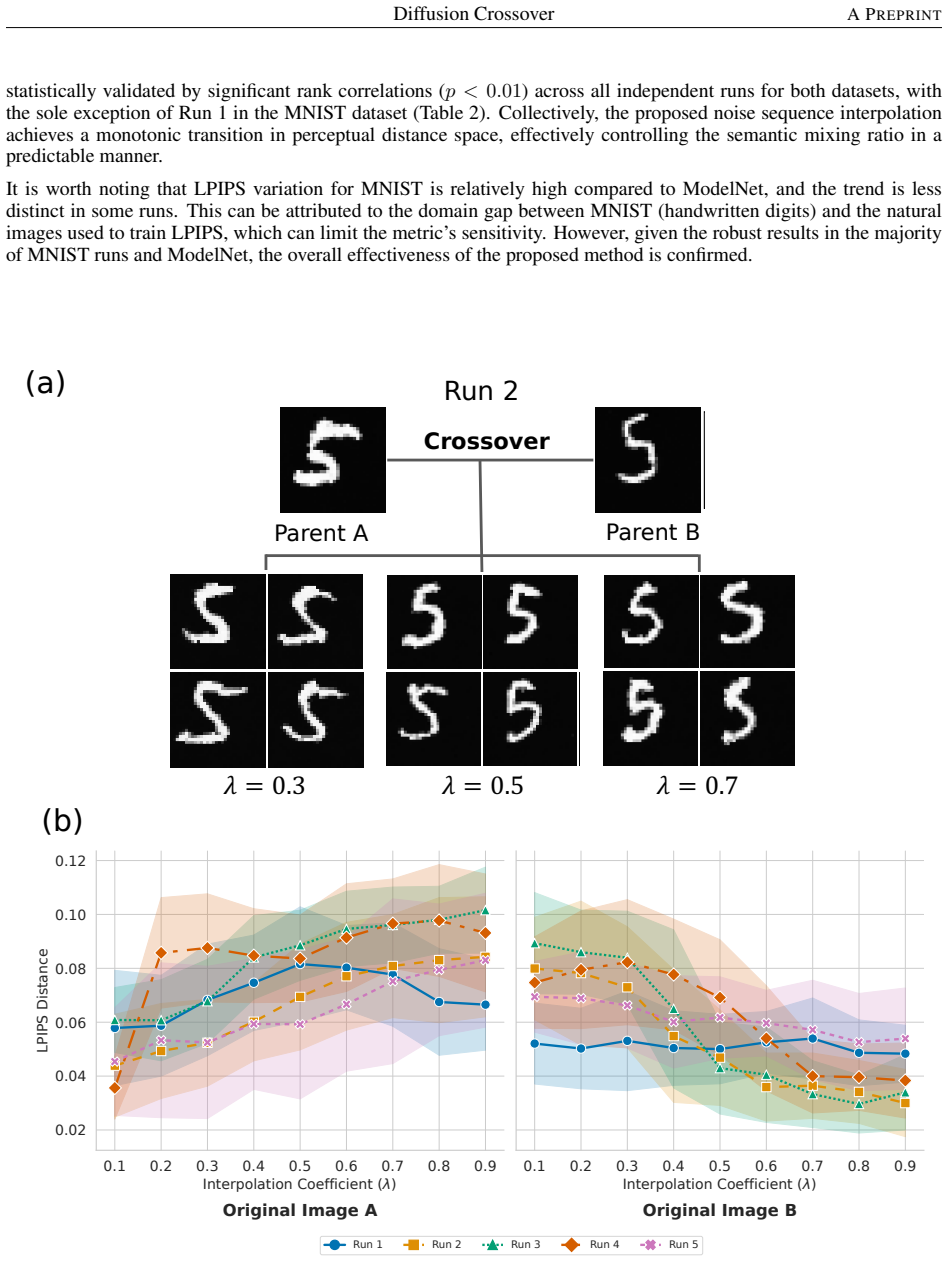
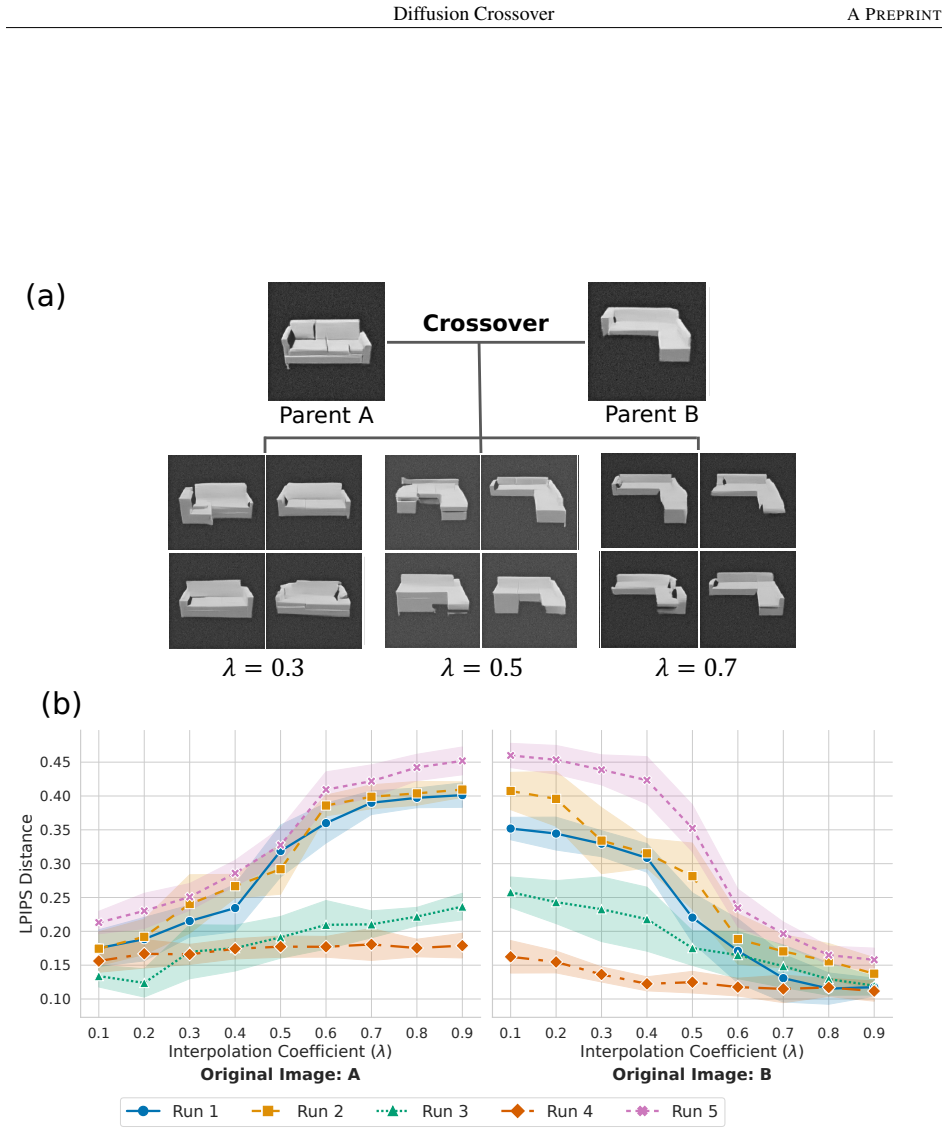
- Offspring exhibit perceptually smooth and semantically consistent transitions, as measured by PCA analysis and LPIPS perceptual similarity.
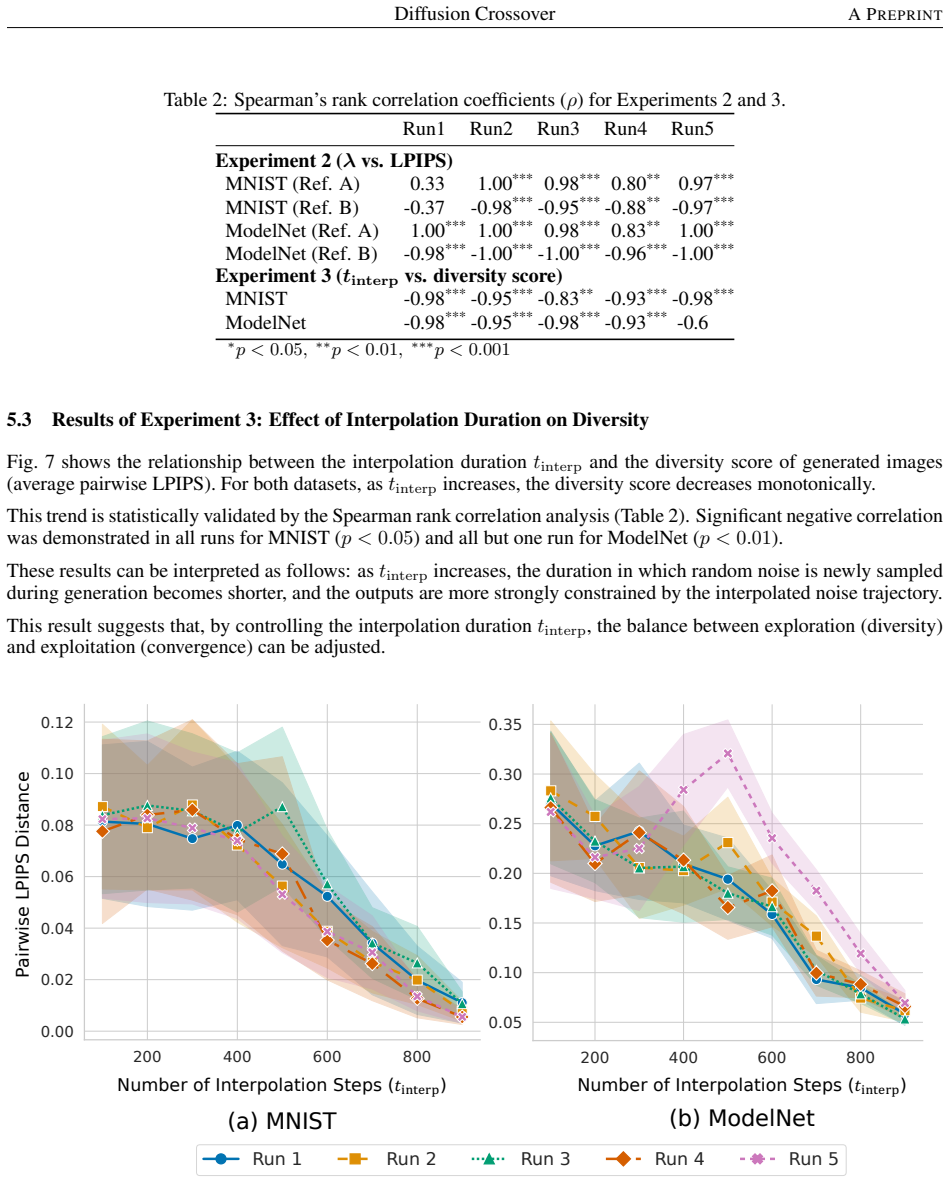
- Varying the time-step range of interpolation directly trades off image diversity against convergence to parental traits.
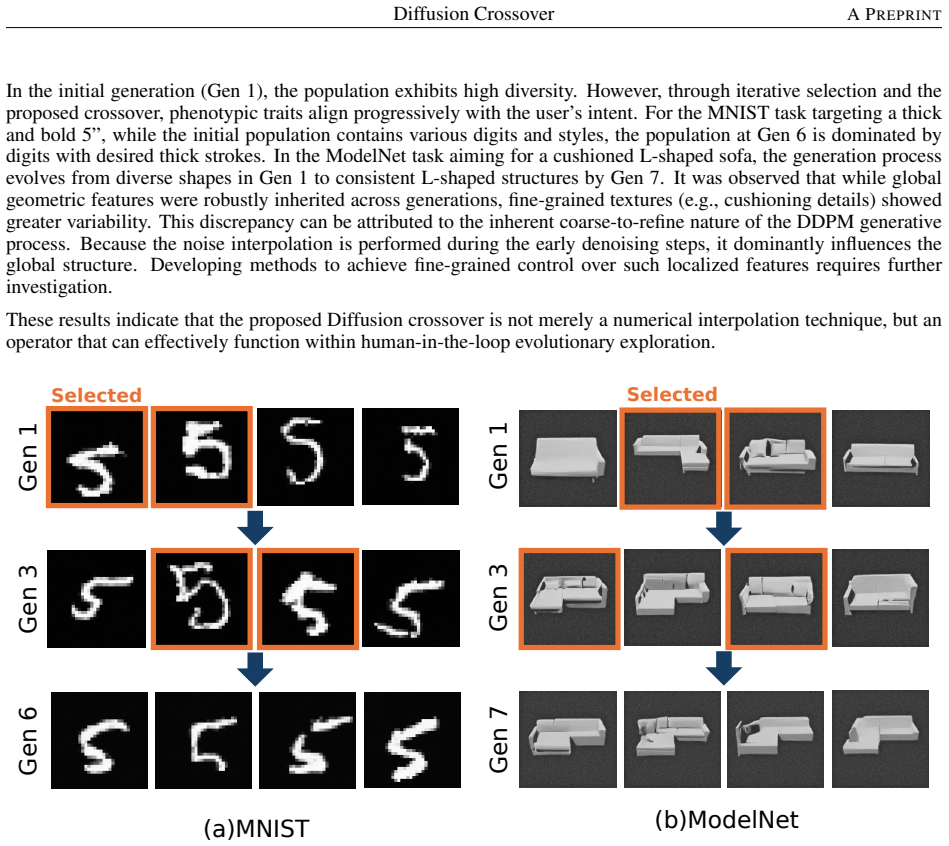
- The approach supplies a practical operator for human-in-the-loop image exploration within interactive evolutionary systems.
- Diffusion models function as explicit, controllable evolutionary search spaces rather than black-box generators.
Where Pith is reading between the lines
- Similar noise-sequence interpolation could be tested in other sequential generative models to create recombination operators without retraining.
- The method might be combined with diffusion-specific mutation operators that add controlled noise at selected steps to balance exploration more finely.
- In creative design workflows the controllable trade-off could let users evolve families of images while staying within desired stylistic bounds.
- Quantitative tracking of trait inheritance via embedding distances could turn the operator into a measurable genetic algorithm component for generative tasks.
Load-bearing premise
That interpolating noise sequences step by step in the reverse process will produce offspring images whose visual traits combine those of the parents in a controllable and semantically consistent way rather than arbitrary or broken blends.
What would settle it
An experiment in which LPIPS distances between generated offspring and their parents fail to vary smoothly with the interpolation parameter, or in which visual inspection shows offspring lack distinct inherited features from each parent.
Figures
read the original abstract
Interactive Evolutionary Computation (IEC) provides a powerful framework for optimizing subjective criteria such as human preferences and aesthetics, yet it suffers from a fundamental limitation: in high-dimensional generative representations, defining crossover in a semantically consistent manner is difficult, often leading to a mutation-dominated search. In this work, we explicitly define crossover in diffusion models. We propose Diffusion crossover, which formulates evolutionary recombination as step-wise interpolation of noise sequences in the reverse process of Denoising Diffusion Probabilistic Models (DDPMs). By applying spherical linear interpolation (Slerp) to the noise sequences associated with selected parent images, the proposed method generates offspring that inherit characteristics from both parents while preserving the geometric structure of the diffusion process. Furthermore, controlling the time-step range of interpolation enables a principled trade-off between diversity (exploration) and convergence (exploitation). Experimental results using PCA analysis and perceptual similarity metrics (LPIPS) demonstrate that Diffusion crossover produces perceptually smooth and semantically consistent transitions between parent images. Qualitative interactive evolution experiments further confirm that the proposed method effectively supports human-in-the-loop image exploration. These findings suggest a new perspective: diffusion models are not only powerful generators, but also structured evolutionary search spaces in which recombination can be explicitly defined and controlled.
Editorial analysis
A structured set of objections, weighed in public.
Referee Report
Summary. The paper proposes 'Diffusion Crossover' as an explicit recombination operator for diffusion models in interactive evolutionary computation. It defines crossover via step-wise spherical linear interpolation (Slerp) of the noise sequences used to generate parent images in the DDPM reverse process, claiming that this produces offspring inheriting characteristics from both parents while preserving the diffusion geometry. The timestep range of interpolation is presented as a control for the diversity-convergence trade-off. Supporting evidence consists of PCA analysis and LPIPS perceptual metrics indicating smooth, semantically consistent transitions, plus qualitative results from human-in-the-loop image exploration.
Significance. If the central claim holds, the work would offer a parameter-free recombination mechanism grounded in the existing DDPM reverse process and standard Slerp, addressing the mutation-dominated limitation of IEC in high-dimensional generative spaces. It reframes diffusion models as structured evolutionary search spaces with controllable recombination, which could improve human-in-the-loop optimization of subjective criteria. The absence of invented free parameters and the direct use of the diffusion process are notable strengths.
major comments (2)
- [Abstract and Experimental Results] The claim that step-wise Slerp on noise sequences yields offspring that 'inherit characteristics from both parents' in a controllable, semantically meaningful way rests on PCA and LPIPS results (Abstract). These metrics primarily quantify global manifold smoothness and perceptual distance rather than explicit, measurable inheritance of distinct parental traits (e.g., object identity or style) under controlled variation of the interpolation range; this is load-bearing for the recombination definition and requires stronger validation such as trait-specific ablations or semantic metrics.
- [Method and Abstract] Because the DDPM reverse step applies a non-linear denoising network conditioned on the current latent and timestep, linear/spherical mixing of noise inputs at corresponding steps does not automatically guarantee corresponding mixing of high-level semantic features (Abstract). The manuscript would benefit from explicit analysis showing how the interpolation range maps to trait blending, as the current evidence leaves open the possibility of arbitrary blends rather than principled recombination.
minor comments (1)
- The abstract and method description would be clearer with a concise pseudocode or equation for the exact Slerp application across timesteps and the precise definition of the interpolation range parameter.
Simulated Author's Rebuttal
We thank the referee for the constructive comments, which identify key areas where the validation of our recombination operator can be strengthened. We address each major comment below, providing clarification on our current evidence and indicating the revisions we will make to improve the manuscript.
read point-by-point responses
-
Referee: [Abstract and Experimental Results] The claim that step-wise Slerp on noise sequences yields offspring that 'inherit characteristics from both parents' in a controllable, semantically meaningful way rests on PCA and LPIPS results (Abstract). These metrics primarily quantify global manifold smoothness and perceptual distance rather than explicit, measurable inheritance of distinct parental traits (e.g., object identity or style) under controlled variation of the interpolation range; this is load-bearing for the recombination definition and requires stronger validation such as trait-specific ablations or semantic metrics.
Authors: We agree that PCA and LPIPS primarily demonstrate global smoothness and perceptual consistency rather than direct, trait-specific inheritance. Our experiments were designed to show that step-wise Slerp produces transitions without introducing artifacts, supporting its use as a recombination operator in IEC. To address the concern, we will revise the experimental results section to incorporate additional analysis, including feature-based metrics from a pre-trained classifier to quantify retention of distinct parental traits (such as object categories or stylistic elements) as a function of the interpolation timestep range. revision: yes
-
Referee: [Method and Abstract] Because the DDPM reverse step applies a non-linear denoising network conditioned on the current latent and timestep, linear/spherical mixing of noise inputs at corresponding steps does not automatically guarantee corresponding mixing of high-level semantic features (Abstract). The manuscript would benefit from explicit analysis showing how the interpolation range maps to trait blending, as the current evidence leaves open the possibility of arbitrary blends rather than principled recombination.
Authors: The referee is correct that the non-linearity of the denoising network means noise-sequence interpolation does not automatically imply linear semantic blending. Our approach relies on the empirical observation that the resulting trajectories remain on the data manifold and produce coherent offspring, as evidenced by the PCA projections and qualitative results. In the revised manuscript, we will expand the method description with a dedicated subsection providing explicit analysis of the interpolation range to trait blending, including further visualizations of how varying the timestep range controls the degree of feature combination from each parent. revision: partial
Circularity Check
No circularity: definition of diffusion crossover is independent of its inputs
full rationale
The paper defines crossover explicitly as step-wise Slerp interpolation on DDPM noise sequences, a construction grounded in the pre-existing DDPM reverse process and standard spherical interpolation. No equation or claim reduces the recombination operator to a fitted parameter, self-referential quantity, or prior self-citation chain. Experimental support via PCA and LPIPS is presented as empirical validation rather than a tautological consequence of the definition itself. The derivation chain therefore remains self-contained against external benchmarks.
Axiom & Free-Parameter Ledger
axioms (2)
- standard math The reverse process of Denoising Diffusion Probabilistic Models follows the standard Markov chain formulation.
- domain assumption Spherical linear interpolation of noise sequences preserves the geometric properties required for semantic consistency in generated images.
invented entities (1)
-
Diffusion crossover operator
no independent evidence
discussion (0)
Sign in with ORCID, Apple, or X to comment. Anyone can read and Pith papers without signing in.