REVIEW 1 major objections 2 minor 36 references
Influence of DFT Functionals on Low-Energy Electron Scattering Cross Sections of Nitric Oxide
T0 review · 1 major / 2 minor · reviewed 2026-06-27 · grok-4.3
Pith's one-line read Different DFT functionals alter nitric oxide's low-energy electron scattering resonances by changing its target electronic properties.
desk verdict DFT functional swaps shift NO low-energy resonances by ~0.1 eV in R-matrix runs, with ωB97X-D3 backed mainly by target-property agreement rather than direct scattering validation. read the letter →
The pith
A machine-rendered reading of the paper's core claim, the machinery that carries it, and where it could break.
The reading
What carries the argument
R-matrix scattering calculations performed on electronic target models generated by different DFT functionals, which translate variations in molecular properties into changes in resonance positions and cross-section magnitudes.
What would settle it
High-resolution experimental measurement of the position and width of the resonance feature near 1 eV, compared directly against the calculated values obtained from each functional.
Extended reading notes
Core claim
The authors establish that the DFT functional and basis set used to describe the NO target directly influence the low-energy electron-scattering observables obtained from R-matrix calculations, with the largest effects appearing in the resonance structures of the total cross sections.
Load-bearing premise
That the observed differences in scattering cross sections are caused mainly by variations in the DFT-generated target properties rather than by other fixed elements of the R-matrix setup.
Editorial extensions
If this is right
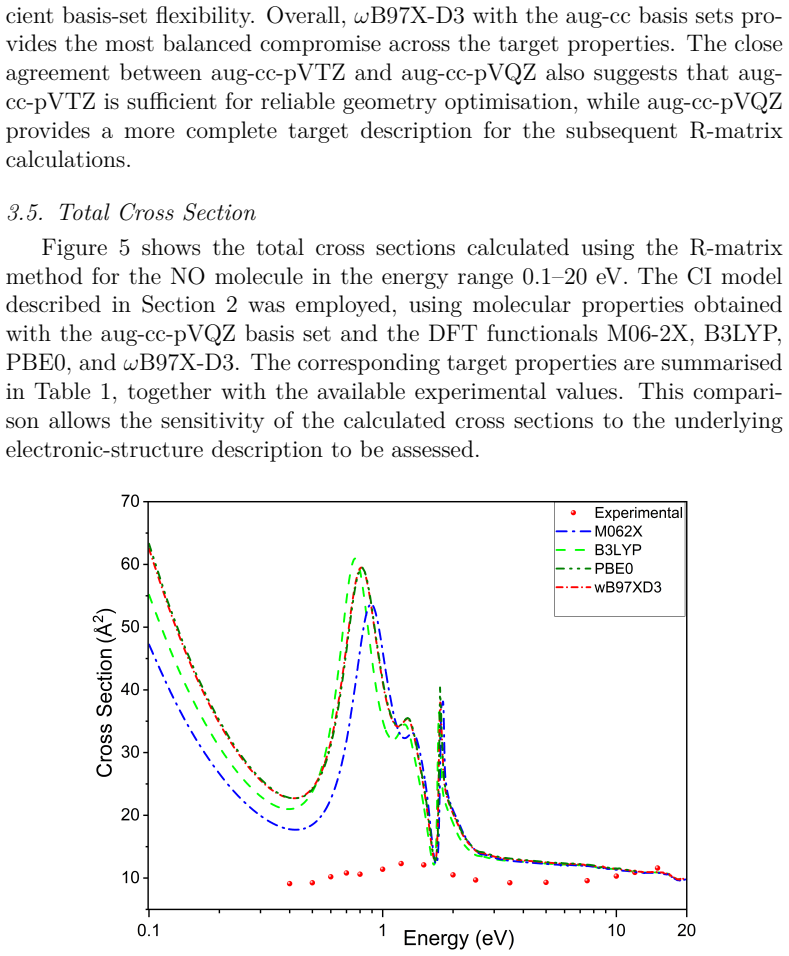
- Resonance positions in the total cross section shift from 1.74 eV to 1.82 eV depending on the functional.
- The broad peak near 0.8-1.0 eV exhibits the strongest dependence on the target description.
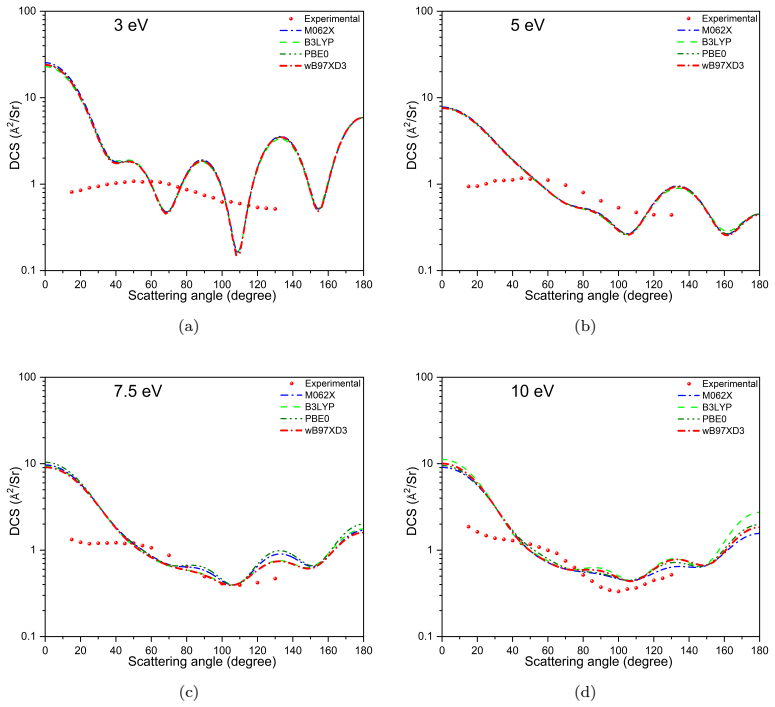
- Differential cross sections display modest functional sensitivity, clearest at 7.5 and 10 eV.
- ωB97X-D3 geometry optimisation with aug-cc-pVTZ followed by aug-cc-pVQZ property calculation is supported as a reliable protocol.
Reading between the lines
- The same DFT-sensitivity pattern may appear in scattering calculations for other atmospheric diatomic molecules.
- Selecting functionals by how well they reproduce resonance locations could improve agreement with experiment across a wider energy range.
- The protocol could be tested by predicting cross sections at energies above 20 eV and checking against new measurements.
Editorial analysis
A structured set of objections, weighed in public.
Referee Report
Summary. The manuscript performs a systematic comparison of four DFT functionals (B3LYP, M06-2X, PBE0, ωB97X-D3) and multiple basis sets for computing NO target properties (bond length, dipole moment, ionization potential, polarizability). These targets are then used in fixed-setup ab initio R-matrix calculations to generate total and differential electron-scattering cross sections from 0.1–20 eV. Resonance positions shift with functional (broad feature 0.8–1.0 eV; sharp feature 1.74–1.82 eV), and the authors recommend ωB97X-D3/aug-cc-pVTZ geometry optimization followed by aug-cc-pVQZ property calculations as a practical protocol based on closest agreement of target properties with experiment.
Significance. If the reported sensitivity holds, the work supplies concrete, actionable guidance for choosing DFT protocols when constructing R-matrix targets for NO, a molecule relevant to atmospheric, plasma, and astrophysical modeling. The approach of holding the scattering calculation fixed while swapping only the target description isolates the effect of the electronic-structure method and yields falsifiable predictions for resonance locations that can be tested against future experiments.
major comments (1)
- [Results (scattering cross sections)] The central recommendation rests on target-property agreement with experiment rather than on direct validation of the resulting cross sections against measured scattering data. A quantitative statement of how much the observed 0.08 eV shift in the sharp resonance improves or worsens agreement with existing experimental total cross sections would strengthen the claim that the protocol is practically useful for scattering applications.
minor comments (2)
- [Abstract] The abstract states that the aug-cc-pVQZ basis set was used for the R-matrix targets, yet the recommended protocol specifies aug-cc-pVTZ for geometry optimization; a brief clarification of whether single-point property calculations at the larger basis were performed on the VTZ geometries would remove ambiguity.
- [Figures/Tables] Table or figure captions listing the exact resonance peak positions (in eV) for each functional would make the reported 0.8–1.0 eV and 1.74–1.82 eV ranges easier to compare quantitatively.
Simulated Author's Rebuttal
We thank the referee for the positive assessment and the constructive suggestion. We address the major comment below.
read point-by-point responses
-
Referee: [Results (scattering cross sections)] The central recommendation rests on target-property agreement with experiment rather than on direct validation of the resulting cross sections against measured scattering data. A quantitative statement of how much the observed 0.08 eV shift in the sharp resonance improves or worsens agreement with existing experimental total cross sections would strengthen the claim that the protocol is practically useful for scattering applications.
Authors: We agree that a direct quantitative comparison of the computed total cross sections against experimental scattering data would provide stronger support for the practical utility of the recommended protocol. The manuscript isolates the effect of the target description by holding the R-matrix setup fixed and demonstrates that functional choice shifts resonance positions by up to 0.08 eV; however, it does not include a side-by-side metric (e.g., mean absolute deviation or integrated cross-section difference) versus measured total cross sections for each functional. Because the experimental total cross sections in the 1–2 eV region are themselves broad and carry their own uncertainties, the small shift is expected to produce only modest changes in agreement. In the revised manuscript we will add a concise quantitative statement comparing the computed resonance locations and the resulting total cross sections (near 1.8 eV) to the available experimental data sets, thereby addressing the referee’s point directly. revision: yes
Circularity Check
No significant circularity identified
full rationale
The paper performs independent DFT calculations for each functional/basis combination to obtain target properties (bond length, dipole, IP, polarisability), then inserts those fixed values into an otherwise unchanged R-matrix scattering calculation. Differences in resonance positions and cross sections are reported as direct consequences of the input target variation, with the final protocol recommendation resting on external experimental agreement rather than any internal fit or self-definition. No equations reduce outputs to fitted parameters defined by the inputs, no load-bearing self-citations appear, and no ansatz or uniqueness claim is smuggled in. This is a standard sensitivity study whose central inference remains independent of its own outputs.
Assumptions & free parameters
assumptions (1)
- domain assumption DFT functionals provide sufficiently accurate target electronic properties for low-energy electron scattering calculations on NO.
Cite this review
Pith. "Pith review of Influence of DFT Functionals on Low-Energy Electron Scattering Cross Sections of Nitric Oxide." pith.science (2026). https://pith.science/paper/43LE5SP5
@misc{pith2026260606006,
  author       = {Pith},
  title        = {Pith review of: Influence of DFT Functionals on Low-Energy Electron Scattering Cross Sections of Nitric Oxide},
  year         = {2026},
  howpublished = {\url{https://pith.science/paper/43LE5SP5}},
  note         = {Machine review of arXiv:2606.06006}
}
abstract
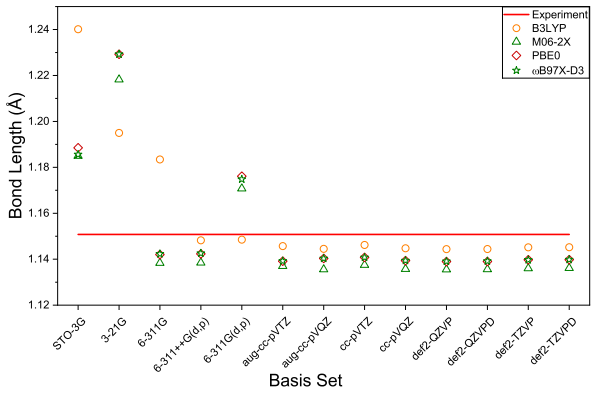
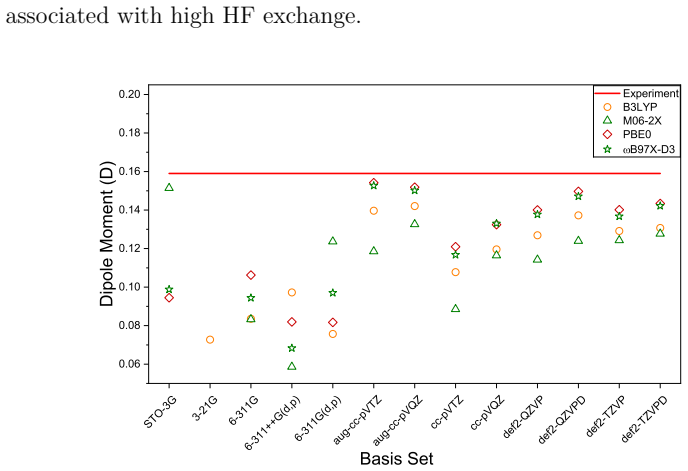
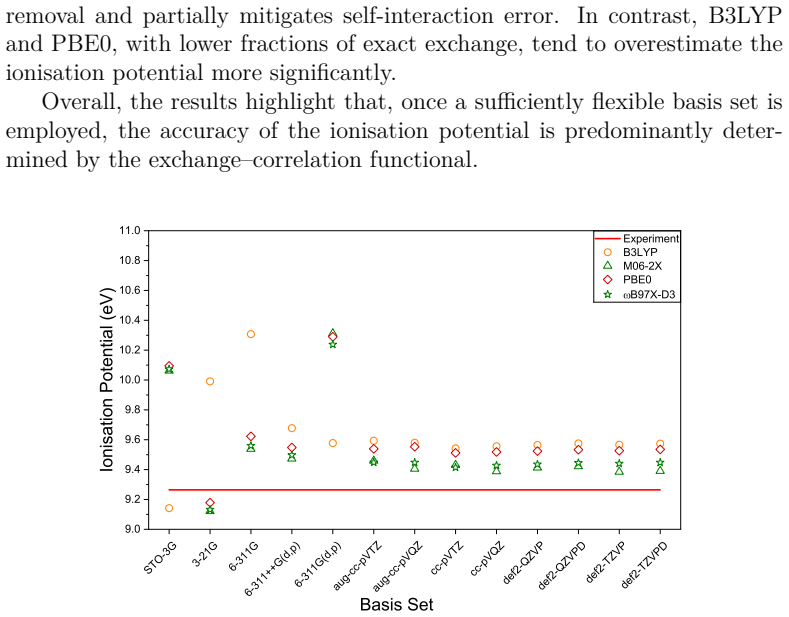
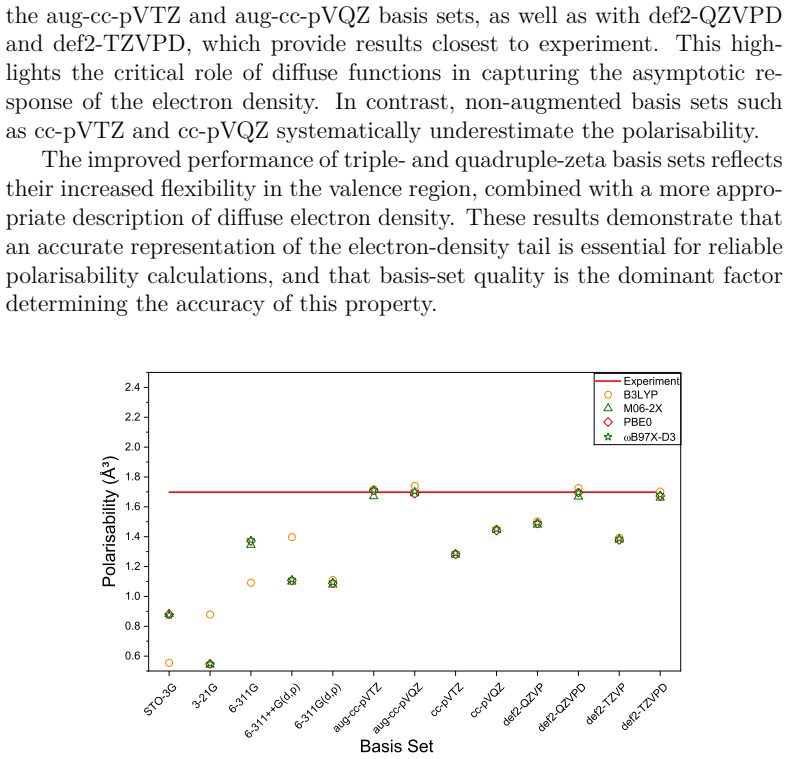
Nitric oxide (NO) is important in biological, atmospheric, plasma, industrial, and astrophysical environments, where reliable electron-collision data support modelling charged-particle interactions with matter. Its well-known experimental properties make it suitable for assessing how the target electronic-structure description affects low-energy electron scattering calculations. In this work, NO properties were evaluated using B3LYP, M06-2X, PBE0, and $\omega$B97X-D3, with basis sets ranging from minimal to quadruple-zeta quality. Bond length, dipole moment, ionisation potential, and polarisability were compared with experiment to assess the sensitivity of the target description to the functional and basis set. The aug-cc-pVQZ basis set was then used to generate target models for ab initio R-matrix calculations over 0.1--20 eV. The total cross sections show low-energy resonance features, with the strongest functional dependence around the broad peak near 0.8--1.0 eV. A sharper, higher-energy structure is also observed below 2 eV, shifting from 1.74 to 1.82 eV depending on the functional. Differential cross sections show modest functional sensitivity, with more noticeable angular differences at 7.5 and 10 eV. These results show that the DFT functional and basis set affect the target properties, with the resulting target description influencing low-energy electron-scattering observables of NO. The comparison supports $\omega$B97X-D3/aug-cc-pVTZ geometry optimisation followed by aug-cc-pVQZ target-property calculations as a practical protocol for R-matrix modelling of NO.
Figures
Figures from the paper (3 more)
Reference graph
Works this paper leans on
-
[1]
Toward reliable density functional methods without adjustable parameters: The PBE0 model
Adamo, C., Barone, V., 1999. Toward reliable density functional methods without adjustable parameters: The PBE0 model. The Journal of Chem- ical Physics 110, 6158–6170
1999
-
[2]
Biomolecular Damage In- duced by Ionizing Radiation: The Direct and Indirect Effects of Low- Energy Electrons on DNA
Alizadeh, E., Orlando, T.M., Sanche, L., 2015. Biomolecular Damage In- duced by Ionizing Radiation: The Direct and Indirect Effects of Low- Energy Electrons on DNA. Annual Review of Physical Chemistry 66, 379–398
2015
-
[3]
Improved electron-molecule scattering calcu- lations with the relativistic optical-potential method
Arya, S., Antony, B., 2026. Improved electron-molecule scattering calcu- lations with the relativistic optical-potential method. RSC Advances 16, 13548–13558
2026
-
[4]
Self-Interaction Error in Den- sity Functional Theory: An Appraisal
Bao, J.L., Gagliardi, L., Truhlar, D.G., 2018. Self-Interaction Error in Den- sity Functional Theory: An Appraisal. The Journal of Physical Chemistry Letters 9, 2353–2358
2018
-
[5]
Global ob- servations of nitric oxide in the thermosphere
Barth, C.A., Mankoff, K.D., Bailey, S.M., Solomon, S.C., 2003. Global ob- servations of nitric oxide in the thermosphere. Journal of Geophysical Research: Space Physics 108
2003
-
[6]
Density‐functional thermochemistry
Becke, A.D., 1993. Density‐functional thermochemistry. iii. the role of exact exchange. The Journal of Chemical Physics 98, 5648–5652
1993
-
[7]
Gas discharge plasmas and their applications
Bogaerts, A., Neyts, E., Gijbels, R., van der Mullen, J., 2002. Gas discharge plasmas and their applications. Spectrochimica Acta Part B: Atomic Spec- troscopy 57, 609–658
2002
-
[8]
Electron scattering and transport in biofuels, biomolecules and biomass fragments
Brunger, M.J., 2017. Electron scattering and transport in biofuels, biomolecules and biomass fragments. International Reviews in Physical Chemistry 36, 333–376. 17
2017
Show all 36 references
-
[9]
Electron collisions in atmospheres
Campbell, L., Brunger, M., 2016. Electron collisions in atmospheres. Inter- national Reviews in Physical Chemistry 35, 297–351
2016
-
[10]
Multiscale Perspectives on Solid-Phase Astrochemistry: Laboratory, Computation, and Open Questions
Dickers, M.D., Mifsud, D.V., Mason, N.J., Fantuzzi, F., 2025. Multiscale Perspectives on Solid-Phase Astrochemistry: Laboratory, Computation, and Open Questions. Space Science Reviews 221, 106
2025
-
[11]
Assessment of the Perdew–Burke– Ernzerhof exchange-correlation functional
Ernzerhof, M., Scuseria, G.E., 1999. Assessment of the Perdew–Burke– Ernzerhof exchange-correlation functional. The Journal of Chemical Physics 110, 5029–5036
1999
-
[12]
New forms of asymptotic expansions for wavefunctions of charged-particle scattering
Gailitis, M., 1976. New forms of asymptotic expansions for wavefunctions of charged-particle scattering. Journal of Physics B: Atomic and Molecular Physics 9, 843
1976
-
[13]
Chapter one - chemistry of nitric oxide and related species, in: Poole, R.K
Hughes, M.N., 2008. Chapter one - chemistry of nitric oxide and related species, in: Poole, R.K. (Ed.), Globins and Other Nitric Oxide-Reactive
2008
-
[14]
Comparative DFT study for molecular geome- tries and spectra of methyl pheophorbides-a: test of M06-2X and two other functionals
Huh, D.S., Choe, S.J., 2010. Comparative DFT study for molecular geome- tries and spectra of methyl pheophorbides-a: test of M06-2X and two other functionals. Journal of Porphyrins and Phthalocyanines 14, 592–604
2010
-
[15]
Cross sections for electron collisions with nitric oxide
Itikawa, Y., 2016. Cross sections for electron collisions with nitric oxide. Journal of Physical and Chemical Reference Data 45, 033106
2016
-
[16]
The performance of Dun- ning, Jensen, and Karlsruhe basis sets on computing relative energies and geometries
Kirschner, K.N., Reith, D., Heiden, W., 2020. The performance of Dun- ning, Jensen, and Karlsruhe basis sets on computing relative energies and geometries. Soft Materials 18, 200–214
2020
-
[17]
A sensitive search for nitric oxide in the lower atmospheres of Venus and Mars: Detection on Venus and upper limit for Mars
Krasnopolsky, V.A., 2006. A sensitive search for nitric oxide in the lower atmospheres of Venus and Mars: Detection on Venus and upper limit for Mars. Icarus 182, 80–91
2006
-
[18]
Long-Range Corrected Hy- brid Density Functionals with Improved Dispersion Corrections
Lin, Y.S., Li, G.D., Mao, S.P., Chai, J.D., 2013. Long-Range Corrected Hy- brid Density Functionals with Improved Dispersion Corrections. Journal of Chemical Theory and Computation 9, 263–272
2013
-
[19]
Microwave detection of interstellar NO
Liszt, H.S., Turner, B.E., 1978. Microwave detection of interstellar NO. The Astrophysical Journal 224, L73. 18
1978
-
[20]
Nitrogen sources and formation routes of nitric oxide from pure ammonia combustion
Liu, X., Si, J., Wang, G., Wu, M., Mi, J., 2025. Nitrogen sources and formation routes of nitric oxide from pure ammonia combustion. Energy 315, 134455
2025
-
[21]
Electron attach- ment to nitric oxide (NO) controversy
Lozano, A.I., Oller, J.C., Limão-Vieira, P., García, G., 2025. Electron attach- ment to nitric oxide (NO) controversy. The Journal of Physical Chemistry A 129, 2429–2433
2025
-
[22]
Thirty years of density functional theory in computational chemistry: an overview and extensive assessment of 200 density functionals
Mardirossian, N., Head-Gordon, M., 2017. Thirty years of density functional theory in computational chemistry: an overview and extensive assessment of 200 density functionals. Molecular Physics 115, 2315–2372
2017
-
[23]
Mason, N.J., Ioppolo, S., Quitián-Lara, H.M., Fantuzzi, F., Mifsud, D.V., Bocková, J., 2026. Foundations of astrochemistry i: Observations and ion- and electron-induced processes in ices, in: Advances in Atomic and Molecular Physics at the Interfaces with Natural Sciences, Tec...
2026
-
[24]
Electron collision with N2H and HCO
Modak, P., Singh, A., Goswami, B., Antony, B., 2021. Electron collision with N2H and HCO. The European Physical Journal D 75
2021
-
[25]
Total and elastic cross sections for methyl halides by electron impact
Naghma, R., Antony, B., 2013. Total and elastic cross sections for methyl halides by electron impact. Journal of Electron Spectroscopy and Related Phenomena 189, 17–22
2013
-
[26]
The ORCA quantum chemistry program package
Neese, F., Wennmohs, F., Becker, U., Riplinger, C., 2020. The ORCA quantum chemistry program package. The Journal of Chemical Physics 152, 224108. NIST, 2025. Computational chemistry comparison and benchmark database. URL: https://cccbdb.nist.gov/
2020
-
[27]
Production of low-energy electrons by ionizing radiation
Pimblott, S.M., LaVerne, J.A., 2007. Production of low-energy electrons by ionizing radiation. Radiation Physics and Chemistry 76, 1244–1247
2007
-
[28]
Irradiation of organic and polymer films with low-energy electrons
Sanche, L., 2003. Irradiation of organic and polymer films with low-energy electrons. Nuclear Instruments and Methods in Physics Research Section B: Beam Interactions with Materials and Atoms 208, 4–10
2003
-
[29]
Differential cross sections for elec- tron/positron scattering from polyatomic molecules
Sanna, N., Gianturco, F., 1998. Differential cross sections for elec- tron/positron scattering from polyatomic molecules. Computer physics communications 114, 142–167. 19
1998
-
[30]
Adsorption and valence elec- tronic states of nitric oxide on metal surfaces
Shiotari, A., Koshida, H., Okuyama, H., 2021. Adsorption and valence elec- tronic states of nitric oxide on metal surfaces. Surface Science Reports 76, 100500
2021
-
[31]
A plasma needle generates nitric oxide
Stoffels, E., Gonzalvo, Y.A., Whitmore, T.D., Seymour, D.L., Rees, J.A., 2006. A plasma needle generates nitric oxide. Plasma Sources Science and Technology 15, 501–506
2006
-
[32]
Electron–molecule collision calculations using the R- matrix method
Tennyson, J., 2010. Electron–molecule collision calculations using the R- matrix method. Physics Reports 491, 29–76
2010
-
[33]
Quantemol-n: an expert system for performing electron molecule collision calculations using the r-matrix method, in: Journal of Physics: Conference Series, p
Tennyson, J., Brown, D.B., Munro, J.J., Rozum, I., Varambhia, H.N., Vinci, N., 2007. Quantemol-n: an expert system for performing electron molecule collision calculations using the r-matrix method, in: Journal of Physics: Conference Series, p. 012001
2007
-
[34]
Low-energy electron scattering from pyrrole and its isomers
Tomer, H., Goswami, B., Modak, P., Alam, M., Ahmad, S., Antony, B., 2023. Low-energy electron scattering from pyrrole and its isomers. The Journal of Physical Chemistry A 127, 10464–10480
2023
-
[35]
Investigation of electron collisions with organic phosphates
Yadav, A., Antony, B., 2025. Investigation of electron collisions with organic phosphates. The Journal of Physical Chemistry A 129, 8013–8023
2025
-
[36]
A systematic IR and VUV spectroscopic investigation of ion, electron, and thermally processed ethanolamine ice
Dawes, A., Sivaraman, B., Juhász, Z., Sulik, B., Linnartz, H., Hornekær, L., Fantuzzi, F., Mason, N.J., Ioppolo, S., 2024. A systematic IR and VUV spectroscopic investigation of ion, electron, and thermally processed ethanolamine ice. Monthly Notices of the Royal Astronomical ...
2024
Reviewed June 27, 2026 · model on record in the stance chip above.
Discussion (0). Continue with ORCID to comment.