Chiral Magnons and Cycloidal Phonons in Altermagnetic CuF₂ Monolayer
Pith reviewed 2026-06-27 09:28 UTC · model grok-4.3
The pith
Monolayer CuF₂ exhibits chirality-split magnons and cycloidal phonons controlled by the same P2₁/c symmetry operations, with magnon bands carrying Chern numbers ±2.
A machine-rendered reading of the paper's core claim, the machinery that carries it, and where it could break.
Core claim
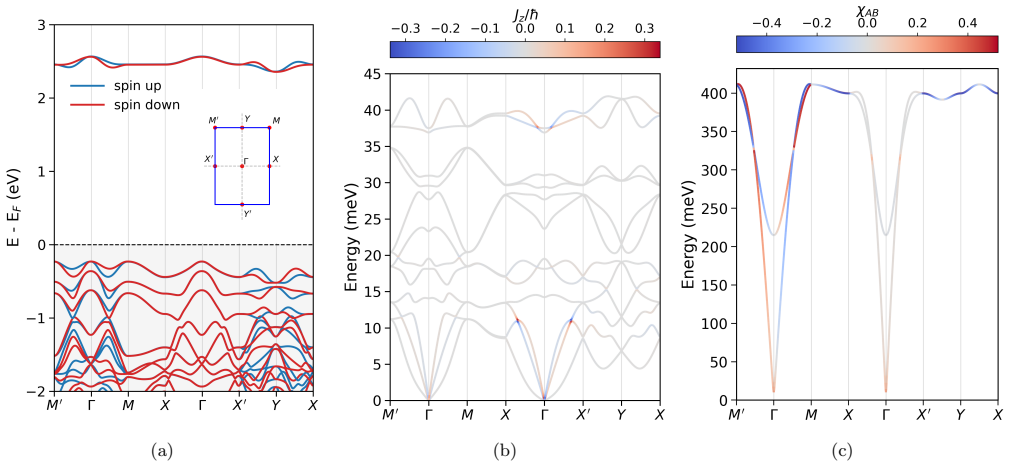
Using first-principles calculations and linear spin-wave theory, the authors show that monolayer CuF₂ hosts both chirality-split magnons and cycloidal phonons controlled by the same P2₁/c symmetry operations. The altermagnetic order drives strongly anisotropic magnon chirality via symmetric anisotropic exchange, with Dzyaloshinskii-Moriya interactions acting as a weak secondary modulation. The phonon and magnon chiral responses are directionally complementary, and the magnon bands carry quantized Chern numbers C^M = ±2, confirming non-trivial altermagnetic topology.
What carries the argument
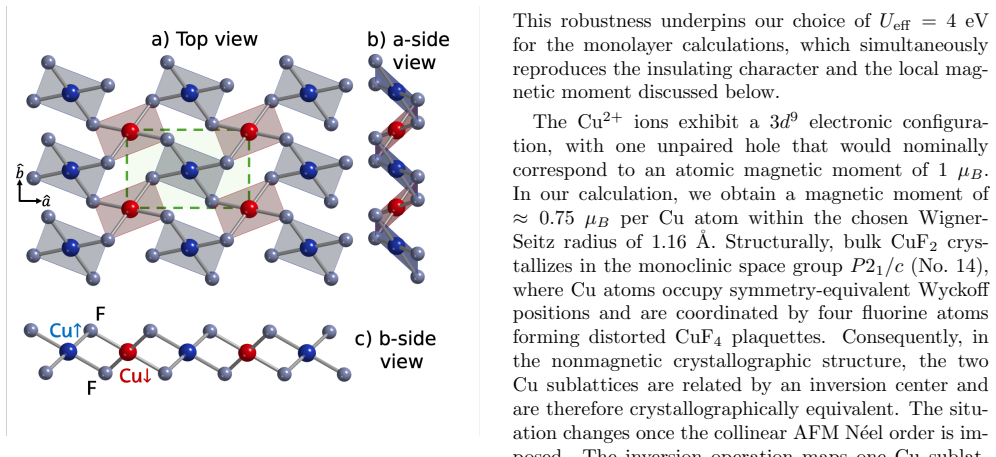
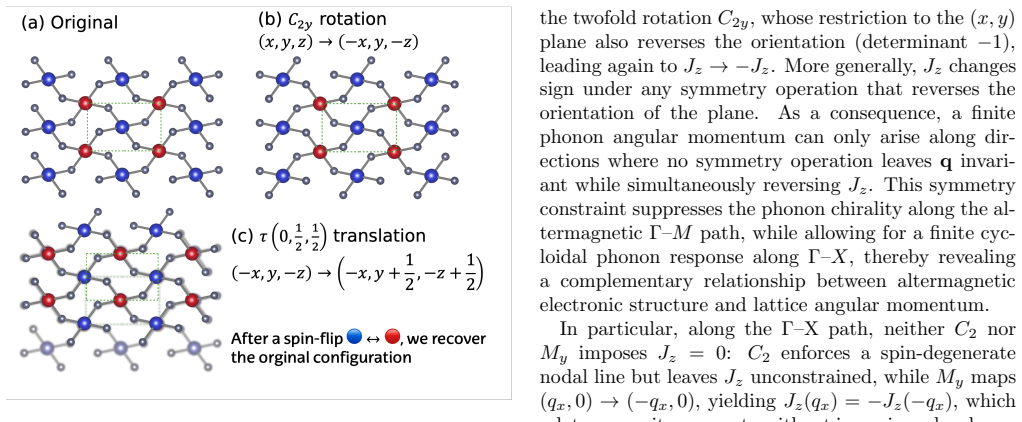
The P2₁/c symmetry operations that simultaneously govern chirality-split magnons and cycloidal phonons in the altermagnetic monolayer.
If this is right
- Altermagnetic order produces strongly anisotropic magnon chirality driven primarily by symmetric anisotropic exchange.
- Cycloidal phonon angular momentum emerges precisely where magnon chirality is symmetry-suppressed.
- Magnon bands carry quantized Chern numbers C^M = ±2, establishing non-trivial altermagnetic topology.
- A single symmetry framework engineers magnonic, phononic, and topological responses together.
Where Pith is reading between the lines
- The same symmetry control may appear in other altermagnetic monolayers with related crystal structures.
- Complementary chirality responses could enable devices that route magnons and phonons along orthogonal directions.
- Thermal Hall or inelastic scattering measurements could directly test the predicted Chern numbers and directional complementarity.
Load-bearing premise
The P2₁/c symmetry operations simultaneously govern both spin and lattice collective excitations as determined from the first-principles calculations and linear spin-wave theory.
What would settle it
Observation that magnon bands in monolayer CuF₂ lack quantized Chern numbers of ±2 or that phonon angular momentum fails to appear where magnon chirality is symmetry-suppressed would falsify the central claim.
Figures

read the original abstract
Altermagnetism establishes momentum-dependent spin splitting through non-symmorphic crystal symmetries, yet whether these same symmetries simultaneously govern spin and lattice collective excitations remains open. Here we show, using first-principles calculations and linear spin-wave theory, that monolayer CuF$_2$ hosts both chirality-split magnons and cycloidal phonons controlled by the same $P2_1/c$ symmetry operations. The altermagnetic order drives strongly anisotropic magnon chirality via symmetric anisotropic exchange, with Dzyaloshinskii--Moriya interactions acting as a weak secondary modulation. Crucially, the phonon and magnon chiral responses are directionally complementary: cycloidal phonon angular momentum emerges precisely where magnon chirality is symmetry-suppressed, and vice versa. The magnon bands further carry quantized Chern numbers $C^M = \pm 2$, confirming non-trivial altermagnetic topology. These results establish monolayer CuF$_2$ as a platform where a single symmetry framework engineers magnonic, phononic, and topological responses, providing a direct connection between altermagnetism and spin-lattice chirality in two-dimensional materials.
Editorial analysis
A structured set of objections, weighed in public.
Referee Report
Summary. The manuscript claims that the P2₁/c symmetry of the altermagnetic CuF₂ monolayer simultaneously governs chirality-split magnons (driven primarily by symmetric anisotropic exchange, with DM as a weak correction) and cycloidal phonons, as computed via first-principles DFT and linear spin-wave theory. The magnon spectrum carries quantized Chern numbers C^M = ±2, and the chiral responses of magnons and phonons are directionally complementary.
Significance. If the calculations hold, the work is significant because it supplies a concrete, symmetry-based example linking altermagnetism to both magnonic and phononic chirality plus non-trivial topology in a 2D material. The directional complementarity and the use of standard, symmetry-constrained methods constitute a clear advance over purely magnon-focused altermagnet studies.
Simulated Author's Rebuttal
We thank the referee for the positive evaluation of our manuscript and the recommendation to accept. The report accurately captures the central claims regarding the P2₁/c symmetry control of both magnon and phonon chirality in the CuF₂ monolayer, the role of symmetric anisotropic exchange, and the directional complementarity of the responses.
Circularity Check
No significant circularity
full rationale
The derivation relies on standard first-principles DFT and linear spin-wave theory applied to the monolayer structure, with P2_1/c symmetry operations acting directly on both spin and lattice degrees of freedom to produce the reported magnon chirality splitting, cycloidal phonons, and Chern numbers C^M = ±2. These steps are externally verifiable computational procedures rather than self-definitions, fitted inputs renamed as predictions, or load-bearing self-citations. No equation reduces to its input by construction, and the central claims remain independent of any internal renaming or ansatz smuggling.
Axiom & Free-Parameter Ledger
axioms (2)
- domain assumption Standard assumptions of density functional theory for electronic and magnetic structure calculations
- domain assumption Validity of linear spin-wave theory for magnon excitations and chirality
Reference graph
Works this paper leans on
-
[1]
Emerging research landscape of altermag- netism
Libor ˇSmejkal, Jairo Sinova, and Tomas Jung- wirth. Emerging research landscape of altermag- netism. Physical Review X, 12:040501, 2022
2022
-
[2]
Beyond conventional ferromagnetism and antiferromagnetism: A phase with nonrelativistic spin and crystal rotation symmetry
Libor ˇSmejkal, Jairo Sinova, and Tomas Jung- wirth. Beyond conventional ferromagnetism and antiferromagnetism: A phase with nonrelativistic spin and crystal rotation symmetry. Physical Review X, 12(3):031042, 2022
2022
-
[3]
Al- termagnetism with non-collinear spins
Sang-Wook Cheong and Fei-Ting Huang. Al- termagnetism with non-collinear spins. NPJ Quantum Materials, 9(1):13, 2024
2024
-
[4]
Dominant orbital mag- netization in the prototypical altermagnet MnTe
Chao Chen Ye, Karma Tenzin, Jagoda S lawi´ nska, and Carmine Autieri. Dominant orbital mag- netization in the prototypical altermagnet MnTe. Physical Review B, 113:014413, 2026
2026
-
[5]
Oppeneer, Sang-Wook Cheong, and Hyun-Woo Lee
Daegeun Jo, Dongwook Go, Yuriy Mokrousov, Peter M. Oppeneer, Sang-Wook Cheong, and Hyun-Woo Lee. Weak ferromagnetism in altermag- nets from alternatingg-tensor anisotropy. Physical Review Letters, 134:196703, 2025
2025
-
[6]
Activation of anomalous Hall effect and orbital magnetization by domain walls in altermagnets
Sopheak Sorn and Yuriy Mokrousov. Activation of anomalous Hall effect and orbital magnetization by domain walls in altermagnets. Physical Review B, 112:245115, 2025
2025
-
[7]
Relativ- istic spin-momentum locking in altermagnets
Carmine Autieri and Amar Fakhredine. Relativ- istic spin-momentum locking in altermagnets. The Journal of Physical Chemistry Letters, 17(2):449– 455, 2026
2026
-
[8]
Persistent spin textures, alter- magnetism and charge-to-spin conversion in metal- lic chiral crystals TM 3X6
Karma Tenzin, Berkay Kilic, Raghottam M Sat- tigeri, Zhiren He, Chao Chen Ye, Marcio Costa, Marco Buongiorno Nardelli, Carmine Autieri, and Jagoda S lawi´ nska. Persistent spin textures, alter- magnetism and charge-to-spin conversion in metal- lic chiral crystals TM 3X6. NPJ Spintronics, 3(1): 46, 2025
2025
-
[9]
Altermagnons at the metal-insulator transition
Jonas Issing, Matteo D¨ urrnagel, Sarbajit Mazum- dar, Alena Lorenz, Niklas Witt, Giorgio San- giovanni, Michael Klett, Lennart Klebl, Ronny 7 Thomale, and Jannis Seufert. Altermagnons at the metal-insulator transition. arXiv preprint arXiv:2605.11669, 2026
Pith/arXiv arXiv 2026
-
[10]
Chiral magnons in altermagnetic RuO 2
Libor ˇSmejkal, Alberto Marmodoro, Kyo-Hoon Ahn, Rafael Gonz´ alez-Hern´ andez, Ilja Turek, Ser- giy Mankovsky, Hubert Ebert, Sunil W D’Souza, Ondˇ rejˇSipr, Jairo Sinova, et al. Chiral magnons in altermagnetic RuO 2. Physical Review Letters, 131(25):256703, 2023
2023
-
[11]
Structure, control, and dynamics of altermagnetic textures
Olena Gomonay, Volodymyr P Kravchuk, Rodrigo Jaeschke-Ubiergo, Kostiantyn V Yershov, Tom´ aˇ s Jungwirth, Libor ˇSmejkal, J van den Brink, and Jairo Sinova. Structure, control, and dynamics of altermagnetic textures. NPJ Spintronics, 2(1):35, 2024
2024
-
[12]
Chiral phonons
Dominik M Juraschek, R Matthias Geilhufe, Hanyu Zhu, Martina Basini, Peter Baum, Andrey Baydin, Swati Chaudhary, Michael Fechner, Bene- detta Flebus, Gael Grissonnanche, et al. Chiral phonons. Nature Physics, 21(10):1532–1540, 2025
2025
-
[13]
Com- prehensive study of phonon chirality under sym- metry constraints
Shuai Zhang, Zhiheng Huang, Muchen Du, Tian- ping Ying, Luojun Du, and Tiantian Zhang. Com- prehensive study of phonon chirality under sym- metry constraints. Physical Review B, 113(2): 024302, 2026
2026
-
[14]
Angular momentum of phonons and the Einstein–de Haas effect
Lifa Zhang and Qian Niu. Angular momentum of phonons and the Einstein–de Haas effect. Physical Review Letters, 112(8):085503, 2014
2014
-
[15]
Chiral phonon induced spin polar- ization
Jonas Fransson. Chiral phonon induced spin polar- ization. Physical Review Research, 5(2):L022039, 2023
2023
-
[16]
Magnetic order induced chiral phonons in a ferromagnetic weyl se- mimetal
Mengqian Che, Jinxuan Liang, Yunpeng Cui, Hao Li, Bingru Lu, Wenbo Sang, Xiang Li, Xuebin Dong, Le Zhao, Shuai Zhang, et al. Magnetic order induced chiral phonons in a ferromagnetic weyl se- mimetal. Physical Review Letters, 134(19):196906, 2025
2025
-
[17]
Magnetic signature of chiral phonons revealed by neutron spectroscopy in ferrimagnetic Fe 1.75Zn0.25Mo3O8
Song Bao, Junbo Liao, Zhentao Huang, Yanyan Shangguan, Zhen Ma, Bo Zhang, Shufan Cheng, Hao Xu, Zihang Song, Shuai Dong, et al. Magnetic signature of chiral phonons revealed by neutron spectroscopy in ferrimagnetic Fe 1.75Zn0.25Mo3O8. Physical Review Letters, 136(9):096502, 2026
2026
-
[18]
Chiral phonon transport induced by topological magnons
Even Thingstad, Akashdeep Kamra, Arne Brataas, and Asle Sudbø. Chiral phonon transport induced by topological magnons. Physical Review Letters, 122(10):107201, 2019
2019
-
[19]
Theory of spin magnetization driven by chiral phonons
Dapeng Yao and Shuichi Murakami. Theory of spin magnetization driven by chiral phonons. Physical Review B, 111(13):134414, 2025
2025
-
[20]
Pu Zhang, Sun-Bo Xie, Junxi Yu, Yichen Liu, and Cheng-Cheng Liu. Odd-parity magnons. arXiv preprint arXiv:2605.31411, 2026
Pith/arXiv arXiv 2026
-
[21]
Alter- axial phonons in collinear magnets
Fuyi Wang, Junqi Xu, Xinqi Liu, Huaiqiang Wang, Lifa Zhang, and Haijun Zhang. Alter- axial phonons in collinear magnets. arXiv preprint arXiv:2512.07518, 2025
arXiv 2025
-
[22]
Magnon–phonon coupling: from fundamental physics to applications
Ke Wang, Kai Ren, Yinlong Hou, Yuan Cheng, and Gang Zhang. Magnon–phonon coupling: from fundamental physics to applications. Physical Chemistry Chemical Physics, 25(33):21802–21815, 2023
2023
-
[23]
Magnon-phonon fermi resonance in antiferromagnetic cof2
Thomas WJ Metzger, Kirill A Grishunin, Chris Reinhoffer, Roman M Dubrovin, Atiqa Arshad, Igor Ilyakov, Thales VAG de Oliveira, Alexey Ponomaryov, Jan-Christoph Deinert, Sergey Ko- valev, et al. Magnon-phonon fermi resonance in antiferromagnetic cof2. Nature Communications, 15(1):5472, 2024
2024
-
[24]
Poly- morphism of two-dimensional antiferromagnets, AgF 2 andCuF 2
Daniel Jezierski and Wojciech Grochala. Poly- morphism of two-dimensional antiferromagnets, AgF 2 andCuF 2. Physical Review Mater., 8: 034407, 2024
2024
-
[25]
Why is thed-Wave spin splitting in CuF 2 bulk-like? arXiv preprint arXiv:2602.14608, 2026
Subhadeep Bandyopadhyay, Sayantika Bhowal, et al. Why is thed-Wave spin splitting in CuF 2 bulk-like? arXiv preprint arXiv:2602.14608, 2026
arXiv 2026
-
[26]
Ferroelastic altermagnetism
Rui Peng, Shibo Fang, Pin Ho, Fanxin Liu, Tong Zhou, Junwei Liu, and Yee Sin Ang. Ferroelastic altermagnetism. NPJ Quantum Materials, 2025
2025
-
[27]
Sliding ferroelectri- city driven spin-layertronics in altermagnetic mul- tilayers
Rui Peng, Guangxu Su, Yangyang Fan, Jiaan Li, Fanxin Liu, and Yee Sin Ang. Sliding ferroelectri- city driven spin-layertronics in altermagnetic mul- tilayers. arXiv preprint arXiv:2603.10907, 2026
arXiv 2026
-
[28]
Ab initio molecu- lar dynamics for liquid metals
Georg Kresse and J¨ urgen Hafner. Ab initio molecu- lar dynamics for liquid metals. Physical Review B, 47(1):558, 1993
1993
-
[29]
From ultrasoft pseudopotentials to the projector augmented-wave method
Georg Kresse and Daniel Joubert. From ultrasoft pseudopotentials to the projector augmented-wave method. Physical Review B, 59(3):1758, 1999
1999
-
[30]
Perdew, Kieron Burke, and Matthias Ernzerhof
John P. Perdew, Kieron Burke, and Matthias Ernzerhof. Generalized gradient approximation made simple. Physical Review Letters, 77:3865– 3868, 1996
1996
-
[31]
Numerical atomic basis or- bitals from H to Kr
T Ozaki and H Kino. Numerical atomic basis or- bitals from H to Kr. Physical Review B, 69(19): 195113, 2004
2004
-
[32]
Efficient projector expansion for the ab-initio LCAO method
T Ozaki and H Kino. Efficient projector expansion for the ab-initio LCAO method. Physical Review B, 72(4):045121, 2005. 8
2005
-
[33]
Spe- cial points for Brillouin-zone integrations
Hendrik J Monkhorst and James D Pack. Spe- cial points for Brillouin-zone integrations. Physical Review B, 13(12):5188, 1976
1976
-
[34]
Electron-energy-loss spectra and the struc- tural stability of nickel oxide: An LSDA+ U study
Sergei L Dudarev, Gianluigi A Botton, Sergey Y Savrasov, CJ Humphreys, and Adrian P Sut- ton. Electron-energy-loss spectra and the struc- tural stability of nickel oxide: An LSDA+ U study. Physical Review B, 57(3):1505, 1998
1998
-
[35]
Zheng, P
Y. Zheng, P. Zhang, S.Q. Wu, Y.H. Wen, Z.Z. Zhu, and Y. Yang. First-principles studies on the structural and electronic properties of li- ion battery cathode material CuF 2. Solid State Communications, 152(17):1703–1706, 2012
2012
-
[36]
TB2J: A python package for computing magnetic interaction parameters
Xu He, Nicole Helbig, Matthieu J Verstraete, and Eric Bousquet. TB2J: A python package for computing magnetic interaction parameters. Computer Physics Communications, 264:107938, 2021
2021
-
[37]
Andrey Rybakov. MAGNOPY. URLhttps:// docs.magnopy.org
-
[38]
Fast and robust algorithm for energy minimization of spin systems applied in an ana- lysis of high temperature spin configurations in terms of skyrmion density
Aleksei V Ivanov, Valery M Uzdin, and Hannes J´ onsson. Fast and robust algorithm for energy minimization of spin systems applied in an ana- lysis of high temperature spin configurations in terms of skyrmion density. Computer Physics Communications, 260:107749, 2021
2021
-
[39]
Topological chiral magnonic edge mode in a magnonic crystal
Ryuichi Shindou, Ryo Matsumoto, Shuichi Murakami, and Jun-ichiro Ohe. Topological chiral magnonic edge mode in a magnonic crystal. Physical Review B, 87(17):174427, 2013
2013
-
[40]
Chern numbers in discretized Brillouin zone: Efficient method of computing (spin) Hall conductances
Takahiro Fukui, Yasuhiro Hatsugai, and Hiroshi Suzuki. Chern numbers in discretized Brillouin zone: Efficient method of computing (spin) Hall conductances. Journal of the Physical Society of Japan, 74(6):1674–1677, 2005
2005
-
[41]
J. W. Gonz´ alez, R. A. Gallardo, N. Vidal-Silva, and A. M. Le´ on. Topological chiral magnons in the altermagnet AgF2 monolayer. Chinese Physics Letters, 43(2):020705, 2026
2026
-
[42]
Implementation strategies in phonopy and phono3py
Atsushi Togo, Laurent Chaput, Terumasa Tadano, and Isao Tanaka. Implementation strategies in phonopy and phono3py. Journal of Physics: Condensed Matter, 35(35):353001, 2023
2023
-
[43]
First-principles phonon calcula- tions with phonopy and phono3py
Atsushi Togo. First-principles phonon calcula- tions with phonopy and phono3py. Journal of the Physical Society of Japan, 92(1):012001, 2023
2023
-
[44]
Phonopy: A phonon calculation toolkit.https://phonopy.github.io/phonopy/,
Atsushi Togo. Phonopy: A phonon calculation toolkit.https://phonopy.github.io/phonopy/,
-
[45]
phonon angular momentum
Qijing Zheng. phonon angular momentum. https://github.com/QijingZheng/phonon_ angular_momentum, 2023. GitHub repository. Accessed: 2025-10-27
2023
-
[46]
Chiral phonons at high- symmetry points in monolayer hexagonal lattices
Lifa Zhang and Qian Niu. Chiral phonons at high- symmetry points in monolayer hexagonal lattices. Physical Review Letters, 115(11):115502, 2015
2015
-
[47]
Explaining the op- tical spectrum of CrF 2 and CuF 2 model materi- als: role of the tetragonal to monoclinic instabil- ity
JA Aramburu and M Moreno. Explaining the op- tical spectrum of CrF 2 and CuF 2 model materi- als: role of the tetragonal to monoclinic instabil- ity. Physical Chemistry Chemical Physics, 21(22): 11714–11723, 2019
2019
-
[48]
Absorption spectra and ligand field parameters of tetragonal 3d-transition metal fluorides
Dieter Oelkrug. Absorption spectra and ligand field parameters of tetragonal 3d-transition metal fluorides. In Structutal and Bonding, pages 1–26. Springer, 2008
2008
-
[49]
Proposing altermagnetic-ferroelectric type-iii multiferroics with robust magnetoelectric coupling
Wei Sun, Changhong Yang, Wenxuan Wang, Ying Liu, Xiaotian Wang, Shifeng Huang, and Zhenxi- ang Cheng. Proposing altermagnetic-ferroelectric type-iii multiferroics with robust magnetoelectric coupling. Advanced Materials, 37(26):2502575, 2025
2025
-
[50]
J. W. Gonz´ alez, T Brumme, E Su´ arez Morell, and A. M. Le´ on. Engineering altermagnetism via layer shifts and spin order in bilayer MnPS 3. NPJ 2D Materials and Applications, 2025
2025
-
[51]
Magnon topology driven by altermagnet- ism
Subhankar Khatua, Volodymyr P Kravchuk, Kostiantyn V Yershov, and Jeroen van den Brink. Magnon topology driven by altermagnet- ism. Physical Review B, 112(21):214422, 2025
2025
-
[52]
Altermag- netic boosting of chiral phonons
J Okamoto, CY Mou, HY Huang, G Chann- agowdra, C Won, K Du, X Fang, EV Koml- eva, CT Chen, SV Streltsov, et al. Altermag- netic boosting of chiral phonons. arXiv preprint arXiv:2512.00388, 2025
arXiv 2025
-
[53]
Altermagnetic and Dipolar Splitting of Magnons in FeF 2
J Sears, VO Garlea, D Lederman, JM Tranquada, and IA Zaliznyak. Altermagnetic and Dipolar Splitting of Magnons in FeF 2. Physical Review Letters, 136(22):226701, 2026
2026
-
[54]
Altermagnetism revealed by polarized neutrons in MnF 2
Quentin Faure, Dalila Bounoua, Victor Bal´ edent, Arsen Gukasov, V Ovidiu Garlea, Afonso Ribeiro, Jeffrey G Rau, Sylvain Petit, and Paul McClarty. Altermagnetism revealed by polarized neutrons in MnF 2. arXiv preprint arXiv:2509.07087, 2025. 9 Supplementary Information Chiral Magnons and Cycloidal Phonons in Altermagnetic CuF 2 monolayers To clarify the r...
arXiv 2025
discussion (0)
Sign in with ORCID, Apple, or X to comment. Anyone can read and Pith papers without signing in.