REVIEW 3 major objections 6 minor 300 references
Recent advances in DNA origami-engineered nanomaterials and applications
T0 review · 3 major / 6 minor · reviewed 2026-08-07 · deepseek-v4-flash
Pith's one-line read The paper argues that DNA origami has become a general platform for engineering nanomaterials, mapping the past five years across assembled structures, dynamic machines, templated materials, drug delivery, membranes, and photonics.
desk verdict A solid, useful narrative review that does what it claims—as long as you don't expect a systematic survey; the lack of inclusion criteria is real but not fatal. read the letter →
The pith
A machine-rendered reading of the paper's core claim, the machinery that carries it, and where it could break.
The reading
What carries the argument
The central object is DNA origami itself: a long single-stranded DNA scaffold folded by hundreds of short staple strands into a programmed shape, with each staple addressable as a pixel or handle. The review treats this addressability as the mechanism that carries nearly all recent applications: the origami acts as a template that places other components at designed positions and distances, and its strand-displacement programmability lets structures reconfigure, walk, sort cargo, or release payloads.
What would settle it
Randomly sample 50 of the papers cited in the review, read the primary reports, and check whether the review's one-sentence characterization matches what the primary paper actually shows; also run a systematic database search of the same five-year window and look for whole subfields absent from the review. A pattern of misdescription or a missing result category would show the survey is not reliable as a map.
Extended reading notes
Core claim
The central claim on the paper's own terms is that recent work has made DNA origami a working platform for engineered nanomaterials rather than only a way to make DNA shapes. The review's organizing assertion, stated in the introduction, is that it covers the most recent advances in DNA-origami-based nanomaterials, including DNA assemblies, superstructures, nanodevices, and functional hybrid systems, over the past five years. It argues this through examples: static structures assembled from scaffolds, tiles, bricks, wireframes, and single strands; RNA assemblies; reconfigurable and motorized nanomachines; origami-templated inorganic and biological materials; drug carriers; membrane-engineering tools; and plasmonic and photonic devices. The claim is not that any single device is mature, but that the method's addressability has made a broad range of applications worth pursuing.
Load-bearing premise
The load-bearing premise is that the papers chosen for the review are representative of the past five years of DNA-origami research and are described accurately, since the manuscript states no inclusion criteria, search strategy, or method for resolving conflicting reports.
Editorial extensions
If this is right
- If the survey is right, a researcher entering any of these subfields can treat DNA origami as a general positioning tool: placing a molecule or nanoparticle at a chosen address on a DNA object is routine, and the remaining problem is what to build with that control.
- The dynamic systems described imply that DNA nanostructures can perform mechanical tasks, including directed walking, cargo sorting, rotation, sliding, and self-replication, at scales and speeds relevant for molecular robotics.
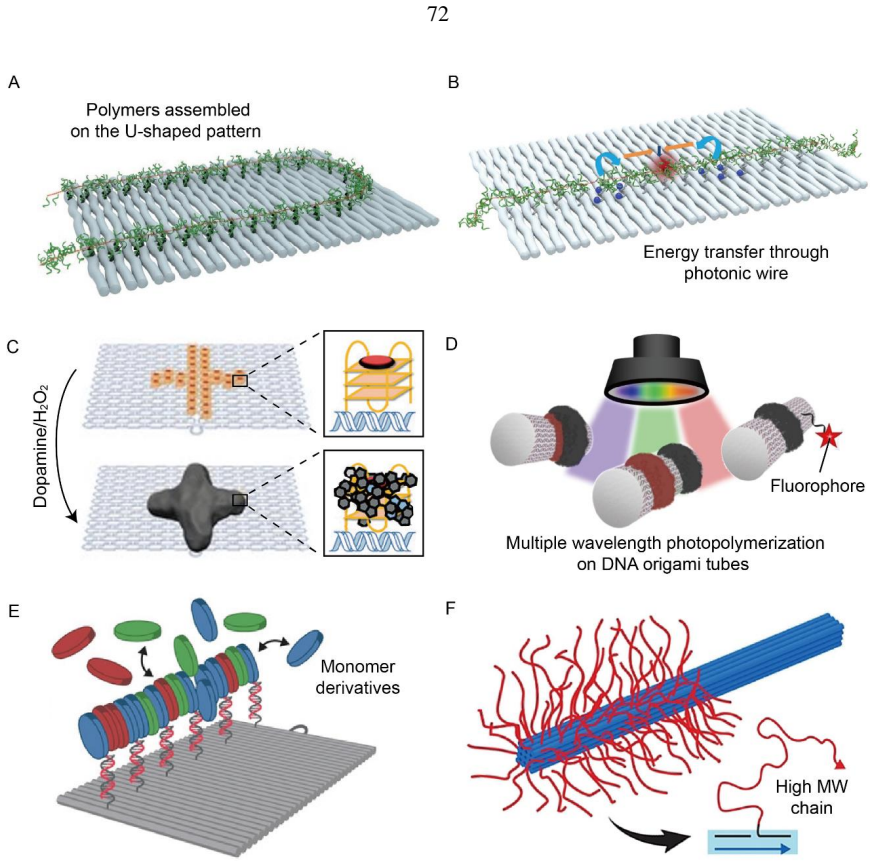
- The templating results imply that DNA origami can serve as a foundry for non-DNA materials, with silica, metals, semiconductors, magnetic clusters, and polymers grown or placed with nanometre precision on the origami mold.
- The therapy and membrane sections imply that origami carriers can deliver proteins, siRNAs, and drugs in vivo, and that DNA objects can shape lipid bilayers or act as nanopores.
- The review's conclusion that unexplored avenues remain implies that the next advances are less about folding DNA and more about integrating these modules into working devices.
Reading between the lines
- A gap the paper leaves implicit is that the field still lacks a quantitative head-to-head benchmark connecting design rules, such as staple concentration or crossover placement, to assembly yield and error rate across platforms; the review describes many mechanisms but no common metric.
- A testable extension of the review's map would be to compile the cited primary studies into a searchable database with standardized descriptors, letting newcomers ask which origami geometry has been used for which nanophotonic or biomedical function without reading every primary paper.
- If DNA origami's addressability is as general as the review suggests, the practical bottleneck for real-world use is likely environmental robustness, and the membrane and drug-delivery sections hint that silica or polymer coatings are emerging as the workaround.
- The emphasis in the review on nanophotonics and biomedicine, relative to electronics or energy, suggests that near-term applications are concentrated there, though that is an inference from emphasis rather than a stated claim.
Signed reviews
Editorial analysis
A structured set of objections, weighed in public.
Referee Report
Summary. This review surveys recent advances in DNA-origami-engineered nanomaterials, spanning structural DNA nanotechnology, RNA self-assembly, dynamic DNA devices, DNA-origami-templated inorganic and biological materials, drug delivery, membrane engineering, and nanophotonics. It opens with historical milestones and then discusses more recent work, with figures reproduced from the primary literature. The paper does not present new experiments, datasets, or derivations; its contribution is a curated synthesis of the field.
Significance. If the cited work is accepted as representative, this review is a useful interdisciplinary entry point: it organizes a large body of literature under clear headings, connects fundamental assembly science to applications, and gives readers a structured overview of a fast-moving field. Its main value is as a map of recent progress, so the credibility of that map depends on the transparency of the literature selection. The manuscript currently provides no search or inclusion methodology, which limits the verifiability of its central claim to cover the most recent advances of the past five years.
major comments (3)
- [Section 1 (Introduction)] The Introduction states that the review 'focuses on the most recent advances ... in the recent five years,' but the manuscript neither defines the five-year window (for example, 2020-2025 or submission date minus five years) nor describes the search strategy, databases, inclusion criteria, or conflict-resolution method used to select the cited papers. Without this information, the representativeness of the cited set cannot be independently audited, and this is a load-bearing claim for a review. The authors should add a scope/methods paragraph specifying the date window, databases, inclusion and exclusion criteria, and how they handled potentially conflicting reports, or they should explicitly weaken the claim to 'selected recent advances.'
- [Sections 2.2.3, 2.3.2, 6, 7, 8] Several major sections are organized substantially around primary papers from the authors' own research programs (for example, Ke-group DNA-brick and higher-order assembly, Ding-group drug-delivery vehicles, Lin-group membrane engineering, and Liu-group nanophotonics). This is not improper in a review, but in the absence of any stated selection methodology it creates a risk of coverage bias that directly affects the usefulness of the 'recent advances' map. The authors should provide a quantitative or explicit account of the literature search and selection process, or they should state that the selection is illustrative rather than exhaustive and discuss how balanced coverage across research programs was attempted.
- [Sections 2.3.2 and 5.1.1] The claimed five-year focus is not consistently applied in the body text: recent advances are interleaved with landmark work from 2006-2019 without a clear date demarcation, so a reader cannot always tell which contribution falls inside the claimed window. For example, Section 2.3.2 discusses the 2012 DNA-brick master set and 2017 gigadalton structures before later seeded-assembly work, and Section 5.1.1 begins silica templating with work from 2009. The authors should either mark historical background separately from the five-year window throughout, or soften the central claim to a survey with emphasis on recent work.
minor comments (6)
- [Figure 2D caption] The caption attributes the smiley-face DNA origami image to ref 26, but the main text (page 8) and the original Rothemund 2006 work (ref 24) describe this structure; the caption should cite ref 24.
- [Figure 7E caption] The caption reads 'Copyright 207 American Chemical Society'; this should be 'Copyright 2017 American Chemical Society.'
- [Figure 15B caption] The caption says 'Helical sliver patterns'; this should be 'Helical silver patterns.'
- [Section 4.2] The text reports that the speed of motion 'reached 0.3 µm2/s'; speed should be expressed in units of µm/s, or if a diffusion coefficient is meant, the text should say so explicitly.
- [Section 2.6] The statement that a 10-nt meta-base 'could be programmed to have up to 410 different types of bonds' appears to be a formatting artifact; it should read 4^10 (1,048,576) different sequences.
- [Abstract and Introduction] Several phrases such as 'glory time' and 'spirits and asset' are informal; consider more standard academic wording.
Circularity Check
No circular derivation: the paper is a literature review whose claims are descriptive of cited works.
full rationale
The manuscript is a review article, not a derivation. Its central claim is that it surveys recent advances in DNA-origami-based nanomaterials over the past five years; that claim is supported by citations to primary literature rather than by the paper's own assumptions or fitted parameters. The Introduction states, 'This review focuses on the most recent advances in DNA-origami-based nanomaterials,' which is a scope statement, not an inference. No equation or model is introduced, no parameter is fitted and then renamed a prediction, and no uniqueness theorem is imported from the authors' prior work. The authors' own publications appear frequently, but they are presented as attributed literature and are not used as load-bearing justifications that reduce to the review's conclusions. Coverage bias or incompleteness of the selected citation set would be a limitation of the review's utility, not circular reasoning. Therefore, no circular step can be exhibited with a specific reduction, and the appropriate finding is no significant circularity.
Assumptions & free parameters
assumptions (2)
- domain assumption The cited primary literature is accurately represented and the selected works are representative of recent field progress.
- domain assumption Prior reviews cited as background (Hong et al. and others) adequately cover work before the five-year window.
Cite this review
Pith. "Pith review of Recent advances in DNA origami-engineered nanomaterials and applications." pith.science (2026). https://pith.science/paper/44XJZLV4
@misc{pith2026250611505,
  author       = {Pith},
  title        = {Pith review of: Recent advances in DNA origami-engineered nanomaterials and applications},
  year         = {2026},
  howpublished = {\url{https://pith.science/paper/44XJZLV4}},
  note         = {Machine review of arXiv:2506.11505}
}
read the original abstract
DNA nanotechnology is a unique field, where physics, chemistry, biology, mathematics, engineering, and materials science can elegantly converge. Since the original proposal of Nadrian Seeman, significant advances have been achieved in the past four decades. During this glory time, the DNA origami technique developed by Paul Rothemund further pushed the field forward with a vigorous momentum, fostering a plethora of concepts, models, methodologies, and applications that were not thought of before. This review focuses on the recent progress in DNA origami-engineered nanomaterials in the past five years, outlining the exciting achievements as well as the unexplored research avenues. We believe that the spirits and asset that Seeman left for scientists will continue to bring inter-disciplinary innovations and useful applications to this field in the next decade.
Figures


Figures from the paper (28 more)




Reference graph
Works this paper leans on
-
[1]
C., Nucleic acid junctions and lattices
Seeman, N. C., Nucleic acid junctions and lattices. Journal of theoretical biology 1982, 99 (2), 237-247
1982
-
[2]
Hong, F.; Zhang, F.; Liu, Y.; Yan, H., DNA Origami: Scaffolds for Creating Higher Order Structures. Chem. Rev. 2017, 117 (20), 12584-12640
2017
-
[3]
V.; Li, J.; Lin, C.; Liu, L.; Liu, N.; Nijenhuis, M
Dey, S.; Fan, C.; Gothelf, K. V.; Li, J.; Lin, C.; Liu, L.; Liu, N.; Nijenhuis, M. A.; Saccà, B.; Simmel, F. C., DNA origami. Nature Reviews Methods Primers 2021, 1 (1), 1-24. 157 157
2021
-
[4]
A.; Wamhoff, E
Knappe, G. A.; Wamhoff, E. -C.; Bathe, M., Functionalizing DNA origami to investigate and interact with biological systems. Nat Rev Mater 2022, 1-16
2022
-
[5]
R.; Ma, R
Kallenbach, N. R.; Ma, R. -I.; Seema n, N. C., An immobile nucleic acid junction constructed from oligonucleotides. Nature 1983, 305 (5937), 829-831
1983
-
[6]
C., Synthesis from DNA of a molecule with the connectivity of a cube
Chen, J.; Seeman, N. C., Synthesis from DNA of a molecule with the connectivity of a cube. Nature 1991, 350 (6319), 631-633
1991
-
[7]
C., Construction of a DNA -Truncated Octahedron
Zhang, Y.; Seeman, N. C., Construction of a DNA -Truncated Octahedron. J. Am. Chem. Soc. 1994, 116 (5), 1661-1669
1994
-
[8]
C., Assembly of Borromean rings from DNA
Mao, C.; Sun, W.; Seeman, N. C., Assembly of Borromean rings from DNA. Nature 1997, 386 (6621), 137-138
1997
Show all 300 references
-
[9]
J.; Seeman, N
Fu, T. J.; Seeman, N. C., DNA double -crossover molecules. Biochemistry 1993, 32 (13), 3211-3220
1993
-
[10]
C., Antiparallel DNA Double Crossover Molecules As Components for Nanoconstruction
Li, X.; Yang, X.; Qi, J.; Seeman, N. C., Antiparallel DNA Double Crossover Molecules As Components for Nanoconstruction. J. Am. Chem. Soc. 1996, 118 (26), 6131-6140
1996
-
[11]
A.; Seeman, N
Winfree, E.; Liu, F.; Wenzler, L. A.; Seeman, N. C., Design and self -assembly of two - dimensional DNA crystals. Nature 1998, 394 (6693), 539-544
1998
-
[12]
C., Modifying the Surface Features of Two-Dimensional DNA Crystals
Liu, F.; Sha, R.; Seeman, N. C., Modifying the Surface Features of Two-Dimensional DNA Crystals. J. Am. Chem. Soc. 1999, 121 (5), 917-922
1999
-
[13]
H.; Yan, H.; Kopatsch, J.; Liu, F.; Winfree, E.; Reif, J
LaBean, T. H.; Yan, H.; Kopatsch, J.; Liu, F.; Winfree, E.; Reif, J. H.; Seeman, N. C., Construction, Analysis, Ligation, and Self-Assembly of DNA Triple Crossover Complexes. J. Am. Chem. Soc. 2000, 122 (9), 1848-1860
2000
-
[14]
Reishus, D.; Shaw, B.; Brun, Y.; Chelyapov, N.; Adleman, L., Self -Assembly of DNA Double-Double Crossover Complexes into High-Density, Doubly Connected, Planar Structures. J. Am. Chem. Soc. 2005, 127 (50), 17590-17591
2005
-
[15]
Ke, Y.; Liu, Y.; Zhang, J.; Yan, H., A Study of DNA Tube Formation Mechanisms Using 4-, 8-, and 12-Helix DNA Nanostructures. J. Am. Chem. Soc. 2006, 128 (13), 4414-4421
2006
-
[16]
C., Designed Two -Dimensional DNA Holliday Junction Arrays Visualized by Atomic Force Microscopy
Mao, C.; Sun, W.; Seeman, N. C., Designed Two -Dimensional DNA Holliday Junction Arrays Visualized by Atomic Force Microscopy. J. Am. Chem. Soc. 1999, 121 (23), 5437-5443
1999
-
[17]
H.; Finkelstein, G.; Reif, J
Yan, H.; Park, S. H.; Finkelstein, G.; Reif, J. H.; LaBean, T. H., DNA -Templated Self- Assembly of Protein Arrays and Highly Conductive Nanowires. Science 2003, 301 (5641), 1882- 1884
2003
-
[18]
Chelyapov, N.; Brun, Y.; Gopalkrishnan, M.; Reishus, D.; Shaw, B.; Adleman, L., DNA Triangles and Self-Assembled Hexagonal Tilings. J. Am. Chem. Soc. 2004, 126 (43), 13924-13925
2004
-
[19]
C., Pseudohexagonal 2D DNA Crystals from Double Crossover Cohesion
Ding, B.; Sha, R.; Seeman, N. C., Pseudohexagonal 2D DNA Crystals from Double Crossover Cohesion. J. Am. Chem. Soc. 2004, 126 (33), 10230-10231
2004
-
[20]
Liu, D.; Wang, M.; Deng, Z.; Walulu, R.; Mao, C., Tensegrity: Construction of Rigid DNA Triangles with Flexible Four-Arm DNA Junctions. J. Am. Chem. Soc. 2004, 126 (8), 2324-2325
2004
-
[21]
E.; Mao, C., Self-Assembly of Hexagonal DNA Two- Dimensional (2D) Arrays
He, Y.; Chen, Y.; Liu, H.; Ribbe, A. E.; Mao, C., Self-Assembly of Hexagonal DNA Two- Dimensional (2D) Arrays. J. Am. Chem. Soc. 2005, 127 (35), 12202-12203
2005
-
[22]
Lund, K.; Liu, Y.; Lindsay, S.; Yan, H., Self -Assembling a Molecular Pegbo ard. J. Am. Chem. Soc. 2005, 127 (50), 17606-17607
2005
-
[23]
H.; Pistol, C.; Ahn, S
Park, S. H.; Pistol, C.; Ahn, S. J.; Reif, J. H.; Lebeck, A. R.; Dwyer, C.; LaBean, T. H., Finite-Size, Fully Addressable DNA Tile Lattices Formed by Hierarchical Assembly Procedures. Angew. Chem., Int. Ed. 2006, 45 (5), 735-739
2006
-
[24]
Rothemund, P. W. K., Folding DNA to create nanoscale shapes and patterns. Nature 2006, 440 (7082), 297-302
2006
-
[25]
Yan, H.; LaBean Thomas, H.; Feng, L.; Reif John, H., Directed nucleation assembly of DNA tile complexes for barcode-patterned lattices. Proc. Natl. Acad. Sci. U. S. A. 2003, 100 (14), 8103-8108
2003
-
[26]
M.; Quispe, J
Shih, W. M.; Quispe, J. D.; Joyce, G. F., A 1.7 -kilobase single-stranded DNA that folds into a nanoscale octahedron. Nature 2004, 427 (6975), 618-621. 158 158
2004
-
[27]
M.; Dietz, H.; Liedl, T.; Högberg, B.; Graf, F.; Shih, W
Douglas, S. M.; Dietz, H.; Liedl, T.; Högberg, B.; Graf, F.; Shih, W. M., Self-assembly of DNA into nanoscale three-dimensional shapes. Nature 2009, 459 (7245), 414-418
2009
-
[28]
M.; Marblestone, A
Douglas, S. M.; Marblestone, A. H.; Teerapittayanon, S.; Vazquez, A.; Church, G. M.; Shih, W. M., Rapid prototyping of 3D DNA -origami shapes with caDNAno. Nucleic Acids Res. 2009, 37 (15), 5001-5006
2009
-
[29]
M.; Liu, M.; Sharma, J.; Cheng, A.; Leung, A.; Liu, Y.; Shih, W
Ke, Y.; Douglas, S. M.; Liu, M.; Sharma, J.; Cheng, A.; Leung, A.; Liu, Y.; Shih, W. M.; Yan, H., Multilayer DNA Origami Packed on a Square Lattice. J. Am. Chem. Soc. 2009, 131 (43), 15903-15908
2009
-
[30]
V.; Gothelf, K
Ke, Y.; Voigt, N. V.; Gothelf, K. V.; Shih, W. M., Multi layer DNA Origami Packed on Hexagonal and Hybrid Lattices. J. Am. Chem. Soc. 2012, 134 (3), 1770-1774
2012
-
[31]
Science 2009, 325 (5941), 725-730
Dietz, H.; Douglas Shawn, M.; Shih William, M., Folding DNA into Twisted and Curved Nanoscale Shapes. Science 2009, 325 (5941), 725-730
2009
-
[32]
Science 2011, 332 (6027), 342-346
Han, D.; Pal, S.; Nangreave, J.; Deng, Z.; Liu, Y.; Yan, H., DNA Origami with Complex Curvatures in Three-Dimensional Space. Science 2011, 332 (6027), 342-346
2011
-
[33]
Science 2013, 339 (6126), 1412-1415
Han, D.; Pal, S.; Yang, Y.; Jiang, S.; Nangreave, J.; Liu, Y.; Yan, H., DNA Gridiron Nanostructures Based on Four-Arm Junctions. Science 2013, 339 (6126), 1412-1415
2013
-
[34]
Zhang, F.; Jiang, S.; Wu, S.; Li, Y.; Mao, C.; Liu, Y.; Yan, H., Complex wireframe DNA origami nanostructures with multi-arm junction vertices. Nat. Nanotechnol. 2015, 10 (9), 779-784
2015
-
[35]
Nature 2015, 523 (7561), 441-444
Benson, E.; Mohammed, A.; Gardell, J.; Masich, S.; Czeizler, E.; Orponen, P.; Hogberg, B., DNA rendering of polyhedral meshes at the nanoscale. Nature 2015, 523 (7561), 441-444
2015
-
[36]
Science 2016, 352 (6293), 1534-1534
Veneziano, R.; Ratanalert, S.; Zhang, K.; Zhang, F.; Yan, H.; Chiu, W.; Bathe, M., Designer nanoscale DNA assemblies programmed from the top down. Science 2016, 352 (6293), 1534-1534
2016
-
[37]
Science 2014, 344 (6179), 65-69
Iinuma, R.; Ke, Y.; Jungmann, R.; Schlichthaerle, T.; Woehrstein Joh annes, B.; Yin, P., Polyhedra Self-Assembled from DNA Tripods and Characterized with 3D DNA -PAINT. Science 2014, 344 (6179), 65-69
2014
-
[38]
T.; Park Sung, H.; LaBean Thomas, H.; Reif John, H., Programming DNA Tube Circumferences
Yin, P.; Hariadi Rizal, F.; Sahu, S.; Choi Harry, M. T.; Park Sung, H.; LaBean Thomas, H.; Reif John, H., Programming DNA Tube Circumferences. Science 2008, 321 (5890), 824-826
2008
-
[39]
Nature 2012, 485 (7400), 623-626
Wei, B.; Dai, M.; Yin, P., Complex shapes self-assembled from single-stranded DNA tiles. Nature 2012, 485 (7400), 623-626
2012
-
[40]
Science 2012, 338 (6111), 1177-1183
Ke, Y.; Ong Luvena, L.; Shih William, M.; Yin, P., Three -Dimensional Structures Self- Assembled from DNA Bricks. Science 2012, 338 (6111), 1177-1183
2012
-
[41]
L.; Sun, W.; Song, J.; Dong, M.; Shih, W
Ke, Y.; Ong, L. L.; Sun, W.; Song, J.; Dong, M.; Shih, W. M.; Yin, P., DNA brick crystals with prescribed depths. Nat. Chem. 2014, 6 (11), 994-1002
2014
-
[42]
Wei, X.; Nangreave, J.; Jiang, S.; Yan, H.; Liu, Y., Mapping the Thermal Behavior of DNA Origami Nanostructures. J. Am. Chem. Soc. 2013, 135 (16), 6165-6176
2013
-
[43]
E.; Dannenberg, F.; Ouldridge, T
Dunn, K. E.; Dannenberg, F.; Ouldridge, T. E.; Kwiatkowska, M.; Turberfield, A. J.; Bath, J., Guiding the folding pathway of DNA origami. Nature 2015, 525 (7567), 82-86
2015
-
[44]
Science 2012, 338 (6113), 1458-1461
Sobczak Jean-Philippe, J.; Martin Thomas, G.; Gerling, T.; Dietz, H., Rapid Folding of DNA into Nanoscale Shapes at Constant Temperature. Science 2012, 338 (6113), 1458-1461
2012
-
[45]
Arbona, J.-M.; Aimé, J.-P.; Elezgaray, J., Cooperativity in the annealing of DNA origamis. J. Chem. Phys. 2013, 138 (1), 015105
2013
-
[46]
G.; Dietz, H., Magnesium-free self-assembly of multi-layer DNA objects
Martin, T. G.; Dietz, H., Magnesium-free self-assembly of multi-layer DNA objects. Nat. Commun. 2012, 3 (1), 1103
2012
-
[47]
ACS Nano 2016, 10 (2), 1978- 1987
Lee Tin Wah, J.; David, C.; Rudiuk, S.; Baigl, D.; Estevez -Torres, A., Observing and Controlling the Folding Pathway of DNA Origami at the Nanoscale. ACS Nano 2016, 10 (2), 1978- 1987
2016
-
[48]
M.; Nash, J
Majikes, J. M.; Nash, J. A.; LaBean, T. H., Competitive annealing of multiple DNA origami: formation of chimeric origami. New J. Phys. 2016, 18 (11), 115001
2016
-
[49]
Sci Adv 2019, 5 (5), eaaw1412
Schneider, F.; Moritz, N.; Dietz, H., The sequence of events during folding of a DNA origami. Sci Adv 2019, 5 (5), eaaw1412. 159 159
2019
-
[50]
Zhang, H.; Chao, J.; Pan, D.; Liu , H.; Huang, Q.; Fan, C., Folding super -sized DNA origami with scaffold strands from long-range PCR. Chem. Commun. 2012, 48 (51), 6405-6407
2012
-
[51]
N.; Saaem, I.; Vogen, B
Marchi, A. N.; Saaem, I.; Vogen, B. N.; Brown, S.; LaBean, T. H., Toward Larger DNA Origami. Nano Lett. 2014, 14 (10), 5740-5747
2014
-
[52]
E.; Simmel, F
Jungmann, R.; Scheible, M.; Kuzyk, A.; Pardatscher, G.; Castro, C. E.; Simmel, F. C., DNA origami-based nanoribbons: assembly, length distribution, and twist. Nanotechnology 2011, 22 (27), 275301
2011
-
[53]
Li, Z.; Liu, M.; Wang, L.; Nangr eave, J.; Yan, H.; Liu, Y., Molecular Behavior of DNA Origami in Higher-Order Self-Assembly. J. Am. Chem. Soc. 2010, 132 (38), 13545-13552
2010
-
[54]
Nano Lett
Tigges, T.; Heuser, T.; Tiwari, R.; Walther, A., 3D DNA Origami Cuboids as Monodisperse Patchy Nanoparticles for Switchable Hierarchical Self-Assembly. Nano Lett. 2016, 16 (12), 7870-7874
2016
-
[55]
C., Crystalline Two -Dimensional DNA - Origami Arrays
Liu, W.; Zhong, H.; Wang, R.; Seeman, N. C., Crystalline Two -Dimensional DNA - Origami Arrays. Angew. Chem., Int. Ed. 2011, 50 (1), 264-267
2011
-
[56]
Rajendran, A.; Endo, M.; Hidaka, K.; Sugiyama, H., Control of the two -dimensional crystallization of DNA origami with various loop arrangements. Chem. Commun. 2013, 49 (7), 686-688
2013
-
[57]
M.; Ke, Y., Programming Self - Assembly of DNA Origami Honeycomb Two-Dimensional Lattices and Plasmonic Metamaterials
Wang, P.; Gaitanaros, S.; Lee, S.; Bathe, M.; Shih, W. M.; Ke, Y., Programming Self - Assembly of DNA Origami Honeycomb Two-Dimensional Lattices and Plasmonic Metamaterials. J. Am. Chem. Soc. 2016, 138 (24), 7733-7740
2016
-
[58]
Woo, S.; Rothemund, P. W. K., Programmable molecular recognition based on the geometry of DNA nanostructures. Nat. Chem. 2011, 3 (8), 620-627
2011
-
[59]
F.; Neuner, A
Gerling, T.; Wagenbauer, K. F.; Neuner, A. M.; Dietz, H., Dynamic DNA devices and assemblies formed by shape-complementary, non–base pairing 3D components. Science 2015, 347 (6229), 1446-1452
2015
-
[60]
K.; Gerling, T.; Sedlak, S
Bruetzel, L. K.; Gerling, T.; Sedlak, S. M.; Walk er, P. U.; Zheng, W.; Dietz, H.; Lipfert, J., Conformational Changes and Flexibility of DNA Devices Observed by Small -Angle X -ray Scattering. Nano Lett. 2016, 16 (8), 4871-4879
2016
-
[61]
Tikhomirov, G.; Petersen, P.; Qian, L., Programmable disorder in random DN A tilings. Nat. Nanotechnol. 2017, 12 (3), 251-259
2017
-
[62]
Endo, M.; Sugita, T.; Rajendran, A.; Katsuda, Y.; Emura, T.; Hidaka, K.; Sugiyama, H., Two-dimensional DNA origami assemblies using a four-way connector. Chem. Commun. 2011, 47 (11), 3213-3215
2011
-
[63]
Endo, M.; Sugita, T.; Katsuda, Y.; Hidaka, K.; Sugiyama, H., Programmed -Assembly System Using DNA Jigsaw Pieces. Chem. Eur. J. 2010, 16 (18), 5362-5368
2010
-
[64]
ACS Nano 2011, 5 (1), 665- 671
Rajendran, A.; Endo, M.; Katsuda, Y.; Hidaka, K.; Sugiyama, H., Programmed Two - Dimensional Self-Assembly of Multiple DNA Origami Jigsaw Pieces. ACS Nano 2011, 5 (1), 665- 671
2011
-
[65]
Langmuir 2015, 31 (44), 12106-12110
Kopielski, A.; Csaki, A.; Fritzsche, W., Surface Mobility and Ordered Rearran gement of Immobilized DNA Origami. Langmuir 2015, 31 (44), 12106-12110
2015
-
[66]
B.; Kostina, A.; Simmel, F
Aghebat Rafat, A.; Pirzer, T.; Scheible, M. B.; Kostina, A.; Simmel, F. C., Surface - Assisted Large-Scale Ordering of DNA Origami Tiles. Angew. Chem., Int. Ed. 2014, 53 (29), 7665- 7668
2014
-
[67]
F.; Grundmeier, G.; Keller, A., Regular Nanoscale Protein Patterns via Directed Adsorption through Self-Assembled DNA Origami Masks
Ramakrishnan, S.; Subramaniam, S.; Stewart, A. F.; Grundmeier, G.; Keller, A., Regular Nanoscale Protein Patterns via Directed Adsorption through Self-Assembled DNA Origami Masks. ACS Appl. Mater. Interfaces 2016, 8 (45), 31239-31247
2016
-
[68]
Woo, S.; Rothemund, P. W. K., Self -assembly of two-dimensional DNA origami lattices using cation-controlled surface diffusion. Nat. Commun. 2014, 5 (1), 4889
2014
-
[69]
ACS Nano 2015, 9 (4), 3418-3420
Suzuki, Y.; Endo, M.; Sugiyama, H., Mimicking Membrane-Related Biological Events by DNA Origami Nanotechnology. ACS Nano 2015, 9 (4), 3418-3420
2015
-
[70]
G., DNA –Cholesterol Barges as 160 160 Programmable Membrane-Exploring Agents
Johnson-Buck, A.; Jiang, S.; Yan, H.; Walter, N. G., DNA –Cholesterol Barges as 160 160 Programmable Membrane-Exploring Agents. ACS Nano 2014, 8 (6), 5641-5649
2014
-
[71]
J.; Seidel, R
Czogalla, A.; Kauert, D. J.; Seidel, R. ; Schwille, P.; Petrov, E. P., DNA Origami Nanoneedles on Freestanding Lipid Membranes as a Tool To Observe Isotropic –Nematic Transition in Two Dimensions. Nano Lett. 2015, 15 (1), 649-655
2015
-
[72]
J.; Franquelim, H
Czogalla, A.; Kauert, D. J.; Franquelim, H. G.; Uzunova, V.; Z hang, Y.; Seidel, R.; Schwille, P., Amphipathic DNA Origami Nanoparticles to Scaffold and Deform Lipid Membrane Vesicles. Angew. Chem., Int. Ed. 2015, 54 (22), 6501-6505
2015
-
[73]
Suzuki, Y.; Endo, M.; Yang, Y.; Sugiyama, H., Dynamic Assembly/Disassembly Processes of Photoresponsive DNA Origami Nanostructures Directly Visualized on a Lipid Membrane Surface. J. Am. Chem. Soc. 2014, 136 (5), 1714-1717
2014
-
[74]
Suzuki, Y.; Endo, M.; Sugiyama, H., Lipid-bilayer-assisted two-dimensional self-assembly of DNA origami nanostructures. Nat. Commun. 2015, 6 (1), 8052
2015
-
[75]
M.; Simmel, F
Kocabey, S.; Kempter, S.; List, J.; Xing, Y.; Bae, W.; Schiffels, D.; Shih, W. M.; Simmel, F. C.; Liedl, T., Membrane -Assisted Growth of DNA Origami Nanostructure Arrays. ACS Nano 2015, 9 (4), 3530-3539
2015
-
[76]
F.; Sigl, C.; Dietz, H., Gigadalton -scale shape -programmable DNA assemblies
Wagenbauer, K. F.; Sigl, C.; Dietz, H., Gigadalton -scale shape -programmable DNA assemblies. Nature 2017, 552 (7683), 78-83
2017
-
[77]
Nature 2017, 552 (7683), 67-71
Tikhomirov, G.; Petersen, P.; Qian, L., Fractal assembly of micrometre-scale DNA origami arrays with arbitrary patterns. Nature 2017, 552 (7683), 67-71
2017
-
[78]
Tikhomirov, G.; Petersen, P.; Qian, L., Triangular DNA Origami Tilings. J. Am. Chem. Soc. 2018, 140 (50), 17361-17364
2018
-
[79]
Lin, Z.; Xiong, Y.; Xiang, S.; Gang, O., Controllable Covalent -Bound Nanoarchitectures from DNA Frames. J. Am. Chem. Soc. 2019, 141 (17), 6797-6801
2019
-
[80]
Lin, Z.; Emamy, H.; Minevich, B.; Xiong, Y.; Xiang, S.; Kumar, S.; Ke, Y.; Gang, O., Engineering Organization of DNA Nano-Chambers through Dimensionally Controlled and Multi- Sequence Encoded Differentiated Bonds. J. Am. Chem. Soc. 2020, 142 (41), 17531-17542
2020
-
[81]
Zhou, Y.; Dong, J.; Zhou, C.; Wang, Q., Finite Assembly of Three -Dimensional DNA Hierarchical Nanoarchitectures through Orthogonal and Directional Bonding. Angew. Chem., Int. Ed. 2022, 61 (13), e202116416
2022
-
[82]
Wang, X.; Jun, H.; Bathe, M., Programming 2D Supramolecular Assemblies with Wireframe DNA Origami. J. Am. Chem. Soc. 2022, 144 (10), 4403-4409
2022
-
[83]
Li, Y.; Pei, J.; Lu, X.; Jiao, Y.; Liu, F.; Wu, X.; Liu, J.; Ding, B., Hierarchical Assembly of Super-DNA Origami Based on a Flexible and Covalent-Bound Branched DNA Structure. J. Am. Chem. Soc. 2021, 143 (47), 19893-19900
2021
-
[84]
Liu, J.; Chen, L.; Zhai, T.; Li, W.; Liu, Y.; Gu, H., Programmable Assembly of Amphiphilic DNA through Controlled Cholesterol Stacking. J. Am. Chem. Soc. 2022, 144 (36), 16598-16603
2022
-
[85]
Schulman, R.; Winfree, E., Synthesis of crystals with a programmable kinetic barrier to nucleation. Proc. Natl. Acad. Sci. U. S. A. 2007, 104 (39), 15236-15241
2007
-
[86]
Li, W.; Yang, Y.; Jiang, S.; Yan, H.; Liu, Y., Controlled Nucleation and Growth of DNA Tile Arrays within Prescribed DNA Origami Frames and Their Dynamics. J. Am. Chem. Soc. 2014, 136 (10), 3724-3727
2014
-
[87]
Sharma, J.; Ke, Y.; Lin, C.; Chhabra, R.; Wang, Q.; Nangreave, J.; Liu, Y.; Yan, H., DNA- Tile-Directed Self -Assembly of Quantum Dots into Two -Dimensional Nanopatterns. Angew. Chem., Int. Ed. 2008, 47 (28), 5157-5159
2008
-
[88]
Rothemund, P. W. K.; Ekani -Nkodo, A.; Papadakis, N.; Kumar, A.; Fygenson, D. K.; Winfree, E., Design and Characterization of Programmable DNA Nanotubes. J. Am. Chem. Soc. 2004, 126 (50), 16344-16352
2004
-
[89]
Y.; Hariadi, R
Zhang, D. Y.; Hariadi, R. F.; Choi, H. M. T.; Winfree, E., Integrating DNA strand - displacement circuitry with DNA tile self-assembly. Nat. Commun. 2013, 4 (1), 1965
2013
-
[90]
H.; Winfree, E.; Murata, S., Toward Reliable 161 161 Algorithmic Self-Assembly of DNA Tiles: A Fixed-Width Cellular Automaton Pattern
Fujibayashi, K.; Hariadi, R.; Park, S. H.; Winfree, E.; Murata, S., Toward Reliable 161 161 Algorithmic Self-Assembly of DNA Tiles: A Fixed-Width Cellular Automaton Pattern. Nano Lett. 2008, 8 (7), 1791-1797
2008
-
[91]
Rothemund, P. W. K.; Papadakis, N.; Winfree, E., Algorithmic Self -Assembly of DNA Sierpinski Triangles. PLoS Biol. 2004, 2 (12), e424
2004
-
[92]
E.; Maass, C.; Pine, D
Wang, T.; Sha, R.; Dreyfus, R.; Leunissen, M. E.; Maass, C.; Pine, D. J.; Chaikin, P. M.; Seeman, N. C., Self -replication of information -bearing nanoscale patterns. Nature 2011, 478 (7368), 225-228
2011
-
[93]
Schulman, R.; Yurke, B.; Winfree, E., Robust self-replication of combinatorial information via crystal growth and scission. Proc. Natl. Acad. Sci. U. S. A. 2012, 109 (17), 6405-6410
2012
-
[94]
D.; Schulman, R.; Rothemund, P
Barish, R. D.; Schulman, R.; Rothemund, P. W.; Winfree, E., An information-bearing seed for nucleating algorithmic self-assembly. Proc. Natl. Acad. Sci. U. S. A. 2009, 106 (15), 6054-9
2009
-
[95]
P.; Feng, F.; Li, S.; Seeman, N
Jiang, C.; Lu, B.; Zhang, W.; Ohayon, Y. P.; Feng, F.; Li, S.; Seeman, N. C.; Xiao, S. -J., Regulation of 2D DNA Nanostructures by the Coupling of Intrinsic Tile Curvature and Arm Twist. Journal of the American Chemical Society 2022, 144 (15), 6759-6769
2022
-
[96]
M.; Bae, W.; Schiffels, D.; Emmerig, J
Maier, A. M.; Bae, W.; Schiffels, D.; Emmerig, J. F.; Schiff, M.; Liedl, T., Self-Assembled DNA Tubes Forming Helices of Controlled Diameter and Chirality. ACS Nano 2017, 11 (2), 1301- 1306
2017
-
[97]
Zhang, Y.; Chen, X.; Kang, G.; Peng, R.; Pan, V.; Sundaresan, R.; Wang, P.; Ke, Y., Programming DNA Tube Circumference by Tile Offset Connection. J. Am. Chem. Soc. 2019, 141 (50), 19529-19532
2019
-
[98]
ACS Nano 2014, 8 (6), 5826-5832
Jiang, S.; Yan, H.; Liu, Y., Kinetics of DNA Tile D imerization. ACS Nano 2014, 8 (6), 5826-5832
2014
-
[99]
ACS Nano 2017, 11 (9), 9370-9381
Jiang, S.; Hong, F.; Hu, H.; Yan, H.; Liu, Y., Understanding the Elementary Steps in DNA Tile-Based Self-Assembly. ACS Nano 2017, 11 (9), 9370-9381
2017
-
[100]
E.; Hu, H.; Vrbanac, M.; Yan, H.; Walter, N
Jiang, S.; Pal, N.; Hong, F.; Fahmi, N. E.; Hu, H.; Vrbanac, M.; Yan, H.; Walter, N. G.; Liu, Y., Regulating DNA Self-Assembly Dynamics with Controlled Nucleation. ACS Nano 2021, 15 (3), 5384-5396
2021
-
[101]
M.; Ershova, A.; Shih, W
Minev, D.; Wintersinger, C. M.; Ershova, A.; Shih, W. M., Robust nucleation control via crisscross polymerization of highly coordinated DNA slats. Nat. Commun. 2021, 12 (1), 1741
2021
-
[102]
L.; Hanikel, N.; Yaghi, O
Ong, L. L.; Hanikel, N.; Yaghi, O. K.; Grun, C.; Strauss, M. T.; Bron, P.; Lai-Kee-Him, J.; Schueder, F.; Wang, B.; Wang, P.; Kishi, J. Y.; Myhrvold, C.; Zhu, A.; Jungmann, R.; Bellot, G.; Ke, Y.; Yin, P., Programmable self -assembly of three -dimensional nanostructures from 1...
2017
-
[103]
K.; Frenkel, D.; Reinhardt, A., Investigating the role of boundary bricks in DNA brick self-assembly
Wayment-Steele, H. K.; Frenkel, D.; Reinhardt, A., Investigating the role of boundary bricks in DNA brick self-assembly. Soft Matter 2017, 13 (8), 1670-1680
2017
-
[104]
Zhang, Y.; Reinhardt, A.; Wang, P.; Song, J.; Ke, Y., Programming the Nucleation of DNA Brick Self-Assembly with a Seeding Strand. Angew. Chem., Int. Ed. 2020, 59 (22), 8594-8600
2020
-
[105]
P.; Bathe, M., Automated sequence design of 2D wireframe DNA origami with honeycomb edges
Jun, H.; Wang, X.; Bricker, W. P.; Bathe, M., Automated sequence design of 2D wireframe DNA origami with honeycomb edges. Nat. Commun. 2019, 10 (1), 5419
2019
-
[106]
R.; Zhang, K.; Bricker, W
Jun, H.; Shepherd, T. R.; Zhang, K.; Bricker, W. P.; Li, S.; Chiu, W.; Bathe, M., Automated sequence design of 3D polyhedral wireframe DNA origami with honeycomb edges. ACS Nano 2019, 13 (2), 2083-2093
2019
-
[107]
Jun, H.; Zhang, F.; Shepherd, T.; Ratanalert, S.; Qi, X.; Yan, H.; Bathe, M., Autonomously designed free-form 2D DNA origami. Sci. Adv. 5 (1), eaav0655
-
[108]
Wang, X.; Li, S.; Jun, H.; John, T.; Zhang, K.; Fowler, H.; Doye, J. P. K.; Chiu, W.; Bathe, M., Planar 2D wireframe DNA origami. Sci. Adv. 8 (20), eabn0039
-
[109]
Nucleic Acids Res
Jun, H.; Wang, X.; Parsons, Molly F.; Bricker, William P.; John, T.; Li, S.; Jackson, S.; Chiu, W.; Bathe, M., Rapid prototyping of arbitrary 2D and 3D wireframe DNA origami. Nucleic Acids Res. 2021, 49 (18), 10265-10274
2021
-
[110]
P.; Schaap, I
Goodman, R. P.; Schaap, I. A. T.; Tardin, C. F.; Erben, C. M.; Berry, R. M.; Schmidt, C. F.; Turberfield, A. J., Rapid Chiral Assembly of Rigid DNA Building Blocks for Molecular 162 162 Nanofabrication. Science 2005, 310 (5754), 1661-1665
2005
-
[111]
A.; Sleiman, H
Aldaye, F. A.; Sleiman, H. F., Modular Access to Structurally Switchable 3D Discrete DNA Assemblies. J. Am. Chem. Soc. 2007, 129 (44), 13376-13377
2007
-
[112]
E.; Jiang, W.; Mao, C., Hierarchical self - assembly of DNA into symmetric supramolecular polyhedra
He, Y.; Ye, T.; Su, M.; Zhang, C.; Ribbe, A. E.; Jiang, W.; Mao, C., Hierarchical self - assembly of DNA into symmetric supramolecular polyhedra. Nature 2008, 452 (7184), 198-201
2008
-
[113]
Tian, C.; Li, X.; Liu, Z.; Jiang , W.; Wang, G.; Mao, C., Directed self -assembly of DNA tiles into complex nanocages. Angew. Chem., Int. Ed. 2014, 53 (31), 8041-4
2014
-
[114]
Wang, W.; Chen, S.; An, B.; Huang, K.; Bai, T.; Xu, M.; Bellot, G.; Ke, Y.; Xiang, Y.; Wei, B., Complex wireframe DNA na nostructures from simple building blocks. Nat. Commun. 2019, 10 (1), 1067
2019
-
[115]
Lin, C.; Xie, M.; Chen, J. J. L.; Liu, Y.; Yan, H., Rolling -Circle Amplification of a DNA Nanojunction. Angew. Chem., Int. Ed. 2006, 45 (45), 7537-7539
2006
-
[116]
C.; Yan, H., Rolling Circle Enzymatic Replication of a Complex Multi -Crossover DNA Nanostructure
Lin, C.; Wang, X.; Liu, Y.; Seeman, N. C.; Yan, H., Rolling Circle Enzymatic Replication of a Complex Multi -Crossover DNA Nanostructure. J. Am. Chem. Soc. 2007, 129 (46), 14475- 14481
2007
-
[117]
Li, Z.; Wei, B.; Nangreave, J.; Lin, C.; Liu, Y.; Mi, Y.; Yan, H., A Replicable Tetrahedral Nanostructure Self-Assembled from a Single DNA Strand. J. Am. Chem. Soc. 2009, 131 (36), 13093-13098
2009
-
[118]
K.; Andersen Ebbe, S., A single-stranded architecture for cotranscriptional folding of RNA nanostructures
Geary, C.; Rothemund Paul, W. K.; Andersen Ebbe, S., A single-stranded architecture for cotranscriptional folding of RNA nanostructures. Science 2014, 345 (6198), 799-804
2014
-
[119]
Lin, C.; Rinker, S.; Wang, X.; Liu, Y.; Seeman Nadrian, C.; Yan, H., In vivo cloning of artificial DNA nanostructures. Proc. Natl. Acad. Sci. U. S. A. 2008, 105 (46), 17626-17631
2008
-
[120]
Science 2017, 358 (6369), eaao2648
Han, D.; Qi, X.; Myhrvold, C.; Wang, B.; Dai, M.; Jiang, S.; Bates, M.; Liu, Y.; An, B.; Zhang, F.; Yan, H.; Yin, P., Single -stranded DNA and RNA origami. Science 2017, 358 (6369), eaao2648
2017
-
[121]
R.; Shen, Z.; Ohayon, Y
Wang, X.; Chandrasekaran, A. R.; Shen, Z.; Ohayon, Y. P.; Wang, T.; Kizer, M. E.; Sha, R.; Mao, C.; Yan, H.; Zhang, X.; Liao, S.; Ding, B.; Chakraborty, B.; Jonoska, N.; Niu, D.; Gu, H.; Chao, J.; Gao, X.; Li, Y.; Ciengshin, T.; Seeman, N. C., Paranemic Cr ossover DNA: There a...
2019
-
[122]
Qi, X.; Zhang, F.; Su, Z.; Jiang, S.; Han, D.; Ding, B.; Liu, Y.; Chiu, W.; Yin, P.; Yan, H., Programming molecular topologies from single-stranded nucleic acids. Nat. Commun. 2018, 9 (1), 4579
2018
-
[123]
E.; Du, S
Mueller, J. E.; Du, S. M.; Seeman, N. C., Design and synthesis of a knot from single - stranded DNA. J. Am. Chem. Soc. 1991, 113 (16), 6306-6308
1991
-
[124]
M.; Seeman, N
Du, S. M.; Seeman, N. C., Synthesis of a DNA knot containing both positive and negative nodes. J. Am. Chem. Soc. 1992, 114 (24), 9652-9655
1992
-
[125]
M.; Stollar, B
Du, S. M.; Stollar, B. D.; Seeman, N. C., A synthetic DNA molecule in three knotted topologies. J. Am. Chem. Soc. 1995, 117 (4), 1194-1200
1995
-
[126]
P.; Sha, R.; Flint, O.; Chandrasekaran, A
Ohayon, Y. P.; Sha, R.; Flint, O.; Chandrasekaran, A. R.; Abdallah, H. O.; Wang, T.; Wang, X.; Zhang, X.; Seeman, N. C., Topological Linkage of DNA Tiles Bonded by Paranemic Cohesion. ACS Nano 2015, 9 (10), 10296-10303
2015
-
[127]
P.; Sha, R.; Flint, O.; Liu, W.; Chakraborty, B.; Subramanian, H
Ohayon, Y. P.; Sha, R.; Flint, O.; Liu, W.; Chakraborty, B.; Subramanian, H. K. K.; Zheng, J.; Chandrasekaran, A. R.; Abdallah, H. O.; Wang, X.; Zhang, X.; Seeman, N. C., Covalent Linkage of One-Dimensional DNA Arrays Bonded by Paranemic Cohesion. ACS Nano 2015, 9 (10), 10304- 10312
2015
-
[128]
M.; Weizmann, Y., Creating complex molecular topologies by configuring DNA four-way junctions
Liu, D.; Chen, G.; Akhter, U.; Cronin, T. M.; Weizmann, Y., Creating complex molecular topologies by configuring DNA four-way junctions. Nat. Chem. 2016, 8 (10), 907-914
2016
-
[129]
Y.; Yurke, B., A DNA Superstructure -based Replicator without Product Inhibition
Zhang, D. Y.; Yurke, B., A DNA Superstructure -based Replicator without Product Inhibition. Nat. Comput. 2006, 5 (2), 183-202
2006
-
[130]
Chandran, H.; Gopalkrishnan, N.; Yurke, B.; Reif, J., Meta -DNA: synthetic biology via DNA nanostructures and hybridization reactions. J. R. Soc. Interface 2012, 9 (72), 1637-1653. 163 163
2012
-
[131]
Hamada, S.; Murata, S., Substrate -Assisted Assembly of Interconnected Single-Duplex DNA Nanostructures. Angew. Chem., Int. Ed. 2009, 48 (37), 6820-6823
2009
-
[132]
Yao, G.; Zhang, F.; Wang, F.; Peng, T.; Liu, H.; Poppleton, E.; Šulc, P.; Jiang, S.; Liu, L.; Gong, C.; Jing, X.; Liu, X.; Wang, L.; Liu, Y.; Fan, C.; Yan, H., Meta-DNA structures. Nat. Chem. 2020, 12 (11), 1067-1075
2020
-
[133]
J.; Chen, Y.; Wang, T.; Sha, R.; Constantinou, P
Zheng, J.; Birktoft, J. J.; Chen, Y.; Wang, T.; Sha, R.; Constantinou, P. E.; Ginell, S. L.; Mao, C.; Seeman, N. C., From molecular to macroscopic via the rational design of a self-assembled 3D DNA crystal. Nature 2009, 461 (7260), 74-77
2009
-
[134]
C., A DNA Crystal Designed to Contain Two Molecules per Asymmetric Unit
Wang, T.; Sha, R.; Birktoft, J.; Zheng, J.; Mao, C.; Seeman, N. C., A DNA Crystal Designed to Contain Two Molecules per Asymmetric Unit. J. Am. Chem. Soc. 2010, 132 (44), 15471-15473
2010
-
[135]
J.; Sha, R.; Wang, T.; Zheng, J.; Constantinou, P
Nguyen, N.; Birktoft, J. J.; Sha, R.; Wang, T.; Zheng, J.; Constantinou, P. E.; Ginell, S. L.; Chen, Y.; Mao, C.; Seeman, N. C., The absence of tertiary interactions in a self -assembled DNA crystal structure. J. Mol. Recognit. 2012, 25 (4), 234-237
2012
-
[136]
P.; Sha, R.; Woloszyn, K.; Yang, B.; Mao, C.; Seeman, N
Lu, B.; Vecchioni, S.; Ohayon, Y. P.; Sha, R.; Woloszyn, K.; Yang, B.; Mao, C.; Seeman, N. C., 3D Hexagonal Arrangement of DNA Tensegrity Triangles. ACS Nano 2021, 15 (10), 16788- 16793
2021
-
[137]
P.; Hernandez, C.; Chandrasekaran, A
Ohayon, Y. P.; Hernandez, C.; Chandrasekaran, A. R.; Wang, X.; Abdallah, H. O.; Jong, M. A.; Mohsen, M. G.; Sha, R.; Birktoft, J. J.; Lukeman, P. S.; Chaikin, P. M.; Ginell, S. L.; Mao, C.; Seeman, N. C., Designing Higher Resolution Self -Assembled 3D DNA Crystals via Strand T...
2019
-
[138]
C.; Mao, C., 5′-Phosphorylation Strengthens Sticky- End Cohesions
Li, Z.; Zheng, M.; Liu, L.; Seeman, N. C.; Mao, C., 5′-Phosphorylation Strengthens Sticky- End Cohesions. J. Am. Chem. Soc. 2021, 143 (37), 14987-14991
2021
-
[139]
C.; Mao, C., Modulating Self - Assembly of DNA Cry stals with Rationally Designed Agents
Zhao, J.; Zhao, Y.; Li, Z.; Wang, Y.; Sha, R.; Seeman, N. C.; Mao, C., Modulating Self - Assembly of DNA Cry stals with Rationally Designed Agents. Angew. Chem., Int. Ed. 2018, 57 (50), 16529-16532
2018
-
[140]
R.; Li, Q.; Li, X.; Sha, R.; Seeman, N
Zhao, J.; Chandrasekaran, A. R.; Li, Q.; Li, X.; Sha, R.; Seeman, N. C.; Mao, C., Post - Assembly Stabilization of Rationally Designed DNA Crystals. Angew. Chem., Int. Ed. 2015, 54 (34), 9936-9939
2015
-
[141]
O.; Ohayon, Y
Abdallah, H. O.; Ohayon, Y. P.; Chandrasekaran, A. R.; Sha, R.; Fox, K. R.; Brown, T.; Rusling, D. A.; Mao, C.; Seeman, N. C., Stabilisation of self -assembled DNA crystals by triplex- directed photo-cross-linking. Chem. Commun. 2016, 52 (51), 8014-8017
2016
-
[142]
J., Enhancing DNA Crystal Durability through Chemical Crosslinking
Zhang, D.; Paukstelis, P. J., Enhancing DNA Crystal Durability through Chemical Crosslinking. ChemBioChem 2016, 17 (12), 1163-1170
2016
-
[143]
C.; Mao, C., Making Engineered 3D DNA Crystals Robust
Li, Z.; Liu, L.; Zheng, M.; Zhao, J.; Seeman, N. C.; Mao, C., Making Engineered 3D DNA Crystals Robust. J. Am. Chem. Soc. 2019, 141 (40), 15850-15855
2019
-
[144]
R.; Zhang, F.; Birktoft, J
Simmons, C. R.; Zhang, F.; Birktoft, J. J.; Qi, X.; Han, D.; Liu, Y.; Sha, R.; Abdallah, H. O.; Hernandez, C.; Ohayon, Y. P.; Seeman, N. C.; Yan, H., Construction and Structure Determination of a Three -Dimensional DNA Crystal. J. Am. Chem. Soc. 2016, 138 (31), 10047- 10054
2016
-
[145]
R.; Zhang, F.; MacCulloch, T.; Fahmi, N.; Stephanopoulos, N.; Liu, Y.; Seeman, N
Simmons, C. R.; Zhang, F.; MacCulloch, T.; Fahmi, N.; Stephanopoulos, N.; Liu, Y.; Seeman, N. C.; Yan, H., Tuning the Cavity Size and Chirality of Self-Assembling 3D DNA Crystals. J. Am. Chem. Soc. 2017, 139 (32), 11254-11260
2017
-
[146]
R.; Gates, J.; Liu, Y.; Yan, H., Self-Assembly of a 3D DNA Crystal Structure with Rationally Designed Six -Fold Symmetry
Zhang, F.; Simmons, C. R.; Gates, J.; Liu, Y.; Yan, H., Self-Assembly of a 3D DNA Crystal Structure with Rationally Designed Six -Fold Symmetry. Angew. Chem., Int. Ed. 2018, 57 (38), 12504-12507
2018
-
[147]
Simmons, C. R.; MacCulloch, T.; Krepl, M.; Matthies, M.; Buchberger, A.; Crawford, I.; Šponer, J.; Šulc, P.; Stephanopoulos, N.; Yan, H., The influence of Holliday junction sequence and dynamics on DNA crystal self-assembly. Nat. Commun. 2022, 13 (1), 3112
2022
-
[148]
C.; Nickel, B.; Liedl, T., 3D DNA Origami Crystals
Zhang, T.; Hartl, C.; Frank, K.; Heuer-Jungemann, A.; Fischer, S.; Nickels, P. C.; Nickel, B.; Liedl, T., 3D DNA Origami Crystals. Adv. Mater. 2018, 30 (28), 1800273. 164 164
2018
-
[149]
Journal of the American Chemical Society 2022, 144 (22), 9747-9752
Yu, L.; Cheng, J.; Wang, D.; Pan, V.; Chang, S.; Song, J.; Ke, Y., Stress in DNA Gridiron Facilitates the Formation of Two -Dimensional Crystalline Structures. Journal of the American Chemical Society 2022, 144 (22), 9747-9752
2022
-
[150]
B., Tecto-RNA: One-Dimensional Self-Assembly through Tertiary Interactions
Jaeger, L.; Leontis, N. B., Tecto-RNA: One-Dimensional Self-Assembly through Tertiary Interactions. Angew. Chem., Int. Ed. 2000, 39 (14), 2521-2524
2000
-
[151]
B., TectoRNA: modular assembly units for the construction of RNA nano-objects
Jaeger, L.; Westhof, E.; Leontis, N. B., TectoRNA: modular assembly units for the construction of RNA nano-objects. Nucleic Acids Res. 2001, 29 (2), 455-463
2001
-
[152]
Science 2004, 306 (5704), 2068-2072
Chworos, A.; Severcan, I.; Koyfman Alexey, Y.; Weinkam, P.; Oroudjev, E.; Hansma Helen, G.; Jaeger, L., Building Programmable Jigsaw Puzzles with RNA. Science 2004, 306 (5704), 2068-2072
2004
-
[153]
p.; Leontis, N
Nasalean, L.; Baudrey, S. p.; Leontis, N. B.; Jaeger, L., Controlling RNA self-assembly to form filaments. Nucleic Acids Res. 2006, 34 (5), 1381-1392
2006
-
[154]
Nano Lett
Severcan, I.; Geary, C.; Verzemnieks, E.; Chworos, A.; Jaeger, L., Square -Shaped RNA Particles from Different RNA Folds. Nano Lett. 2009, 9 (3), 1270-1277
2009
-
[155]
W.; Zakrevsky, P.; Afonin, K
Grabow, W. W.; Zakrevsky, P.; Afonin, K. A.; Chworos, A.; Shapiro, B. A.; Jaeger, L., Self-Assembling RNA Nanorings Based on RNAI/II Inverse Kissing Complexes. Nano Lett. 2011, 11 (2), 878-887
2011
-
[156]
Severcan, I.; Geary, C.; Chworos, A.; Voss, N.; Jacovetty, E.; Jaeger, L., A polyhedron made of tRNAs. Nat. Chem. 2010, 2 (9), 772-779
2010
-
[157]
X.; Wu, S
Li, M.; Zheng, M. X.; Wu, S. Y.; Tian, C.; Liu, D.; Weizmann, Y.; Jiang, W.; Wang, G. S.; Mao, C. D., In vivo production of RNA nanostructures via programmed folding of single-stranded RNAs. Nature Communications 2018, 9
2018
-
[158]
Geary, C.; Grossi, G.; McRae, E. K. S.; Rothemund, P. W. K.; Andersen, E. S., RNA origami design tools enable cotranscriptional folding of kilobase-sized nanoscaffolds. Nat. Chem. 2021, 13 (6), 549-558
2021
-
[159]
W.; Chen, G.; Shao, Y.; Li, M.; Mao, C.; Andersen, E
Liu, D.; Geary, C. W.; Chen, G.; Shao, Y.; Li, M.; Mao, C.; Andersen, E. S.; Piccirilli, J. A.; Rothemund, P. W. K.; Weizmann, Y., Branched kissing loops for the construction of diverse RNA homooligomeric nanostructures. Nat. Chem. 2020, 12 (3), 249-259
2020
-
[160]
J.; Seeman, N
Wang, H.; Di Gate, R. J.; Seeman, N. C., An RNA topoisomerase. Proc. Natl. Acad. Sci. U. S. A. 1996, 93 (18), 9477-9482
1996
-
[161]
L.; Piao, Y.; Machamer, J.; Joshi, S
Xu, D.; Shen, W.; Guo, R.; Xue, Y.; Peng, W.; Sima, J.; Yang , J.; Sharov, A.; Srikantan, S.; Yang, J.; Fox, D.; Qian, Y.; Martindale, J. L.; Piao, Y.; Machamer, J.; Joshi, S. R.; Mohanty, S.; Shaw, A. C.; Lloyd, T. E.; Brown, G. W.; Ko, M. S. H.; Gorospe, M.; Zou, S.; Wang, W...
2013
-
[162]
K.; Martindale, J
Ahmad, M.; Xue, Y.; Lee, S. K.; Martindale, J. L.; Shen, W.; Li, W.; Zou, S.; Ciaramella, M.; Debat, H.; Nadal, M.; Leng, F.; Zhang, H.; Wang, Q. ; Siaw, G. E.-L.; Niu, H.; Pommier, Y.; Gorospe, M.; Hsieh, T.-S.; Tse-Dinh, Y.-C.; Xu, D.; Wang, W., RNA topoisomerase is prevalen...
2016
-
[163]
A.; Weizmann, Y., Synthesizing topological structures containing RNA
Liu, D.; Shao, Y.; Chen, G.; Tse-Dinh, Y.-C.; Piccirilli, J. A.; Weizmann, Y., Synthesizing topological structures containing RNA. Nat. Commun. 2017, 8 (1), 14936
2017
-
[164]
C., A nanomechanical device based on the B –Z transition of DNA
Mao, C.; Sun, W.; Shen, Z.; Seeman, N. C., A nanomechanical device based on the B –Z transition of DNA. Nature 1999, 397 (6715), 144-146
1999
-
[165]
J.; Mills, A
Yurke, B.; Turberfield, A. J.; Mills, A. P.; Simmel, F. C.; Neumann, J. L., A DNA-fuelled molecular machine made of DNA. Nature 2000, 406 (6796), 605-608
2000
-
[166]
Dirks Robert, M.; Pierce Niles, A., Triggered amplification by hybridization chain reaction. Proc. Natl. Acad. Sci. U. S. A. 2004, 101 (43), 15275-15278
2004
-
[167]
A., A Synthetic DNA Walker for Molecular Transport
Shin, J.-S.; Pierce, N. A., A Synthetic DNA Walker for Molecular Transport. J. Am. Chem. Soc. 2004, 126 (35), 10834-10835
2004
-
[168]
G.; Turberfield, A
Yin, P.; Yan, H.; Daniell, X. G.; Turberfield, A. J.; Reif, J. H., A Unidirectional DNA 165 165 Walker That Moves Autonomously along a Track. Angew. Chem., Int. Ed. 2004, 43 (37), 4906- 4911
2004
-
[169]
Nano Lett
Wang, Z.-G.; Elbaz, J.; Willner, I., DNA Machines: Bipedal Walker an d Stepper. Nano Lett. 2011, 11 (1), 304-309
2011
-
[170]
-J.; Seeman, N
Gu, H.; Chao, J.; Xiao, S. -J.; Seeman, N. C., A proximity -based programmable DNA nanoscale assembly line. Nature 2010, 465 (7295), 202-205
2010
-
[171]
R.; Shih, W
Li, J.; Johnson-Buck, A.; Yang, Y. R.; Shih, W. M.; Yan, H.; Walter, N. G., Exploring the speed limit of toehold exchange with a cartwheeling DNA acrobat. Nat. Nanotechnol. 2018, 13 (8), 723-729
2018
-
[172]
P.; Heilemann, M.; Doose, S.; Erben, C
Goodman, R. P.; Heilemann, M.; Doose, S.; Erben, C. M.; Kapanidis, A. N.; Turberfield, A. J., Reconfigurable, braced, three-dimensional DNA nanostructures. Nat. Nanotechnol. 2008, 3 (2), 93-96
2008
-
[173]
C., A robust DNA mechanical device controlled by hybridization topology
Yan, H.; Zhang, X.; Shen, Z.; Seeman, N. C., A robust DNA mechanical device controlled by hybridization topology. Nature 2002, 415 (6867), 62-65
2002
-
[174]
C.; Yurke, B., A DNA -based molecular device switchable between three distinct mechanical states
Simmel, F. C.; Yurke, B., A DNA -based molecular device switchable between three distinct mechanical states. Appl. Phys. Lett. 2002, 80 (5), 883-885
2002
-
[175]
C., A DNA-based nanomechanical device with three robust states
Chakraborty, B.; Sha, R.; Seeman, N. C., A DNA-based nanomechanical device with three robust states. Proc. Natl. Acad. Sci. U. S. A. 2008, 105 (45), 17245-17249
2008
-
[176]
C., RNA Used to Control a DNA Rotary Nanomachine
Zhong, H.; Seeman, N. C., RNA Used to Control a DNA Rotary Nanomachine. Nano Lett. 2006, 6 (12), 2899-2903
2006
-
[177]
Tian, Y.; Mao, C., Molecular Gears: A Pair of DNA Circles Continuously Rolls against Each Other. J. Am. Chem. Soc. 2004, 126 (37), 11410-11411
2004
-
[178]
C., Operation of a DNA Robot Arm Inserted into a 2D DNA Crystalline Substrate
Ding, B.; Seeman, N. C., Operation of a DNA Robot Arm Inserted into a 2D DNA Crystalline Substrate. Science 2006, 314 (5805), 1583-1585
2006
-
[179]
H.; Reif, J
Feng, L.; Park, S. H.; Reif, J. H.; Yan, H., A Two -State DNA Lattice Switched by DNA Nanoactuator. Angew. Chem., Int. Ed. 2003, 42 (36), 4342-4346
2003
-
[180]
M.; Bellot, G., Regulation at a distance of biomolecular interactions using a DNA origami nanoactuator
Ke, Y.; Meyer, T.; Shih, W. M.; Bellot, G., Regulation at a distance of biomolecular interactions using a DNA origami nanoactuator. Nat. Commun. 2016, 7 (1), 10935
2016
-
[181]
Lubrich, D.; Lin, J.; Yan, J., A Contractile DNA Machine. Angew. Chem., Int. Ed. 2008, 47 (37), 7026-7028
2008
-
[182]
C.; Bath, J.; Turberfield, A
Benson, E.; Marzo, R. C.; Bath, J.; Turberfield, A. J., A DNA molecular printer capable of programmable positioning and patterning in two dimensions. Sci. Robot. 7 (65), eabn5459
-
[183]
Science 2012, 335 (6070), 831-834
Douglas Shawn, M.; Bachelet, I.; Church George, M., A Logic -Gated Nanorobot for Targeted Transport of Molecular Payloads. Science 2012, 335 (6070), 831-834
2012
-
[184]
Science 2017, 357 (6349), eaan3377
Song, J.; Li, Z.; Wang, P.; Meyer, T.; Mao, C.; Ke, Y., Reconfiguration of DNA molecular arrays driven by information relay. Science 2017, 357 (6349), eaan3377
2017
-
[185]
W.; Ricci, F., A DNA Nanodevice That Loads and Releases a Cargo with Hemoglobin -Like Allosteric Control and Cooperativity
Mariottini, D.; Idili, A.; Vallée-Bélisle, A.; Plaxco, K. W.; Ricci, F., A DNA Nanodevice That Loads and Releases a Cargo with Hemoglobin -Like Allosteric Control and Cooperativity. Nano Lett. 2017, 17 (5), 3225-3230
2017
-
[186]
A.; Linko, V., Reconfigurable DNA Origami Nanocapsule for pH -Controlled Encapsulation and Display of Cargo
Ijas, H.; Hakaste, I.; Shen, B.; Kostiainen, M. A.; Linko, V., Reconfigurable DNA Origami Nanocapsule for pH -Controlled Encapsulation and Display of Cargo. ACS Nano 2019, 13 (5), 5959-5967
2019
-
[187]
N.; Amodio, A.; Subramanian, H
Green, L. N.; Amodio, A.; Subramanian, H. K. K.; Ricci, F.; Franco, E., pH -Driven Reversible Self-Assembly of Micron-Scale DNA Scaffolds. Nano Lett. 2017, 17 (12), 7283-7288
2017
-
[188]
M.; Ferraz, L
Majikes, J. M.; Ferraz, L. C. C.; LaBean, T. H., pH-Driven Actuation of DNA Origami via Parallel I-Motif Sequences in Solution and on Surfaces. Bioconjugate Chem. 2017, 28 (7), 1821- 1825
2017
-
[189]
Wang, W.; Yang, Y.; Cheng, E.; Zhao, M.; Meng, H.; Liu, D.; Zhou, D., A pH -driven, reconfigurable DNA nanotriangle. Chem. Commun. 2009, (7), 824-826
2009
-
[190]
Liu, D.; Bruckbauer, A.; Abell, C.; Balasubramanian, S.; Kang, D.-J.; Klenerman, D.; Zhou, D., A Reversible pH-Driven DNA Nanoswitch Array. J. Am. Chem. Soc. 2006, 128 (6), 2067-2071. 166 166
2006
-
[191]
G, S.; Goswam i, D.; Gupta, G
Modi, S.; M. G, S.; Goswam i, D.; Gupta, G. D.; Mayor, S.; Krishnan, Y., A DNA nanomachine that maps spatial and temporal pH changes inside living cells. Nat. Nanotechnol. 2009, 4 (5), 325-330
2009
-
[192]
Wang, Y.; Yan, X.; Zhou, Z.; Ma, N.; Tian, Y., pH-Induced Symmetry Conversion of DNA Origami Lattices. Angew. Chem., Int. Ed. 2022, 61 (40), e202208290
2022
-
[193]
M.; Howorka, S., A Temperature-Gated Nanovalve Self-Assembled from DNA to Control Molecular Transport across Membranes
Arnott, P. M.; Howorka, S., A Temperature-Gated Nanovalve Self-Assembled from DNA to Control Molecular Transport across Membranes. ACS Nano 2019, 13 (3), 3334-3340
2019
-
[194]
Yang, Y.; En do, M.; Hidaka, K.; Sugiyama, H., Photo -Controllable DNA Origami Nanostructures Assembling into Predesigned Multiorientational Patterns. J. Am. Chem. Soc. 2012, 134 (51), 20645-20653
2012
-
[195]
E.; Han, X., Light sensitization of DNA nanostructures via incorporation of photo-cleavable spacers
Kohman, R. E.; Han, X., Light sensitization of DNA nanostructures via incorporation of photo-cleavable spacers. Chem. Commun. 2015, 51 (26), 5747-5750
2015
-
[196]
Qu, X.; Zhu, D.; Yao, G.; Su, S.; Chao, J.; Liu, H.; Zuo, X.; Wang, L.; Shi, J.; Wang, L.; Huang, W.; Pei, H.; Fan, C., An Exonuclease III -Powered, On-Particle Stochastic DNA Walker. Angew. Chem., Int. Ed. 2017, 56 (7), 1855-1858
2017
-
[197]
J.; Turberfield, A
Bath, J.; Green, S. J.; Turberfield, A. J., A Free -Running DNA Motor Powered by a Nicking Enzyme. Angew. Chem., Int. Ed. 2005, 44 (28), 4358-4361
2005
-
[198]
P.; Matthies, M.; Joff roy, B.; Schmidt, T
Agarwal, N. P.; Matthies, M.; Joff roy, B.; Schmidt, T. L., Structural Transformation of Wireframe DNA Origami via DNA Polymerase Assisted Gap -Filling. ACS Nano 2018, 12 (3), 2546-2553
2018
-
[199]
V.; Mohammadiroozbahani, G.; Abdelhamid, M
Darcy, M.; Crocker, K.; Wang, Y.; Le, J. V.; Mohammadiroozbahani, G.; Abdelhamid, M. A. S.; Craggs, T. D.; Castro, C. E.; Bundschuh, R.; Poirier, M. G., High -Force Application by a Nanoscale DNA Force Spectrometer. ACS Nano 2022, 16 (4), 5682-5695
2022
-
[200]
R.; Marras, A
Lauback, S.; Mattioli, K. R.; Marras, A. E.; Armstrong, M.; Rudibaugh, T. P.; Sooryakumar, R.; Castro, C. E., Real -time magnetic actuation of DNA nanodevices via modular integration with stiff micro-levers. Nat. Commun. 2018, 9 (1), 1446
2018
-
[201]
E.; Zhou, L.; Su, H
Marras, A. E.; Zhou, L.; Su, H. -J.; Castro, C. E., Programmable motion of DNA origami mechanisms. Proc. Natl. Acad. Sci. U. S. A. 2015, 112 (3), 713-718
2015
-
[202]
Nano Lett
Wang, D.; Yu, L.; Ji, B.; Chang, S.; Song, J.; Ke, Y., Programming the Curvatures in Reconfigurable DNA Domino Origami by Using Asymmetric Units. Nano Lett. 2020, 20 (11), 8236-8241
2020
-
[203]
-M.; Arya, G.; Chang, S.; Ke, Y., Programmable Transformations of DNA Origami Made of Small Modular Dynamic Units
Wang, D.; Yu, L.; Huang , C. -M.; Arya, G.; Chang, S.; Ke, Y., Programmable Transformations of DNA Origami Made of Small Modular Dynamic Units. J. Am. Chem. Soc. 2021, 143 (5), 2256-2263
2021
-
[204]
Suzuki, Y.; Kawamata, I.; Mizuno, K.; Murata, S., Large Deformation of a DNA-Origami Nanoarm Induced by the Cumulative Actuation of Tension -Adjustable Modules. Angew. Chem., Int. Ed. 2020, 59 (15), 6230-6234
2020
-
[205]
C.; Lee, H.; Kwon, S., A Reconfigurable DNA Accordion Rack
Choi, Y.; Choi, H.; Lee, A. C.; Lee, H.; Kwon, S., A Reconfigurable DNA Accordion Rack. Angew. Chem., Int. Ed. 2018, 57 (11), 2811-2815
2018
-
[206]
O.; Liedl, T.; Liu, N., Reconfigurable 3D plasmonic metamolecules
Kuzyk, A.; Schreiber, R.; Zhang, H.; Govorov, A. O.; Liedl, T.; Liu, N., Reconfigurable 3D plasmonic metamolecules. Nat. Mater. 2014, 13 (9), 862-866
2014
-
[207]
K.; Wang, P.; Song, G.; Dai, M.; Zhao, S
Zhan, P.; Dutta, P. K.; Wang, P.; Song, G.; Dai, M.; Zhao, S. -X.; Wang, Z. -G.; Yin, P.; Zhang, W.; Ding, B.; Ke, Y., Reconfigurable Three -Dimensional Gold Nanorod Plasmonic Nanostructures Organized on DNA Origami Tripod. ACS Nano 2017, 11 (2), 1172-1179
2017
-
[208]
J.; Hernandez, C.; Mao, C.; Seeman, N
Hao, Y.; Kristiansen, M.; Sha, R.; Birktoft, J. J.; Hernandez, C.; Mao, C.; Seeman, N. C., A device that operates within a self-assembled 3D DNA crystal. Nat. Chem. 2017, 9 (8), 824-827
2017
-
[209]
C.; Mao, C., Poweri ng ≈50 µm Motion by a Molecular Event in DNA Crystals
Zheng, M.; Li, Z.; Zhang, C.; Seeman, N. C.; Mao, C., Poweri ng ≈50 µm Motion by a Molecular Event in DNA Crystals. Adv. Mater. 2022, 34 (26), 2200441
2022
-
[210]
D.; Gracias, D
Cangialosi, A.; Yoon, C.; Liu, J.; Huang, Q.; Guo, J.; Nguyen, T. D.; Gracias, D. H.; Schulman, R., DNA sequence–directed shape change of photopatterned hydrogels via high-degree swelling. Science 2017, 357 (6356), 1126-1130. 167 167
2017
-
[211]
B.; Seeman, N
Sherman, W. B.; Seeman, N. C., A Precisely Controlled DNA Biped Walking Device. Nano Lett. 2004, 4 (7), 1203-1207
2004
-
[212]
Yin, P.; Choi, H. M. T.; Calvert, C. R.; Pierce, N. A., Programmi ng biomolecular self - assembly pathways. Nature 2008, 451 (7176), 318-322
2008
-
[213]
Science 2009, 324 (5923), 67-71
Omabegho, T.; Sha, R.; Seeman Nadrian, C., A Bipedal DNA Brownian Motor with Coordinated Legs. Science 2009, 324 (5923), 67-71
2009
-
[214]
Science 2017, 357 (6356), eaan6558
Thubagere Anupama, J.; Li, W.; Johnson Rober t, F.; Chen, Z.; Doroudi, S.; Lee Yae, L.; Izatt, G.; Wittman, S.; Srinivas, N.; Woods, D.; Winfree, E.; Qian, L., A cargo-sorting DNA robot. Science 2017, 357 (6356), eaan6558
2017
-
[215]
C.; Fan, C., Solving mazes with single-molecule DNA navigators
Chao, J.; Wang, J.; Wang, F.; Ouyang, X.; Kopperger, E.; Liu, H.; Li, Q.; Shi, J.; Wang, L.; Hu, J.; Wang, L.; Huang, W.; Simmel, F. C.; Fan, C., Solving mazes with single-molecule DNA navigators. Nat. Mater. 2019, 18 (3), 273-279
2019
-
[216]
B.; Ellington, A
Jung, C.; Allen, P. B.; Ellington, A. D., A stochastic DNA walker that traverses a microparticle surface. Nat. Nanotechnol. 2016, 11 (2), 157-163
2016
-
[217]
Zhou, C.; Duan, X.; Liu, N., A plasmonic nanorod that walks on DNA origami. Nat. Commun. 2015, 6 (1), 8102
2015
-
[218]
J.; Zhou, C.; Duan, X.; Liu, N., Optically Resolving the Dynamic Walking of a Plasmonic Walker Couple
Urban, M. J.; Zhou, C.; Duan, X.; Liu, N., Optically Resolving the Dynamic Walking of a Plasmonic Walker Couple. Nano Lett. 2015, 15 (12), 8392-8396
2015
-
[219]
Tian, Y.; He, Y.; Chen, Y.; Yin, P.; Mao, C., A DNAzyme That Walks Processively and Autonomously along a One-Dimensional Track. Angew. Chem., Int. Ed. 2005, 44 (28), 4355-4358
2005
-
[220]
Wickham, S. F. J.; Endo, M.; Katsuda, Y.; Hidaka, K.; Bath, J.; Sugiyama, H.; Turberfield, A. J., Direct observation of stepwise movement of a synthetic molecular transporter. Nat. Nanotechnol. 2011, 6 (3), 166-169
2011
-
[221]
Wickham, S. F. J.; Bath, J.; Katsuda, Y.; Endo, M.; Hidaka, K.; Sugiyama, H.; Turberfield, A. J., A DNA-based molecular motor that can navigate a network of tracks. Nat. Nanotechnol. 2012, 7 (3), 169-173
2012
-
[222]
R.; Salai ta, K., High-speed DNA-based rolling motors powered by RNase H
Yehl, K.; Mugler, A.; Vivek, S.; Liu, Y.; Zhang, Y.; Fan, M.; Weeks, E. R.; Salai ta, K., High-speed DNA-based rolling motors powered by RNase H. Nat. Nanotechnol. 2016, 11 (2), 184- 190
2016
-
[223]
A.; Su, H.; Brockman, J
Bazrafshan, A.; Meyer, T. A.; Su, H.; Brockman, J. M.; Blanchard, A. T.; Piranej, S.; Duan, Y.; Ke, Y.; Salaita, K., Tunable DNA Origami Motors Translocate Ballistically Over μm Distances at nm/s Speeds. Angew. Chem., Int. Ed. 2020, 59 (24), 9514-9521
2020
-
[224]
A.; Hidaka, K.; You, M.; Tan, W.; Sugiyama, H.; Endo, M., Direct Visualization of Walking Motions of Photocontrolled Na nomachine on the DNA Nanostructure
Yang, Y.; Goetzfried, M. A.; Hidaka, K.; You, M.; Tan, W.; Sugiyama, H.; Endo, M., Direct Visualization of Walking Motions of Photocontrolled Na nomachine on the DNA Nanostructure. Nano Lett. 2015, 15 (10), 6672-6676
2015
-
[225]
Science 2018, 359 (6373), 296-301
Kopperger, E.; List, J.; Madhira, S.; Rothfischer, F.; Lamb Don, C.; Simmel Friedrich, C., A self-assembled nanoscale robotic arm controlled by electric fields. Science 2018, 359 (6373), 296-301
2018
-
[226]
Klapper, Y.; Sinha, N.; Ng, T. W. S.; Lubrich, D., A Rotational DNA Nanomotor Driven by an Externally Controlled Electric Field. Small 2010, 6 (1), 44-47
2010
-
[227]
J.; Both, S.; Zhou, C.; Kuzyk, A.; Lindfors, K.; Weiss, T.; Liu , N., Gold nanocrystal-mediated sliding of doublet DNA origami filaments
Urban, M. J.; Both, S.; Zhou, C.; Kuzyk, A.; Lindfors, K.; Weiss, T.; Liu , N., Gold nanocrystal-mediated sliding of doublet DNA origami filaments. Nat. Commun. 2018, 9 (1), 1454
2018
-
[228]
Nano Lett
Zhan, P.; Both, S.; Weiss, T.; Liu, N., DNA -Assembled Multilayer Sliding Nanosystems. Nano Lett. 2019, 19 (9), 6385-6390
2019
-
[229]
J.; Both, S.; Duan, X.; Kuzyk, A.; Weiss, T.; Liu, N., DNA-assembled nanoarchitectures with multiple components in regulated and coordinated motion
Zhan, P.; Urban, M. J.; Both, S.; Duan, X.; Kuzyk, A.; Weiss, T.; Liu, N., DNA-assembled nanoarchitectures with multiple components in regulated and coordinated motion. Sci. Adv. 2019, 5 (11), eaax6023
2019
-
[230]
M.; Dietz, H., Nanoscale rotary apparatus formed from tight-fitting 3D DNA components
Ketterer, P.; Willner, E. M.; Dietz, H., Nanoscale rotary apparatus formed from tight-fitting 3D DNA components. Sci. Adv. 2016, 2 (2), e1501209
2016
-
[231]
N.; Bertosin, E.; Langecker, M.; Golestanian, R.; Simmel, F
Pumm, A.-K.; Engelen, W.; Kopperger, E.; Isensee, J.; Vogt, M.; Kozina, V.; Kube, M.; Honemann, M. N.; Bertosin, E.; Langecker, M.; Golestanian, R.; Simmel, F. C.; Dietz, H., A DNA 168 168 origami rotary ratchet motor. Nature 2022, 607 (7919), 492-498
2022
-
[232]
Xin, L.; Zhou, C.; Duan, X.; Liu, N., A rotary plasmonic nanoclock. Nat. Commun. 2019, 10 (1), 5394
2019
-
[233]
ACS Nano 2022, 16 (4), 5284-5291
Peil, A.; Xin, L.; Both, S.; Shen, L.; Ke, Y.; Weiss, T.; Zhan, P.; Liu, N., DNA Assembly of Modular Components into a Rotary Nanodevice. ACS Nano 2022, 16 (4), 5284-5291
2022
-
[234]
R., Autonomous multistep organic synthesis in a single isothermal solution mediated by a DNA walker
He, Y.; Liu, D. R., Autonomous multistep organic synthesis in a single isothermal solution mediated by a DNA walker. Nat. Nanotechnol. 2010, 5 (11), 778-782
2010
-
[235]
Y.; Winfree, E., Control of DNA Strand Displacement Kinetics Using Toehold Exchange
Zhang, D. Y.; Winfree, E., Control of DNA Strand Displacement Kinetics Using Toehold Exchange. J. Am. Chem. Soc. 2009, 131 (47), 17303-17314
2009
-
[236]
y., Programmable molecular transport achieved by engineering protein motors to move on DNA nanotubes
Ibusuki, R.; Morishita, T.; Furuta, A.; Nakayama, S.; Yoshio, M.; Kojima, H.; Oiwa, K.; Furuta, K. y., Programmable molecular transport achieved by engineering protein motors to move on DNA nanotubes. Science 2022, 375 (6585), 1159-1164
2022
-
[237]
N.; Kube, M.; Simmel, F
Stömmer, P.; Kiefer, H.; Kopperger, E.; Honemann, M. N.; Kube, M.; Simmel, F. C.; Netz, R. R.; Dietz, H., A synthetic tubular molecular transport system. Nature communications 2021, 12 (1), 1-10
2021
-
[238]
Olkhovets Anatoli, G.; Craighead Harold, G.; Montemagno Carlo, D., Powering an Inorganic Nanodevice with a Biomolecular Motor
Soong Ricky, K.; Bachand George, D.; Neves Hercules, P. ; Olkhovets Anatoli, G.; Craighead Harold, G.; Montemagno Carlo, D., Powering an Inorganic Nanodevice with a Biomolecular Motor. Science 2000, 290 (5496), 1555-1558
2000
-
[239]
J.; Dabby, N.; Michelotti, N.; Johnson -Buck, A.; Nangreave, J.; Taylor, S.; Pei, R.; Stojanovic, M
Lund, K.; Manzo, A. J.; Dabby, N.; Michelotti, N.; Johnson -Buck, A.; Nangreave, J.; Taylor, S.; Pei, R.; Stojanovic, M. N.; Walter, N. G.; Winfree, E.; Yan, H., Molecular robots guided by prescriptive landscapes. Nature 2010, 465 (7295), 206-210
2010
-
[240]
H., A synthetic DNA motor that transports nanoparticles along carbon nanotubes
Cha, T.-G.; Pan, J.; Chen, H.; Salgado, J.; Li, X.; Mao, C.; Choi, J. H., A synthetic DNA motor that transports nanoparticles along carbon nanotubes. Nat. Nanotechnol. 2014, 9 (1), 39-43
2014
-
[241]
Li, Q.; Liu, L.; Mao, D.; Yu, Y.; Li, W.; Zhao, X.; Mao, C., ATP -Triggered, Allosteric Self-Assembly of DNA Nanostructures. J. Am. Chem. Soc. 2020, 142 (2), 665-668
2020
-
[242]
F.; Castronovo, M.; Franco, E.; Ricci, F., pH -Controlled Assembly of DNA Tiles
Amodio, A.; Adedeji, A. F.; Castronovo, M.; Franco, E.; Ricci, F., pH -Controlled Assembly of DNA Tiles. J. Am. Chem. Soc. 2016, 138 (39), 12735-12738
2016
-
[243]
N.; Subramanian, H
Green, L. N.; Subramanian, H. K. K.; Mardanlou, V.; Kim, J.; Hariadi, R. F.; Fran co, E., Autonomous dynamic control of DNA nanostructure self-assembly. Nat. Chem. 2019, 11 (6), 510- 520
2019
-
[244]
Brown, J. W. P.; Alford, R. G.; Walsh, J. C.; Spinney, R. E.; Xu, S. Y.; Hertel, S.; Berengut, J. F.; Spenkelink, L. M.; van Oijen, A. M.; Böcking, T.; Morris, R. G.; Lee, L. K., Rapid Exchange of Stably Bound Protein and DNA Cargo on a DNA Origami Receptor. ACS Nano 2022, 16 ...
2022
-
[245]
E.; Franco, E.; Prins, L
Gentile, S.; Del Grosso, E.; Pungchai, P. E.; Franco, E.; Prins, L. J.; Ricci, F., Spontaneous Reorganization of DNA -Based Polymers in Higher Ordered Structures Fueled by RNA. J. Am. Chem. Soc. 2021, 143 (48), 20296-20301
2021
-
[246]
Petersen, P.; Tikhomirov, G.; Qian, L., Information-based autonomous reconfiguration in systems of interacting DNA nanostructures. Nat. Commun. 2018, 9 (1), 5362
2018
-
[247]
Nature 2019, 567 (7748), 366-372
Woods, D.; Doty, D.; Myhrvold, C.; Hui, J.; Zhou, F.; Yin, P.; Winfree, E., Diverse and robust molecular algorithms using reprogrammable DNA self-assembly. Nature 2019, 567 (7748), 366-372
2019
-
[248]
M.; Schulman , R., Directing Self -Assembly of DNA Nanotubes Using Programmable Seeds
Mohammed, A. M.; Schulman , R., Directing Self -Assembly of DNA Nanotubes Using Programmable Seeds. Nano Lett. 2013, 13 (9), 4006-4013
2013
-
[249]
K.; Jiang, R.; Reinhart, S.; Mohammed, A
Agrawal, D. K.; Jiang, R.; Reinhart, S.; Mohammed, A. M.; Jorgenson, T. D.; Schulman, R., Terminating DNA Tile Assembly with Nanostructured Ca ps. ACS Nano 2017, 11 (10), 9770- 9779
2017
-
[250]
M.; Šulc, P.; Zenk, J.; Schulman, R., Self -assembling DNA nanotubes to connect molecular landmarks
Mohammed, A. M.; Šulc, P.; Zenk, J.; Schulman, R., Self -assembling DNA nanotubes to connect molecular landmarks. Nat. Nanotechnol. 2017, 12 (4), 312-316
2017
-
[251]
Nano Lett
Li, Y.; Schulman, R., DNA Nanostructures that Self -Heal in Serum. Nano Lett. 2019, 19 (6), 3751-3760. 169 169
2019
-
[252]
D.; Mohammed, A
Jorgenson, T. D.; Mohammed, A. M.; Agrawal, D. K.; Schulman, R., Self -Assembly of Hierarchical DNA Nanotube Architectures with Well-Defined Geometries. ACS Nano 2017, 11 (2), 1927-1936
2017
-
[253]
Science 2009, 323 (5918), 1229-1232
Lincoln Tra cey, A.; Joyce Gerald, F., Self -Sustained Replication of an RNA Enzyme. Science 2009, 323 (5918), 1229-1232
2009
-
[254]
M.; Seeman, N
He, X.; Sha, R.; Zhuo, R.; Mi, Y.; Chaikin, P. M.; Seeman, N. C., Exponential growth and selection in self-replicating materials from DNA origami rafts. Nat. Mater. 2017, 16 (10), 993-997
2017
-
[255]
Zhuo, R.; Zhou, F.; He, X.; Sha, R.; Seeman Nadrian, C.; Chaikin Paul, M., Litters of self- replicating origami cross-tiles. Proc. Natl. Acad. Sci. U. S. A. 2019, 116 (6), 1952-1957
2019
-
[256]
Zhou, F.; Sha, R.; Ni, H.; Seeman, N.; Chaikin, P., Mutations in artificial self -replicating tiles: A step toward Darwinian evolution. Proc. Natl. Acad. Sci. U. S. A. 2021, 118 (50), e2111193118
2021
-
[257]
Angew Chem Int Ed Engl 2009, 48 (49), 9268-72
Jin, C.; Han, L.; Che, S., Synthesis of a DNA -silica complex with rare two -dimensional square p4mm symmetry. Angew Chem Int Ed Engl 2009, 48 (49), 9268-72
2009
-
[258]
Angew Chem Int Ed Engl 2012, 51 (4), 923-7
Liu, B.; Han, L.; Che, S., Formation of enantiomeric impeller-like helical architectures by DNA self-assembly and silica mineralization. Angew Chem Int Ed Engl 2012, 51 (4), 923-7
2012
-
[259]
Angew Chem Int Ed Engl 2013, 52 (52), 14186-90
Liu, B.; Yao, Y.; Che, S., Template -assisted self -assembly: alignment, placement, and arrangement of two -dimensional mesostructured DNA-silica platelets. Angew Chem Int Ed Engl 2013, 52 (52), 14186-90
2013
-
[260]
Angew Chem Int Ed Engl 2016, 55 (6), 2037-41
Cao, Y.; Kao, K.; Mou, C.; Han, L.; Che, S., Oriented Chiral DNA-Silica Film Guided by a Natural Mica Substrate. Angew Chem Int Ed Engl 2016, 55 (6), 2037-41
2016
-
[261]
J.; Choi, C
Auyeung, E.; Macfarlane, R. J.; Choi, C. H.; Cutler, J. I.; Mirkin, C. A., Transitioning DNA-engineered nanoparticle superlattices from solution to the solid state. Advanced materials (Deerfield Beach, Fla.) 2012, 24 (38), 5181-6
2012
-
[262]
Nature 2018, 559 (7715), 593-598
Liu, X.; Zhang, F.; Jing, X.; Pan, M.; Liu, P.; Li, W.; Zhu, B.; Li, J.; Chen, H.; Wang, L.; Lin, J.; Liu, Y.; Z hao, D.; Yan, H.; Fan, C., Complex silica composite nanomaterials templated with DNA origami. Nature 2018, 559 (7715), 593-598
2018
-
[263]
Angew Chem Int Ed Engl 2019, 58 (3), 912-916
Nguyen, L.; Doblinger, M.; Liedl, T.; Heuer -Jungemann, A., DNA -Origami-Templated Silica Growth by Sol-Gel Chemistry. Angew Chem Int Ed Engl 2019, 58 (3), 912-916
2019
-
[264]
H.; Natarajan, A
Nguyen, M.-K.; Nguyen, V. H.; Natarajan, A. K.; Huang, Y.; Ryssy, J.; Shen, B.; Kuzyk, A., Ultrathin Silica Coating of DNA Origami Nanostructures. Chem. Mater. 2020, 32 (15), 6657- 6665
2020
-
[265]
G.; Zhang, Z.; Ding, B., Site -Specific Synthesis of Silica Nanostructures on DNA Origami Templates
Shang, Y.; Li, N.; L iu, S.; Wang, L.; Wang, Z. G.; Zhang, Z.; Ding, B., Site -Specific Synthesis of Silica Nanostructures on DNA Origami Templates. Advanced materials (Deerfield Beach, Fla.) 2020, 32 (21), e2000294
2020
-
[266]
F.; Baptist, A.; Wassermann, L.; Heuer-Jungemann, A.; Nickel, B., In situ small- angle X-ray scattering reveals strong condensation of DNA origami during silicification
Ober, M. F.; Baptist, A.; Wassermann, L.; Heuer-Jungemann, A.; Nickel, B., In situ small- angle X-ray scattering reveals strong condensation of DNA origami during silicification. arXiv preprint arXiv:2204.07385 2022
2022 arXiv
-
[267]
Small 2021, 17 (47), e2103877
Zhao, Y.; Zhang, C.; Yang, L.; Xu, X.; Xu, R.; Ma, Q.; Tang, Q.; Yang, Y.; Han, D., Programmable and Site -Specific Patterning on DNA Origami Templates with Heterogeneous Condensation of Silver and Silica. Small 2021, 17 (47), e2103877
2021
-
[268]
Angew Chem Int Ed Engl 2022, 61 (11), e202114190
Dai, X.; Chen, X.; Jing, X.; Zhang, Y.; Pan, M.; Li, M.; Li, Q.; Liu, P.; Fan, C.; Liu, X., DNA Origami-Encoded Integration of Heterostructures. Angew Chem Int Ed Engl 2022, 61 (11), e202114190
2022
-
[269]
N.; Minevich, B.; Fleger, Y.; Stern, M.; Shaulov, A.; Yeshurun, Y.; Gang, O., DNA -assembled superconducting 3D nanoscale architectures
Shani, L.; Michelson, A. N.; Minevich, B.; Fleger, Y.; Stern, M.; Shaulov, A.; Yeshurun, Y.; Gang, O., DNA -assembled superconducting 3D nanoscale architectures. Nat Commun 2020, 11 (1), 5697
2020
-
[270]
Chem 2020, 6 (2), 472-485
Liu, X.; Jing, X.; Liu, P.; Pan, M.; Liu, Z.; Dai, X.; Lin, J.; Li, Q.; Wang, F.; Yang, S.; Wang, L.; Fan, C., DNA Framework-Encoded Mineralization of Calcium Phosphate. Chem 2020, 6 (2), 472-485
2020
-
[271]
ACS Nano 2021, 15 (1), 1555-1565
Wu, S.; Zhang, M.; Song, J.; Weber, S.; Liu, X.; Fan, C.; Wu, Y., Fine Customization of 170 170 Calcium Phosphate Nanostructures with Site -Specific Modification by DNA Templated Mineralization. ACS Nano 2021, 15 (1), 1555-1565
2021
-
[272]
T.; Han, S
Maune, H. T.; Han, S. -p.; Barish, R. D.; Bockrath, M.; Rothemund, P. W.; Winfree, E., Self-assembly of carbon nanotubes into two-dimensional geometries using DNA origami templates. Nature nanotechnology 2010, 5 (1), 61-66
2010
-
[273]
P.; Kuzyk, A.; Kaltiaisenaho, T
Eskelinen, A. P.; Kuzyk, A.; Kaltiaisenaho, T. K.; Timmermans, M. Y.; Nasibulin, A. G.; Kauppinen, E. I.; Törmä, P., Assembly of single ‐walled carbon nanotubes on DNA ‐origami templates through streptavidin–biotin interaction. Small 2011, 7 (6), 746-750
2011
-
[274]
Organic & biomolecular chemistry 2013, 11 (4), 596-598
Zhao, Z.; Liu, Y.; Yan, H., DNA origami templated self-assembly of discrete length single wall carbon nanotubes. Organic & biomolecular chemistry 2013, 11 (4), 596-598
2013
-
[275]
Angewandte Chemie 2020, 132 (12), 4922-4926
Zhang, Y.; Mao, X.; Li, F.; Li, M.; Jing, X.; Ge, Z.; Wang, L.; Liu, K.; Zhang, H.; Fan, C., Nanoparticle‐Assisted Alignment of Carbon Nanotubes on DNA Origami. Angewandte Chemie 2020, 132 (12), 4922-4926
2020
-
[276]
K.; Fagan, J
Zhao, M.; Chen, Y.; Wang, K.; Zhang, Z.; Streit, J. K.; Fagan, J. A.; Tang, J.; Zheng, M.; Yang, C.; Zhu, Z., DNA -directed nano fabrication of high -performance carbon nanotube field - effect transistors. Science 2020, 368 (6493), 878-881
2020
-
[277]
J Am Chem Soc 2019, 141 (45), 17968-17972
Li, N.; Shang, Y.; Xu, R.; Jiang, Q.; Liu, J.; Wang, L.; Cheng, Z.; Ding, B., Precise Organization of Metal and Metal Oxide Nanoclusters into Arbitrary Patterns on DNA Origami. J Am Chem Soc 2019, 141 (45), 17968-17972
2019
-
[278]
B.; Jiang, C.; Liu, Y.; Pradeep Narayanan, R.; Williams, D.; Zuo, X.; Wang, L.; Yan, H.; Liu, H.; Fan, C., Prescribing Silver Chirality with DNA Origami
Zhang, Y.; Qu, Z. B.; Jiang, C.; Liu, Y.; Pradeep Narayanan, R.; Williams, D.; Zuo, X.; Wang, L.; Yan, H.; Liu, H.; Fan, C., Prescribing Silver Chirality with DNA Origami. J Am Chem Soc 2021, 143 (23), 8639-8646
2021
-
[279]
V.; Fan, C., Programming DNA origami patterning with non -canonical DNA-based metallization reactions
Jia, S.; Wang, J.; Xie, M.; Sun, J.; Liu, H.; Zhang, Y.; Chao, J.; Li, J.; Wang, L.; Lin, J.; Gothelf, K. V.; Fan, C., Programming DNA origami patterning with non -canonical DNA-based metallization reactions. Nat Commun 2019, 10 (1), 5597
2019
-
[280]
R.; Ranasinghe, D
Aryal, B. R.; Ranasinghe, D. R.; Pang, C.; Ehlert, A. E. F.; Westover, T. R.; Harb, J. N.; Davis, R. C.; Woolley, A. T., Annealing of Polymer-Encased Nanorods on DNA Origami Forming Metal–Semiconductor Nanowires: Implications for Nanoelectronics. ACS Appl. Nano Mater. 2021, 4 ...
2021
-
[281]
R.; Ranasinghe, D
Aryal, B. R.; Ranasinghe, D. R.; Westover, T. R.; Calvopiña, D. G.; Davis, R. C.; Harb, J. N.; Woolley, A. T., DNA origami mediated electrically connected metal—semiconductor junctions. Nano Res. 2020, 13 (5), 1419-1426
2020
-
[282]
A.; Zhang, C.; Bao, G.; Ke, Y., Programmable assembly of iron oxide nanoparticles using DNA origami
Meyer, T. A.; Zhang, C.; Bao, G.; Ke, Y., Programmable assembly of iron oxide nanoparticles using DNA origami. Nano Letters 2020, 20 (4), 2799-2805
2020
-
[283]
L.; Guan, A
Sun, W.; Boulais, E.; Hakobyan, Y.; Wang, W. L.; Guan, A. ; Bathe, M.; Yin, P., Casting inorganic structures with DNA molds. Science 2014, 346 (6210), 1258361
2014
-
[284]
J.; Seidel, R., Shape -controlled synthesis of gold nanostructures using DNA origami molds
Helmi, S.; Ziegler, C.; Kauert, D. J.; Seidel, R., Shape -controlled synthesis of gold nanostructures using DNA origami molds. Nano letters 2014, 14 (11), 6693-6698
2014
-
[285]
r.; Helmi, S.; Ye, J.; Kauert, D.; Kelling, J.; Schönherr, T.; Weichelt, R.; Erbe, A.; Seidel, R., DNA-mold templated assembly of conductive gold nanowires
Bayrak, T. r.; Helmi, S.; Ye, J.; Kauert, D.; Kelling, J.; Schönherr, T.; Weichelt, R.; Erbe, A.; Seidel, R., DNA-mold templated assembly of conductive gold nanowires. Nano Letters 2018, 18 (3), 2116-2123
2018
-
[286]
Nano Letters 2019, 19 (4), 2707-2714
Ye, J.; Helmi, S.; Tesk e, J.; Seidel, R., Fabrication of metal nanostructures with programmable length and patterns using a modular DNA platform. Nano Letters 2019, 19 (4), 2707-2714
2019
-
[287]
A.; Eychmüller, A.; Seidel, R., Casting of Gold Nanoparticles with High Aspect Ratios inside DNA Molds
Ye, J.; Weichelt, R.; Kemper, U.; Gupta, V.; König, T. A.; Eychmüller, A.; Seidel, R., Casting of Gold Nanoparticles with High Aspect Ratios inside DNA Molds. Small 2020, 16 (39), 2003662
2020
-
[288]
A.; Erbe, A.; Seidel, R., Complex Metal Nanostructures with Programmable Shapes from Simple DNA Building Blocks
Ye, J.; Aftenieva, O.; Bayrak, T.; Jain, A.; König, T. A.; Erbe, A.; Seidel, R., Complex Metal Nanostructures with Programmable Shapes from Simple DNA Building Blocks. Advanced Materials 2021, 33 (29), 2100381. 171 171
2021
-
[289]
Hannewald, N.; Winterwerber, P.; Zechel, S.; Ng, D. Y. W.; Hager, M. D.; Weil, T.; Schubert, U. S., DNA Origami Meets Polymers: A Powerful Tool for the Design of Defined Nanostructures. Angew Chem Int Ed Engl 2021, 60 (12), 6218-6229
2021
-
[290]
B.; Liu, L.; Bank Kodal, A
Knudsen, J. B.; Liu, L.; Bank Kodal, A. L.; Madsen, M.; Li, Q.; Song, J.; Woehrstein, J. B.; Wickham, S. F.; Strauss, M. T.; Schueder, F.; Vinther, J.; Krissanaprasit, A.; Gudnason, D.; Smith, A. A.; Ogaki, R.; Zelikin, A. N.; Besenbacher, F.; Birkedal, V.; Yin, P.; Shih, W. M...
2015
-
[291]
B.; Gudnason, D.; Surareungchai, W.; Birkedal, V.; Gothelf, K
Krissanaprasit, A.; Madsen, M.; Knudsen, J. B.; Gudnason, D.; Surareungchai, W.; Birkedal, V.; Gothelf, K. V., P rogrammed switching of single polymer conformation on DNA origami. ACS nano 2016, 10 (2), 2243-2250
2016
-
[292]
R.; Gudnason, D
Madsen, M.; Bakke, M. R.; Gudnason, D. A.; Sandahl, A. F.; Hansen, R. A.; Knudsen, J. B.; Kodal, A. L. B.; Birkedal, V.; Gothelf, K. V., A Single Mole cule Polyphenylene-Vinylene Photonic Wire. ACS Nano 2021, 15 (6), 9404-9411
2021
-
[293]
S.; Krissanaprasit, A.; Bakke, M
Madsen, M.; Christensen, R. S.; Krissanaprasit, A.; Bakke, M. R.; Riber, C. F.; Nielsen, K. S.; Zelikin, A. N.; Gothelf, K. V., Preparation, Single-Molecule Manipulation, and Energy Transfer Investigation of a Polyfluorene-graft-DNA polymer. Chem. Eur. J. 2017, 23 (44), 10511-10515
2017
-
[294]
Nano Lett 2017, 17 (8), 5163-5170
Zessin, J.; Fischer, F.; Heerwig, A.; Kick, A.; Boye, S.; Stamm, M.; Kiriy, A.; Mertig, M., Tunable Fluorescence of a Semiconducting Polythiophene Positioned on DNA Origami. Nano Lett 2017, 17 (8), 5163-5170
2017
-
[295]
Tokura, Y.; Harvey, S.; Chen, C.; Wu, Y.; Ng, D. Y. W.; Weil, T., Fabrication of Defined Polydopamine Nanostructures by DNA Origami -Templated Polymerization. Angew Chem Int Ed Engl 2018, 57 (6), 1587-1591
2018
-
[296]
Winterwerber, P.; Harvey, S.; Ng, D. Y. W.; Weil, T., Photocontrolled Dopamine Polymerization on DNA Origami with Nanometer Resolution. Angew Chem Int Ed Engl 2020, 59 (15), 6144-6149
2020
-
[297]
J.; Ng , D
Winterwerber, P.; Whitfield, C. J.; Ng , D. Y. W.; Weil, T., Multiple Wavelength Photopolymerization of Stable Poly(Catecholamines)-DNA Origami Nanostructures. Angew Chem Int Ed Engl 2022, 61 (8), e202111226
2022
-
[298]
Schill, J.; Rosier, B.; Gumi Audenis, B.; Magdalena Estirado, E.; de Greef, T. F. A.; Brunsveld, L., Assembly of Dynamic Supramolecular Polymers on a DNA Origami Platform. Angew Chem Int Ed Engl 2021, 60 (14), 7612-7616
2021
-
[299]
M.; Qian, H.; Zhang, Y.; Deshpande, S.; Arya, G.; Ke, Y.; Zauscher, S., Programmable Site-Specific Functionalization of DNA Origami with Polynucleotide Brushes
Yang, Y.; Lu, Q.; Huang, C. M.; Qian, H.; Zhang, Y.; Deshpande, S.; Arya, G.; Ke, Y.; Zauscher, S., Programmable Site-Specific Functionalization of DNA Origami with Polynucleotide Brushes. Angew Chem Int Ed Engl 2021, 60 (43), 23241-23247
2021
-
[300]
M., Assembly and purification of enzyme -functionalized DNA origami structures
Timm, C.; Niemeyer, C. M., Assembly and purification of enzyme -functionalized DNA origami structures. Angew Chem Int Ed Engl 2015, 54 (23), 6745-50
2015
Reviewed August 7, 2026 · model on record in the stance chip above.
Discussion (0). Continue with ORCID to comment.