Battery detection of XRay images using transfer learning
Pith reviewed 2026-06-27 10:10 UTC · model grok-4.3
The pith
Transfer learning from electronic device detection raises battery identification in X-ray images to 94 percent precision.
A machine-rendered reading of the paper's core claim, the machinery that carries it, and where it could break.
Core claim
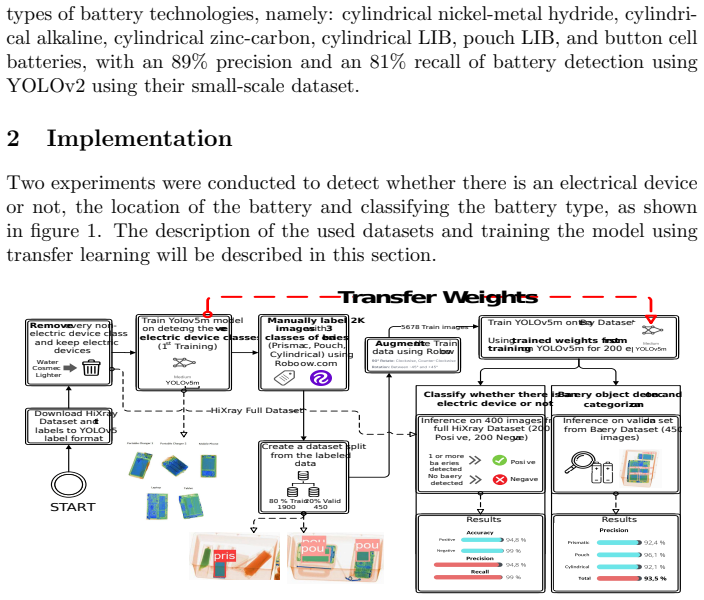
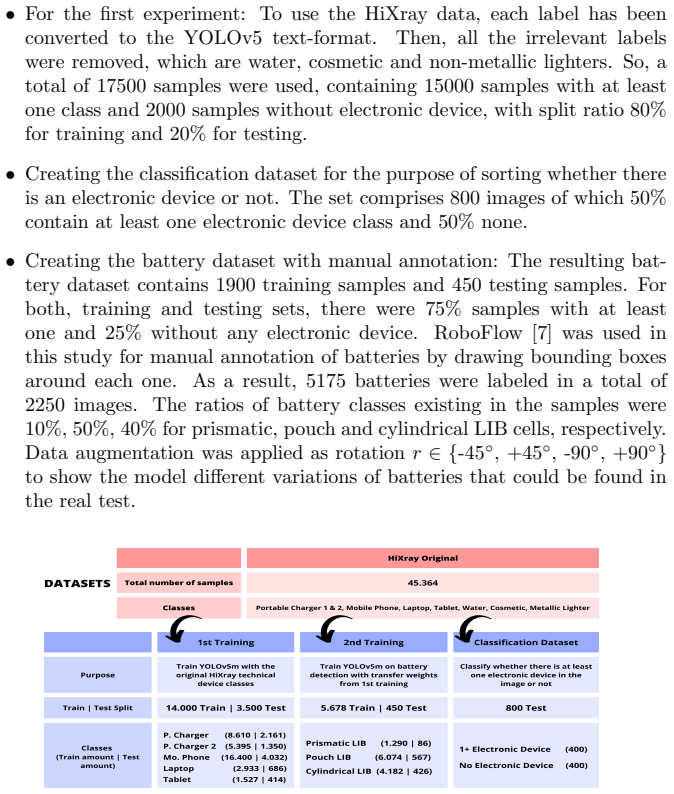
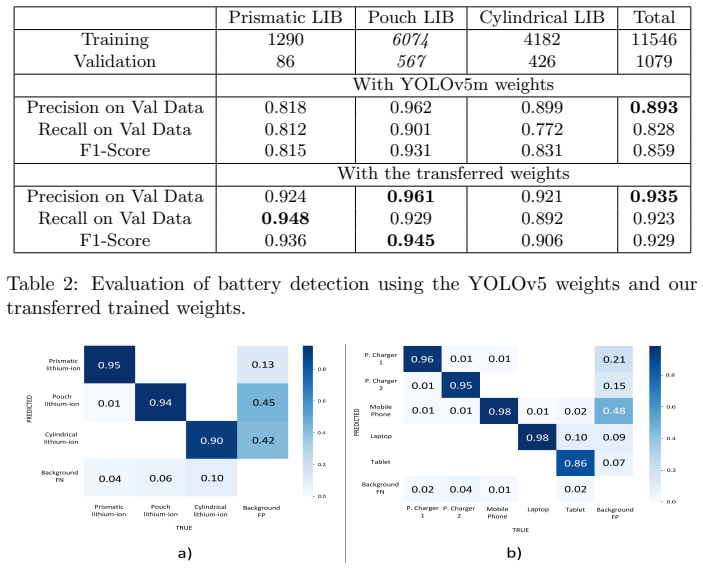
Training YOLOv5m on electronic devices produces weights that, when transferred, detect batteries in X-ray images and classify them as prismatic, pouch, or cylindrical at 94 percent precision while running in 22 ms, outperforming the original pretrained YOLOv5m weights by 5 percent.
What carries the argument
The YOLOv5m model with weights transferred from an electronic-device detection task to X-ray battery images, performing both localization and three-class classification.
If this is right
- Battery presence, location, and type can be determined in X-ray images at 94 percent precision using the transferred model.
- Inference completes in 22 milliseconds, supporting real-time processing.
- The transferred weights outperform the original pretrained YOLOv5m by five percentage points on this task.
- Three battery geometries—prismatic, pouch, and cylindrical—can be distinguished after the transfer step.
Where Pith is reading between the lines
- The same transfer approach might be tested on X-ray images of other recyclable components such as circuit boards.
- Integration into conveyor-belt sorting systems could reduce manual inspection time in battery recycling plants.
- If domain shift proves larger on new X-ray sources, targeted fine-tuning on a small battery-specific set could restore performance.
- The method implies that pretraining on broad object categories can bootstrap specialized industrial inspection tasks.
Load-bearing premise
Weights learned on general electronic-device images will transfer effectively to X-ray battery images without major loss from domain differences.
What would settle it
A test on a held-out X-ray battery dataset that yields precision below 89 percent would show the transferred weights do not deliver the claimed improvement.
Figures
read the original abstract
The need for detecting and sorting batteries is drastically increasing for many applications. This study proves the potential of transfer learning in predicting whether the image contains a battery or not, the location and identifying three types of batteries, namely: prismatic, pouch, and cylindrical Lithium-Ion Batteries (LIB). Particularly, it focuses on the transfer learning method in two applications: Training a large-scale dataset to detect electronic devices using a pre-trained YOLOv5m, then using these latter trained weights to detect and classify the batteries. The precision of battery detection achieves 94%, which outperforms the pretrained YOLOv5m weights with 5%, in 22 ms inference time.
Editorial analysis
A structured set of objections, weighed in public.
Referee Report
Summary. The manuscript describes a transfer-learning pipeline that first fine-tunes a pretrained YOLOv5m detector on a large electronic-device dataset and then applies the resulting weights to X-ray images for binary battery presence detection plus three-class classification (prismatic, pouch, cylindrical). It reports 94 % precision (5 % above the original YOLOv5m weights) at 22 ms inference time.
Significance. If the numerical claims are reproducible, the work would illustrate that weights learned on RGB electronic-device imagery can be transferred to grayscale X-ray battery images, offering a practical route for automated sorting in battery recycling. The absence of dataset statistics, training protocol, and evaluation details, however, prevents any assessment of whether the reported gain is attributable to successful transfer or to unstated experimental choices.
major comments (2)
- [Abstract] Abstract: the central claim of 94 % precision and a 5 % improvement is presented without any information on the size or composition of the battery X-ray dataset, the train/validation/test splits, or the fine-tuning schedule (layers frozen, learning-rate schedule, number of epochs). These omissions make the numerical result impossible to evaluate and are load-bearing for the transfer-learning assertion.
- [Abstract] Abstract: no description is given of any domain-adaptation step, input preprocessing (e.g., conversion of X-ray grayscale to three-channel input), or modality-specific augmentations, despite the large distribution shift between RGB electronic-device photographs and density-based X-ray images. This gap directly undermines the transfer-learning narrative.
Simulated Author's Rebuttal
We thank the referee for the detailed feedback. The comments correctly identify omissions in the abstract that hinder evaluation of the transfer-learning claims. We have revised the manuscript to supply the missing details on datasets, splits, training protocols, preprocessing, and handling of the domain shift.
read point-by-point responses
-
Referee: [Abstract] Abstract: the central claim of 94 % precision and a 5 % improvement is presented without any information on the size or composition of the battery X-ray dataset, the train/validation/test splits, or the fine-tuning schedule (layers frozen, learning-rate schedule, number of epochs). These omissions make the numerical result impossible to evaluate and are load-bearing for the transfer-learning assertion.
Authors: We agree that these details were absent from the abstract and are essential. The revised manuscript expands the abstract and adds a Methods subsection that reports the battery X-ray dataset size and class composition, the train/validation/test splits, and the full fine-tuning schedule (including which layers were frozen, the learning-rate schedule, and number of epochs). These additions allow direct assessment of the reported 94 % precision and the 5 % gain over the original YOLOv5m weights. revision: yes
-
Referee: [Abstract] Abstract: no description is given of any domain-adaptation step, input preprocessing (e.g., conversion of X-ray grayscale to three-channel input), or modality-specific augmentations, despite the large distribution shift between RGB electronic-device photographs and density-based X-ray images. This gap directly undermines the transfer-learning narrative.
Authors: The referee is correct that the abstract provided no information on these aspects. The revised manuscript now includes a description of the input preprocessing (replicating the single-channel X-ray image to three channels) and the augmentations applied during fine-tuning. No additional domain-adaptation technique (such as adversarial alignment) was employed beyond direct weight transfer followed by fine-tuning; this is now explicitly stated so that readers can evaluate the transfer-learning approach in light of the modality shift. revision: yes
Circularity Check
No circularity: purely empirical transfer-learning study
full rationale
The manuscript reports an experimental pipeline that fine-tunes a publicly available YOLOv5m checkpoint first trained on an electronic-device corpus and then evaluates it on a separate X-ray battery dataset. No equations, uniqueness theorems, or parameter-fitting steps are presented that would reduce a claimed prediction back to the input by construction. All performance numbers (94 % precision, 5 % gain, 22 ms inference) are direct empirical outcomes of training and testing; they are not derived from any self-referential definition or self-citation chain. The work therefore contains no load-bearing circular steps of the enumerated kinds.
Axiom & Free-Parameter Ledger
Reference graph
Works this paper leans on
-
[1]
Feature-fusion transfer learning method as a basis to support automated smartphone recycling in a circular smart city
Nermeen Abou Baker, Paul Szabo-M´ yller, and Uwe Handmann. Feature-fusion transfer learning method as a basis to support automated smartphone recycling in a circular smart city. InEAI S-CUBE 2020 - 11th EAI International Conference on Sensor Systems and Software, online, 2020
2020
-
[2]
Transfer learning-based method for automated e-waste recycling in smart cities.EAI Endorsed Transactions on Smart Cities, 5(16), 4 2021
Nermeen Abou Baker, Paul Szabo-M´ yller, and Uwe Handmann. Transfer learning-based method for automated e-waste recycling in smart cities.EAI Endorsed Transactions on Smart Cities, 5(16), 4 2021
2021
-
[3]
Wouter Sterkens, Dillam Diaz-Romero, Toon Goedeme, Wim Dewulf, and Jef R. Peeters. Detection and recognition of batteries on x-ray images of waste electrical and electronic equipment using deep learning.Resources, Conservation and Recycling, 168:105246, 2021
2021
-
[4]
Yona Falinie Abdul Gaus, Neelanjan Bhowmik, and T. Breckon. On the use of deep learning for the detection of firearms in x-ray baggage security imagery.2019 IEEE International Symposium on Technologies for Homeland Security (HST), pages 1–7, 2019
2019
-
[5]
Towards real- world prohibited item detection: A large-scale x-ray benchmark
Boying Wang, Libo Zhang, Longyin Wen, Xianglong Liu, and Yanjun Wu. Towards real- world prohibited item detection: A large-scale x-ray benchmark. In2021 IEEE/CVF International Conference on Computer Vision (ICCV), pages 5392–5401, Los Alamitos, CA, USA, oct 2021. IEEE Computer Society
2021
-
[6]
Renshuai Tao, Yanlu Wei, Xiangjian Jiang, Hainan Li, Haotong Qin, Jiakai Wang, Yuqing Ma, Libo Zhang, and Xianglong Liu. Towards real-world x-ray security inspection: A high- quality benchmark and lateral inhibition module for prohibited items detection.2021 IEEE/CVF International Conference on Computer Vision (ICCV), pages 10903–10912, 2021
2021
-
[7]
https://roboflow.com/
-
[8]
ultralytics/yolov5, Jun 2020
Glenn Jocher. ultralytics/yolov5, Jun 2020
2020
-
[9]
Comparing yolov3, yolov4 and yolov5 for autonomous landing spot detection in faulty uavs.Sensors, 22(2), 2022
Upesh Nepal and Hossein Eslamiat. Comparing yolov3, yolov4 and yolov5 for autonomous landing spot detection in faulty uavs.Sensors, 22(2), 2022
2022
-
[10]
Faster r-cnn: Towards real- time object detection with region proposal networks
Shaoqing Ren, Kaiming He, Ross Girshick, and Jian Sun. Faster r-cnn: Towards real- time object detection with region proposal networks. In C. Cortes, N. Lawrence, D. Lee, M. Sugiyama, and R. Garnett, editors,Advances in Neural Information Processing Sys- tems, volume 28. Curran Associates, Inc., 2015
2015
-
[11]
Wei Liu, Dragomir Anguelov, Dumitru Erhan, Christian Szegedy, Scott Reed, Cheng- Yang Fu, and Alexander C. Berg. Ssd: Single shot multibox detector. In Bastian Leibe, Jiri Matas, Nicu Sebe, and Max Welling, editors,Computer Vision – ECCV 2016, pages 21–37, Cham, 2016. Springer International Publishing
2016
-
[12]
Girshick, Kaiming He, and Piotr Doll´ ar
Tsung-Yi Lin, Priya Goyal, Ross B. Girshick, Kaiming He, and Piotr Doll´ ar. Focal loss for dense object detection.IEEE Transactions on Pattern Analysis&Machine Intelligence, 42(02):318–327, feb 2020
2020
-
[13]
A survey of deep learning-based object detection.CoRR, abs/1907.09408, 2019
Licheng Jiao, Fan Zhang, Fang Liu, Shuyuan Yang, Lingling Li, Zhixi Feng, and Rong Qu. A survey of deep learning-based object detection.CoRR, abs/1907.09408, 2019
arXiv 1907
discussion (0)
Sign in with ORCID, Apple, or X to comment. Anyone can read and Pith papers without signing in.