REVIEW 2 major objections 1 minor 37 references
Holographic Beamforming for Semantic Communication
T0 review · 2 major / 1 minor · reviewed 2026-06-26 · grok-4.3
Pith's one-line read Holographic beamforming can be adapted to give higher signal quality to more important semantic information.
desk verdict The paper adds semantic importance weighting to holographic beamforming via a data-fitted performance model, which is a direct but empirically driven extension. read the letter →
The pith
A machine-rendered reading of the paper's core claim, the machinery that carries it, and where it could break.
The reading
What carries the argument
Semantic-aware holographic beamforming algorithm that optimizes radiated amplitudes of metamaterial antennas according to a data-fitted model of performance versus semantic importance and SNR.
What would settle it
A controlled simulation or hardware test in which the fitted performance model produces amplitude allocations that yield no measurable gain in task completion rate compared with uniform-amplitude holographic beamforming.
Extended reading notes
Core claim
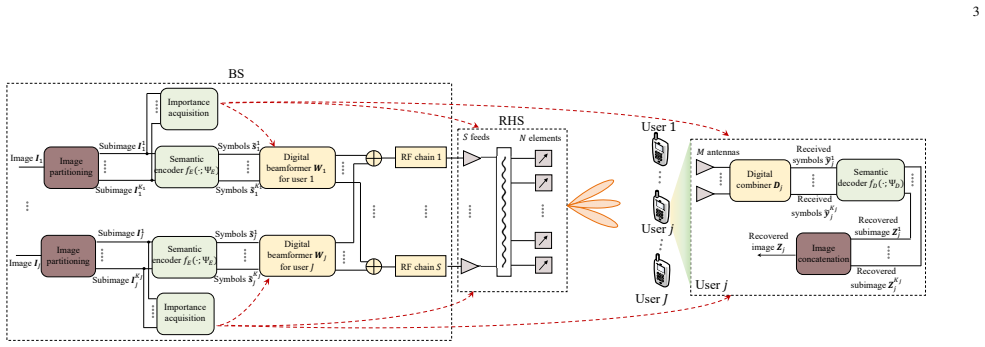
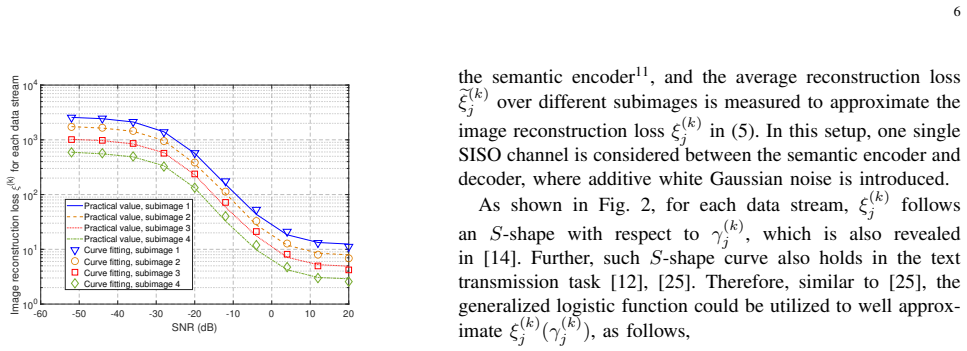
The central claim is that a semantic-importance-aware holographic beamforming scheme, realized with metamaterial antennas whose radiated amplitudes can be tuned, ensures reliable delivery of highly important semantic information. The scheme works by first characterizing the dependence of semantic communication performance on semantic importance and received SNR through data fitting, then designing a beamforming algorithm that removes the mismatch between importance levels and transmission quality.
Load-bearing premise
The relationship between semantic importance, received SNR, and overall task performance can be captured accurately enough by data fitting to guide reliable beamforming decisions.
Editorial extensions
If this is right
- Task performance in semantic communication improves because critical information receives higher SNR while less critical information can tolerate lower quality.
- Hardware cost and power consumption stay low because the same metamaterial antenna structure is reused with only a change in amplitude control policy.
- Mismatches that degrade semantic system performance are eliminated by design rather than left to chance.
- The approach extends the applicability of holographic beamforming from bit-pipe systems to meaning-aware wireless links.
Reading between the lines
- The same fitting-plus-optimization idea could be tested on other reconfigurable surfaces or phased arrays that also control amplitude or phase.
- Importance labels might be allowed to change over time within a single transmission if the underlying task requirements shift.
- Validation would need to check whether the fitted curves remain stable when channel statistics or semantic vocabularies differ from the training data.
Editorial analysis
A structured set of objections, weighed in public.
Referee Report
Summary. The paper proposes a semantic-importance-aware holographic beamforming scheme for metamaterial antennas with tunable radiated amplitudes. It addresses mismatches in conventional holographic beamforming by characterizing the dependence of semantic communication performance on semantic importance and received SNR via data fitting, then designing an algorithm to prioritize delivery of highly important semantic information, with effectiveness validated through simulations.
Significance. If the data-fitted performance model is robust and the resulting algorithm reliably improves semantic task performance, the work would usefully extend holographic beamforming techniques to semantic communication by incorporating importance-aware resource allocation at low hardware cost. The explicit use of simulations for validation provides a concrete empirical check, though the empirical modeling approach limits closed-form insights or parameter-free guarantees.
major comments (2)
- [Abstract] Abstract: the central algorithm relies on a performance model obtained via data fitting of semantic communication outcomes versus importance and SNR, yet the manuscript provides no description of the fitting procedure, dataset size, functional form, goodness-of-fit metrics, or cross-validation, leaving the reliability of the subsequent optimization unclear.
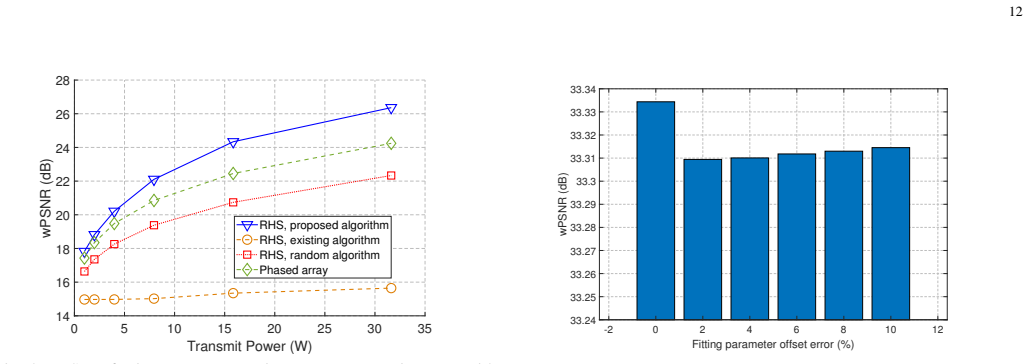
- [Abstract] Abstract: the claim that the scheme 'ensures reliable delivery of highly important semantic information' is load-bearing for the contribution, but rests entirely on the fitted model without reported error bounds, sensitivity analysis, or comparison against an unfitted baseline, so any mismatch between the fitted surface and true performance directly undermines the algorithm's guarantees.
minor comments (1)
- [Abstract] The abstract states that 'simulation results validate effectiveness' but supplies no quantitative metrics, scenario parameters, or baseline comparisons; adding these would strengthen the validation claim without altering the technical core.
Simulated Author's Rebuttal
We thank the referee for the detailed comments. We agree that additional details on the data-fitting procedure and supporting analyses for the performance claims are required to strengthen the manuscript. We will revise accordingly.
read point-by-point responses
-
Referee: [Abstract] Abstract: the central algorithm relies on a performance model obtained via data fitting of semantic communication outcomes versus importance and SNR, yet the manuscript provides no description of the fitting procedure, dataset size, functional form, goodness-of-fit metrics, or cross-validation, leaving the reliability of the subsequent optimization unclear.
Authors: We agree that the current manuscript does not provide sufficient detail on the data-fitting process. In the revised version we will add a dedicated subsection (likely in Section III or IV) that specifies: the size and composition of the simulation dataset used for fitting, the chosen functional form (e.g., a bivariate polynomial or exponential surface), the optimization criterion for the fit, quantitative goodness-of-fit metrics (R², RMSE), and results from k-fold cross-validation. This will allow readers to assess the robustness of the model that underpins the beamforming algorithm. revision: yes
-
Referee: [Abstract] Abstract: the claim that the scheme 'ensures reliable delivery of highly important semantic information' is load-bearing for the contribution, but rests entirely on the fitted model without reported error bounds, sensitivity analysis, or comparison against an unfitted baseline, so any mismatch between the fitted surface and true performance directly undermines the algorithm's guarantees.
Authors: We acknowledge that the abstract claim currently lacks explicit quantification of model uncertainty. In the revision we will (i) report point-wise error bounds derived from the cross-validation residuals, (ii) include a sensitivity analysis showing how variations in the fitted parameters affect the final beamforming solution and semantic-task accuracy, and (iii) add a comparison against a baseline holographic beamforming scheme that ignores the fitted importance-SNR surface. These additions will be placed in the simulation section and will be summarized in the abstract. revision: yes
Circularity Check
Semantic performance model obtained via data fitting, then used as basis for beamforming optimization and validation
-
fitted input called prediction
[Abstract]
"we characterize the dependence of semantic communication performance on semantic importance and received SNR via data fitting, and design a semantic-aware holographic beamforming algorithm to ensure reliable delivery of highly important semantic information. Simulation results validate effectiveness of the proposed method."
The dependence (performance vs. importance/SNR) is obtained by fitting rather than derived from first principles or external closed-form model. The subsequent algorithm allocates resources to 'ensure' high-SNR delivery for important semantics using this fitted relation, and validation uses the same characterization, so the effectiveness claim is statistically forced by the fit.
full rationale
The paper explicitly characterizes semantic communication performance dependence on importance and SNR by data fitting, then designs an optimization algorithm around that fitted model to 'ensure' prioritized delivery, with simulations validating the scheme. This matches the fitted-input-called-prediction pattern: the load-bearing performance model is not independently derived but fitted from data, so claims that the algorithm reliably prioritizes important information reduce to the fit by construction. No equations or self-citations are shown to create further reduction, and the fitting step is presented as characterization rather than a hidden prediction. This produces partial circularity (score 6) but leaves independent content in the metamaterial beamforming structure and algorithm design.
Assumptions & free parameters
free parameters (1)
- parameters in semantic performance model
assumptions (1)
- domain assumption Different semantic information contributes unequally to task completion and thus requires different transmission quality.
Cite this review
Pith. "Pith review of Holographic Beamforming for Semantic Communication." pith.science (2026). https://pith.science/paper/453NR5N7
@misc{pith2026260620887,
  author       = {Pith},
  title        = {Pith review of: Holographic Beamforming for Semantic Communication},
  year         = {2026},
  howpublished = {\url{https://pith.science/paper/453NR5N7}},
  note         = {Machine review of arXiv:2606.20887}
}
read the original abstract
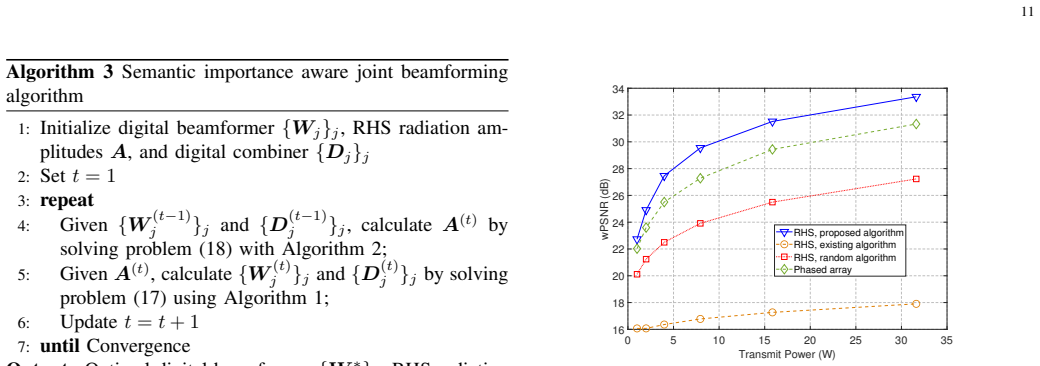
Holographic beamforming enabled by metamaterial antennas has been proposed to facilitate spatial multiplexing at low hardware cost and low power consumption. However, existing holographic beamforming schemes are mainly developed for conventional bit-communication systems, which have not considered semantic-level importance and thus cannot be directly applied to support semantic communication. Specifically, in conventional bit communication, all bits are treated as equally important. In contrast, in semantic communication, different semantic information contribute unequally to task completion and therefore has different degrees of importance, with more important information requiring higher transmission quality. Ignoring semantic importance in holographic beamforming causes mismatches between importance of semantic information and its received SNR, thus degrading performances. In this paper, we propose a semantic-importance-aware holographic beamforming scheme enabled by metamaterial antennas with tunable radiated amplitudes to support semantic communication. It is challenging to design semantic-aware holographic beamforming schemes due to non-trivial modeling of the impact of semantic importance and unique amplitude-controlled structures of holographic beamforming. To address this, we characterize the dependence of semantic communication performance on semantic importance and received SNR via data fitting, and design a semantic-aware holographic beamforming algorithm to ensure reliable delivery of highly important semantic information. Simulation results validate effectiveness of the proposed method.
Figures
Figures from the paper (4 more)
Reference graph
Works this paper leans on
-
[1]
Semantic MIMO Systems for Speech-to-Text Transmission,
Z. Weng, Z. Qin, H. Xie, X. Tao, and K. B. Letaief, “Semantic MIMO Systems for Speech-to-Text Transmission,”IEEE Trans. Wireless Commun., vol. 23, no. 12, pp. 18697-18710, Dec. 2024
2024
-
[2]
SecDiff: Diffusion-Aided Secure Deep Joint Source-Channel Coding Against Adversarial Attacks,
C. Zhao, J. Wang, R. Zhang, D. Niyato, H. Du, Z. Xiong, D. Kim, and P. Zhang, “SecDiff: Diffusion-Aided Secure Deep Joint Source-Channel Coding Against Adversarial Attacks,” [online]:https://arxiv.org/abs/2511. 01466
-
[3]
Explainable Semantic Communication for Text Tasks,
C. Liu, C. Guo, Y . Yang, W. Ni, Y . Zhou, L. Li, and T. Q. S. Quek, “Explainable Semantic Communication for Text Tasks,”IEEE Internet Things J., vol. 11, no. 24, pp. 39820-39833, Dec. 2024
2024
-
[4]
A Speculative Study on 6G,
F. Tariq, M. R. A. Khandaker, K. Wong, M. A. Imran, M. Bennis, and M. Debbah, “A Speculative Study on 6G,”IEEE Wireless Commun., vol. 27, no. 4, pp. 118-125, Aug. 2020
2020
-
[5]
Reconfigurable Intelligent Surface-based Wireless Communications: Antenna Design, Prototyping, and Experimental Results,
L. Dai, B. Wang, M. Wang, X. Yang, J. Tan, S. Bi, S. Xu, F. Yang, Z. Chen, M. Di Renzo, C. Chae, and L. Hanzo, “Reconfigurable Intelligent Surface-based Wireless Communications: Antenna Design, Prototyping, and Experimental Results,”IEEE Access, vol. 8, no. 1, pp. 45913-45923, Mar. 2020
2020
-
[6]
Holographic Beamforming for Integrated Sensing and Communication with Mutual Coupling Effects,
S. Zeng, H. Zhang, B. Di, H. Zhang, Z. Shao, Z. Han, H. V . Poor, and L. Song, “Holographic Beamforming for Integrated Sensing and Communication with Mutual Coupling Effects,”IEEE J. Sel. Areas Commun., to be published
-
[7]
Reconfigurable Holographic Surface Enabled Multi-User Wireless Communications: Amplitude-Controlled Holographic Beamforming,
R. Deng, B. Di, H. Zhang, Y . Tan, and L. Song, “Reconfigurable Holographic Surface Enabled Multi-User Wireless Communications: Amplitude-Controlled Holographic Beamforming,”IEEE Trans. Wire- less Commun., vol. 21, no. 8, pp. 6003-6017, Aug. 2022
2022
-
[8]
Towards holographic beam-forming metasurface technology for next generation CubeSats,
O. Yurduseven, S. Podilchak, and M. Khalily, “Towards holographic beam-forming metasurface technology for next generation CubeSats,” inProc. Int. Conf. UK-China Emerging Technol., Glasgow, UK, Aug. 2020
2020
Show all 37 references
-
[9]
Reconfigurable Holographic Surface Assisted Wireless Energy Transfer with Non-Linear Power Amplifier: Joint Waveform and Beamforming Design,
Z. Wang, J. Hu, Y . Zhao, and K. Yang, “Reconfigurable Holographic Surface Assisted Wireless Energy Transfer with Non-Linear Power Amplifier: Joint Waveform and Beamforming Design,”IEEE Trans. Wireless Commun., to be published
-
[10]
HDMA: Holographic-Pattern Division Multiple Access,
R. Deng, B. Di, H. Zhang, and L. Song, “HDMA: Holographic-Pattern Division Multiple Access,”IEEE J. Sel. Areas Commun., vol. 40, no. 4, pp. 1317-1332, Jan. 2022
2022
-
[11]
Goldsmith,Wireless Communications, New York, USA: Cambridge University Press, 2005
A. Goldsmith,Wireless Communications, New York, USA: Cambridge University Press, 2005
2005
-
[12]
Performance Limits of a Deep Learning-Enabled Text Semantic Communication under Interference,
T. M. Getu, W. Saad, G. Kaddoum, and M. Bennis, “Performance Limits of a Deep Learning-Enabled Text Semantic Communication under Interference,”IEEE Trans. Wireless Commun., vol. 23, no. 8, pp. 10213–10228, Aug. 2024
2024
-
[13]
Deep Joint Semantic Coding and Beamforming for Near-Space Airship- Borne Massive MIMO Network,
M. Wu, Z. Gao, Z. Wang, D. Niyato, G. K. Karagiannidis, and S. Chen, “Deep Joint Semantic Coding and Beamforming for Near-Space Airship- Borne Massive MIMO Network,”IEEE J. Sel. Areas Commun., vol. 43, no. 1, pp. 260-278, Jan. 2025
2025
-
[14]
Beamforming Design for Semantic-Bit Coexisting Communication System
M. Zhang, G. Zhu, R. Jin, X. Chen, Q. Shi, C. Zhong, and K. Huang, “Beamforming Design for Semantic-Bit Coexisting Communication System”,IEEE J. Sel. Areas Commun., vol. 43, no. 4, pp. 1262-1277, Apr. 2025
2025
-
[15]
Zero-Forcing Methods for Downlink Spatial Multiplexing in Multiuser MIMO Chan- nels,
Q. H. Spencer, A. Lee Swindlehurst, and M. Haardt, “Zero-Forcing Methods for Downlink Spatial Multiplexing in Multiuser MIMO Chan- nels,”IEEE Trans. Signal. Process., vol. 52, no. 2, pp. 461-471, Feb. 2004
2004
-
[16]
Holographic Metasurfaces for Extremely Large-Scale MIMO Communications: De- sign, Implementation, and Experiment Results,
B. Di, Y . Zhang, R. Deng, M. Wang, S. Sun, and L. Song, “Holographic Metasurfaces for Extremely Large-Scale MIMO Communications: De- sign, Implementation, and Experiment Results,”IEEE Wireless Com- mun., early access
-
[17]
Dual-Polarized Re- configurable Intelligent Surface-Based Antenna for Holographic MIMO Communications,
S. Zeng, H. Zhang, B. Di, Z. Han, and H. V . Poor, “Dual-Polarized Re- configurable Intelligent Surface-Based Antenna for Holographic MIMO Communications,”IEEE Trans. Wireless Commun., vol. 23, no. 11, pp. 17339-17353, Nov. 2024
2024
-
[18]
Three Types of Incremental Learning,
G. M. van de Ven, T. Tuytelaars, and A. S. Tolias, “Three Types of Incremental Learning,”Nat. Machine Intell., vol. 4, pp. 1185–1197, Dec. 2022
2022
-
[19]
Semantic Segmentation-Based Semantic Communication System for Image Transmission,
J. Wu, C. Wu, Y . Lin, T. Yoshinaga, L. Zhong, X. Chen, and Y . Ji, “Semantic Segmentation-Based Semantic Communication System for Image Transmission,”Digital Commun. Netw., vol. 10, no. 3, Jun. 2024
2024
-
[20]
Reconfigurable Holographic Surface: A New Paradigm for Ultra-Massive MIMO,
B. Di, H. Zhang, R. Zhang, Z. Han, and L. Song, “Reconfigurable Holographic Surface: A New Paradigm for Ultra-Massive MIMO,” [online]: https://arxiv.org/abs/2411.19334
-
[21]
Hybrid Near-Far Field Channel Estimation for Holographic MIMO Communications,
S. Yue, S. Zeng, L. Liu, Y . C. Eldar, and B. Di, “Hybrid Near-Far Field Channel Estimation for Holographic MIMO Communications,”IEEE Trans. Wireless Commun., vol. 23, no. 11, pp. 15798-15813, Aug. 2024
2024
-
[22]
Resource Allocation for Text Semantic Communications,
L. Yan, Z. Qin, R. Zhang, Y . Li, and G. Y . Li, “Resource Allocation for Text Semantic Communications,”IEEE Wireless Commun. Lett., vol. 11, no. 7, pp. 1394–1398, Jul. 2022
2022
-
[23]
The PASCAL Visual Object Classes Challenge 2012 (VOC2012) Results,
M. Everingham, L. Van Gool, C. K. I. Williams, J. Winn, and A. Zisserman, “The PASCAL Visual Object Classes Challenge 2012 (VOC2012) Results,” http://www.pascalnetwork.org/challenges/ VOC/voc2012/workshop/index.html
2012
-
[24]
Siamese Cooperative Learning for Unsupervised Image Reconstruction From Incomplete Measurements,
Y . Quan, X. Qin, T. Pang, and H. Ji, “Siamese Cooperative Learning for Unsupervised Image Reconstruction From Incomplete Measurements,” IEEE Trans. Pattern Anal. Mach. Intell., vol. 46, no. 7, pp. 4866-4879, Jul. 2024
2024
-
[25]
Heterogeneous Semantic and Bit Communications: A Semi-NOMA Scheme,
X. Mu, Y . Liu, L. Guo, and N. Al-Dhahir, “Heterogeneous Semantic and Bit Communications: A Semi-NOMA Scheme,”IEEE J. Sel. Areas Commun., vol. 41, no. 1, pp. 155–169, Jan. 2023
2023
-
[26]
Cover and Joy A
Thomas M. Cover and Joy A. Thomas,Elements of Information Theory, 2nd Edition, Wiley
-
[27]
A Vec- tor Perturbation Technique for Near-capacity Multiantenna Multiuser Communication- Part I: Channel Inversion and Regularization,
C. B. Peel, B. M. Hochwald, and A. L. Swindlehurst, “A Vec- tor Perturbation Technique for Near-capacity Multiantenna Multiuser Communication- Part I: Channel Inversion and Regularization,”IEEE Trans. Signal Process., vol. 53, no. 1, pp. 195-202, Feb. 2005
2005
-
[28]
Boyd and L
S. Boyd and L. Vandenberghe,Convex Optimization.Cambridge, U.K.: Cambridge University Press, 2004
2004
-
[29]
Intelligent Omni-Surfaces: Reflection-Refraction Circuit Model, Full-Dimensional Beamforming, and System Implementation,
S. Zeng, H. Zhang, B. Di, Y . Liu, M. Di Renzo, Z. Han, H. V . Poor, and L. Song, “Intelligent Omni-Surfaces: Reflection-Refraction Circuit Model, Full-Dimensional Beamforming, and System Implementation,” IEEE Trans. Commun., vol. 70, no. 11, pp. 7711-7727, Nov. 2022
2022
-
[30]
Reconfigurable Intelligent Surfaces in 6G: Reflective, Transmissive, or Both,
S. Zeng, H. Zhang, B. Di, Y . Tan, Z. Han, H. V . Poor, and L. Song, “Reconfigurable Intelligent Surfaces in 6G: Reflective, Transmissive, or Both,”IEEE Commun. Lett., vol. 25, no. 6, pp. 2063-2067, Jun. 2021
-
[31]
Semantic Segment Anything,
J. Chen, Z. Yang, and L. Zhang, “Semantic Segment Anything,” https: //github.com/fudan-zvg/Semantic-Segment-Anything,2023
2023
-
[32]
Deep Joint Source-Channel Coding for Wire- less Image Transmission with Adaptive Rate Control,
M. Yang and H.-S. Kim, “Deep Joint Source-Channel Coding for Wire- less Image Transmission with Adaptive Rate Control,” inProc. IEEE Int. Conf. Acoustics Speech Signal Processing (ICASSP), Singapore, May 2022
2022
-
[33]
Holographic Integrated Sensing and Communication,
H. Zhang, H. Zhang, B. Di, M. Di Renzo, Z. Han, H. V . Poor, and L. Song, “Holographic Integrated Sensing and Communication,”IEEE J. Sel. Areas Commun., vol. 40, no. 7, pp. 2114-2130, Jul. 2022
2022
-
[34]
Holographic Beam- forming for Ultra Massive MIMO With Limited Radiation Amplitudes: How Many Quantized Bits Do We Need?
X. Hu, R. Deng, B. Di, H. Zhang, and L. Song, “Holographic Beam- forming for Ultra Massive MIMO With Limited Radiation Amplitudes: How Many Quantized Bits Do We Need?”IEEE Commun. Lett., vol. 26, no. 6, pp. 1403-1407, Jun. 2022
2022
-
[35]
Holographic Metasurfaces for Extremely Large-Scale MIMO Communications: De- sign, Implementation, and Experiment Results,
B. Di, Y . Zhang, R. Deng, M. Wang, S. Sun, and L. Song, “Holographic Metasurfaces for Extremely Large-Scale MIMO Communications: De- sign, Implementation, and Experiment Results,”IEEE Wireless Com- mun., to be published
-
[36]
A Study of the Perceptually Weighted Peak Signal-To- Noise Ratio (WPSNR) for Image Compression,
J. Erfurt, C. R. Helmrich, S. Bosse, H. Schwarz, D. Marpe, and T. Wiegand, “A Study of the Perceptually Weighted Peak Signal-To- Noise Ratio (WPSNR) for Image Compression,” inProc. 2019 IEEE International Conference on Image Processing (ICIP), Taipei, Taiwan, Aug. 2019
2019
-
[37]
Feature-foundation model evolution for low-latency semantic communication,
H. Zhang, B. Di, H. Zhang, D. Niyato, and L. Song, “Feature-foundation model evolution for low-latency semantic communication,”IEEE Trans. Wireless Commun., vol. 25, pp. 11915-11931, Feb. 2026
2026
Reviewed June 26, 2026 · model on record in the stance chip above.
Discussion (0). Continue with ORCID to comment.