REVIEW 4 major objections 4 minor 43 references
Hierarchical Flow Matching for 3D Point Cloud Generation
T0 review · 4 major / 4 minor · reviewed 2026-08-08 · deepseek-v4-flash
Pith's one-line read Hierarchical flow matching decomposes 3D point cloud generation into two flow-matching levels, trained with plain MSE regression and sampled in 15 Euler steps per flow, reaching state-of-the-art or competitive quality on ShapeNet and…
desk verdict A credible, incremental flow-matching paper on point clouds whose competitive numbers depend on a latent-prior assumption with only thin direct evidence — worth reviewing, not yet fully supported. read the letter →
The pith
A machine-rendered reading of the paper's core claim, the machinery that carries it, and where it could break.
The reading
What carries the argument
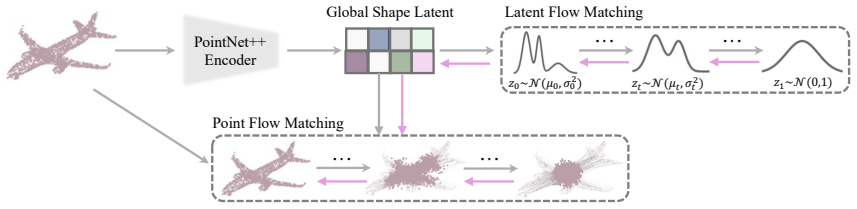
The central object is the optimal-transport conditional flow-matching (OT-CFM) objective, in which a velocity network v_theta(x_t, t) regresses, by MSE, onto the constant target velocity (x_1 - x_0)/T along the straight interpolation x_t = (1 - t/T)x_0 + (t/T)x_1 between a data point x_1 and noise x_0. HFM applies this objective at two levels: a latent OT-CFM models the prior p(z) over shape codes, and a conditional point OT-CFM models p(X|z) with the velocity network conditioned on the shape code z via AdaptiveConditionLinear layers that modulate each linear layer with a context vector [t, z]. The encoder is a PointNet++ that outputs diagonal-Gaussian parameters (mu, sigma), trained with an entropy regularization term -lambda_entropy H[q(z|X)] with lambda_entropy = 1e-4 to prevent posterior collapse. The straightness of the learned OT paths is what allows sampling with very few Euler steps; the paper observes that Heun integration gives negligible improvement, confirming near-zero truncation error.
What would settle it
A direct falsifier would be a cross-category or cross-dataset experiment in which HFM is trained with the same entropy coefficient and architecture on categories not used for tuning; if removing the learned latent prior shows no degradation on those categories, or if 1-NNA-CD under 15-step sampling does not beat a single-level flow with matched compute, then the hierarchical latent prior is not the cause of the reported gains. Concretely, one would train on Car and Chair with lambda_entropy fixed at 1e-4 and check whether the gap between the full model and the w/o-latent-flow variant persists at the reported level.
Extended reading notes
Core claim
The paper's central claim is that the hierarchical, bilevel structure of 3D shape generation, global topology first and local geometric detail second, can be implemented entirely within the flow-matching framework, and that doing so yields a single-stage, simulation-free training procedure whose samples match or surpass prior diffusion- and flow-based models. HFM trains an encoder that maps a point cloud X to a 128-dimensional latent code z, an unconditional optimal-transport flow that maps Gaussian noise to the distribution of these codes, and a conditional optimal-transport flow that maps independent noise per point to a point cloud conditioned on z. Because both flows interpolate along straight OT paths, reverse Euler integration with 15 steps per flow (30 function evaluations total) is sufficient, and no distillation or reflow is needed. The paper supports this claim with extensive experiments on ShapeNet and ModelNet, including generation metrics, auto-encoding reconstruction, and classification accuracy, and with ablations that isolate the role of the learned latent prior.
Load-bearing premise
The learned latent prior, trained with an entropy weight of 1e-4 tuned on the Airplane category, faithfully captures the multi-modal distribution of shape codes, so that sampling from it and running the conditional point flow yields point clouds close to the data distribution; the paper's evidence for this is one interpolation visualization and a single-category ablation.
Editorial extensions
If this is right
- On Airplane, Car, and Chair, HFM achieves 1-NNA-CD of 66.61, 53.37, and 53.62 with 30 function evaluations, improving on or matching previous state-of-the-art methods that require hundreds of sampling steps.
- The learned latent prior contributes substantially: removing it by sampling z from a standard Gaussian raises 1-NNA-CD on Airplane from 66.61 to 78.43, showing the latent flow's role in steering the point flow.
- HFM provides a structured latent space useful for downstream tasks, reaching 87.9% linear-SVM accuracy on ModelNet-40, the best among compared methods.
- Training is a single-stage, end-to-end MSE regression over both flows, with no ODE solver, trace estimation, log-likelihood computation, distillation, or reflow stage.
- Sampling time per single shape is about 0.05 s, nearly as fast as the fastest single-level flow baseline and orders of magnitude faster than diffusion-based methods.
Reading between the lines
- If the entropy-regularized latent prior generalizes beyond the single tuned category, the same hierarchical recipe could be applied to other set-structured data, such as molecular point sets or scene graphs, where a global code should condition local element generation.
- Because the entropy coefficient is tuned on Airplane and the latent-flow ablation is reported only there, a fair reader might want the latent prior's benefit verified across all 55 ShapeNet categories before treating it as the load-bearing component.
- The straight OT paths suggest HFM could be pushed toward one-step generation via distillation or by training with minibatch-OT couplings, a direction the authors name as future work but do not test.
Editorial analysis
A structured set of objections, weighed in public.
Referee Report
Summary. The paper proposes Hierarchical Flow Matching (HFM), a two-level flow-matching model for unconditional 3D point cloud generation. A PointNet++ encoder maps each point cloud to a 128-dimensional latent code; an unconditional latent flow, trained with optimal-transport conditional flow matching and an MSE regression loss, models the prior over codes; a conditional point flow models p(X|z). The two flows are trained jointly with an entropy-regularized objective, and sampling uses reverse Euler integration with 15 steps per flow (30 NFEs in total). Experiments on ShapeNet per-category benchmarks report 1-NNA-CD values of 66.61/53.37/53.62 for Airplane/Car/Chair, competitive or best MMD and COV values, best EMD in auto-encoding, and 87.9% linear SVM accuracy on ModelNet-40. Ablations study the number of inference steps, the entropy coefficient, and the effect of removing the latent flow.
Significance. The central idea is a clean integration of flow matching into a two-level generative model for point clouds, and the training objectives are specified precisely (Eqs. 5, 7, 8), making the method easy to reimplement. The ablation in Table 6 gives initial evidence that the learned latent prior is beneficial, and the sampling-efficiency numbers are practically attractive. If the reported results are reproducible, the paper makes a useful contribution: a simulation-free, hierarchical alternative to CNF-based PointFlow and diffusion-based LION/PVD. However, the strength of the empirical claim is currently limited by the absence of error bars, the omission of the closest flow-matching baseline (MFM-point), and the thin evidence that latent-flow samples are actually in-distribution for the conditional point flow. The limitations acknowledged in Section 8 (independent per-point OT coupling and MLP velocity network) are honest but are not connected to quantitative outcomes.
major comments (4)
- [§3.3, §3.4, §4.6 (Table 6)] The learned latent prior is the load-bearing component of the pipeline, but its fidelity is not established. During training the point flow receives z sampled from q(z|X) (Eq. 7), while during generation it receives z produced by reversing the latent flow (Eq. 10). Table 6 shows that replacing the latent prior with N(0,I) changes 1-NNA-CD from 66.61 to 78.43, so the pipeline is highly sensitive to the z-distribution. The current evidence that latent-flow outputs are close to encoder-code samples consists of one Airplane ablation and the qualitative Fig. 5. Please add a quantitative test: compare full HFM against a variant in which the point flow is conditioned on held-out encoder codes, and report a distributional distance (e.g., MMD or sliced-Wasserstein) between latent-flow samples and the empirical encoder-code distribution. Without this, the ablation shows only that the learned prior is better than an uninformed Gaussian, not that it is well calibrated.
- [§2.1, §4.2, Tables 1–2] The paper cites MFM-point [28] as a closely related simulation-free flow-matching method for point clouds, but no quantitative comparison with MFM-point appears in any table or figure. Since MFM-point is the most direct flow-matching baseline, the claim of 'competitive or even best performance' cannot be fully evaluated without an MFM-point row, or at least a concrete explanation of why it is omitted.
- [§4.1, Tables 1–2] All headline metrics are single-run numbers, and several differences against the best baselines are small. For example, Airplane 1-NNA-CD is 66.61 versus 67.41 for LION, and Airplane COV-EMD is 52.14 versus 52.11. Without standard deviations over multiple seeds, and with no code release, the state-of-the-art claim is not statistically supported. Please report mean ± std over at least three seeds for the main per-category benchmarks, and wherever possible rerun the strongest baselines under the same preprocessing and evaluation protocol.
- [§4.6, Fig. 7, §6] The entropy coefficient λ_entropy and the final time T are tuned on the Airplane category and then applied to all categories and tasks. If this tuning was done on the test benchmark, the Airplane results are selection-biased, and there is no evidence that the same settings are appropriate for Car and Chair. Please state whether hyperparameters were selected on held-out validation splits and, ideally, include the λ_entropy sweep for at least one additional category.
minor comments (4)
- [§8] The acknowledged limitations (point-wise independent OT coupling and the MLP velocity network) are not connected to any quantitative analysis; a short experiment or an explicit statement of their expected impact would help readers calibrate the quality ceiling.
- [§4.2 and reference list] ShapeGF is listed among VAE-based methods and cited as [40], but reference [40] is the PVD paper and ShapeGF is a score-based generative model; the citation and taxonomy both appear incorrect and should be fixed.
- [Tables 1 and 2] The category order is inconsistent across the two tables (Chair/Airplane/Car versus Airplane/Car/Chair); the column order should be aligned.
- [Algorithms 2 and 3] The line 'µ, log σ = 0 ← Enc(X)' is ambiguous; it should be written as two separate steps, for example 'µ ← Enc(X); log σ := 0'.
Circularity Check
No circular derivation: HFM's two flow levels are trained on independent OT regression targets and evaluated on held-out data; the latent-prior fidelity concern is an empirical robustness issue, not a built-in equivalence.
full rationale
HFM is an empirical architecture paper with an explicit training and sampling procedure. The latent flow (Eq. 5) regresses a velocity field onto the OT target (z0 - z)/T using encoder codes z, and the point flow (Eq. 7) regresses onto (x0 - x)/T conditioned on that code; neither target is defined in terms of the final evaluation metric. Sampling in Algorithm 4 reverses both learned fields, so generated point clouds are produced by the same conditional distribution that was trained, not by a quantity fitted to the evaluation set. The 1-NNA, CD/EMD, and SVM results are computed against held-out reference data using standard metrics, so no 'prediction' reduces to a fitted parameter. Hyperparameters such as λ_entropy and step count are selected on Airplane and then applied to other categories; this is standard model selection, not a derivation that collapses into its own input. The paper contains no load-bearing self-citation: its methodological premise (bilevel latent + conditional generation) cites prior external work (PointFlow, DPM), and the authors do not invoke a uniqueness theorem from their own prior work. The latent-prior fidelity concern raised by the skeptic is a legitimate empirical robustness issue, but it is an assumption about out-of-distribution generalization, not a circular step: the latent flow is trained to match encoder codes and the point flow is trained on those same codes, so the pipeline is self-consistent by construction rather than circular.
Assumptions & free parameters
free parameters (4)
- entropy coefficient lambda_entropy =
1e-4
- final time T =
0.5
- inference steps per flow =
15
- latent dimension d =
128
assumptions (4)
- standard math The conditional flow matching objective (Eq. 2) is a valid surrogate for the true flow matching objective, so training with MSE regression on straight OT paths yields the marginal vector field.
- domain assumption Euclidean straight-line interpolation in the 128-dimensional latent space is a near-optimal transport map for shape codes, so the latent flow can model the code manifold with few steps.
- domain assumption Point-wise independent OT coupling, with all points sharing only the conditioning code, is sufficient to generate coherent shapes.
- domain assumption The standard evaluation metrics (1-NNA, MMD, COV) computed on the same protocol as prior papers give a fair comparison of generation quality.
Cite this review
Pith. "Pith review of Hierarchical Flow Matching for 3D Point Cloud Generation." pith.science (2026). https://pith.science/paper/4544WAX2
@misc{pith2026260805557,
  author       = {Pith},
  title        = {Pith review of: Hierarchical Flow Matching for 3D Point Cloud Generation},
  year         = {2026},
  howpublished = {\url{https://pith.science/paper/4544WAX2}},
  note         = {Machine review of arXiv:2608.05557}
}
read the original abstract
Generating high-quality 3D point clouds requires capturing both global shape topology and local geometric details. Existing flow-based methods rely on continuous normalizing flows (CNFs) that demand expensive ODE solving and trace estimation during training, while diffusion models require hundreds of iterative denoising steps. Moreover, most approaches adopt single-level generation directly in point space, disregarding the hierarchical structure natural to 3D shapes. We propose Hierarchical Flow Matching (HFM) that extends flow matching to bilevel structure for unconditional 3D point cloud generation. HFM decomposes the task into two levels via optimal-transport flow matching: a \textit{Latent Flow Matching} models the global shape manifold in a compact latent space, and a \textit{Conditional Point Flow Matching} reconstructs detailed point clouds conditioned on the latent code. Both flows are trained with simple MSE regression losses. The resulting straight OT paths enable efficient sampling with as few as 15 Euler steps per flow, while the structured latent space supports downstream tasks including classification. Extensive experiments on ShapeNet and ModelNet benchmarks demonstrate that HFM achieves competitive or even best performance compared with prior state-of-the-art methods.
Figures


Figures from the paper (7 more)


Reference graph
Works this paper leans on
-
[28]
Petr Molodyk, Jaemoo Choi, David W Romero, Ming- Yu Liu, and Yongxin Chen. Mfm-point: Multi-scale flow matching for point cloud generation.arXiv preprint arXiv:2511.20041, 2025. 1, 2
-
[1]
Learning representations and generative models for 3d point clouds
Panos Achlioptas, Olga Diamanti, Ioannis Mitliagkas, and Leonidas Guibas. Learning representations and generative models for 3d point clouds. InInternational conference on machine learning, pages 40–49. PMLR, 2018. 1, 2, 5, 6
work page 2018
-
[2]
Building nor- malizing flows with stochastic interpolants.arXiv preprint arXiv:2209.15571, 2022
Michael S Albergo and Eric Vanden-Eijnden. Building nor- malizing flows with stochastic interpolants.arXiv preprint arXiv:2209.15571, 2022. 1, 2
arXiv 2022
-
[3]
Shapenet: An information-rich 3d model repository.arXiv preprint arXiv:1512.03012, 2015
Angel X Chang, Thomas Funkhouser, Leonidas Guibas, Pat Hanrahan, Qixing Huang, Zimo Li, Silvio Savarese, Manolis Savva, Shuran Song, Hao Su, et al. Shapenet: An information-rich 3d model repository.arXiv preprint arXiv:1512.03012, 2015. 6
arXiv 2015
-
[4]
Guangyan Chen, Meiling Wang, Yi Yang, Kai Yu, Li Yuan, and Yufeng Yue. Pointgpt: Auto-regressively generative pre- training from point clouds.Advances in Neural Information Processing Systems, 36:29667–29679, 2023. 6
work page 2023
-
[5]
Neural ordinary differential equa- tions.Advances in neural information processing systems, 31, 2018
Ricky TQ Chen, Yulia Rubanova, Jesse Bettencourt, and David K Duvenaud. Neural ordinary differential equa- tions.Advances in neural information processing systems, 31, 2018. 1, 2
work page 2018
-
[6]
Autoregressive 3d shape generation via canon- ical mapping
An-Chieh Cheng, Xueting Li, Sifei Liu, Min Sun, and Ming- Hsuan Yang. Autoregressive 3d shape generation via canon- ical mapping. InEuropean Conference on Computer Vision, pages 89–104. Springer, 2022. 5
work page 2022
-
[7]
Nice: Non-linear independent components estimation.arXiv preprint arXiv:1410.8516, 2014
Laurent Dinh, David Krueger, and Yoshua Bengio. Nice: Non-linear independent components estimation.arXiv preprint arXiv:1410.8516, 2014. 1
arXiv 2014
Show all 43 references
-
[8]
Density estimation using real nvp.arXiv preprint arXiv:1605.08803, 2016
Laurent Dinh, Jascha Sohl-Dickstein, and Samy Ben- gio. Density estimation using real nvp.arXiv preprint arXiv:1605.08803, 2016. 1, 2
2016 arXiv
-
[9]
Scaling recti- fied flow transformers for high-resolution image synthesis
Patrick Esser, Sumith Kulal, Andreas Blattmann, Rahim Entezari, Jonas M ¨uller, Harry Saini, Yam Levi, Dominik Lorenz, Axel Sauer, Frederic Boesel, et al. Scaling recti- fied flow transformers for high-resolution image synthesis. InForty-first international conference on machi...
-
[10]
Multires- olution tree networks for 3d point cloud processing
Matheus Gadelha, Rui Wang, and Subhransu Maji. Multires- olution tree networks for 3d point cloud processing. InPro- ceedings of the European Conference on Computer Vision (ECCV), pages 103–118, 2018. 1, 2, 5
2018
-
[11]
Get3d: A generative model of high quality 3d tex- tured shapes learned from images.Advances in neural infor- mation processing systems, 35:31841–31854, 2022
Jun Gao, Tianchang Shen, Zian Wang, Wenzheng Chen, Kangxue Yin, Daiqing Li, Or Litany, Zan Gojcic, and Sanja Fidler. Get3d: A generative model of high quality 3d tex- tured shapes learned from images.Advances in neural infor- mation processing systems, 35:31841–31854, 2022. 1, 5
2022
-
[12]
Ffjord: Free-form con- tinuous dynamics for scalable reversible generative models
Will Grathwohl, Ricky TQ Chen, Jesse Bettencourt, Ilya Sutskever, and David Duvenaud. Ffjord: Free-form con- tinuous dynamics for scalable reversible generative models. arXiv preprint arXiv:1810.01367, 2018. 1, 2
2018 arXiv
-
[13]
A papier-m ˆach´e ap- proach to learning 3d surface generation
Thibault Groueix, Matthew Fisher, Vladimir G Kim, Bryan C Russell, and Mathieu Aubry. A papier-m ˆach´e ap- proach to learning 3d surface generation. InProceedings of the IEEE conference on computer vision and pattern recog- nition, pages 216–224, 2018. 6
2018
-
[14]
Not-so-optimal transport flows for 3d point cloud genera- tion
Ka-Hei Hui, Chao Liu, Chi-Wing Fu, Arash Vahdat, et al. Not-so-optimal transport flows for 3d point cloud genera- tion. InInternational Conference on Learning Representa- tions, volume 2025, pages 98748–98771, 2025. 1, 2, 6
2025
-
[15]
Softflow: Probabilis- tic framework for normalizing flow on manifolds.Advances in Neural Information Processing Systems, 33:16388–16397,
Hyeongju Kim, Hyeonseung Lee, Woo Hyun Kang, Joun Yeop Lee, and Nam Soo Kim. Softflow: Probabilis- tic framework for normalizing flow on manifolds.Advances in Neural Information Processing Systems, 33:16388–16397,
-
[16]
Setvae: Learning hierarchical composition for generative modeling of set-structured data
Jinwoo Kim, Jaehoon Yoo, Juho Lee, and Seunghoon Hong. Setvae: Learning hierarchical composition for generative modeling of set-structured data. InProceedings of the IEEE/CVF Conference on Computer Vision and Pattern Recognition, pages 15059–15068, 2021. 1, 2, 5
2021
-
[17]
Auto-encoding variational bayes.arXiv preprint arXiv:1312.6114, 2013
Diederik P Kingma. Auto-encoding variational bayes.arXiv preprint arXiv:1312.6114, 2013. 2, 10
2013 arXiv
-
[18]
Glow: Generative flow with invertible 1x1 convolutions.Advances in neural information processing systems, 31, 2018
Durk P Kingma and Prafulla Dhariwal. Glow: Generative flow with invertible 1x1 convolutions.Advances in neural information processing systems, 31, 2018. 2
2018
-
[19]
Discrete point flow networks for efficient point cloud generation
Roman Klokov, Edmond Boyer, and Jakob Verbeek. Discrete point flow networks for efficient point cloud generation. In European Conference on Computer Vision, pages 694–710. Springer, 2020. 1, 6
2020
-
[20]
Salad: Part-level latent diffusion for 3d shape gen- eration and manipulation
Juil Koo, Seungwoo Yoo, Minh Hieu Nguyen, and Minhyuk Sung. Salad: Part-level latent diffusion for 3d shape gen- eration and manipulation. InProceedings of the ieee/cvf international conference on computer vision, pages 14441– 14451, 2023. 6
2023
-
[21]
Articflow: Gener- ative simulation of articulated mechanisms via flow match- ing.arXiv preprint arXiv:2511.17883, 2025
Jiong Lin, Jinchen Ruan, and Hod Lipson. Articflow: Gener- ative simulation of articulated mechanisms via flow match- ing.arXiv preprint arXiv:2511.17883, 2025. 2
2025
-
[22]
Flow matching for generative mod- eling.arXiv preprint arXiv:2210.02747, 2022
Yaron Lipman, Ricky TQ Chen, Heli Ben-Hamu, Maximil- ian Nickel, and Matt Le. Flow matching for generative mod- eling.arXiv preprint arXiv:2210.02747, 2022. 1, 2
2022 arXiv
-
[23]
Flow straight and fast: Learning to generate and transfer data with rectified flow.arXiv preprint arXiv:2209.03003, 2022
Xingchao Liu, Chengyue Gong, and Qiang Liu. Flow straight and fast: Learning to generate and transfer data with rectified flow.arXiv preprint arXiv:2209.03003, 2022. 1, 2
2022 arXiv
-
[24]
Diffusion probabilistic models for 3d point cloud generation
Shitong Luo and Wei Hu. Diffusion probabilistic models for 3d point cloud generation. InProceedings of the IEEE/CVF conference on computer vision and pattern recognition, pages 2837–2845, 2021. 1, 2, 4, 6
2021
-
[25]
Lt3sd: Latent trees for 3d scene diffusion
Quan Meng, Lei Li, Matthias Nießner, and Angela Dai. Lt3sd: Latent trees for 3d scene diffusion. InProceedings of the Computer Vision and Pattern Recognition Conference, pages 650–660, 2025. 2
2025
-
[26]
Pointnsp: Au- toregressive 3d point cloud generation with next-scale level- of-detail prediction
Ziqiao Meng, Qichao Wang, Zhiyang Dou, Zixing Song, Zhipeng Zhou, Irwin King, and Peilin Zhao. Pointnsp: Au- toregressive 3d point cloud generation with next-scale level- of-detail prediction. InProceedings of the IEEE/CVF Con- ference on Computer Vision and Pattern Recognitio...
2026
-
[27]
Dit-3d: Exploring plain diffusion transformers for 3d shape generation.Advances in neural information processing systems, 36:67960–67971,
Shentong Mo, Enze Xie, Ruihang Chu, Lanqing Hong, Matthias Niessner, and Zhenguo Li. Dit-3d: Exploring plain diffusion transformers for 3d shape generation.Advances in neural information processing systems, 36:67960–67971,
-
[29]
Normalizing flows for probabilistic modeling and inference
George Papamakarios, Eric Nalisnick, Danilo Jimenez Rezende, Shakir Mohamed, and Balaji Lakshminarayanan. Normalizing flows for probabilistic modeling and inference. Journal of Machine Learning Research, 22(57):1–64, 2021. 1
2021
-
[30]
Multisample flow matching: Straight- ening flows with minibatch couplings.arXiv preprint arXiv:2304.14772, 2023
Aram-Alexandre Pooladian, Heli Ben-Hamu, Carles Domingo-Enrich, Brandon Amos, Yaron Lipman, and Ricky TQ Chen. Multisample flow matching: Straight- ening flows with minibatch couplings.arXiv preprint arXiv:2304.14772, 2023. 2, 10
2023 arXiv
-
[31]
Pointnet++: Deep hierarchical feature learning on point sets in a metric space.Advances in neural information processing systems, 30, 2017
Charles Ruizhongtai Qi, Li Yi, Hao Su, and Leonidas J Guibas. Pointnet++: Deep hierarchical feature learning on point sets in a metric space.Advances in neural information processing systems, 30, 2017. 2, 3, 10
2017
-
[32]
Tiger: Time-varying denoising model for 3d point cloud generation with diffusion process
Zhiyuan Ren, Minchul Kim, Feng Liu, and Xiaoming Liu. Tiger: Time-varying denoising model for 3d point cloud generation with diffusion process. InProceedings of the IEEE/CVF Conference on Computer Vision and Pattern Recognition, pages 9462–9471, 2024. 2, 10
2024
-
[33]
Variational inference with normalizing flows
Danilo Rezende and Shakir Mohamed. Variational inference with normalizing flows. InInternational conference on ma- chine learning, pages 1530–1538. PMLR, 2015. 2
2015
-
[34]
Improving and generalizing flow-based generative models with minibatch optimal transport.arXiv preprint arXiv:2302.00482, 2023
Alexander Tong, Kilian Fatras, Nikolay Malkin, Guillaume Huguet, Yanlei Zhang, Jarrid Rector-Brooks, Guy Wolf, and Yoshua Bengio. Improving and generalizing flow-based generative models with minibatch optimal transport.arXiv preprint arXiv:2302.00482, 2023. 2, 10
2023 arXiv
-
[35]
Lion: Latent point dif- fusion models for 3d shape generation.Advances in neural information processing systems, 35:10021–10039, 2022
Arash Vahdat, Francis Williams, Zan Gojcic, Or Litany, Sanja Fidler, Karsten Kreis, et al. Lion: Latent point dif- fusion models for 3d shape generation.Advances in neural information processing systems, 35:10021–10039, 2022. 1, 2, 5, 6, 7
2022
-
[36]
Attention is all you need.Advances in neural information processing systems, 30, 2017
Ashish Vaswani, Noam Shazeer, Niki Parmar, Jakob Uszko- reit, Llion Jones, Aidan N Gomez, Łukasz Kaiser, and Illia Polosukhin. Attention is all you need.Advances in neural information processing systems, 30, 2017. 10
2017
-
[37]
Fast point cloud genera- tion with straight flows
Lemeng Wu, Dilin Wang, Chengyue Gong, Xingchao Liu, Yunyang Xiong, Rakesh Ranjan, Raghuraman Krishnamoor- thi, Vikas Chandra, and Qiang Liu. Fast point cloud genera- tion with straight flows. InProceedings of the IEEE/CVF conference on computer vision and pattern recognition, ...
2023
-
[38]
3d shapenets: A deep representation for volumetric shapes
Zhirong Wu, Shuran Song, Aditya Khosla, Fisher Yu, Lin- guang Zhang, Xiaoou Tang, and Jianxiong Xiao. 3d shapenets: A deep representation for volumetric shapes. In Proceedings of the IEEE conference on computer vision and pattern recognition, pages 1912–1920, 2015. 6
1912
-
[39]
Pointflow: 3d point cloud generation with continuous normalizing flows
Guandao Yang, Xun Huang, Zekun Hao, Ming-Yu Liu, Serge Belongie, and Bharath Hariharan. Pointflow: 3d point cloud generation with continuous normalizing flows. InProceed- ings of the IEEE/CVF international conference on computer vision, pages 4541–4550, 2019. 1, 2, 4, 5, 6, 10
2019
-
[40]
3d shape generation and completion through point-voxel diffusion
Linqi Zhou, Yilun Du, and Jiajun Wu. 3d shape generation and completion through point-voxel diffusion. InProceed- ings of the IEEE/CVF international conference on computer vision, pages 5826–5835, 2021. 1, 2, 5, 6, 7
2021
-
[41]
The point velocity networkv θ consists of our proposed AdaptiveConditionLinear layers with 256 hidden units and Tanh activations
Implementation Details Architecture.The encoder adopts a PointNet++ [31] archi- tecture with three hierarchical Set Abstraction layers: the first downsamples to 512 points via FPS (radius 0.2, 32 neighbors, Conv 3→64→128), the second to 128 points (ra- dius 0.4, 64 neighbors, ...
-
[42]
More Generation Results We provide additional qualitative generation results for Airplane, Car, and Chair categories in Fig. 8, Fig. 9, and Fig. 10, respectively
-
[43]
Limitations and Future Work Point-wise independent OT coupling.In the current Con- ditional Point Flow Matching, each point independently fol- lows an OT path from noise to data, without explicit inter- point coupling beyond the shared shape codez. While this design is simple ...
Reviewed August 8, 2026 · model on record in the stance chip above.
Discussion (0). Continue with ORCID to comment.