REVIEW 5 major objections 6 minor 58 references
LLM Online Spatial-temporal Signal Reconstruction Under Noise
T0 review · 5 major / 6 minor · reviewed 2026-08-12 · deepseek-v4-flash
Pith's one-line read This paper claims that a pretrained GPT-4-o mini LLM, given graph-denoised neighbor values and its own previous estimate in a text prompt, reconstructs missing spatial-temporal signals more accurately than graph filters, graph time-series…
desk verdict Promising GSP+LLM combination for online graph signal reconstruction, but a load-bearing missing control: the GSP filter alone already outputs values for missing nodes, so the LLM's contribution is not actually isolated. read the letter →
The pith
A machine-rendered reading of the paper's core claim, the machinery that carries it, and where it could break.
The reading
What carries the argument
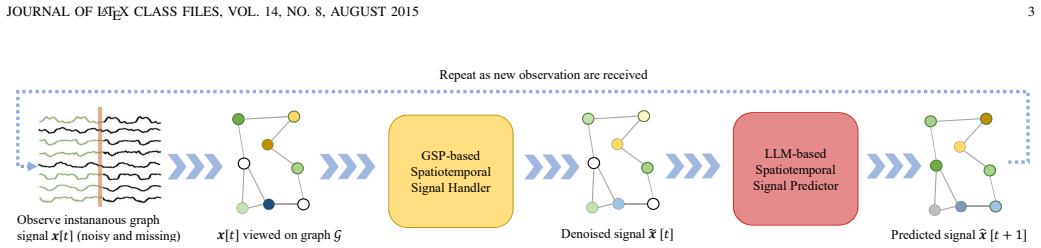
The central object is the LLM-OSR pipeline: an undirected graph $\mathcal{G}$ with Laplacian $L = D - A$; a learned graph filter $h(\lambda)$ applied through the graph convolution $\tilde{x} = U \mathrm{diag}(h(\lambda)) U^{\top} x$ to denoise the noisy, partially observed signal $o[t] = M(x_g[t] + \epsilon[t])$; and a reverse-embedding step that turns each missing node's prediction into the text prompt $T(v_i) = \mathrm{agg}(\{(\hat{x}_i[t-1], \tilde{x}_j[t]) \mid j \in (A v_i \cup O)\})$. The filter parameters are trained by gradient descent on the MAE loss, and the LLM is used zero-shot with a system role that demands one numeric output per node and a user role that supplies the numeric context. The load-bearing mechanism is the LLM performing self-aggregation over neighbor values plus the previous estimate, converting graph signal prediction into a language-completion task.
What would settle it
Run the same LLM-OSR-4 pipeline twice on the traffic data: once feeding the LLM's previous estimate $\hat{x}[t-1]$ in each prompt and once feeding the true previous value $x_g[t-1]$; a large drop in RMSE in the second run would show that recursive error accumulation, not robust spatial-temporal understanding, drives the reported performance. A complementary control shuffles the neighbor values in the prompts, because if reconstruction error does not rise when neighbor context is destroyed, the LLM is not using spatial information at all.
Extended reading notes
Core claim
On the paper's own terms, the central discovery is that combining a GSP denoiser with a zero-shot LLM predictor gives the most accurate one-step reconstruction of missing graph signals among the tested methods under Gaussian noise. The GSP handler learns filter parameters by gradient descent on the graph Laplacian to minimize MAE against clean training signals, and the LLM then outputs the missing node values from prompts of the form: time index, entity index, previous estimated value, and observed neighbor values. In the reported numbers, LLM-OSR-4 reaches RMSE 4.05 and 4.69 on the Seattle traffic dataset for noise variances 1.0 and 1.5, ahead of RGDAN's 5.32 and 6.61, and leads on wind and temperature RMSE at low noise while degrading faster than RGDAN as noise variance rises. The authors attribute the success to the LLM using the spatial smoothness of graph signals through natural-language descriptions rather than through explicit topological reasoning.
Load-bearing premise
The load-bearing premise is that the system can keep feeding the LLM its own earlier guesses as temporal context without the errors accumulating and spoiling later predictions; the paper does not test this by swapping in ground-truth past values.
Editorial extensions
If this is right
- If the reported margins hold, an off-the-shelf LLM plus a learned graph filter can outperform dedicated graph filters, GNNs, and graph time-series models for one-step missing-data reconstruction.
- The method requires no LLM fine-tuning, so it can be deployed with API access alone on any graph where node neighborhoods and a denoising filter are available.
- The large gap between GPT-4-o mini and GPT-3.5-turbo inside the same pipeline indicates that LLM capability, not just the GSP handler, drives the result.
- Performance degrades as Gaussian noise variance grows, so the practical niche is moderate noise; the paper attributes the degradation to residual noise left by the GSP filter.
- The retry-and-error-check mechanism for invalid LLM outputs is a practical requirement for online deployment.
Reading between the lines
- A testable implication the paper leaves implicit: if the LLM truly uses spatial information, shuffling or replacing the neighbor values in the prompts should increase error; if error is unchanged, the gains may come mostly from temporal persistence plus denoising.
- Because the temporal context is the LLM's own previous estimate, errors can compound over long horizons; an ablation that feeds the true past value would separate one-step skill from long-horizon stability.
- The prompt design could be extended to few-shot learning by inserting numeric examples, which the paper identifies as a likely path to better accuracy; this extension would test whether in-context examples beat the current zero-shot format.
- For impulsive or heavy-tailed noise, the Gaussian observation model and the MAE-trained graph filter would need to be reworked, and the paper suggests $\alpha$-stable noise as the natural next case.
Editorial analysis
A structured set of objections, weighed in public.
Referee Report
Summary. The paper proposes LLM-OSR, an online framework that combines a learned graph-spectral filter (GSP-based spatial-temporal signal handler) with a pretrained LLM predictor to reconstruct missing graph signal values from noisy, partially observed time-varying signals. The GSP filter is trained by minimizing the MAE between the filtered training signals and ground truth; the LLM (GPT-3.5-turbo or GPT-4o mini) is prompted with the filtered observed neighbor values and the previous node estimate to output each missing node value. Experiments on the Seattle Loop traffic dataset and NOAA wind-speed/temperature datasets under additive Gaussian noise report RMSE/MAE for LLM-OSR variants and seven baselines (GLMS, GNLMS, GNS, GCN, GVARMA, GGARCH, RGDAN). The results show that LLM-OSR-4 achieves the best or second-best accuracy in most settings, and the authors acknowledge that its performance degrades relative to RGDAN at higher noise levels.
Significance. If the claimed gain is real, the paper demonstrates a novel and practical integration of a pretrained LLM with graph signal processing for online reconstruction tasks, a direction that is currently of wide interest. The manuscript is also transparent about limitations (numerical instability of LLM outputs, one-node-per-prompt cost, recursive memory issues, and scalability), which is a strength. However, the evidence is not yet sufficient to support the central claim: no experiment isolates the GSP handler's contribution, the recursive feedback loop is not stress-tested, and the comparison with deep-learning baselines rests on very short training sequences. The scientific value therefore depends on completing the missing control experiments; the concept is interesting but the current validation is incomplete. The paper does not ship code or reproducibility details, which further limits verification.
major comments (5)
- [Section IV, Tables I-VI] The experiments compare the full LLM-OSR pipeline against baselines but never report the reconstruction obtained by the GSP-based spatial-temporal signal handler alone. Applying the learned filter from Eq. (4), U diag(h(Λ)) U^T o[t], yields a value at every node, including the missing nodes, so its missing-node output is already a reconstruction. Without this control, it is unclear how much of LLM-OSR-4's accuracy comes from the LLM predictor and how much from the GSP filter's smooth interpolation. This is a load-bearing omission for the central claim that GPT-4o mini is an accurate and robust predictor.
- [Algorithm 1 line 7 and Algorithm 3 line 5] The predictor feeds the previous estimate x̂[t-1] as temporal context, creating a recursive loop that can accumulate errors over long horizons (up to 1440 test time steps for traffic). The paper provides no experiment replacing predicted past values with ground-truth past values, nor any analysis of error growth over time. Without such a test, the stability of the online scheme is unverified, and a single bad prediction could contaminate all subsequent reconstructions.
- [Algorithm 2 and Section IV-A] There is a train/test mismatch in how the GSP filter is used. In Algorithm 2, the filter is learned by applying the graph convolution to full training signals x[t] and minimizing MAE against xg[t]. In the test phase, however, the filter is applied to observations o[t] = M(xg[t] + ϵ[t]) with zero-masked missing nodes (Eq. (5)). The filter is never trained or validated under the masked observation model, so its behavior on the actual deployment input is unknown; this weakens the premise that the GSP handler 'enhances' the signals that the LLM receives.
- [Section II-A and Section IV-A1] The method is developed for undirected, unweighted graphs with adjacency entries in {0,1} (Eq. (1)), but the weather experiments use a k-nearest-neighbor graph with Gaussian-kernel edge weights. The graph Laplacian in Eq. (2) and the GFT in Eq. (3) are not defined for weighted adjacency matrices, and no normalized Laplacian or alternative treatment is specified. This makes the spectral filter implementation for the weather datasets (Tables III–VI) under-specified and potentially inconsistent with the theory.
- [Section IV-A2 and IV-A1] The offline deep baselines (GCN, GVARMA, GGARCH, RGDAN) are trained on very short sequences: 24 time steps for weather and 576 for traffic, with no architecture or hyperparameter details reported. For a fair comparison, the training configuration, validation procedure, and early stopping criteria should be stated; otherwise the reported advantage over these baselines may reflect insufficient training rather than genuine superiority of the proposed method.
minor comments (6)
- [Equation (4)] The notation "PF f=1 h(λ)f" is malformed; it should be written as a sum over filter components (e.g., ∑_{f=1}^F h(λ_f), with a clear definition of h(λ)). This makes the graph convolution formula hard to parse.
- [Equation (8) and surrounding text] The symbol x̂ is used for the processed signal in the text before Eq. (8) but x̃ is used in the equation; please use one consistent notation for the filtered signal and define it at first use.
- [Section III-B] The text says "During the training phase of LLM-SRO" but the algorithm is called LLM-OSR; this typo should be corrected.
- [Section I] The sentence "The limitations and some potential future extensions of the proposed LLM-OSR are discussed in Section V provides an in-depth discussion..." is grammatically broken; please rephrase to a single coherent statement.
- [Table II, GCN row] The entries "19.22 ± e+00" are missing the numerical value before the exponent; they should read e.g., "19.22 ± 1.0e+00" with the correct standard deviation.
- [Section IV-B and IV-C] The abstract claims robustness under Gaussian noise, but Section IV-C notes that LLM-OSR-4 degrades more quickly than RGDAN as noise variance increases. The claim of robustness should be qualified to the low-to-moderate noise regime in the abstract and conclusion.
Circularity Check
No circularity: the fitted GSP filter and the pretrained LLM are distinct components, and no claimed result reduces by construction to a fitted parameter or to a self-citation.
full rationale
The derivation chain is self-contained. The only fitted component is the GSP filter h(Λ), trained by gradient descent on the MAE objective (Eqs. 8-9) on the training split, and then applied as a fixed graph convolution (Eq. 4) during testing. The LLM predictor receives processed observed-neighbor values and the previous estimate (Eq. 11, Algorithm 3), but no equation equates the LLM output with h(Λ) or with the training loss; the reported RMSE/MAE are measured on held-out test signals against the baselines. The recursive use of x-hat[t-1] in Algorithms 1 and 3 is standard autoregressive feedback, not definitional circularity. Author self-citations ([25], [41], [44], [46]) support baseline algorithms and graph-construction details and do not carry the central claim. The limitations in Section V (zero-shot numerical weakness, long-term memory, scalability, noise sensitivity) are acknowledged empirical caveats, not hidden circularity. The absence of a GSP-handler-only control and the possibility of pretraining-data leakage are benchmark-design and external-validity concerns, but they are not instances of a prediction reducing to its input by construction.
Assumptions & free parameters
free parameters (3)
- Graph filter response h(λ) =
not reported
- GSP filter training hyperparameters (η, F, stopping criterion) =
not reported
- Weather kNN graph parameters (k, Gaussian kernel bandwidth) =
not reported
assumptions (6)
- domain assumption Graph signal smoothness with respect to the graph Laplacian
- domain assumption Training and test signals have similar spectral content
- domain assumption Missing nodes are fixed and known (30% unobserved throughout)
- domain assumption Noise is i.i.d. zero-mean additive Gaussian
- domain assumption The graph topology correctly represents spatial dependencies
- domain assumption LLM API returns valid numeric outputs with bounded retries
Cite this review
Pith. "Pith review of LLM Online Spatial-temporal Signal Reconstruction Under Noise." pith.science (2026). https://pith.science/paper/45EDXMIK
@misc{pith2026241115764,
  author       = {Pith},
  title        = {Pith review of: LLM Online Spatial-temporal Signal Reconstruction Under Noise},
  year         = {2026},
  howpublished = {\url{https://pith.science/paper/45EDXMIK}},
  note         = {Machine review of arXiv:2411.15764}
}
read the original abstract
This work introduces the LLM Online Spatial-temporal Reconstruction (LLM-OSR) framework, which integrates Graph Signal Processing (GSP) and Large Language Models (LLMs) for online spatial-temporal signal reconstruction. The LLM-OSR utilizes a GSP-based spatial-temporal signal handler to enhance graph signals and employs LLMs to predict missing values based on spatiotemporal patterns. The performance of LLM-OSR is evaluated on traffic and meteorological datasets under varying Gaussian noise levels. Experimental results demonstrate that utilizing GPT-4-o mini within the LLM-OSR is accurate and robust under Gaussian noise conditions. The limitations are discussed along with future research insights, emphasizing the potential of combining GSP techniques with LLMs for solving spatiotemporal prediction tasks.
Figures


Figures from the paper (2 more)


Reference graph
Works this paper leans on
-
[1]
Multimodal biomedical ai,
J. N. Acosta, G. J. Falcone, P. Rajpurkar, and E. J. Topol, “Multimodal biomedical ai,” Nature Medicine, vol. 28, no. 9, pp. 1773–1784, 2022
2022
-
[2]
G. Sonkavde, D. S. Dharrao, A. M. Bongale, S. T. Deokate, D. Doreswamy, and S. K. Bhat, “Forecasting stock market prices using machine learning and deep learning models: A systematic review, performance analysis and discussion of implications,” International Journal of Financial Studies , vol. 11, no. 3, pp. 94, 2023
work page 2023
-
[3]
Better language models and their implications,
A. Radford, J. Wu, D. Amodei, D. Amodei, J. Clark, M. Brundage, and I. Sutskever, “Better language models and their implications,” OpenAI blog, vol. 1, no. 2, 2019
2019
-
[4]
Bert: Pre-training of deep bidirectional transformers for language understanding,
J. Devlin, “Bert: Pre-training of deep bidirectional transformers for language understanding,” arXiv preprint arXiv:1810.04805 , 2018
arXiv 2018
-
[5]
Gpt-3: Its nature, scope, limits, and consequences,
L. Floridi and M. Chiriatti, “Gpt-3: Its nature, scope, limits, and consequences,” Minds and Machines , vol. 30, pp. 681–694, 2020
2020
-
[6]
Gpt-4: a new era of artificial intelligence in medicine,
E. Waisberg, J. Ong, M. Masalkhi, S. A. Kamran, N. Zaman, P. Sarker, A. G. Lee, and A. Tavakkoli, “Gpt-4: a new era of artificial intelligence in medicine,” Irish Journal of Medical Science (1971-) , vol. 192, no. 6, pp. 3197–3200, 2023
work page 1971
-
[7]
Ernie 3.0: Large-scale knowledge enhanced pre-training for language understanding and generation,
Y . Sun, S. Wang, S. Feng, S. Ding, C. Pang, J. Shang, J. Liu, X. Chen, Y . Zhao, Y . Lu, et al., “Ernie 3.0: Large-scale knowledge enhanced pre-training for language understanding and generation,” arXiv preprint arXiv:2107.02137, 2021
arXiv 2021
-
[8]
J. Chen, S. Li, Q. Huang, S. Yan, Z. Xie, and Y . Lu, “Application of kimi intelligent assistant in the teaching of water pollution control engineering course,” International Journal of Education and Humanities , vol. 13, no. 3, pp. 39–43, 2024
work page 2024
Show all 58 references
-
[9]
Decoding chatgpt: a taxonomy of existing research, current challenges, and possible future directions,
S. S. Sohail, F. Farhat, Y . Himeur, M. Nadeem, D. Ø. Madsen, Y . Singh, S. Atalla, and W. Mansoor, “Decoding chatgpt: a taxonomy of existing research, current challenges, and possible future directions,” Journal of King Saud University-Computer and Information Sciences , p. 1...
2023
-
[10]
Exploring multilingual pretrained machine translation models for interactive translation,
A. Navarro and F. Casacuberta, “Exploring multilingual pretrained machine translation models for interactive translation,” in Proceedings of Machine Translation Summit XIX, Vol. 2: Users Track , 2023, pp. 132–142
2023
-
[11]
Llms to the moon? reddit market sentiment analysis with large language models,
X. Deng, V . Bashlovkina, F. Han, S. Baumgartner, and M. Bendersky, “Llms to the moon? reddit market sentiment analysis with large language models,” in Companion Proceedings of the ACM Web Conference 2023, 2023, pp. 1014–1019
2023
-
[12]
Evaluating large language models on medical evidence summarization,
L. Tang, Z. Sun, B. Idnay, J. G. Nestor, A. Soroush, P. A. Elias, Z. Xu, Y . Ding, G. Durrett, J. F. Rousseau, et al., “Evaluating large language models on medical evidence summarization,” NPJ digital medicine, vol. 6, no. 1, pp. 158, 2023
2023
-
[13]
Brain connectivity and graph theory analysis in alzheimer’s and parkinson’s disease: the contribution of electrophysiological techniques,
F. Miraglia, F. Vecchio, C. Pappalettera, L. Nucci, M. Cotelli, E. Judica, F. Ferreri, and P. M. Rossini, “Brain connectivity and graph theory analysis in alzheimer’s and parkinson’s disease: the contribution of electrophysiological techniques,” Brain Sciences , vol. 12, no. 3...
2022
-
[14]
Graph learning based financial market crash identification and prediction,
D. Qin and E. E. Kuruoglu, “Graph learning based financial market crash identification and prediction,” in IEEE CAI, 2024
2024
-
[15]
Community detection algorithms in healthcare applications: a systematic review,
M. Rostami, M. Oussalah, K. Berahmand, and V . Farrahi, “Community detection algorithms in healthcare applications: a systematic review,” IEEE Access, vol. 11, pp. 30247–30272, 2023
2023
-
[16]
Binarized simplicial convolutional neural networks,
Y . Yan and E. E. Kuruoglu, “Binarized simplicial convolutional neural networks,” Neural Networks, 2024
2024
-
[17]
RGDAN: A random graph diffusion attention network for traffic prediction,
J. Fan, W. Weng, H. Tian, H. Wu, F. Zhu, and J. Wu, “RGDAN: A random graph diffusion attention network for traffic prediction,” Neural Networks, vol. 172, pp. 106093, 2024
2024
-
[18]
Quantum feature embeddings for graph neural networks.,
S. Xu, F. Wilhelm-Mauch, and W. Maass, “Quantum feature embeddings for graph neural networks.,” in HICSS, 2024, pp. 7633–7642
2024
-
[19]
Monitoring and flaw detection during wire-based directed energy deposition using in-situ acoustic sensing and wavelet graph signal analysis,
B. Bevans, A. Ramalho, Z. Smoqi, A. Gaikwad, T. G. Santos, P. Rao, and J. Oliveira, “Monitoring and flaw detection during wire-based directed energy deposition using in-situ acoustic sensing and wavelet graph signal analysis,” Materials & Design , vol. 225, pp. 111480, 2023
2023
-
[20]
Emerging trends in eeg signal processing: A systematic review,
R. Sharma and H. K. Meena, “Emerging trends in eeg signal processing: A systematic review,” SN Computer Science , vol. 5, no. 4, pp. 1–14, 2024
2024
-
[21]
Graph signal processing for machine learning: A review and new perspectives,
X. Dong, D. Thanou, L. Toni, M. Bronstein, and P. Frossard, “Graph signal processing for machine learning: A review and new perspectives,” IEEE Signal Processing Magazine , vol. 37, no. 6, pp. 117–127, 2020
2020
-
[22]
Semi-supervised classification with graph convolutional networks,
T. N. Kipf and M. Welling, “Semi-supervised classification with graph convolutional networks,” ICLR, 2017
2017
-
[23]
Spatio-temporal graph convolutional networks: A deep learning framework for traffic forecasting,
B. Yu, H. Yin, and Z. Zhu, “Spatio-temporal graph convolutional networks: A deep learning framework for traffic forecasting,” IJCAI, 2018
2018
-
[24]
Robust adaptive estimation of graph signals based on welsch loss,
W. Wang and Q. Sun, “Robust adaptive estimation of graph signals based on welsch loss,” Symmetry, vol. 14, no. 2, pp. 426, 2022
2022
-
[25]
Adaptive sign algorithm for graph signal processing,
Y . Yan, E. E. Kuruoglu, and M. A. Altinkaya, “Adaptive sign algorithm for graph signal processing,” Signal Processing, vol. 200, pp. 108662, 2022
2022
-
[26]
Large language models on graphs: A comprehensive survey,
B. Jin, G. Liu, C. Han, M. Jiang, H. Ji, and J. Han, “Large language models on graphs: A comprehensive survey,” IEEE Transactions on Knowledge and Data Engineering , 2024
2024
-
[27]
Can llms effectively leverage graph structural information: when and why,
J. Huang, X. Zhang, Q. Mei, and J. Ma, “Can llms effectively leverage graph structural information: when and why,” arXiv preprint arXiv:2309.16595, 2023
2023 arXiv
-
[28]
Natural language is all a graph needs,
R. Ye, C. Zhang, R. Wang, S. Xu, Y . Zhang, et al., “Natural language is all a graph needs,” arXiv preprint arXiv:2308.07134 , vol. 4, no. 5, pp. 7, 2023
2023 arXiv
-
[29]
Graph signal processing: Overview, challenges, and ap- plications,
A. Ortega, P. Frossard, J. Kova ˇcevi´c, J. M. F. Moura, and P. Van- dergheynst, “Graph signal processing: Overview, challenges, and ap- plications,” Proceedings of the IEEE , vol. 106, no. 5, pp. 808–828, 2018
2018
-
[30]
Design of graph filters and filterbanks,
N. Tremblay, P. Gonc ¸alves, and P. Borgnat, “Design of graph filters and filterbanks,” in Cooperative and Graph Signal Processing, pp. 299–324. Elsevier, 2018
2018
-
[31]
Language models are few-shot learners,
T. Brown, B. Mann, N. Ryder, M. Subbiah, J. D. Kaplan, P. Dhariwal, A. Neelakantan, P. Shyam, G. Sastry, A. Askell, S. Agarwal, A. Herbert- V oss, G. Krueger, T. Henighan, R. Child, A. Ramesh, D. Ziegler, J. Wu, C. Winter, C. Hesse, M. Chen, E. Sigler, M. Litwin, S. Gray, B. C...
2020
-
[32]
Gpt-4 technical report,
J. Achiam, S. Adler, S. Agarwal, L. Ahmad, I. Akkaya, F. L. Aleman, D. Almeida, J. Altenschmidt, S. Altman, S. Anadkat, et al., “Gpt-4 technical report,” arXiv preprint arXiv:2303.08774 , 2023
2023 arXiv
-
[33]
Sparks of artificial general intelligence: Early experiments with gpt-4,
S. Bubeck, V . Chandrasekaran, R. Eldan, J. Gehrke, E. Horvitz, E. Ka- mar, P. Lee, Y . T. Lee, Y . Li, S. Lundberg, et al., “Sparks of artificial general intelligence: Early experiments with gpt-4,” arXiv preprint arXiv:2303.12712, 2023
2023 arXiv
-
[34]
Reconstruction of time-varying graph signals via sobolev smoothness,
J. H. Giraldo, A. Mahmood, B. Garcia-Garcia, D. Thanou, and T. Bouw- mans, “Reconstruction of time-varying graph signals via sobolev smoothness,” IEEE Transactions on Signal and Information Processing over Networks, vol. 8, pp. 201–214, 2022
2022
-
[35]
Spatiotem- poral smoothing aggregation enhanced multi-scale residual deep graph convolutional networks for skeleton-based gait recognition,
G. Chen, X. Chen, C. Zheng, J. Wang, X. Liu, and Y . Han, “Spatiotem- poral smoothing aggregation enhanced multi-scale residual deep graph convolutional networks for skeleton-based gait recognition,” Applied Intelligence, pp. 1–21, 2024
2024
-
[36]
Smoothness harmonic: A graph-based approach to reveal spatiotemporal patterns of cortical dynamics in fmri data,
W. Bai, “Smoothness harmonic: A graph-based approach to reveal spatiotemporal patterns of cortical dynamics in fmri data,” Applied Sciences, vol. 13, no. 12, 2023. JOURNAL OF LATEX CLASS FILES, VOL. 14, NO. 8, AUGUST 2015 11
2023
-
[37]
Eve: explainable vector based em- bedding technique using wikipedia,
M. A. Qureshi and D. Greene, “Eve: explainable vector based em- bedding technique using wikipedia,” Journal of Intelligent Information Systems, vol. 53, pp. 137–165, 2019
2019
-
[38]
node2vec: Scalable feature learning for networks,
A. Grover and J. Leskovec, “node2vec: Scalable feature learning for networks,” in SIGKDD, 2016, pp. 855–864
2016
-
[39]
Seattle loop detector data,
C. of Seattle, “Seattle loop detector data,” https://github.com/zhiyongc/ Seattle-Loop-Data, 2020
2020
-
[40]
National oceanic and atmospheric administration (noaa) weather data,
National Oceanic and Atmospheric Administration, “National oceanic and atmospheric administration (noaa) weather data,” https://www.noaa. gov/, 2024
2024
-
[41]
Graph normalized-lmp algo- rithm for signal estimation under impulsive noise,
Y . Yan, R. Adel, and E. E. Kuruoglu, “Graph normalized-lmp algo- rithm for signal estimation under impulsive noise,” Journal of Signal Processing Systems, vol. 95, no. 1, pp. 25–36, 2023
2023
-
[42]
Adaptive least mean squares estimation of graph signals,
P. D. Lorenzo, S. Barbarossa, P. Banelli, and S. Sardellitti, “Adaptive least mean squares estimation of graph signals,” IEEE Transactions on Signal and Information Processing over Networks. , vol. 2, no. 4, pp. 555 – 568, 2016
2016
-
[43]
Normalized lms algorithm and data-selective strategies for adaptive graph signal estimation,
M. J. M. Spelta and W. A. Martins, “Normalized lms algorithm and data-selective strategies for adaptive graph signal estimation,” Signal Processing, vol. 167, pp. 107326, 2020
2020
-
[44]
Adaptive message passing sign algorithm,
C. Peng, Y . Yan, and E. KURUOGLU, “Adaptive message passing sign algorithm,” in Temporal Graph Learning Workshop @ NeurIPS 2023 , 2023
2023
-
[45]
Forecasting Time Series With V ARMA Recursions on Graphs,
E. Isufi, A. Loukas, N. Perraudin, and G. Leus, “Forecasting Time Series With V ARMA Recursions on Graphs,” IEEE Transactions on Signal Processing, vol. 67, no. 18, pp. 4870–4885, 2019
2019
-
[46]
Multivariate time series forecasting with GARCH models on graphs,
J. Hong, Y . Yan, E. E. Kuruoglu, and W. K. Chan, “Multivariate time series forecasting with GARCH models on graphs,” IEEE Transactions on Signal and Information Processing over Networks. , vol. 9, pp. 557– 568, 2023
2023
-
[47]
Simac: simulating agile collaboration to generate acceptance criteria in user story elaboration,
Y . Li, J. Keung, Z. Yang, X. Ma, J. Zhang, and S. Liu, “Simac: simulating agile collaboration to generate acceptance criteria in user story elaboration,” Automated Software Engineering, vol. 31, no. 2, pp. 55, 2024
2024
-
[48]
Can large language models truly understand prompts? a case study with negated prompts,
J. Jang, S. Ye, and M. Seo, “Can large language models truly understand prompts? a case study with negated prompts,” in Transfer learning for natural language processing workshop . PMLR, 2023, pp. 52–62
2023
-
[49]
Gpt4mts: Prompt- based large language model for multimodal time-series forecasting,
F. Jia, K. Wang, Y . Zheng, D. Cao, and Y . Liu, “Gpt4mts: Prompt- based large language model for multimodal time-series forecasting,” in Proceedings of the AAAI Conference on Artificial Intelligence , 2024, vol. 38, pp. 23343–23351
2024
-
[50]
Zero-shot and few-shot learning with knowledge graphs: A comprehensive survey,
J. Chen, Y . Geng, Z. Chen, J. Z. Pan, Y . He, W. Zhang, I. Horrocks, and H. Chen, “Zero-shot and few-shot learning with knowledge graphs: A comprehensive survey,” Proceedings of the IEEE , vol. 111, no. 6, pp. 653–685, 2023
2023
-
[51]
Evaluating very long-term conversational memory of llm agents,
A. Maharana, D.-H. Lee, S. Tulyakov, M. Bansal, F. Barbieri, and Y . Fang, “Evaluating very long-term conversational memory of llm agents,” in Proceedings of the Annual Meeting of the Association for Computational Linguistics, 2024, vol. 1, pp. 13851–13870
2024
-
[52]
Putting gpt-4o to the sword: A comprehensive evaluation of language, vision, speech, and multimodal proficiency,
S. Shahriar, B. D. Lund, N. R. Mannuru, M. A. Arshad, K. Hayawi, R. V . K. Bevara, A. Mannuru, and L. Batool, “Putting gpt-4o to the sword: A comprehensive evaluation of language, vision, speech, and multimodal proficiency,” Applied Sciences , vol. 14, no. 17, pp. 7782, 2024
2024
-
[53]
Modelling impulsive noise in indoor powerline communication systems,
O. Karakus, E. E. Kuruoglu, and M. A. Altinkaya, “Modelling impulsive noise in indoor powerline communication systems,” Signal, image and video processing, vol. 14, no. 8, pp. 1655–1661, 2020
2020
-
[54]
Deep learning-based image enhancement in optical coherence tomography by exploiting interference fringe,
W. Lee, H. S. Nam, J. Y . Seok, W.-Y . Oh, J. W. Kim, and H. Yoo, “Deep learning-based image enhancement in optical coherence tomography by exploiting interference fringe,” Communications Biology, vol. 6, no. 1, pp. 464, 2023
2023
-
[55]
An alpha-stable approach to the study of the p (d) distribution of unresolved point sources in cmb sky maps,
D. Herranz, E. Kuruo ˘glu, and L. Toffolatti, “An alpha-stable approach to the study of the p (d) distribution of unresolved point sources in cmb sky maps,” Astronomy & Astrophysics, vol. 424, no. 3, pp. 1081–1096, 2004
2004
-
[56]
A new analytic representation for the symmetric alpha-stable probability density function,
E. Kuruoglu, C. Molina, S. Godsill, and W. Fitzgerald, “A new analytic representation for the symmetric alpha-stable probability density function,” in Proceedings of the 5th World Meeting of the International Society for Bayesian Analysis (ISBA). ASA: American Statistical Asso...
1997
-
[57]
Using annotations for summarizing a document image and itemizing the summary based on similar annota- tions,
E. E. Kuruoglu and A. S. Taylor, “Using annotations for summarizing a document image and itemizing the summary based on similar annota- tions,” May 4 2010, US Patent 7,712,028
2010
-
[58]
Insights on features’ contribution to desalination dynamics and capacity of capacitive deionization through machine learning study,
F. Saffarimiandoab, R. Mattesini, W. Fu, E. E. Kuruoglu, and X. Zhang, “Insights on features’ contribution to desalination dynamics and capacity of capacitive deionization through machine learning study,” Desalina- tion, vol. 515, pp. 115197, 2021
2021
Reviewed August 12, 2026 · model on record in the stance chip above.
Discussion (0). Continue with ORCID to comment.