Quasilinear evolution versus von Neumann selective measurement
Pith reviewed 2026-05-20 21:12 UTC · model grok-4.3
The pith
A nonlinear quasilinear evolution replaces the von Neumann projection in selective quantum measurements while preserving ensemble equivalence and no-signalling.
A machine-rendered reading of the paper's core claim, the machinery that carries it, and where it could break.
Core claim
The central claim is that selective measurement can be realized by quasilinear evolution obeying a nonlinear generalization of the von Neumann equation rather than by discontinuous projection. Because the equation preserves the equivalence of quantum ensembles, the no-signalling principle is automatically satisfied and Einstein causality is respected. The stochastic nature of outcomes and the Born rule are retained exactly, while the post-measurement state is reached by continuous evolution without ever invoking a quantum state for the apparatus. Numerical and analytic solutions confirm that the scheme agrees with the von Neumann projection except in very narrow parameter windows where the (
What carries the argument
The quasilinear evolution equation, defined as a nonlinear generalization of the von Neumann equation that drives continuous state reduction while preserving ensemble equivalence.
If this is right
- The stochastic character of selective measurement and the Born rule remain exactly the same as in standard quantum mechanics.
- Numerical solutions for two-level systems agree with von Neumann projection except inside narrow parameter regions that may be experimentally accessible.
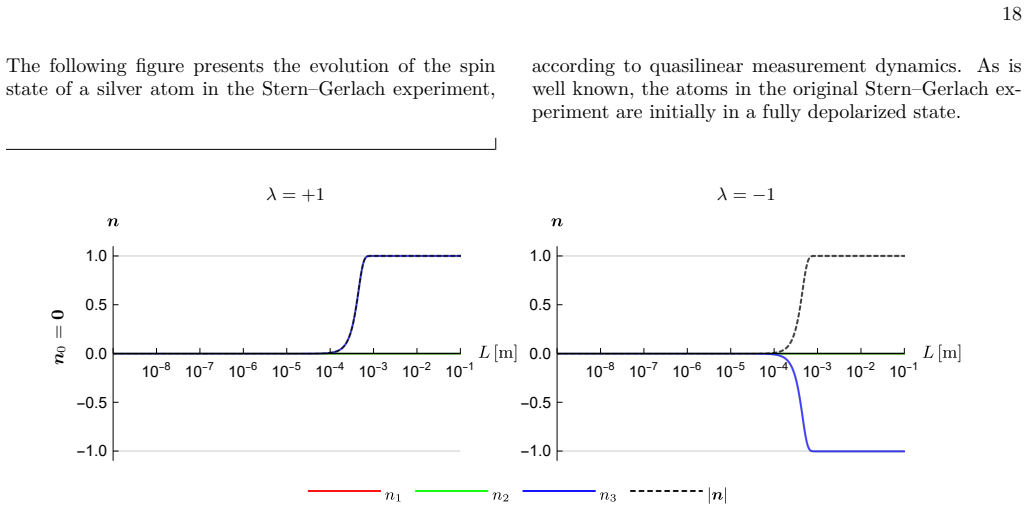
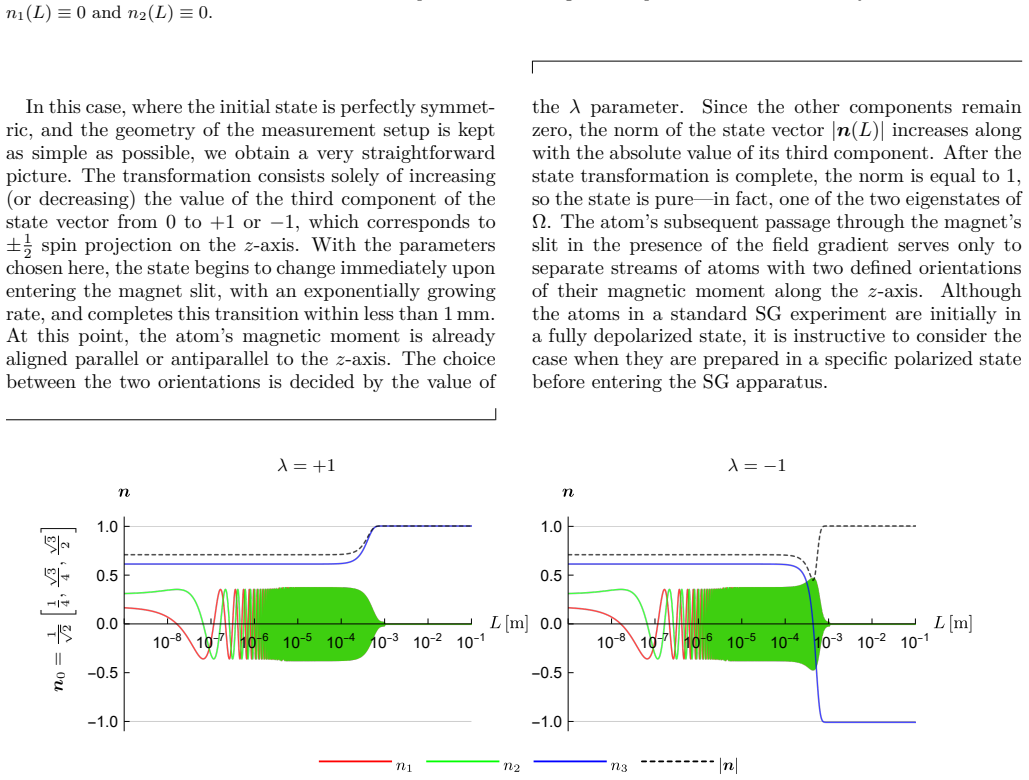
- Analytic treatment reproduces the spatial separation observed in the Stern-Gerlach experiment.
- No instantaneous collapse or quantum state for the classical apparatus is required.
- The scheme supplies a unified dynamical description of post-measurement state reduction.
Where Pith is reading between the lines
- The continuous dynamics could serve as a concrete model for the measurement process that avoids the usual instantaneous-collapse paradox while staying inside the quantum formalism.
- The narrow unstable regions might be used to design precision tests that distinguish the quasilinear scheme from ordinary projection without requiring new apparatus.
- Because ensemble equivalence is built in, the approach automatically satisfies relativistic causality for any choice of measurement decomposition.
- Similar nonlinear extensions might be explored for other open-system or many-body measurement scenarios.
Load-bearing premise
The specific nonlinear generalization of the von Neumann equation can be written so that it maintains ensemble equivalence and no-signalling without introducing new inconsistencies or hidden variables.
What would settle it
An experiment on a two-level system that finds measurable deviations from von Neumann outcomes outside the narrow parameter intervals identified in the paper, or that detects signalling between ensembles prepared with different decompositions.
Figures





read the original abstract
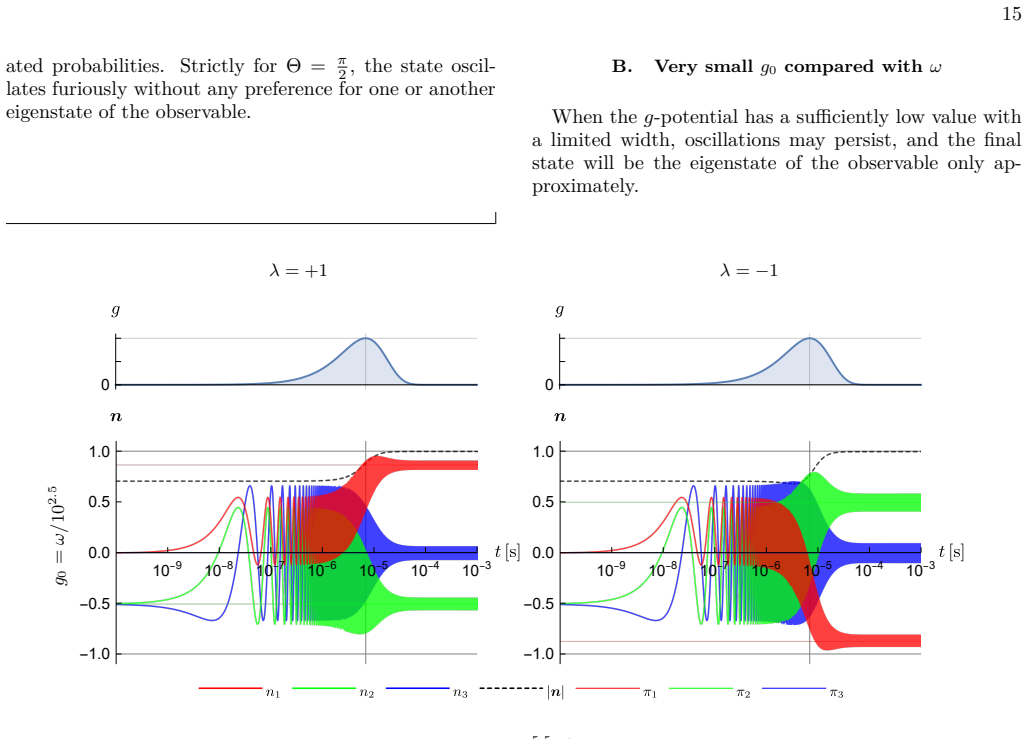
In this article, we introduce a new form of quantum selective measurement in which the von Neumann projection postulate is replaced by quasilinear evolution, governed by a nonlinear generalization of the von Neumann equation. We demonstrate that this equation preserves the equivalence of quantum ensembles and, consequently, satisfies the no-signalling principle, ensuring consistency with both quantum mechanics and Einstein causality. Our approach eliminates the need for instantaneous, discontinuous state collapse and provides a unified description of the postmeasurement quantum state reduction as a form of quantum state evolution. Notably, it does not require invoking concepts such as the quantum state assigned to a classical apparatus. At the same time, the stochastic character of selective measurement and the Born rule remain unchanged. We present several numerical solutions of the evolution equation for quasilinear selective measurement in two-level quantum systems and compare them with the standard von Neumann projection. The results demonstrate agreement between the two measurement schemes in their fundamental properties. Furthermore, we investigate phenomena associated with the structural instability of the evolution equation and identify very narrow parameter regions in which the outcomes deviate from those predicted by the von Neumann projection. These regions may offer opportunities to test the proposed approach experimentally. Finally, using specific analytical solutions, we discuss the Stern-Gerlach experiment within the framework of quasilinear measurement.
Editorial analysis
A structured set of objections, weighed in public.
Referee Report
Summary. The manuscript proposes replacing the von Neumann projection postulate with a quasilinear evolution governed by a nonlinear generalization of the von Neumann equation for describing selective quantum measurements. It claims that this evolution preserves the equivalence of quantum ensembles, thereby satisfying the no-signalling principle and remaining consistent with quantum mechanics and Einstein causality, while retaining the stochastic character and Born rule. Numerical solutions for two-level systems are presented and compared to standard projection, with discussion of structural instabilities in narrow parameter regions and an analytical treatment of the Stern-Gerlach experiment.
Significance. If the central claims on ensemble equivalence and no-signalling are established by explicit derivation rather than construction, the work would offer a continuous dynamical alternative to discontinuous collapse that maintains relativistic consistency, with potential experimental implications in the identified instability regions. The numerical comparisons for two-level systems and the Stern-Gerlach analysis provide concrete illustrations, strengthening the case for further investigation if the foundational properties hold.
major comments (3)
- [§3] §3 (Definition of the quasilinear evolution equation): The specific nonlinear generalization is asserted to preserve no-signalling by leaving the reduced density operator of an unmeasured subsystem invariant. However, the manuscript does not provide an explicit step-by-step verification that the nonlinear term commutes with the partial trace in the required manner for arbitrary measurement bases on the correlated partner; without this, the property risks appearing imposed by the functional form chosen rather than independently derived.
- [§4] §4 (Proof of ensemble equivalence): The claim that the evolution preserves equivalence of quantum ensembles is central to the no-signalling result, yet the derivation appears to rely on the equation being constructed to enforce this invariance. A concrete counter-example check or general proof showing invariance under the nonlinear map for entangled states would be required to substantiate that the result is not circular.
- [§5] §5 (Numerical solutions for two-level systems): While agreement with von Neumann projection is reported, the manuscript lacks a detailed error analysis, convergence criteria for the integration method, or quantification of deviations in the structural instability regions. This makes it difficult to evaluate the robustness of the claimed fundamental agreement or the narrowness of the testable parameter windows.
minor comments (3)
- [Abstract] The abstract introduces 'quasilinear selective measurement' without a brief definition; adding one sentence clarifying the term would aid readers unfamiliar with the specific nonlinear form.
- [§3] Notation for the nonlinear term in the evolution equation should be introduced with an explicit equation number on first use to improve traceability in later sections.
- [§5] The figures comparing time evolution under the two schemes would benefit from inclusion of numerical uncertainty estimates or multiple runs to illustrate stability outside the narrow instability regions.
Simulated Author's Rebuttal
We thank the referee for the thorough review and valuable suggestions. We address each of the major comments in detail below, providing clarifications and indicating the revisions we will make to the manuscript to strengthen the presentation of our results on the quasilinear evolution equation for selective quantum measurements.
read point-by-point responses
-
Referee: [§3] §3 (Definition of the quasilinear evolution equation): The specific nonlinear generalization is asserted to preserve no-signalling by leaving the reduced density operator of an unmeasured subsystem invariant. However, the manuscript does not provide an explicit step-by-step verification that the nonlinear term commutes with the partial trace in the required manner for arbitrary measurement bases on the correlated partner; without this, the property risks appearing imposed by the functional form chosen rather than independently derived.
Authors: We appreciate this observation. Upon re-examination, we recognize that while the invariance is stated, an explicit verification was not detailed. In the revised version, we will add a subsection in §3 providing a step-by-step proof that the nonlinear term, when partially traced over the unmeasured subsystem, vanishes or commutes appropriately for any choice of measurement basis on the partner system. This will show that the no-signalling property is a direct consequence of the quasilinear structure and not merely constructed. We will include the mathematical steps involving the partial trace operation on the nonlinear correction term. revision: yes
-
Referee: [§4] §4 (Proof of ensemble equivalence): The claim that the evolution preserves equivalence of quantum ensembles is central to the no-signalling result, yet the derivation appears to rely on the equation being constructed to enforce this invariance. A concrete counter-example check or general proof showing invariance under the nonlinear map for entangled states would be required to substantiate that the result is not circular.
Authors: We agree that clarity is needed here. The proof in §4 proceeds by showing that for any ensemble of states, the quasilinear evolution leads to the same reduced statistics as the von Neumann projection when averaged. To address potential circularity, we will include in the revision a general proof for arbitrary entangled states by direct computation of the time derivative of the ensemble-averaged density operator, demonstrating invariance. Additionally, we will provide a concrete counter-example check using a maximally entangled two-qubit state and verify numerically that the nonlinear evolution preserves the equivalence. revision: yes
-
Referee: [§5] §5 (Numerical solutions for two-level systems): While agreement with von Neumann projection is reported, the manuscript lacks a detailed error analysis, convergence criteria for the integration method, or quantification of deviations in the structural instability regions. This makes it difficult to evaluate the robustness of the claimed fundamental agreement or the narrowness of the testable parameter windows.
Authors: We acknowledge the need for more rigorous numerical validation. In the updated manuscript, we will expand §5 to include: (i) specification of the numerical integration method (e.g., adaptive Runge-Kutta with absolute and relative tolerances), (ii) convergence criteria based on step size halving and error estimates, (iii) a detailed error analysis comparing the quasilinear trajectories to the projected states with L2 norms or fidelity measures, and (iv) quantification of deviations in the instability regions, including the width of parameter intervals where deviations exceed a threshold (e.g., 1% difference). This will better substantiate the robustness and identify testable windows. revision: yes
Circularity Check
No significant circularity: derivation is self-contained
full rationale
The paper introduces a specific nonlinear generalization of the von Neumann equation as a new ansatz for selective measurement, then derives from it the preservation of ensemble equivalence and no-signalling. These properties are shown as consequences of the equation's functional form rather than being used to define the equation itself. No load-bearing step reduces by construction to a prior fit, self-citation chain, or renaming of an input; the central claims rest on explicit verification against the stated evolution rule and external consistency with quantum mechanics and causality. The derivation chain is therefore independent of its target results.
Axiom & Free-Parameter Ledger
axioms (1)
- domain assumption The quasilinear evolution equation preserves equivalence of quantum ensembles.
Lean theorems connected to this paper
-
IndisputableMonolith/Cost/FunctionalEquation.leanwashburn_uniqueness_aczel unclear?
unclearRelation between the paper passage and the cited Recognition theorem.
quasilinear evolution … preserves the equivalence of quantum ensembles and, consequently, satisfies the no-signalling principle
-
IndisputableMonolith/Foundation/RealityFromDistinction.leanreality_from_one_distinction unclear?
unclearRelation between the paper passage and the cited Recognition theorem.
nonlinear generalization of the von Neumann equation … Eq. (11)
What do these tags mean?
- matches
- The paper's claim is directly supported by a theorem in the formal canon.
- supports
- The theorem supports part of the paper's argument, but the paper may add assumptions or extra steps.
- extends
- The paper goes beyond the formal theorem; the theorem is a base layer rather than the whole result.
- uses
- The paper appears to rely on the theorem as machinery.
- contradicts
- The paper's claim conflicts with a theorem or certificate in the canon.
- unclear
- Pith found a possible connection, but the passage is too broad, indirect, or ambiguous to say the theorem truly supports the claim.
Forward citations
Cited by 2 Pith papers
-
Quantum selective measurement as a quasilinear evolution
A quasilinear continuous evolution is introduced for selective quantum measurements that converges to von Neumann projection outcomes while preserving ensemble equivalence and no-signaling.
-
Quantum selective measurement as a quasilinear evolution
A quasilinear continuous evolution is introduced that reproduces the final states of von Neumann rank-one projective measurement while preserving no-signaling and ensemble equivalence.
discussion (0)
Sign in with ORCID, Apple, or X to comment. Anyone can read and Pith papers without signing in.