REVIEW 1 major objections 2 minor 2 cited by
Rydberg-atom quantum computers achieve lower energy use than classical supercomputers for the Fourier transform under ideal conditions.
Reviewed by Pith at T0; open to challenge. T0 means a machine referee read the full paper against a public rubric. the ladder, T0–T4 →
T0 review · grok-4.3
2026-05-21 15:34 UTC pith:46LVXMR6
load-bearing objection The paper gives a first concrete energy breakdown and scaling estimate for Rydberg QFT versus classical DFT, but the claimed advantage only holds if component power stays close to linear in qubit number. the 1 major comments →
Energetics of Rydberg-atom Quantum Computing
The pith
A machine-rendered reading of the paper's core claim, the machinery that carries it, and where it could break.
Core claim
The energy cost of executing the Quantum Fourier Transform on a Rydberg atom quantum computer scales favorably compared to the Discrete Fourier Transform on state-of-the-art classical supercomputers, leading to a quantum energy advantage in an ideal error-free scenario.
What carries the argument
Estimates of energy consumption for Rydberg atom preparation, laser-driven gates, and state readout, used to derive scaling with qubit number for the Quantum Fourier Transform.
Load-bearing premise
The calculations depend on idealized models of power consumption for lasers, traps, and readout that assume perfect, error-free operation without real hardware losses.
What would settle it
Direct measurement of the total electrical power drawn by a Rydberg atom setup while executing a quantum Fourier transform on a small number of qubits, compared against the predicted energy cost and against classical supercomputer energy use for equivalent tasks.
If this is right
- The energy expenditure can be compared across different components of the Rydberg quantum computer to identify areas for improvement.
- In an ideal scenario, the Rydberg platform offers lower energy use for the Fourier transform than classical supercomputers.
- This advantage holds in a regime where classical algorithms are still computationally faster.
- Analysis of quantum phase estimation provides initial experimental energy estimates.
Where Pith is reading between the lines
- If real hardware inefficiencies and error correction overheads are included, the energy advantage might shift or disappear.
- Similar energy scaling analyses could be applied to other quantum algorithms or platforms to identify energy-efficient use cases.
- Improvements in laser efficiency or atom trapping could further enhance the energy performance of Rydberg systems.
Editorial analysis
A structured set of objections, weighed in public.
Referee Report
Summary. The manuscript analyzes the energy consumption of Rydberg-atom quantum computers. It first estimates the energetic cost of an experimental implementation of the Quantum Phase Estimation algorithm. It then derives the scaling of energy cost for the Quantum Fourier Transform as a function of qubit number N. The analysis breaks down contributions from atom preparation, algorithm execution, and readout, and benchmarks the resulting QFT energy scaling against the Discrete Fourier Transform executed on two state-of-the-art classical supercomputers. The central conclusion is that, in an ideal error-free scenario, the Rydberg platform achieves a quantum energy advantage for the Fourier Transform in a regime where classical algorithms remain faster.
Significance. If the scaling estimates prove robust, the work supplies a useful first quantitative framework for assessing energetic viability of the Rydberg platform and for identifying which hardware components dominate the energy budget. The explicit comparison to classical supercomputer DFT performance supplies a concrete, falsifiable benchmark that could guide future hardware improvements.
major comments (1)
- [QFT energy scaling section] QFT energy scaling section: the derivation of total energy versus N assumes that the summed power draw from laser systems (Rydberg excitation), atom trapping, state preparation, and readout remains sub-quadratic (or better) in N. No hardware-validated bounds or scaling arguments are supplied to justify this assumption; if beam delivery, trap-depth maintenance, or cooling power must increase faster than linearly to preserve coherence and gate fidelity at large N, the claimed energy advantage over classical DFT disappears even in the ideal error-free limit. This assumption is load-bearing for the final benchmark and conclusion.
minor comments (2)
- [Abstract and final comparison section] The abstract and comparison section should explicitly state the functional form of the derived QFT energy scaling (e.g., O(N), O(N log N), etc.) rather than only describing the qualitative advantage.
- [Benchmark comparison] Clarify the precise energy metric (wall-clock power, total joules per transform, etc.) and the exact classical supercomputers and DFT implementations used in the benchmark so that the crossover point can be reproduced.
Simulated Author's Rebuttal
We thank the referee for their careful reading of the manuscript and for identifying a key assumption in the QFT energy scaling analysis. We address the comment below and will revise the manuscript accordingly to improve clarity and transparency.
read point-by-point responses
-
Referee: [QFT energy scaling section] QFT energy scaling section: the derivation of total energy versus N assumes that the summed power draw from laser systems (Rydberg excitation), atom trapping, state preparation, and readout remains sub-quadratic (or better) in N. No hardware-validated bounds or scaling arguments are supplied to justify this assumption; if beam delivery, trap-depth maintenance, or cooling power must increase faster than linearly to preserve coherence and gate fidelity at large N, the claimed energy advantage over classical DFT disappears even in the ideal error-free limit. This assumption is load-bearing for the final benchmark and conclusion.
Authors: We agree that the assumption regarding sub-quadratic scaling of total power draw is load-bearing for the reported energy advantage and that the manuscript does not supply explicit hardware-validated bounds or detailed scaling arguments for large N. Our estimates extrapolate component-wise costs from existing small-scale Rydberg experiments, where laser beams and trap arrays are typically shared or multiplexed such that incremental power per additional atom remains modest. We will revise the QFT scaling section to state this assumption explicitly, add a short discussion paragraph on potential super-linear growth in cooling or beam delivery at scale (with references to current neutral-atom scaling literature), and qualify the energy-advantage conclusion as holding only under the stated ideal scaling. This revision will make the scope and limitations of the benchmark transparent without altering the core calculations. revision: yes
Circularity Check
No significant circularity; energy estimates are explicit model extrapolations compared to external classical benchmarks
full rationale
The paper constructs energy estimates for Rydberg QFT by summing modeled contributions from atom preparation, laser excitation, trapping, gates, and readout, then extrapolates scaling with N under idealized error-free assumptions. These models are presented as first-principles engineering estimates rather than fitted parameters renamed as predictions. The comparison to classical DFT energy on supercomputers uses independent external data and does not reduce any quantum result to its own inputs by construction. No self-citations, uniqueness theorems, or ansatzes imported from prior author work appear as load-bearing steps. The derivation chain remains self-contained against the stated modeling assumptions and external benchmarks.
Axiom & Free-Parameter Ledger
read the original abstract
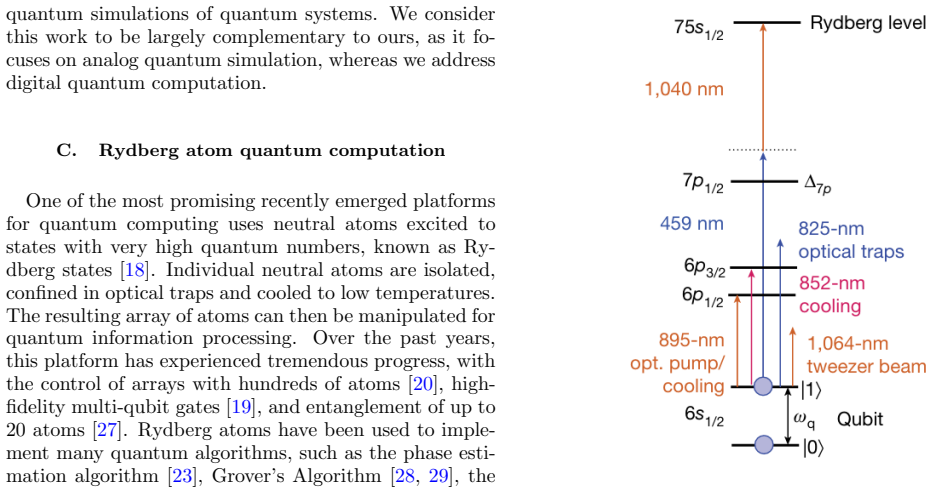
While extensive research over the past decades has been dedicated to developing scalable quantum computers, the question of their energetic performance has only gained attention more recently, but its importance is now recognized. In fact, quantum computers can only be a viable alternative if their energy cost scales favorably, and some research has shown that there is even a potential quantum energy advantage. In parallel, Rydberg atoms have recently emerged as one of the most promising platforms to implement a large-scale quantum computer. This work aims at contributing first steps to understand the energy efficiency of this platform, by investigating the energy consumption of the different elements of a Rydberg atom quantum computer. First, an experimental implementation of the Quantum Phase Estimation algorithm is analyzed, and an estimation of the energetic cost of executing it is calculated. Then, we derive an estimate of how the energy cost of performing the Quantum Fourier Transform scales with the number of qubits in the Rydberg platform. This analysis facilitates a comparison of the energy consumption of different elements within a Rydberg atom quantum computer, from the preparation of the atoms to the execution of the algorithm, and the measurement of the final state, enabling the evaluation of the energy expenditure of the Rydberg platform and the identification of potential improvements. Finally, we use the Quantum Fourier Transform as an energetic benchmark, comparing the scaling we obtained to that of the execution of the Discrete Fourier Transform in two state-of-the-art classical supercomputers. This comparison indicates that, in an ideal error-free scenario, a quantum energy advantage is achieved in the Rydberg platform for the Fourier Transform, in a regime where classical algorithms are still faster.
Figures




Forward citations
Cited by 2 Pith papers
-
Unveiling Energetic Advantage in Superconducting Cat-Qubits Quantum Computation
Energy modeling and parameter optimization for cat-qubit superconducting quantum computers performing semiclassical QFT with error correction indicates an energetic advantage over classical systems for more than 26 qu...
-
Revisiting semiclassical scalar QED in 1+1 dimensions
Backreaction in semiclassical scalar QED in 1+1D avoids instabilities and produces over-screening at high external charges.
Reference graph
Works this paper leans on
-
[1]
M. A. Nielsen and I. L. Chuang,Quantum Computation and Quantum Information: 10th Anniversary Edition (Cambridge University Press, 2010)
work page 2010
-
[2]
R. P. Feynman, International Journal of Theoretical Physics21, 467 (1982)
work page 1982
- [3]
-
[4]
H.-P. Breuer and F. Petruccione,The Theory of Open Quantum Systems(Oxford University Press, 2007)
work page 2007
- [5]
-
[6]
P. W. Shor, SIAM Journal on Computing26, 1484–1509 (1997)
work page 1997
-
[7]
J. P. Moutinho, M. Pezzutto, S. S. Pratapsi, F. F. da Silva, S. De Franceschi, S. Bose, A. T. Costa, and Y. Omar, PRX Energy2, 033002 (2023)
work page 2023
-
[8]
S. Silva Pratapsi, P. H. Huber, P. Barthel, S. Bose, C. Wunderlich, and Y. Omar, Applied Physics Letters 123, 154003 (2023)
work page 2023
-
[9]
Energetics of Trapped-Ion Quantum Computation
F. G´ ois, M. Pezzutto, and Y. Omar, Energet- ics of trapped-ion quantum computation (2024), arXiv:2404.11572 [quant-ph]
work page internal anchor Pith review Pith/arXiv arXiv 2024
-
[10]
D. Jaschke and S. Montangero, Is quantum computing green? An estimate for an energy-efficiency quantum ad- vantage, arXiv:2205.12092 (2022)
-
[11]
A. Auff` eves, PRX Quantum3, 10.1103/PRXQuan- tum.3.020101 (2022)
-
[12]
E. Masanet, A. Shehabi, N. Lei, S. Smith, and J. Koomey, Science367, 984 (2020)
work page 2020
-
[13]
G. E. Mooreet al., Cramming more components onto integrated circuits (1965)
work page 1965
-
[14]
L. B. Kish, Physics Letters A305, 144 (2002)
work page 2002
- [15]
-
[16]
J. G. Koomey, inAIP Conference Proceedings, Vol. 1652 (American Institute of Physics, 2015) pp. 82–89
work page 2015
- [17]
-
[18]
M. Morgado and S. Whitlock, AVS Quantum Science3, 10.1116/5.0036562 (2021)
-
[19]
Available: https://link.aps.org/doi/10.1103/PhysRevLett.123.170503
H. Levine, A. Keesling, G. Semeghini,et al., Phys. Rev. Lett.123, 10.1103/PhysRevLett.123.170503 (2019)
- [20]
-
[21]
D. Barredo, V. Lienhard, S. de L´ es´ eleuc, T. Lahaye, and A. Browaeys, Nature561, 79 (2018)
work page 2018
- [22]
- [23]
- [24]
-
[25]
V. Cimini, S. Gherardini, M. Barbieri, I. Gianani, M. Sbroscia, L. Buffoni, M. Paternostro, and F. Caruso, npj Quantum Information6, 10.1038/s41534-020-00325- 7 (2020)
-
[26]
J. Vovrosh, T. Mendes-Santos, H. Mamann, K. Bidzhiev, F. Hayes, B. Ximenez, L. B´ eguin, C. Dalyac, and A. Dauphin, Resource assessment of classical and quantum hardware for post-quench dynamics (2025), arXiv:2511.20388 [quant-ph]
- [27]
-
[28]
K. Mølmer, L. Isenhower, and M. Saffman, Journal of Physics B: Atomic, Molecular and Optical Physics44, 10.1088/0953-4075/44/18/184016 (2011)
-
[29]
S. Tang, C. Yang, D. Li,et al., Entropy24, 10.3390/e24101371 (2022)
- [30]
-
[31]
S. Jeong, M. Kim, M. Hhan,et al., Phys. Rev. Res.5, 10.1103/PhysRevResearch.5.043037 (2023)
-
[32]
Optical dipole traps for neutral atoms
R. Grimm, M. Weidem¨ uller, and Y. B. Ovchin- nikov, Optical dipole traps for neutral atoms (1999), arXiv:physics/9902072 [physics.atom-ph]
work page internal anchor Pith review Pith/arXiv arXiv 1999
- [33]
- [34]
- [35]
- [36]
-
[37]
B. F. A. Silva, Improved Quantum Compilation through Rydberg-Atoms Quantum Computing (2023), Master’s Thesis. Instituto Superior T´ ecnico
work page 2023
-
[38]
D. Bluvstein, H. Levine, G. Semeghini,et al., Nature 604, 451–456 (2022)
work page 2022
-
[39]
Top 500 project,https://www.top500.org/project/ (2025), accessed: July 2025
work page 2025
discussion (0)
Sign in with ORCID, Apple, or X to comment. Anyone can read and Pith papers without signing in.