REVIEW 3 major objections 4 minor 94 references
Demonstration of measurement-free universal fault-tolerant quantum computation
T0 review · 3 major / 4 minor · reviewed 2026-08-06 · deepseek-v4-flash
Pith's one-line read Universal fault-tolerant quantum computation can run without mid-circuit measurements, demonstrated on a trapped-ion processor with a universal gate set on an eight-qubit code and a three-logical-qubit Grover search.
desk verdict Impressive first measurement-free FT universal gate set on an ion trap, but the FT claim outruns the evidence because the noise model omits the global dephasing that dominates the experiment. read the letter →
The pith
A machine-rendered reading of the paper's core claim, the machinery that carries it, and where it could break.
The reading
What carries the argument
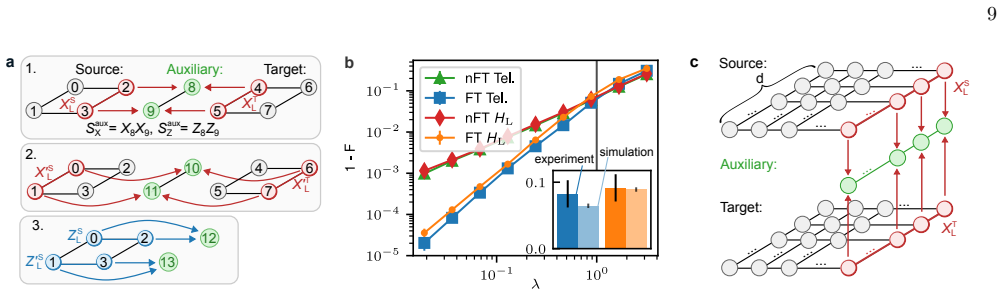
The central mechanism is coherent feedback replacing measurement: logical operators are mapped onto auxiliary qubits, and conditional operations are applied directly instead of being triggered by classical measurement outcomes. Fault tolerance is bought by redundancy—using two stabilizer-equivalent representations of each logical operator with disjoint qubit support, and GHZ-stabilized auxiliary registers, so that a single fault either remains detectable or cancels. On the [[8,3,2]] code, the non-Clifford and Hadamard capabilities come from a transversal CCZ_L and state injection from a [[4,2,2]] ancilla code; the inter-block CNOT needed for injection is non-transversal but constructed so every single fault remains detectable.
What would settle it
Simulate or measure the H_L injection circuit under a global dephasing channel that rotates all qubits together; if any single fault then yields a trivial stabilizer syndrome together with a logical X or Z flip on the [[8,3,2]] code, the circuits are not fault-tolerant as claimed. Experimentally, one can prepare |000>_L, apply the H_L gadget with a deliberately added global dephasing pulse, and check whether postselection removes the resulting logical error at the rate predicted by the local-dephasing model.
Extended reading notes
Core claim
On its own terms, the paper establishes that the [[8,3,2]] color code—an eight-physical-qubit code encoding three logical qubits and detecting any single error—admits a complete, fault-tolerant, measurement-free universal gate set {H_L, CNOT_L, CCZ_L}: CNOT_L is done by relabeling physical qubits, CCZ_L is transversal using T- and T-dagger gates, and the missing H_L is injected coherently using an auxiliary [[4,2,2]] code prepared in |+0>_L, with the measurement and feed-forward of standard state injection replaced by CNOT-based coherent feedback. Fault tolerance is engineered by mapping two stabilizer-equivalent, disjoint-support representations of logical operators onto auxiliary GHZ states so that no single fault produces an undetected logical error. The same mechanism underlies logical teleportation between two [[4,1,2]] blocks, and the toolbox runs a two-solution Grover search whose total success probability is 0.40(4), with simulations indicating that modest error-rate reductions would push it past the classical 0.46.
Load-bearing premise
The fault-tolerance proof rests on a noise model of local depolarizing gates plus independent dephasing on idle qubits, and the experiment itself shows global magnetic-field dephasing is missing from that model, so if such global noise creates faults the circuits do not detect, the fault-tolerance claim would not hold.
Editorial extensions
If this is right
- Mid-circuit measurement is not necessary for fault-tolerant universal computation: qubit reset or replacement of auxiliary qubits suffices to remove entropy.
- The teleportation protocol generalizes to higher-distance surface codes by preparing d-qubit GHZ states and mapping d disjoint operator representations, so the method is not specific to distance-2 codes.
- A measurement-free logical Grover search currently achieves 0.40(4) success probability, below the 0.46 classical bound, but simulations show a two-qubit-gate error of 1.5% or a coherence time of 100 ms would exceed it.
- The toolbox transfers to other platforms with all-to-all or long-range connectivity, such as neutral-atom arrays, where mid-circuit measurement is especially costly.
Reading between the lines
- Editorial inference: if the fault-tolerance construction survives non-local dephasing, then the practical bottleneck for measurement-free QEC shifts from measurement speed to idling-qubit coherence, favoring codes tailored to biased Z noise.
- Editorial inference: the reported acceptance rates (as low as 10% for the H_L gate after postselection) suggest that for distance-2 codes, measurement-free fault tolerance currently trades run overhead for circuit simplicity; extending the flag-qubit ideas to distance-3 codes is the natural next test.
- Editorial inference: the observed correlated logical errors across the three logical qubits imply that treating logical qubits as independent error channels underestimates the decoder complexity for small block codes.
Editorial analysis
A structured set of objections, weighed in public.
Referee Report
Summary. The paper proposes and experimentally demonstrates a measurement-free toolbox for fault-tolerant logical operations on a trapped-ion processor. The central results are: (i) modular logical state teleportation between two [[4,1,2]]-code blocks using coherent feedback instead of mid-circuit measurements; (ii) a fault-tolerant universal gate set {H_L, CNOT_L, CCZ_L} on the [[8,3,2]] code, with H_L realized by state injection using an auxiliary [[4,2,2]] code; and (iii) a three-logical-qubit Grover search encoded in the [[8,3,2]] code. The experimental section reports logical fidelities for state preparation, teleportation, H_L injection, and the transversal CCZ_L gate, together with Monte Carlo simulations based on local depolarizing and dephasing noise. The fault-tolerance claims are primarily supported by simulated quadratic scaling of logical infidelity under a scaled local-noise model.
Significance. If the central claim survives scrutiny, this would be a notable first: a small-scale fault-tolerant universal gate set executed without mid-circuit measurements, plus the first fault-tolerant logical Grover search on three logical qubits. The paper is generally careful about circuit design, makes the explicit circuits and simulation code available, and uses independently measured error parameters rather than fitting noise rates to the target results. The theoretical construction appears plausible for local stochastic faults. However, the experimental demonstration of fault tolerance is not yet supported, because the noise model used to establish fault tolerance omits the experimentally dominant global dephasing channel, as the authors themselves document in Appendix G. The projected near-term advantage in Appendix J inherits the same limitation.
major comments (3)
- [Appendix G and Fig. 12] The central evidence that the implemented circuits are fault tolerant is the quadratic scaling of logical infidelity versus the scaled local-noise parameter lambda in Fig. 12, obtained from the Monte Carlo model of Appendix C. Appendix G reports that this model misses the experimental fidelity for |000>_L and |+00>_L by more than 14%, and attributes the discrepancy to global dephasing acting collectively on all physical qubits. For |000>_L, Appendix G estimates that global dephasing decays the relevant coherences eight times faster than local dephasing. This missing channel is load-bearing: a collective Z-type error can produce a logical error that the distance-2 stabilizer checks do not detect, so the quadratic scaling under local noise does not demonstrate fault tolerance under the device's actual dominant noise. Please augment the simulations with a global dephasing channel (e.g., a collective Z rotation with randomly fluctuating angle) and report the resulting logical infidelities, acceptance rates, and scaling; if the fault-tolerance claim remains valid under this augmented model, that should be shown explicitly.
- [Appendix H and Appendix J] The error budget in Appendix H concludes that dephasing contributes almost two-thirds of the logical error rate, and the projected improvements in Appendix J (p2=0.015 or T2=100 ms) are computed with the same local-dephasing model that Appendix G shows to be incomplete. Because global dephasing accelerates logical dephasing for states such as |000>_L, the projected success probabilities of 0.52 and 0.67, and the statement that a regime outperforming the classical strategy 'is reachable today', are not yet supported. Please recompute the projections with the global-dephasing model and state whether the conclusions survive.
- [Section D and Fig. 8] The H_L gate on the [[8,3,2]] code relies on a non-transversal inter-block CNOT gate between the [[8,3,2]] block and the [[4,2,2]] auxiliary block, and the fault-tolerance of this gadget is argued by stating that any single fault remains detectable. The provided evidence is again the Monte Carlo scaling under local noise. Given the global-dephasing issue above, please provide a direct fault-propagation analysis for the inter-block CNOT gadget under correlated Z noise, or clearly restrict the fault-tolerance claim to local stochastic faults.
minor comments (4)
- [Abstract and Section F] The phrase 'fault-tolerant quantum computation' in the abstract and outlook should be qualified, since the demonstrations use a distance-2 error-detecting code with final postselection; the paper should state more explicitly that this is error-detecting fault-tolerance with postselection, not full error-correcting QEC without postselection.
- [Appendix G, Eq. (G1)] The notation for the global-dephasing decay prefactor is compressed and could confuse readers; a short derivation or an explicit reference to the formula in Ref. [86] would improve clarity.
- [Figure 1] The labels in Fig. 1b and 1e are small and some overlapping text makes the two protocols difficult to distinguish; enlarging the fonts and separating the panels would help.
- [Reference list] Several central protocol references are to the authors' own prior work (e.g., Refs. [26, 35, 37, 39, 42, 44]); this is not inappropriate, but the introduction should also cite independent measurement-free QEC proposals where available, so that the novelty framing is not overly self-referential.
Circularity Check
No significant circularity: the noise parameters are independently measured, the FT scaling is a self-consistency check, and the App. G global-dephasing gap is an acknowledged model limitation rather than a circular step.
full rationale
The paper's derivation chain is self-contained. The Monte Carlo fault-tolerance results use noise parameters (p1=3.6e-3, p2=2.5e-2, pi=pm=3e-3, T2=50 ms) taken from earlier independent characterization of the same trapped-ion setup, not fitted to the logical fidelities that are later reported. The quadratic scaling of logical infidelity with the common noise factor lambda in Figs. 5 and 12 is a falsifiable consequence of the circuit design (a single undetectable fault would produce linear scaling), so it is a self-consistency check rather than a prediction that assumes the conclusion. The H_L injection relies on a known transversal H property of the auxiliary [[4,2,2]] code and on known transversal CCZ for the [[8,3,2]] code; neither is defined in terms of the target result. The Grover success probability psuccess = 0.40(4) is an experimental measurement, and the p2/T2 improvement projections in App. J are explicitly model extrapolations. Appendix G candidly reports that the local-depolarizing-plus-local-dephasing model misses the experiment by more than 14% for |000>_L and attributes the gap to global dephasing; this is an honest limitation of the noise model, not a step that reduces the demonstration to its assumptions. The self-citations (e.g., refs. 7, 17, 21, 35, 37, 42, 86) provide prior experimental error characterization and theoretical context, but none is load-bearing for the central measured fidelities or for the universal-gate construction.
Assumptions & free parameters
assumptions (4)
- standard math Quantum mechanics and the stabilizer formalism, including the [[4,1,2]], [[8,3,2]], and [[4,2,2]] code definitions.
- domain assumption Noise is modeled as depolarizing channels after gates with probabilities p1=0.0036, p2=0.025, plus local dephasing on idle qubits with T2=50 ms (App. C).
- domain assumption A single fault in the constructed circuits produces only detectable errors, so postselecting on trivial syndrome preserves the logical output.
- domain assumption The reset procedure (optical pumping plus electron shelving) initializes auxiliary qubits without disturbing data qubits, with process fidelity 0.955(9).
Cite this review
Pith. "Pith review of Demonstration of measurement-free universal fault-tolerant quantum computation." pith.science (2026). https://pith.science/paper/46Q4U7BI
@misc{pith2026250622600,
  author       = {Pith},
  title        = {Pith review of: Demonstration of measurement-free universal fault-tolerant quantum computation},
  year         = {2026},
  howpublished = {\url{https://pith.science/paper/46Q4U7BI}},
  note         = {Machine review of arXiv:2506.22600}
}
read the original abstract
The ability to perform quantum error correction (QEC) and robust gate operations on encoded qubits opens the door to demonstrations of quantum algorithms. Contemporary QEC schemes typically require mid-circuit measurements with feed-forward control, which are challenging for qubit control, often slow, and susceptible to relatively high error rates. In this work, we propose and experimentally demonstrate a universal toolbox of fault-tolerant logical operations without mid-circuit measurements on a trapped-ion quantum processor. We present modular logical state teleportation between two four-qubit error-detecting codes without measurements during algorithm execution. Moreover, we realize a fault-tolerant universal gate set on an eight-qubit error-detecting code hosting three logical qubits, based on state injection, which can be executed by coherent gate operations only. We apply this toolbox to experimentally realize Grover's quantum search algorithm fault-tolerantly on three logical qubits encoded in eight physical qubits, with the implementation displaying clear identification of the desired solution states. Our work demonstrates the practical feasibility and provides first steps into the largely unexplored direction of measurement-free quantum computation.
Figures


Figures from the paper (12 more)



Reference graph
Works this paper leans on
-
[1]
apply single-qubit H- gates to all qubits
Initialization: Prepare all qubits in an equal-weight superposition of the computational basis states with the Hadamard transform, i.e. apply single-qubit H- gates to all qubits
-
[2]
(b) Apply a diffusion operator D that reflects the state about the initial state
Grover iteration: Perform (a) and (b) j times to am- plify the amplitude of the solution-states s: (a) Apply an oracle operator O, that marks the so- lutions by flipping the sign of these states. (b) Apply a diffusion operator D that reflects the state about the initial state
-
[3]
We implement Grover’s algorithm on three logical qubits, thus searching a database of size N = 2 n = 8 bits
Measurement: Measure the qubit register in the com- putational basis. We implement Grover’s algorithm on three logical qubits, thus searching a database of size N = 2 n = 8 bits. As an example, we consider the phase oracle that marks s = 2 solution-states |011⟩ and |101⟩. In this set- ting, the probability to find a solution after one Grover iteration in ...
-
[4]
MILLENION-SGA1
Grover Iteration 3. Meas.a b T T T T T T T T XL 2 ZL 0 XL 0XL 3 ZL 2ZL 0 SWAP C2NOT0 H H H H H H X X X H H H X X X Z Z Z X solution no solution FIG. 3: Two-solution Grover search on a database of size N = 2 3. a, We recompile the Grover search algorithm that includes a phase oracle [54, 55] into the available FT gate operations within one [[8 , 3, 2]]-cod...
-
[5]
Preskill, Quantum computing in the NISQ era and beyond, Quantum 2, 79 (2018)
J. Preskill, Quantum computing in the NISQ era and beyond, Quantum 2, 79 (2018)
2018
-
[6]
Gottesman, Stabilizer Codes and Quantum Error Cor- rection, Ph.D
D. Gottesman, Stabilizer Codes and Quantum Error Cor- rection, Ph.D. thesis, California Institute of Technology (1997)
1997
-
[7]
M. A. Nielsen and I. L. Chuang, Quantum Computation and Quantum Information: 10th Anniversary Edition (Cambridge University Press, 2010)
2010
-
[8]
Knill, R
E. Knill, R. Laflamme, and W. H. Zurek, Resilient quan- tum computation, Science 279, 342 (1998)
1998
Show all 94 references
-
[9]
Eastin and E
B. Eastin and E. Knill, Restrictions on transversal en- coded quantum gate sets, Phys. Rev. Lett. 102, 110502 (2009)
2009
-
[10]
Ryan-Anderson, J
C. Ryan-Anderson, J. G. Bohnet, K. Lee, D. Gresh, A. Hankin, J. Gaebler, D. Francois, A. Chernoguzov, D. Lucchetti, N. C. Brown, et al. , Realization of real- time fault-tolerant quantum error correction, Phys. Rev. X 11, 041058 (2021)
2021
-
[11]
Postler, F
L. Postler, F. Butt, I. Pogorelov, C. D. Marciniak, S. Heußen, R. Blatt, P. Schindler, M. Rispler, M. M¨ uller, and T. Monz, Demonstration of fault-tolerant Steane quantum error correction, PRX Quantum 5, 030326 (2024)
2024
-
[12]
Huang, K
S. Huang, K. R. Brown, and M. Cetina, Comparing Shor and Steane error correction using the Bacon-Shor code, Science Advances 10, eadp2008 (2024)
2024
-
[13]
B. W. Reichardt, D. Aasen, R. Chao, A. Chernoguzov, W. van Dam, J. P. Gaebler, D. Gresh, D. Lucchetti, M. Mills, S. A. Moses, et al. , Demonstration of quan- tum computation and error correction with a tesseract code (2024), Preprint at arXiv:2409.04628
2024 arXiv
-
[14]
N. H. Nguyen, M. Li, A. M. Green, C. Huerta Alderete, Y. Zhu, D. Zhu, K. R. Brown, and N. M. Linke, Demon- stration of Shor encoding on a trapped-ion quantum com- puter, Phys. Rev. Appl. 16, 024057 (2021)
2021
-
[15]
Acharya, L
R. Acharya, L. Aghababaie-Beni, I. Aleiner, T. I. Ander- sen, M. Ansmann, F. Arute, K. Arya, A. Asfaw, N. As- trakhantsev, J. Atalaya, et al. , Quantum error correc- tion below the surface code threshold (2024), Preprint at arXiv:408.13687
2024
-
[16]
Lacroix, A
N. Lacroix, A. Bourassa, F. J. Heras, L. M. Zhang, J. Bausch, A. W. Senior, T. Edlich, N. Shutty, V. Sivak, A. Bengtsson, et al., Scaling and logic in the color code on a superconducting quantum processor (2024), Preprint at arXiv:2412.14256
2024
-
[17]
Krinner, N
S. Krinner, N. Lacroix, A. Remm, A. Di Paolo, E. Genois, C. Leroux, C. Hellings, S. Lazar, F. Swiadek, J. Her- rmann, et al. , Realizing repeated quantum error correc- tion in a distance-three surface code, Nature 605, 669 (2022)
2022
-
[18]
Y. Zhao, Y. Ye, H.-L. Huang, Y. Zhang, D. Wu, H. Guan, Q. Zhu, Z. Wei, T. He, S. Cao, et al. , Realization of an error-correcting surface code with superconducting qubits, Phys. Rev. Lett. 129, 030501 (2022)
2022
-
[19]
Bluvstein, S
D. Bluvstein, S. J. Evered, A. A. Geim, S. H. Li, H. Zhou, T. Manovitz, S. Ebadi, M. Cain, M. Kalinowski, D. Hangleiter, et al., Logical quantum processor based on reconfigurable atom arrays, Nature 626, 58 (2024)
2024
-
[20]
Bedalov, M
M. Bedalov, M. Blakely, P. Buttler, C. Carnahan, F. T. Chong, W. C. Chung, D. C. Cole, P. Goiporia, P. Gokhale, B. Heim, et al., Fault-tolerant operation and materials science with neutral atom logical qubits (2024), Preprint at arXiv:2412.07670
2024 arXiv
-
[21]
Pogorelov, F
I. Pogorelov, F. Butt, L. Postler, C. D. Marciniak, P. Schindler, M. M¨ uller, and T. Monz, Experimental fault-tolerant code switching, Nat. Phys. 21, 298 (2025)
2025
-
[22]
Daguerre, R
L. Daguerre, R. Blume-Kohout, N. C. Brown, D. Hayes, and I. H. Kim, Experimental demonstration of high- fidelity logical magic states from code switching (2025), Preprint at arXiv:2506.14169
2025
-
[23]
S. Dasu, S. Burton, K. Mayer, D. Amaro, J. A. Gerber, K. Gilmore, D. Gresh, D. DelVento, A. C. Potter, and D. Hayes, Breaking even with magic: demonstration of a high-fidelity logical non-Clifford gate (2025), Preprint at arXiv:2506.14688
2025 arXiv
-
[24]
Ryan-Anderson, N
C. Ryan-Anderson, N. Brown, C. Baldwin, J. Dreiling, C. Foltz, J. Gaebler, T. Gatterman, N. Hewitt, C. Hol- liman, C. Horst, et al. , High-fidelity teleportation of a logical qubit using transversal gates and lattice surgery, Science 385, 1327 (2024)
2024
-
[25]
Postler, S
L. Postler, S. Heußen, I. Pogorelov, M. Rispler, T. Feld- ker, M. Meth, C. D. Marciniak, R. Stricker, M. Ring- bauer, R. Blatt, P. Schindler, M. M¨ uller, and T. Monz, Demonstration of fault-tolerant universal quantum gate operations, Nature 605, 675 (2022)
2022
-
[26]
P. S. Rodriguez, J. M. Robinson, P. N. Jepsen, Z. He, C. Duckering, C. Zhao, K.-H. Wu, J. Campo, K. Bag- nall, M. Kwon, et al. , Experimental demonstration of logical magic state distillation (2024), Preprint at arXiv:2412.15165
2024
-
[27]
R. S. Gupta, N. Sundaresan, T. Alexander, C. J. Wood, S. T. Merkel, M. B. Healy, M. Hillenbrand, T. Jochym- O’Connor, J. R. Wootton, T. J. Yoder, et al., Encoding a magic state with beyond break-even fidelity, Nature 625, 259 (2024)
2024
-
[28]
Bernstein and U
E. Bernstein and U. Vazirani, Quantum complexity the- ory, in Proceedings of the twenty-fifth annual ACM sym- posium on Theory of computing (1993) pp. 11–20
1993
-
[29]
B. W. Reichardt, A. Paetznick, D. Aasen, I. Basov, J. M. Bello-Rivas, P. Bonderson, R. Chao, W. van Dam, M. B. Hastings, A. Paz, et al. , Logical computation demon- strated with a neutral atom quantum processor (2024), Preprint at arXiv:2411.11822
2024 arXiv
-
[30]
Y. Wang, S. Simsek, T. M. Gatterman, J. A. Gerber, K. Gilmore, D. Gresh, N. Hewitt, C. V. Horst, M. Ma- theny, T. Mengle, et al. , Fault-tolerant one-bit addition with the smallest interesting color code, Science Ad- vances 10, eado9024 (2024)
2024
-
[31]
Mayer, C
K. Mayer, C. Ryan-Anderson, N. Brown, E. Durso- Sabina, C. H. Baldwin, D. Hayes, J. M. Dreiling, C. Foltz, J. P. Gaebler, T. M. Gatterman, et al. , Benchmarking logical three-qubit quantum Fourier transform encoded in the Steane code on a trapped-ion quantum computer (2024), P...
2024 arXiv
-
[32]
Graham, L
T. Graham, L. Phuttitarn, R. Chinnarasu, Y. Song, C. Poole, K. Jooya, J. Scott, A. Scott, P. Eichler, and M. Saffman, Midcircuit measurements on a single-species neutral alkali atom quantum processor, Phys. Rev. X 13, 041051 (2023)
2023
-
[33]
Singh, C
K. Singh, C. E. Bradley, S. Anand, V. Ramesh, R. White, and H. Bernien, Mid-circuit correction of correlated phase errors using an array of spectator qubits, Science 18 380, 1265 (2023)
2023
-
[34]
S. A. Moses, C. H. Baldwin, M. S. Allman, R. Ancona, L. Ascarrunz, C. Barnes, J. Bartolotta, B. Bjork, P. Blan- chard, M. Bohn, et al., A race-track trapped-ion quantum processor, Phys. Rev. X 13, 041052 (2023)
2023
-
[35]
G. A. Paz-Silva, G. K. Brennen, and J. Twamley, Fault tolerance with noisy and slow measurements and prepa- ration, Phys. Rev. Lett. 105, 100501 (2010)
2010
-
[36]
Gottesman, Surviving as a quantum computer in a classical world (2016)
D. Gottesman, Surviving as a quantum computer in a classical world (2016)
2016
-
[37]
H. Goto, Y. Ho, and T. Kanao, Measurement-free fault- tolerant logical-zero-state encoding of the distance-three nine-qubit surface code in a one-dimensional qubit array, Phys. Rev. Res. 5, 043137 (2023)
2023
-
[38]
M. A. Perlin, V. N. Premakumar, J. Wang, M. Saffman, and R. Joynt, Fault-tolerant measurement-free quantum error correction with multiqubit gates, Phys. Rev. A108, 062426 (2023)
2023
-
[39]
Heußen, D
S. Heußen, D. F. Locher, and M. M¨ uller, Measurement- free fault-tolerant quantum error correction in near-term devices, PRX Quantum 5, 010333 (2024)
2024
-
[40]
Veroni, M
S. Veroni, M. M¨ uller, and G. Giudice, Optimized measurement-free and fault-tolerant quantum error cor- rection for neutral atoms, Phys. Rev. Res. 6, 043253 (2024)
2024
-
[41]
F. Butt, D. F. Locher, K. Brechtelsbauer, H. P. B¨ uchler, and M. M¨ uller, Measurement-free, scalable and fault- tolerant universal quantum computing (2024), Preprint at arXiv:2410.13568
2024 arXiv
-
[42]
Veroni, A
S. Veroni, A. Paler, and G. Giudice, Universal quantum computation via scalable measurement-free error correc- tion (2024), Preprint at arXiv:2412.15187
2024
-
[43]
Brechtelsbauer, F
K. Brechtelsbauer, F. Butt, D. F. Locher, S. H. Quintero, S. Weber, M. M¨ uller, and H. P. B¨ uchler, Measurement- free quantum error correction optimized for biased noise (2025), Preprint at arXiv:2505.15669
2025
-
[44]
Pogorelov, T
I. Pogorelov, T. Feldker, C. D. Marciniak, L. Postler, G. Jacob, O. Krieglsteiner, V. Podlesnic, M. Meth, V. Negnevitsky, M. Stadler, B. H¨ ofer, C. W¨ achter, K. Lakhmanskiy, R. Blatt, P. Schindler, and T. Monz, Compact ion-trap quantum computing demonstrator, PRX Quantum 2, ...
2021
-
[45]
Sørensen and K
A. Sørensen and K. Mølmer, Entanglement and quantum computation with ions in thermal motion, Phys. Rev. A 62, 022311 (2000)
2000
-
[46]
Heußen, L
S. Heußen, L. Postler, M. Rispler, I. Pogorelov, C. D. Marciniak, T. Monz, P. Schindler, and M. M¨ uller, Strate- gies for a practical advantage of fault-tolerant circuit de- sign in noisy trapped-ion quantum computers, Phys. Rev. A 107, 042422 (2023)
2023
-
[47]
Horsman, A
D. Horsman, A. G. Fowler, S. Devitt, and R. Van Meter, Surface code quantum computing by lattice surgery, NJP 14, 123011 (2012)
2012
-
[48]
Guti´ errez, M
M. Guti´ errez, M. M¨ uller, and A. Berm´ udez, Transversal- ity and lattice surgery: Exploring realistic routes toward coupled logical qubits with trapped-ion quantum proces- sors, Phys. Rev. A 99, 022330 (2019)
2019
-
[49]
Zhang, G
B. Zhang, G. Liu, G. Bornet, S. P. Horvath, P. Peng, S. Ma, S. Huang, S. Puri, and J. D. Thompson, Leverag- ing erasure errors in logical qubits with metastable 171yb atoms (2025), Preprint at arXiv:2506.13724, 2506.13724
2025 arXiv
-
[50]
Erhard, H
A. Erhard, H. Poulsen Nautrup, M. Meth, L. Postler, R. Stricker, M. Stadler, V. Negnevitsky, M. Ringbauer, P. Schindler, H. J. Briegel, et al. , Entangling logical qubits with lattice surgery, Nature 589, 220 (2021)
2021
-
[51]
Besedin, M
I. Besedin, M. Kerschbaum, J. Knoll, I. Hesner, L. B¨ odeker, L. Colmenarez, L. Hofele, N. Lacroix, C. Hellings, F. Swiadek, et al. , Realizing lattice surgery on two distance-three repetition codes with supercon- ducting qubits (2025), Preprint at arXiv:2501.04612
2025
-
[52]
E. T. Campbell, The smallest interesting colour code, Blog post (2016)
2016
-
[53]
Bombin and M.-A
H. Bombin and M.-A. Martin-Delgado, Topological com- putation without braiding, Phys. Rev. Lett. 98, 160502 (2007)
2007
-
[54]
Kubica, B
A. Kubica, B. Yoshida, and F. Pastawski, Unfolding the color code, NJP 17, 083026 (2015)
2015
-
[55]
Honciuc Menendez, A
D. Honciuc Menendez, A. Ray, and M. Vasmer, Imple- menting fault-tolerant non-Clifford gates using the [[8, 3, 2]] color code, Phys. Rev. A 109, 062438 (2024)
2024
-
[56]
Bravyi and A
S. Bravyi and A. Kitaev, Universal quantum computa- tion with ideal Clifford gates and noisy ancillas, Phys. Rev. A 71, 022316 (2005)
2005
-
[57]
Goto, Minimizing resource overheads for fault-tolerant preparation of encoded states of the Steane code, Scien- tific Reports 6, 19578 (2016)
H. Goto, Minimizing resource overheads for fault-tolerant preparation of encoded states of the Steane code, Scien- tific Reports 6, 19578 (2016)
2016
-
[58]
L. K. Grover, Quantum mechanics helps in searching for a needle in a haystack, Phys. Rev. Lett. 79, 325 (1997)
1997
-
[59]
Figgatt, D
C. Figgatt, D. Maslov, K. A. Landsman, N. M. Linke, S. Debnath, and C. Monroe, Complete 3-qubit Grover search on a programmable quantum computer, Nat. Comm. 8, 1918 (2017)
2017
-
[60]
Boyer, G
M. Boyer, G. Brassard, P. Høyer, and A. Tapp, Tight bounds on quantum searching, Fortschritte der Physik: Progress of Physics 46, 493 (1998)
1998
-
[61]
Chakrabarty, S
I. Chakrabarty, S. Khan, and V. Singh, Dynamic Grover search: Applications in recommendation systems and op- timization problems, Quant. Inf. Proc. 16, 1 (2017)
2017
-
[62]
Roget, S
M. Roget, S. Guillet, P. Arrighi, and G. Di Molfetta, Grover search as a naturally occurring phenomenon, Phys. Rev. Lett. 124, 180501 (2020)
2020
-
[63]
Tezuka, K
H. Tezuka, K. Nakaji, T. Satoh, and N. Yamamoto, Grover search revisited: Application to image pattern matching, Phys. Rev. A 105, 032440 (2022)
2022
-
[64]
Nagib, M
O. Nagib, M. Saffman, and K. Mølmer, Efficient prepa- ration of entangled states in cavity QED with Grover’s algorithm (2025), Preprint at arXiv:2501.18881
2025 arXiv
-
[65]
Javadi-Abhari, M
A. Javadi-Abhari, M. Treinish, K. Krsulich, C. J. Wood, J. Lishman, J. Gacon, S. Martiel, P. D. Nation, L. S. Bishop, A. W. Cross, B. R. Johnson, and J. M. Gam- betta, Qiskit textbook: Grover’s algorithm
-
[66]
Brickman, P
K.-A. Brickman, P. Haljan, P. Lee, M. Acton, L. Deslau- riers, and C. Monroe, Implementation of Grover’s quan- tum search algorithm in a scalable system, Phys. Rev. A 72, 050306 (2005)
2005
-
[67]
AbuGhanem, Characterizing Grover search algorithm on large-scale superconducting quantum computers, Sci- entific Reports 15, 1281 (2025)
M. AbuGhanem, Characterizing Grover search algorithm on large-scale superconducting quantum computers, Sci- entific Reports 15, 1281 (2025)
2025
-
[68]
T. Roy, S. Hazra, S. Kundu, M. Chand, M. P. Patankar, and R. Vijay, A programmable three-qubit superconduct- ing processor with all-to-all connectivity (2018), Preprint at arXiv:14.014072
2018
-
[69]
DiCarlo, J
L. DiCarlo, J. M. Chow, J. M. Gambetta, L. S. Bishop, B. R. Johnson, D. Schuster, J. Majer, A. Blais, L. Frun- zio, S. Girvin, et al. , Demonstration of two-qubit algo- rithms with a superconducting quantum processor, Na- ture 460, 240 (2009). 19
2009
-
[70]
Thorvaldson, D
I. Thorvaldson, D. Poulos, C. Moehle, S. Misha, H. Edl- bauer, J. Reiner, H. Geng, B. Voisin, M. Jones, M. Don- nelly, et al. , Grover’s algorithm in a four-qubit silicon processor above the fault-tolerant threshold, Nat. Nan- otechnology , 1 (2025)
2025
-
[71]
I. L. Chuang, N. Gershenfeld, and M. Kubinec, Experi- mental implementation of fast quantum searching, Phys. Rev. Lett. 80, 3408 (1998)
1998
-
[72]
Pokharel and D
B. Pokharel and D. A. Lidar, Better-than-classical Grover search via quantum error detection and suppres- sion, npj Quantum Inf. 10, 23 (2024)
2024
-
[73]
C. J. Ballance, T. P. Harty, N. M. Linke, M. A. Sepiol, and D. M. Lucas, High-fidelity quantum logic gates us- ing trapped-ion hyperfine qubits, Phys. Rev. Lett. 117, 060504 (2016)
2016
-
[74]
J.-S. Chen, E. Nielsen, M. Ebert, V. Inlek, K. Wright, V. Chaplin, A. Maksymov, E. P´ aez, A. Poudel, P. Maunz, and J. Gamble, Benchmarking a trapped-ion quantum computer with 30 qubits, Quantum 8, 1516 (2024)
2024
-
[75]
T. P. Harty, D. T. C. Allcock, C. J. Ballance, L. Guidoni, H. A. Janacek, N. M. Linke, D. N. Stacey, and D. M. Lu- cas, High-fidelity preparation, gates, memory, and read- out of a trapped-ion quantum bit, Phys. Rev. Lett. 113, 220501 (2014)
2014
-
[76]
Ruster, C
T. Ruster, C. T. Schmiegelow, H. Kaufmann, C. Warschburger, F. Schmidt-Kaler, and U. G. Poschinger, A long-lived Zeeman trapped-ion qubit, Appl. Phys. B 122, 254 (2016)
2016
-
[77]
Wang, C.-Y
P. Wang, C.-Y. Luan, M. Qiao, M. Um, J. Zhang, Y. Wang, X. Yuan, M. Gu, J. Zhang, and K. Kim, Single ion qubit with estimated coherence time exceeding one hour, Nat. Comm. 12, 233 (2021)
2021
-
[78]
J. M. Pino, J. M. Dreiling, C. Figgatt, J. P. Gaebler, S. A. Moses, M. Allman, C. Baldwin, M. Foss-Feig, D. Hayes, K. Mayer,et al., Demonstration of the trapped- ion quantum CCD computer architecture, Nature 592, 209 (2021)
2021
-
[79]
Debnath, N
S. Debnath, N. M. Linke, C. Figgatt, K. A. Landsman, K. Wright, and C. Monroe, Demonstration of a small programmable quantum computer with atomic qubits, Nature 536, 63 (2016)
2016
-
[80]
Hangleiter, M
D. Hangleiter, M. Kalinowski, D. Bluvstein, M. Cain, N. Maskara, X. Gao, A. Kubica, M. D. Lukin, and M. J. Gullans, Fault-tolerant compiling of classically hard IQP circuits on hypercubes (2024), Preprint at arXiv:2404.19005
2024 arXiv
-
[81]
S. Jain, T. S¨ agesser, P. Hrmo, C. Torkzaban, M. Stadler, R. Oswald, C. Axline, A. Bautista-Salvador, C. Os- pelkaus, D. Kienzler, et al., Penning micro-trap for quan- tum computing, Nature 627, 510 (2024)
2024
-
[82]
S. J. Evered, D. Bluvstein, M. Kalinowski, S. Ebadi, T. Manovitz, H. Zhou, S. H. Li, A. A. Geim, T. T. Wang, N. Maskara, et al., High-fidelity parallel entangling gates on a neutral-atom quantum computer, Nature 622, 268 (2023)
2023
-
[83]
Radnaev, W
A. Radnaev, W. Chung, D. Cole, D. Mason, T. Bal- lance, M. Bedalov, D. Belknap, M. Berman, M. Blakely, I. Bloomfield, et al. , A universal neutral-atom quantum computer with individual optical addressing and non- destructive readout (2024), Preprint at arXiv:408.08288
2024
-
[84]
R. B.-S. Tsai, X. Sun, A. L. Shaw, R. Finkelstein, and M. Endres, Benchmarking and fidelity response theory of high-fidelity Rydberg entangling gates, PRX Quantum6, 010331 (2025)
2025
-
[85]
R. Zen, J. Olle, L. Colmenarez, M. Puviani, M. M¨ uller, and F. Marquardt, Quantum circuit discovery for fault- tolerant logical state preparation with reinforcement learning (2024), Preprint at arXiv:2402.17761
2024
-
[86]
J. P. Bonilla Ataides, D. K. Tuckett, S. D. Bartlett, S. T. Flammia, and B. J. Brown, The XZZX surface code, Nat. Comm. 12, 2172 (2021)
2021
-
[87]
Schindler, D
P. Schindler, D. Nigg, T. Monz, J. T. Barreiro, E. Mar- tinez, S. X. Wang, S. Quint, M. F. Brandl, V. Nebendahl, C. F. Roos, M. Chwalla, M. Hennrich, and R. Blatt, A quantum information processor with trapped ions, NJP 15, 123012 (2013)
2013
-
[88]
Ryan-Anderson, PECOS: Performance estimator of codes on surfaces (2019)
C. Ryan-Anderson, PECOS: Performance estimator of codes on surfaces (2019)
2019
-
[89]
ibm.com/api/qiskit/quantum_info
Qiskit, Quantum information, https://docs.quantum. ibm.com/api/qiskit/quantum_info
-
[90]
A. K. Pal, P. Schindler, A. Erhard, ´A. Rivas, M.-A. Martin-Delgado, R. Blatt, T. Monz, and M. M¨ uller, Re- laxation times do not capture logical qubit dynamics, Quantum 6, 632 (2022)
2022
-
[91]
Poulin, Optimal and efficient decoding of concate- nated quantum block codes, Phys
D. Poulin, Optimal and efficient decoding of concate- nated quantum block codes, Phys. Rev. A 74, 052333 (2006)
2006
-
[92]
Gottesman, Fault-tolerant quantum computation with constant overhead (2013), Preprint at arXiv:1310.2984
D. Gottesman, Fault-tolerant quantum computation with constant overhead (2013), Preprint at arXiv:1310.2984
2013 arXiv
-
[93]
N. P. Breuckmann and J. N. Eberhardt, Quantum low- density parity-check codes, PRX Quantum 2, 040101 (2021)
2021
-
[94]
J. Old, M. Rispler, and M. M¨ uller, Lift-connected sur- face codes, Quantum Science and Technology 9, 045012 (2024)
2024
Reviewed August 6, 2026 · model on record in the stance chip above.
Discussion (0). Sign in to comment.