REVIEW 2 major objections 5 minor 56 references
Scalable Cell-Free Massive MIMO Systems
T0 review · 2 major / 5 minor · reviewed 2026-08-14 · deepseek-v4-flash
Pith's one-line read The paper proposes a scalable implementation of Cell-Free Massive MIMO in which each access point's computation, fronthaul, and channel-estimation load stay finite even as the number of users grows without bound.
desk verdict Genuinely sound scalability framework with real per-AP complexity bounds, but the 'negligible performance loss' headline is only supported in the uplink; worth serious review with revisions. read the letter →
The pith
A machine-rendered reading of the paper's core claim, the machinery that carries it, and where it could break.
The reading
What carries the argument
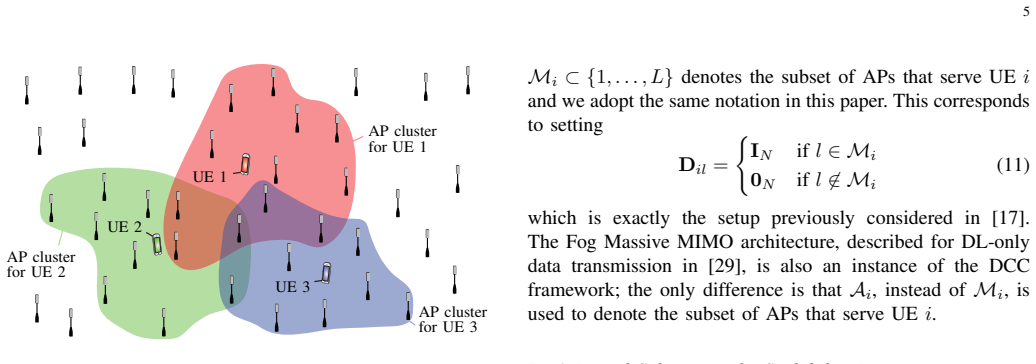
The load-bearing mechanism is the dynamic cooperation clustering (DCC) framework, i.e., a set of diagonal matrices $D_{il}$ that decide which AP antennas may transmit to or decode signals from which UE, together with the scalability condition of Assumption 1: each AP serves at most one UE per pilot, so the serving set $D_l$ satisfies $|D_l| \leq \tau_p$ with $\tau_p$ fixed as $K \to \infty$. This single bound caps channel estimation, combining/precoding, and fronthaul load per AP independently of $K$, turning Lemma 1 into a sufficient condition for Definition 1. The second load-bearing tool is the uplink-downlink duality of Proposition 4, which shows that for any uplink combining vectors and powers there exists a downlink power allocation with the same total power under which the downlink SINRs equal the uplink SINRs when the precoders are chosen as scaled combiners; this makes the scalability of uplink combining carry over to downlink precoding. The partial MMSE (P-MMSE) and local partial MMSE (LP-MMSE) schemes are the concrete designs that realize this, with per-AP complexity independent of $K$.
What would settle it
Measure or compute the per-AP fronthaul load and channel-estimation complexity in a setting where the pilot pool size $\tau_p$ grows with the number of users $K$ (for instance, a fixed short coherence block with increasing $K$). If the per-AP load grows without bound under the proposed access and clustering algorithm, the central scalability claim is falsified. A more targeted check is to create pilot collisions in which two users sharing a pilot have comparable channel gains to the same AP, violating Assumption 1, and observe whether the AP's serving set and processing load grow with the number of such collisions.
Extended reading notes
Core claim
The central claim is that Cell-Free Massive MIMO can be made scalable in a precise sense: under the paper's Definition 1, a network is scalable when each AP's channel estimation, signal processing, fronthaul signaling, and power-control complexity remain finite as the number of users $K$ goes to infinity. The paper first shows that the original all-users-to-all-APs form of Cell-Free Massive MIMO fails this definition on all four tasks, and then proposes a framework that satisfies it. The key move is to impose Assumption 1, that each AP serves at most one UE per pilot sequence with a pilot pool size $\tau_p$ independent of $K$, which bounds the AP's serving set $|D_l| \leq \tau_p$ and makes all four tasks finite per AP. A three-step distributed access algorithm assigns each new UE a Master AP and a pilot, and lets neighboring APs decide whether to join the cluster, guaranteeing that every UE is served by at least one AP. The scalable combining and precoding schemes P-MMSE and LP-MMSE have complexity set by $|D_l|$ rather than $K$, and the new uplink-downlink duality (Proposition 4) shows that downlink precoders chosen as scaled uplink combiners preserve the SINR, transferring scalability from uplink to downlink. Simulations with 100 UEs show LP-MMSE achieving about 2.7 times the average spectral efficiency of maximum-ratio processing and centralized P-MMSE reaching 89% of the average spectral efficiency of the optimal unscalable MMSE combining.
Load-bearing premise
Everything rests on the assumption that the pilot pool size stays constant and that each AP serves at most one user per pilot, so if the number of pilots must grow with the number of users, for example because coherence blocks are short or many users are highly mobile, the per-AP workload grows with $K$ and the scalability guarantee collapses.
Editorial extensions
If this is right
- Per-AP fronthaul, computation, and channel-estimation load become bounded by the pilot pool size and cluster size, so adding users to a large network does not require upgrading APs or backhaul.
- The three-step access algorithm guarantees every user at least one serving AP, avoiding the dropped-user problem of earlier user-centric clustering, and assigns pilots to minimize contamination at the Master AP.
- Because downlink precoders can be derived from uplink combiners via the UL-DL duality, distributed APs can implement spatially selective transmission without sharing network-wide CSI.
- The scalable P-MMSE and LP-MMSE schemes beat maximum-ratio processing by a large margin and approach the spectral efficiency of unscalable MMSE alternatives, indicating that scalability costs little in performance.
Reading between the lines
- A testable extension would let the pilot pool size adapt to the active-user density and map the tradeoff between pilot contamination and per-AP complexity, since the paper fixes $\tau_p$ but the framework suggests a smooth degradation curve.
- With high user mobility the steady-state load stays bounded, but the re-clustering overhead of repeatedly running the access algorithm may become the practical bottleneck; this is an implication the paper leaves implicit.
- The same DCC-plus-pilot-bound design could be applied to other user-centric architectures, such as Fog Massive MIMO, where per-AP load would similarly be capped by a pilot-pool-sized serving set.
Signed reviews
Editorial analysis
A structured set of objections, weighed in public.
Referee Report
Summary. This paper proposes a framework for scalable Cell-Free Massive MIMO. The key idea is to bound the per-AP load by having each AP serve at most one UE per pilot sequence, with the pilot pool size τp independent of K. The authors define scalability (Definition 1), prove Lemma 1 that a constant number of served UEs per AP suffices, and develop a joint initial access, pilot assignment, and cluster formation algorithm (Section V-A). They derive spectral efficiency expressions for centralized and distributed uplink/downlink processing, propose partial MMSE (P-MMSE) and local partial MMSE (LP-MMSE) schemes, and prove an uplink-downlink duality that motivates using uplink combiners as downlink precoders. Numerical results show that in the uplink, P-MMSE and LP-MMSE perform close to unscalable MMSE benchmarks while MR is far worse; downlink results compare three scalable precoders under different power allocations.
Significance. If the scalability guarantee and the numerical claims hold, this is an important step toward practical Cell-Free Massive MIMO: it provides a formal complexity bound, concrete algorithms, and reproducible simulation code. The paper's main strength is that the scalability proof is clean and does not rely on fitted parameters; the P-MMSE and LP-MMSE schemes are evaluated against standard benchmarks in the uplink, and the complexity tables are consistent with the stated assumptions. However, the downlink performance claim is not supported by the current simulations, because Fig. 6 has no unscalable baseline and the centralized/distributed comparison is confounded by different power allocation policies. Since the downlink is the direction where scalable local processing could cause the largest loss, the practical significance of the framework is currently only demonstrated for the uplink.
major comments (2)
- [Section VI-B, Fig. 6] The abstract and Section VII claim that the proposed scalable schemes 'perform closely to the best unscalable alternatives' and that 'the scalability can be achieved with a negligible performance loss'. This claim is only tested in the uplink (Fig. 5), where P-MMSE and LP-MMSE are compared against unscalable MMSE, L-MMSE, and MR baselines. The downlink evaluation in Fig. 6 compares only three scalable precoders (P-MMSE, LP-MMSE, MR) and uses different power allocation policies for the centralized and distributed schemes, with the distributed schemes using 40 times more transmit power (Section VI-B). Consequently, the downlink is missing both the unscalable baseline and a matched power allocation, so the margin by which scalability costs performance in the downlink is not quantified. The authors should either add downlink simulations with unscalable MMSE or L-MMSE precoding under the same power allocation rules, or restrict the 'negligible loss' statements to the uplink.
- [Section V-A, Assumption 1 and footnote 5] The scalability proof relies on Lemma 1, which requires |D_l| <= tau_p for every AP. The proposed access algorithm assigns each AP at most one UE per pilot through Steps 2 and 3, but the Master AP role is not explicitly load-limited: footnote 5 states that an AP 'can only be the Master AP of up to tau_p UEs', yet the algorithm does not enforce this, and the footnote proceeds to allow multiple UEs on the same pilot via time/frequency multiplexing in the 'unlikely event' of overloading. Such multiplexing would increase |D_l| beyond tau_p and break the bounded-complexity guarantee of Lemma 1. The authors should modify the algorithm to include a reservation or handover mechanism that guarantees the Master AP load is at most tau_p, or they should provide a probabilistic argument that the overload event has vanishing probability as K,L tend to infinity under the proposed access rule.
minor comments (5)
- [Section VI-B, first sentence] The sentence 'Since we have established that the proposed scalable Cell-Free Massive MIMO provides very competitive performance' refers to uplink results only; it would be clearer to say 'very competitive uplink performance'.
- [Figure 6, caption] The caption should state the power allocation policy used for each curve, since the centralized and distributed schemes have different total transmit power, which is material to the comparison.
- [Abstract] The phrase 'performs closely' should be 'perform closely' to agree with the compound subject.
- [Section V-A, footnote 5] Even if an overload probability bound is outside the scope of the paper, the text should state explicitly that Assumption 1 is a condition on the algorithm's inputs, not a guaranteed consequence of the access procedure.
- [Remark 2] The perfect-synchronization assumption is flagged as practically infeasible; a brief discussion of the expected impact of imperfect synchronization on the SE bounds would improve the paper's completeness.
Circularity Check
No significant circularity: the scalability guarantee is a constructive proof from an algorithm that enforces Assumption 1, and the performance claims are Monte Carlo evaluations rather than fitted predictions.
full rationale
The paper's central claim is that the Section V-A algorithm yields a scalable Cell-Free Massive MIMO system under Definition 1. The proof chain is Definition 1 -> Lemma 1 -> Assumption 1 -> Algorithm in Section V-A. Assumption 1 bounds |D_l| by tau_p, and Lemma 1 shows bounded |D_l| gives bounded per-AP estimation, combining/precoding, and fronthaul. The algorithm then implements the assumption: Step 1 guarantees every UE has a Master AP, Step 2 assigns a pilot, and Step 3 ensures an AP serves at most one UE per pilot. This is a constructive verification, not a circular reduction: the target property is the definition of scalability and the construction actually enforces it. No parameter is fitted to a subset of the data and then renamed a prediction; P-MMSE and LP-MMSE are heuristics whose SEs are computed by Monte Carlo and compared with unscalable benchmarks in Fig. 5. The new UL-DL duality in Proposition 4 is proved directly in the Appendix; it extends the standard duality of [2, Th. 4.8] to the DCC signal model rather than importing the result as an unverified premise. Self-citations are numerous ([2], [7], [10], [17]) but are not load-bearing in a circular sense: [2] provides standard estimation and bounding tools, [7] provides the L-MMSE baseline that the paper explicitly generalizes, and [10], [17] define the DCC framework, which the paper says it extends with 'many missing details' (initial access, pilot assignment, channel estimation). The assumption that tau_p is independent of K is a stated modeling condition in Section V; if it fails, the scalability guarantee collapses, but that is a limitation of the assumptions, not a circular step. Similarly, the absence of an unscalable downlink baseline in Section VI-B (Fig. 6) and the unequal power budgets weaken the headline 'negligible loss' generalization, but this is an evidence/completeness concern, not a case of a result being equivalent to its inputs by construction.
Assumptions & free parameters
assumptions (6)
- domain assumption Assumption 1: each AP serves at most one UE per pilot sequence and uses all N antennas for these UEs.
- domain assumption Pilot pool size t_p is a constant independent of K.
- domain assumption Channels are independent correlated Rayleigh fading with known correlation matrices R_kl.
- standard math Use-and-then-forget and hardening capacity bounds are valid achievable SE bounds for the DCC signal model.
- standard math The duality matrix Gamma - Sigma is invertible and yields a nonnegative downlink power vector in (48).
- domain assumption Perfect symbol-level synchronization among APs and UEs.
Cite this review
Pith. "Pith review of Scalable Cell-Free Massive MIMO Systems." pith.science (2026). https://pith.science/paper/46TQL4JL
@misc{pith2026190803119,
  author       = {Pith},
  title        = {Pith review of: Scalable Cell-Free Massive MIMO Systems},
  year         = {2026},
  howpublished = {\url{https://pith.science/paper/46TQL4JL}},
  note         = {Machine review of arXiv:1908.03119}
}
read the original abstract
Imagine a coverage area with many wireless access points that cooperate to jointly serve the users, instead of creating autonomous cells. Such a cell-free network operation can potentially resolve many of the interference issues that appear in current cellular networks. This ambition was previously called Network MIMO (multiple-input multiple-output) and has recently reappeared under the name Cell-Free Massive MIMO. The main challenge is to achieve the benefits of cell-free operation in a practically feasible way, with computational complexity and fronthaul requirements that are scalable to large networks with many users. We propose a new framework for scalable Cell-Free Massive MIMO systems by exploiting the dynamic cooperation cluster concept from the Network MIMO literature. We provide a novel algorithm for joint initial access, pilot assignment, and cluster formation that is proved to be scalable. Moreover, we adapt the standard channel estimation, precoding, and combining methods to become scalable. A new uplink and downlink duality is proved and used to heuristically design the precoding vectors on the basis of the combining vectors. Interestingly, the proposed scalable precoding and combining outperform conventional maximum ratio processing and also performs closely to the best unscalable alternatives.
Figures


Figures from the paper (3 more)


Reference graph
Works this paper leans on
-
[1]
A new look at cell-free Massive MIMO: Making it practical with dynamic cooperation,
E. Björnson and L. Sanguinetti, “A new look at cell-free Massive MIMO: Making it practical with dynamic cooperation,” in Proc. IEEE International Symposium on Personal, Indoor and Mobile Radio Com- munications (PIMRC), 2019
work page 2019
-
[2]
Massive MIMO networks: Spectral, energy, and hardware efficiency,
E. Björnson, J. Hoydis, and L. Sanguinetti, “Massive MIMO networks: Spectral, energy, and hardware efficiency,” Foundations and Trends R© in Signal Processing , vol. 11, no. 3-4, pp. 154–655, 2017
work page 2017
-
[3]
Enhancing the cellular downlink capacity via co-processing at the transmitting end,
S. Shamai and B. M. Zaidel, “Enhancing the cellular downlink capacity via co-processing at the transmitting end,” in IEEE Vehicular Technology Conference (VTC Spring) , vol. 3, 2001, pp. 1745–1749
2001
-
[4]
Network MIMO: Over- coming intercell interference in indoor wireless systems,
S. Venkatesan, A. Lozano, and R. Valenzuela, “Network MIMO: Over- coming intercell interference in indoor wireless systems,” in Asilomar Conference on Signals, Systems and Computers , 2007, pp. 83–87
2007
-
[5]
Cell-free Massive MIMO versus small cells,
H. Q. Ngo, A. Ashikhmin, H. Yang, E. G. Larsson, and T. L. Marzetta, “Cell-free Massive MIMO versus small cells,” IEEE Trans. Wireless Commun., vol. 16, no. 3, pp. 1834–1850, 2017
2017
-
[6]
Pre- coding and power optimization in cell-free Massive MIMO systems,
E. Nayebi, A. Ashikhmin, T. L. Marzetta, H. Yang, and B. D. Rao, “Pre- coding and power optimization in cell-free Massive MIMO systems,” IEEE Trans. Wireless Commun. , vol. 16, no. 7, 2017
work page 2017
-
[7]
Making cell-free massive MIMO competitive with MMSE processing and centralized implementation,
E. Björnson and L. Sanguinetti, “Making cell-free massive MIMO competitive with MMSE processing and centralized implementation,” IEEE Trans. Wireless Commun. , vol. 19, no. 1, pp. 77–90, 2020
work page 2020
-
[8]
Multi-cell MIMO cooperative networks: A new look at interference,
D. Gesbert, S. Hanly, H. Huang, S. Shamai, O. Simeone, and W. Yu, “Multi-cell MIMO cooperative networks: A new look at interference,” IEEE J. Sel. Areas Commun. , vol. 28, no. 9, pp. 1380–1408, 2010
work page 2010
Show all 56 references
-
[9]
Cooperative multicell precoding: Rate region characterization and distributed strate- gies with instantaneous and statistical CSI,
E. Björnson, R. Zakhour, D. Gesbert, and B. Ottersten, “Cooperative multicell precoding: Rate region characterization and distributed strate- gies with instantaneous and statistical CSI,”IEEE Trans. Signal Process., vol. 58, no. 8, pp. 4298–4310, 2010
2010
-
[10]
Optimal resource allocation in coordi- nated multi-cell systems,
E. Björnson and E. Jorswieck, “Optimal resource allocation in coordi- nated multi-cell systems,” Foundations and Trends R© in Communica- tions and Information Theory , vol. 9, no. 2-3, pp. 113–381, 2013
2013
-
[11]
On multicell cooperative transmission in backhaul-constrained cellular systems,
P. Marsch and G. Fettweis, “On multicell cooperative transmission in backhaul-constrained cellular systems,” Ann. Telecommun., vol. 63, pp. 253–269, 2008
2008
-
[12]
Networked MIMO with clustered linear precoding,
J. Zhang, R. Chen, J. G. Andrews, A. Ghosh, and R. Heath, “Networked MIMO with clustered linear precoding,”IEEE Trans. Wireless Commun., vol. 8, no. 4, pp. 1910–1921, 2009
1910
-
[13]
Increasing downlink cellular throughput with limited network MIMO coordination,
H. Huang, M. Trivellato, A. Hottinen, M. Shafi, P. Smith, and R. Valen- zuela, “Increasing downlink cellular throughput with limited network MIMO coordination,” IEEE Trans. Wireless Commun., vol. 8, no. 6, pp. 2983–2989, 2009
2009
-
[14]
Osseiran, J
A. Osseiran, J. F. Monserrat, and P. Marsch, 5G Mobile and Wireless Communications Technology. Cambridge: Cambridge University Press, 2016, ch. 9, Coordinated Multi-Point Transmission in 5G
2016
-
[15]
Dynamic cooperation set clustering on base station cooperation cellular networks,
I. D. Garcia, N. Kusashima, K. Sakaguchi, and K. Araki, “Dynamic cooperation set clustering on base station cooperation cellular networks,” in IEEE PIMRC, 2010, pp. 2127–2132. 14
2010
-
[16]
Cooperative MIMO-OFDM cellular system with soft handover between distributed base station antennas,
A. Tölli, M. Codreanu, and M. Juntti, “Cooperative MIMO-OFDM cellular system with soft handover between distributed base station antennas,” IEEE Trans. Wireless Commun., vol. 7, no. 4, pp. 1428–1440, 2008
2008
-
[17]
Optimality properties, distributed strategies, and measurement-based evaluation of coordinated multicell OFDMA transmission,
E. Björnson, N. Jaldén, M. Bengtsson, and B. Ottersten, “Optimality properties, distributed strategies, and measurement-based evaluation of coordinated multicell OFDMA transmission,” IEEE Trans. Signal Process., vol. 59, no. 12, pp. 6086–6101, 2011
2011
-
[18]
Linear precoding and equalization for network MIMO with partial cooperation,
S. Kaviani, O. Simeone, W. Krzymien, and S. Shamai, “Linear precoding and equalization for network MIMO with partial cooperation,” IEEE Trans. Veh. Technol., vol. 61, no. 5, pp. 2083–2095, 2012
2012
-
[19]
A dynamic clustering approach in wireless networks with multi-cell cooperative processing,
A. Papadogiannis, D. Gesbert, and E. Hardouin, “A dynamic clustering approach in wireless networks with multi-cell cooperative processing,” in IEEE International Conference on Communication (ICC) , 2008
2008
-
[20]
The role of small cells, coordinated multipoint, and massive MIMO in 5G,
V . Jungnickel, K. Manolakis, W. Zirwas, B. Panzner, V . Braun, M. Los- sow, M. Sternad, R. Apelfrojd, and T. Svensson, “The role of small cells, coordinated multipoint, and massive MIMO in 5G,” IEEE Commun. Mag., vol. 52, no. 5, pp. 44–51, 2014
2014
-
[21]
An introduction to pCell,
S. Perlman and A. Forenza, “An introduction to pCell,” 2015, Artemis Networks LLC, White paper. [Online]. Available: http://www.rearden. com/artemis/An-Introduction-to-pCell-White-Paper-150224.pdf
2015
-
[22]
Noncooperative cellular wireless with unlimited num- bers of base station antennas,
T. L. Marzetta, “Noncooperative cellular wireless with unlimited num- bers of base station antennas,” IEEE Trans. Wireless Commun. , vol. 9, no. 11, pp. 3590–3600, 2010
2010
-
[23]
Towards massive MIMO 2.0: Understanding spatial correlation, interference suppression, and pilot contamination,
L. Sanguinetti, E. Björnson, and J. Hoydis, “Towards massive MIMO 2.0: Understanding spatial correlation, interference suppression, and pilot contamination,”IEEE Trans. Commun., vol. 68, no. 1, pp. 232–257, 2020
2020
-
[24]
Massive MIMO in sub-6 GHz and mmWave: Physical, practical, and use-case differences,
E. Björnson, L. V . der Perre, S. Buzzi, and E. G. Larsson, “Massive MIMO in sub-6 GHz and mmWave: Physical, practical, and use-case differences,” IEEE Wireless Commun., vol. 26, pp. 100–108, 2019
2019
-
[25]
NR: The new 5G radio access technology,
S. Parkvall, E. Dahlman, A. Furuskär, and M. Frenne, “NR: The new 5G radio access technology,” IEEE Communications Standards Magazine , vol. 1, no. 4, pp. 24–30, 2017
2017
-
[26]
Performance analysis and power control of cell-free massive MIMO systems with hardware impairments,
J. Zhang, Y . Wei, E. Björnson, Y . Han, and S. Jin, “Performance analysis and power control of cell-free massive MIMO systems with hardware impairments,” IEEE Access, vol. 6, pp. 55 302–55 314, 2018
2018
-
[27]
Cell-free massive MIMO: User-centric approach,
S. Buzzi and C. D’Andrea, “Cell-free massive MIMO: User-centric approach,” IEEE Commun. Lett. , vol. 6, no. 6, pp. 706–709, 2017
2017
-
[28]
On the total energy efficiency of cell-free massive MIMO,
H. Q. Ngo, L. Tran, T. Q. Duong, M. Matthaiou, and E. G. Larsson, “On the total energy efficiency of cell-free massive MIMO,”IEEE Trans. Green Commun. Net. , vol. 2, no. 1, pp. 25–39, 2018
2018
-
[29]
Fog massive MIMO: A user-centric seamless hot-spot architecture,
O. Y . Bursalioglu, G. Caire, R. K. Mungara, H. C. Papadopoulos, and C. Wang, “Fog massive MIMO: A user-centric seamless hot-spot architecture,” IEEE Trans. Wireless Commun. , vol. 18, no. 1, pp. 559– 574, 2019
2019
-
[30]
Performance of cell-free massive MIMO systems with MMSE and LSFD receivers,
E. Nayebi, A. Ashikhmin, T. L. Marzetta, and B. D. Rao, “Performance of cell-free massive MIMO systems with MMSE and LSFD receivers,” in Asilomar Conference on Signals, Systems and Computers , 2016
2016
-
[31]
On the uplink max-min SINR of cell-free massive MIMO systems,
M. Bashar, K. Cumanan, A. G. Burr, M. Debbah, and H. Q. Ngo, “On the uplink max-min SINR of cell-free massive MIMO systems,” IEEE Trans. Wireless Commun., vol. 18, no. 4, pp. 2021–2036, 2019
2021
-
[32]
Adaptation, co- ordination, and distributed resource allocation in interference-limited wireless networks,
D. Gesbert, S. Kiani, A. Gjendemsjø, and G. Øien, “Adaptation, co- ordination, and distributed resource allocation in interference-limited wireless networks,” Proc. IEEE, vol. 95, no. 12, pp. 2393–2409, 2007
2007
-
[33]
Scalability aspects of cell-free massive MIMO,
G. Interdonato, P. Frenger, and E. G. Larsson, “Scalability aspects of cell-free massive MIMO,” in IEEE International Conference on Communication (ICC), 2019
2019
-
[34]
Uplink fractional power control for cell- free wireless networks,
R. Nikbakht and A. Lozano, “Uplink fractional power control for cell- free wireless networks,” in IEEE International Conference on Commu- nication (ICC), 2019
2019
-
[35]
Ultra-dense radio access networks for smart cities: Cloud-RAN, fog-RAN and “cell-free
A. G. Burr, M. Bashar, and D. Maryopi, “Ultra-dense radio access networks for smart cities: Cloud-RAN, fog-RAN and “cell-free” massive MIMO,” in PIMRC, International Workshop of CorNer , 2018
2018
-
[36]
Massive MIMO with imperfect channel covariance information,
E. Björnson, L. Sanguinetti, and M. Debbah, “Massive MIMO with imperfect channel covariance information,” in Asilomar Conference on Signals, Systems and Computers , Nov 2016, pp. 974–978
2016
-
[37]
Covariance matrix estima- tion in massive MIMO,
D. Neumann, M. Joham, and W. Utschick, “Covariance matrix estima- tion in massive MIMO,” IEEE Signal Processing Letters, vol. 25, no. 6, pp. 863–867, June 2018
2018
-
[38]
Covariance matrix estimation for massive MIMO,
K. Upadhya and S. A. V orobyov, “Covariance matrix estimation for massive MIMO,” IEEE Signal Processing Letters , vol. 25, no. 4, pp. 546–550, April 2018
2018
-
[39]
Massive MIMO pilot decontamination and channel interpolation via wideband sparse channel estimation,
S. Haghighatshoar and G. Caire, “Massive MIMO pilot decontamination and channel interpolation via wideband sparse channel estimation,”IEEE Transactions on Wireless Communications , vol. 16, no. 12, pp. 8316– 8332, Dec 2017
2017
-
[40]
Robust pilot decontamination based on joint angle and power domain discrim- ination,
H. Yin, L. Cottatellucci, D. Gesbert, R. R. Müller, and G. He, “Robust pilot decontamination based on joint angle and power domain discrim- ination,” IEEE Trans. Signal Process. , vol. 64, no. 11, pp. 2990–3003, 2016
2016
-
[41]
Massive MIMO has unlimited capacity,
E. Björnson, J. Hoydis, and L. Sanguinetti, “Massive MIMO has unlimited capacity,” IEEE Trans. Wireless Commun., vol. 17, no. 1, pp. 574–590, Jan. 2018
2018
-
[42]
Sesia, I
S. Sesia, I. Toufik, and M. Baker, LTE - the UMTS long term evolution: from theory to practice . Chichester: Wiley, 2009. [Online]. Available: http://opac.inria.fr/record=b1130916
2009
-
[43]
An initial ranging scheme for the IEEE 802.16 OFDMA uplink,
L. Sanguinetti and M. Morelli, “An initial ranging scheme for the IEEE 802.16 OFDMA uplink,” IEEE Trans. Wireless Commun., vol. 11, no. 9, pp. 3204–3215, Sept. 2012
2012
-
[44]
A random access algo- rithm for LTE systems,
L. Sanguinetti, M. Morelli, and L. Marchetti, “A random access algo- rithm for LTE systems,”Trans. Emerging Telecommun. Technol., vol. 24, no. 1, 2013
2013
-
[45]
On the capacity of cloud radio access networks with oblivious relaying,
I. Estella Aguerri, A. Zaidi, G. Caire, and S. Shamai Shitz, “On the capacity of cloud radio access networks with oblivious relaying,” IEEE Trans. Inf. Theory, vol. 65, no. 7, pp. 4575–4596, 2019
2019
-
[46]
Fading channels: Information- theoretic and communications aspects,
E. Biglieri, J. Proakis, and S. Shamai, “Fading channels: Information- theoretic and communications aspects,” IEEE Trans. Inf. Theory, vol. 44, no. 6, pp. 2619–2691, 1998
1998
-
[47]
Channel hardening and favorable propagation in cell-free massive MIMO with stochastic geometry,
Z. Chen and E. Björnson, “Channel hardening and favorable propagation in cell-free massive MIMO with stochastic geometry,” IEEE Trans. Commun., vol. 17, no. 11, pp. 5205–5219, 2018
2018
-
[48]
On the performance of backhaul constrained cell- free massive MIMO with linear receivers,
M. Bashar, H. Q. Ngo, A. G. Burr, D. Maryopi, K. Cumanan, and E. G. Larsson, “On the performance of backhaul constrained cell- free massive MIMO with linear receivers,” in Asilomar Conference on Signals, Systems and Computers , Nov. 2018
2018
-
[49]
Transmitter optimization for the multi-antenna downlink with per-antenna power constraints,
W. Yu and T. Lan, “Transmitter optimization for the multi-antenna downlink with per-antenna power constraints,” IEEE Trans. Signal Process., vol. 55, no. 6, pp. 2646–2660, June 2007
2007
-
[50]
A general duality theory for uplink and downlink beamforming,
H. Boche and M. Schubert, “A general duality theory for uplink and downlink beamforming,” in IEEE VTC-Fall, 2002, pp. 87–91
2002
-
[51]
Sum capacity of the vector Gaussian broadcast channel and uplink-downlink duality,
P. Viswanath and D. N. C. Tse, “Sum capacity of the vector Gaussian broadcast channel and uplink-downlink duality,” IEEE Trans. Inf. The- ory, vol. 49, no. 8, pp. 1912–1921, 2003
1912
-
[52]
Massive MIMO for maximal spectral efficiency: How many users and pilots should be allocated?
E. Björnson, E. G. Larsson, and M. Debbah, “Massive MIMO for maximal spectral efficiency: How many users and pilots should be allocated?” IEEE Trans. Wireless Commun. , vol. 15, no. 2, pp. 1293– 1308, 2016
2016
-
[53]
Massive MIMO in the UL/DL of cellular networks: How many antennas do we need?
J. Hoydis, S. ten Brink, and M. Debbah, “Massive MIMO in the UL/DL of cellular networks: How many antennas do we need?” IEEE J. Sel. Areas Commun., vol. 31, no. 2, pp. 160–171, Feb. 2013
2013
-
[54]
Energy and spectral effi- ciency of very large multiuser MIMO systems,
H. Q. Ngo, E. G. Larsson, and T. L. Marzetta, “Energy and spectral effi- ciency of very large multiuser MIMO systems,” IEEE Trans. Commun., vol. 61, no. 4, pp. 1436–1449, 2013
2013
-
[55]
Recent progress on C-RAN centralization and cloudification,
C. I, J. Huang, R. Duan, C. Cui, J. Jiang, and L. Li, “Recent progress on C-RAN centralization and cloudification,” IEEE Access , vol. 2, pp. 1030–1039, 2014
2014
-
[56]
Recent advances in cloud radio access networks: System architectures, key techniques, and open issues,
M. Peng, Y . Sun, X. Li, Z. Mao, and C. Wang, “Recent advances in cloud radio access networks: System architectures, key techniques, and open issues,” IEEE Communications Surveys Tutorials , vol. 18, no. 3, pp. 2282–2308, 2016
2016
Reviewed August 14, 2026 · model on record in the stance chip above.
Discussion (0). Continue with ORCID to comment.