REVIEW 4 major objections 5 minor 34 references
Improving Personalized Image Generation through Social Context Feedback
T0 review · 4 major / 5 minor · reviewed 2026-08-06 · deepseek-v4-flash
Pith's one-line read Detector feedback improves pose, gaze, and identity in personalized image generation.
desk verdict A genuinely new timestep-gated feedback idea undercut by a circular evaluation and the paper's own tables; the full model does not improve gaze or identity. read the letter →
The pith
A machine-rendered reading of the paper's core claim, the machinery that carries it, and where it could break.
The reading
What carries the argument
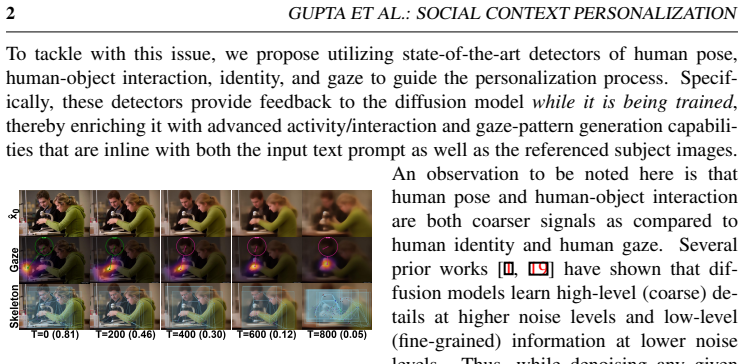
The central mechanism is timestep-gated detector feedback. During training, at each noise level the model predicts the noise, converts the latent back to an approximate clean image $\hat{x}_0$ through the VAE decoder, and runs frozen detectors on that image; the losses push $\hat{x}_0$'s detector outputs toward the same detectors' outputs on the ground-truth image. Because diffusion recovers coarse structure at high noise and fine details at low noise, the paper gates each loss to timesteps where the signal is trustworthy: gaze for $t \in [0,200]$, identity for $t \in [0,400]$, interaction for $t \in [0,500]$, and pose for $t \in [0,700]$. The total loss is the denoising loss plus these detector losses, each weighted at 0.01, together with the SSR-Encoder regularization loss.
What would settle it
Train the model exactly as described, then evaluate identity, gaze, and interaction with detectors not used in training and with human raters; if the improvements over SSR-Encoder shrink to noise, the reported gains are detector-specific rather than real image improvements.
Extended reading notes
Core claim
The paper's central claim is that feedback from frozen pretrained detectors can act as a training signal that fixes three known weaknesses of personalized generation: incorrect human poses and interactions, lost facial identity, and unnatural gaze. The authors fine-tune SSR-Encoder with additional losses for boundary-gradient consistency, ArcFace identity matching, Sharingan gaze target and vector matching, X-Pose keypoint matching, and CMMP interaction logit matching, and they apply each loss only in the timestep range where the corresponding signal is still recoverable from the noisy latent: gaze for $t \in [0,200]$, identity for $t \in [0,400]$, interaction for $t \in [0,500]$, and pose for $t \in [0,700]$. On the HICO-DET test set the full method raises interaction mAP from 15.87 to 16.43, on GazeFollow the gaze-only feedback raises gaze accuracy from 53.81% to 56.39%, and on Concept101 the method improves CLIP-I and DINO scores over the non-feedback baselines including an SDXL-based model. The paper concludes that its feedback-guided diffusion model, leveraging pretrained gaze, identity, and interaction detectors, improves the generated images in each of these aspects.
Load-bearing premise
The paper assumes the frozen detectors' outputs on real and generated images are accurate enough that bringing the generated image's detector signals close to the real image's signals truly improves pose, identity, gaze, and interaction, rather than just making those detectors happier.
Editorial extensions
If this is right
- Complex activities in prompts, such as 'pushing a motorcycle,' will be generated with the correct pose and interaction rather than showing the subject riding or ignoring the object.
- The method is a fine-tuning wrapper, so it can be applied to other personalization backbones beyond SSR-Encoder without changing their inference-time pipeline.
- Timestep-gated supervision stabilizes training, so combining coarse and fine social signals does not require reweighting or adversarial scheduling.
- Generated images keep reference identities in social scenes, while gaze follows the person or object implied by the caption.
- Overall image quality, measured by CLIP-I and DINO, improves or holds relative to the baselines while the social cues improve.
Reading between the lines
- A natural extension, not tested in the paper, is to apply the same detector-feedback recipe to other relational cues such as body contact, relative depth, or object state changes, where the same coarse-to-fine timestep logic should apply.
- Because the evaluation uses the very detectors that supervised training, part of the reported gains may be specific to those detectors; measuring identity with a different face recognition model or gaze with human annotators would show whether the improvement transfers.
- The timestep cutoffs were selected by inspecting loss curves; an adaptive scheduler that learns when each detector's signal is reliable could replace the manual ranges.
- The boundary-gradient loss's sensitivity to fine detail suggests the same feedback idea could be used for texture or edge quality in non-social personalized generation, though the paper does not explore that.
Editorial analysis
A structured set of objections, weighed in public.
Referee Report
Summary. The paper proposes fine-tuning the SSR-Encoder personalized image generation model with additional feedback losses derived from frozen pretrained detectors: a boundary loss computed from segmentation gradients (Eq. 2), an identity loss using ArcFace embeddings (Eq. 3), a gaze loss using Sharingan targets and vectors (Eq. 4), a pose loss using X-Pose keypoints (Eq. 5), and an interaction loss using CMMP logits (Eq. 6). These losses are applied only within manually selected timestep ranges, under the rationale that coarse cues (pose, interaction) are recovered earlier in denoising than fine cues (identity, gaze). The method is evaluated on HICO-DET, GazeFollow, and Concept101, with ablations of each loss. The central claim, stated in the Abstract and Section 4.4, is that the feedback-guided model improves generated interactions, facial identities, and gaze patterns.
Significance. If the claims were well supported, the timestep-aware use of multiple social-cue detectors as feedback would be a useful contribution to personalized generation, and the ablation structure is reasonably thorough. The paper also contains a potentially useful observation, illustrated in Figure 1, that different semantic attributes become reliable at different denoising timesteps. However, the quantitative evaluation is not trustworthy for the attribute-specific claims because the metrics reuse the same detectors that define the training losses, and the full model's reported identity and gaze scores are internally inconsistent with the paper's headline claims. The interaction mAP metric is especially weak because it ignores localization entirely. These issues bear directly on the main contributions, so the current manuscript does not establish its claims.
major comments (4)
- [Section 3 (Eqs. 3-6) and Section 4.2] The evaluation of interaction, identity, and gaze is circular with respect to the training objectives. Equations 3, 4, and 6 train the diffusion model to match outputs of ArcFace, Sharingan, and CMMP respectively, and Section 4.2 evaluates the same attributes with the same detectors: CMMP mAP for interactions, ArcFace cosine similarity for identity, and Sharingan-based gaze-target matching. Improving these metrics therefore partly reflects better alignment with the frozen detectors' outputs rather than independently verified improvements in true image attributes. The paper provides no human evaluation and no comparison against detectors that were not used in the loss functions. This is load-bearing because every attribute-specific quantitative gain is reported through these detectors.
- [Abstract, Section 4.4, Tables 1 and 2] The central claim that the method improves facial identity and gaze is contradicted by the paper's own tables. In Table 1, the full model 'Ours' has facial cosine similarity 0.6398 versus 0.6531 for SSR-Encoder, and in Table 2 it has gaze accuracy 53.73% versus 53.81% for SSR-Encoder. Thus, under the paper's own evaluation, two of the three attribute-specific claims fail on the relevant benchmarks; only interaction mAP improves for the full model. The Abstract and Section 4.4 nevertheless state that the method improves identity and gaze, which is internally inconsistent.
- [Section 4.2 and Eq. 6] The interaction mAP metric is not a valid measure of generated interactions because Section 4.2 explicitly counts a CMMP label prediction as positive irrespective of the predicted bounding box location, i.e., with no IoU constraint. Since Eq. 6 trains the model against CMMP logits, the reported interaction mAP gain of 16.43 versus 15.87 in Table 1 may reflect improved alignment with CMMP's label distribution rather than correct spatial interaction placement. A localization-aware metric, or an independent interaction detector, is needed to support the interaction claim.
- [Section 3F and Table 1] The timestep thresholds for applying each feedback loss are 'determined through manual inspection,' and all loss weights are fixed at 0.01. The inverse-timestep ablation in Table 1 shows that a different weighting strategy degrades performance, but this does not establish that the chosen thresholds are robust or that the results are not tuned to the specific benchmarks. A sensitivity analysis over thresholds and weights would strengthen the paper's central methodological claim, though this issue is secondary to the circular evaluation and internal contradictions above.
minor comments (5)
- [Abstract] The phrase 'timestep-based inculcation' is unusual; 'incorporation' or 'application' would be clearer.
- [Section 3F and Figure 3] The description of Figure 3 (right) says the boundary loss curve is 'increasing' after Gaussian filtering, but the visual trend is not easy to verify at the printed figure resolution; a clearer plot or explicit numbers would help.
- [Section 4.3] The text says 'the row 3 in the table indicates the performance of SSR-model when it is finetuned on the hicodet dataset' but the table caption labels this row 'SSR-Encoder*'; the terminology should be consistent.
- [Tables 1 and 2] MIP-Adapter is based on SDXL and is described as a 'topline'; because it uses a different base architecture and training data, direct comparison with the SDV1.5-based methods is not apples-to-apples and should be presented as an upper reference only.
- [Section 4.3] In Table 2, the full model's gaze accuracy is slightly lower than SSR-Encoder, but the text emphasizes the gain in facial embedding similarity; this selective emphasis obscures the fact that the headline claim of improved gaze is not supported.
Circularity Check
Attribute-specific evaluations reuse the same detectors that provide the training feedback, so the interaction, gaze, and identity gains are at least partly by construction; only the CLIP/DINO metrics are independent.
-
fitted input called prediction
[Section 3(E), Eq. (6); Section 4.2, Table 1]
"Linteraction = Focal loss(HOI labelGround Truth,CMMP (ˆx0)) (6) ... we calculate the mean Average Precision (mAP) of the CMMP [13] detector across all the interaction classes, considering a label prediction as positive irrespective of the predicted bounding box location (i.e. no IoU constraint with the ground truth bounding boxes)."
The training loss directly optimizes CMMP's logits on the reconstructed image to match the ground-truth HOI label, and the evaluation metric is CMMP mAP with no localization requirement. The reported interaction improvement (15.87 to 16.43 for the full model, and 17.84 for the L_interaction ablation) therefore measures how well the generator reproduces the same detector's label outputs that were used as supervision, rather than an independent measure of interaction fidelity. The no-IoU rule makes the metric even closer to the label-only focal loss, so the positive interaction result is substantially by construction.
-
fitted input called prediction
[Section 3(C), Eq. (4); Section 4.2, Table 2]
"Lgaze = ∥[gt]Ground Truth − Sharingan (ˆx0) [gt]∥2 + 1 − cos ([gv]Ground Truth ,Sharingan (ˆx0) [gv]) ... The gaze of a head in a generated image is considered to have been rendered correctly if the Sharingan [24]-detected gaze target lies within the bounding box of the same object label as in the corresponding ground truth image."
The gaze feedback loss trains the generator so that Sharingan's predicted gaze target and vector on x̂0 match the ground-truth target and vector extracted by Sharingan on x0. The gaze accuracy metric then asks whether Sharingan's gaze target on the generated image falls into the ground-truth object's bounding box. Thus the gaze accuracy gain of the L_gaze ablation (56.39 vs 53.81) is measured by the very detector whose outputs were used as supervision, so it does not establish gaze improvement independent of Sharingan's biases. The full model's gaze accuracy slightly decreases (53.73 vs 53.81), further weakening the claim.
1 more flagged steps
-
fitted input called prediction
[Section 3(B), Eq. (3); Section 4.2, Tables 1 and 2]
"Lid = ∥ArcFace(x0 [face bbox]) − ArcFace(ˆx0 [face bbox])∥2 ... For facial identity evaluation, we calculate the ArcFace [4] embeddings of each of the faces in each of the generated images, and then form (real, generated) identity embedding pairs for each image through greedy matching using cosine similarities."
Identity preservation is trained by minimizing the L2 distance between ArcFace embeddings of the real and reconstructed face crops, and it is evaluated by the cosine similarity of ArcFace embeddings on real and generated faces. Any gain on this metric can be obtained by making the generated face conform to ArcFace's expected embedding geometry rather than by truly preserving identity. In the paper's own Table 1 the full model's facial cosine similarity decreases (0.6398 vs 0.6531), so even this same-detector metric does not support the HICO-DET identity claim; the small GazeFollow increase (0.6237 vs 0.6208) remains inside the ArcFace train/eval loop.
full rationale
No load-bearing self-citation is present: the cited detectors and baselines are external works, and the paper does not rely on a uniqueness theorem or an unverified prior claim by the same authors. The main circularity is methodological: for each social cue, Eqs. (3), (4), and (6) minimize the distance between outputs of a frozen pretrained detector on x0 and x̂0, and Section 4.2 evaluates the generated images with those same frozen detectors. Consequently, improvements on the CMMP interaction mAP, Sharingan gaze accuracy, and ArcFace cosine similarity are at least partly by construction, because the evaluation metric is a direct function of the training supervision. This is most severe for interaction: the no-IoU mAP rule counts any CMMP label prediction as correct anywhere in the image, which is almost the same label-only matching performed by the focal loss in Eq. (6). It is less severe for the full-model gaze and identity claims, since the paper's own Tables 1 and 2 show the full model does not improve gaze accuracy (53.73 vs 53.81) or HICO-DET facial similarity (0.6398 vs 0.6531); those failures are correctness concerns rather than circularity. The CLIP-T, CLIP-I, and DINO metrics are independent of the training losses and show modest gains, so the paper is not entirely circular. Because several attribute-specific predictions reduce to the same detectors used as training feedback, a score of 6 is appropriate; the result is partially circular, not fully definitional.
Assumptions & free parameters
free parameters (2)
- timestep thresholds =
[0,200] for gaze, [0,400] for identity, [0,500] for interaction, [0,700] for pose
- lambda weights =
0.01 for all six auxiliary losses
assumptions (3)
- domain assumption Pretrained detectors (ArcFace, Sharingan, X-Pose, CMMP) provide reliable and transferable signals for both supervision and evaluation.
- domain assumption Diffusion models recover coarse structure before fine details during denoising.
- domain assumption SSR-Encoder is a suitable base framework that learns personalized subject representation without test-time fine-tuning.
Cite this review
Pith. "Pith review of Improving Personalized Image Generation through Social Context Feedback." pith.science (2026). https://pith.science/paper/47OE4JO5
@misc{pith2026250716095,
  author       = {Pith},
  title        = {Pith review of: Improving Personalized Image Generation through Social Context Feedback},
  year         = {2026},
  howpublished = {\url{https://pith.science/paper/47OE4JO5}},
  note         = {Machine review of arXiv:2507.16095}
}
abstract
Personalized image generation, where reference images of one or more subjects are used to generate their image according to a scene description, has gathered significant interest in the community. However, such generated images suffer from three major limitations -- complex activities, such as $<$man, pushing, motorcycle$>$ are not generated properly with incorrect human poses, reference human identities are not preserved, and generated human gaze patterns are unnatural/inconsistent with the scene description. In this work, we propose to overcome these shortcomings through feedback-based fine-tuning of existing personalized generation methods, wherein, state-of-art detectors of pose, human-object-interaction, human facial recognition and human gaze-point estimation are used to refine the diffusion model. We also propose timestep-based inculcation of different feedback modules, depending upon whether the signal is low-level (such as human pose), or high-level (such as gaze point). The images generated in this manner show an improvement in the generated interactions, facial identities and image quality over three benchmark datasets.
Figures


Figures from the paper (1 more)

Reference graph
Works this paper leans on
-
[1]
Omri Avrahami, Ohad Fried, and Dani Lischinski. Blended latent diffusion. ACM Trans. Graph., 42(4), jul 2023. ISSN 0730-0301. doi: 10.1145/3592450. URL https://doi.org/10.1145/3592450
doi:10.1145/3592450 2023
-
[2]
Emerging properties in self-supervised vision trans- formers
Mathilde Caron, Hugo Touvron, Ishan Misra, Hervé Jegou, Julien Mairal, Piotr Bo- janowski, and Armand Joulin. Emerging properties in self-supervised vision trans- formers. In 2021 IEEE/CVF International Conference on Computer Vision (ICCV) , pages 9630–9640, 2021. doi: 10.1109/ICCV48922.2021.00951
arXiv 2021
-
[3]
Learning to detect human-object interactions
Yu-Wei Chao, Yunfan Liu, Xieyang Liu, Huayi Zeng, and Jia Deng. Learning to detect human-object interactions. In Proceedings of the IEEE Winter Conference on Applica- tions of Computer Vision, 2018
work page 2018
-
[4]
Arcface: Additive angular margin loss for deep face recognition
Jiankang Deng, Jia Guo, Niannan Xue, and Stefanos Zafeiriou. Arcface: Additive angular margin loss for deep face recognition. In Proceedings of the IEEE/CVF Con- ference on Computer Vision and Pattern Recognition (CVPR), June 2019
work page 2019
-
[5]
Bermano, Gal Chechik, and Daniel Cohen-Or
Rinon Gal, Yuval Alaluf, Yuval Atzmon, Or Patashnik, Amit H. Bermano, Gal Chechik, and Daniel Cohen-Or. An image is worth one word: Personalizing text-to-image gen- GUPTA ET AL.: SOCIAL CONTEXT PERSONALIZA TION 11 eration using textual inversion, 2022. URL https://arxiv.org/abs/2208. 01618
work page 2022
-
[6]
Mix-of-show: Decentralized low-rank adaptation for multi-concept customization of diffusion models
Yuchao Gu, Xintao Wang, Jay Zhangjie Wu, Yujun Shi, Yunpeng Chen, Zihan Fan, WUYOU XIAO, Rui Zhao, Shuning Chang, Weijia Wu, Yixiao Ge, Ying Shan, and Mike Zheng Shou. Mix-of-show: Decentralized low-rank adaptation for multi-concept customization of diffusion models. In A. Oh, T. Naumann, A. Globerson, K. Saenko, M. Hardt, and S. Levine, editors, Advances...
work page 2023
-
[7]
Svdiff: Compact parameter space for diffusion fine-tuning
Ligong Han, Yinxiao Li, Han Zhang, Peyman Milanfar, Dimitris Metaxas, and Feng Yang. Svdiff: Compact parameter space for diffusion fine-tuning. InProceedings of the IEEE/CVF International Conference on Computer Vision (ICCV) , pages 7323–7334, October 2023
work page 2023
-
[8]
In- teractdiffusion: Interaction control in text-to-image diffusion models
Jiun Tian Hoe, Xudong Jiang, Chee Seng Chan, Yap-Peng Tan, and Weipeng Hu. In- teractdiffusion: Interaction control in text-to-image diffusion models. In Proceedings of the IEEE/CVF Conference on Computer Vision and Pattern Recognition (CVPR) , pages 6180–6189, June 2024
work page 2024
Show all 34 references
-
[9]
Resolv- ing multi-condition confusion for finetuning-free personalized image generation, 2024
Qihan Huang, Siming Fu, Jinlong Liu, Hao Jiang, Yipeng Yu, and Jie Song. Resolv- ing multi-condition confusion for finetuning-free personalized image generation, 2024. URL https://arxiv.org/abs/2409.17920
2024 arXiv
-
[10]
Magicapture: High-resolution multi- concept portrait customization
Junha Hyung, Jaeyo Shin, and Jaegul Choo. Magicapture: High-resolution multi- concept portrait customization. arXiv preprint arXiv:2309.06895, 2023
2023 arXiv
-
[11]
Berg, Wan-Yen Lo, Piotr Dol- lár, and Ross Girshick
Alexander Kirillov, Eric Mintun, Nikhila Ravi, Hanzi Mao, Chloe Rolland, Laura Gustafson, Tete Xiao, Spencer Whitehead, Alexander C. Berg, Wan-Yen Lo, Piotr Dol- lár, and Ross Girshick. Segment anything. arXiv:2304.02643, 2023
2023 arXiv
-
[12]
Multi-concept customization of text-to-image diffusion
Nupur Kumari, Bingliang Zhang, Richard Zhang, Eli Shechtman, and Jun-Yan Zhu. Multi-concept customization of text-to-image diffusion. In Proceedings of the IEEE/CVF Conference on Computer Vision and Pattern Recognition (CVPR) , pages 1931–1941, June 2023
1931
-
[13]
Exploring conditional multi-modal prompts for zero-shot hoi detection
Ting Lei, Shaofeng Yin, Yuxin Peng, and Yang Liu. Exploring conditional multi-modal prompts for zero-shot hoi detection. In Computer Vision – ECCV 2024: 18th Eu- ropean Conference, Milan, Italy, September 29–October 4, 2024, Proceedings, Part LXXXII, page 1–19, Berlin, Heidelb...
2024 doi
-
[14]
Dongxu Li, Junnan Li, and Steven C.H. Hoi. Blip-diffusion: pre-trained subject repre- sentation for controllable text-to-image generation and editing. In Proceedings of the 37th International Conference on Neural Information Processing Systems , NIPS ’23, Red Hook, NY , USA, 2...
2023
-
[15]
Focal loss for dense object detection
Tsung-Yi Lin, Priya Goyal, Ross Girshick, Kaiming He, and Piotr Dollár. Focal loss for dense object detection. In 2017 IEEE International Conference on Computer Vision (ICCV), pages 2999–3007, 2017. doi: 10.1109/ICCV .2017.324
2017 doi
-
[16]
Grounding dino: Mar- rying dino with grounded pre-training for open-set object detection
Shilong Liu, Zhaoyang Zeng, Tianhe Ren, Feng Li, Hao Zhang, Jie Yang, Qing Jiang, Chunyuan Li, Jianwei Yang, Hang Su, Jun Zhu, and Lei Zhang. Grounding dino: Mar- rying dino with grounded pre-training for open-set object detection. In Aleš Leonardis, Elisa Ricci, Stefan Roth, ...
2024
-
[17]
Subject-diffusion: Open do- main personalized text-to-image generation without test-time fine-tuning
Jian Ma, Junhao Liang, Chen Chen, and Haonan Lu. Subject-diffusion: Open do- main personalized text-to-image generation without test-time fine-tuning. In ACM SIGGRAPH 2024 Conference Papers , SIGGRAPH ’24, New York, NY , USA, 2024. Association for Computing Machinery. ISBN 979...
2024
-
[18]
spacy: Industrial-strength natural language processing in python, 2020
Ines Montani, Matthew Honnibal, Matthew Honnibal, Sofie Van Landeghem, Adri- ane Boyd, Henning Peters, Paul O’Leary McCann, Maxim Samsonov, Jim Geovedi, Jim O’Regan, Duygu Altinok, György Orosz, Søren Lind Kristiansen, , Roman, Ex- plosion Bot, Lj Miranda, Leander Fiedler, Dan...
2020
-
[19]
Boost- ing diffusion models with moving average sampling in frequency domain
Yurui Qian, Qi Cai, Yingwei Pan, Yehao Li, Ting Yao, Qibin Sun, and Tao Mei. Boost- ing diffusion models with moving average sampling in frequency domain. In Pro- ceedings of the IEEE/CVF Conference on Computer Vision and Pattern Recognition (CVPR), pages 8911–8920, June 2024
2024
-
[20]
Learning transferable visual models from natural lan- guage supervision
Alec Radford, Jong Wook Kim, Chris Hallacy, Aditya Ramesh, Gabriel Goh, Sand- hini Agarwal, Girish Sastry, Amanda Askell, Pamela Mishkin, Jack Clark, Gretchen Krueger, and Ilya Sutskever. Learning transferable visual models from natural lan- guage supervision. In Marina Meila ...
2021
-
[21]
Where are they looking? In Advances in Neural Information Processing Systems (NIPS), 2015
Adria Recasens ∗, Aditya Khosla ∗, Carl V ondrick, and Antonio Torralba. Where are they looking? In Advances in Neural Information Processing Systems (NIPS), 2015. ∗ indicates equal contribution
2015
-
[22]
Dreambooth: Fine tuning text-to-image diffusion models for subject-driven generation
Nataniel Ruiz, Yuanzhen Li, Varun Jampani, Yael Pritch, Michael Rubinstein, and Kfir Aberman. Dreambooth: Fine tuning text-to-image diffusion models for subject-driven generation. In Proceedings of the IEEE/CVF Conference on Computer Vision and Pattern Recognition (CVPR), page...
2023
-
[23]
Instantbooth: Personalized text- to-image generation without test-time finetuning
Jing Shi, Wei Xiong, Zhe Lin, and Hyun Joon Jung. Instantbooth: Personalized text- to-image generation without test-time finetuning. In 2024 IEEE/CVF Conference on GUPTA ET AL.: SOCIAL CONTEXT PERSONALIZA TION 13 Computer Vision and Pattern Recognition (CVPR), pages 8543–8552,...
2024
-
[24]
Sharingan: A transformer archi- tecture for multi-person gaze following
Samy Tafasca, Anshul Gupta, and Jean-Marc Odobez. Sharingan: A transformer archi- tecture for multi-person gaze following. In Proceedings of the IEEE/CVF Conference on Computer Vision and Pattern Recognition (CVPR), pages 2008–2017, June 2024
2008
-
[25]
Textgaze: Gaze-controllable face generation with natural language
Hengfei Wang, Zhongqun Zhang, Yihua Cheng, and Hyung Jin Chang. Textgaze: Gaze-controllable face generation with natural language. In Proceedings of the 32nd ACM International Conference on Multimedia, MM ’24, page 7143–7151, New York, NY , USA, 2024. Association for Computing...
2024
-
[26]
MS-diffusion: Multi-subject zero-shot image personalization with layout guidance
Xierui Wang, Siming Fu, Qihan Huang, Wanggui He, and Hao Jiang. MS-diffusion: Multi-subject zero-shot image personalization with layout guidance. In The Thir- teenth International Conference on Learning Representations , 2025. URL https: //openreview.net/forum?id=PJqP0wyQek
2025
-
[27]
Elite: Encoding visual concepts into textual embeddings for customized text-to-image generation
Yuxiang Wei, Yabo Zhang, Zhilong Ji, Jinfeng Bai, Lei Zhang, and Wangmeng Zuo. Elite: Encoding visual concepts into textual embeddings for customized text-to-image generation. In Proceedings of the IEEE/CVF International Conference on Computer Vision (ICCV), pages 15943–15953,...
2023
-
[28]
Freeman, Frédo Durand, and Song Han
Guangxuan Xiao, Tianwei Yin, William T. Freeman, Frédo Durand, and Song Han. Fastcomposer: Tuning-free multi-subject image generation with localized attention. International Journal of Computer Vision, 2024
2024
-
[29]
Semantic-aware human object in- teraction image generation
Zhu Xu, Qingchao Chen, Yuxin Peng, and Yang Liu. Semantic-aware human object in- teraction image generation. In Forty-first International Conference on Machine Learn- ing, 2024
2024
-
[30]
X-pose: Detecting any keypoints
Jie Yang, Ailing Zeng, Ruimao Zhang, and Lei Zhang. X-pose: Detecting any keypoints. In Computer Vision – ECCV 2024: 18th European Confer- ence, Milan, Italy, September 29–October 4, 2024, Proceedings, Part XLVI , page 249–268, Berlin, Heidelberg, 2024. Springer-Verlag. ISBN 9...
2024
-
[31]
URL https://doi.org/10.1007/ 978-3-031-72952-2_15
doi: 10.1007/978-3-031-72952-2_15. URL https://doi.org/10.1007/ 978-3-031-72952-2_15
-
[32]
Ip-adapter: Text compatible image prompt adapter for text-to-image diffusion models, 2023
Hu Ye, Jun Zhang, Sibo Liu, Xiao Han, and Wei Yang. Ip-adapter: Text compatible image prompt adapter for text-to-image diffusion models, 2023. URL https:// arxiv.org/abs/2308.06721
2023 arXiv
-
[33]
Ssr-encoder: Encoding selective subject representation for subject-driven generation
Yuxuan Zhang, Yiren Song, Jiaming Liu, Rui Wang, Jinpeng Yu, Hao Tang, Huaxia Li, Xu Tang, Yao Hu, Han Pan, and Zhongliang Jing. Ssr-encoder: Encoding selective subject representation for subject-driven generation. In Proceedings of the IEEE/CVF Conference on Computer Vision a...
2024
-
[34]
Unipc: a unified predictor-corrector framework for fast sampling of diffusion models
Wenliang Zhao, Lujia Bai, Yongming Rao, Jie Zhou, and Jiwen Lu. Unipc: a unified predictor-corrector framework for fast sampling of diffusion models. In Proceedings of the 37th International Conference on Neural Information Processing Systems, NIPS ’23, Red Hook, NY , USA, 202...
2023
Reviewed August 6, 2026 · model on record in the stance chip above.
Discussion (0). Continue with ORCID to comment.