REVIEW 4 major objections 5 minor 2 cited by
Self-Similar Cosmic-Ray Transport in High-Resolution Magnetohydrodynamic Turbulence
T0 review · 4 major / 5 minor · reviewed 2026-08-06 · deepseek-v4-flash
Pith's one-line read Cosmic rays traveling through strongly turbulent magnetic fields are scattered by sharp field-line bends, and the rarest, longest excursions—not a mean free path—set the diffusion rate, making transport nearly energy-independent over two…
desk verdict Worth refereeing, but the two-decade plateau in kappa_z is a resolution-dependent hint, not a converged result, and the authors say so themselves. read the letter →
The pith
A machine-rendered reading of the paper's core claim, the machinery that carries it, and where it could break.
The reading
What carries the argument
The load-bearing object is the collision-time distribution $P(\tau)$ for three definitions of a scattering event: reversal of the particle's velocity along the local field ($\tau_b$), reversal along the guide field ($\tau_z$), and a magnetic-moment change large enough to move between logarithmic bins ($\tau_\mu$). The argument is carried by (i) resonant-curvature scattering, defined by the local field-line curvature $K \equiv |\hat{\boldsymbol{b}}\cdot\nabla\hat{\boldsymbol{b}}|$ satisfying $K\,2\pi c/\Omega \gtrsim 1$; (ii) the power-law tail $P(\tau)\sim\tau^{-\alpha}$ with $1.5 \lesssim \alpha \lesssim 2$, which, for a truncated power law, makes $\kappa = \langle\lambda^2\rangle/2\langle\tau\rangle \propto c^2\tau_{\max}$ (equation 5), so the longest excursions—not the mean free path—set the transport rate; and (iii) the field-line random walk, whose $\tau_{z,\max}$ is roughly independent of gyro-radius and resolution, acting as the cutoff that produces the nearly flat $\kappa_z$. The curvature PDF's $K^{-1.5}$ tail ties the mechanism to the self-similar structure of the turbulence.
What would settle it
Re-run the same $\delta B_{\rm rms}/B_0 = 2$ turbulence at $20{,}480^3$ cells (or with a direct numerical simulation using explicit viscosity and resistivity) and recompute $\kappa_z$ and the collision-time distribution $P(\tau)$. If the nearly flat $\kappa_z$ plateau over $r_L/L \approx 10^{-3}$--$10^{-1}$ disappears, or if the power-law exponent $\alpha$ moves outside $1.5$--$2$, the self-similar transport is an artifact of the implicit large-eddy scheme. A cheaper diagnostic is the curvature PDF of Figure 7: check whether its peak width and the $K^{-1.5}$ tail continue to shift with resolution, since convergence of that PDF is required for the resonant-curvature mechanism to be physical.
Extended reading notes
Core claim
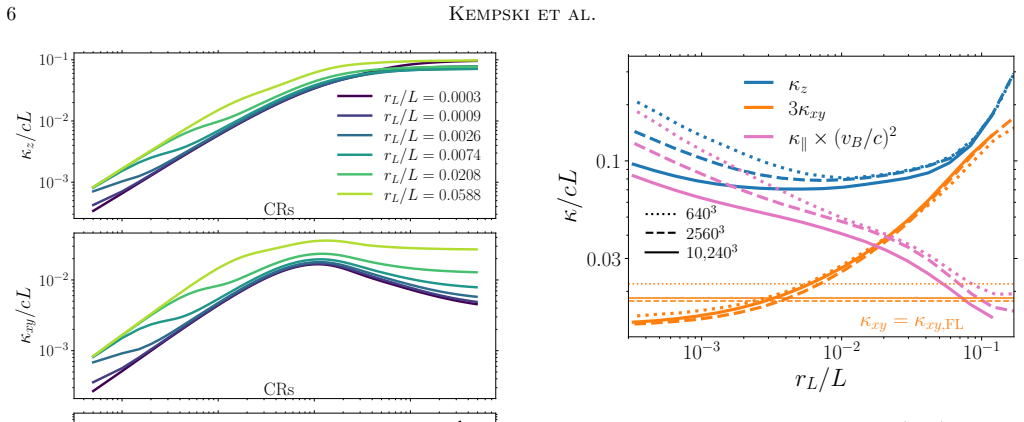
The paper's central claim is that resonant-curvature scattering—abrupt magnetic-moment changes when a cosmic ray hits a field-line bend whose curvature radius is comparable to or smaller than its gyro-radius—is efficient on small scales even in the presence of a significant guide field. At $10{,}240^3$ resolution with $\delta B_{\rm rms}/B_0 = 2$, the parallel diffusion coefficient $\kappa_z$ is almost constant over nearly two decades in gyro-radius ($r_L/L \approx 10^{-3}$ to $10^{-1}$), because the collision-time PDF develops a power-law tail $P(\tau)\sim\tau^{-\alpha}$ with $\alpha \approx 1.5$--$2$ and the global diffusion rate is set by the rarest, longest excursions ($\kappa \propto \tau_{\max}$) rather than by a characteristic mean free path. What caps those excursions is the random walk of the magnetic field lines themselves, which is why $\kappa_z$ depends so weakly on energy. For a galactic driving scale $L \approx 100\,\mathrm{pc}$, the simulated $\kappa_z \approx 0.07\,cL$ implies $\kappa_z \approx 7\times 10^{29}\,\mathrm{cm}^2\,\mathrm{s}^{-1}$, comparable to the transport coefficient inferred from the observed B/C flattening at ~TeV/nucleon. Despite $\delta B_{\rm rms} > B_0$, the guide field still makes transport strongly anisotropic, with $\kappa_z$ exceeding $\kappa_{xy}$ by more than an order of magnitude at small rigidities.
Load-bearing premise
The conclusion rests on the assumption that the $10{,}240^3$ grid and its numerical dissipation resolve the small, sharply curved field regions that scatter the lowest-energy cosmic rays; the curvature statistics are not yet converged with resolution, so a finer grid could still change the transport.
Editorial extensions
If this is right
- Galactic cosmic-ray transport above a few hundred GeV can be nearly energy-independent, providing a direct explanation for the observed B/C flattening, spectral hardening, and weak anisotropy scaling without new scattering physics.
- Standard diffusion models built around a single mean free path are insufficient in this regime; propagation codes must incorporate Lévy or fractional-diffusion transport, since the simulated collision-time distributions have no characteristic scale.
- Resolving the Alfvén scale is a precondition for measuring the correct energy dependence: lower-resolution runs show stronger, non-converged energy dependence in $\kappa_z$, so scalings obtained without resolving $l_A$ should be treated cautiously.
- Even with $\delta B_{\rm rms}/B_0 = 2$, transport remains strongly anisotropic ($\kappa_z \gg \kappa_{xy}$), so isotropic diffusion coefficients will misestimate cosmic-ray escape from the Galaxy.
- The measured $\kappa_z \approx 0.07\,cL$ at small $r_L/L$ yields $\kappa_z \approx 7\times 10^{29}\,\mathrm{cm}^2\,\mathrm{s}^{-1}$ for $L\approx 100\,\mathrm{pc}$, matching the order-of-magnitude value inferred from the TeV B/C flattening.
Reading between the lines
- If the same formalism is applied to a steeper collision-time PDF with $\alpha$ in $(2,3)$, the diffusion coefficient switches from $\kappa\propto\tau_{\max}$ to $\kappa\propto\tau_{\max}^{3-\alpha}r_L^{\alpha-2}$; with $\alpha=7/3$ this reproduces the observed $\kappa\sim E^{1/3}$ scaling below a few hundred GeV. The paper states this possibility but does not claim it, so treating it as a quantita
- The resolution dependence of $\kappa_z$ is the natural control: because the authors speculate that the flattening comes from resolution-driven broadening of the curvature PDF, a still higher-resolution run (or a direct numerical simulation with explicit dissipation) should either stabilize the plateau or reveal it as an artifact of implicit large-eddy numerics.
- The framework predicts that in turbulence with a weaker guide field (larger $\delta B_{\rm rms}/B_0$), the field-line random walk caps the longest $z$-excursions more quickly, so the flat-$\kappa_z$ range should widen while $\kappa_z$ rises; the authors' announced survey across initial conditions is the direct test of this extrapolation.
- Because the longest excursions along $z$ are limited by field-line geometry rather than by the microscopic scattering process, the plateau level $\kappa_z\approx 0.07\,cL$ is probably robust to changes in the collision mechanism, while the slope of $P(\tau)$ is where microphysics such as cosmic-ray feedback or non-ideal dissipation would show up.
Editorial analysis
A structured set of objections, weighed in public.
Referee Report
Summary. The manuscript reports test-particle cosmic-ray transport through a static snapshot of isothermal ideal-MHD turbulence from an implicit large-eddy simulation at 10,240^3 resolution with δB_rms/B0 = 2. It finds that parallel diffusion κz is almost flat over nearly two decades in particle gyro-radius, that scattering is dominated by sharply curved magnetic-field-line regions (resonant curvature scattering), and that the collision-time PDFs are broad power laws with slope between approximately 1.5 and 2, implying that global diffusion is set by the rarest, largest excursions. The authors connect this behavior to the observed flattening of the B/C ratio, the hardening of CR primary spectra, and the weak energy dependence of CR anisotropy above roughly a TeV.
Significance. If the result holds, it is significant: it offers a concrete, mechanism-based route to efficient CR scattering across a wide range of energies without a scale-by-scale resonant wave cascade, and it suggests that fractional diffusion may be needed for Galactic propagation modeling. The 10,240^3 run and ~2×10^9 test particles are a computational tour de force, and the separate field-line tracers and collision-time PDF diagnostics are genuinely useful. However, the central quantitative claim is not yet converged, and the key model parameters are measured from the same simulation used to compute κz, so the present version is a promising consistency check rather than a demonstrated prediction.
major comments (4)
- [Section 3, Figure 4] The two-decade weak energy dependence of κz appears only at 10,240^3; at 640^3 and 2560^3 κz is steeper and lacks the extended plateau. Because this plateau is the manuscript's central claim, the absence of numerical convergence is load-bearing. The text in Section 4 attributes the plateau to resolution-dependent broadening of the curvature PDF, which is itself not converged (Figure 7). Please provide a quantitative convergence test (e.g., a run at an intermediate resolution in the same regime, or a systematic diagnostic showing that the small-rL plateau has stabilized) or explicitly reframe the claim as tentative and remove 'self-similar' from the title and abstract.
- [Section 4, Figure 6 and Eqs. (4)-(5)] The conclusion that diffusion is controlled by the largest excursions rests on comparing the measured power-law slope α and cutoff τmax with Eq. (5). These quantities are extracted from the same particle tracks that yield κz, so the agreement is a consistency check rather than an independent prediction. A direct and transparent test would be to compute κz from the measured P(τ) via Eq. (4) for each gyro-radius and overplot the result on Figure 4; without this, the causal claim that the cutoff sets the diffusion rate remains one plausible interpretation, with trapping or magnetic mirroring as alternatives.
- [Appendix A, Figure 7 and Section 2] The simulation is an ILES without explicit dissipation, and Figure 7 shows that the width of the curvature PDF near its peak continues to change between 640^3 and 10,240^3, with the power-law tail moving to higher K. The high-curvature regions that scatter the smallest-rL CRs are therefore at least partly numerical. To support the statement that small-scale curvature structures are captured properly, please provide a numerical-convergence test of the curvature PDF itself (e.g., at several resolutions with a fixed injection scale) and/or a comparison with an explicit-dissipation run or a different Riemann solver/reconstruction scheme.
- [Section 3] All transport coefficients are taken from a single static snapshot of a single turbulence realization, and no statistical uncertainties are given. It would strengthen the paper to state how many independent large-scale eddies are sampled and to provide bootstrap errors or realization-to-realization scatter; as written, it is not possible to tell whether the 'almost constant' plateau is statistically distinguishable from a slowly varying slope.
minor comments (5)
- [Section 4] The sentence 'P(τ) ∼ τ^{−α} and α ∈ [−1.5, −2]' should read 'α ∈ [1.5, 2]'; as written the sign is inconsistent with the subsequent discussion of α < 2 and with Eq. (5).
- [Figure 6] The caption does not identify the colors or line styles corresponding to the different gyro-radii; please add a legend or an explicit description so the reader can associate each curve with the rL values listed in the text.
- [Footnote 7] The statement that no evidence is found for significant CR scattering by small-amplitude waves relies on follow-up work not presented in this Letter; either remove the claim or qualify it as preliminary and dependent on unpublished results.
- [Data Availability] Sharing data 'on reasonable request' is weak for a numerical paper of this type; consider depositing the magnetic-field snapshot or particle trajectories in a public repository to enable external verification of the convergence issue.
- [Title and Section 2] The title contains obvious typos ('T ransport' and 'T urbulence'), and 'δBrms/B0' is written with inconsistent spacing; these should be corrected during typesetting.
Circularity Check
No significant circularity: the central transport results are direct simulation measurements, and the analytic relations (4)–(5) are consistency checks rather than fitted predictions.
full rationale
The paper's central claims—weak energy dependence of κ_z, broad power-law collision-time PDFs, and curvature-mediated scattering—are measured directly from the 10,240^3 particle trajectories and magnetic-field statistics. Equations (4)–(5) use the measured α and τ_max to estimate κ_z ≈ 0.1cL and then compare with the directly measured κ_z; this is an internal consistency check, not a parameter fit to κ_z, and it does not define κ_z. The Section 5.2 toy model is explicitly illustrative ('not meant to represent theoretical models of the measured PDFs') and is not load-bearing. Self-citations to Kempski et al. (2023) and Lemoine (2023) supply context and a name for resonant-curvature scattering, but the paper independently demonstrates the mechanism with its own tracked particle data (Figures 5–6), so the citations are not load-bearing. The authors' admitted resolution dependence of κ_z and the curvature PDF (Figure 7, Section 4) is a numerical-convergence caveat, not a circularity: the claim does not assume the conclusion, it reports unresolved resolution sensitivity. No circular reduction of a prediction to an input was found.
Assumptions & free parameters
free parameters (3)
- Power-law slope α of collision-time distribution =
≈ 1.5 to 2 (measured from simulation; ≈ 5/3 used in eq. 5)
- Maximum collision time τz,max / cutoff =
≈ L/c
- Curvature PDF slope β =
≈ 2.5
assumptions (5)
- domain assumption The magnetic field is frozen (static snapshot) while test particles propagate; field evolution is neglected.
- domain assumption The implicit large-eddy simulation with piecewise linear reconstruction, HLLD, and no explicit dissipation captures the curvature statistics relevant for CR scattering.
- domain assumption Ideal MHD and test-particle approximation: the plasma is isothermal, and CRs do not feed back on the turbulence.
- standard math Equation (3): κz = κ∥ (vB/c)^2 for fully magnetized particles.
- ad hoc to paper The toy-model scaling λ(K) ~ 1/[P(K)K] and σ_eff(K) ~ K^{-1/2} in Section 5.2.
Cite this review
Pith. "Pith review of Self-Similar Cosmic-Ray Transport in High-Resolution Magnetohydrodynamic Turbulence." pith.science (2026). https://pith.science/paper/47S6S6AC
@misc{pith2026250710651,
  author       = {Pith},
  title        = {Pith review of: Self-Similar Cosmic-Ray Transport in High-Resolution Magnetohydrodynamic Turbulence},
  year         = {2026},
  howpublished = {\url{https://pith.science/paper/47S6S6AC}},
  note         = {Machine review of arXiv:2507.10651}
}
abstract
We study the propagation of cosmic rays (CRs) through a simulation of magnetohydrodynamic (MHD) turbulence at unprecedented resolution of $10{,}240^3$. We drive turbulence that is subsonic and super-Alfv\'enic, characterized by $\delta B_{\rm rms}/B_0=2$. The high resolution enables an extended inertial range such that the Alfv\'en scale $l_A$, where $\delta B (l_A)\approx B_0$, is well resolved. This allows us to properly capture how the cascade transitions from large amplitudes on large scales to small amplitudes on small scales. We find that sharp bends in the magnetic field are key mediators of particle transport even on small scales via resonant curvature scattering. We further find that particle scattering in the turbulence shows strong hints of self-similarity: (1) the diffusion has weak energy dependence over almost two decades in particle energy and (2) the particles' random walk exhibits a broad power-law distribution of collision times such that the diffusion is dominated by the rarest, long-distance excursions. Our results suggest that large-amplitude MHD turbulence can provide efficient scattering over a wide range of CR energies and may help explain many CR observations above a $\sim$TeV: the flattening of the B/C spectrum, the hardening of CR primary spectra and the weak dependence of arrival anisotropy on CR energy.
Figures


Figures from the paper (4 more)


Forward citations
Cited by 2 Pith papers
-
Sub-sonic compressible magnetohydrodynamic turbulence I. Alfv\'enic and fast-magnetosonic injection, amplitude dependence, and compressibility effects
In decaying sub-sonic MHD turbulence simulations, the amplitude and plasma beta, not the injection wave type, set the turbulent density fluctuation level, while curvature and mirror statistics change dramatically with...
-
Superdiffusion of cosmic rays in the vicinity of their accelerators and the resulting $\gamma$-ray emission
Superdiffusion produces constant or r^{α-3} CR radial profiles near sources; the associated γ-ray morphology can distinguish it from normal diffusion with IACTs.
Reference graph
Works this paper leans on
-
[1]
, " * write output.state after.block = add.period write newline
ENTRY address archivePrefix author booktitle chapter doi edition editor eprint howpublished institution journal key month number organization pages publisher school series title misctitle type volume year version url label extra.label sort.label short.list INTEGERS output.state before.all mid.sentence after.sentence after.block FUNCTION init.state.consts ...
-
[2]
write newline
" write newline "" before.all 'output.state := FUNCTION format.url url empty "" new.block "" url * "" * if FUNCTION format.eprint eprint empty "" archivePrefix empty "" archivePrefix "arXiv" = new.block " " eprint * " " * new.block " " eprint * " " * if if if FUNCTION format.doi doi empty "" " " doi * " " * if FUNCTION format.pid doi empty eprint empty ur...
-
[3]
thebibliography [1] 20pt to REFERENCES 6pt =0pt -12pt 10pt plus 3pt =0pt =0pt =1pt plus 1pt =0pt =0pt -12pt =13pt plus 1pt =20pt =13pt plus 1pt \@M =10000 =-1.0em =0pt =0pt 0pt =0pt =1.0em @enumiv\@empty 10000 10000 `\.\@m \@noitemerr \@latex@warning Empty `thebibliography' environment \@ifnextchar \@reference \@latexerr Missing key on reference command E...
arXiv 2021
-
[4]
2019, , 122, 181102, 10.1103/PhysRevLett.122.181102
Adriani , O., Akaike , Y., Asano , K., et al. 2019, , 122, 181102, 10.1103/PhysRevLett.122.181102
-
[5]
2022, , 129, 251103, 10.1103/PhysRevLett.129.251103
---. 2022, , 129, 251103, 10.1103/PhysRevLett.129.251103
-
[6]
2023, , 130, 171002, 10.1103/PhysRevLett.130.171002
---. 2023, , 130, 171002, 10.1103/PhysRevLett.130.171002
-
[7]
2015 a , , 114, 171103, 10.1103/PhysRevLett.114.171103
Aguilar , M., Aisa , D., Alpat , B., et al. 2015 a , , 114, 171103, 10.1103/PhysRevLett.114.171103
-
[8]
2015 b , , 115, 211101, 10.1103/PhysRevLett.115.211101
---. 2015 b , , 115, 211101, 10.1103/PhysRevLett.115.211101
Show all 83 references
-
[9]
2016, , 117, 231102, 10.1103/PhysRevLett.117.231102
Aguilar , M., Ali Cavasonza , L., Ambrosi , G., et al. 2016, , 117, 231102, 10.1103/PhysRevLett.117.231102
2016 doi
-
[10]
2021, , 894, 1, https://doi.org/10.1016/j.physrep.2020.09.003
Aguilar, M., Ali Cavasonza , L., Ambrosi, G., et al. 2021, , 894, 1, https://doi.org/10.1016/j.physrep.2020.09.003
2021 doi
-
[11]
2024, , 109, L121101, 10.1103/PhysRevD.109.L121101
Alemanno , F., Altomare , C., An , Q., et al. 2024, , 109, L121101, 10.1103/PhysRevD.109.L121101
2024 doi
-
[12]
2018, , 62, 2731, 10.1016/j.asr.2017.04.019
Amato , E., & Blasi , P. 2018, , 62, 2731, 10.1016/j.asr.2017.04.019
2018 doi
-
[13]
2019, , 5, eaax3793, 10.1126/sciadv.aax3793
An , Q., Asfandiyarov , R., Azzarello , P., et al. 2019, , 5, eaax3793, 10.1126/sciadv.aax3793
2019 doi
-
[14]
Andersen, E. S. 1954, Mathematica Scandinavica, 2, 195. http://eudml.org/doc/165543
1954
- [15]
-
[16]
2022, , 928, 112, 10.3847/1538-4357/ac56e1
Bai , X.-N. 2022, , 928, 112, 10.3847/1538-4357/ac56e1
2022 doi
-
[17]
C., Plotnikov , I., & Stone , J
Bai , X.-N., Ostriker , E. C., Plotnikov , I., & Stone , J. M. 2019, , 876, 60, 10.3847/1538-4357/ab1648
2019 doi
-
[18]
H., et al
Bandyopadhyay , R., Yang , Y., Matthaeus , W. H., et al. 2020, , 893, L25, 10.3847/2041-8213/ab846e
2020 doi
- [19]
-
[20]
1991, Plasma Physics via Computer Simulation (1st ed.)
Birdsall , C., & Langdon , A. 1991, Plasma Physics via Computer Simulation (1st ed.)
1991
-
[21]
2012, , 2012, 011, 10.1088/1475-7516/2012/01/011
Blasi , P., & Amato , E. 2012, , 2012, 011, 10.1088/1475-7516/2012/01/011
2012 doi
-
[22]
Blasi , P., Amato , E., & Serpico , P. D. 2012, , 109, 061101, 10.1103/PhysRevLett.109.061101
2012 doi
-
[23]
Boris, J. P. 1970, Proceeding of Fourth Conference on Numerical Simulations of Plasmas
1970
-
[24]
1990, , 195, 127, 10.1016/0370-1573(90)90099-N
Bouchaud , J.-P., & Georges , A. 1990, , 195, 127, 10.1016/0370-1573(90)90099-N
1990 doi
-
[25]
S., Hopkins , P
Butsky , I. S., Hopkins , P. F., Kempski , P., et al. 2024, , 528, 4245, 10.1093/mnras/stae276
2024 doi
-
[26]
Chandran, B. D. G. 2000, , 85, 4656, 10.1103/PhysRevLett.85.4656
2000 doi
-
[27]
2010, , 82, 023009, 10.1103/PhysRevD.82.023009
Cowsik , R., & Burch , B. 2010, , 82, 023009, 10.1103/PhysRevD.82.023009
2010 doi
-
[28]
2022, Science Bulletin, 67, 2162, 10.1016/j.scib.2022.10.002
Dampe Collaboration . 2022, Science Bulletin, 67, 2162, 10.1016/j.scib.2022.10.002
2022 doi
-
[29]
2022, , 8, eabn7627, 10.1126/sciadv.abn7627
Dong , C., Wang , L., Huang , Y.-M., et al. 2022, , 8, eabn7627, 10.1126/sciadv.abn7627
2022 doi
-
[30]
J., Reichherzer , P., Bott , A
Ewart , R. J., Reichherzer , P., Bott , A. F. A., Kunz , M. W., & Schekochihin , A. A. 2024, , 532, 2098, 10.1093/mnras/stae1578
2024 doi
- [31]
-
[32]
B., Ripperda , B., & Philippov , A
Fielding , D. B., Ripperda , B., & Philippov , A. A. 2023, , 949, L5, 10.3847/2041-8213/accf1f
2023 doi
-
[33]
S., De La Torre Luque , P., & Gabici , S
Fornieri , O., Gaggero , D., Cerri , S. S., De La Torre Luque , P., & Gabici , S. 2021, , 502, 5821, 10.1093/mnras/stab355
2021 doi
-
[34]
M., Haverkorn , M., Staveley-Smith , L., et al
Gaensler , B. M., Haverkorn , M., Staveley-Smith , L., et al. 2005, , 307, 1610, 10.1126/science.1108832
2005 doi
-
[35]
K., Kunz , M
Galishnikova , A. K., Kunz , M. W., & Schekochihin , A. A. 2022, , 12, 041027, 10.1103/PhysRevX.12.041027
2022 doi
-
[36]
1995, , 438, 763, 10.1086/175121
Goldreich , P., & Sridhar , S. 1995, , 438, 763, 10.1086/175121
1995 doi
-
[37]
W., & Beckwith , K
Grete , P., O'Shea , B. W., & Beckwith , K. 2023, , 942, L34, 10.3847/2041-8213/acaea7
2023 doi
-
[38]
2015, Magnetic Fields in the Milky Way, ed
Haverkorn, M. 2015, Magnetic Fields in the Milky Way, ed. A. Lazarian, E. M. de Gouveia Dal Pino, & C. Melioli (Berlin, Heidelberg: Springer Berlin Heidelberg), 483--506, 10.1007/978-3-662-44625-6_17
2015 doi
-
[39]
2023, , 672, A21, 10.1051/0004-6361/202245223
Heesen , V., de Gasperin , F., Schulz , S., et al. 2023, , 672, A21, 10.1051/0004-6361/202245223
2023 doi
-
[40]
2019, , 882, 3, 10.3847/1538-4357/ab328a
Holcomb , C., & Spitkovsky , A. 2019, , 882, 3, 10.3847/1538-4357/ab328a
2019 doi
-
[41]
F., Squire , J., Butsky , I
Hopkins , P. F., Squire , J., Butsky , I. S., & Ji , S. 2022, , 517, 5413, 10.1093/mnras/stac2909
2022 doi
-
[42]
2022, , 512, 2111, 10.1093/mnras/stac319
Hu , Y., Lazarian , A., & Xu , S. 2022, , 512, 2111, 10.1093/mnras/stac319
2022 doi
-
[43]
2012, , 109, 265002, 10.1103/PhysRevLett.109.265002
Huang , Y.-M., & Bhattacharjee , A. 2012, , 109, 265002, 10.1103/PhysRevLett.109.265002
2012 doi
-
[44]
R., Leahy , J
Jaffe , T. R., Leahy , J. P., Banday , A. J., et al. 2010, , 401, 1013, 10.1111/j.1365-2966.2009.15745.x
2010
-
[45]
Ji , S., Squire , J., & Hopkins , P. F. 2022, , 513, 282, 10.1093/mnras/stac895
2022 doi
-
[46]
B., Quataert , E., et al
Kempski , P., Fielding , D. B., Quataert , E., et al. 2023, , 525, 4985, 10.1093/mnras/stad2609
2023 doi
-
[47]
2022, , 514, 657, 10.1093/mnras/stac1240
Kempski , P., & Quataert , E. 2022, , 514, 657, 10.1093/mnras/stac1240
2022 doi
-
[48]
Kulsrud , R., & Pearce , W. P. 1969, , 156, 445, 10.1086/149981
1969 doi
-
[49]
M., & Cesarsky , C
Kulsrud , R. M., & Cesarsky , C. J. 1971, , 8, 189
1971
-
[50]
2021, , 923, 53, 10.3847/1538-4357/ac2de9
Lazarian , A., & Xu , S. 2021, , 923, 53, 10.3847/1538-4357/ac2de9
2021 doi
-
[51]
2014, , 784, 38, 10.1088/0004-637X/784/1/38
Lazarian , A., & Yan , H. 2014, , 784, 38, 10.1088/0004-637X/784/1/38
2014 doi
-
[52]
2025, , 979, 34, 10.3847/1538-4357/ad8eb3
Lemmerz , R., Shalaby , M., Pfrommer , C., & Thomas , T. 2025, , 979, 34, 10.3847/1538-4357/ad8eb3
2025 doi
-
[53]
2023, , 89, 175890501, 10.1017/S0022377823000946
Lemoine , M. 2023, , 89, 175890501, 10.1017/S0022377823000946
2023 doi
-
[54]
Liang , N., & Oh , S. P. 2025, arXiv e-prints, arXiv:2503.10747, 10.48550/arXiv.2503.10747
2025 doi
-
[55]
2025, arXiv e-prints, arXiv:2505.18155, 10.48550/arXiv.2505.18155
L \"u bke , J., Reichherzer , P., Aerdker , S., et al. 2025, arXiv e-prints, arXiv:2505.18155, 10.48550/arXiv.2505.18155
2025 doi
-
[56]
2021, , 28, 092106, 10.1063/5.0059017
Majeski , S., Ji , H., Jara-Almonte , J., & Yoo , J. 2021, , 28, 092106, 10.1063/5.0059017
2021 doi
-
[57]
Narayan , R., & Medvedev , M. V. 2001, , 562, L129, 10.1086/338325
2001 doi
-
[58]
1993, , 262, 953, 10.1093/mnras/262.4.953
Ohno , H., & Shibata , S. 1993, , 262, 953, 10.1093/mnras/262.4.953
1993 doi
-
[59]
V., Blackburn , G., Lomholt , M
Palyulin , V. V., Blackburn , G., Lomholt , M. A., et al. 2019, , 21, 103028, 10.1088/1367-2630/ab41bb
2019 doi
-
[60]
M., Sironi , L., & Giannios , D
Petropoulou , M., Christie , I. M., Sironi , L., & Giannios , D. 2018, , 475, 3797, 10.1093/mnras/sty033
2018 doi
-
[61]
2024, , 529, L13, 10.1093/mnrasl/slad192
Pezzi , O., & Blasi , P. 2024, , 529, L13, 10.1093/mnrasl/slad192
2024 doi
-
[62]
2024, , 692, A20, 10.1051/0004-6361/202349005
Recchia , S., & Gabici , S. 2024, , 692, A20, 10.1051/0004-6361/202349005
2024 doi
-
[63]
2001, A Guide to First-Passage Processes (Cambridge University Press)
Redner, S. 2001, A Guide to First-Passage Processes (Cambridge University Press)
2001
-
[64]
Reichherzer , P., Bott , A. F. A., Ewart , R. J., et al. 2025, , 9, 438, 10.1038/s41550-024-02442-1
2025 doi
-
[65]
2023, , 31, 4, 10.1007/s00159-023-00149-2
Ruszkowski , M., & Pfrommer , C. 2023, , 31, 4, 10.1007/s00159-023-00149-2
2023 doi
-
[66]
A., Cowley , S
Schekochihin , A. A., Cowley , S. C., Taylor , S. F., Maron , J. L., & McWilliams , J. C. 2004, , 612, 276, 10.1086/422547
2004 doi
-
[67]
2025, , 134, 045201, 10.1103/PhysRevLett.134.045201
Schroer , B., Caprioli , D., & Blasi , P. 2025, , 134, 045201, 10.1103/PhysRevLett.134.045201
2025 doi
-
[68]
2021, , 908, 206, 10.3847/1538-4357/abd02d
Shalaby , M., Thomas , T., & Pfrommer , C. 2021, , 908, 206, 10.3847/1538-4357/abd02d
2021 doi
-
[69]
2019, , 881, L27, 10.3847/2041-8213/ab379d
Shalchi , A. 2019, , 881, L27, 10.3847/2041-8213/ab379d
2019 doi
- [70]
-
[71]
M., & Gardiner , T
Stone , J. M., & Gardiner , T. 2009, , 14, 139, 10.1016/j.newast.2008.06.003
2009 doi
- [72]
-
[73]
W., Moskalenko , I
Strong , A. W., Moskalenko , I. V., & Ptuskin , V. S. 2007, , 57, 285, 10.1146/annurev.nucl.57.090506.123011
2007
- [74]
-
[75]
E., & Ornstein , L
Uhlenbeck , G. E., & Ornstein , L. S. 1930, , 36, 823, 10.1103/PhysRev.36.823
1930 doi
-
[76]
2018, , 868, 36, 10.3847/1538-4357/aae840
Xu , S., & Lazarian , A. 2018, , 868, 36, 10.3847/1538-4357/aae840
2018 doi
- [77]
-
[78]
2004, , 614, 757, 10.1086/423733
Yan , H., & Lazarian , A. 2004, , 614, 757, 10.1086/423733
2004 doi
- [79]
-
[80]
H., et al
Yang , Y., Wan , M., Matthaeus , W. H., et al. 2019, , 26, 072306, 10.1063/1.5099360
2019 doi
- [81]
-
[82]
Zweibel, E. G. 2013, , 20, 055501, 10.1063/1.4807033
2013 doi
-
[83]
Zweibel , E. G. 2020, , 890, 67, 10.3847/1538-4357/ab67bf
2020 doi
Reviewed August 6, 2026 · model on record in the stance chip above.
Discussion (0). Sign in to comment.