REVIEW 3 major objections 6 minor 53 references
Shared 2D Gaussians compress mipmapped SVBRDF stacks better than ASTC while keeping random-access, non-neural GPU decoding.
Reviewed by Pith at T0; open to challenge. T0 means a machine referee read the full paper against a public rubric. the ladder, T0–T4 →
T0 review · grok-4.5
2026-07-31 22:39 UTC pith:4A4BSABV
load-bearing objection Solid systems paper: shared 2D Gaussians across mips and SVBRDF maps beat ASTC/Image-GS on measured RD with a real non-neural random-access path; deployment metrics and code are the main gaps, not the claim. the 3 major comments →
Compact Representation of Mipmapped SVBRDFs via Shared Gaussians
The pith
A machine-rendered reading of the paper's core claim, the machinery that carries it, and where it could break.
Core claim
The authors claim that mipmapped SVBRDF stacks are dominated by two aligned redundancies—shared low-frequency structure across mips and shared spatial support across material maps—and that representing them with shared 2D Gaussians (footprint once, features per level/map), trained progressively from coarse to fine with residual initialization, group-lasso, and pruning, yields a compact random-access format that beats ASTC on quality and memory while remaining non-neural and GPU-decodable.
What carries the argument
Shared Gaussians with LoD labels: each primitive stores a UV center, anisotropic scale/rotation, a multi-channel feature vector, and a mip label; a texel at level ℓ sums every Gaussian whose label is at least ℓ, so coarse Gaussians form a reusable low-frequency base and finer ones only add residual detail.
Load-bearing premise
The method assumes that a fixed heuristic for how many Gaussians each mip gets, plus residual seeding and simple pruning, will keep working well outside the twenty tested texture stacks and that the tile-list decoder stays practical under real engine bandwidth limits.
What would settle it
Compress the same twenty (or a larger held-out) 2048² multi-map mip stacks at matched bits-per-pixel with GTC versus ASTC and Image-GS: if GTC does not keep roughly ≥3 dB PSNR gains at low rates and better or equal quality at lower storage than ASTC’s ~0.4 bppc operating point, or if tile-list decode fails real-time random access on target GPUs, the central claim fails.
If this is right
- Material packs can drop well below ASTC memory at matched or better visual quality without a neural decoder at runtime.
- Mip chains no longer need independent block streams for low-frequency content; one shared coarse Gaussian basis serves all finer levels.
- Rate can be steered by a single Gaussian budget with content-adaptive placement instead of fixed block sizes.
- Engines that already sample textures randomly can keep that access pattern via per-tile Gaussian lists rather than full-image decode.
Where Pith is reading between the lines
- If shared footprints are the real win, the same progressive residual-Gaussian idea may extend to other stacked maps (lightmaps, multi-layer masks) that share edges but differ in channels.
- The stated limits on stochastic cloth and long-range repeats suggest pairing GTC with UV-atlas repetition removal could cut Gaussian count further without changing the decoder.
- Per-asset optimization cost is the practical adoption gate; a feed-forward initializer that predicts a good Gaussian set would matter more for production libraries than another small RD gain.
Editorial analysis
A structured set of objections, weighed in public.
Referee Report
Summary. The paper proposes Gaussian Texture Compression (GTC), a 2D Gaussian representation for mipmapped multi-map SVBRDF stacks. Each Gaussian carries a shared spatial footprint (center, anisotropic scale, rotation) plus a multi-channel feature and an LoD label; coarser Gaussians are reused at all finer mips (Eq. 6), and map channels share geometry under a group-lasso regularizer with pruning. A progressive coarse-to-fine pipeline initializes residual Gaussians, allocates a heuristic per-level budget (Eq. 10), and finishes with adaptive quantization. A two-stage tile linked-list scheme provides non-neural random-access decode. On 20 2048² SVBRDF stacks, GTC reports better rate–distortion than Image-GS and ASTC among non-neural random-access methods (Fig. 4, Table 1), with ablations (Table 2) and extensive mip qualitative results.
Significance. If the reported quality–memory gains hold under broader assets and practical decode costs, GTC is a meaningful step for real-time material storage: it jointly exploits cross-mip and cross-map redundancy that fixed block codecs cannot, while avoiding neural inference at sample time. The shared-footprint formulation is a clean fit to mipmapped SVBRDFs, the progressive residual construction is well motivated, and the empirical package (dual mip aggregation, bppc-matched Table 1, ablations with mean±std, full-pyramid figures) is stronger than typical texture-compression systems papers. Flexible content-adaptive rate control versus fixed ASTC block sizes is practically relevant for mobile and download-size constrained titles.
major comments (3)
- [§3.4, Abstract] Abstract and §3.4 claim random-access, non-neural decoding “suitable for real-time rendering,” and the intro contrasts this with neural overhead on mobile. The two-stage tile linked-list algorithm is specified, but the manuscript reports no decode latency, bandwidth, occupancy, or frame-time numbers on GPU (desktop or mobile), nor comparison against hardware ASTC fetch. Because suitability for real-time is part of the central positioning versus ASTC/NTC, at least one controlled microbenchmark (e.g., full-screen mip-filtered SVBRDF sample cost vs ASTC and vs Image-GS splat) is needed, or the claim should be narrowed to “random-access, non-neural” without asserting real-time readiness.
- [§4.2, Table 1, Supp. S1.5] The strongest quantitative claim versus industry practice is Table 1 / §4.2 (e.g., 43.11 dB at 0.299 bppc vs ASTC 41.10 dB at 0.407 bppc). Storage is reported as dataset-wide bppc after adaptive quantization (Supp. S1.5), but the main text does not state the exact bit layout, per-parameter bit widths chosen, or how empty/pruned Gaussians and LoD labels enter the denominator. Without that accounting (or a small worked example), independent verification of the “26.5% less storage” headline is difficult. Please add a concise storage model in the main paper and confirm ASTC sizes use the same channel packing and full mip chain.
- [§3.3.2, Eq. (10), Table 2] Eq. 10’s coarse-to-fine budget rule is described as a heuristic with “consistent performance in our experiments” (§3.3.2). Table 2 shows that a uniform LoD budget hurts equal-mip quality, which supports the design, but all results use the same 20-stack 2048² corpus and fixed loss/prune/Adam hyperparameters. The central generalization claim—that shared Gaussians plus this schedule deliver favorable RD beyond the reported set—would be stronger with either a held-out material split, sensitivity to N_max allocation, or failure cases tied to budget mis-allocation. As written, the RD advantage is convincing on this set but the robustness of Eq. 10 remains under-supported relative to how much the method depends on it.
minor comments (6)
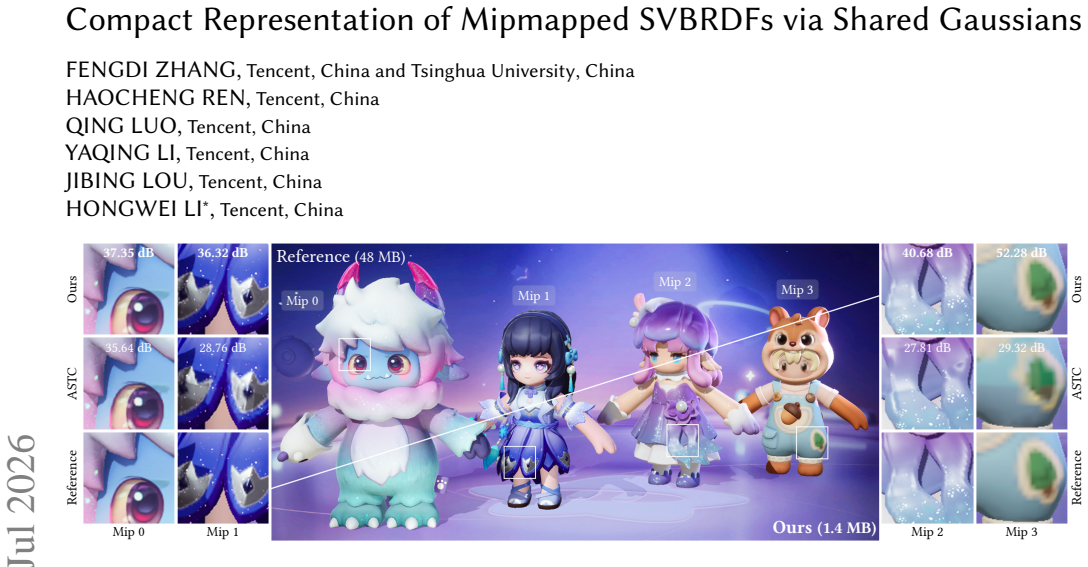
- [Fig. 1] Fig. 1 caption states a 6.75 dB gain over ASTC with 22.5% less memory; Table 1’s matched points differ. Clarify whether Fig. 1 is a single scene operating point and how it relates to the dataset aggregates.
- [Fig. 4, Table 1] Equal-mip vs texel-weighted aggregation is well motivated; consider marking which operating points in Fig. 4 correspond to the Table 1 columns to ease cross-reading.
- [§5, Fig. 5] §5 correctly flags stochastic cloth patterns and repetition; a quantitative failure-case metric (e.g., PSNR stratified by high-frequency energy) would make the limitation more actionable.
- [§2.1] Related work on 2DGS image codecs is adequate; a brief note on how GTC’s hierarchical activation differs from multi-level Gaussian image models [18] would help readers place the mip contribution.
- [§3.2] Notation: ℓ_i is both LoD label and used in sums; a short parameter table (μ, s, θ, f, ℓ and bit widths) would reduce ambiguity between main text and supplement.
- [§4.1, Supp. S1.2] Typos/style: “atlassubset”/“materialsubset” spacing in §4.1; “Lreg” formatting; ensure ASTC encoder version consistency (v5.6.0 in refs vs v5.3.0 in supp).
Circularity Check
No significant circularity: GTC is an optimization-based compressor evaluated against external baselines and ground-truth mipmaps.
full rationale
The paper’s load-bearing claims are empirical rate–distortion comparisons (PSNR/SSIM/FLIP vs bppc) of a learned 2D-Gaussian representation against ASTC, Image-GS, NTC, JPEG, and JPEG-XL on held-out SVBRDF stacks. The representation (shared footprints with LoD labels and multi-channel features, Eq. 5–6), progressive residual initialization, heuristic budget (Eq. 10), group-lasso, and pruning are design choices optimized to match ground-truth mipmaps (Eq. 7); they do not define the reported quality metrics or force the ASTC/Image-GS gaps by construction. Citations to prior 2DGS work (Image-GS, GaussianImage) and block/neural TC are used as baselines or related art, not as uniqueness theorems that make the result tautological. Hyperparameters and the budget heuristic are fitted engineering choices, which is normal for a methods paper and does not turn external RD tables into self-predictions. No self-definitional loop, fitted-input-as-prediction, or load-bearing self-citation chain is present.
Axiom & Free-Parameter Ledger
free parameters (6)
- N_max Gaussian budget schedule (Eq. 10) =
e.g. 10k–500k max Gaussians (Supp. S1.2)
- Loss weights λ_L1, λ_ssim, λ_reg =
1.0, 0.1, 1e-7 (§4.1)
- Pruning threshold and interval =
3e-4 every 100 iterations
- Adam learning rates and LoD update rescaling m_ℓ=1/(ℓ+1) =
5e-4 centers/features; 2e-3 scale/rotation
- Quantization bit widths per parameter group =
selected per group in [6,16] (Supp. S1.5)
- Image-GS baseline decay factor r=1.5 =
1.5
axioms (5)
- domain assumption Anisotropic 2D Gaussian splatting (Eqs. 2–4) is a valid differentiable image basis for material textures.
- domain assumption Mip levels share low-frequency spatial structure so coarser Gaussians can remain active at finer levels (Eq. 6).
- domain assumption Different SVBRDF maps of one asset share enough spatial support that one geometry with multi-channel features plus group-lasso is beneficial.
- domain assumption PSNR/SSIM/FLIP on reconstructed maps (texel-weighted and equal-mip) proxy rendering quality for the claimed real-time use case.
- standard math Standard optimization and linear algebra (Adam, SSIM, group-lasso, STE quantization) behave as in the cited literature.
invented entities (3)
-
GTC shared-Gaussian SVBRDF representation (μ, s, θ, f, ℓ) with hierarchical activation
no independent evidence
-
Progressive residual Gaussian construction + group-lasso pruning pipeline
no independent evidence
-
Two-stage tile linked-list random-access Gaussian texture decoder
no independent evidence
Cite this review
Pith. "Pith review of Compact Representation of Mipmapped SVBRDFs via Shared Gaussians." pith.science (2026). https://pith.science/paper/4A4BSABV
@misc{pith2026260727943,
  author       = {Pith},
  title        = {Pith review of: Compact Representation of Mipmapped SVBRDFs via Shared Gaussians},
  year         = {2026},
  howpublished = {\url{https://pith.science/paper/4A4BSABV}},
  note         = {Machine review of arXiv:2607.27943}
}
read the original abstract
Spatially-varying BRDFs (SVBRDFs) are central to material representation in computer graphics, but their high-resolution, multi-channel, mipmapped textures impose a substantial storage burden. Existing compression methods face a fundamental trade-off: block-based compression provides random access and hardware-friendly decoding but exploits redundancy only within local blocks; image codecs offer strong rate-distortion performance but are not designed for direct real-time texture access; and neural texture compression achieves high compression ratios but requires neural inference during decoding, which introduces additional runtime overhead, especially on mobile platforms. We present Gaussian Texture Compression (GTC), a compact 2D Gaussian-based representation for mipmapped SVBRDF texture stacks that delivers high-quality compression with flexible rate-distortion trade-offs. Our method is based on a key observation that there are two dominant sources of redundancy in such data: across mip levels and across material maps. Both share a common underlying structure: the same spatial support is reused, with only level- or map-specific information attached. This property naturally suits 2D Gaussians, since each Gaussian explicitly separates its spatial footprint from the values it carries, allowing the footprint to be shared while the values vary per level and per map. Building on this property, GTC shares Gaussians along both redundancy dimensions and is trained via a progressive optimization pipeline. Experiments show that GTC achieves higher reconstruction quality and lower memory usage than ASTC, the industry-standard GPU texture compression format, while supporting random-access, non-neural decoding suitable for real-time rendering.
Figures


Reference graph
Works this paper leans on
-
[1]
Pyramidal parametrics.ACM SIGGRAPH Computer Graphics, 17 (3):1–11, 1983
Lance Williams. Pyramidal parametrics.ACM SIGGRAPH Computer Graphics, 17 (3):1–11, 1983
1983
-
[2]
Delp and Owen Robert Mitchell
Edward J. Delp and Owen Robert Mitchell. Image compression using block truncation coding.IEEE Transactions on Communications, 27(9):1335–1342, 1979
1979
-
[3]
Iourcha, Krishna S
Konstantine I. Iourcha, Krishna S. Nayak, and Zhou Hong. System and method for fixed-rate block-based image compression with inferred pixel values. U.S. Patent 5,956,431, 1999
1999
-
[4]
Texture block compression in Direct3D 11
Microsoft. Texture block compression in Direct3D 11. Microsoft Learn, 2020
2020
-
[5]
Adap- tive scalable texture compression
Jørn Nystad, Anders Lassen, Andy Pomianowski, Sean Ellis, and Tom Olson. Adap- tive scalable texture compression. InEurographics/ACM SIGGRAPH Symposium on High Performance Graphics, pages 105–114, 2012
2012
-
[6]
iPACKMAN: High-quality, low- complexity texture compression for mobile phones
Jacob Ström and Tomas Akenine-Möller. iPACKMAN: High-quality, low- complexity texture compression for mobile phones. InGraphics Hardware, pages 63–70, 2005
2005
-
[7]
ETC2: Texture compression using invalid combinations
Jacob Ström and Martin Pettersson. ETC2: Texture compression using invalid combinations. InSIGGRAPH/Eurographics Workshop on Graphics Hardware, pages 49–54, 2007
2007
-
[8]
JPEG XL next-generation image compression architecture and coding tools
Jyrki Alakuijala, Ruud van Asseldonk, Sami Boukortt, Martin Bruse, Iulia-Maria Comşa, Moritz Firsching, Thomas Fischbacher, Evgenii Kliuchnikov, Sebastian Gomez, Robert Obryk, Krzysztof Potempa, Alexander Rhatushnyak, Jon Sneyers, Zoltán Szabadka, Lode Vandevenne, Luca Versari, and Jan Wassenberg. JPEG XL next-generation image compression architecture and...
2019
-
[9]
Trudeau, Nathan E
Yue Chen, Debargha Mukherjee, Jingning Han, Adrian Grange, Yaowu Xu, Zoe Liu, Sarah Parker, Cheng Chen, Hui Su, Urvang Joshi, Ching-Han Chiang, Yunqing Wang, Paul Wilkins, Jim Bankoski, Luc N. Trudeau, Nathan E. Egge, Jean-Marc Valin, Thomas Davies, Steinar Midtskogen, Andrey Norkin, and Peter de Rivaz. An overview of core coding tools in the AV1 video co...
2018
-
[10]
Instant neu- ral graphics primitives with a multiresolution hash encoding.ACM Transactions on Graphics, 41(4):102:1–102:15, 2022
Thomas Müller, Alex Evans, Christoph Schied, and Alexander Keller. Instant neu- ral graphics primitives with a multiresolution hash encoding.ACM Transactions on Graphics, 41(4):102:1–102:15, 2022
2022
-
[11]
Random-access neural compression of material textures.ACM Transactions on Graphics, 42(4):88:1–88:25, 2023
Karthik Vaidyanathan, Marco Salvi, Bartlomiej Wronski, Tomas Akenine-Möller, Pontus Ebelin, and Aaron Lefohn. Random-access neural compression of material textures.ACM Transactions on Graphics, 42(4):88:1–88:25, 2023
2023
-
[12]
Neural texture block compression
Shin Fujieda and Takahiro Harada. Neural texture block compression. InWorkshop on Material Appearance Modeling: Joint MAM–MANER Conference, 2024
2024
-
[13]
Real-time neural materials using block-compressed features.Computer Graphics Forum, 43(2):e15013, 2024
Clément Weinreich, Louis De Oliveira, Antoine Houdard, and Georges Nader. Real-time neural materials using block-compressed features.Computer Graphics Forum, 43(2):e15013, 2024
2024
-
[14]
Srinivasan, Matthew Tancik, Jonathan T
Ben Mildenhall, Pratul P. Srinivasan, Matthew Tancik, Jonathan T. Barron, Ravi Ramamoorthi, and Ren Ng. NeRF: Representing scenes as neural radiance fields for view synthesis. InComputer Vision – ECCV 2020, volume 12346, pages 405–421, 2020
2020
-
[15]
3D Gaussian splatting for real-time radiance field rendering.ACM Transactions on Graphics, 42(4):139:1–139:14, 2023
Bernhard Kerbl, Georgios Kopanas, Thomas Leimkühler, and George Drettakis. 3D Gaussian splatting for real-time radiance field rendering.ACM Transactions on Graphics, 42(4):139:1–139:14, 2023
2023
-
[16]
Image-GS: Content-adaptive image representation via 2D Gaussians
Yunxiang Zhang, Bingxuan Li, Alexandr Kuznetsov, Akshay Jindal, Stavros Dio- latzis, Kenneth Chen, Anton Sochenov, Anton Kaplanyan, and Qi Sun. Image-GS: Content-adaptive image representation via 2D Gaussians. InACM SIGGRAPH 2025 Conference Proceedings, pages 102:1–102:11, 2025
2025
-
[17]
GaussianImage: 1000 FPS image representation and compression by 2D Gaussian splatting
Xinjie Zhang, Xingtong Ge, Tongda Xu, Dailan He, Yan Wang, Hongwei Qin, Guo Lu, Jing Geng, and Jun Zhang. GaussianImage: 1000 FPS image representation and compression by 2D Gaussian splatting. InComputer Vision – ECCV 2024, volume 15067, pages 327–345, 2025. 8•Zhang et al
2024
-
[18]
Lingting Zhu, Guying Lin, Jinnan Chen, Xinjie Zhang, Zhenchao Jin, Zhao Wang, and Lequan Yu. Large images are Gaussians: High-quality large image represen- tation with levels of 2D Gaussian splatting.Proceedings of the AAAI Conference on Artificial Intelligence, 39(10):10977–10985, 2025
2025
-
[19]
Gregory K. Wallace. The JPEG still picture compression standard.Communications of the ACM, 34(4):30–44, 1991
1991
-
[20]
Image coding using wavelet transform.IEEE Transactions on Image Processing, 1(2): 205–220, 1992
Marc Antonini, Michel Barlaud, Pierre Mathieu, and Ingrid Daubechies. Image coding using wavelet transform.IEEE Transactions on Image Processing, 1(2): 205–220, 1992
1992
-
[21]
AV1 image file format (AVIF)
Alliance for Open Media. AV1 image file format (AVIF). AOM Final Deliverable, Version 1.2.0, 2025
2025
-
[22]
DeFanti, Jeff Frederiksen, Stephen A
Graham Campbell, Thomas A. DeFanti, Jeff Frederiksen, Stephen A. Joyce, Lawrence A. Leske, John A. Lindberg, and Daniel J. Sandin. Two bit/pixel full color encoding. InProceedings of the 13th Annual Conference on Computer Graphics and Interactive Techniques, pages 215–223, 1986
1986
-
[23]
Vincent Sitzmann, Julien N. P. Martel, Alexander W. Bergman, David B. Lindell, and Gordon Wetzstein. Implicit neural representations with periodic activation functions. InAdvances in Neural Information Processing Systems, volume 33, pages 7462–7473, 2020
2020
-
[24]
Srinivasan, Ben Mildenhall, Sara Fridovich-Keil, Nithin Raghavan, Utkarsh Singhal, Ravi Ramamoorthi, Jonathan T
Matthew Tancik, Pratul P. Srinivasan, Ben Mildenhall, Sara Fridovich-Keil, Nithin Raghavan, Utkarsh Singhal, Ravi Ramamoorthi, Jonathan T. Barron, and Ren Ng. Fourier features let networks learn high-frequency functions in low-dimensional domains. InAdvances in Neural Information Processing Systems, volume 33, pages 7537–7547, 2020
2020
-
[25]
COIN: COmpression with implicit neural representations
Emilien Dupont, Adam Goliński, Milad Alizadeh, Yee Whye Teh, and Arnaud Doucet. COIN: COmpression with implicit neural representations. InNeural Compression Workshop at ICLR 2021, 2021
2021
-
[26]
COIN++: Neural compression across modalities.Transactions on Machine Learning Research, 2022
Emilien Dupont, Hrushikesh Loya, Milad Alizadeh, Adam Goliński, Yee Whye Teh, and Arnaud Doucet. COIN++: Neural compression across modalities.Transactions on Machine Learning Research, 2022
2022
-
[27]
Julien N. P. Martel, David B. Lindell, Connor Z. Lin, Eric R. Chan, Marco Monteiro, and Gordon Wetzstein. ACORN: Adaptive coordinate networks for neural scene representation.ACM Transactions on Graphics, 40(4):58:1–58:13, 2021
2021
-
[28]
Variable bitrate neural fields
Towaki Takikawa, Alex Evans, Jonathan Tremblay, Thomas Müller, Morgan McGuire, Alec Jacobson, and Sanja Fidler. Variable bitrate neural fields. InACM SIGGRAPH 2022 Conference Proceedings, pages 41:1–41:9, 2022
2022
-
[29]
Neural layered BRDFs
Jiahui Fan, Beibei Wang, Miloš Hašan, Jian Yang, and Ling-Qi Yan. Neural layered BRDFs. InACM SIGGRAPH 2022 Conference Proceedings, pages 4:1–4:8, 2022
2022
-
[30]
MetaLayer: A meta-learned BSDF model for layered materials.ACM Transactions on Graphics, 42(6):222:1–222:15, 2023
Jie Guo, Zeru Li, Xueyan He, Beibei Wang, Wenbin Li, Yanwen Guo, and Ling- Qi Yan. MetaLayer: A meta-learned BSDF model for layered materials.ACM Transactions on Graphics, 42(6):222:1–222:15, 2023
2023
-
[31]
NeuMIP: Multi-resolution neural materials.ACM Transactions on Graphics, 40(4):175:1–175:13, 2021
Alexandr Kuznetsov, Krishna Mullia, Zexiang Xu, Miloš Hašan, and Ravi Ra- mamoorthi. NeuMIP: Multi-resolution neural materials.ACM Transactions on Graphics, 40(4):175:1–175:13, 2021
2021
-
[32]
Tizian Zeltner, Fabrice Rousselle, Andrea Weidlich, Petrik Clarberg, Jan Novák, Benedikt Bitterli, Alex Evans, Tomáš Davidovič, Simon Kallweit, and Aaron E. Lefohn. Real-time neural appearance models.ACM Transactions on Graphics, 43 (3):33:1–33:17, 2024
2024
-
[33]
Towards comprehensive neural materials: Dynamic structure- preserving synthesis with accurate silhouette at instant inference speed
Zilin Xu, Xiang Chen, Chen Liu, Beibei Wang, Lu Wang, Zahra Montazeri, and Ling-Qi Yan. Towards comprehensive neural materials: Dynamic structure- preserving synthesis with accurate silhouette at instant inference speed. InACM SIGGRAPH 2025 Conference Proceedings, pages 161:1–161:11, 2025
2025
-
[34]
Model selection and estimation in regression with grouped variables.Journal of the Royal Statistical Society Series B: Statistical Methodology, 68(1):49–67, 2006
Ming Yuan and Yi Lin. Model selection and estimation in regression with grouped variables.Journal of the Royal Statistical Society Series B: Statistical Methodology, 68(1):49–67, 2006
2006
-
[35]
Order-independent transparency using per-pixel linked lists
Nicolas Thibieroz. Order-independent transparency using per-pixel linked lists. In Wolfgang Engel, editor,GPU Pro 2: Advanced Rendering Techniques, pages 409–431. A K Peters/CRC Press, 2011
2011
-
[36]
Yibo Zhang, Li Zhang, Rui Ma, and Nan Cao. TexVerse: A universe of 3D objects with high-resolution textures.arXiv preprint arXiv:2508.10868, 2025
Pith/arXiv arXiv 2025
-
[37]
FreeStylized stylized textures
FreeStylized. FreeStylized stylized textures. Website, 2026
2026
-
[38]
Scope of validity of PSNR in image/video quality assessment.Electronics Letters, 44(13):800–801, 2008
Quan Huynh-Thu and Mohammed Ghanbari. Scope of validity of PSNR in image/video quality assessment.Electronics Letters, 44(13):800–801, 2008
2008
-
[39]
Bovik, Hamid R
Zhou Wang, Alan C. Bovik, Hamid R. Sheikh, and Eero P. Simoncelli. Image quality assessment: From error visibility to structural similarity.IEEE Transactions on Image Processing, 13(4):600–612, 2004
2004
-
[40]
Fairchild
Pontus Andersson, Jim Nilsson, Tomas Akenine-Möller, Magnus Oskarsson, Kalle Åström, and Mark D. Fairchild. FLIP: A difference evaluator for alternating images. Proceedings of the ACM on Computer Graphics and Interactive Techniques, 3(2): 15:1–15:23, 2020
2020
-
[41]
astcenc: The Arm ASTC encoder
Arm Limited. astcenc: The Arm ASTC encoder. Software repository, 2026. Version 5.6.0
2026
-
[42]
Kingma and Jimmy Ba
Diederik P. Kingma and Jimmy Ba. Adam: A method for stochastic optimization. In3rd International Conference on Learning Representations (ICLR), 2015
2015
-
[43]
SplineSplat: Repre- senting radiance fields using B-splines
Nygel George Thomas and Chandra Sekhar Seelamantula. SplineSplat: Repre- senting radiance fields using B-splines. InProceedings of the SIGGRAPH Asia 2025 Technical Communications, pages 18:1–18:4, 2025
2025
-
[44]
Deformable radial kernel splatting
Yi-Hua Huang, Ming-Xian Lin, Yang-Tian Sun, Ziyi Yang, Xiaoyang Lyu, Yan-Pei Cao, and Xiaojuan Qi. Deformable radial kernel splatting. InProceedings of the IEEE/CVF Conference on Computer Vision and Pattern Recognition (CVPR), pages 21513–21523, 2025
2025
-
[45]
𝐴2TG: Adaptive anisotropic textured Gaussians for efficient 3D scene representation
Sheng-Chi Hsu, Ting-Yu Yen, Shih-Hsuan Hung, and Hung-Kuo Chu. 𝐴2TG: Adaptive anisotropic textured Gaussians for efficient 3D scene representation. arXiv preprint arXiv:2601.09243, 2026
Pith/arXiv arXiv 2026
-
[46]
EdgeGaussians - 3D edge mapping via Gaussian splatting
Kunal Chelani, Assia Benbihi, Torsten Sattler, and Fredrik Kahl. EdgeGaussians - 3D edge mapping via Gaussian splatting. InProceedings of the IEEE/CVF Winter Conference on Applications of Computer Vision (W ACV), pages 3268–3279, 2025
2025
-
[47]
Baraniuk
Vishwanath Saragadam, Daniel LeJeune, Jasper Tan, Guha Balakrishnan, Ashok Veeraraghavan, and Richard G. Baraniuk. WIRE: Wavelet implicit neural repre- sentations. InProceedings of the IEEE/CVF Conference on Computer Vision and Pattern Recognition (CVPR), pages 18507–18516, 2023
2023
-
[48]
Texture atlas compression based on repeated content removal
Yuzhe Luo, Xiaogang Jin, Zherong Pan, Kui Wu, Qilong Kou, Xiajun Yang, and Xifeng Gao. Texture atlas compression based on repeated content removal. In SIGGRAPH Asia 2023 Conference Papers, pages 52:1–52:11, 2023
2023
-
[49]
Texture size reduction through symmetric overlap and texture carving.ACM Transactions on Graphics, 44(1):11:1–11:20, 2025
Julian Knodt and Xifeng Gao. Texture size reduction through symmetric overlap and texture carving.ACM Transactions on Graphics, 44(1):11:1–11:20, 2025
2025
-
[50]
Richter, and Vladlen Koltun
Lars Mescheder, Wei Dong, Shiwei Li, Xuyang Bai, Marcel Santos, Peiyun Hu, Bruno Lecouat, Mingmin Zhen, Amaël Delaunoy, Tian Fang, Yanghai Tsin, Stephan R. Richter, and Vladlen Koltun. Sharp monocular view synthesis in less than a second. InInternational Conference on Learning Representations (ICLR), 2026
2026
-
[51]
NVIDIA Texture Tools Exporter
NVIDIA. NVIDIA Texture Tools Exporter. Software, 2024. Version 2024.1
2024
-
[52]
Announcing the NVIDIA Texture Tools Exporter 2020.1
Nefi Alarcon. Announcing the NVIDIA Texture Tools Exporter 2020.1. NVIDIA Technical Blog, 2020
2020
-
[53]
Yoshua Bengio, Nicholas Léonard, and Aaron Courville. Estimating or propagating gradients through stochastic neurons for conditional computation.arXiv preprint arXiv:1308.3432, 2013. Compact Representation of Mipmapped SVBRDFs via Shared Gaussians•9 mip 0 2048 2 Base color mip 4 128 2 mip 7 162 mip 0 2048 2 Normal map mip 4 128 2 mip 7 162 mip 0 2048 2 AR...
Pith/arXiv arXiv 2013
discussion (0)
Sign in with ORCID, Apple, or X to comment. Anyone can read and Pith papers without signing in.