REVIEW 4 major objections 6 minor 35 references
Diffusion Sampling Path Tells More: An Efficient Plug-and-Play Strategy for Sample Filtering
T0 review · 4 major / 6 minor · reviewed 2026-08-07 · deepseek-v4-flash
Pith's one-line read Low-quality diffusion samples are exposed by their own score gap.
desk verdict Useful empirical hook with a load-bearing indexing bug in Eq. (7); worth a serious referee but needs fixes. read the letter →
The pith
A machine-rendered reading of the paper's core claim, the machinery that carries it, and where it could break.
The reading
What carries the argument
The central object is the Accumulated Score Differences (ASD), the accumulated squared norm of the per-step gap between the conditional and unconditional score predictions of a classifier-free guided diffusion model: $G_t(c)=\|S_\theta(x_t;\sigma_t,c)-S_\theta(x_t;\sigma_t,\emptyset)\|_2$ and $E_T(c)=\sum_{t=1}^T G_t(c)^2$. ASD carries the argument by acting as a density proxy—the paper reports a log-linear rise of local sample density with ASD in the toy setting and a corresponding shift from high- to low-density regions as ASD falls on ImageNet. The operational mechanism is partial accumulation: the paper's CFG-Rejection uses a truncated sum $E_{\tau:T}$ over a subset of steps (its Eq. 7 writes this as the final $\tau$ steps) and a percentile threshold $\gamma$, so that low-scoring trajectories are stopped before full denoising, turning the correlation into an early-exit filter.
What would settle it
On a standard text-to-image model, generate a large batch of samples, compute the partial ASD over only the first few denoising steps, then score every fully generated sample with an independent human-preference metric; if the early-ASD ranking does not separate high- from low-quality outputs—for instance, if the lowest-early-ASD quartile scores as well as the highest—the central filtering claim is refuted.
Extended reading notes
Core claim
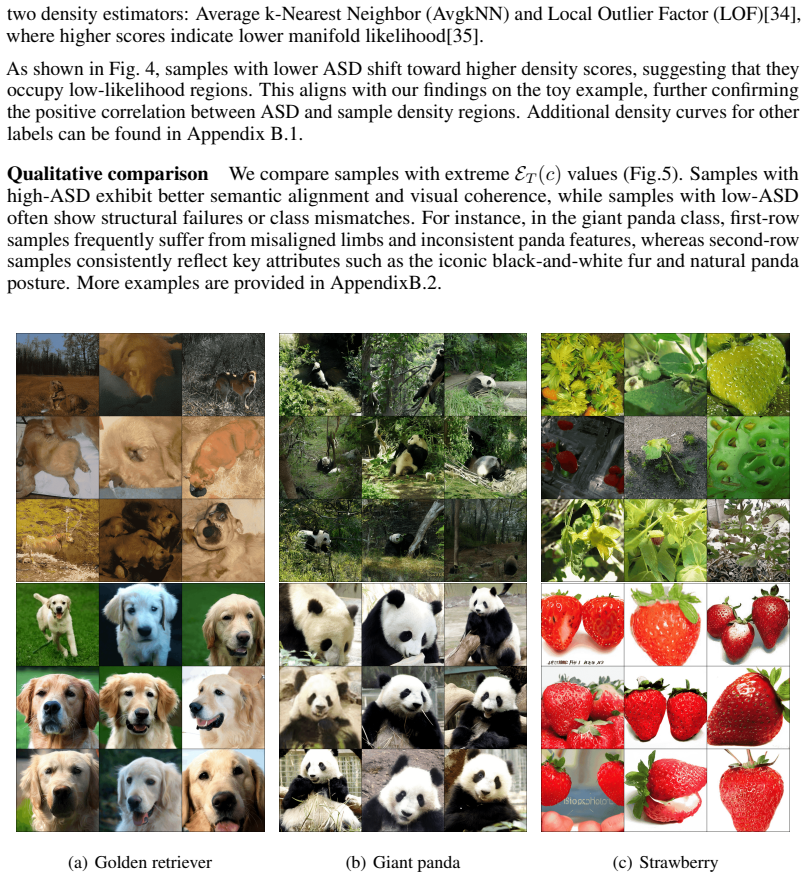
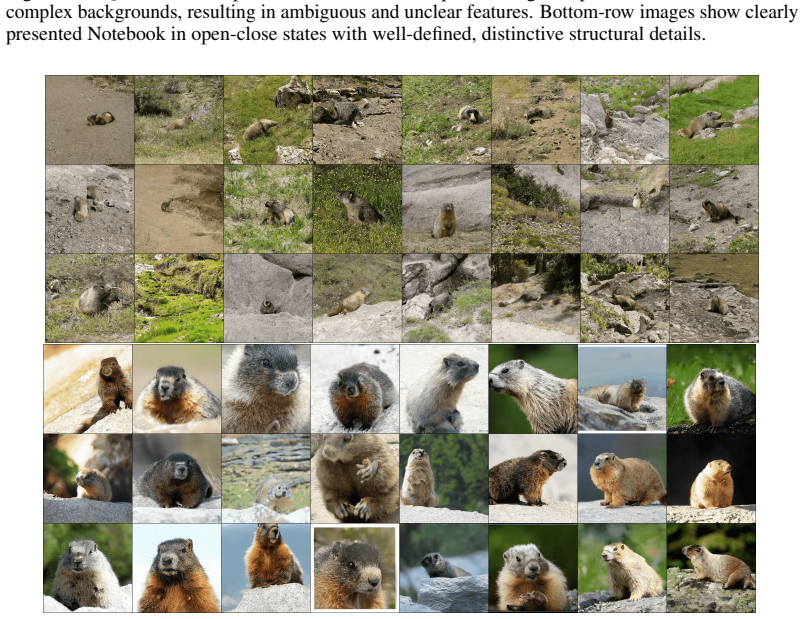
On the paper's own terms, the central discovery is a previously unobserved correlation: samples generated under classifier-free guidance whose trajectories accumulate large squared differences between conditional and unconditional score estimates are disproportionately found in high-density regions of the generated distribution, while trajectories with small accumulated differences tend to end in low-density outliers, class mismatches, or semantically broken images. The evidence comes first from a 2D fractal-like mixture toy model, where the relationship between local density and ASD is log-linear, and then from ImageNet, where AvgkNN and LOF density estimators show the same ordering, and where the highest-ASD samples are qualitatively cleaner and better aligned than the lowest-ASD ones. The paper formalizes the signal as $E_T(c)=\sum_{t=1}^T \|S_\theta(x_t;\sigma_t,c)-S_\theta(x_t;\sigma_t,\emptyset)\|_2^2$ and prunes samples whose partial accumulation $E_{\tau:T}$ is below a percentile threshold $\gamma$, reporting that filtering on the early portion of the trajectory already separates good from bad samples. Across EDM2-S, SDv1.5, SDXL, and FLUX, the same intrinsic signal improves human-preference metrics and compositional benchmarks, which is the paper's evidence that ASD is a general, reward-free quality signal rather than a toy effect.
Load-bearing premise
The load-bearing premise is that a short early portion of the denoising path reveals the same quality ordering as the full trajectory; if early ASD does not predict final quality, stopping at an early cutoff would discard good samples or retain bad ones, and the efficiency claim collapses.
Editorial extensions
If this is right
- Filtering by ASD means a user can generate several candidates, stop the low-scoring trajectories before they finish, and deliver a high-quality subset under a fixed compute budget.
- Because the signal is intrinsic to CFG, the filter needs no external reward model, no task-specific training, and no change to model architectures or sampling schedules.
- On EDM2-S, SDv1.5, SDXL, and FLUX, the filter improves human-preference metrics (PickScore, HPSv2, Aesthetic Score) and compositional benchmarks (GenEval, DPG-Bench) compared with unfiltered sampling.
- CFG-Rejection is orthogonal to reward-based alignment, so it can be stacked with methods like Best-of-N or noise optimization to combine early stopping with external controllability.
- The paper argues the same early-filtering principle should transfer to other generative modalities, such as 3D synthesis or audio, where CFG-style guidance signals exist.
Reading between the lines
- Editorial inference: if ASD is a true density proxy, the rejection threshold could be made adaptive, e.g., per prompt or per class, so the filter becomes an anytime algorithm that stops each trajectory when its accumulated score difference becomes statistically unlikely.
- Editorial inference: the log-linear density–ASD relation in the toy data suggests ASD may behave like an approximate log-likelihood surrogate; a direct test would be measuring whether the ratio of conditional to unconditional score magnitudes predicts density as well as, or better than, their difference.
- Editorial inference: the method's success with early truncation implies the discriminative information is concentrated in the high-noise stages of denoising; ablating the contribution of later steps could reveal an even cheaper stopping rule than the $\tau$ sweeps reported.
- Editorial inference: the clean separation on visual text rendering hints that ASD tracks conditioning fidelity in general, not just aesthetics; applying the same filter to audio or 3D diffusion outputs and asking human judges to compare high-ASD versus low-ASD subsets would test this extension.
Editorial analysis
A structured set of objections, weighed in public.
Referee Report
Summary. The paper proposes CFG-Rejection, a filtering strategy for diffusion sampling that uses the Accumulated Score Difference (ASD), defined as the cumulative squared norm of the difference between conditional and unconditional score estimates during classifier-free guidance, to identify and discard low-quality trajectories at an early denoising stage. The authors first demonstrate on a 2D toy distribution that ASD correlates with local sample density, then report experiments on ImageNet with EDM2-S, on GenEval and DPG-Bench with SDv1.5 and SDXL, and on visual text rendering with FLUX. The claimed contribution is a reward-free, architecture-agnostic, plug-and-play filtering mechanism that improves human-preference metrics and compositional benchmarks while reducing compute relative to Best-of-N sampling.
Significance. If the central empirical claim is correct, CFG-Rejection would be a useful and inexpensive addition to diffusion-based generation pipelines: it requires no retraining, no external reward model, and no modification of the sampling schedule, and it is validated against external benchmarks (PickScore, HPSv2, GenEval, DPG-Bench) that are not used to fit the method. The paper also makes a good-faith effort to ground the phenomenon in a controlled toy setup taken from an external source. However, the evidence as presented is suggestive rather than conclusive: the key efficiency claim rests on a partial-sum statistic whose definition in Eq. (7) is inconsistent with early termination, the supposed monotonic decrease of per-step score differences is asserted without plotted profiles or quantitative support, and most quantitative tables lack error bars and significance tests. The paper is therefore a promising starting point, but the load-bearing empirical and definitional issues need to be resolved before the claims can be accepted.
major comments (4)
- [Section 3.2, Eq. (7)] The definition E_{τ:T}(c)=Σ_{t=T−τ}^{T} G_t(c)^2 sums over the last τ steps of the trajectory, so it is only available after the full denoising process is completed. This directly contradicts the stated mechanism of discarding samples 'without completing full denoising.' If the intended statistic is instead E_{1:τ}=Σ_{t=1}^{τ} G_t(c)^2, then the paper provides no evidence that this early partial sum preserves the ranking of the full ASD: the assertion that G_t 'typically decreases in later steps' does not imply that the first-τ sum is a sufficient statistic for final quality, especially for σ-scaled schedulers where per-step norms may not be monotone. Please correct the definition and report, at minimum, the correlation between early partial ASD and full ASD, and between early partial ASD and the downstream quality metrics.
- [Section 4, Tables 1-5] The central quantitative claims are presented without error bars, confidence intervals, or significance tests. Table 1 appears to be based on a single run, and while Appendix C states that the GenEval and DPG-Bench results are averaged over three seeds, no variance is reported. Many of the observed differences are small (e.g., Table 1 HPSv2: 26.13 for the full set versus 26.57 for the top 10%; several per-category entries in Tables 2-5 differ by less than 0.01 or 0.1 points), so selection noise is not excluded. Please provide standard errors over independent seeds for all tables and a statistical test (e.g., paired bootstrap or permutation test) for the headline comparisons against the random baseline.
- [Section 3.1 and Section 4.1, Fig. 4] The density correlation is quantified on the generated samples themselves using AvgkNN and LOF, which can reflect clustering artifacts of the generator rather than proximity to the true data manifold. Because the ultimate claim is about sample quality, the density analysis should be supplemented by a comparison against a fixed reference distribution (e.g., real ImageNet feature embeddings) or by evidence that the density ranking is stable across independent generation seeds. As reported, Fig. 4 shows only three class labels in the main text and provides no correlation coefficient between ASD and AvgkNN/LOF scores; the phrase 'strong positive correlation' is not backed by a number.
- [Sections 3.2 and 4, Appendices C-D] The early-stage ASD statistic may be confounded by initialization effects: G_t is a norm of score estimates whose magnitude depends on the current latent x_t, and the treatment of the σ_t scaling is inconsistent across models (SDv1.5 uses the raw difference without σ_t scaling, while SDXL and FLUX multiply by σ_t, according to Appendices C and D). Without controlling for the initial noise norm ||x_T|| or normalizing ASD appropriately, the apparent density-quality link could be partly an artifact of seed-specific initialization rather than trajectory semantics. Please plot G_t profiles for several seeds and models, and report whether the early-ASD ranking survives after conditioning on ||x_T|| or after normalizing G_t by the current noise norm.
minor comments (6)
- [Eq. (4)] The guidance-term notation is ambiguous: the expression should be ∇_x log(p(x|c)/p(x|∅)) rather than a gradient applied to the ratio as written; please clarify.
- [References] Reference [4] lists 'Jaehoon Song' as the author of DDIM; the correct name is Jiaming Song.
- [Section 4.1] The text says the ImageNet evaluation generates '10k samples in 50 random ImageNet classes,' but Fig. 4 shows density curves for only three classes; please clarify how the 50 classes were used and whether the reported numbers aggregate over all of them.
- [Appendix C] The statement that filtering is applied with three distinct initial seeds and results are averaged should be moved to the main text for Tables 2-5, and the random baseline should be averaged over the same seeds for a fair comparison.
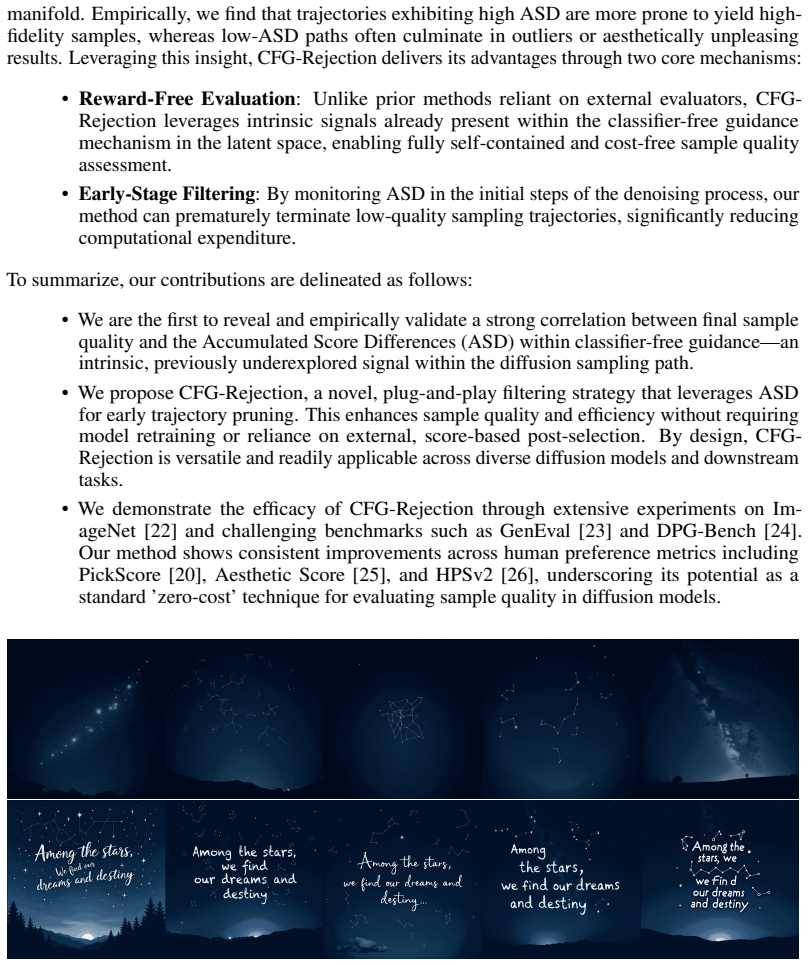
- [Section 4.3 and Appendix D] The visual text experiment is described as qualitative, but the text claims that the method 'improves the success rate of text rendering' without reporting a quantitative success rate; please provide numbers for the rate of legible text with and without filtering.
- [General] The 'Official Implementation' line does not contain a URL; please provide a working code link to support reproducibility.
Circularity Check
No significant circularity: the central ASD-quality claim is tested against external, non-fitted benchmarks, and the only self-citation is a non-load-bearing literature reference.
full rationale
The paper's central claim is that accumulated conditional-vs-unconditional score differences (ASD) correlate with sample density and final quality. This claim is an empirical finding, not an identity: ASD is defined from score-network outputs in Eqs. (5)-(6), while density is measured independently (closed-form ground-truth density in the toy model; AvgkNN/LOF on generated ImageNet samples) and final quality is scored with external human-preference and task metrics (PickScore, Aesthetic Score, HPSv2, GenEval, DPG-Bench). Those external metrics are not used to select samples or to fit any parameter, so the reported improvements are not forced by construction. The toy distribution is imported from prior external work [28], and the only author self-citation ([2], DNO) appears as a baseline example of external-reward inference-time alignment, not as load-bearing support for the new method. The paper does exhibit a technical inconsistency: Eq. (7) defines E_{τ:T} as a sum over the last τ steps, which cannot be known before full denoising, contradicting the stated early-termination mechanism. That is a correctness or presentation flaw, not a circular derivation, because the partial statistic is still evaluated against independent benchmarks. No fitted input is renamed as a prediction, and no uniqueness or ansatz is imported from the authors' prior work. Therefore there is no significant circularity.
Assumptions & free parameters
free parameters (2)
- t (cutoff step) =
5 to 40 depending on experiment
- gamma (percentile threshold) =
Not given explicitly; e.g., top 10% on ImageNet, 4 of 20 candidates on GenEval
assumptions (5)
- standard math The neural network S_theta approximates the true score function grad log p(x; sigma)
- domain assumption The 2D fractal toy distribution from the cited work mimics properties of real data manifolds (low local dimensionality, anisotropy)
- domain assumption AvgkNN and LOF provide valid relative density estimates on high-dimensional image manifolds
- domain assumption Human preference scores (PickScore, HPSv2, Aesthetic Score) are reliable proxies for sample quality
- ad hoc to paper The instantaneous score difference magnitude G_t typically decreases in later denoising steps
Cite this review
Pith. "Pith review of Diffusion Sampling Path Tells More: An Efficient Plug-and-Play Strategy for Sample Filtering." pith.science (2026). https://pith.science/paper/4A4N7IMW
@misc{pith2026250523343,
  author       = {Pith},
  title        = {Pith review of: Diffusion Sampling Path Tells More: An Efficient Plug-and-Play Strategy for Sample Filtering},
  year         = {2026},
  howpublished = {\url{https://pith.science/paper/4A4N7IMW}},
  note         = {Machine review of arXiv:2505.23343}
}
read the original abstract
Diffusion models often exhibit inconsistent sample quality due to stochastic variations inherent in their sampling trajectories. Although training-based fine-tuning (e.g. DDPO [1]) and inference-time alignment techniques[2] aim to improve sample fidelity, they typically necessitate full denoising processes and external reward signals. This incurs substantial computational costs, hindering their broader applicability. In this work, we unveil an intriguing phenomenon: a previously unobserved yet exploitable link between sample quality and characteristics of the denoising trajectory during classifier-free guidance (CFG). Specifically, we identify a strong correlation between high-density regions of the sample distribution and the Accumulated Score Differences (ASD)--the cumulative divergence between conditional and unconditional scores. Leveraging this insight, we introduce CFG-Rejection, an efficient, plug-and-play strategy that filters low-quality samples at an early stage of the denoising process, crucially without requiring external reward signals or model retraining. Importantly, our approach necessitates no modifications to model architectures or sampling schedules and maintains full compatibility with existing diffusion frameworks. We validate the effectiveness of CFG-Rejection in image generation through extensive experiments, demonstrating marked improvements on human preference scores (HPSv2, PickScore) and challenging benchmarks (GenEval, DPG-Bench). We anticipate that CFG-Rejection will offer significant advantages for diverse generative modalities beyond images, paving the way for more efficient and reliable high-quality sample generation.
Figures


Figures from the paper (20 more)





Reference graph
Works this paper leans on
-
[28]
Guiding a diffusion model with a bad version of itself
Tero Karras, Miika Aittala, Tuomas Kynkäänniemi, Jaakko Lehtinen, Timo Aila, and Samuli Laine. Guiding a diffusion model with a bad version of itself. Advances in Neural Information Processing Systems, 37:52996–53021, 2024
2024
-
[1]
Training diffusion models with reinforcement learning
Kevin Black, Michael Janner, Yilun Du, Ilya Kostrikov, and Sergey Levine. Training diffusion models with reinforcement learning. arXiv preprint arXiv:2305.13301, 2023
arXiv 2023
-
[2]
Inference-time alignment of diffusion models with direct noise optimization
Zhiwei Tang, Jiangweizhi Peng, Jiasheng Tang, Mingyi Hong, Fan Wang, and Tsung-Hui Chang. Inference-time alignment of diffusion models with direct noise optimization. arXiv preprint arXiv:2405.18881, 2024
arXiv 2024
-
[3]
Denoising diffusion probabilistic models
Jonathan Ho, Ajay Jain, and Pieter Abbeel. Denoising diffusion probabilistic models. In Proc. NeurIPS, 2020
work page 2020
-
[4]
Denoising diffusion implicit models
Jaehoon Song, Chenlin Meng, and Stefano Ermon. Denoising diffusion implicit models. In Proc. ICLR, 2021
work page 2021
-
[5]
Generative modeling by estimating gradients of the data distribution
Yang Song and Stefano Ermon. Generative modeling by estimating gradients of the data distribution. Advances in neural information processing systems , 32, 2019
2019
-
[6]
Sdxl: Improving latent diffusion models for high-resolution image synthesis
Dustin Podell, Zion English, Kyle Lacey, Andreas Blattmann, Tim Dockhorn, Jonas Müller, Joe Penna, and Robin Rombach. Sdxl: Improving latent diffusion models for high-resolution image synthesis. arXiv preprint arXiv:2307.01952, 2023
arXiv 2023
-
[7]
Scalable diffusion models with transformers
William Peebles and Saining Xie. Scalable diffusion models with transformers. In Proceedings of the IEEE/CVF international conference on computer vision , pages 4195–4205, 2023
2023
Show all 35 references
-
[8]
Diffusion models beat gans on image synthesis
Prafulla Dhariwal and Alexander Nichol. Diffusion models beat gans on image synthesis. Advances in neural information processing systems , 34:8780–8794, 2021
2021
-
[9]
Wan: Open and advanced large-scale video generative models
Ang Wang, Baole Ai, Bin Wen, Chaojie Mao, Chen-Wei Xie, Di Chen, Feiwu Yu, Haiming Zhao, Jianxiao Yang, Jianyuan Zeng, et al. Wan: Open and advanced large-scale video generative models. arXiv preprint arXiv:2503.20314, 2025
2025 arXiv
-
[10]
Viewdiff: 3d-consistent image generation with text-to-image models
Lukas Höllein, Aljaž Boži ˇc, Norman Müller, David Novotny, Hung-Yu Tseng, Christian Richardt, Michael Zollhöfer, and Matthias Nießner. Viewdiff: 3d-consistent image generation with text-to-image models. In Proceedings of the IEEE/CVF conference on computer vision and pattern ...
2024
-
[11]
Sv3d: Novel multi-view synthesis and 3d generation from a single image using latent video diffusion
Vikram V oleti, Chun-Han Yao, Mark Boss, Adam Letts, David Pankratz, Dmitry Tochilkin, Christian Laforte, Robin Rombach, and Varun Jampani. Sv3d: Novel multi-view synthesis and 3d generation from a single image using latent video diffusion. In European Conference on Computer V...
2024
-
[12]
Score-based generative modeling through stochastic differential equations
Yang Song, Jascha Sohl-Dickstein, Diederik P Kingma, Abhishek Kumar, Stefano Ermon, and Ben Poole. Score-based generative modeling through stochastic differential equations. arXiv preprint arXiv:2011.13456, 2020
2011 arXiv
-
[13]
Loraclr: Contrastive adaptation for customization of diffusion models
Enis Simsar, Thomas Hofmann, Federico Tombari, and Pinar Yanardag. Loraclr: Contrastive adaptation for customization of diffusion models. arXiv preprint arXiv:2412.09622, 2024
2024
-
[14]
Diffusion model alignment using direct preference optimization
Bram Wallace, Meihua Dang, Rafael Rafailov, Linqi Zhou, Aaron Lou, Senthil Purushwalkam, Stefano Ermon, Caiming Xiong, Shafiq Joty, and Nikhil Naik. Diffusion model alignment using direct preference optimization. In Proceedings of the IEEE/CVF Conference on Computer Vision and...
2024
-
[15]
Raft: Reward ranked finetuning for generative foundation model alignment
Hanze Dong, Wei Xiong, Deepanshu Goyal, Yihan Zhang, Winnie Chow, Rui Pan, Shizhe Diao, Jipeng Zhang, Kashun Shum, and Tong Zhang. Raft: Reward ranked finetuning for generative foundation model alignment. arXiv preprint arXiv:2304.06767, 2023. 10
2023 arXiv
-
[16]
Dpok: Reinforcement learning for fine-tuning text-to-image diffusion models
Ying Fan, Olivia Watkins, Yuqing Du, Hao Liu, Moonkyung Ryu, Craig Boutilier, Pieter Abbeel, Mohammad Ghavamzadeh, Kangwook Lee, and Kimin Lee. Dpok: Reinforcement learning for fine-tuning text-to-image diffusion models. Advances in Neural Information Processing Systems, 36:79...
2023
-
[17]
End-to-end diffusion latent optimization improves classifier guidance
Bram Wallace, Akash Gokul, Stefano Ermon, and Nikhil Naik. End-to-end diffusion latent optimization improves classifier guidance. In Proceedings of the IEEE/CVF International Conference on Computer Vision, pages 7280–7290, 2023
2023
-
[18]
Inference-time scaling for diffusion models beyond scaling denoising steps
Nanye Ma, Shangyuan Tong, Haolin Jia, Hexiang Hu, Yu-Chuan Su, Mingda Zhang, Xuan Yang, Yandong Li, Tommi Jaakkola, Xuhui Jia, et al. Inference-time scaling for diffusion models beyond scaling denoising steps. arXiv preprint arXiv:2501.09732, 2025
2025 arXiv
-
[19]
D-flow: Differentiating through flows for controlled generation
Heli Ben-Hamu, Omri Puny, Itai Gat, Brian Karrer, Uriel Singer, and Yaron Lipman. D-flow: Differentiating through flows for controlled generation. arXiv preprint arXiv:2402.14017, 2024
2024 arXiv
-
[20]
Pick-a-pic: An open dataset of user preferences for text-to-image generation
Yuval Kirstain, Adam Polyak, Uriel Singer, Shahbuland Matiana, Joe Penna, and Omer Levy. Pick-a-pic: An open dataset of user preferences for text-to-image generation. Advances in Neural Information Processing Systems, 36:36652–36663, 2023
2023
-
[21]
Classifier-free diffusion guidance
Jonathan Ho and Tim Salimans. Classifier-free diffusion guidance. arXiv preprint arXiv:2207.12598, 2022
2022 arXiv
-
[22]
Imagenet: A large- scale hierarchical image database
Jia Deng, Wei Dong, Richard Socher, Li-Jia Li, Kai Li, and Li Fei-Fei. Imagenet: A large- scale hierarchical image database. In 2009 IEEE conference on computer vision and pattern recognition, pages 248–255. Ieee, 2009
2009
-
[23]
Geneval: An object-focused framework for evaluating text-to-image alignment
Dhruba Ghosh, Hannaneh Hajishirzi, and Ludwig Schmidt. Geneval: An object-focused framework for evaluating text-to-image alignment. Advances in Neural Information Processing Systems, 36:52132–52152, 2023
2023
-
[24]
Ella: Equip diffusion models with llm for enhanced semantic alignment
Xiwei Hu, Rui Wang, Yixiao Fang, Bin Fu, Pei Cheng, and Gang Yu. Ella: Equip diffusion models with llm for enhanced semantic alignment. arXiv preprint arXiv:2403.05135, 2024
2024 arXiv
-
[25]
Laion- 5b: An open large-scale dataset for training next generation image-text models
Christoph Schuhmann, Romain Beaumont, Richard Vencu, Cade Gordon, Ross Wightman, Mehdi Cherti, Theo Coombes, Aarush Katta, Clayton Mullis, Mitchell Wortsman, et al. Laion- 5b: An open large-scale dataset for training next generation image-text models. Advances in neural inform...
2022
-
[26]
Human preference score v2: A solid benchmark for evaluating human preferences of text-to-image synthesis
Xiaoshi Wu, Yiming Hao, Keqiang Sun, Yixiong Chen, Feng Zhu, Rui Zhao, and Hongsheng Li. Human preference score v2: A solid benchmark for evaluating human preferences of text-to-image synthesis. arXiv preprint arXiv:2306.09341, 2023
2023 arXiv
-
[27]
Elucidating the design space of diffusion-based generative models
Tero Karras, Miika Aittala, Timo Aila, and Samuli Laine. Elucidating the design space of diffusion-based generative models. Advances in neural information processing systems , 35:26565–26577, 2022
2022
-
[29]
Reno: Enhancing one-step text-to-image models through reward-based noise optimization
Luca Eyring, Shyamgopal Karthik, Karsten Roth, Alexey Dosovitskiy, and Zeynep Akata. Reno: Enhancing one-step text-to-image models through reward-based noise optimization. Advances in Neural Information Processing Systems , 37:125487–125519, 2024
2024
-
[30]
Loss-guided diffusion models for plug-and-play controllable generation
Jiaming Song, Qinsheng Zhang, Hongxu Yin, Morteza Mardani, Ming-Yu Liu, Jan Kautz, Yongxin Chen, and Arash Vahdat. Loss-guided diffusion models for plug-and-play controllable generation. In International Conference on Machine Learning , pages 32483–32498. PMLR, 2023
2023
-
[31]
Verifying the union of manifolds hypothesis for image data
Bradley CA Brown, Anthony L Caterini, Brendan Leigh Ross, Jesse C Cresswell, and Gabriel Loaiza-Ganem. Verifying the union of manifolds hypothesis for image data. arXiv preprint arXiv:2207.02862, 2022. 11
2022 arXiv
-
[32]
The intrinsic dimension of images and its impact on learning
Phillip Pope, Chen Zhu, Ahmed Abdelkader, Micah Goldblum, and Tom Goldstein. The intrinsic dimension of images and its impact on learning. arXiv preprint arXiv:2104.08894, 2021
2021 arXiv
-
[33]
Analyzing and improving the training dynamics of diffusion models
Tero Karras, Miika Aittala, Jaakko Lehtinen, Janne Hellsten, Timo Aila, and Samuli Laine. Analyzing and improving the training dynamics of diffusion models. In Proceedings of the IEEE/CVF Conference on Computer Vision and Pattern Recognition, pages 24174–24184, 2024
2024
-
[34]
Lof: identifying density-based local outliers
Markus M Breunig, Hans-Peter Kriegel, Raymond T Ng, and Jörg Sander. Lof: identifying density-based local outliers. In Proceedings of the 2000 ACM SIGMOD international conference on Management of data , pages 93–104, 2000
2000
-
[35]
A beach with shells organized to form the words ’Every grain of sand holds a universe of endless possibilities’
Vikash Sehwag, Caner Hazirbas, Albert Gordo, Firat Ozgenel, and Cristian Canton. Generating high fidelity data from low-density regions using diffusion models. In Proceedings of the IEEE/CVF Conference on Computer Vision and Pattern Recognition , pages 11492–11501, 2022. 12 A ...
2022
Reviewed August 7, 2026 · model on record in the stance chip above.
Discussion (0). Sign in to comment.