REVIEW 3 major objections 5 minor 34 references
topicwizard -- a Modern, Model-agnostic Framework for Topic Model Visualization and Interpretation
T0 review · 3 major / 5 minor · reviewed 2026-08-15 · deepseek-v4-flash
Pith's one-line read The paper introduces topicwizard, a model-agnostic framework for interactive visualization and interpretation of topic models.
desk verdict A genuinely useful, well-engineered topic-model visualization package whose main weakness is an overbroad 'model-agnostic' claim and no evidence that the views actually improve interpretation. read the letter →
The pith
A machine-rendered reading of the paper's core claim, the machinery that carries it, and where it could break.
The reading
What carries the argument
The key machinery is the pair of matrices $\phi$ (topics by vocabulary) and $\Theta$ (documents by topics), together with the derived group-topic matrix $G$ (groups by topics). The paper argues that these matrices are common to matrix-factorization, probabilistic generative, clustering-based, and neural topic models, so every visualization is computed from them rather than from model-specific internals. UMAP dimensionality reduction maps the columns of $\phi$, the rows of $\Theta$, and the rows of $G$ into the two-dimensional word, document, and group maps, and interactive elements turn those maps into a close-reading tool for the corpus.
What would settle it
Run topicwizard on a hierarchical topic model, such as a nested LDA variant, and see whether the topic, word, document, and group views render without manual preprocessing; the paper itself lists dynamic, hierarchical, and supervised topic models as unsupported, which marks the current boundary of the model-agnostic claim.
Extended reading notes
Core claim
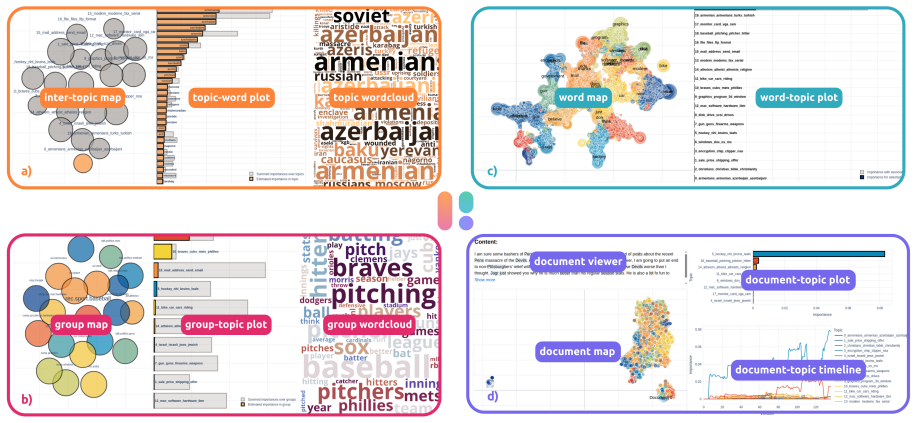
The paper's contribution is a model-agnostic interpretation framework built on the observation that every topic model learns a three-way relationship among words, documents, and topics, encoded in a topic-term matrix $\phi$ and a document-topic matrix $\Theta$. From these matrices, topicwizard produces an inter-topic distance map with topic sizes weighted by document length; a word map and word-topic distribution obtained by UMAP-projecting the word columns of $\phi$; a document map colored by dominant topic with per-document topic timelines and highlighted key terms; and a group map, group-topic plot, and group wordcloud computed from a group-topic matrix $G$ that sums $\Theta$ over user-defined document groups. The framework is natively compatible with topic model libraries using the scikit-learn API and ships compatibility layers for Gensim and BERTopic, and it is distributed both as an interactive web application and as a static figures API.
Load-bearing premise
The load-bearing premise is that every topic model family can expose its output as comparable topic-term and document-topic matrices, so that a single set of views works for all models.
Editorial extensions
If this is right
- A user can switch between LDA-style probabilistic models, clustering models, and transformer-based topic models without learning a new visualization interface for each.
- Topic interpretation can move beyond top-10 word lists: the word map, word-topic plot, and document viewer expose distributional and contextual evidence behind each topic.
- Document and group views let analysts verify that topics are grounded in the actual corpus, which the paper argues increases trust in model output.
- New model families can be added by writing a small compatibility layer, because the visualizations depend only on $\phi$ and $\Theta$.
Reading between the lines
- The $\phi$/$\Theta$ abstraction suggests a natural path to model comparison, which the paper lists as future work: the same corpus fitted with different model families could be inspected through identical views and compared side by side.
- The group-topic matrix construction is generalizable beyond static labels; any metadata partition (time bins, sources, authors) yields a group representation that inherits the same UMAP projection and plotting machinery.
- Since the paper treats word columns of $\phi$ as semantic embeddings, a testable extension is to compare those within-corpus word similarities against general-purpose embeddings on a standard word-similarity benchmark.
- The document-topic timeline could be used to trace how a topic waxes and wanes inside a single document, complementing corpus-level discourse analysis.
Signed reviews
Editorial analysis
A structured set of objections, weighed in public.
Referee Report
Summary. The paper introduces topicwizard, a Python package for interactive visualization and interpretation of topic models. It claims to be model-agnostic, building all views on a topic-term matrix φ and a document-topic matrix Θ, and provides a web application and a figures API with topic maps, word maps, document maps, and group maps. The paper defines two formulas: topic importance s_t and group-topic matrix G_ij, and reports over 45,000 PyPI downloads as evidence of adoption. No user study or quantitative evaluation is presented; the interpretability benefit is asserted from design considerations and screenshots.
Significance. As a software artifact, topicwizard is a real, installable package with a clear API, explicit formulas, and a broader model compatibility story than earlier tools like Termite or LDAvis. Its acknowledgment of limitations (dynamic, hierarchical, supervised, and cross-model comparison) is honest. If the stronger claims in the abstract are taken at face value, however, the paper needs to substantiate them: the universal φ/Θ assumption is false for some model families, and the claimed improvement in user understanding is not measured. The main value is therefore a well-engineered tool for a specific class of topic models, rather than a demonstrated advance in topic-model interpretability.
major comments (3)
- [Section 1.2, Figure 2] The premise that 'all topic models have a method for extracting the K most relevant words' from a topic-term matrix φ, and that 'models compute a document-topic-matrix Θ', is too strong. Top2Vec, which the paper itself catalogs under clustering-based models in Section 1.1 (Angelov, 2020), obtains topic words by nearest-neighbor search over word embeddings and does not natively provide a dense document-topic matrix. Since every view in Section 3 (topic map, word map, document map, group map) is built on φ and Θ, the abstract's unqualified 'model-agnostic' claim is not supported for this model family. I suggest either supplying a working adapter for such a model or rephrasing the claim to 'agnostic across models that expose, or can be adapted to expose, φ and Θ.'
- [Abstract and Section 1.3] The paper states that visualization 'can help users gain a more complete and accurate understanding of topic models' output,' but no user study, task-based evaluation, or quantitative comparison against top-word lists or existing tools (e.g., LDAvis/PyLDAvis) is reported. The download count in Section 4 is evidence of adoption, not of interpretability gains. Unless the claim is explicitly reframed as a design goal rather than an empirical result, this central benefit is unsupported. Adding even a small case study with objective tasks (e.g., topic labeling accuracy, document-topic grounding) would strengthen the paper.
- [Section 3.5] The description of the compatibility layers for Gensim and BERTopic is too thin to verify the 'model-agnostic' architecture. The paper does not specify what data structures are extracted from each library or how missing or non-conforming φ/Θ are handled. A table of the adapter interface, or pseudocode showing the extraction and normalization steps, would allow readers to assess whether the framework truly generalizes across the claimed model families or merely handles a handful of sklearn-API libraries.
minor comments (5)
- [Throughout] There are numerous typos: 'exmined' (Section 1), 'prevelant' (Section 3.1), 'highighted' (Section 3.3), 'enabeling' and 'seemless' (Section 3.5), 'utilites' (Section 2), 'preceeded' (Appendix A), and 'model-angosticity' (Limitations). A thorough proofread is needed.
- [Section 3.1 vs. Section 3.4] The topic importance formula s_t weights documents by length |d|, but the group-topic matrix G_ij in Section 3.4 sums Θ_kj without a document-length weight. The text should explain whether this asymmetry is intentional and how it affects the semantic distances shown on the group map.
- [Section 3.2] Calling each column of the topic-term matrix a 'semantic embedding' for a word is loose, especially for probabilistic models, where these columns are conditional distributions over topics. Please clarify the precise sense in which these are embeddings and why UMAP over raw columns is expected to produce a meaningful word map.
- [Section 3.3] The document map for contextual models uses 'pre-computed sentence embeddings,' but the paper does not specify how these are produced, aligned with the document map, or distinguished from the document-topic representations. A sentence of clarification would improve reproducibility.
- [Figure 3] Figure 3 is referenced in text with subfigures 3a–3d, but the caption itself does not enumerate the subpanels or their labels. Aligning the caption with the in-text references would make the overview easier to follow.
Circularity Check
No circularity found: topicwizard is a self-contained software description whose metrics are definitions over model outputs, not fitted predictions.
full rationale
The paper makes no derivation claim whose conclusion is equivalent to its input. The central contribution is a software framework, not a quantitative prediction or fitted model. The quantities st = sum_d Theta_dt |d| and Gij = sum_k Theta_kj I(g_k = i) are definitions over the document-topic matrix Theta that the framework consumes, so there is no reduction of an output to an input: the visualizations plot these defined aggregates and projections of them. No parameter is fitted to a subset of data and then renamed as a prediction; no uniqueness theorem from prior work is invoked to force a choice; and no ansatz is smuggled in through self-citation. The paper does cite the authors' own libraries (tweetopic, Turftopic, S3, KeyNMF), but these citations are for the existence and nature of compatible models or for example visualizations, not as load-bearing evidence for the framework's claimed functionality. The paper's Limitations section explicitly acknowledges that model-agnosticity is partial, e.g. that some visualizations may be less useful for clustering topic models, which further indicates that the framework is presented as an interface over available model outputs rather than as a universal mathematical derivation. The skeptical concern that Section 1.2's universal phi/Theta premise is false for clustering-based models such as Top2Vec is a correctness and coverage risk about the strength of the word 'model-agnostic,' not a circularity: even if the premise is inaccurate, that inaccuracy does not make the framework's own definitions or design reduce to their inputs. Because the manuscript's claims are self-contained against its described architecture and make no prediction that is forced by construction, the appropriate circularity score is 0.
Assumptions & free parameters
assumptions (3)
- domain assumption Every topic model can be represented by a topic-term matrix phi and a document-topic matrix theta.
- domain assumption UMAP projections of phi, theta, and group-topic matrices preserve local semantic structure useful for interpretation.
- domain assumption Interpreting topics from top-10 word lists is biased, and richer visualizations reduce that bias.
Cite this review
Pith. "Pith review of topicwizard -- a Modern, Model-agnostic Framework for Topic Model Visualization and Interpretation." pith.science (2026). https://pith.science/paper/4AB5FSXX
@misc{pith2026250513034,
  author       = {Pith},
  title        = {Pith review of: topicwizard -- a Modern, Model-agnostic Framework for Topic Model Visualization and Interpretation},
  year         = {2026},
  howpublished = {\url{https://pith.science/paper/4AB5FSXX}},
  note         = {Machine review of arXiv:2505.13034}
}
read the original abstract
Topic models are statistical tools that allow their users to gain qualitative and quantitative insights into the contents of textual corpora without the need for close reading. They can be applied in a wide range of settings from discourse analysis, through pretraining data curation, to text filtering. Topic models are typically parameter-rich, complex models, and interpreting these parameters can be challenging for their users. It is typical practice for users to interpret topics based on the top 10 highest ranking terms on a given topic. This list-of-words approach, however, gives users a limited and biased picture of the content of topics. Thoughtful user interface design and visualizations can help users gain a more complete and accurate understanding of topic models' output. While some visualization utilities do exist for topic models, these are typically limited to a certain type of topic model. We introduce topicwizard, a framework for model-agnostic topic model interpretation, that provides intuitive and interactive tools that help users examine the complex semantic relations between documents, words and topics learned by topic models.
Figures


Figures from the paper (6 more)


Reference graph
Works this paper leans on
-
[1]
Dimo Angelov. 2020. https://doi.org/10.48550/arXiv.2008.09470 Top2vec: Distributed representations of topics . Preprint, arXiv:2008.09470
-
[2]
Alexander T. J. Barron, Jenny Huang, Rebecca L. Spang, and Simon DeDeo. 2018. https://doi.org/10.1073/pnas.1717729115 Individuals, institutions, and innovation in the debates of the french revolution . Proceedings of the National Academy of Sciences, 115(18):4607–4612
-
[3]
Katrine Frøkjær Baunvig. 2024. https://www.universitypress.dk/shop/grundtvig-og-monstrene-4143p.html Grundtvig og monstrene
work page 2024
-
[4]
Monika Bednarek. 2024. https://doi.org/10.1177/14614456241293075 Topic modelling in corpus-based discourse analysis: Uses and critiques . Discourse Studies
-
[5]
Federico Bianchi, Silvia Terragni, and Dirk Hovy. 2021 a . https://doi.org/10.18653/v1/2021.acl-short.96 Pre-training is a hot topic: Contextualized document embeddings improve topic coherence . In Proceedings of the 59th Annual Meeting of the Association for Computational Linguistics and the 11th International Joint Conference on Natural Language Process...
-
[6]
Federico Bianchi, Silvia Terragni, Dirk Hovy, Debora Nozza, and Elisabetta Fersini. 2021 b . https://doi.org/10.18653/v1/2021.eacl-main.143 Cross-lingual contextualized topic models with zero-shot learning . In Proceedings of the 16th Conference of the European Chapter of the Association for Computational Linguistics: Main Volume, pages 1676--1683, Online...
-
[7]
David M. Blei. 2012. https://doi.org/10.1145/2133806.2133826 Probabilistic topic models . Commun. ACM, 55(4):77–84
arXiv 2012
-
[8]
Blei, Andrew Y
David M. Blei, Andrew Y. Ng, and Michael I. Jordan. 2003. Latent dirichlet allocation. J. Mach. Learn. Res., 3(null):993–1022
2003
Show all 34 references
-
[9]
Manning, and Jeffrey Heer
Jason Chuang, Christopher D. Manning, and Jeffrey Heer. 2012 a . https://doi.org/10.1145/2254556.2254572 Termite: visualization techniques for assessing textual topic models . In Proceedings of the International Working Conference on Advanced Visual Interfaces, AVI '12, page 7...
2012
-
[10]
Jason Chuang, Daniel Ramage, Christopher Manning, and Jeffrey Heer. 2012 b . https://doi.org/10.1145/2207676.2207738 Interpretation and trust: designing model-driven visualizations for text analysis . In Proceedings of the SIGCHI Conference on Human Factors in Computing System...
2012
-
[11]
Mathew Gillings and Andrew Hardie. 2022. https://doi.org/10.1093/llc/fqac075 The interpretation of topic models for scholarly analysis: An evaluation and critique of current practice . Digital Scholarship in the Humanities, 38(2):530--543
2022 doi
-
[12]
Nicolas Gillis and Stephen A. Vavasis. 2014. https://doi.org/10.1109/TPAMI.2013.226 Fast and robust recursive algorithmsfor separable nonnegative matrix factorization . IEEE Transactions on Pattern Analysis and Machine Intelligence, 36(4):698--714
2014 doi
-
[13]
Maarten Grootendorst. 2022. https://arxiv.org/abs/2203.05794 Bertopic: Neural topic modeling with a class-based tf-idf procedure . Preprint, arXiv:2203.05794
2022 arXiv
-
[14]
Thomas Hofmann. 1999. https://doi.org/10.1145/312624.312649 Probabilistic latent semantic indexing . In Proceedings of the 22nd Annual International ACM SIGIR Conference on Research and Development in Information Retrieval, SIGIR '99, page 50–57, New York, NY, USA. Association...
1999
-
[15]
Márton Kardos. 2022. https://github.com/centre-for-humanities-computing/tweetopic tweetopic: Blazing fast topic modelling for short texts
2022
-
[16]
Márton Kardos, Jan Kostkan, and Roberta Rocca. 2024 a . https://github.com/x-tabdeveloping/turftopic Turftopic: Robust and fast implementations of transformer-based topic models in Python
2024
- [17]
-
[18]
Pooja Kherwa and Poonam Bansal. 2017. https://doi.org/10.1109/CTCEEC.2017.8455018 Latent semantic analysis: An approach to understand semantic of text . In 2017 International Conference on Current Trends in Computer, Electrical, Electronics and Communication (CTCEEC), pages 870--874
2017
- [19]
-
[20]
Saar Kuzi, Anna Shtok, and Oren Kurland. 2016. https://doi.org/10.1145/2983323.2983876 Query expansion using word embeddings . In Proceedings of the 25th ACM International on Conference on Information and Knowledge Management, CIKM '16, page 1929–1932, New York, NY, USA. Assoc...
2016
-
[21]
Dilin Liu and Lei Lei. 2018. https://doi.org/10.1016/j.dcm.2018.05.001 The appeal to political sentiment: An analysis of donald trump’s and hillary clinton’s speech themes and discourse strategies in the 2016 us presidential election . Discourse, Context & Media, 25:143--152
2018 doi
-
[22]
Jialin Ma, Yongjun Zhang, Jinling Liu, Kun Yu, and XuAn Wang. 2016. https://doi.org/10.1109/INCoS.2016.47 Intelligent sms spam filtering using topic model . In 2016 International Conference on Intelligent Networking and Collaborative Systems (INCoS), pages 380--383
2016 doi
-
[23]
Leland McInnes, John Healy, and James Melville. 2020. https://arxiv.org/abs/1802.03426 Umap: Uniform manifold approximation and projection for dimension reduction . Preprint, arXiv:1802.03426
2020 arXiv
-
[24]
Nielbo, Folgert Karsdorp, Melvin Wevers, Alie Lassche, Rebekah B
Kristoffer L. Nielbo, Folgert Karsdorp, Melvin Wevers, Alie Lassche, Rebekah B. Baglini, Mike Kestemont, and Nina Tahmasebi. 2024. https://doi.org/10.1038/s43586-024-00302-w Quantitative text analysis . Nature Reviews Methods Primers, 4(1)
2024 doi
-
[25]
Pedregosa, G
F. Pedregosa, G. Varoquaux, A. Gramfort, V. Michel, B. Thirion, O. Grisel, M. Blondel, P. Prettenhofer, R. Weiss, V. Dubourg, J. Vanderplas, A. Passos, D. Cournapeau, M. Brucher, M. Perrot, and E. Duchesnay. 2011. Scikit-learn: Machine learning in P ython. Journal of Machine L...
2011
-
[26]
Jiahui Peng, Xinlin Zhuang, Qiu Jiantao, Ren Ma, Jing Yu, Tianyi Bai, and Conghui He. 2025. https://arxiv.org/abs/2502.16802 Unsupervised topic models are data mixers for pre-training language models . Preprint, arXiv:2502.16802
2025 arXiv
-
[27]
Nils Reimers and Iryna Gurevych. 2019. https://doi.org/10.18653/v1/D19-1410 Sentence- BERT : Sentence embeddings using S iamese BERT -networks . In Proceedings of the 2019 Conference on Empirical Methods in Natural Language Processing and the 9th International Joint Conference...
2019 doi
-
[28]
Carson Sievert and Kenneth Shirley. 2014. https://doi.org/10.3115/v1/W14-3110 LDA vis: A method for visualizing and interpreting topics . In Proceedings of the Workshop on Interactive Language Learning, Visualization, and Interfaces, pages 63--70, Baltimore, Maryland, USA. Ass...
2014 doi
- [29]
-
[30]
Xiaohui Yan, Jiafeng Guo, Yanyan Lan, and Xueqi Cheng. 2013. https://doi.org/10.1145/2488388.2488514 A biterm topic model for short texts . In Proceedings of the 22nd International Conference on World Wide Web, WWW '13, page 1445–1456, New York, NY, USA. Association for Comput...
2013
-
[31]
Xing Yi and James Allan. 2009. A comparative study of utilizing topic models for information retrieval. In Advances in Information Retrieval, pages 29--41, Berlin, Heidelberg. Springer Berlin Heidelberg
2009
-
[32]
Jianhua Yin and Jianyong Wang. 2014. https://doi.org/10.1145/2623330.2623715 A dirichlet multinomial mixture model-based approach for short text clustering . In Proceedings of the 20th ACM SIGKDD International Conference on Knowledge Discovery and Data Mining, KDD '14, page 23...
2014
-
[33]
online" 'onlinestring :=
ENTRY address archivePrefix author booktitle chapter edition editor eid eprint eprinttype howpublished institution journal key month note number organization pages publisher school series title type volume year doi pubmed url lastchecked label extra.label sort.label short.list...
-
[34]
write newline
" write newline "" before.all 'output.state := FUNCTION n.dashify 't := "" t empty not t #1 #1 substring "-" = t #1 #2 substring "--" = not "--" * t #2 global.max substring 't := t #1 #1 substring "-" = "-" * t #2 global.max substring 't := while if t #1 #1 substring * t #2 gl...
Reviewed August 15, 2026 · model on record in the stance chip above.
Discussion (0). Continue with ORCID to comment.