REVIEW 4 major objections 5 minor 1 cited by
Learning Encoding-Decoding Direction Pairs to Unveil Concepts of Influence in Deep Vision Networks
T0 review · 4 major / 5 minor · reviewed 2026-08-04 · deepseek-v4-flash
Pith's one-line read An unsupervised method recovers the direction pairs that let deep vision networks encode and decode concepts, enabling concept attribution, counterfactual explanations, and model correction without labels.
desk verdict Useful, well-built unsupervised concept-direction tool with a genuine but addressable gap: the real-world encoding-direction estimate leans on an untested independence assumption. read the letter →
The pith
A machine-rendered reading of the paper's core claim, the machinery that carries it, and where it could break.
The reading
What carries the argument
The central objects are the encoding-decoding direction pair: a concept detector (a linear filter w_i plus bias b_i forming a binary classifier that reads the concept's latent factor) and a signal vector s_i (an estimate of the concept's encoding direction). The detector is learned via directional clustering with sparsity and maximum-activation losses, plus new interpretability losses (Focal Sparsity Loss, Excessively Active Classifier Loss) and a Self-Weighted Reduction soft-max aggregation. The signal vector is estimated from a multi-concept signal-distractor data model using the covariance formula s_i = cov[x_p, z_p,i] / var[z_p,i], crucially subsampling to patches that contain the concep
What would settle it
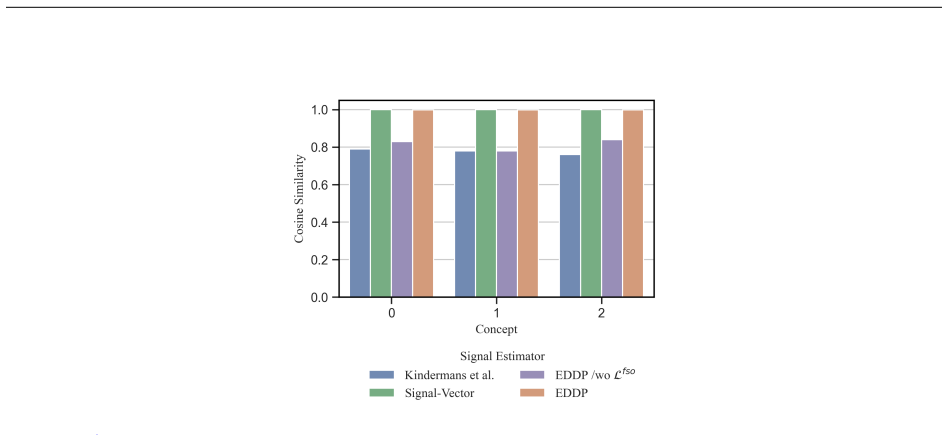
Construct a synthetic or semi-natural dataset where the positive patches of a concept always also contain a second concept (so the two latent factors are perfectly correlated in the subsampled set). If EDDP's signal vector for one of those concepts deviates substantially from its ground-truth encoding direction (cosine similarity well below the near-perfect values reported for the independent-factor synthetic experiment), the subsampling independence assumption is violated and the encoding-direction half of the central claim fails.
Extended reading notes
Core claim
Each concept in a deep vision network can be characterized by an encoding-decoding direction pair: an encoding direction (signal vector) that writes the concept's latent factor into a patch embedding, and a decoding direction (filter) that reads the factor back via an inner product. The paper's central claim is that these pairs can be learned jointly and unsupervised from unlabeled activations by (1) finding decoding directions through directional clustering that enforces sparsity in a soft-binary concept space, (2) estimating encoding directions with a subsampled covariance formula that, among patches containing the concept, treats latent factors of different concepts as independent, and (3
Load-bearing premise
The signal-vector estimate is valid only if, among patches that contain a concept, that concept's latent factor is independent of other concepts' latent factors and of distractor noise; the paper asserts this independence after subsampling rather than verifying it on real data, and it further assumes that the learned filters become approximately orthogonal to other signal directions and to the unestimated distractor subspace.
Editorial extensions
If this is right
- If the recovered direction pairs are faithful, model predictions can be explained in terms of the concepts the model actually uses, without needing concept annotations or additional trained heads.
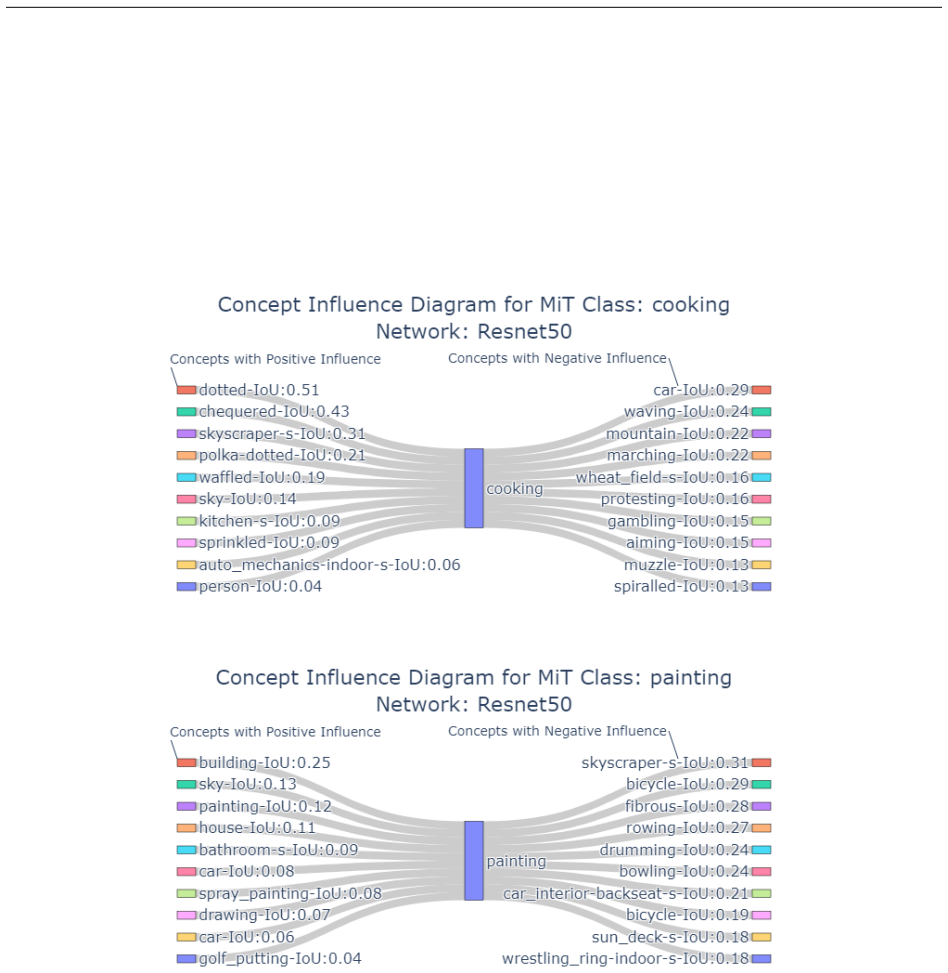
- The encoding direction enables concept sensitivity testing (e.g., with RCAV) to identify which concepts the network relies on for each class, enabling global model-behavior diagrams.
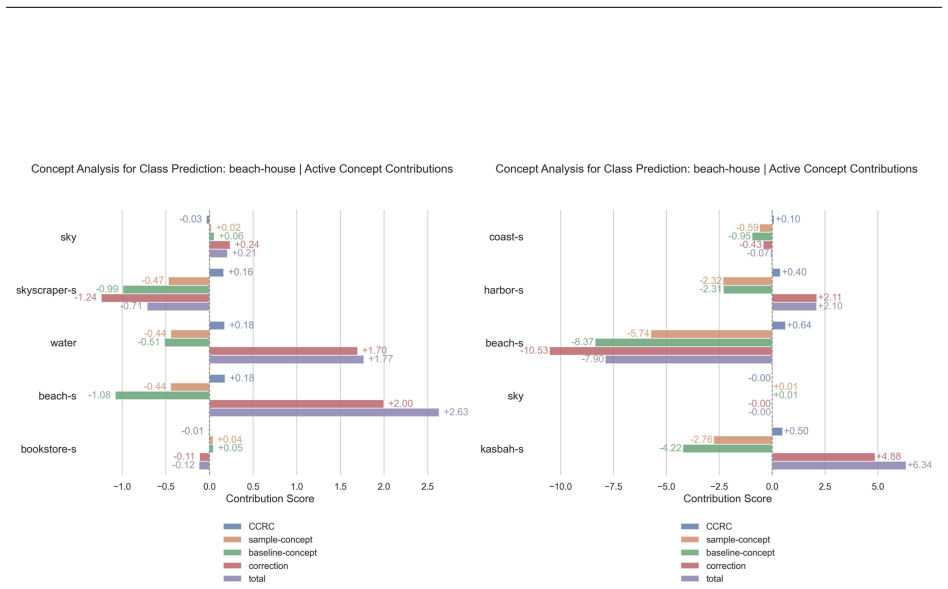
- The decoding direction and signal vector together support local, spatially-aware Concept Contribution Maps that break down a prediction logit into per-concept, per-patch contributions.
- Interventions become possible: the signal value of a concept can be overwritten to produce counterfactual explanations (e.g., replacing 'road' with 'building' changes the prediction as expected).
- The method can identify and suppress unintended biases: in a toy model, the watermark concept was detected with IoU 0.85, its signal vector matched a supervised Pattern-CAV with cosine similarity 0.99, and suppressing it recovered most of the poisoned-set accuracy.
- The paper argues this provides many of the benefits of Concept Bottleneck Models without training additional components or accessing annotations.
Reading between the lines
- The observed interpretability-influence tradeoff (more monosemantic directions often scored lower on average sensitivity) hints that a fully faithful account of a model's decision strategy may require sacrificing human-friendly monosemanticity in favor of more abstract, multi-concept directions—an editorial inference beyond the paper's conclusions.
- The subsampling independence assumption is most likely to break when concepts are strongly correlated or mutually exclusive within the positive subset (e.g., 'car' patches almost always contain 'road'); the paper only tests synthetic data with independent concept factors, so the method's real-world fidelity may degrade exactly in such common, entangled concept groups.
- The method's reliance on directional clustering of activations suggests it could transfer to vision transformers or even non-image modalities whenever the linear representation hypothesis holds, but the paper does not test these settings and this remains an open extension.
- The paper's model-correction example points toward a general recipe: discover a spurious concept's encoding direction unsupervisedly, then subtract it from representations during inference; because this requires no retraining, it could scale to auditing large pre-trained models, though the safety of such interventions appears unanalyzed.
Editorial analysis
A structured set of objections, weighed in public.
Referee Report
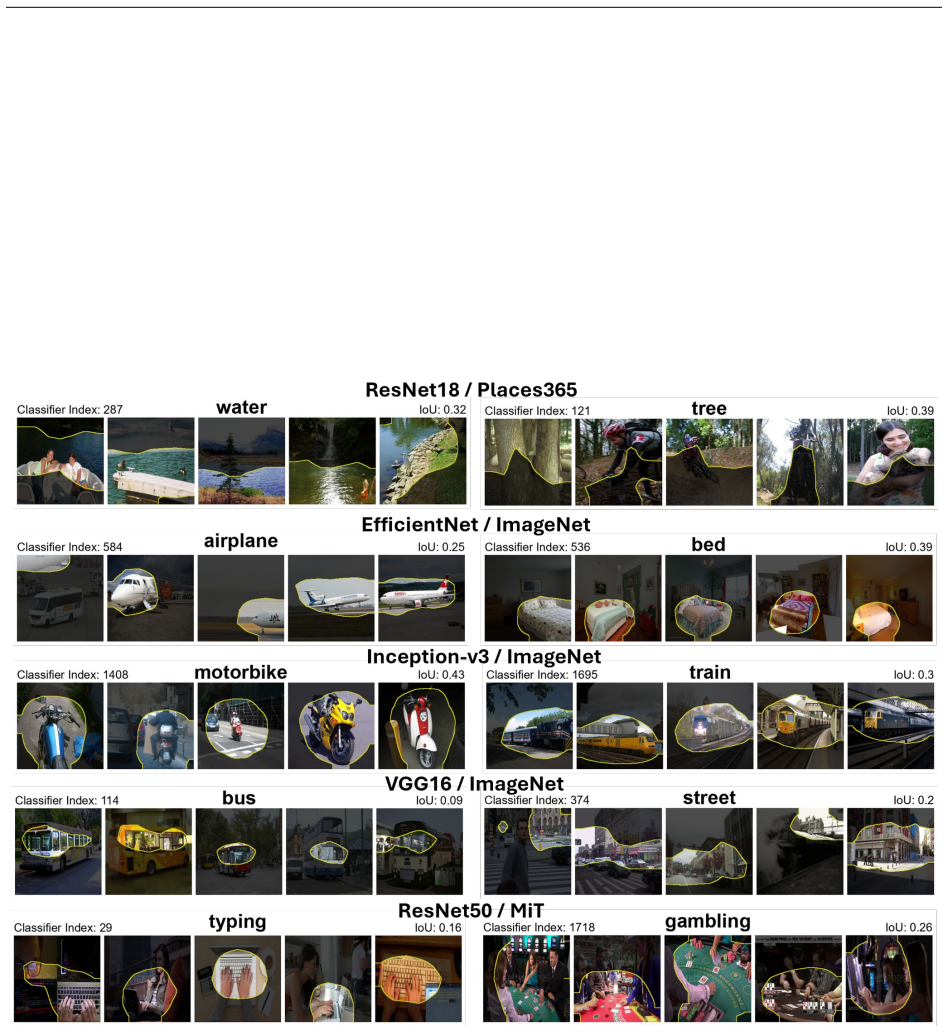
Summary. The paper proposes Encoding-Decoding Direction Pairs (EDDP), an unsupervised method to recover, for concepts encoded as directions in a deep network's latent space, both a decoding direction (filter/concept detector) and an encoding direction (signal vector). The decoding directions are obtained by directional clustering with sparsity losses, the encoding directions by a covariance-based signal-vector estimator applied to concept-positive subsamples, and the search is guided by a novel Uncertainty Region Alignment (URA) loss that aligns the uncertainty region of the concept detectors with that of the network. The method is validated on synthetic data with ground-truth direction pairs, on several CNN architectures (ResNet18, ResNet50, EfficientNet, Inception-v3, VGG16) with interpretability and influence metrics, and through applications including global sensitivity analysis, local Concept Contribution Maps, counterfactual explanations, and model correction on a toy watermark task.
Significance. If fully validated, this would be a useful contribution to unsupervised concept discovery in vision networks: it explicitly separates decoding from encoding directions, avoids feature-reconstruction objectives, and leverages network weights via URA. The paper's strengths include a controlled synthetic experiment with perfect recovery, a broad evaluation across five architectures, careful ablations, and a concrete model-correction demonstration where the learned signal vector agrees with a supervised Pattern-CAV (cosine 0.99). However, the real-world faithfulness claim for signal vectors rests on an independence assumption that is asserted rather than tested, and on a dreaming-direction validation that is partly circular. These issues are load-bearing for the central claim (c), so the current evidence is not yet conclusive.
major comments (4)
- [Section 4.3, Eq. (1)] The unbiasedness of the signal-vector estimator ŝ_i = cov[x_p, α_{p,i}]/var[α_{p,i}] requires that, within the subsample of patches containing concept i, α_{p,i} is uncorrelated with all other concept factors α_{p,j} and all distractor coefficients β_{p,f}. The paper states that these 'can be considered independent by assumption' after removing detection biases, but this is not generally true for natural concepts (e.g., patches containing 'car' are more likely to contain 'road' and less likely to contain 'sky'). L_fso encourages w_i ⊥ ŝ_j but does not remove correlations among the α factors, and URA is an indirect heuristic. This is load-bearing for claim (c). Please provide either an empirical test of the residual correlations on real features, or an alternative validation of signal-vector fidelity that does not rely on the learned decoding direction (e.g., compare with supervised Patte
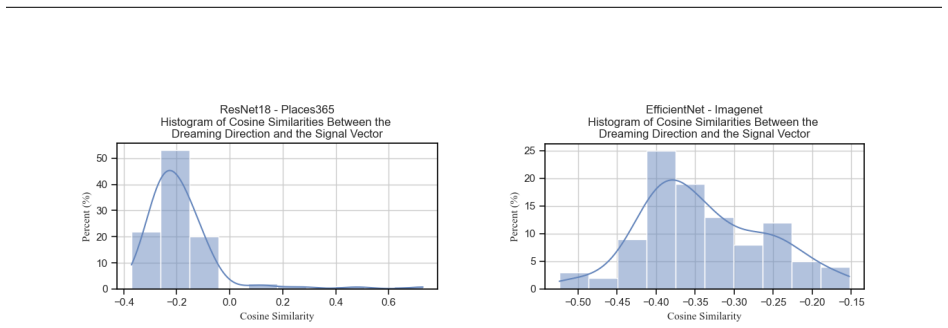
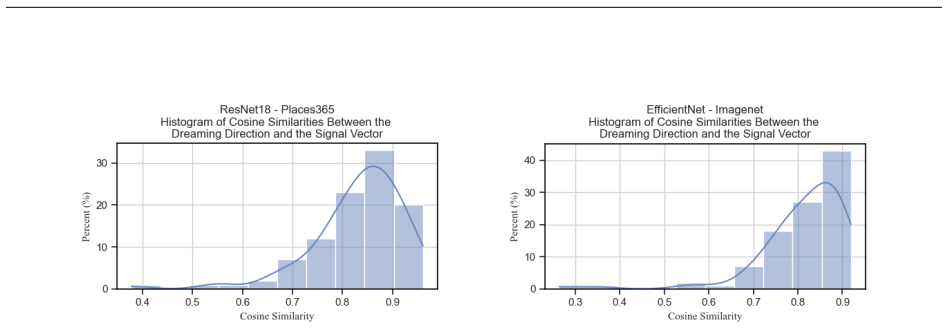
- [Section 7.2, Figures 9–13] The 'dreaming direction' faithfulness check is partly circular. The direction is obtained by maximizing the learned decoding direction w_i, then fitting a line to the feature evolution during that optimization. Any signal vector lying near the span of w_i and the model's Jacobian will appear consistent with this direction, so high cosine similarity does not independently confirm that ŝ_i is the true encoding direction. The histograms (e.g., Figs. 11–12) report that ~90% of directions exceed 0.7, but no comparison is made to random directions or to directions learned by an independent method. This weakens claim (c) for real data. I recommend adding a non-circular validation, such as the supervised Pattern-CAV comparison from Section 7.11.4 applied to multiple concepts, or a baseline using random or shuffled directions to calibrate the cosine-similarity threshold.
- [Section 7.5, Tables 3–7] The influence metric I1 shows EDDP variants ranked last in most cases (e.g., ResNet18: I1=0.58–0.63 vs. PCA 0.73–0.74; EfficientNet: 0.94 vs. PCA 0.95). The paper interprets this as an interpretability–influence trade-off, but this is not established. Since the title and abstract emphasize 'concepts of influence', the lower I1 should be discussed more carefully or matched against the significant-direction metrics (SDC/SCDP) where EDDP-C improves with L_cur. Without this, the claim that the method recovers 'concepts of influence' in the unsupervised comparison is only weakly supported.
- [Section 7.11.5 and Eq. (33)] The model-correction experiment is a convincing demonstration for a single, artificially injected concept, and the cosine similarity of 0.99 to the supervised Pattern-CAV is encouraging. However, this is a toy setup where the watermark is a low-dimensional, highly localized artifact. It does not resolve the concern that real-world concepts are correlated and high-dimensional. Please clarify how this evidence generalizes to the broader claim (c).
minor comments (5)
- [Figure 8 caption] Typo: 'In constrast' should be 'In contrast'. Also the caption lists four items but the numbering is confusing; please renumber or use clearer labels.
- [Section 7.1] Typo: 'EDPP' should be 'EDDP' in the description of the basis change for PCA and EDDP.
- [Section 4.3] The notation mixes a_{p,i}, α_{p,i}, and a_p,i. Please standardize to α_{p,i} throughout.
- [Section 4.4] The URA loss L_ur is defined with a negative sign: -E[H(f+(X'))]. Since maximizing entropy should reduce uncertainty, the sign convention should be stated explicitly in the text to avoid confusion.
- [Section A.11, Tables 24–25] The comparison with CBE /w Luur is informative, but the notation 'Ortho' is not defined in the table; please add a footnote explaining the columns.
Circularity Check
No significant circularity: the paper derives signal-vector estimators from an explicit probabilistic model, tests recovery on synthetic ground truth, and evaluates interpretability against external labels; the main weaknesses are an asserted independence assumption and a heuristic dreaming-direction validation, which are correctness concerns rather than circular reductions.
full rationale
The central derivation chain is not circular. The signal-vector estimator (Section 4.3) is a covariance-based statistical estimator, not a parameter fitted to the quantity it later validates. Its unbiasedness is proved under an explicit independence condition; the paper then asserts, rather than demonstrates, that this condition holds after subsampling positive patches. That is an unvalidated assumption, and a real correctness risk, but it is not a case of defining the estimator in terms of the target direction or of fitting the direction to the validation target. On synthetic data, the method is checked against independently generated ground-truth direction matrices S and D, with the unsupervised pipeline recovering those directions; this is an external, self-contained test. On real data, interpretability is evaluated by Network Dissection/Broden labels and compared with PCA, NMF, and natural-basis baselines, so the interpretability claims are anchored to external annotations rather than to the method's own outputs. The influence evaluation uses RCAV sensitivity with a permutation test against random directions. The main validation concern is Section 7.2's 'dreaming direction' faithfulness check: the features used to estimate the dreaming direction are optimized to increase the same decoding direction w that is also used, via the filter, to define the signal values entering the signal-vector estimate. Thus the check is not an independent ground truth and may share dependence on w. However, the paper does not equate the dreaming direction to the signal vector by any formula, nor does it train the signal vector to match the dreaming direction, so this is a weakness in the validation design, not a circular derivation by construction. The self-citations to Doumanoglou et al. (2023; 2024) supply the base clustering losses and prior UIBE/CBE method; these are not used as a load-bearing uniqueness theorem, and the paper provides its own comparisons and ablations against those prior methods. Overall, the paper is largely self-contained and its central claims do not reduce to their inputs.
Assumptions & free parameters
free parameters (5)
- I, number of concept detectors/clusters =
384-2048 depending on network
- lambda_fs, lambda_ur (loss weights) =
2.6 and 0.25 respectively
- tau_mm (target margin) =
5.0 or 6.0 per network
- tau_ma, tau_ic, tau_eac, tau_fso (constraint targets) =
0.8, 0, 0, 0.01 respectively
- sharpening factors mu, nu, gamma and rho =
mu=2.0, nu=2.0, gamma=2.0, rho varies
assumptions (5)
- domain assumption Linear representation hypothesis
- ad hoc to paper Multi-concept signal-distractor model (Eq. 3)
- ad hoc to paper Post-subsampling independence of signal values
- domain assumption Distractor orthogonality approximately achieved without explicit distractor estimation
- standard math Network Dissection provides a valid interpretability proxy
invented entities (2)
-
Signal vector s_i
independent evidence
-
Uncertainty Region Alignment (URA)
independent evidence
Cite this review
Pith. "Pith review of Learning Encoding-Decoding Direction Pairs to Unveil Concepts of Influence in Deep Vision Networks." pith.science (2026). https://pith.science/paper/4AHJV4A7
@misc{pith2026250923926,
  author       = {Pith},
  title        = {Pith review of: Learning Encoding-Decoding Direction Pairs to Unveil Concepts of Influence in Deep Vision Networks},
  year         = {2026},
  howpublished = {\url{https://pith.science/paper/4AHJV4A7}},
  note         = {Machine review of arXiv:2509.23926}
}
read the original abstract
Empirical evidence shows that deep vision networks often represent concepts as directions in latent space with concept information written along directional components in the vector representation of the input. However, the mechanism to encode (write) and decode (read) concept information to and from vector representations is not directly accessible as it constitutes a latent mechanism that naturally emerges from the training process of the network. Recovering this mechanism unlocks significant potential to open the black-box nature of deep networks, enabling understanding, debugging, and improving deep learning models. In this work, we propose an unsupervised method to recover this mechanism. For each concept, we explain that under the hypothesis of linear concept representations, this mechanism can be implemented with the help of two directions: the first facilitating encoding of concept information and the second facilitating decoding. Unlike prior matrix decomposition, autoencoder, or dictionary learning methods that rely on feature reconstruction, we propose a new perspective: decoding directions are identified via directional clustering of activations, and encoding directions are estimated with signal vectors under a probabilistic view. We further leverage network weights through a novel technique, Uncertainty Region Alignment, which reveals interpretable directions affecting predictions. Our analysis shows that (a) on synthetic data, our method recovers ground-truth direction pairs; (b) on real data, decoding directions map to monosemantic, interpretable concepts and outperform unsupervised baselines; and (c) signal vectors faithfully estimate encoding directions, validated via activation maximization. Finally, we demonstrate applications in understanding global model behavior, explaining individual predictions, and intervening to produce counterfactuals or correct errors.
Figures


Figures from the paper (49 more)












Forward citations
Cited by 1 Pith paper
-
Why Fake ? Unveiling the Semantic Vocabulary of Deepfake Detectors
Applying Encoding-Decoding Direction Pairs to an Xception deepfake detector reveals 16 interpretable concepts (e.g., fake-mouth, real-eyes) that drive real/fake predictions, with concept-level interventions achieving ...
Reference graph
Works this paper leans on
-
[1]
Understanding intermediate layers using linear classifier probes
Guillaume Alain and Yoshua Bengio. Understanding intermediate layers using linear classifier probes. arXiv:1610.01644 [cs, stat], November 2018. arXiv: 1610.01644
arXiv 2018
-
[2]
Anders, Leander Weber, David Neumann, Wojciech Samek, Klaus-Robert Müller, and Sebastian Lapuschkin
Christopher J. Anders, Leander Weber, David Neumann, Wojciech Samek, Klaus-Robert Müller, and Sebastian Lapuschkin. Finding and removing clever hans: Using explanation methods to debug and improve deep models. Information Fusion, 77: 0 261--295, 2022. ISSN 1566-2535
2022
-
[3]
Network dissection: Quantifying interpretability of deep visual representations
David Bau, Bolei Zhou, Aditya Khosla, Aude Oliva, and Antonio Torralba. Network dissection: Quantifying interpretability of deep visual representations. arXiv:1704.05796 [cs], April 2017. arXiv: 1704.05796
arXiv 2017
-
[4]
Show and tell: Visually explainable deep neural nets via spatially-aware concept bottleneck models
Itay Benou and Tammy Riklin Raviv. Show and tell: Visually explainable deep neural nets via spatially-aware concept bottleneck models. In Proceedings of the Computer Vision and Pattern Recognition Conference, pp.\ 30063--30072, 2025
2025
-
[5]
Mechanistic interpretability for ai safety--a review
Leonard Bereska and Efstratios Gavves. Mechanistic interpretability for ai safety--a review. arXiv preprint arXiv:2404.14082, 2024
arXiv 2024
-
[6]
Constrained optimization and Lagrange multiplier methods
Dimitri P Bertsekas. Constrained optimization and Lagrange multiplier methods. Academic press, 2014
2014
-
[7]
Towards monosemanticity: Decomposing language models with dictionary learning
Trenton Bricken, Adly Templeton, Joshua Batson, Brian Chen, Adam Jermyn, Tom Conerly, Nick Turner, Cem Anil, Carson Denison, Amanda Askell, Robert Lasenby, Yifan Wu, Shauna Kravec, Nicholas Schiefer, Tim Maxwell, Nicholas Joseph, Zac Hatfield-Dodds, Alex Tamkin, Karina Nguyen, Brayden McLean, Josiah E Burke, Tristan Hume, Shan Carter, Tom Henighan, and Ch...
2023
-
[8]
Learning multi-level features with matryoshka sparse autoencoders
Bart Bussmann, Noa Nabeshima, Adam Karvonen, and Neel Nanda. Learning multi-level features with matryoshka sparse autoencoders. In Forty-second International Conference on Machine Learning, 2025
2025
Show all 67 references
-
[9]
Emerging properties in self-supervised vision transformers
Mathilde Caron, Hugo Touvron, Ishan Misra, Herv \'e J \'e gou, Julien Mairal, Piotr Bojanowski, and Armand Joulin. Emerging properties in self-supervised vision transformers. In Proceedings of the IEEE/CVF international conference on computer vision, pp.\ 9650--9660, 2021
2021
-
[10]
Disentangled explanations of neural network predictions by finding relevant subspaces
Pattarawat Chormai, Jan Herrmann, Klaus-Robert M \"u ller, and Gr \'e goire Montavon. Disentangled explanations of neural network predictions by finding relevant subspaces. IEEE Transactions on Pattern Analysis and Machine Intelligence, 2024
2024
-
[11]
Sparse autoencoders find highly interpretable features in language models
Hoagy Cunningham, Aidan Ewart, Logan Riggs, Robert Huben, and Lee Sharkey. Sparse autoencoders find highly interpretable features in language models. In International Conference on Learning Representations (ICLR), October 2024
2024
-
[12]
Imagenet: A large-scale hierarchical image database
Jia Deng, Wei Dong, Richard Socher, Li-Jia Li, Kai Li, and Li Fei-Fei. Imagenet: A large-scale hierarchical image database. In 2009 IEEE conference on computer vision and pattern recognition, pp.\ 248--255. Ieee, 2009
2009
-
[13]
Unsupervised interpretable basis extraction for concept--based visual explanations
Alexandros Doumanoglou, Stylianos Asteriadis, and Dimitrios Zarpalas. Unsupervised interpretable basis extraction for concept--based visual explanations. IEEE Transactions on Artificial Intelligence, 2023
2023
-
[14]
Concept basis extraction for latent space interpretation of image classifiers
Alexandros Doumanoglou, Dimitrios Zarpalas, and Kurt Driessens. Concept basis extraction for latent space interpretation of image classifiers. VISIGRAPP. Proceedings, 3: 0 417--424, 2024. ISSN 2184-4321
2024
-
[15]
From hope to safety: Unlearning biases of deep models via gradient penalization in latent space
Maximilian Dreyer, Frederik Pahde, Christopher J Anders, Wojciech Samek, and Sebastian Lapuschkin. From hope to safety: Unlearning biases of deep models via gradient penalization in latent space. In Proceedings of the AAAI Conference on Artificial Intelligence, volume 38, pp.\...
2024
-
[16]
Pure: Turning polysemantic neurons into pure features by identifying relevant circuits
Maximilian Dreyer, Erblina Purelku, Johanna Vielhaben, Wojciech Samek, and Sebastian Lapuschkin. Pure: Turning polysemantic neurons into pure features by identifying relevant circuits. In Proceedings of the IEEE/CVF Conference on Computer Vision and Pattern Recognition, pp.\ 8...
2024
-
[17]
Toy models of superposition
Nelson Elhage, Tristan Hume, Catherine Olsson, Nicholas Schiefer, Tom Henighan, Shauna Kravec, Zac Hatfield-Dodds, Robert Lasenby, Dawn Drain, Carol Chen, et al. Toy models of superposition. arXiv preprint arXiv:2209.10652, 2022
2022 arXiv
-
[18]
Decomposing the dark matter of sparse autoencoders
Joshua Engels, Logan Riggs Smith, and Max Tegmark. Decomposing the dark matter of sparse autoencoders. Transactions on Machine Learning Research, 2025. ISSN 2835-8856. URL https://openreview.net/forum?id=sXq3Wb3vef
2025
-
[19]
Unlocking feature visualization for deep network with magnitude constrained optimization
Thomas Fel, Thibaut Boissin, Victor Boutin, Agustin Picard, Paul Novello, Julien Colin, Drew Linsley, Tom Rousseau, R \'e mi Cad \`e ne, Lore Goetschalckx, et al. Unlocking feature visualization for deep network with magnitude constrained optimization. Advances in Neural Infor...
2023
-
[20]
A holistic approach to unifying automatic concept extraction and concept importance estimation
Thomas Fel, Victor Boutin, Louis B\' e thune, Remi Cadene, Mazda Moayeri, L\' e o And\' e ol, Mathieu Chalvidal, and Thomas Serre. A holistic approach to unifying automatic concept extraction and concept importance estimation. In Advances in Neural Information Processing Syste...
2023
-
[21]
Craft: Concept recursive activation factorization for explainability
Thomas Fel, Agustin Picard, Louis Bethune, Thibaut Boissin, David Vigouroux, Julien Colin, Rémi Cadénc, and Thomas Serre. Craft: Concept recursive activation factorization for explainability. In 2023 IEEE/CVF Conference on Computer Vision and Pattern Recognition (CVPR), pp.\ 2...
2023
-
[22]
Large-scale unsupervised semantic segmentation
Shanghua Gao, Zhong-Yu Li, Ming-Hsuan Yang, Ming-Ming Cheng, Junwei Han, and Philip Torr. Large-scale unsupervised semantic segmentation. TPAMI, 2022
2022
-
[23]
Concept discovery and dataset exploration with singular value decomposition
Mara Graziani, An-phi Nguyen, Laura O’Mahony, Henning M \"u ller, and Vincent Andrearczyk. Concept discovery and dataset exploration with singular value decomposition. In ICLR 2023 Workshop on Pitfalls of limited data and computation for Trustworthy ML, 2023 a
2023
-
[24]
Uncovering unique concept vectors through latent space decomposition
Mara Graziani, Laura O'Mahony, An phi Nguyen, Henning M \"u ller, and Vincent Andrearczyk. Uncovering unique concept vectors through latent space decomposition. Transactions on Machine Learning Research, 2023 b . ISSN 2835-8856. URL https://openreview.net/forum?id=LT4DXqUJTD
2023
-
[25]
On the interpretation of weight vectors of linear models in multivariate neuroimaging
Stefan Haufe, Frank Meinecke, Kai Görgen, Sven Dähne, John-Dylan Haynes, Benjamin Blankertz, and Felix Bießmann. On the interpretation of weight vectors of linear models in multivariate neuroimaging. NeuroImage, 87: 0 96–110, February 2014. ISSN 1053-8119
2014
-
[26]
Deep residual learning for image recognition
Kaiming He, Xiangyu Zhang, Shaoqing Ren, and Jian Sun. Deep residual learning for image recognition. In Proceedings of the IEEE conference on computer vision and pattern recognition, pp.\ 770--778, 2016
2016
-
[27]
Masked autoencoders are scalable vision learners
Kaiming He, Xinlei Chen, Saining Xie, Yanghao Li, Piotr Doll \'a r, and Ross Girshick. Masked autoencoders are scalable vision learners. In Proceedings of the IEEE/CVF conference on computer vision and pattern recognition, pp.\ 16000--16009, 2022
2022
-
[28]
Multiplier and gradient methods
Magnus R Hestenes. Multiplier and gradient methods. Journal of optimization theory and applications, 4 0 (5): 0 303--320, 1969
1969
-
[29]
Which direction to choose? an analysis on the representation power of self-supervised vits in downstream tasks
Yannis Kaltampanidis, Alexandros Doumanoglou, and Dimitrios Zarpalas. Which direction to choose? an analysis on the representation power of self-supervised vits in downstream tasks. In 3rd World Conference on eXplainable Artificial Intelligence (XAI), 2025. URL https://zenodo....
2025
-
[30]
Explaining ai through mechanistic interpretability
Lena K \"a stner and Barnaby Crook. Explaining ai through mechanistic interpretability. European journal for philosophy of science, 14 0 (4): 0 52, 2024
2024
-
[31]
Interpretability beyond feature attribution: Quantitative testing with concept activation vectors (tcav), June 2018
Been Kim, Martin Wattenberg, Justin Gilmer, Carrie Cai, James Wexler, Fernanda Viegas, and Rory Sayres. Interpretability beyond feature attribution: Quantitative testing with concept activation vectors (tcav), June 2018. arXiv: 1711.11279
2018 arXiv
-
[32]
Schütt, Maximilian Alber, Klaus-Robert Müller, Dumitru Erhan, Been Kim, and Sven Dähne
Pieter-Jan Kindermans, Kristof T. Schütt, Maximilian Alber, Klaus-Robert Müller, Dumitru Erhan, Been Kim, and Sven Dähne. Learning how to explain neural networks: Patternnet and patternattribution, October 2017. arXiv: 1705.05598
2017 arXiv
-
[33]
Adam: A method for stochastic optimization
Diederik P Kingma. Adam: A method for stochastic optimization. arXiv preprint arXiv:1412.6980, 2014
2014 arXiv
-
[34]
Concept bottleneck models
Pang Wei Koh, Thao Nguyen, Yew Siang Tang, Stephen Mussmann, Emma Pierson, Been Kim, and Percy Liang. Concept bottleneck models. In International conference on machine learning, pp.\ 5338--5348. PMLR, 2020
2020
-
[35]
Sparse autoencoders reveal selective remapping of visual concepts during adaptation, December 2024
Hyesu Lim, Jinho Choi, Jaegul Choo, and Steffen Schneider. Sparse autoencoders reveal selective remapping of visual concepts during adaptation, December 2024. arXiv:2412.05276 [cs]
2024 arXiv
-
[36]
Focal loss for dense object detection
Tsung-Yi Lin, Priya Goyal, Ross Girshick, Kaiming He, and Piotr Doll \'a r. Focal loss for dense object detection. In Proceedings of the IEEE international conference on computer vision, pp.\ 2980--2988, 2017
2017
-
[37]
SGDR : Stochastic gradient descent with warm restarts
Ilya Loshchilov and Frank Hutter. SGDR : Stochastic gradient descent with warm restarts. arXiv preprint arXiv:1608.03983, 2016
2016 arXiv
-
[38]
Understanding deep image representations by inverting them
Aravindh Mahendran and Andrea Vedaldi. Understanding deep image representations by inverting them. In Proceedings of the IEEE conference on computer vision and pattern recognition, pp.\ 5188--5196, 2015
2015
-
[39]
Visualizing deep convolutional neural networks using natural pre-images
Aravindh Mahendran and Andrea Vedaldi. Visualizing deep convolutional neural networks using natural pre-images. International Journal of Computer Vision, 120 0 (3): 0 233--255, 2016
2016
-
[40]
Moments in time dataset: one million videos for event understanding
Mathew Monfort, Alex Andonian, Bolei Zhou, Kandan Ramakrishnan, Sarah Adel Bargal, Tom Yan, Lisa Brown, Quanfu Fan, Dan Gutfruend, Carl Vondrick, et al. Moments in time dataset: one million videos for event understanding. IEEE Transactions on Pattern Analysis and Machine Intel...
2019
-
[41]
Emergent linear representations in world models of self-supervised sequence models
Neel Nanda, Andrew Lee, and Martin Wattenberg. Emergent linear representations in world models of self-supervised sequence models. In Proceedings of the 6th BlackboxNLP Workshop: Analyzing and Interpreting Neural Networks for NLP, BlackboxNLP@EMNLP 2023, Singapore, December 7,...
2023
-
[42]
Sparse autoencoder
Andrew Ng et al. Sparse autoencoder. CS294A Lecture notes, 72 0 (2011): 0 1--19, 2011
2011
-
[43]
Understanding neural networks via feature visualization: A survey
Anh Nguyen, Jason Yosinski, and Jeff Clune. Understanding neural networks via feature visualization: A survey. Explainable AI: interpreting, explaining and visualizing deep learning, pp.\ 55--76, 2019
2019
-
[44]
Label-free concept bottleneck models
Tuomas Oikarinen, Subhro Das, Lam M Nguyen, and Tsui-Wei Weng. Label-free concept bottleneck models. In The 11th International Conference on Learning Representations, 2023
2023
-
[45]
Feature visualization
Chris Olah, Alexander Mordvintsev, and Ludwig Schubert. Feature visualization. Distill, 2 0 (11): 0 e7, 2017
2017
-
[46]
Reveal to revise: An explainable ai life cycle for iterative bias correction of deep models
Frederik Pahde, Maximilian Dreyer, Wojciech Samek, and Sebastian Lapuschkin. Reveal to revise: An explainable ai life cycle for iterative bias correction of deep models. In Medical Image Computing and Computer Assisted Intervention – MICCAI 2023, Lecture Notes in Computer Scie...
2023
-
[47]
Anders, Thomas Wiegand, Wojciech Samek, and Sebastian Lapuschkin
Frederik Pahde, Maximilian Dreyer, Leander Weber, Moritz Weckbecker, Christopher J. Anders, Thomas Wiegand, Wojciech Samek, and Sebastian Lapuschkin. Navigating neural space: Revisiting concept activation vectors to overcome directional divergence, 2024
2024
-
[48]
Robust semantic interpretability: Revisiting concept activation vectors
Jacob Pfau, Albert T Young, Jerome Wei, Maria L Wei, and Michael J Keiser. Robust semantic interpretability: Revisiting concept activation vectors. In Fifth Annual Workshop on Human Interpretability in Machine Learning (WHI), ICML 2020, 2020, 2020
2020
-
[49]
Learning transferable visual models from natural language supervision
Alec Radford, Jong Wook Kim, Chris Hallacy, Aditya Ramesh, Gabriel Goh, Sandhini Agarwal, Girish Sastry, Amanda Askell, Pamela Mishkin, Jack Clark, et al. Learning transferable visual models from natural language supervision. In International conference on machine learning, pp...
2021
-
[50]
Searching for activation functions
Prajit Ramachandran, Barret Zoph, and Quoc V Le. Searching for activation functions. arXiv preprint arXiv:1710.05941, 2017
2017 arXiv
-
[51]
Identifying interpretable action concepts in deep networks
Kandan Ramakrishnan, Mathew Monfort, Barry A McNamara, Alex Lascelles, Dan Gutfreund, Rog \'e rio Schmidt Feris, and Aude Oliva. Identifying interpretable action concepts in deep networks. In CVPR Workshops, pp.\ 12--15, 2019
2019
-
[52]
Discover-then-name: Task-agnostic concept bottlenecks via automated concept discovery
Sukrut Rao, Sweta Mahajan, Moritz B \"o hle, and Bernt Schiele. Discover-then-name: Task-agnostic concept bottlenecks via automated concept discovery. In European Conference on Computer Vision, pp.\ 444--461. Springer, 2024
2024
-
[53]
Mechanistic? arXiv preprint arXiv:2410.09087, 2024
Naomi Saphra and Sarah Wiegreffe. Mechanistic? arXiv preprint arXiv:2410.09087, 2024
2024 arXiv
-
[54]
Taking features out of superposition with sparse autoencoders, 2022
L Sharkey, D Braun, and B Millidge. Taking features out of superposition with sparse autoencoders, 2022. URL https://www.alignmentforum.org/posts/z6QQJbtpkEAX3Aojj/interim-research-report-taking-features-out-of-superposition
2022
-
[55]
What does clip know about a red circle? visual prompt engineering for vlms
Aleksandar Shtedritski, Christian Rupprecht, and Andrea Vedaldi. What does clip know about a red circle? visual prompt engineering for vlms. In Proceedings of the IEEE/CVF International Conference on Computer Vision, pp.\ 11987--11997, 2023
2023
-
[56]
Very deep convolutional networks for large-scale image recognition
Karen Simonyan and Andrew Zisserman. Very deep convolutional networks for large-scale image recognition. arXiv preprint arXiv:1409.1556, 2014
2014 arXiv
-
[57]
Goodfellow, and Rob Fergus
Christian Szegedy, Wojciech Zaremba, Ilya Sutskever, Joan Bruna, Dumitru Erhan, Ian J. Goodfellow, and Rob Fergus. Intriguing properties of neural networks. In 2nd International Conference on Learning Representations, ICLR 2014, Banff, AB, Canada, April 14-16, 2014, Conference...
2014
-
[58]
Rethinking the inception architecture for computer vision
Christian Szegedy, Vincent Vanhoucke, Sergey Ioffe, Jon Shlens, and Zbigniew Wojna. Rethinking the inception architecture for computer vision. In Proceedings of the IEEE conference on computer vision and pattern recognition, pp.\ 2818--2826, 2016
2016
-
[59]
Efficientnet: Rethinking model scaling for convolutional neural networks
Mingxing Tan and Quoc Le. Efficientnet: Rethinking model scaling for convolutional neural networks. In International conference on machine learning, pp.\ 6105--6114. PMLR, 2019
2019
-
[60]
Multi-dimensional concept discovery ( MCD ): A unifying framework with completeness guarantees
Johanna Vielhaben, Stefan Bluecher, and Nils Strodthoff. Multi-dimensional concept discovery ( MCD ): A unifying framework with completeness guarantees. Transactions on Machine Learning Research, 2023. ISSN 2835-8856. URL https://openreview.net/forum?id=KxBQPz7HKh
2023
-
[61]
pytorch-nmf: Non-negative matrix fatorization in pytorch
Chin Yun Yu. pytorch-nmf: Non-negative matrix fatorization in pytorch. https://github.com/yoyolicoris/pytorch-NMF, 2020. Accessed: 2025-08-01
2020
-
[62]
Post-hoc concept bottleneck models
Mert Yuksekgonul, Maggie Wang, and James Zou. Post-hoc concept bottleneck models. In The 11th International Conference on Learning Representations, 2023
2023
-
[63]
Olshausen, and Yann LeCun
Zeyu Yun, Yubei Chen, Bruno A. Olshausen, and Yann LeCun. Transformer visualization via dictionary learning: contextualized embedding as a linear superposition of transformer factors, April 2023. arXiv:2103.15949 [cs]
2023 arXiv
-
[64]
Invertible concept-based explanations for cnn models with non-negative concept activation vectors
Ruihan Zhang, Prashan Madumal, Tim Miller, Krista A Ehinger, and Benjamin IP Rubinstein. Invertible concept-based explanations for cnn models with non-negative concept activation vectors. In Proceedings of the AAAI Conference on Artificial Intelligence, volume 35, pp.\ 11682--...
2021
-
[65]
Places: A 10 million image database for scene recognition
Bolei Zhou, Agata Lapedriza, Aditya Khosla, Aude Oliva, and Antonio Torralba. Places: A 10 million image database for scene recognition. IEEE transactions on pattern analysis and machine intelligence, 40 0 (6): 0 1452--1464, 2017
2017
-
[66]
Interpretable basis decomposition for visual explanation
Bolei Zhou, Yiyou Sun, David Bau, and Antonio Torralba. Interpretable basis decomposition for visual explanation. In European Conference on Computer Vision (ECCV), pp.\ 119–134, 2018
2018
-
[67]
write newline
" write newline "" before.all 'output.state := FUNCTION n.dashify 't := "" t empty not t #1 #1 substring "-" = t #1 #2 substring "--" = not "--" * t #2 global.max substring 't := t #1 #1 substring "-" = "-" * t #2 global.max substring 't := while if t #1 #1 substring * t #2 gl...
Reviewed August 4, 2026 · model on record in the stance chip above.
Discussion (0). Sign in to comment.