REVIEW 3 major objections 4 minor 1 cited by
Transverse momentum dependent parton distributions of pion in the light-front holographic model
T0 review · 3 major / 4 minor · reviewed 2026-08-14 · deepseek-v4-flash
Pith's one-line read The light-front holographic model, with a spin-improved wave function, predicts analytic pion TMDs and a measurable Sudakov broadening of $f_{1\pi}$ between $Q_0=0.316$ GeV and $Q=1$ GeV.
desk verdict The paper's model application is new and worth a look, but the central unpolarized TMD as printed does not follow from its own wave functions, so all numerical results inherit an unverified x-dependent prefactor. read the letter →
The pith
A machine-rendered reading of the paper's core claim, the machinery that carries it, and where it could break.
The reading
What carries the argument
The load-bearing object is the spin-improved light-front holographic wave function of the pion, built as the product of the holographic momentum-space wave function $\psi_\pi(x,k_\perp)=\frac{4\pi N_0}{\kappa}\sqrt{x(1-x)}\exp[-(k_\perp^2+m^2)/(2\kappa^2 x(1-x))]$ and a spin wave function $\varphi_\pi(\lambda_1,\lambda_2)$ with parameters $A=B=1$. From this wave function the paper obtains two pion light-front wave-function amplitudes, $\Psi_\pi^{(0)}$ for $L_z=0$ and $\Psi_\pi^{(1)}$ for $|L_z|=1$, whose overlap yields the unpolarized TMD in Eq. (13); the Boer-Mulders function in Eq. (18) follows from expanding the Wilson line to one gluon exchange between the struck quark and spectator. The evolution machinery is the $b_\perp$-space TMD evolution formula with the Sudakov form factor, using $b_*(b_\perp)$ and a nonperturbative function $g_K(b_\perp)=-g_2 b_\perp^2/2$ with $g_2=0.09$ or $0.13$.
What would settle it
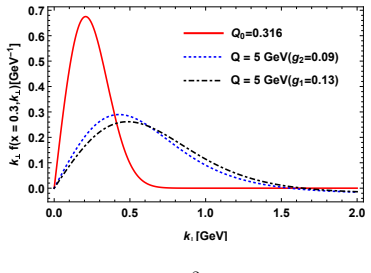
Measure the unpolarized pion TMD through pion-induced Drell-Yan or SIDIS at $Q\approx 1$ GeV and compare the evolved $f_{1\pi}(x=0.3,k_\perp)$ from Eq. (13): the model predicts the $k_\perp$ peak moves from $0.2$ GeV at $Q_0=0.316$ GeV to roughly $0.4$ GeV ($g_2=0.09$) or $0.5$ GeV ($g_2=0.13$) and the distribution broadens. If the observed peak location or the double-peak shape at small $k_\perp$ is absent, the spin-improved holographic input or the $g_2$ dependence of the evolution is ruled out.
Extended reading notes
Core claim
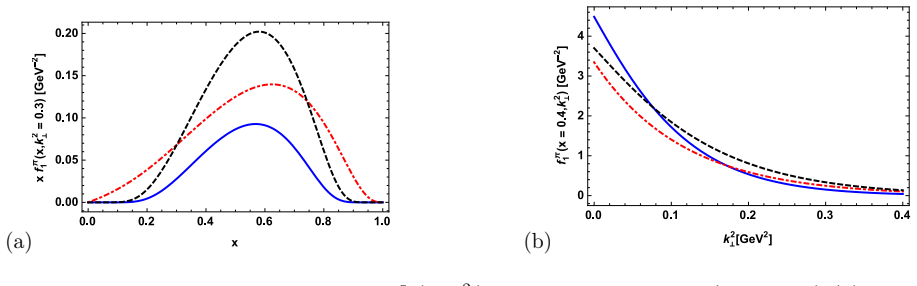
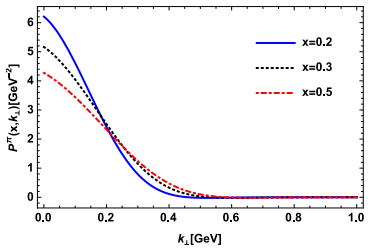
Using the spin-improved light-front holographic wave function, which includes the $L_z=0$ and $|L_z|=1$ orbital angular momentum components of the valence $|q\bar q\rangle$ Fock state, the paper derives the unpolarized pion TMD as $f_{1\pi}(x,k_\perp^2)$ in Eq. (13) and the Boer-Mulders function as $h_{1\pi}^\perp(x,k_\perp^2)$ in Eq. (18). The $f_{1\pi}$ expression is an overlap of the two light-front wave-function amplitudes and reduces to a Gaussian in $k_\perp$ modulated by $[k_\perp^2+(m+x(1-x)M_\pi)^2]$; the Boer-Mulders function comes from a one-gluon-exchange final-state interaction through the Wilson line and satisfies the model-independent positivity bound $f_{1\pi}\ge (k_\perp/M_\pi)|h_{1\pi}^\perp|$ at all $x$ and $k_\perp$. Both distributions are symmetric under $x\leftrightarrow 1-x$, yielding a double-peak structure at small $k_\perp$ that merges into a single Gaussian at larger $k_\perp$, and the evolution of $f_{1\pi}$ from $Q_0=0.316$ GeV to $Q=1$ GeV in $b_\perp$-space exhibits Sudakov broadening whose size depends on $g_2$.
Load-bearing premise
The whole prediction inherits its absolute size and shape from an earlier fit of the model parameters $\kappa=523$ MeV, $m=330$ MeV, $M_\pi=139$ MeV and $A=B=1$ to pion decay constant, charge radius, and form factor; no pion TMD data anchor these curves, so if that fit is not valid for TMDs at leading twist the predicted normalization and $x,k_\perp$ dependence shift accordingly.
Editorial extensions
If this is right
- The analytic $f_{1\pi}$ and Boer-Mulders expressions can be used directly as model-scale inputs for phenomenological studies of pion SIDIS and Drell-Yan azimuthal asymmetries.
- The model satisfies the positivity bound $h_{1\pi}^\perp$ at all $x$ and $k_\perp$, so it provides a controlled template where the unpolarized quark probability always dominates the transversely polarized one.
- The leading-order Sudakov evolution predicts a measurable broadening: at $x=0.3$ the peak of $k_\perp f_{1\pi}$ moves from $0.2$ GeV to $0.4$-$0.5$ GeV when $Q$ rises from $0.316$ GeV to $1$ GeV.
- Because $f_{1\pi}$ and $h_{1\pi}^\perp$ are symmetric under $x\leftrightarrow 1-x$, the model predicts a double peak in $x$ at small $k_\perp$ and a single Gaussian-shaped peak at larger $k_\perp$; future data at low transverse momentum can test this shape.
- At large $k_\perp$ the model's $f_{1\pi}$ converges with light-front constituent and soft-wall AdS/QCD results, suggesting the high-transverse-momentum tail is insensitive to the detailed wave function.
Reading between the lines
- The same spin-improved holographic wave function could be applied to other pseudoscalars such as the kaon by changing quark masses; if the $A=B=1$ spin structure is universal, one would predict analogous double-peak TMDs at the kaon's lower model scale.
- The double-peak signature at small $k_\perp$ is essentially a valence-structure effect inherited from the $x\leftrightarrow 1-x$ symmetry; one might test whether any observed pion TMD asymmetry in $z$ or $Q^2$ tracks this symmetry before invoking higher Fock states.
- The evolution from such a low model scale ($0.316$ GeV) assumes the TMD is purely nonperturbative at that scale; a lattice QCD extraction of the pion TMD at moderate virtualities could settle whether the $g_2=0.09$-$0.13$ range is realistic or merely tuned.
Signed reviews
Editorial analysis
A structured set of objections, weighed in public.
Referee Report
Summary. The manuscript computes the leading-twist unpolarized TMD f1π(x,k⊥²) and the Boer-Mulders function h1π⊥(x,k⊥²) for the pion using light-front holographic wave functions with a spin-improved spin wave function. The authors quote analytic expressions in Eqs. (13) and (18), compare their results with light-front constituent and soft-wall AdS/QCD models, check the positivity bound, and perform a leading-order TMD evolution of f1 from a model scale Q0=0.316 GeV to a higher scale. The parameters κ, m, and Mπ are taken from earlier fits to pion properties. The central new objects are the closed-form TMDs and the evolved f1.
Significance. If the formulas were correct, the paper would provide simple analytic pion TMDs with parameters fixed by the pion decay constant, charge radius, and form factor, extending the light-front holographic program to transverse-momentum-dependent structure. The positivity check and the comparison with existing model calculations are conceptually useful. However, the main unpolarized result does not follow from the stated wave functions as written, and the Boer-Mulders derivation omits essential specifications; the quantitative content of the paper is therefore not currently reliable.
major comments (3)
- [Section III.A, Eqs. (4), (7), (12), (13)] The central formula Eq. (13) does not follow from the preceding equations. Direct substitution of Eq. (4) and Eq. (7) into Eq. (12) gives |Ψπ^(0)|² = (8π²N0²/κ²)(m - Mπ x(1-x))² exp[-(k⊥²+m²)/(κ²x(1-x))] and k⊥²|Ψπ^(1)|² = (8π²N0²/κ²) k⊥² exp[-(k⊥²+m²)/(κ²x(1-x))], so that f1π(x,k⊥²) = N0²/(πκ²)[k⊥² + (m - Mπ x(1-x))²] exp[-(k⊥²+m²)/(κ²x(1-x))]. The denominator 1/[x³(1-x)³] in Eq. (13) is not produced by this overlap; it appears to be inherited from the spin wave function in Eq. (6) rather than from the mapped LFWFs in Eq. (7). Since Eq. (13) underlies Figs. 1, 2, 5, and 6, the normalization condition Eq. (14), and the qualitative conclusions, all numerical results and model comparisons must be recomputed after correcting this prefactor.
- [Section III.B, Eqs. (17)-(18)] The derivation of the Boer-Mulders function is not reproducible as written. Equation (17) contains Ψ^(0)(x,k⊥) and Ψ^(1)(x',k'⊥) with k'⊥ = k⊥ - q⊥, but x' is never defined and no relation between x and x' is stated; the q⊥ integral is not evaluated in the text; and the step from Eq. (17) to Eq. (18) is not shown. In addition, the statement g² = 4πα_s(μ0) is not accompanied by any numerical value for α_s(μ0) or g², although this parameter controls the overall magnitude in Figs. 3-5 and in the positivity check in Fig. 5. Please specify x', carry out or reference the q⊥ integration, and quote the coupling value used.
- [Section IV, Eq. (20) and Fig. 6] The evolution formula Eq. (20) is incomplete as stated. The TMD is written without a rapidity scale (ζ), the Sudakov exponent ~S([b*; μ_b, μ) is not defined explicitly, and the μ0 dependence appears only through the g_K ln(μ/μ0) term. Without specifying the rapidity evolution and the exact form of ~S, Eq. (20) cannot be evaluated and Fig. 6 is not reproducible. Please supply the missing definitions or cite the exact convention used in Refs. [71-74].
minor comments (4)
- [Section III.A, Eq. (13)] The normalization constant N0 is never specified; it should be stated explicitly, or its determination from Eq. (14) should be shown, so that the plotted curves can be reproduced.
- [Section IV, Fig. 6] The caption of Fig. 6 states that the evolution is performed up to Q = 1 GeV, while the labels embedded in the figure show Q0 = 0.316 and Q = 5 GeV, with 'g1 = 0.13' instead of 'g2 = 0.13'; this inconsistency should be resolved.
- [Section IV, Fig. 6] The text says the unpolarized TMD is plotted as a function of k⊥², but the horizontal axis of Fig. 6 is labeled k⊥ [GeV]; the vertical axis is labeled k⊥ f(...) while Eq. (13) gives f(...). Please make the axes and the labels consistent with the quantity shown.
- [Section II, Eq. (6) and Eq. (7)] The spin wave function components in Eq. (6) contain explicit 1/[x(1-x)] factors, while the mapped LFWFs in Eq. (7) do not; this discrepancy is likely the source of the erroneous prefactor in Eq. (13) and should be clarified or removed.
Circularity Check
No significant circularity: the pion TMDs are computed from externally fixed holographic model parameters and independent evolution inputs; the only self-citation is a non-load-bearing model comparison.
full rationale
The central derivation is not circular. The unpolarized TMD f1π(x,k⊥²) is obtained by inserting the holographic LFWFs (Eqs. (4) and (7), with A=B=1 from Refs. [65,66]) into the overlap expression (Eq. (12)) and integrating the unpolarized correlator (Eq. (11)); the Boer-Mulders function is obtained independently from the gauge-link correlator (Eqs. (16)-(18)). The model parameters κ=523 MeV, m=330 MeV, Mπ=139 MeV are taken from external fits to the pion decay constant, charge radius, and form factor in Ref. [66]; they are not fitted to the TMDs themselves, and Eq. (14) is a normalization sum rule rather than a fit of the target distribution. The evolution in Sec. IV uses the Sudakov factor with g2 values (0.09, 0.13) taken from Ref. [54], again not tuned to the starting TMD. The only self-citation is Ref. [55] as a comparison curve in Figs. 2(a)-(b); that comparison is illustrative, not load-bearing, and no uniqueness claim is imported from it. No equation is defined in terms of the quantity it is claimed to predict, and no fitted parameter is renamed as a prediction. A separate, non-circularity concern is whether the printed Eq. (13) algebraically follows from Eq. (7) inserted into Eq. (12); if it does not, that is a derivation error, not a circularity.
Assumptions & free parameters
free parameters (7)
- kappa (scale parameter) =
523 MeV
- m (constituent quark mass) =
330 MeV
- A and B (spin wave function constants) =
A=1, B=1
- N0 (wave-function normalization) =
not specified
- g^2 (strong coupling in Boer-Mulders) =
not specified
- g2 (nonperturbative evolution parameter) =
0.09 and 0.13
- bmax (b* prescription cutoff) =
not specified
assumptions (6)
- domain assumption Fock-space truncation to the valence |q qbar> state of the pion.
- domain assumption The holographic wave function Eq. (4) is the correct momentum-space wave function from AdS/QCD for this pion.
- domain assumption The spin-improved wave function in Eqs. (5)-(7) with A=B=1 is the correct spin structure for the pion.
- domain assumption T-odd Boer-Mulders function is generated by expanding the Wilson line to one gluon exchange at order g^2, with no other spectator interactions.
- domain assumption Standard TMD evolution in b_perp space (Eq. (20)) with NLL Sudakov and quadratic gK applies at leading order to the pion TMD at Q0=0.316 GeV.
- standard math The positivity bound Eq. (19) is a model-independent QCD inequality.
Cite this review
Pith. "Pith review of Transverse momentum dependent parton distributions of pion in the light-front holographic model." pith.science (2026). https://pith.science/paper/4AZA2WVO
@misc{pith2026190808657,
  author       = {Pith},
  title        = {Pith review of: Transverse momentum dependent parton distributions of pion in the light-front holographic model},
  year         = {2026},
  howpublished = {\url{https://pith.science/paper/4AZA2WVO}},
  note         = {Machine review of arXiv:1908.08657}
}
abstract
Using the light-front holographic model, we study the transverse momentum dependent parton distributions (TMDs) for the case of pion. At leading twist, the unpolarized parton distribution function $ f_{1\pi}(x,\bfk^{2}) $ and the Boer-Mulders function $ h_{1\pi}^{\bot}(x,\bfk^{2}) $ are obtained for pion. We calculate both the functions using the light-front holographic model with spin improved wave function and compare the predicted results with available results of other models. In order to provide inputs in predicting future experimental data, a LO evolution is performed from model scale to experimental scale for the case of unpolarized parton distribution function $ f_{1\pi}(x,\bfk^{2}) $.
Figures


Figures from the paper (3 more)

Forward citations
Cited by 1 Pith paper
-
New insights from the flavor dependence of quark transverse momentum distributions in the pion
First flavor-dependent extraction of unpolarized quark TMDs in the pion, finding a wider transverse momentum tail for valence d quarks than for sea quarks, with large uncertainties.
Reference graph
Works this paper leans on
-
[1]
M. Burkardt, Phys. Rev. D 62, 071503 (2000); M. Burkardt, Phys. Rev. D 66, 119903 (2002)
work page 2000
- [2]
-
[3]
Ji, Phys
X. Ji, Phys. Rev. Lett. 78, 610 (1997)
1997
-
[4]
A. V. Radyushkin, Phys. Rev. D 56, 5524 (1997)
1997
- [5]
-
[6]
X. Ji, J. Phys. G: Nucl. Part Phys. 24, 1181 (1998)
work page 1998
- [7]
- [8]
Show all 82 references
-
[9]
Diehl, Phys
M. Diehl, Phys. Rep. 388, 41 (2003)
2003
-
[10]
R. D. Tangerman and P. J. Mulders, Phys. Rev. D 51, 3357 (1995)
1995
-
[11]
Kotzinian, Nucl
A. Kotzinian, Nucl. Phys. B 441, 234 (1995)
1995
-
[12]
P. J. Mulders and R. D. Tangerman, Nucl. Phys. B 461, 197 (1996); P. J. Mulders and R. D. Tangerman, Nucl. Phys. B 484, 538 (1997)
1996
-
[13]
Boer and P
D. Boer and P. J. Mulders, Phys. Rev. D 57, 5780 (1998)
1998
-
[14]
Bacchetta, M
A. Bacchetta, M. Diehl, K. Goeke, A. Metz, P. J. Mulders an d M. Schlegel, JHEP 0702, 093 (2007)
2007
-
[15]
X. Ji, J. P. Ma and F. Yuan Phys. Rev. D 71, 034005 (2005)
2005
-
[16]
S. D. Drell and Tung-Mow Yan, Phys. Rev. Lett. 25, 316 (1970); S. D. Drell and Tung-Mow Yan, Phys. Rev. Lett. 25,902(1970)
1970
-
[17]
J. H. Christenson et al. , Phys. Rev. Lett. 25, 1523 (1970)
1970
-
[18]
J. C. Collins, Phys. Lett. B 536, 43 (2002)
2002
-
[19]
Quintans and the COMPASS Collaboration, J
C. Quintans and the COMPASS Collaboration, J. of Phys. C onf. Ser. 295, 012163 (2011). 16
2011
-
[20]
S. P. Baranov, A. V. Lipatov and N. P. Zotov, Phys. Rev. D 89, 094025 (2014)
2014
-
[21]
Boer and P
D. Boer and P. J. Mulders, Phys. Rev. D 57 , 5780 (1998)
1998
-
[22]
S. J. Brodsky, D. S. Hwang and I. Schmidt, Phys. Lett. B 530, 99 (2002)
2002
-
[23]
X. D. Ji and F. Yuan, Phys. Lett. B 543, 66 (2002)
2002
-
[24]
S. J. Brodsky, D. S. Hwang and I. Schmidt, Nucl. Phys. B 642, 344 (2002)
2002
-
[25]
D. Boer, S. J. Brodsky and D. S. Hwang, Phys. Rev. D 67, 054003 (2003)
2003
-
[26]
D. Boer, P. J. Mulders and F. Pijlman, Nucl. Phys. B 667, 201 (2003)
2003
-
[27]
A. V. Belitsky, X. Ji and F. Yuan, Nucl. Phys. B 656, 165 (2003)
2003
-
[28]
P. L. McGaughey, J. M. Moss and J. C. Peng, Ann. Rev. Nucl. Part. Sci. 49, 217 (1999)
1999
-
[29]
P. E. Reimer, J. Phys. G 34, S107 (2007)
2007
-
[30]
W. C. Chang and D. Dutta, Int. J. Mod. Phys. E 22, 1330020 (2013)
2013
-
[31]
J. C. Peng and J.-W. Qiu, Prog. Part. Nucl. Phys. 76, 43 (2014)
2014
-
[32]
Altarelli, S
G. Altarelli, S. Petrarca and F. Rapuano, Phys. Lett. B 373, 200 (1996)
1996
-
[33]
Chang, C
L. Chang, C. Mezrag, H. Moutarde, C. D. Roberts, J. R.-Qu interod and P. C. Tandy, Phys. Lett. B 737, 23 (2014)
2014
-
[34]
C. Shi, C. Mezrag and H.-S. Zong, Phys. Rev. D 98, 054029 (2018)
2018
-
[35]
Nguyen, A
T. Nguyen, A. Bashir, C. D. Roberts and P. C. Tandy, Phys. R ev. C 83, 062201 (2011)
2011
-
[36]
Chang and A
L. Chang and A. W. Thomas, Phys. Lett. B, 749, 547-550 (2015)
2015
-
[37]
M. V. Polyakov and C. Weiss, Phys. Rev. D 60, 114017 (1999)
1999
-
[38]
Dalley, Phys
S. Dalley, Phys. Rev. D 64, 036006 (2001)
2001
-
[39]
R. M. Davidson and E. R. Arriola, Acta. Phys. Polon. B 33, 1791 (2002)
2002
-
[40]
Dalley and B
S. Dalley and B. V. Sande, Phys. Rev. D 67, 114507 (2003)
2003
-
[41]
Broniowski and E
W. Broniowski and E. R. Arriola, Phys. Lett. B 574, 57 (2003)
2003
-
[42]
Bromel et al
D. Bromel et al. , Phys. Rev. Lett. 101, 122001 (2008)
2008
-
[43]
Frederico, E
T. Frederico, E. Pace, B. Pasquini and G. Salme, Phys. Rev D 80, 054021 (2009)
2009
-
[44]
A. E. Dorokhov, W. Broniowski and E. R. Arriola, Phys. Rev . D 84, 074015 (2011)
2011
-
[45]
Mezrag, L
C. Mezrag, L. Chang, H. Moutarde, C. D. Roberts, J. R.-Qu intero , F. SabatiÃľ and S. M. Schmidt, Phys. Lett. B 741, 190 (2015). 17
2015
-
[46]
Gutsche, V
T. Gutsche, V. E. Lyubovitskij, I. Schmidt and A. Vega, J . Phys. G: Nucl. Part. Phys. 42, 095005 (2015)
2015
-
[47]
Pasquini and P
B. Pasquini and P. Schweitzer, Phys. Rev. D 90, 014050 (2014)
2014
-
[48]
LorcÃľ, B
C. LorcÃľ, B. Pasquini and P. Schweitzer, Eur. Phys. J. C 76, 7, 415 (2016)
2016
-
[49]
Lu and B
Z. Lu and B. Q. Ma, Nucl. Phys. A 741, 200 (2004)
2004
-
[50]
Meissner, A
S. Meissner, A. Metz, M. Schlegel and K. Goeke, J. High En ergy Phys. 08, 038 (2008)
2008
-
[51]
Gamberg and M
L. Gamberg and M. Schlegel, Phys. Lett. B 685, 95 (2010)
2010
-
[52]
Lua, B.-Q
Z. Lua, B.-Q. Ma, Phys. Rev. D 70, 094044 (2004)
2004
-
[53]
Noguera and S
S. Noguera and S. Scopetta, J. High Energy Phys. , 102 (20 15)
-
[54]
Bacchetta, S
A. Bacchetta, S. Cotogno and B. Pasquini, Phys. Lett. B 771, 546-552 (2017)
2017
-
[55]
N. Kaur, N. Kumar, C. Mondal and H. Dahiya, Nucl. Phys. B 934, 80-95 (2018)
2018
-
[56]
G. F. de Teramond and S. J. Brodsky, Phys. Rev. Lett. 94, 201601 (2005)
2005
-
[57]
S. J. Brodsky and G. F. de Teramond, Phys. Rev. Lett. 96, 201601 (2006)
2006
-
[58]
G. F. de Teramond and S. J. Brodsky, Phys. Rev. Lett. 102, 081601 (2009)
2009
-
[59]
S. J. Brodsky, G. F. de Teramond and H. G. Dosch, Phys. Lett . B 729, 3(2014)
2014
-
[60]
S. J. Brodsky, G. F. de Teramond, H. G. Dosch and J. Erlich, Phys. Rept 584, 1 (2015)
2015
-
[61]
S. J. Brodsky and G. F. de Teramond, Subnucl. Ser. 45, 139 (2009)
2009
-
[62]
Vega and I
A. Vega and I. Schmidt, Phys. Rev. D 79, 055003 (2009)
2009
-
[63]
A. Vega, I. Schmidt, T. Branz, T. Gutsche and V. E. Lyubovi tskij, Phys. Rev. D 80, 055014 (2009)
2009
-
[64]
Swarnkar and D
R. Swarnkar and D. Chakrabarti, Phys. Rev. D 92, 074023 (2015)
2015
-
[65]
as the results of decay constant and radius of charged pi on obtained in this case are comparable with experimental results. The spin wave function with different helicities of quark and antiquark can be expressed as φ π (↑, ↑) = −k1 −ik2 x(1 −x), φ π (↑, ↓) = m x(1 −x) +Mπ, φ ...
-
[66]
Ahmady, C
M. Ahmady, C. Mondal and R. Sandapen, Phys. Rev. D 98, 034010 (2018)
2018
-
[67]
Ahmady, F
M. Ahmady, F. Chishtie and R. Sandapen, Phys. Rev. D 95, 074008, (2017)
2017
-
[68]
Pasquini and P
B. Pasquini and P. Schweitzer, Phys. Rev. D 78, 071502 (2008)
2008
-
[69]
Pasquini and F
B. Pasquini and F. Yuan, Phys. Rev. D 81, 114013 (2010)
2010
-
[70]
k⊥) ⟨π(P )| ¯ψ (0)γ+ψ (y)|π(P )⟩ ⏐ ⏐ ⏐ y+=0
(without Wilson line) and we have f q 1π (x, k2 ⊥ ) = ∫ dy−d2y ⊥ 2π 3 ei(y−k+− y⊥. k⊥) ⟨π(P )| ¯ψ (0)γ+ψ (y)|π(P )⟩ ⏐ ⏐ ⏐ y+=0 . (11) 7 FIG. 1: 3D plot of unpolarized TMD of pion f q 1π (x, k2 ⊥ ) as a function of x and k2 ⊥ . Using the light-front state of pion given in Eq. (...
2017
-
[71]
Meissner, A
S. Meissner, A. Metz and K. Goeke, Phys. Rev. D 76 , 034002 (2007)
2007
-
[72]
Lua and B.-Q
Z. Lua and B.-Q. Ma, Phys. Lett. B 615, 200âĂŞ206 (2005)
2005
-
[73]
S. M. Aybat and T. C. Rogers, Phys. Rev. D 83, 114042 (2011). 18
2011
-
[74]
Collins, Cambridge Monographs on Particle Physics, Nuclear Physics and Cosmology, 32 Cambridge University Press (2011)
J. Collins, Cambridge Monographs on Particle Physics, Nuclear Physics and Cosmology, 32 Cambridge University Press (2011)
2011
-
[75]
T. C. Rogers, Eur. Phys. J. A 52 (6), 153 (2016)
2016
-
[76]
Collins and T
J. Collins and T. Rogers, Phys. Rev. D 91, 074020, (2015)
2015
-
[77]
Frixione, P
S. Frixione, P. Nason and G. Ridolfi, Nucl. Phys. B 542, 311 (1999)
1999
-
[78]
M. G. Echevarria, A. Idilbi, A. SchÃďfer and I. Scimemi, Eur. Phys. J. C 73(12), 2636 (2013)
2013
-
[79]
Anselmino, M
M. Anselmino, M. Boglione and S. Melis, Phys. Rev. D 86, 014028 (2012)
2012
-
[80]
S. M. Aybat, J. C. Collins, J. W. Qiu and T. C. Rogers, Phys . Rev. D 85, 034043 (2012)
2012
-
[81]
Landry, R
F. Landry, R. Brock, P. M. Nadolsky and C. P. Yuan, Phys. Re v. D 67, 073016 (2003)
2003
-
[82]
J. C. Collins, D. E. Soper and G. F. Sterman, Nucl. Phys. B 250, 199 (1985). 19
1985
Reviewed August 14, 2026 · model on record in the stance chip above.
Discussion (0). Continue with ORCID to comment.