Agentic Analysis for Agentic Infrastructure: An LLM-Powered Pipeline for Comparative Governance of DAO and Corporate AI Protocols
Pith reviewed 2026-06-26 01:46 UTC · model grok-4.3
The pith
LLM pipeline shows similar participation inequality in permissionless and corporate AI agent governance but denser discourse alignment in the open setting.
A machine-rendered reading of the paper's core claim, the machinery that carries it, and where it could break.
Core claim
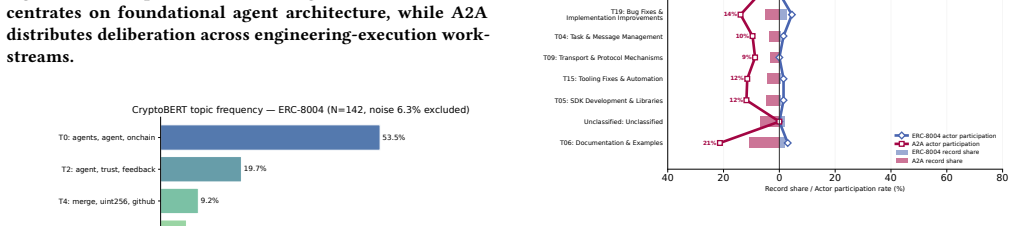
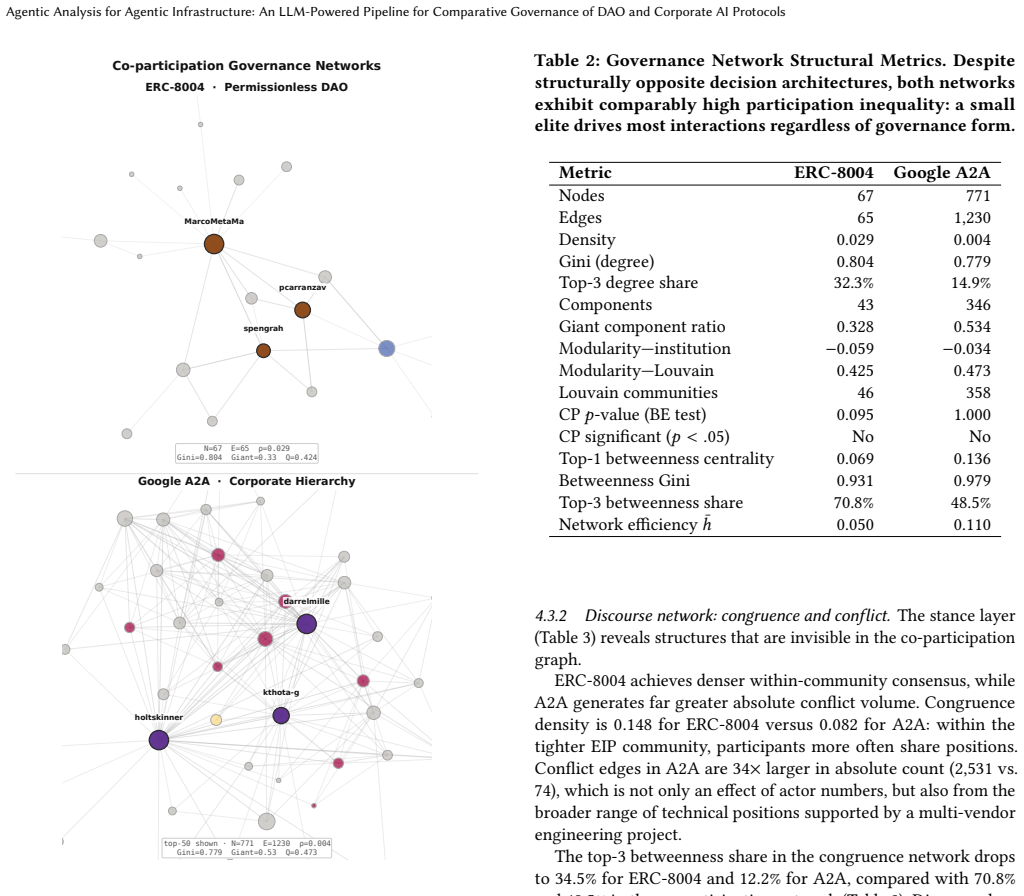
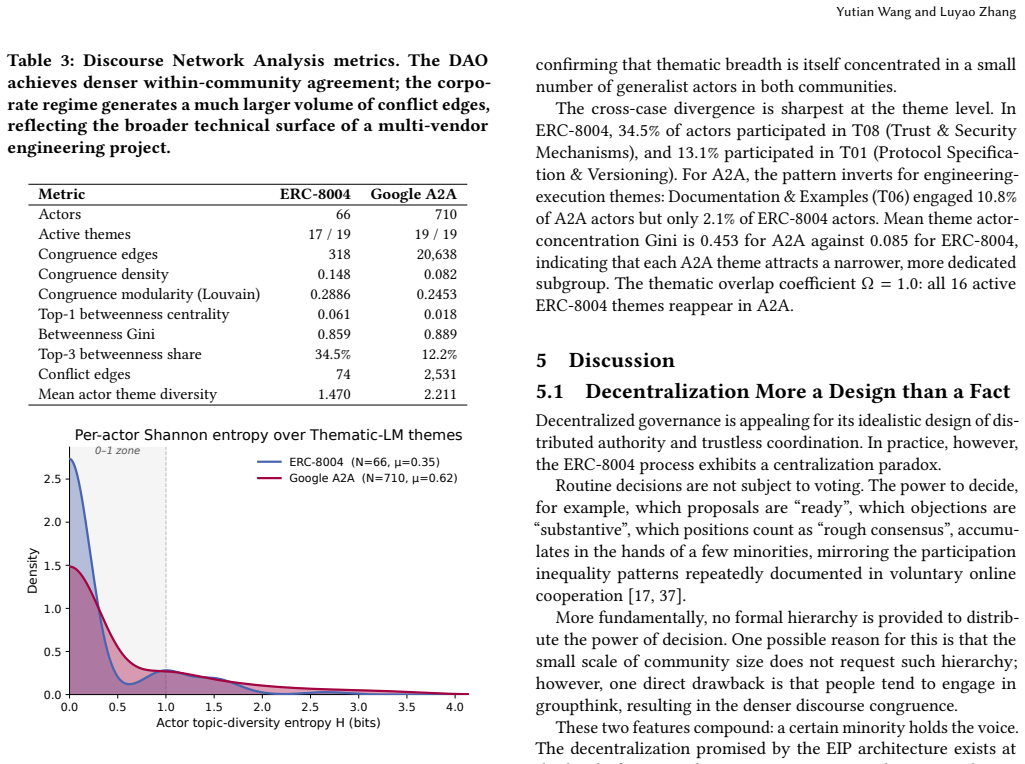
While governance form influences substantive focus, both the permissionless ERC-8004 and corporate-led Google A2A regimes exhibit comparable levels of participation inequality and community fragmentation; discourse alignment is denser in the permissionless setting, as measured by the integrated LLM annotation, topic modeling, and network analysis pipeline on 4,323 governance records.
What carries the argument
LLM-powered comparative pipeline integrating automated annotation, neural topic modeling, and multi-layer network analysis to examine socio-technical power structures in governance discourse.
If this is right
- Governance design affects which substantive themes dominate discussion in AI agent interoperability standards.
- Participation inequality and community fragmentation levels remain similar regardless of permissionless or corporate structure.
- Permissionless governance produces denser discourse alignment, indicating greater thematic convergence.
- LLM-assisted methods scale empirical study of technology governance beyond manual limits.
Where Pith is reading between the lines
- The pipeline could be reused to track governance dynamics in other decentralized AI or blockchain systems over time.
- Open structures may support thematic coherence even when participation remains unequal, challenging assumptions about decentralization increasing fragmentation.
- Standard designers might incorporate periodic automated discourse audits to adjust rules for better alignment without centralizing control.
Load-bearing premise
The automated LLM annotation and topic modeling accurately reflect the underlying governance discourse without introducing systematic bias that would alter the comparative findings on inequality, fragmentation, or alignment.
What would settle it
If a sample of governance records manually coded by humans yields materially different topic distributions, inequality metrics, or alignment measures than the LLM pipeline outputs, the comparative results on participation and discourse would not hold.
Figures
read the original abstract
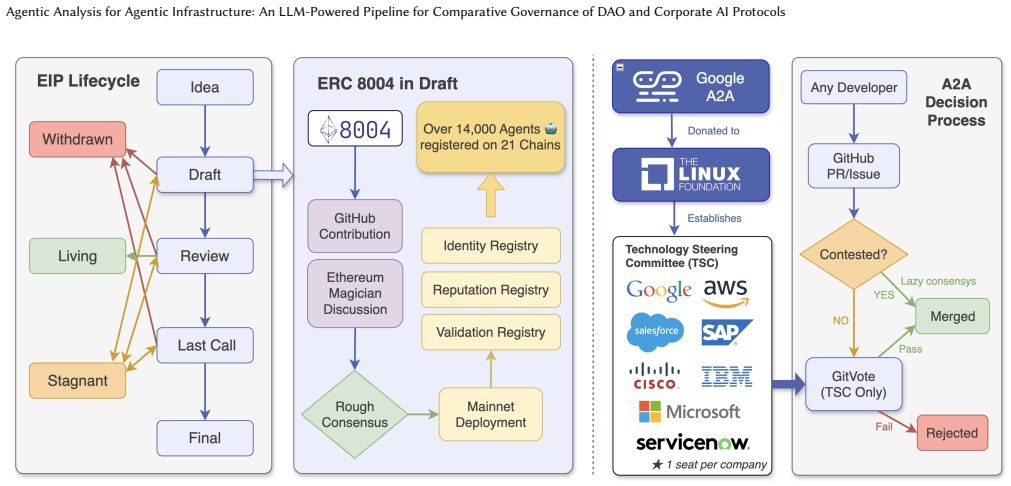
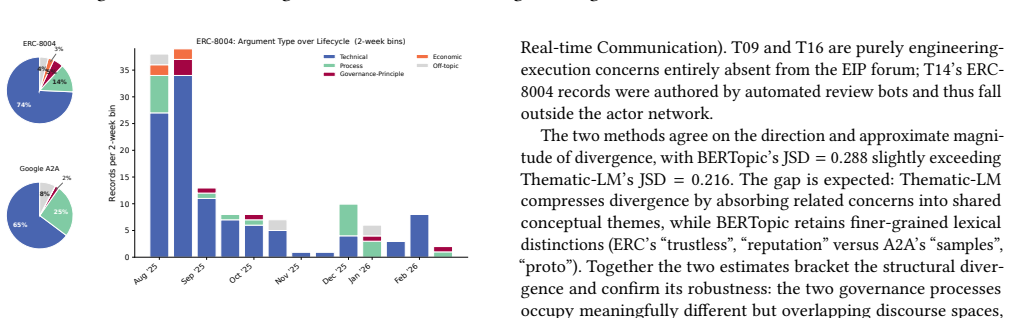
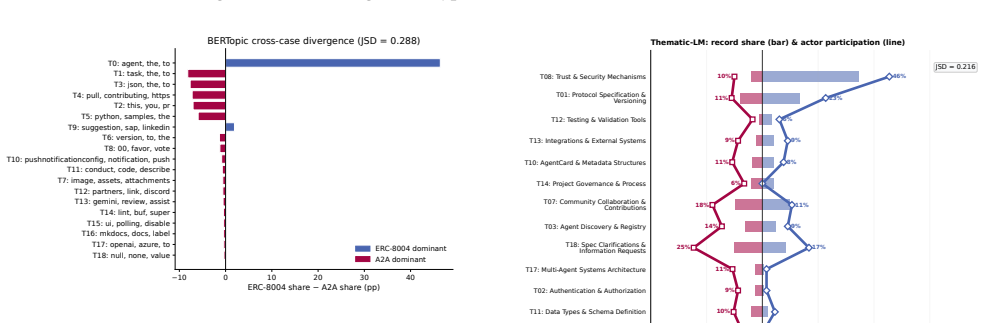
As AI agent protocols proliferate, the governance structures shaping their interoperability standards remain empirically underexamined. We introduce an LLM-powered comparative pipeline for large-scale governance discourse analysis, integrating automated annotation, neural topic modeling, and multi-layer network analysis to study socio-technical power structures at scale. We validate it on two contrasting standards for agent interoperability: ERC-8004 (permissionless, on-chain) and Google A2A (corporate-led). Analyzing 4,323 governance participation records, we combine LLM-assisted coding, topic modeling, and multi-layer network analysis to examine how institutional design shapes thematic priorities and community structure. We find that while governance form influences substantive focus, both regimes exhibit comparable levels of participation inequality and community fragmentation. Discourse alignment is denser in the permissionless setting, suggesting that open governance may foster greater thematic convergence despite decentralized participation. These findings illustrate how LLM-assisted methods can advance the empirical study of technology governance, with implications for designing more equitable agentic AI standards. All data and code are openly available.
Editorial analysis
A structured set of objections, weighed in public.
Referee Report
Summary. The paper introduces an LLM-powered pipeline integrating automated annotation, neural topic modeling, and multi-layer network analysis to compare governance discourse in two AI agent interoperability standards: the permissionless ERC-8004 and the corporate-led Google A2A. Applied to 4,323 participation records, it reports that governance form shapes thematic priorities but both regimes show comparable participation inequality and community fragmentation, with denser discourse alignment in the permissionless setting. All data and code are stated to be openly available.
Significance. If the automated annotations prove reliable, the work offers a scalable empirical approach to studying socio-technical power in emerging AI standards and highlights potential differences in thematic convergence between open and closed governance regimes. The explicit release of data and code supports reproducibility and is a clear methodological strength.
major comments (2)
- [Abstract] Abstract: the claim that the pipeline was 'validated' supplies no quantitative metrics, inter-annotator agreement scores with human coders, prompt-sensitivity tests, or error rates stratified by regime; without these the comparative results on inequality, fragmentation, and alignment cannot be evaluated for support from the underlying records.
- [Methods/results (LLM annotation and topic modeling)] Methods and results sections describing the LLM-assisted coding and topic modeling: the headline findings on comparable inequality/fragmentation and denser alignment rest entirely on the outputs of these steps, yet no human validation, robustness checks, or bias analysis for on-chain versus corporate discourse is reported, leaving open the possibility that systematic annotation differences alter the metrics.
minor comments (2)
- [Data description] Clarify the exact split of the 4,323 records between the two regimes and any exclusion criteria applied before analysis.
- [Topic modeling subsection] Add a brief table or paragraph summarizing the topic-model hyperparameters and any sensitivity checks performed.
Simulated Author's Rebuttal
We thank the referee for highlighting the need for explicit validation metrics and robustness checks. We agree these are essential for supporting the comparative claims and will add the requested analyses in revision.
read point-by-point responses
-
Referee: [Abstract] Abstract: the claim that the pipeline was 'validated' supplies no quantitative metrics, inter-annotator agreement scores with human coders, prompt-sensitivity tests, or error rates stratified by regime; without these the comparative results on inequality, fragmentation, and alignment cannot be evaluated for support from the underlying records.
Authors: We acknowledge that the abstract's reference to validation is not supported by quantitative details in the current manuscript. The methods describe the annotation and modeling steps but omit the requested metrics. In the revised manuscript we will insert a new validation subsection that reports inter-annotator agreement with human coders, prompt-sensitivity results, and error rates stratified by regime. revision: yes
-
Referee: [Methods/results (LLM annotation and topic modeling)] Methods and results sections describing the LLM-assisted coding and topic modeling: the headline findings on comparable inequality/fragmentation and denser alignment rest entirely on the outputs of these steps, yet no human validation, robustness checks, or bias analysis for on-chain versus corporate discourse is reported, leaving open the possibility that systematic annotation differences alter the metrics.
Authors: We agree that the absence of human validation, robustness checks, and regime-specific bias analysis leaves the headline findings vulnerable to systematic annotation differences. We will add these elements: (i) human validation results with agreement scores, (ii) robustness tests across prompts and models, and (iii) a direct comparison of annotation performance and bias between the on-chain and corporate discourse subsets. revision: yes
Circularity Check
No significant circularity; empirical pipeline applied to external records
full rationale
The paper presents an LLM-assisted annotation and topic-modeling pipeline applied to 4,323 external governance records from two distinct standards (ERC-8004 and Google A2A). Comparative metrics on inequality, fragmentation, and alignment are computed directly from the processed data rather than from any self-referential definitions, fitted parameters presented as predictions, or self-citation chains that reduce the central claims to the paper's own inputs. The derivation chain remains self-contained against the external corpus with no quoted equations or steps that collapse by construction.
Axiom & Free-Parameter Ledger
axioms (1)
- domain assumption LLM-assisted coding accurately captures governance themes without significant bias or error
Reference graph
Works this paper leans on
-
[1]
A2A Authors. 2025. Agent2Agent (A2A) Protocol. GitHub. https://github.com/ a2aproject/A2A Accessed: Mar. 28, 2026
2025
-
[2]
A2A Authors. 2025. GOVERNANCE.md. GitHub. https://github.com/a2aproject/ A2A/blob/main/GOVERNANCE.md Accessed: Mar. 28, 2026
2025
-
[3]
a2aproject. 2025. .gitvote.yml. GitHub. https://github.com/a2aproject/A2A/ blob/main/.gitvote.yml
2025
-
[4]
Ziqiao Ao, Lin William Cong, Gergely. Horvath, and Luyao Zhang. 2023. Is Decentralized Finance Actually Decentralized? A Social Network Analysis of the Aave Protocol on the Ethereum Blockchain. arXiv:2206.08401 [econ.GN]
arXiv 2023
-
[5]
Roman Beck, Christoph Mueller-Bloch, and John King. 2018. Governance in the Blockchain Economy: A Framework and Research Agenda.Journal of the Association for Information Systems19 (10 2018), 1020–1034. doi:10.17705/1jais. 00518
-
[6]
Vincent D. Blondel, Jean-Loup Guillaume, Renaud Lambiotte, and Etienne Lefebvre. 2008. Fast unfolding of communities in large networks.Jour- nal of Statistical Mechanics: Theory and Experiment2008, 10 (2008), P10008. doi:10.1088/1742-5468/2008/10/P10008
-
[7]
Stephen P Borgatti and Martin G Everett. 2000. Models of core/periphery struc- tures.Social Networks21, 4 (2000), 375–395. doi:10.1016/S0378-8733(99)00019-2
-
[8]
Natalie A. Carlson and Vanessa Burbano. 2026. The use of LLMs to annotate data in management research: Foundational guidelines and warnings.Strategic Management Journal47, 3 (2026), 699–725. arXiv:https://sms.onlinelibrary.wiley.com/doi/pdf/10.1002/smj.70023 doi:10.1002/smj.70023
-
[9]
Kun Chen, Yifan Fan, Yulin Fang, and Xin (Robert) Luo. 2025. Be- yond Money: Incentive Effects of Tokenized Ownership on User Contribu- tion in DAOs.Journal of Operations Management71, 7 (2025), 988–1016. arXiv:https://onlinelibrary.wiley.com/doi/pdf/10.1002/joom.1351 doi:10.1002/ joom.1351
-
[10]
1988.Statistical Power Analysis for the Behavioral Sciences(2nd ed.)
Jacob Cohen. 1988.Statistical Power Analysis for the Behavioral Sciences(2nd ed.). Lawrence Erlbaum Associates, Hillsdale, NJ
1988
-
[11]
Eleunthia Wong Ellinger, Robert Wayne Gregory, Tobias Mini, Thomas Widjaja, and Ola Henfridsson. 2024. Skin in the game: The transformational potential of decentralized autonomous organizations.MIS quarterly48, 1 (2024), 245–272
2024
-
[12]
ERC-8004 Authors. 2026. erc-8004.md. GitHub. https://github.com/ethereum/ ERCs/blob/c8cd50348b111d13f62e1d71d2b4c8101bd3514f/ERCS/erc-8004.md Ac- cessed: Mar. 10, 2026
2026
-
[13]
Ethereum Foundation. 2015. EIP-1: EIP Purpose and Guidelines. Ethereum Improvement Proposals. https://eips.ethereum.org/EIPS/eip-1 Accessed: Mar. 28, 2026
2015
-
[14]
Ethereum Magicians. 2025. ERC-8004: Trustless Agents. Ethereum Magi- cians Forum, topic 25098. https://ethereum-magicians.org/t/erc-8004-trustless- agents/25098 Accessed: Mar. 10, 2026
2025
-
[15]
Etherscan. 2026. ERC-8004 Identity Registry Contract (0x8004A169. . . ). Ethereum Mainnet. https://etherscan.io/address/ 0x8004A169FB4a3325136EB29fA0ceB6D2e539a432 Deployed Jan. 29, 2026
2026
-
[16]
James Evans, Benjamin Bratton, and Blaise Agüera y Arcas. 2026. Agentic AI and the next intelligence explosion.Science391, 6791 (2026). doi:10.1126/science. aeg1895
-
[17]
Link, Kevin Lumbard, and Sean Goggins
Matt Germonprez, Georg J.P. Link, Kevin Lumbard, and Sean Goggins. 2018. Eight Observations and 24 Research Questions About Open Source Projects: Illuminating New Realities.Proc. ACM Hum.-Comput. Interact.2, CSCW, Article 57 (Nov. 2018), 22 pages. doi:10.1145/3274326
-
[18]
Google Cloud. 2025. Google Cloud Donates A2A to Linux Foundation. Google Developers Blog. https://developers.googleblog.com/en/google-cloud-donates- a2a-to-linux-foundation/ Accessed: Mar. 28, 2026
2025
-
[19]
Maarten Grootendorst. 2022. BERTopic: Neural Topic Modeling with a Class- Based TF-IDF Procedure. arXiv:2203.05794
Pith/arXiv arXiv 2022
-
[20]
Campbell R. Harvey and Daniel Rabetti. 2024. International business and decen- tralized finance.Journal of International Business Studies55, 4 (2024), 840–863. doi:10.1057/s41267-024-00705-7
-
[21]
Harvey, Ashwin Ramachandran, and Joey Santoro
Campbell R. Harvey, Ashwin Ramachandran, and Joey Santoro. 2021.DeFi and the Future of Finance. Wiley, Hoboken, NJ
2021
-
[22]
Xiang Hui and Catherine Tucker. 2025. Decentralization, Blockchain, Artificial Intelligence (AI): Challenges and Opportunities.Jour- nal of Product Innovation Management42, 5 (2025), 947–957. arXiv:https://onlinelibrary.wiley.com/doi/pdf/10.1111/jpim.12800 doi:10.1111/jpim.12800
-
[23]
Richard A. Hunt, David M. Townsend, Robert Nugent, Joseph J. Simpson, Max- imilian Stallkamp, and Esin Bozdag. 2024. Digital Battlegrounds: The Power Dynamics and Governance of Contemporary Platforms.Academy of Management Annals19, 1 (2024). doi:10.5465/annals.2022.0188
-
[24]
Jane Im, Amy X. Zhang, Christopher J. Schilling, and David Karger. 2018. Delib- eration and Resolution on Wikipedia: A Case Study of Requests for Comments. 2, CSCW, Article 74 (Nov. 2018), 24 pages. doi:10.1145/3274343
-
[25]
Jiarui Ji, Ran Lei, Xueqi Pan, Zhenhua Wei, Hao Sun, Yankai Lin, Xu Chen, Yujiu Yang, Yong Li, Bolin Ding, and Ji-Rong Wen. 2026. Leveraging LLM-based agents for social science research: insights from citation network simulations. Humanities and Social Sciences Communications13 (2026), 127. doi:10.1057/ s41599-025-06193-w
2026
-
[26]
Markus Jungnickel, Ferda Özdemir Sönmez, Cathy Mulligan, and William J. Knottenbelt. 2025. DAO Governance: Voting Power, Participation, and Contro- versy - A Review and an Empirical Analysis.Distrib. Ledger Technol.(Nov. 2025). doi:10.1145/3777416 Just Accepted
-
[27]
Aggelos Kiayias and Philip Lazos. 2023. SoK: Blockchain Governance. InProceed- ings of the 4th ACM Conference on Advances in Financial Technologies(Cambridge, MA, USA)(AFT ’22). Association for Computing Machinery, New York, NY, USA, 61–73. doi:10.1145/3558535.3559794
-
[28]
Sadamori Kojaku and Naoki Masuda. 2018. A generalised significance test for individual communities in networks.Scientific Reports8 (2018). doi:10.1038/ s41598-018-25560-z
2018
-
[29]
Mikolaj Kulakowski and Flavius Frasincar. 2023. Sentiment Classification of Cryptocurrency-Related Social Media Posts. 38, 4 (July 2023), 5–9. doi:10.1109/ MIS.2023.3283170
arXiv 2023
-
[30]
Vito Latora and Massimo Marchiori. 2001. Efficient Behavior of Small-World Networks.Physical Review Letters87, 19 (2001), 198701. doi:10.1103/PhysRevLett. 87.198701
-
[31]
Philip Leifeld. 2013. Reconceptualizing Major Policy Change in the Advocacy Coalition Framework: A Discourse Network Analysis of Ger- man Pension Politics.Policy Studies Journal41, 1 (2013), 169–198. arXiv:https://onlinelibrary.wiley.com/doi/pdf/10.1111/psj.12007 doi:10.1111/psj. 12007
-
[32]
Renee Li, Pavitthra Pandurangan, Hana Frluckaj, and Laura Dabbish. 2021. Code of Conduct Conversations in Open Source Software Projects on Github.Proc. ACM Hum.-Comput. Interact.5, CSCW1, Article 19 (April 2021), 31 pages. doi:10. 1145/3449093 Yutian Wang and Luyao Zhang
2021
-
[33]
J. Lin. 1991. Divergence measures based on the Shannon entropy.IEEE Transac- tions on Information Theory37, 1 (1991), 145–151. doi:10.1109/18.61115
-
[34]
Fabrice Lumineau, Wenqian Wang, and Oliver Schilke. 2021. Blockchain Gover- nance—A New Way of Organizing Collaborations?Organization Science32, 2 (March 2021), 500–521. doi:10.1287/orsc.2020.1379
-
[35]
Chang Ma, Junlei Zhang, Zhihao Zhu, Cheng Yang, Yujiu Yang, Yaohui Jin, Zhenzhong Lan, Lingpeng Kong, and Junxian He. 2024. AgentBoard: an analytical evaluation board of multi-turn LLM agents. InProceedings of the 38th International Conference on Neural Information Processing Systems(Vancouver, BC, Canada) (NIPS ’24). Curran Associates Inc., Red Hook, NY,...
2024
-
[36]
MiniMax. 2026. MiniMax M2.5: Built for Real-World Productivity. MiniMax. https://www.minimax.io/news/minimax-m25 Accessed: Apr. 11, 2026
2026
-
[37]
Audris Mockus, Roy T. Fielding, and James D. Herbsleb. 2002. Two case studies of open source software development: Apache and Mozilla.ACM Trans. Softw. Eng. Methodol.11, 3 (July 2002), 309–346. doi:10.1145/567793.567795
-
[38]
Mosa Motea and Pius Oba. 2026. Who governs the ledger: rethinking blockchain governance through democratic innovation.Humanities and Social Sciences Communications13, 1 (2026), 770. doi:10.1057/s41599-026-06980-z
-
[39]
Alex Murray, Scott Kuban, Matthew Josefy, and Jon Anderson. 2021. Contracting in the Smart Era: The Implications of Blockchain and Decentralized Autonomous Organizations for Contracting and Corporate Governance.Academy of Manage- ment Perspectives35, 4 (2021), 622–641. doi:10.5465/amp.2018.0066
-
[40]
Mark E. J. Newman. 2006. Modularity and community structure in networks. Proceedings of the National Academy of Sciences103, 23 (2006), 8577–8582. doi:10. 1073/pnas.0601602103
2006
-
[41]
Tingrui Qiao, Caroline Walker, Chris Cunningham, and Yun Sing Koh. 2025. Thematic-LM: A LLM-based Multi-agent System for Large-scale Thematic Anal- ysis. InProceedings of the ACM on Web Conference 2025(Sydney NSW, Australia) (WWW ’25). Association for Computing Machinery, New York, NY, USA, 649–658. doi:10.1145/3696410.3714595
-
[42]
Yutong Quan, Xintong Wu, Wanlin Deng, and Luyao Zhang. 2024. Decoding Social Sentiment in DAO: A Comparative Analysis of Blockchain Governance Communities. In2024 IEEE 24th International Conference on Software Quality, Reliability, and Security Companion (QRS-C). 216–224. doi:10.1109/QRS-C63300. 2024.00037
-
[43]
Rahman, Arvind Karunakaran, and Lindsey D
Hatim A. Rahman, Arvind Karunakaran, and Lindsey D. Cameron. 2024. Taming Platform Power: Taking Accountability into Account in the Management of Platforms.Academy of Management Annals18, 1 (2024), 251–294. doi:10.5465/ annals.2022.0090
arXiv 2024
-
[44]
Nils Reimers and Iryna Gurevych. 2019. Sentence-BERT: Sentence Embeddings using Siamese BERT-Networks. 3973–3983. doi:10.18653/v1/D19-1410
-
[45]
Philipp Reineke, Riitta Katila, and Kathleen M. Eisenhardt. 2025. Decentralization in Organizations: A Revolution or a Mirage?Academy of Management Annals 19, 1 (2025), 298–342. doi:10.5465/annals.2022.0206
-
[46]
Camille Roth and Jean-Philippe Cointet. 2010. Social and semantic coevolution in knowledge networks.Social Networks32, 1 (2010), 16–29. doi:10.1016/j.socnet. 2009.04.005 Dynamics of Social Networks
-
[47]
Andrew L. Russell. 2006. ‘Rough Consensus and Running Code’ and the Internet- OSI Standards War.IEEE Annals of the History of Computing28, 3 (July 2006), 48–61. doi:10.1109/MAHC.2006.42
-
[48]
Zachary Kimo Stine and Nitin Agarwal. 2020. Comparative Discourse Anal- ysis Using Topic Models: Contrasting Perspectives on China from Reddit. In International Conference on Social Media and Society(Toronto, ON, Canada)(SM- Society’20). Association for Computing Machinery, New York, NY, USA, 73–84. doi:10.1145/3400806.3400816
-
[49]
Ali Sunyaev, Michel Avital, and Mary C. Lacity. 2026. From Ideology to De- sign: Toward Purposeful Decentralization of Information Systems Governance. Journal of the Association for Information Systems41, 1 (2026). doi:10.1177/ 02683962261430919
2026
-
[50]
Qin Wang, Guangsheng Yu, Yilin Sai, Caijun Sun, Lam Duc Nguyen, and Shiping Chen. 2025. Understanding DAOs: An Empirical Study on Governance Dynamics. IEEE Transactions on Computational Social Systems12, 5 (2025), 2814–2832. doi:10. 1109/TCSS.2025.3539889
arXiv 2025
-
[51]
World Economic Forum and Accenture. 2026. Organizational Transformation in the Age of AI: How Organizations Maximize AI’s Potential. World Economic Forum. https://www.weforum.org/publications/organizational-transformation- in-the-age-of-ai-how-organizations-maximize-ais-potential/
2026
-
[52]
Robert K. Yin. 2018.Case Study Research and Applications: Design and Methods (6th ed.). SAGE, Thousand Oaks, CA
2018
-
[53]
Rafael Ziolkowski, Gianluca Miscione, and Gerhard Schwabe. 2020. Decision Problems in Blockchain Governance: Old Wine in New Bottles or Walking in Someone Else’s Shoes?Journal of Management Information Systems37, 2 (2020), 316–348. arXiv:https://doi.org/10.1080/07421222.2020.1759974 doi:10. 1080/07421222.2020.1759974 A Data Expansion and Robustness Verifi...
discussion (0)
Sign in with ORCID, Apple, or X to comment. Anyone can read and Pith papers without signing in.